EXECUTIVE SUMMARY
Australian business leaders are generating more data than ever before — yet the gap between that data and the decisions it should be driving remains one of the most costly and persistent problems in the country's commercial landscape. Manual reporting, disconnected systems, and off-the-shelf software that was never built for the complexity of a real Australian business are costing organisations time, money, and competitive ground every single day.
Australia's data analytics market was valued at AUD 2.00 billion in 2024 and is forecast to reach AUD 19.08 billion by 2034 — a signal that the shift toward data-driven decision-making is no longer an emerging trend. It is a defining feature of how successful Australian businesses will operate for the next decade.
C9 has been at the centre of that shift for over 18 years. As Australia's leading custom software, apps, integration, and database developer, C9 has delivered purpose-built Dashboard and Web Portal solutions for organisations across retail, construction, healthcare, agriculture, media, education, hospitality, government, and more.
This case study blog presents what that looks like in practice — with real clients, real problems, and real outcomes — and explains why a custom-built Dashboard or Web Portal is one of the highest-return technology investments an Australian business can make today.
In short:
- Australian businesses collectively lose billions each year to inefficient, manual, and disconnected data processes — a problem a custom Dashboard or Web Portal is specifically built to solve.
- Off-the-shelf reporting tools solve generic problems. When your business has complex, multi-source, or industry-specific data needs, you require a solution built for your environment.
- C9 has delivered custom Dashboard and Web Portal solutions across more than a dozen industries in Australia — from national franchise networks and government agencies to global engineering firms and construction contractors.
- The outcome, consistently, is faster decisions, eliminated manual overhead, and a level of operational visibility that was previously impossible.
What's next?
If your business is still relying on spreadsheets, manual reporting, or disconnected systems to understand what is happening right now — a conversation with C9 could be among the most valuable 30 minutes you invest this quarter. Read on to see exactly what that looks like in practice.
The Problem Every Growing Australian Business Eventually Faces
There is a frustration familiar to almost every Australian business owner and executive. Your organisation is generating more data than ever — from sales systems, operational platforms, financial software, HR tools, and customer touchpoints across every department. Yet when leadership needs a clear, current picture of what is actually happening in the business, someone has to manually pull it together.
By the time the report lands, it reflects yesterday, last week, or last month — not right now. If you need figures from two different systems cross-referenced, that is another cycle of manual work before anyone can act. And if a supplier, partner, or client needs access to data about their own relationship with your business, your internal team becomes the middleman for every request.
This is not a people problem. It is a systems problem — and it is far more common across Australian organisations than most leaders acknowledge openly.
Australia's SafetyCulture Feedback from the Field report found that Australian businesses collectively lose up to $90 billion annually to inefficiency driven by deficiencies in data, processes, and staffing — with manufacturing alone accounting for $26 billion of that figure. A separate 2024 survey of Western Australian businesses found that over half reported compliance reporting alone consumes more than 120 staff hours per quarter, equivalent to roughly three full working weeks per year spent on a single administrative function.
These are not abstract statistics. They represent the cumulative weight of running a business without a system that lets your data work for you.
Why the Problem Compounds as Your Business Grows
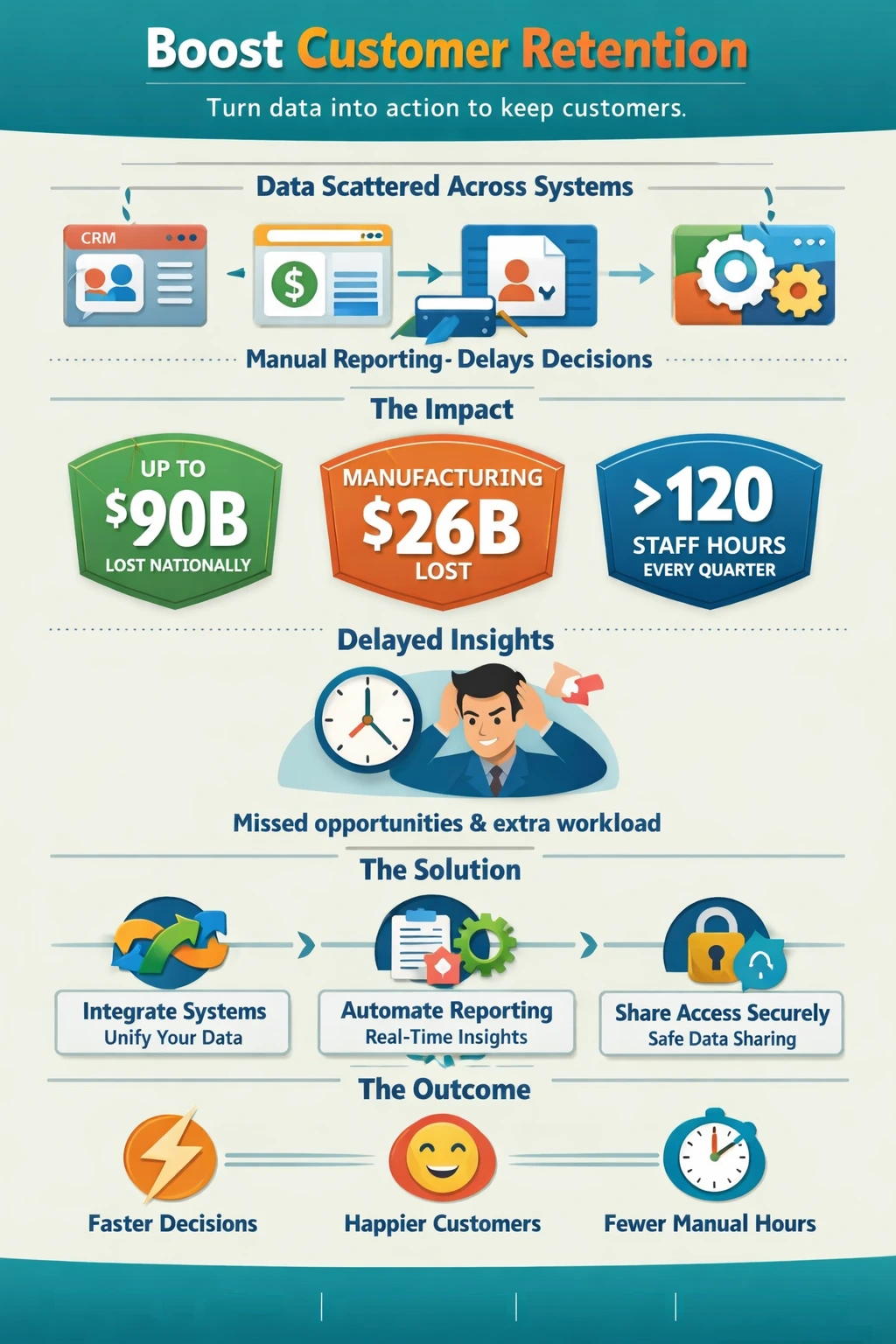
The instinctive response to data challenges is to add another tool. A better spreadsheet template. A new software-as-a-service subscription. Another reporting module bolted onto an existing platform. In the short term, this approach provides temporary relief. But as the business grows, the complexity multiplies.
Multiple systems that do not communicate with each other. Reporting that requires a dedicated staff member to compile and distribute. Leadership teams making high-stakes calls based on data that is days out of date. Field staff and managers who cannot access the information they need without contacting head office. Clients and partners who require a secure window into their own performance data but have no way to access it independently.
The deeper issue is that most off-the-shelf software is designed for the average business. When your operations, your data structure, or your reporting requirements are specific to your industry, your size, or your client model, you will always be working around the tool rather than with it. The workarounds become permanent. The inefficiencies become invisible because everyone adapts to them — until the cost of staying still becomes greater than the cost of change.
Globally, organisations with advanced business intelligence maturity report 2.5 times faster decision-making and 40 per cent higher return on analytics investment compared to those without. In Australia, that advantage is increasingly the line between businesses that lead their sector and those that are perpetually catching up.
A Custom Dashboard or Web Portal Built for How Your Business Actually Operates
A custom Dashboard or Web Portal from C9 is not a product off a shelf. It is a purpose-built solution that starts with a thorough understanding of your operational reality — what data exists in your organisation, where it lives, who needs to see it, at what frequency, and what decisions it needs to support.
From that foundation, C9 designs and builds a solution that is entirely specific to your business. It connects to your existing data sources — whether they sit in a legacy system, a cloud platform, an ERP in another country, or multiple distributed databases — and surfaces that data in a secure, role-appropriate, real-time environment accessible to the right people, at the right time, without manual intervention.
The result is operational visibility that was previously impossible. And because the solution is custom-built, it has no constraints imposed by a third-party vendor's product roadmap, no monthly licence fees tied to feature tiers, and no workarounds required to accommodate the way your business actually works.
The following case studies demonstrate what this looks like across more than a dozen Australian industries — including the customer journey that brought each client to C9 and the outcomes their business achieved on the other side.
C9 Dashboard & Web Portal Case Studies Across Australia
Operational Reporting That Moves at the Speed of Your Business
Tranex Equipment came to C9 with a straightforward but urgent requirement: report on sales performance and daily key performance indicators in a near real-time environment. Their existing process relied on manual data extraction — meaning decision-makers were always operating on information that was hours behind the actual state of the business. C9 built a web-based KPI dashboard that automatically queries and refreshes data every five minutes, giving Tranex leadership a continuous, live view of sales and operational metrics without any manual intervention. The gap between data and decision was eliminated.
PubTek (Third Place Hospitality) had scaled their national operations to a point where the Excel-based reporting mechanism they relied upon was no longer fit for purpose. Critical KPI data needed to reach users across Australia with central visibility for key business stakeholders — something a shared spreadsheet fundamentally could not deliver reliably or at speed. C9 developed a purpose-built dashboard portal that replaced the spreadsheet model entirely, delivering national performance data in real time and central reporting to leadership in a single, live system.
Specialist Electrical Solutions (SES) required an extensible management portal designed around their internal operational processes — initially focused on timesheet management, rostered day off tracking, and financial reporting. The existing process required hours of manual effort to produce profit and loss analysis and expense reports that leadership needed to act on immediately. C9 built a modular portal — delivered in stages so the business saw results without waiting for the complete system — that now reduces the time to produce critical financial information from hours to seconds.
PETA (Compare the Market) required a bespoke internal KPI management system for their team that reflected both individual and team-based performance structures. Generic project management software could not accommodate the bespoke logic of their performance model. C9 delivered a fully custom portal with complete UX design from the ground up — intuitive enough for daily use by non-technical staff, sophisticated enough to manage role-based and team-based KPI logic at an enterprise scale.
Franchise and Multi-Location Visibility
Studio Pilates operates a franchise model nationally and internationally, requiring the ability to view critical performance reporting across every location in the organisation — from class attendance and revenue through to operational metrics — without waiting for franchisees to manually submit their own figures. C9 designed and built an integrated dashboard portal powered by Microsoft Power BI Embedded, providing franchise leadership and individual franchisees with role-appropriate views of their performance data in real time. Leadership gained organisation-wide visibility. Franchisees gained data accountability.
Supplier, Partner, and Sales Portals
Fit Merchandising needed a portal through which retail suppliers could independently access and review their own merchandising performance and store imagery — without needing to contact internal staff for every report request. C9 built a secure, role-isolated supplier portal with Power BI dashboards embedded at the user level. Each supplier sees only their own data. Internal staff are no longer the middlemen between suppliers and the information they need to manage their own performance.
Grant Broadcasters, one of Australia's largest regional broadcasting groups, required a highly customised sales management portal for their national teams — handling activity-driven sales tracking, revenue allocation across forward planning periods, and monthly forecasting for sales staff performance. The added complexity: their critical sales data resided in SQL databases at geographically dispersed offices across Australia, requiring nightly synchronisation via web services. C9 built a bespoke portal that unified national sales data, eliminated manual consolidation, and gave leadership the forecasting accuracy they needed to make informed resourcing and revenue decisions.
Atkins Global, a multinational engineering firm servicing organisations including BHP and Rio Tinto, faced an urgent challenge following a corporate merger that rendered their existing local reporting infrastructure unusable. They required a reporting and billing portal that could integrate with their JD Edwards ERP system located in the United Kingdom — bridging the geographic and technical gap between Australian operations and the corporate financial system. C9 scoped and delivered the solution, restoring full reporting and billing capability for the Australian team without the overhead of a local ERP deployment.
Industry, Agriculture, and Government Portals
Fendley Consultancy (Fendley Secure) operates in the oil, gas, and mining sector, where data governance and permission management are compliance imperatives, not preferences. C9 redeveloped the existing Fendley Secure platform into a modern, enterprise-grade reporting portal with dynamic page and form creation, field-level permission management, and enhanced reporting capabilities — a platform built to remain flexible as the industry itself evolves.
Avocados Australia (Avo Data) required the full redevelopment of a legacy system into a modern, long-term web-based platform used by the entire Australian avocado industry to record, track, and report on avocado distribution and sales nationally. The brief required a solution that the whole industry could rely on — built to replace an ageing legacy platform with a robust, scalable successor.
CSIRO – Data 61, one of Australia's leading scientific research agencies, required a bespoke ticketing and file management portal for the controlled release of sensitive research files to defined users. The system required extensive Amazon S3 integration — including bulk uploading of files exceeding 2GB — which demanded data chunking in transit and validation for successful transfers. C9 delivered a secure, auditable platform built to the precise technical and compliance standards of a national scientific institution.
Queensland Health Department (Caring At Home) required a portal with dynamic reporting capabilities, extensible permission management, and flexible form creation to support community health education programs — with the ability to adjust access and content management as program requirements evolved.
Tasmanian Irrigation required a new water entitlement management system to replace the Excel spreadsheet previously used to manage water rights across the state. C9 built a highly customised intranet web solution that included automatic document generation and integration with the client's existing document management system — transforming a fragile manual process into a secure, auditable web application.
Healthcare and Education Portals
ReferHealth (RHealth) required a middleware integration solution that simplified the referral process between GPs and specialists through their existing platform. C9 scoped, documented, and built a middleware solution with associated data extraction agents for on-site GP deployment, enabling the sending and receiving of referrals and messages with significantly improved usability for both parties.
Storm Road required a SAAS-based medical education platform for the healthcare industry — specifically for learning cardiac rhythms. C9 built a portal leveraging 3D models and Three.js to produce an interactive learning environment that allows clinicians and students to manipulate and study cardiac data in a clinical education context.
Im In Connect (Healthy Tasmania) required a SAAS-based health and fitness event management platform for councils and communities, supporting multiple programs per project with mobile app-based QR code attendance tracking for instructors and participants. C9 delivered a full platform — web portal and mobile application — designed for ease of use in field-based health program delivery.
One School Global required a fully integrated national transport management system, including an in-vehicle tablet application to track student trip locations and relay live data to parents via a dedicated parent-facing mobile app, with full dashboard visibility for administration at base. The system was designed to scale from national operations to international deployment.
Financial, ERP-Connected, and Managed Portals
K2 Partnering required a customised SAP add-on to assist end-of-month processes, including dashboard reporting integrated directly with their SAP Business One and SAP Business Objects environment — extending the platform's native capabilities to meet K2 Partnering's specific reporting and workflow requirements.
Schedule Mate required the full redevelopment of an existing maintenance program into a multi-tenancy SAAS platform enabling users to subscribe and operate their own maintenance businesses. C9 built the platform with a deliberate focus on UX design for non-technical users — enabling the client to bring a commercial subscription product to market with genuine usability at its core.
The University of Tasmania required a desktop application to manage accommodation bookings for international and remote students — with precise drag-and-drop functionality, workflow-driven processes, and the interactivity required to accurately manage high volumes of accommodation allocations at a university scale.
The Bonney Group (BBG, Lloyds North, Caltas) has engaged C9 for ongoing managed services across multiple technology stacks — including dashboard and portal support for transportation and logistics operations across Australia.
For Life engaged C9 in a CTO advisory capacity to provide technical direction for their existing platform, which evolved into ongoing development support, enhancements, and managed services — including portal functionality improvements as the product matured.
Why Australian Businesses Choose C9 for Dashboard and Web Portal Development
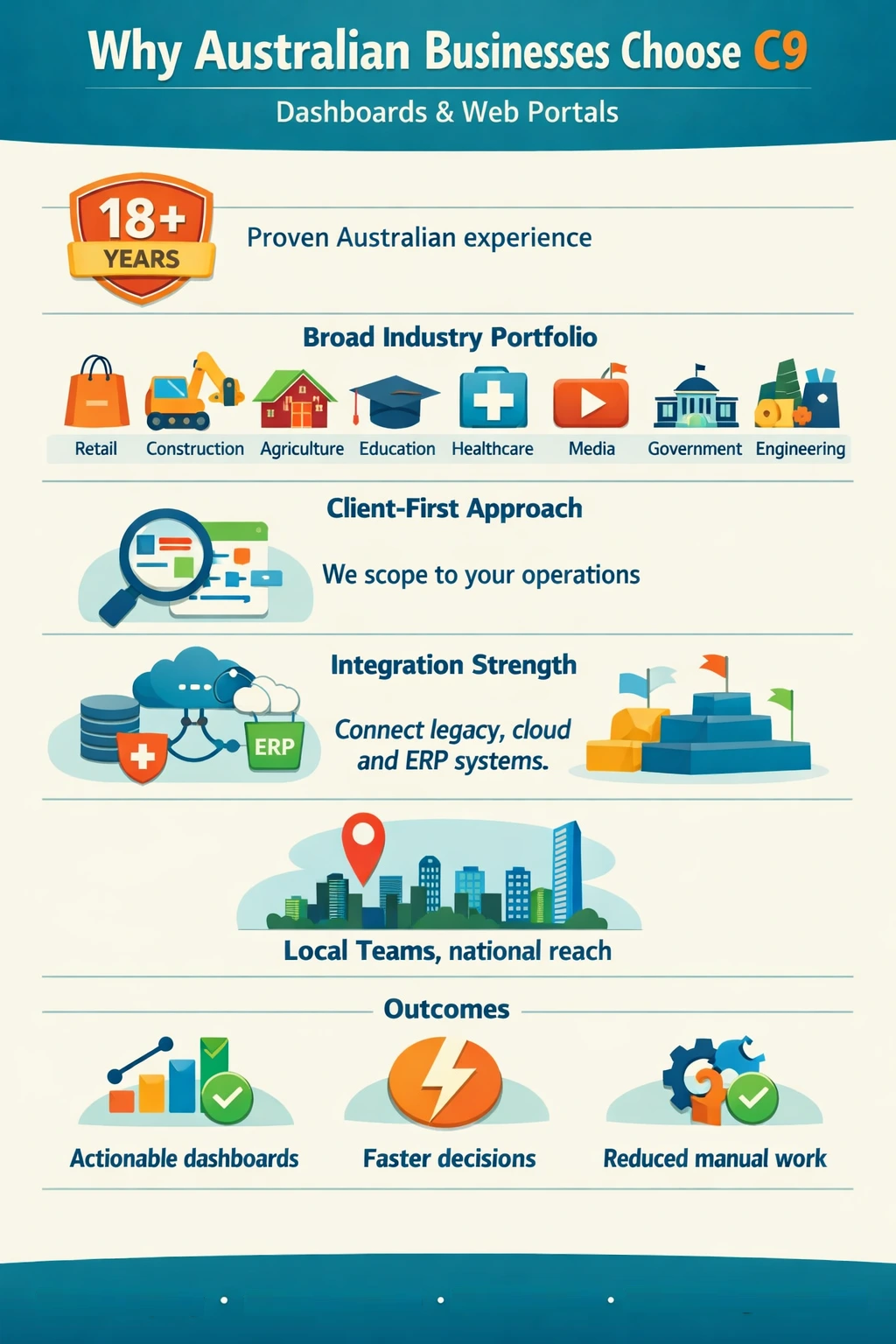
Over more than 18 years of custom software development, C9 has built one of the broadest industry portfolios of any Australian development firm. The organisations in these case studies span retail, construction, agriculture, education, healthcare, media, government, engineering, professional services, and manufacturing — and the consistency of the outcomes across all of them reflects a development approach that prioritises depth of understanding over speed of delivery.
C9 builds for your business, not around it. Every engagement begins with thorough scoping of the client's operational environment — the data sources, the users, the decisions the system needs to support, and the workflows it must fit within. There are no off-the-shelf constraints, no unused features, and no licence dependency that exposes the client to a vendor's commercial decisions.
Integration is not an afterthought. Whether your data lives in a legacy system, a distributed SQL environment, an overseas ERP, or a cloud platform, C9 has the integration capability to connect it, centralise it, and present it in a form that is genuinely actionable. The Grant Broadcasters, Atkins Global, and K2 Partnering case studies each demonstrate this in different technical contexts.
Staged delivery reduces risk and accelerates value. Not every solution requires a complete build before results are visible. The SES Portal case study demonstrates how phased delivery allows clients to see returns early, validate the approach against real operational use, and adjust scope before the final system is locked in.
Local expertise, national reach. With teams in Brisbane, C9 understands the regulatory environment, the commercial pressures, and the operational realities facing Australian businesses — from small and medium enterprises through to multinational organisations managing Australian operations.
Is a Custom Dashboard or Web Portal the Right Investment for Your Business?
Three questions are worth considering before any decision is made.
First: What data does your leadership need to see daily to make better decisions — and how long does it currently take to produce it? If the answer is measured in hours or days rather than seconds, the cost of the status quo is already significant.
Second: Where does that data live, and who is assembling it manually? If the answer involves multiple systems and a staff member, you are paying a recurring cost that a custom portal could eliminate once.
Third: Do your clients, suppliers, or partners need secure, self-service access to data that your team currently provides manually? If so, a web portal is not just an internal efficiency tool — it is a service improvement and a staff-time recovery simultaneously.
Australia's digital transformation market reached USD 18.5 billion in 2024 and is projected to expand to USD 84.7 billion by 2033. The window to gain a competitive advantage through better data infrastructure is open. It will not remain that way indefinitely.
Conclusion
The organisations featured in these case studies did not engage C9 because they were looking for software. They came because they had a specific problem their existing tools could not solve, and they needed a development partner who could understand that problem deeply enough to build something that actually worked.
A custom Dashboard or Web Portal from C9 will not be the right solution for every business at every stage. But if your organisation is generating data that your leadership cannot access in real time, if your reporting is consuming staff hours that should be directed elsewhere, or if your clients and partners need self-service access to information you currently deliver manually — it is very likely the right solution for yours.
The businesses in these case studies chose to solve the problem rather than continue working around it. The results are documented here.
Talk to C9 — Free Initial Consultation
C9 offers a no-obligation consultation for Australian businesses exploring custom Dashboard and Web Portal development. In 30 minutes, C9's team will give you an honest assessment of what a purpose-built solution would look like for your specific environment.
→ Book your free consultation
→ Learn more about C9's Dashboard & Web Portal Development Service
→ Explore all C9 Case Studies
Frequently Asked Questions
What is a custom web portal and how does it differ from off-the-shelf software? A custom web portal is a secure, web-based application built specifically around your business's data, workflows, and users — rather than adapted from a product designed for a generic use case. Unlike off-the-shelf tools, a custom portal has no feature constraints, no licence tiers, and no requirement to work around the vendor's design decisions.
How long does it take to build a custom Dashboard or Web Portal in Australia? Project timelines vary significantly based on scope and complexity. C9 uses a phased delivery approach for larger projects, which means clients typically see working functionality early in the process rather than waiting for a complete build. A detailed timeline is established during the initial scoping process.
Does a custom portal need to connect to my existing systems? In most cases, yes — and C9's integration capability is one of its core strengths. C9 has built solutions that connect to ERP systems, legacy databases, cloud platforms, distributed SQL environments, third-party APIs, and industry-specific platforms across a wide range of Australian and international technology stacks.
Which Australian industries has C9 built Dashboards and Web Portals for? C9 has delivered Dashboard and Web Portal solutions across retail, construction, healthcare, agriculture, media, education, hospitality, government, engineering, manufacturing, professional services, financial services, and transportation — among others.
C9 is Australia's leading custom software, apps, integration, and database developer — with offices in Brisbane. With over 18 years of experience delivering complex, enterprise-grade web applications for Australian and international clients, C9 builds solutions that work the way your business works.
Data Sources and References
-
Codewave — The Rise of Data-Driven Decision Making in Australia (2025) Australia's data analytics market valued at AUD 2.00 billion in 2024, forecast CAGR of 25.30% to AUD 19.08 billion by 2034.
-
IMARC Group — Australia Digital Transformation Market Size (2025) Australia's digital transformation market reached USD 18.5 billion in 2024, projected to reach USD 84.7 billion by 2033 at CAGR of 18.4%.
-
Grand View Research / Horizon Databook — Australia Decision Intelligence Market (2025) Australia's decision intelligence market generated USD 303 million in 2024, projected to reach USD 906.7 million by 2030 at CAGR of 19.7%.
-
Verified Market Research — Australia ICT Market Report (2025) 86% of Australian firms now employ cloud computing services, up from 42% in 2018 (sourced from ACMA). Cloud-based investment by Australian businesses grew 67% between 2020 and 2023, totalling AUD 3.8 billion (sourced from ABS Digital Business Indicators).
-
SafetyCulture — Feedback from the Field (2025) Australian businesses lose up to $90 billion annually to operational inefficiency, with manufacturing alone accounting for $26 billion in lost productivity.
-
DataStackHub — Business Intelligence (BI) Statistics 2025–2026 Executives using BI dashboards for daily decisions increased from 48% in 2023 to 67% in 2025. Enterprises with advanced BI maturity report 2.5× faster decision-making and 40% higher ROI on analytics investment. BI adoption reduces operational costs by an average of 18–22%.
-
CPA Australia — Asia-Pacific Small Business Survey 2024–25 (via NetStripes) Only 42% of Australian SMEs reported growth in 2024, compared to 64% of regional peers. Just 55% expect growth in 2025.
-
ScaleSuite — Australian Business Statistics 2026 (sourced from ABS) As of 30 June 2025, Australia had 2,729,648 actively trading businesses. 45.7% of businesses were actively adopting digital transformation in 2024.
-
C9 — Case Studies All client project details and outcomes referenced in this blog are sourced directly from C9's published case studies.
Explore Our Localised Software & Integration Services
Streamline Your Brisbane Operations with Tailored Digital Solutions
Solution Services in Sydney: Digital Systems Architecture & Engineering
Custom Software Development in Melbourne: Engineering Your Strategic Business Advantage
AI Transparency Notice:
This article was produced with the assistance of artificial intelligence tools, including content drafting, visual asset creation, and audio generation. All content has been reviewed and approved by C9 prior to publication.