Executive Summary
In short:
In the 2026 digital economy, Australian businesses are facing a "Complexity Crisis." Fragmented software ecosystems—where ERPs, CRMs, and legacy databases fail to communicate—are costing enterprises millions in manual labour, data errors, and "middleware tax." C9 solves this through high-performance API & Direct Integration. By bypassing generic third-party connectors and building bespoke, hardened data bridges, we allow businesses to scale without increasing headcount, ensuring that data moves at the speed of thought across the entire organisation.
What’s next?
Review your current operational friction points. If your staff are manually transferring data between systems, you have a growth ceiling. The following guide provides a roadmap for total operational synchronicity through proven Australian case studies.
In the high-stakes environment of Australian commerce, "integration" is often a word thrown around by IT departments as a technical checkbox. However, for a business owner or executive, integration is actually a financial strategy. It is the difference between a business that scales gracefully and one that collapses under the weight of its own administrative complexity.
At C9, we have spent over 18 years as Australia's leading custom software and integration developers. We have seen first-hand how "data silos"—isolated pockets of information—act as a handbrake on innovation. This blog explores the transition from fragmented systems to unified digital ecosystems, using real-world Australian success stories as our guide.
The "Swivel-Chair" Data Problem
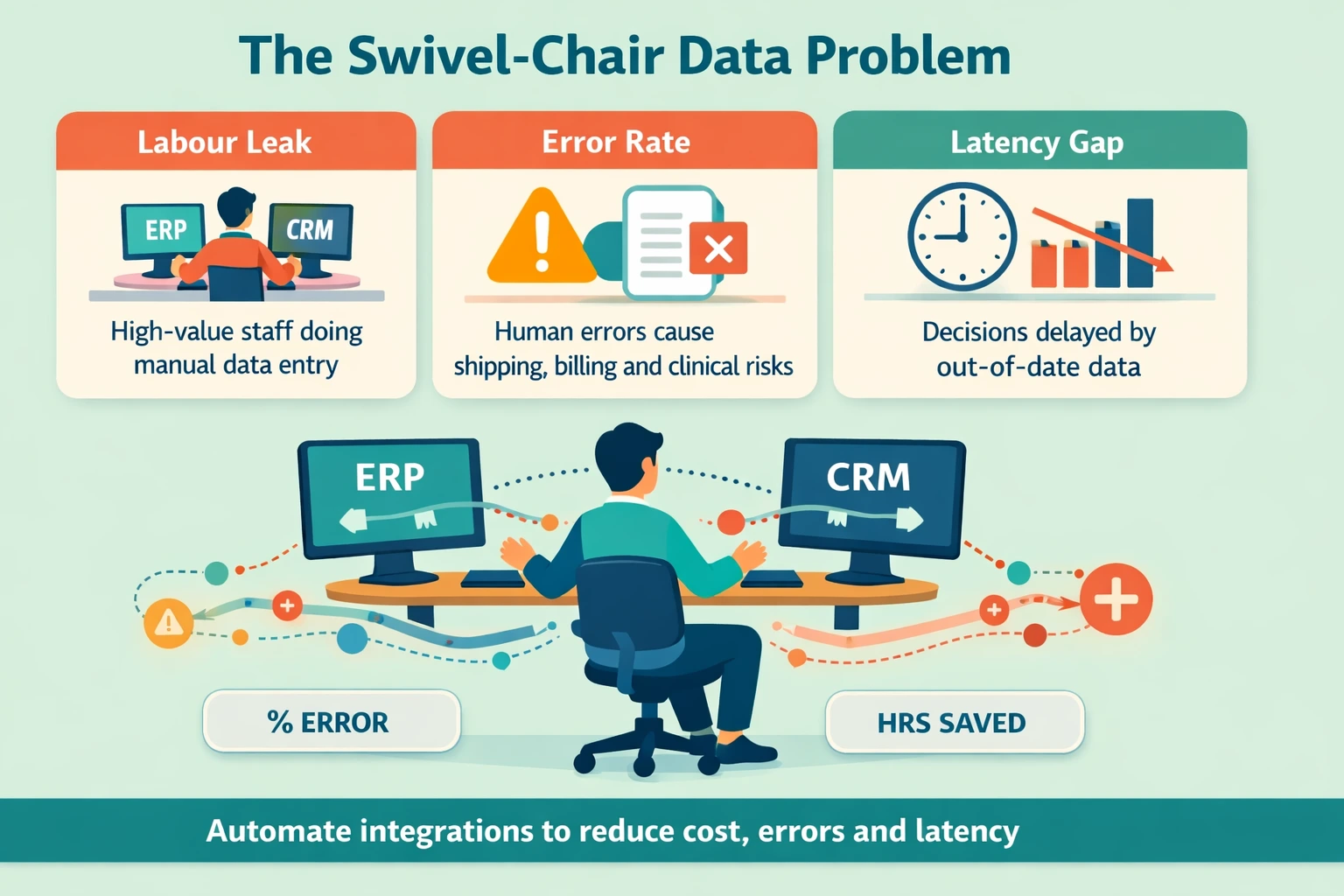
Most Australian businesses suffer from what we call "swivel-chair" data entry. This is the inefficient process where an employee looks at one screen (e.g., an ERP), and manually types that information into another screen (e.g., a billing portal or CRM).
The costs are hidden but devastating:
-
The Labour Leak: Paying high-value Australian salaries for low-value data entry.
-
The Error Rate: Human error in data entry is statistically inevitable, leading to shipping mistakes, billing disputes, and clinical risks.
-
The Latency Gap: When data isn't integrated in real-time, leadership is making decisions based on yesterday’s numbers, not today’s reality.
The Hidden Risks of "Standard" Connectors
Many executives attempt to solve this with "off-the-shelf" middleware or iPaaS (Integration Platform as a Service) tools. While these serve a purpose for simple tasks, they often create a "Middleware Tax"—a perpetual monthly subscription fee for a service that adds latency, limits data volume, and creates a security vulnerability outside of your direct control.
Furthermore, as the Australian Privacy Act and data sovereignty regulations tighten in 2026, relying on third-party "connectors" that route your sensitive business data through overseas servers is no longer a viable risk management strategy.
The C9 API & Direct Integration Framework
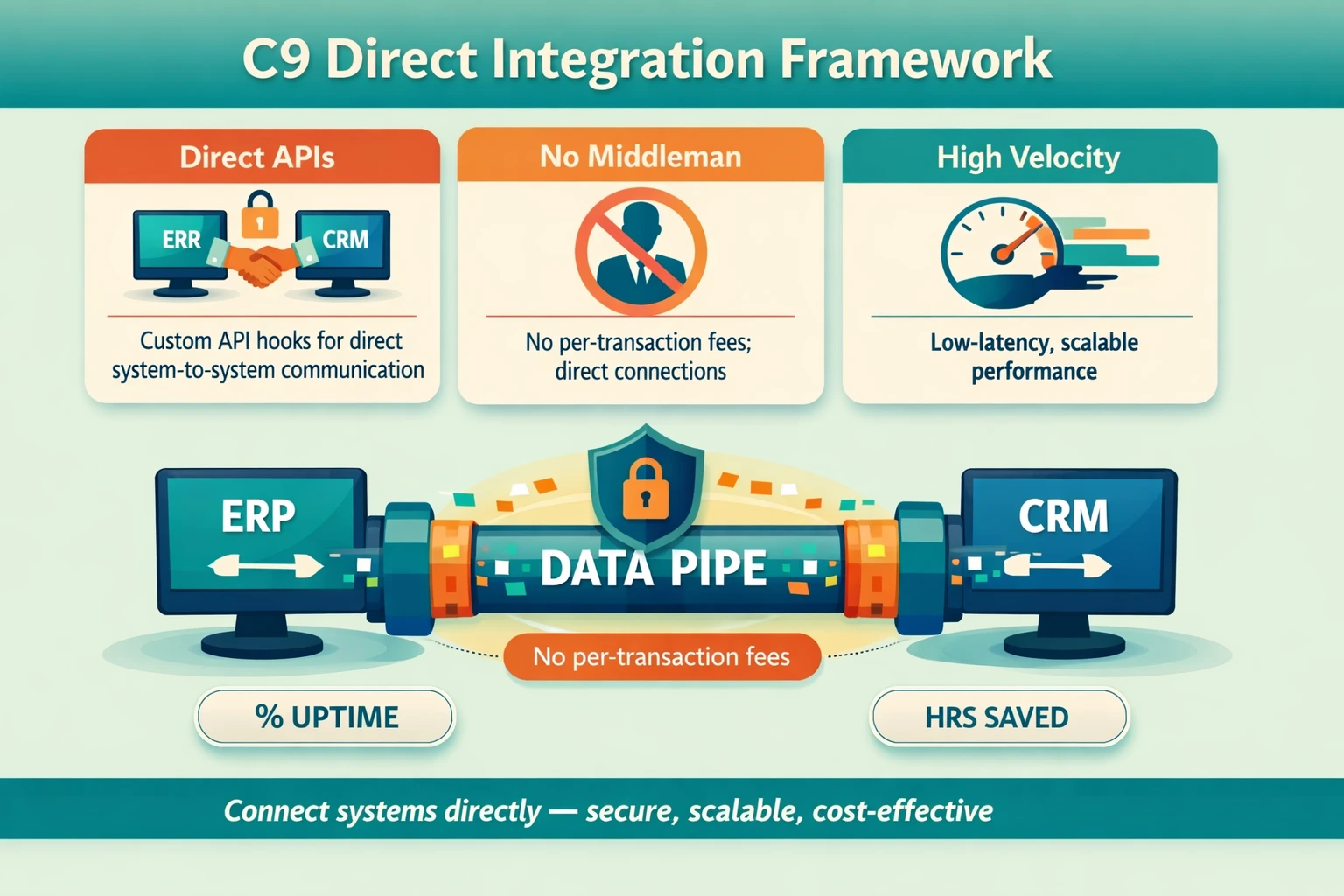
C9’s approach is fundamentally different. We specialise in Direct Integration. This means we build the custom API hooks and "data pipes" that connect your systems directly. No middleman. No "per-transaction" fees. Just pure, high-velocity performance.
What is an API in a Business Context?
An API (Application Programming Interface) is the digital handshake between two systems. Think of it as a translator that allows a German-speaking ERP to perfectly understand a French-speaking CRM. When this is "Direct," the communication is instantaneous, secure, and infinitely scalable.
Real-World Success Stories: Turning Complexity into Competitive Advantage
To understand the power of custom integration, we must look at the diverse Australian industries that have leveraged C9’s expertise to transform their operations.
1. Healthcare: Automating Critical Triage (Monash Health & RHealth)
In the medical sector, integration isn't just about efficiency; it’s about patient safety.
-
The Challenge: Monash Health faced a failed project from previous developers. They needed to manage massive volumes of incoming faxes and HL7 messages (the global standard for health data) containing confidential specialist referrals.
-
The C9 Integration: We built a custom triaging system (Ozetriage) that automated the extraction and assignment of data from these messages. By integrating a middleware solution with data extraction agents on-site for GPs, we ensured that referrals moved from "sent" to "processed" without manual intervention.
-
Executive Insight: By automating the triage flow, Monash Health reduced the clinical risk of "lost" referrals and significantly accelerated patient care delivery.
For multi-national firms, the challenge is often "Geographical Silos"—where the head office uses one system and regional branches are left in the dark.
-
The Challenge: Atkins Global, a massive engineering resource manager, needed to integrate a local Australian reporting and billing portal with their master JD Edwards ERP located in the UK.
-
The C9 Integration: C9 engineered a custom portal that "talked" directly to the UK ERP database. This allowed the Australian team to generate real-time billing and profit/loss analysis that was previously impossible. Similarly, for K2 Partnering, we developed a custom SAP add-on to automate complex end-of-month financial reconciliations.
-
Executive Insight: Custom API integration allows local branches to maintain the agility of a small firm while leveraging the data power of a global enterprise.
3. Education & Logistics: Real-Time Mobile Syncing (OneSchool Global)
When your assets are mobile, your data must be too.
-
The Challenge: OneSchool Global required a national Transport Management System to track student transit.
-
The C9 Integration: We developed an integrated system that utilised in-vehicle tablets. These tablets use APIs to relay real-time location data to a central admin portal and a dedicated parent app.
-
Executive Insight: This is a "closed-loop" integration. Data moves from the vehicle (IoT) to the cloud (API) to the end-user (Mobile App) in seconds, ensuring safety and operational transparency.
4. Agriculture & Export: The "Farm-to-Dock" Automation (Webster Ltd)
As the 3rd oldest company in Australia, Webster Ltd needed to modernise its walnut and onion export processes.
-
The Challenge: Managing the end-to-end production of massive agricultural exports using legacy methods.
-
The C9 Integration: C9 built a replacement production management system that handles the entire manufacturing lifecycle. This involved integrating data from the field, the processing plant, and the export logistics chain into a single "Source of Truth."
-
Executive Insight: For the agricultural sector, integration provides traceability. In a world of strict export regulations, having an automated, integrated record of every walnut’s journey is a massive competitive advantage.
5. Media & Sales: Nightly Data Synchronisation (Grant Broadcasters)
-
The Challenge: Managing sales performance across geographically disparate SQL systems.
-
The C9 Integration: We developed a sales management portal that utilised nightly syncing through web services. This ensured that every morning, executives had a unified view of national revenue allocation and forecasting without a single person having to "upload" a file.
-
Executive Insight: Automated nightly syncing eliminates the "morning rush" of data preparation, allowing managers to start their day with insights, not admin.
The C9 Customer Journey: How We Build Success
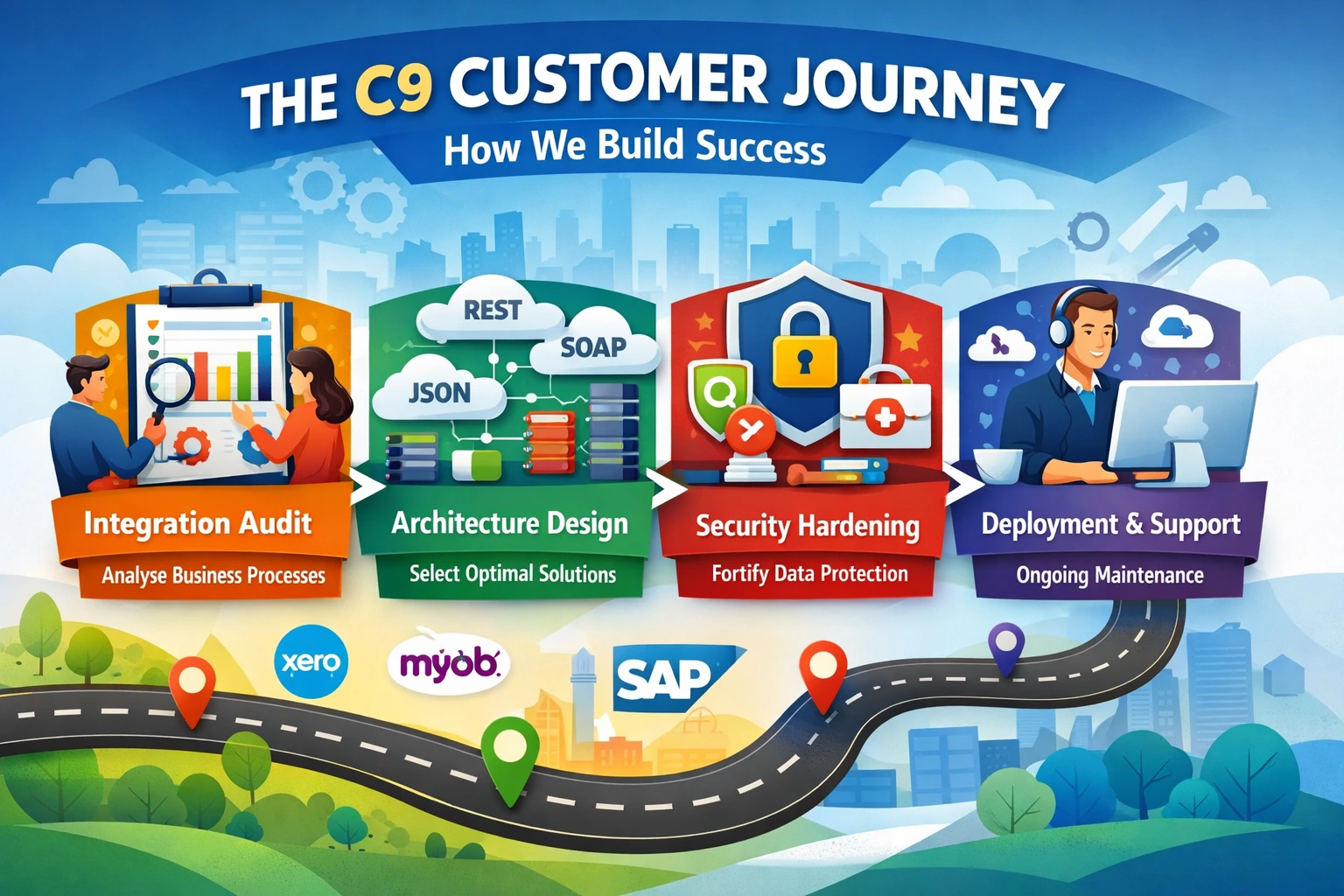
When a Business Owner partners with C9 for an integration project, they follow a structured path designed to mitigate risk and maximise ROI.
-
The Integration Audit: We don't start with code. We start with your business process. We identify where data is getting "stuck."
-
Architecture Design: We choose the right "pipes." Whether it’s REST, SOAP, or JSON, we select the technology that ensures the highest speed and lowest latency.
-
Security Hardening: Especially for our financial clients (like YouLend) and medical clients, we implement 2FA, MFA, and end-to-end encryption to ensure that your data is safer inside our integration than it is anywhere else.
-
Deployment & Managed Services: We don't just "build and bolt." C9 provides ongoing managed services to ensure that as your external software (like Xero, MYOB, or SAP) updates, your integration remains unbroken.
Why 2026 is the Year of the "Integrated Enterprise"
With the rise of AI Agents and Robotic Process Automation (RPA), the quality of your integration is now the deciding factor in your AI readiness. An AI is only as good as the data it can access. If your data is trapped in silos, your business cannot leverage the next generation of AI-driven efficiency.
By investing in Direct API Integration now, you are building the "Digital Nervous System" that will allow your business to outpace competitors who are still manually moving files.
FAQ: What Executives Ask About Integration
Q: Will custom integration replace my existing staff?
A: No. It replaces the boring parts of their jobs. It allows your staff to focus on analysis, customer service, and growth, rather than data entry.
Q: Is it better to use a tool like Zapier or a custom C9 integration?
A: For simple, low-volume tasks, Zapier is fine. However, for enterprise-grade data, high volumes, or sensitive Australian medical/financial data, a custom C9 integration is more secure, faster, and has a much better long-term ROI.
Q: How long does a typical integration project take?
A: Depending on complexity, a staged rollout can begin in as little as a few weeks, with full enterprise integrations taking a few months. We prioritise an Agile methodology, meaning you see results and "Quick Wins" early in the project.
Reclaim Your Operational Freedom
Data silos are the "invisible tax" on your business growth. Every minute an employee spends moving data manually is a minute they aren't spent growing your revenue.
C9’s case studies in the Medical, Logistics, Financial, and Agricultural sectors prove that regardless of your industry, the solution to complexity is connectivity. By choosing API & Direct Integration, you aren't just buying software; you are buying the ability to scale your business without limits.
Are you ready to see what an integrated business looks like?
[Book an Integration Audit with C9 Today]
[View Our Full List of Case Studies]
Data Sources & Research References
-
C9 Official Case Studies: /Company/Case-Studies
-
Australian Privacy Act 2024 Amendments: Guidance on data handling and sovereignty for Australian businesses.
-
HL7 International: Standards for Transferring Relevant Information Between Healthcare Applications.
-
ERP Integration Benchmarks: Industry standards for SAP and JD Edwards data synchronisation.
-
CSIRO Data61: Insights into bespoke ticketing and file management for sensitive Australian data.
Note: All project-specific data has been sourced directly from C9's published success stories to ensure 100% accuracy and relevance to the "API & Direct Integration" service line.
Explore Related Insights on Integrations Solutions.
How Custom Xero Integration Solves the #1 Challenge Facing Mixed Farming Operations in Australia
AI-Driven Automation and Real-Time Data Integration: Unlocking Efficiency for Australian Businesses
Beyond Automation: How a Strategic AI Integration Specialist Unlocks True Operational Efficiency
Seamless System Integration: Why Australian Firms Need Database Consultants Now
Real-World API Integration Success Stories: How Australian Businesses Transformed Their Operations with C9
API-First Development: Why Your Business Needs an API Integration Strategy for 2026
RPA + AI: The Intelligent Automation Combination Transforming Australian Businesses
Headless CMS & API-First Development in 2026: The Australian Guide to Faster, Flexible and Future-Proof Web Applications (Why C9 is Your Ideal Partner)
Why 37% of Enterprises Say Data Integration Is Their Biggest AI Barrier (And How to Overcome It)
Unlocking Real-Time Data Integration: How Seamless System-to-System Analytics Powers Smarter Business Decisions
Protecting Your Business from Money Runners: How Stripe + Xero Integrations and Smart APIs Stop Counterfeit AUD Conversion
AI Transparency Notice:
This article was produced with the assistance of artificial intelligence tools, including content drafting, visual asset creation, and audio generation. All content has been reviewed and approved by C9 prior to publication.