Executive Summary
In short:
- The problem: AI tools now write a growing share of code, yet trust in their output is limited and few organisations have clear rules for using them. Owners and executives struggle to tell what "good" software engineering will look like in 2027, or which developers to trust.
- The shift: Analysts expect AI agents to take over more routine coding. Human value moves to judgement: defining the problem, designing the system, verifying the results and being accountable for them.
- The solution: Judge your team or supplier on twelve human capabilities, from analytical problem solving and ethical decision making to agility and lifelong learning. Tools are table stakes. These capabilities decide whether software is secure, maintainable and tied to business outcomes.
- The Australian angle: AI guidance is voluntary for now, but existing law still applies, including Privacy Act disclosure of automated decisions from 10 December 2026.
What's next?
Before you sign your next software contract or renew a development team, score them against the twelve questions in this article and pilot one workflow first. For a second opinion, talk to C9 about scoping one small, well-defined project.
Why Is It So Hard to Know What Software Engineering Will Look Like in 2027?
Your developers are probably already using AI to write code. So is your supplier's team. Your board wants to know what that means for cost, risk and speed, and nobody can give you a straight answer, with 2027 only weeks away.
It is a fair worry. If AI writes the routine code, what are you paying engineers for? How do you tell a team that uses AI well from one that leaves you with a system nobody understands?
This guide sets out what software and app engineering will likely look like in 2027, what it should look like for your business, and twelve capabilities to look for in the people building your software.
In plain terms: Software and app engineering in 2027 is the practice of designing, building and running software in which AI tools generate much of the routine code, and human engineers remain accountable for defining the problem, designing the system, verifying the result and making ethical, secure decisions.
This is our expectation, not a certainty. The pace of AI change is hard to predict, so treat every forecast here as a planning assumption.
What Is Changing, and What Does the Uncertainty Cost?
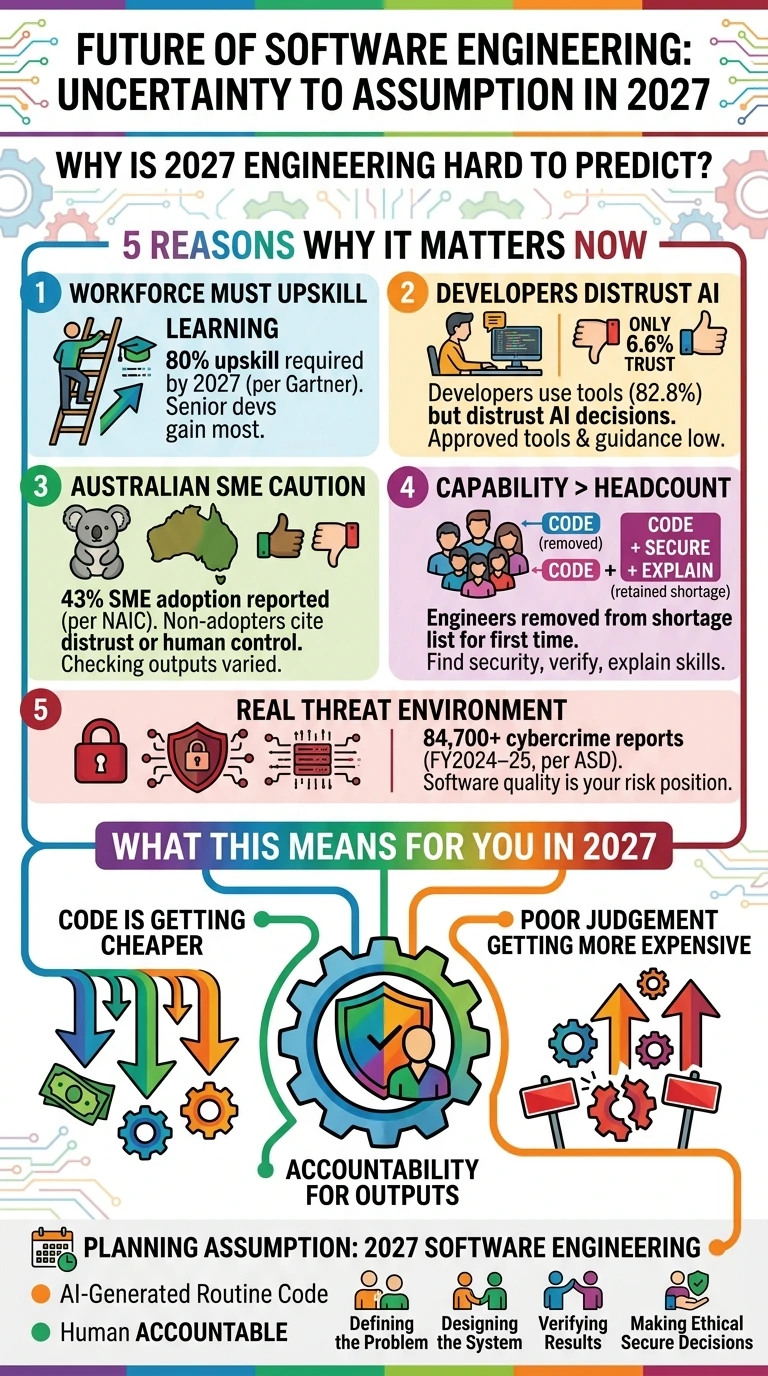
Five pieces of evidence explain why this matters now.
What this means for you: Code is getting cheaper to produce. Poor judgement is not getting cheaper to fix. The risk in 2027 is less about whether your supplier uses AI and more about whether anyone is accountable for what it produces.
What Will Software and App Engineering Look Like in 2027?
Commentators describe a shift from engineers who write most lines of code to engineers who steer AI agents toward the right context and constraints and review what comes back. Gartner also predicts that 75% of software engineers will use AI coding assistants by 2028. The consequence is simple: AI amplifies good engineering practice and bad practice alike.
| Area |
Common habit today |
Reasonable expectation for 2027 |
| Writing code |
Engineers write most code, with AI suggestions |
AI drafts routine code; engineers review, correct and own it |
| Testing |
Added late, often by hand |
Tests written alongside code, with automated checks as a gate |
| Security |
Reviewed near release |
Considered from the first design decision |
| Documentation |
An afterthought |
Produced and reviewed as part of delivery |
| Team shape |
Larger teams, narrower roles |
Smaller teams with senior oversight and broader skills |
| Measure of quality |
Speed of delivery |
Review quality, reliability and business outcomes |
This table reflects our expectations and analyst commentary, not benchmarked data.
The scarce skills in 2027 are human ones. Here are twelve.
Twelve Capabilities to Look For in Your Engineers
Each capability below includes a plain question you can ask a developer, a supplier or your own IT team.
Thinking: how problems get solved
1. Analytical Problem Solving
Someone must define the real problem before any code is written, then test whether the result solves it. AI produces confident answers to poorly framed questions, so this skill matters more, not less. Ask: "How did you decide this was the right problem to solve, and how will we know it worked?"
2. Practical Ingenuity
Good engineers find workable solutions within real limits: legacy systems, budgets, deadlines and imperfect data. That matters for mid-market firms running older systems beside new ones. Ask: "Show me a time you delivered something useful despite a constraint."
3. Creative and Innovation Skills
AI generates options quickly but tends to reproduce familiar patterns. People still decide which ideas are worth testing for your customers and market. Ask: "Which of your ideas did we not take up, and why?"
Working with the business
4. Communication
Engineers who explain trade-offs, risks and limits in plain language prevent expensive misunderstandings. With AI-generated code, clear written decisions also become part of your audit trail. Ask: "Can you explain this to my board in five minutes, without jargon?"
5. Business and Management Acumen
Software exists to serve a business outcome. Look for people who understand cost, scope, risk and return, and can manage delivery against them. Ask: "How will this project affect our costs or revenue, and how will we measure it?"
6. Leadership
In 2027 a senior engineer may lead both people and AI agents, setting standards and deciding what is safe to automate. Ask: "Who sets the standard for reviewing AI-generated work, and how is it enforced?"
7. Teamwork
Useful software comes from several skills working together: development, testing, design and data. Collaboration with your people remains essential even when AI is part of the workflow. Ask: "Who else is on the team, and how do they work with us?"
Trust: how decisions get made
8. Ethical Decision Making
Engineers make choices that affect real people, such as how personal data is used or who an automated decision might disadvantage. Australia's Guidance for AI Adoption (21 October 2025) sets out six practices for responsible AI governance and adoption. Ask: "How do you decide when something should not be automated?"
9. Professionalism
Professionalism means honest estimates, secure handling of your data, tested work, documentation and owning mistakes. It is what makes a supplier safe to depend on when much of the code is machine-assisted. Ask: "What happens when something goes wrong, and who tells me?"
Staying power: how teams keep up
10. Dynamism, Agility and Resilience
Tools, regulations and customer expectations keep shifting. Teams must adapt without dropping quality, and recover quickly when plans or systems fail. Ask: "Tell me about a project where requirements changed midway. What did you do?"
11. Flexibility
Flexible teams match the approach to the problem, whether that means buying, building or blending, and whether the work suits a short sprint or a longer build. Ask: "What would you advise us not to build?"
12. Lifelong Learning
Gartner expects most engineers to need upskilling, so learning is now part of the job. A supplier that cannot show how its people keep their skills current is a risk, especially in AI-assisted work. Ask: "How does your team keep up with new tools, and how do you check AI output as the tools change?"
Which Australian Obligations Apply?
This is general information, not legal advice.
Beware the "AI Cowboy": Speed Without Judgement
AI tools make a working prototype possible in hours. The risk begins when that prototype quietly becomes a business-critical system.
We use "AI cowboy" as an informal label for a builder who ships quickly with AI tools but with little testing or documentation. Firms that repair such systems argue that patching them without structural work becomes the most expensive option within 12 to 18 months of production traction. That is a vendor view, but it matches what many executives describe.
| What speed alone typically gives you |
What a business usually needs |
| A working demo |
A tested, secure system |
| Generated code |
Code your team can read, maintain and extend |
| Fast delivery |
A documented handover |
| A one-off output |
Capability that stays in your organisation |
If your software will connect AI to your data, read MCP Security: Questions to Ask Before Connecting AI to Your Systems.
A Practical Way to Start: One Workflow, 90 Days
- Weeks 1 to 2: choose one well-defined workflow and agree the outcome you will measure.
- Weeks 3 to 6: build it with a small team. Agree up front how AI tools may be used, what a person must always review and what must never be automated.
- Weeks 7 to 10: test it and record decisions and lessons.
- Weeks 11 to 13: review with leadership, using the twelve questions as a scorecard, then expand, adjust or stop.
Why C9 Compares Differently From Hundreds of Other Developers
Australia has no shortage of software developers. What separates C9 is how the team is built and how work is handed over.
A blended hybrid inshore and offshore team. C9 combines local oversight and communication with a wider pool of engineering capacity.
Knowledge transfer built into delivery. Documentation and handover are planned from the start, so you understand what was built and keep the freedom to change suppliers.
Multiple resources, not one developer. Development, testing, design and data skills can work as one team.
Experience. C9's website states 19+ years in business and 350+ completed projects across custom software, apps, integration, web applications, dashboards and business intelligence.
C9 can help assess, design and build custom software, apps, integrations and databases, with outcomes depending on your systems, data and goals. Related reading: MCP vs API vs Direct Integration and Audit-Ready Data Integration.
Staff Augmentation Options and Flexibility
If you would rather direct the work yourself, staff augmentation lets you add skilled people to your team. C9 offers more than a single developer. You can bring in an integrated team, such as developers, testers, designers and data specialists working together.
C9 does not use in-house local hiring in Australia. Team members are remote workers, so do not expect someone to arrive at your office for a 9-to-5 day. Collaboration happens through agreed tools, regular meetings and clear reporting.
| Option |
Best for |
Commitment |
| Minimum term of 3 to 6 months |
Building a product, integration or platform |
Fixed minimum, then extend or scale |
| Monthly contract |
Short top-ups, urgent capacity or trials |
Flexible month to month |
| Project-based |
A clearly scoped deliverable |
Agreed scope and milestones |
A 3 to 6 month minimum usually suits a build, because onboarding takes time and continuity protects quality. Monthly contracts remain useful for short, well-defined needs.
Frequently Asked Questions
Will AI replace software engineers by 2027?
Analysts expect roles to change, not disappear. Gartner says human expertise and creativity remain essential and that organisations will need more skilled engineers to meet demand for AI-powered software. Treat forecasts as planning assumptions.
What skills will software engineers need in 2027?
Technical skill still matters, but so do analytical problem solving, communication, leadership, teamwork, ethical decision making, professionalism, agility and lifelong learning.
Is AI-generated code safe to use in business software?
It can be, when people review, test and secure it. Developer surveys show trust is highest when output can be verified easily.
What should I ask my software supplier about AI?
Ask how AI tools are used, what a person always reviews, how your data is protected and who is accountable for mistakes. The twelve "Ask" questions above are a starting point.
Does Australia have specific AI laws?
There is no standalone AI Act at the time of writing, but existing laws such as the Privacy Act apply. Check current requirements with a qualified adviser.
What is staff augmentation, and will someone work from our office?
Staff augmentation means adding external specialists to your team while you keep control of priorities and direction. C9 uses remote workers and does not hire locally in Australia for client placements, so expect regular online collaboration, not an office presence.
Conclusion
Software and app engineering in 2027 will probably involve more AI and fewer hand-typed lines of code. What it should involve is people who think clearly, communicate honestly, make ethical choices and keep learning, because those capabilities decide whether AI-assisted software helps your business or exposes it.
Judge teams on the twelve capabilities, not only on the tools they use. Start with one workflow, keep a person accountable for review and make sure your own people understand what has been built.
Talk to C9 About Your 2027 Software Plans
Planning software, app or integration work for 2027? C9 can help you scope one workflow, review your systems and data, and choose the team model that suits you, whether a 3 to 6 month engagement or a monthly arrangement.
Book a scoping conversation with C9
Sources and References
Software engineering outlook
Australian data and regulation
About C9
This article is general information, not legal, security or financial advice. Forecasts about 2027 are expectations, not guarantees. Check current legislation and standards for your circumstances.
AI Transparency Notice
This article was produced with the assistance of artificial intelligence tools for research and content drafting. All content has been reviewed and approved by C9 prior to publication.