Executive Summary
In short:
-
The problem: Many Australian boards still receive audit assurance late, from samples and spreadsheets. Off-the-shelf tools can force a Strategic Internal Audit function into a vendor's workflow, while a full custom build can feel costly and risky.
-
The decision: Buy when your audit cycle is standard. Build or extend when continuous auditing depends on your own data, controls and approval paths. Most organisations land on a hybrid.
-
The context: Your organisational structure and reporting model, and a clear view of the responsibility of internal audit, should drive the tooling choice, not the other way around.
-
The delivery option: C9 offers a blended inshore and offshore team, planned knowledge transfer and flexible staff augmentation, so you can start with one workflow and keep control of what is built.
What's next?
Pick one high-risk control and map where its data lives. Then talk to C9 about whether buying, building or a hybrid suits you, before you commit budget.
Why Australian Executives Are Rethinking Audit Technology
Your audit committee asks a simple question: "Are our key controls working right now?" If the honest answer depends on last quarter's sample and a stack of spreadsheets, you have a visibility problem.
That problem is getting more expensive to carry. Four pressures stand out for Australian organisations.
1. Cyber and operational risk is costly. The Australian Signals Directorate (ASD) reports it received over 84,700 cybercrime reports in FY2024–25. Its report puts the average cost of a cybercrime incident at $56,600 for small businesses, $97,200 for medium businesses and $202,700 for large businesses. ASD notes that large-business averages can be skewed by outlier cases, so treat them as indicative.
2. Regulators expect evidence, not intentions. For APRA-regulated entities, CPS 230 requires internal audit to periodically review the business continuity plan and review any proposed material outsourcing of a critical operation. The Cyber Security Act 2024 also requires entities above the turnover threshold of $3 million to report ransomware payments to the ASD within 72 hours.
3. Automated decisions face new transparency rules. From 10 December 2026, Privacy Act changes require many organisations to disclose in their privacy policies where automated decision-making significantly affects people. That is a systems inventory task as much as a legal one.
4. Listed-company governance is evolving. ASX has consulted on a draft fifth edition of its Corporate Governance Principles. The draft recasts Recommendation 7.3 to require disclosure of whether an entity has an internal audit function, how it is structured, and how it assures the board about governance, risk management and internal control. ASX says the timetable may change, with first application for financial years commencing on or after 1 July 2027.
Meanwhile, the profession itself is changing. The IIA's Global Internal Audit Standards, effective 9 January 2025, encourage greater use of data analytics and AI tools. Chief audit executives (CAEs) rank an inability to use AI to lift efficiency as the profession's top strategic risk.
In short, doing nothing is not a neutral choice.
What Is Strategic Internal Audit?
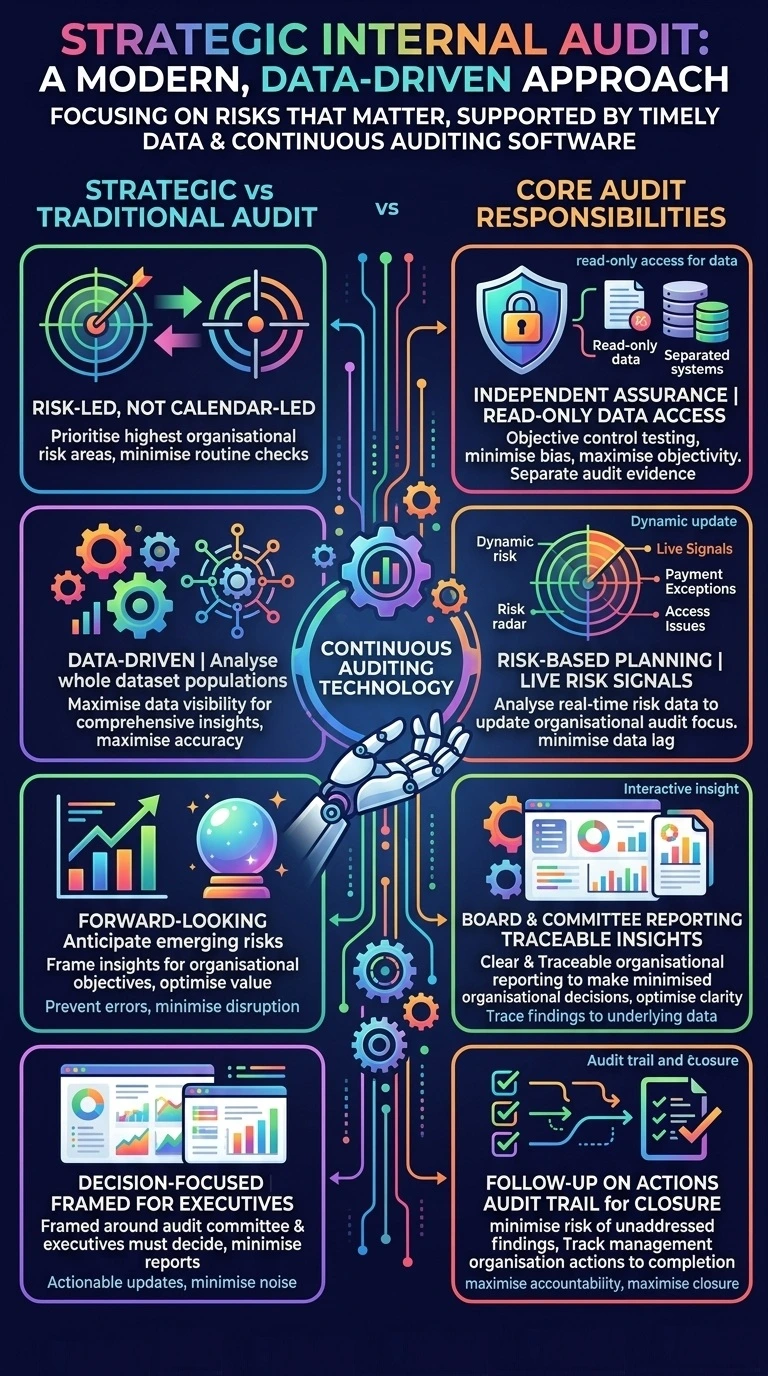
Strategic Internal Audit is an approach where the audit function focuses on the risks that matter most to the organisation's objectives, supported by timely data, rather than on a fixed cycle of routine checks.
It differs from traditional audit in four ways:
- Risk-led, not calendar-led. The audit plan flexes as risks change.
- Data-driven. Testing covers whole populations of transactions where possible, not only samples.
- Board-focused. Insights are framed around what the audit committee and executives must decide.
- Forward-looking. Findings highlight emerging risk, not just past errors.
Technology is what makes this practical. That is where continuous auditing software comes in.
What Is the Responsibility of Internal Audit?
The responsibility of internal audit is to provide independent, objective assurance and advice on governance, risk management and control, without owning the controls it tests.
Understanding this boundary matters when you choose software, because the tool must protect independence as well as speed.
Independent assurance
Internal audit tests whether controls work as designed. Software supporting this should give read-only access to source data and keep audit evidence separate from management systems.
Risk-based planning
The function decides where to focus. Live risk signals, such as exceptions in payments, access or incidents, help update the plan during the year.
Reporting to the board and audit committee
Internal audit must communicate clearly and directly. Dashboards and evidence packs should be traceable to underlying data.
Follow-up on actions
Findings are only valuable if they are fixed. Tracking actions to closure, with an audit trail, is a core requirement.
Organisational Structure and Reporting Model: Why It Shapes Your Software Choice
Your organisational structure and reporting model determine who owns the tool, who sees the data and how independence is protected.
A widely used model has the head of internal audit report functionally to the audit committee, and administratively to a senior executive. The functional line protects independence. The administrative line supports day-to-day operations.
Three common delivery models exist, and each has different software needs.
| Model |
Typical set-up |
What the software needs |
| In-house team |
Internal staff reporting to the audit committee |
Workflow, analytics and a rules library the team can own |
| Co-sourced |
In-house lead plus an external partner |
Shared workspace, strict access controls and clear evidence ownership |
| Outsourced |
External firm provides the function |
Reporting your organisation retains and can reuse if the provider changes |
Ask three questions before you decide:
- Who will own and maintain the audit rules once live?
- Who needs access to results, and who must be kept out?
- What happens to the data and evidence if a supplier relationship ends?
The answers often point toward either flexible custom components or strong data-ownership terms.
What Is Continuous Auditing Software?
Continuous auditing software tests controls and transactions on live or near-live data and flags exceptions as they occur, rather than relying on periodic samples.
Industry commentary describes this shift as continuous assurance. Teams ingest data, automate control tests and surface insights in real time. Continuous controls monitoring (CCM) lets audit and management work from a shared view.
How it typically works
- Connect to source systems such as ERP, finance, HR, identity and ticketing.
- Test data against defined control rules.
- Flag exceptions in a queue for human review.
- Record results in an evidence store with an audit trail.
- Report through dashboards for management and the audit committee.
Build vs Buy: A Practical Decision Framework
There is no universal answer. The right choice depends on how standard your audit work is, how distinctive your data is and how quickly you need results.
| Factor |
Buy off-the-shelf |
Build custom |
Hybrid |
| Time to first value |
Fastest |
Slowest |
Medium |
| Fit with your control framework |
Configure to the vendor's model |
Matches how you work |
Standard workflow, custom rules |
| Integration with ERP and finance data |
Connectors vary by product |
Built to your systems |
Custom connectors into a bought core |
| Data ownership and location |
Depends on vendor terms |
Full control |
Split; define up front |
| Cost profile |
Recurring licences |
Upfront build plus maintenance |
Both, each smaller |
| Response when regulation changes |
Wait for vendor roadmap |
You decide |
Mixed |
This table is general guidance, not benchmarked data. Test it against your volumes, systems and budget.
When buying makes sense
- Your audits follow a standard cycle of planning, workpapers, issue tracking and reporting.
- The team is small and needs to be live within a quarter.
- Your data sits in common, well-supported systems.
When building or extending makes sense
- You test controls on data from bespoke or legacy core systems.
- You want full-population testing across several systems.
- Data residency, security or regulatory evidence requirements need tight control.
- You need audit rules that match your own approval paths.
Reviewers of some commercial audit platforms mention limited customisation to their own audit set-up. That is a common trigger for extending a bought tool with custom components.
Why hybrid is common
A hybrid approach buys the generic workflow, such as planning and issue tracking, and builds the parts that are unique to you. These are usually data connectors, control rules and dashboards. It limits risk while keeping flexibility.
The Hidden Costs and Risks Executives Should Weigh
Buying brings recurring licences, limited customisation and dependence on a vendor's roadmap, so review data location and exit terms carefully. Building brings higher upfront investment, ongoing maintenance and the risk of dependence on one supplier if documentation is poor.
These risks are manageable. Start with one control, agree clear ownership and require documentation and knowledge transfer from day one.
What a Custom Continuous Auditing Build Includes
A well-scoped build typically contains:
- Data connectors into ERP, finance, HR, identity and ticketing systems, read-only by default.
- A control rule library that your team owns, versioned and reviewable.
- An exception queue where a person reviews, accepts or escalates each flag.
- An evidence store with an audit trail so every result is traceable.
- Dashboards for management and the audit committee.
- Access controls that protect independence and sensitive data.
Good design principles include read-only access, lineage on every data field, immutable history and reconciliation checks after each data load.
A Practical Way to Start: One Workflow, 90 Days
Large programs fail when they try to cover everything at once. A safer path:
- Weeks 1 to 2: choose one high-risk control, map its data and write the pass or fail rule in plain language.
- Weeks 3 to 6: build or configure the connector, test logic and exception queue. Run alongside manual testing.
- Weeks 7 to 10: compare results, tune rules and document decisions.
- Weeks 11 to 13: report to the audit committee on results, limits and the next controls to add.
This reduces risk, builds confidence and gives you evidence to decide on wider investment.
Why C9 Compares Differently From Hundreds of Other Developers
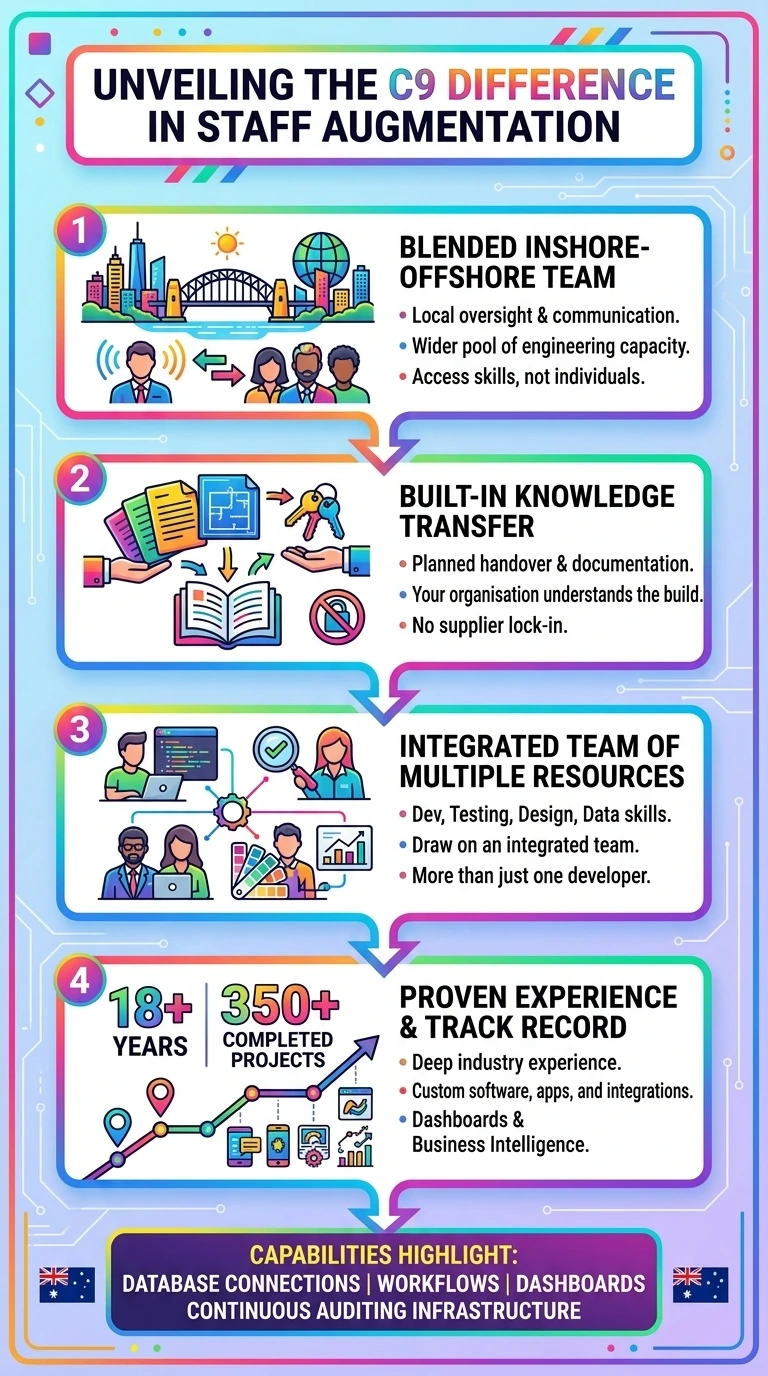
Australia has no shortage of software developers. What separates C9 is how the team is built and how work is handed over.
A blended hybrid inshore and offshore team. C9 combines local oversight and communication with a wider pool of engineering capacity. This helps you access the skills you need without relying on a single individual.
Knowledge transfer built into delivery. C9 plans documentation and handover so your organisation understands what has been built and is not locked into one supplier.
Multiple resources, not a single developer. Projects can draw on development, testing, design and data skills as an integrated team.
Experience. C9's website states 18+ years in business and 350+ completed projects across custom software, apps, integration, web applications, dashboards and business intelligence.
C9 can design and build the connectors, databases, workflows and dashboards that sit behind a continuous auditing capability, whether you buy the workflow layer or build it. Scope, approach and timing are agreed with you at the outset.
Staff Augmentation Options and Flexibility
If you want to build or extend your platform without permanent hiring, staff augmentation lets you add skilled people to your delivery team. C9 offers more than a single software developer. You can bring in an integrated team that works together, such as developers, testers, designers and data specialists.
How the team works
C9 does not use in-house local hiring in Australia. Team members are remote workers. You should not expect someone to arrive at your office for a 9 to 5 day. Collaboration happens through agreed tools, regular meetings and clear reporting.
Engagement options
| Option |
Best for |
Commitment |
| Minimum term of 3 to 6 months |
Building a platform, integration or continuous auditing capability |
Fixed minimum, then extend or scale |
| Monthly contract |
Short top-ups, urgent capacity or trials |
Flexible month to month |
| Project-based |
A clearly scoped deliverable |
Agreed scope and milestones |
Why a 3 to 6 month minimum is usually the better choice
- Onboarding takes time. New people must learn your systems, controls and data. A longer term spreads that effort across more productive weeks.
- Continuity protects quality. Audit software depends on context. Keeping the same people avoids repeated handovers and re-learning.
- Knowledge stays with the project. Stable teams document and transfer knowledge more reliably.
- Planning is easier. A committed term helps match the right skills to each phase of delivery.
- It suits real build cycles. Connectors, rules and dashboards rarely finish in a few weeks. Short rolling arrangements can cause stop-start progress.
Monthly contracts remain useful for short, well-defined needs. For anything that must be built, tested and handed over, a minimum term is generally the safer fit.
Staff Augmentation FAQs
What is staff augmentation?
Staff augmentation means adding external specialists to your team on an agreed basis while you keep control of priorities and direction.
How is it different from outsourcing a whole project?
With staff augmentation you direct the work day to day. With project outsourcing the supplier owns delivery against an agreed scope.
Will I get one developer or a team?
Either. C9 can provide an integrated team with complementary skills, not only a single developer.
Will someone work from our office?
No. C9 uses remote workers and does not hire locally in Australia for client placements. Expect regular online collaboration, not an office presence.
What is the minimum commitment?
Longer builds suit a minimum term of 3 to 6 months. Monthly contracts suit shorter or more flexible needs.
How does knowledge transfer work?
C9 plans documentation and handover so your organisation retains an understanding of what was built. Agree the specific deliverables at the start of the engagement.
Should we buy or build continuous auditing software?
Buy if your needs are standard and you want speed. Build or extend if your data, controls or reporting lines are distinctive. Many organisations choose a hybrid.
Conclusion
Continuous auditing is not only a software decision. It is a decision about independence, evidence and the speed of insight your board receives.
Buy when your needs are standard. Build or extend when your data, controls and reporting model are distinct. Many Australian organisations will do both. Whichever path you choose, define the responsibility of internal audit clearly, start with one workflow and keep ownership of your data and rules.
Talk to C9 About Your Continuous Auditing Needs
Not sure whether to buy, build or blend? C9 can help you scope one workflow, review your data sources and consider the team model that suits you, whether a 3 to 6 month engagement or a monthly arrangement.
Book a scoping conversation with C9
Sources and References
Australian regulation and statistics
Internal audit and technology
About C9
This article is general information, not legal, audit or financial advice. Check current legislation and standards for your circumstances.
AI Transparency Notice
This article was produced with the assistance of artificial intelligence tools for research and content drafting. All content has been reviewed and approved by C9 prior to publication.