EXECUTIVE SUMMARY
In short:
- Australian businesses lose an estimated $126,000 per year on average to missed inbound calls — most going unanswered because owners and staff are occupied with billable work.
- Up to 85% of callers who reach voicemail never call back. They find a competitor who answers and become their customer instead.
- Voice AI Automated Appointments — powered by Twilio and integrated directly into your CRM — answer every call, book every appointment, and fire instant confirmations 24 hours a day, 7 days a week.
- C9, Australia's leading custom software and integration developer, builds bespoke Voice AI Agent Development Services engineered around your specific workflows, software stack, and customer base. No templates. No off-the-shelf compromises.
|
What's next?
Businesses deploying Voice AI right now are capturing after-hours revenue, weekend leads, and emergency bookings that competitors miss every single day. By the end of this article, you will have a clear, actionable picture of how to stop the revenue bleed — and the confidence to take the first step.
|
Picture this. It is 6:53 PM on a Tuesday. A homeowner with a hot water system failure picks up their phone and dials your number. You are still on-site finishing a job. Your front desk closed two hours ago. The call rings out. The homeowner hangs up, scrolls back to Google, and calls the business listed directly below yours. That job — a $600 emergency call-out — is gone in under 30 seconds.
This is not an edge case. For the majority of Australian businesses, this exact scenario plays out multiple times every single day. The plumber under the sink. The GP mid-consultation. The salon owner with their hands full. The real estate agent mid-inspection. Every one of them is doing exactly what their business requires — and every one of them is losing bookings because of it.
The good news? This problem has a name — and it has a solution. The name is the Missed Call Tax. The solution is Voice AI Automated Appointments, built on enterprise-grade Twilio infrastructure and integrated directly into your CRM. This article explains both — with the data to back it up.
The Missed Call Tax: What It Is Actually Costing Australian Businesses
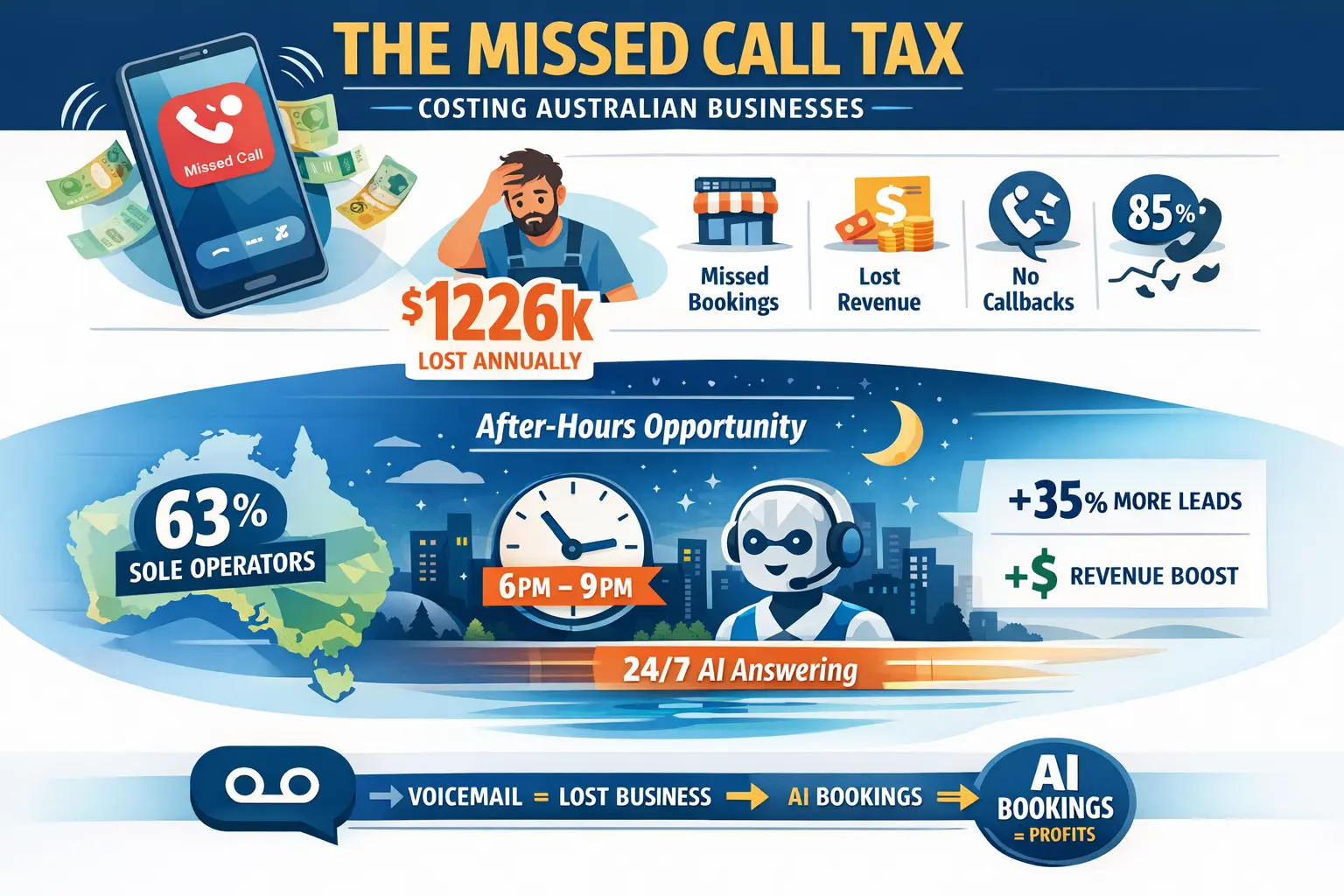
Most Australian business owners know, intuitively, that they miss calls. Very few have calculated what that costs them annually. The number is larger than almost anyone expects — and once you see it, voicemail starts looking like the most expensive tool in your entire operation.
|
$126K
avg. annual revenue lost per SME to missed calls (Ambs Call Centre, 2025)
|
85%
of callers who reach voicemail never call back (industry research, 2025)
|
$8B+
lost annually across Australian businesses to missed calls (Autopilot Genie, 2025)
|
The $126,000 figure is not a worst-case projection. It is the average across small and medium-sized businesses, calculated by multiplying typical call volumes, industry-specific booking values, and the well-documented 85% non-callback rate. For businesses in high-value service categories — trades, allied health, legal, real estate — the individual missed call cost is even higher.
📊 Fact: Home service businesses miss an average of 27% of inbound calls, with each missed call costing approximately $1,200 in lost revenue (Invoca research, 2024). For a plumbing business missing just five calls per week at $200 average job value, that is more than $52,000 in annual lost revenue (Autopilot Genie, 2025).
The Missed Call Tax is structurally invisible. There is no line item in your profit and loss statement that reads 'Revenue Not Earned.' The damage accumulates silently — callers you never knew you had, bookings that were never made, invoices that were never raised. That invisibility is precisely what makes it so damaging, and precisely why so few businesses have addressed it.
Why Australian Businesses Are Uniquely Vulnerable
Australia's business landscape makes this problem structurally worse than almost anywhere else. According to the Australian Bureau of Statistics, at 30 June 2025 there were 2,729,648 actively trading businesses in the Australian economy. Of those, 1,735,470 — 63.5% — are sole operators with zero employees. These business owners are simultaneously the service provider, the salesperson, the administrator, and the customer service function. Answering every inbound call while delivering billable work is structurally impossible.
Layer on Australia's documented labour shortage — Jobs and Skills Australia's 2025 Occupation Shortage List confirms that 29% of assessed occupations remain in shortage nationwide — and the idea of hiring a full-time receptionist to cover this gap becomes both economically and practically unviable for the vast majority of Australian businesses.
📊 Fact: 97.3% of all Australian businesses are classified as small businesses (fewer than 20 employees) by the ABS. Health Care and Social Assistance led all industries with 6.6% growth in 2024-25, reaching 213,177 businesses — and is among the industries most acutely affected by missed call revenue loss (ABS, 2025).
The After-Hours Window: Your Biggest Untapped Revenue Opportunity
Here is the insight that surprises most Australian executives: the highest-intent calls are disproportionately arriving outside business hours. Consumer behaviour data consistently shows that 30 to 40 per cent of bookable inbound calls to Australian service businesses arrive between 6 PM and 9 PM on weeknights — the window when working Australians have time to handle personal and business administration.
With a human-staffed front desk, every one of those calls goes to voicemail. With a 24/7 Voice AI Automated Appointment system, every one of them is answered, processed, and booked — generating revenue that literally did not exist before. AI receptionists that work 24/7 help businesses capture an extra 15 to 20 per cent of appointments outside normal business hours (Ambs Call Centre, 2025).
💡 Revenue Opportunity: If your business captures just two additional after-hours bookings per weeknight at an average value of $350, that represents $91,000 in annual incremental revenue — from calls your human-only front desk was leaving completely unanswered.
The Competitive Cost of Inaction
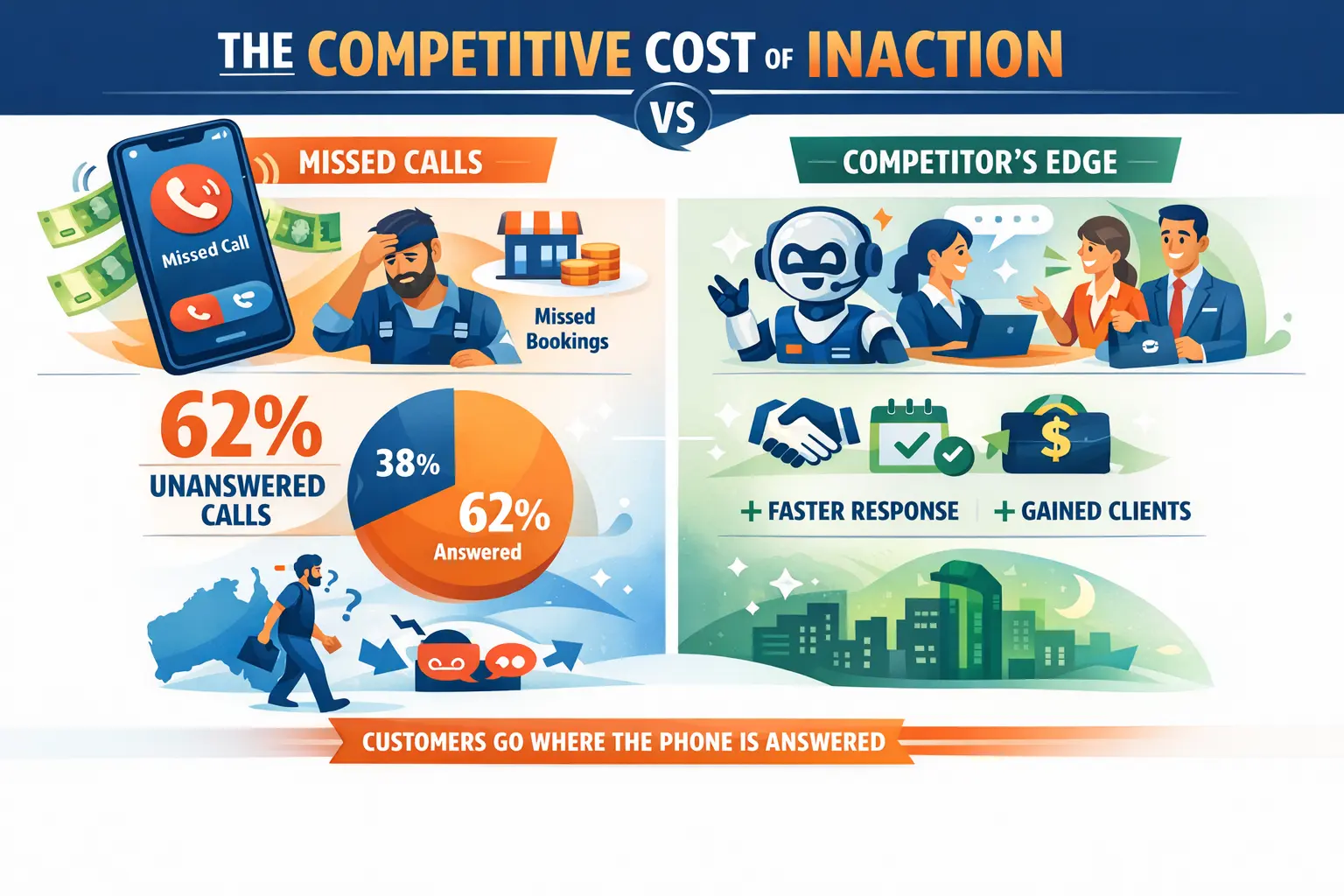
The missed call problem does not occur in isolation. While your calls go to voicemail, those same callers are being answered by competitors who have already deployed Voice AI Automated Appointments. In service industries where first contact wins the relationship, the business that picks up the phone wins the customer.
A study monitoring 85 businesses across 58 industries found that businesses answered only 37.8 per cent of all incoming calls. That means nearly two-thirds of potential customers never spoke to anyone — and those callers did not disappear. They called a competitor who answered.
⚠ Key Insight: 62% of home service businesses miss the majority of their inbound calls. Professional services miss 54%. Even retail businesses with someone 'always at the desk' miss 48% of calls (Sift Digital analysis, 2025). The competitive gap between businesses that answer and those that do not is measurable, permanent, and widening.
For Australian business owners and executives, this is not a technology question. It is a market positioning question. The businesses investing in Voice AI Agent Development Services today are building a structural advantage in their market that becomes harder to match with every passing month.
"The businesses winning in 2026 are not the ones that hired more staff. They are the ones that built smarter systems."
What Is a Voice AI Automated Appointment System — and How Does It Work?
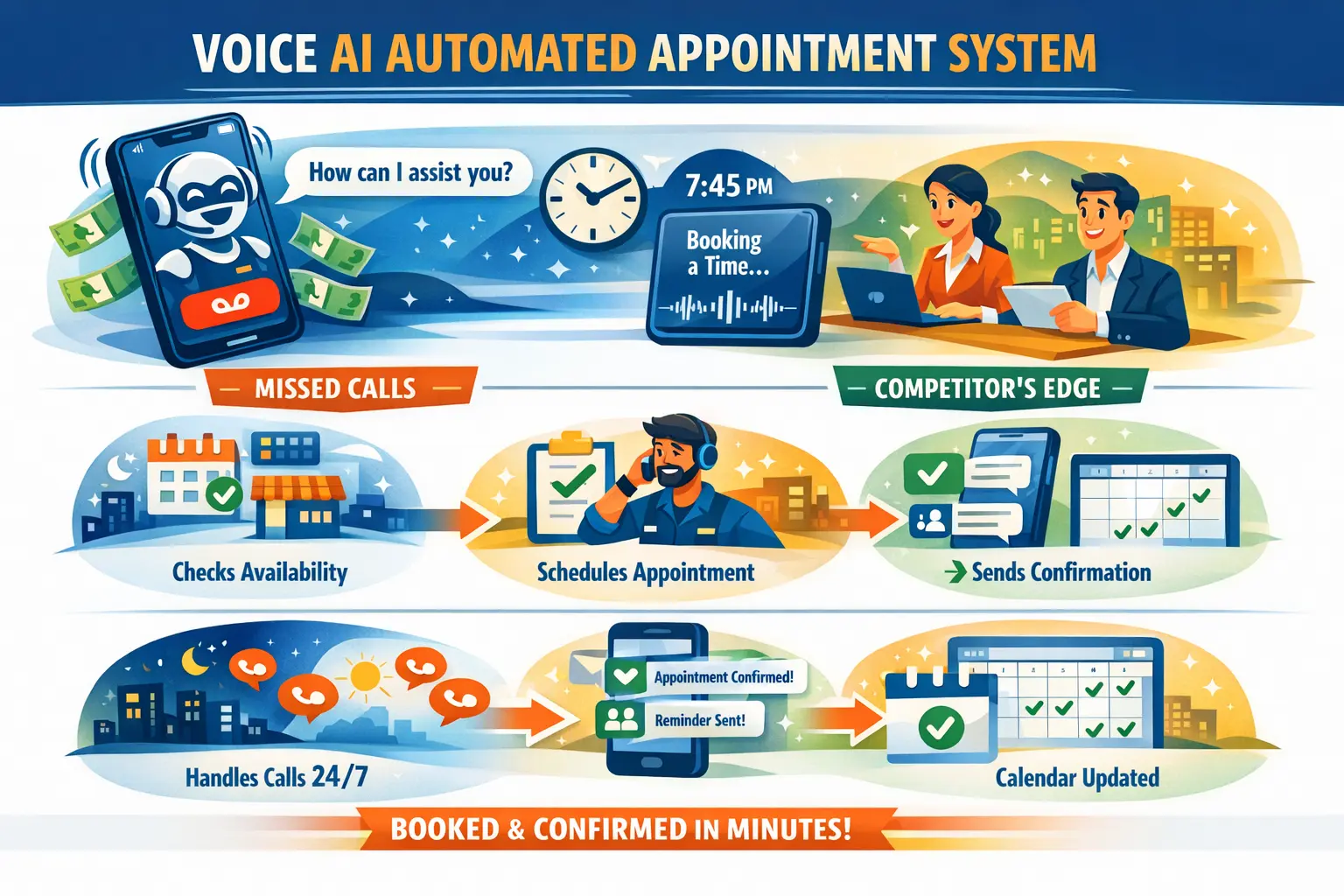
A Voice AI Automated Appointment system is not a voicemail upgrade. It is not a scripted phone menu. It is not a chatbot. It is an intelligent, agentic AI system that converses naturally with your callers, understands their intent, accesses your live calendar, books the appointment, and confirms it by SMS — all within a single phone call, at any hour of the day or night.
When a caller dials your business at 7:45 PM on a Thursday, they are not met with 'Sorry, we're closed.' They are met with your AI agent — responding in natural, professional Australian English — who asks how they can help, identifies what is needed, checks your availability for the following morning, offers two suitable time slots, confirms the booking, and fires an instant SMS confirmation. The call takes three to four minutes. The caller hangs up as a confirmed customer. Your calendar updates in real time.
📌 Note: In independent testing, 85 to 95 per cent of callers cannot distinguish a well-designed Voice AI agent from a human receptionist. C9's bespoke approach designs a voice character — accent, pace, warmth, formality — specifically to match your brand and your customers' expectations.
The Five Capabilities That Separate Voice AI From a Phone Menu
- Natural Language Understanding: The system comprehends intent beyond keywords. 'Can I get in Thursday arvo for a check-up?' is processed identically to 'I would like to book an appointment for Thursday afternoon.' Australian English, colloquialisms, and industry-specific terminology are all handled natively in bespoke deployments.
- Real-Time Calendar Access: The agent checks your live availability during the call and offers specific time slots. No 'we'll call you back to confirm' — the booking is completed before the caller hangs up.
- Simultaneous Call Handling: Unlike a single human receptionist, a Voice AI system handles unlimited concurrent calls. Peak periods, public holidays, and unexpected call surges are managed without queues or call drops.
- Automated Confirmation and Reminders: The moment a booking is confirmed, an SMS confirmation is fired to the caller. Automated reminder sequences follow: a 48-hour voice reminder, a 24-hour SMS with confirm or reschedule options, and a day-of nudge.
- Intelligent Escalation: When the AI detects a complex scenario or urgency signal requiring human intervention, it transfers the call seamlessly with a real-time briefing, or fires an immediate SMS alert to the relevant staff member.
Built on Twilio: Enterprise-Grade Infrastructure for Australian Deployments
C9's Voice AI Automated Appointment systems are built on Twilio — the world's leading Communications Platform as a Service (CPaaS), trusted by Airbnb, Salesforce, Uber, and thousands of Australian businesses for mission-critical customer communications. Twilio facilitates over 193 billion messages, 22 billion calls, and 2.2 trillion emails annually across 180+ countries (Twilio SIGNAL, 2025).
Building on Twilio is a deliberate architectural decision. It delivers four non-negotiable requirements for Australian business deployments: reliability at production scale, HIPAA-eligible compliance architecture for regulated industries, Australian phone number provisioning, and deep integration APIs that connect to the software stack your business already runs on.
The Twilio Product Stack Powering Your Voice AI System
|
01
|
Twilio Programmable Voice — The Call Foundation
Every inbound call is received through Twilio's enterprise voice infrastructure using TwiML (Twilio Markup Language) webhooks that connect to C9's custom agentic AI logic. Australian local numbers (02, 03, 07, 08 area codes), 1300, and 1800 numbers are all supported. Bi-directional audio streaming via WebSocket enables real-time conversation at sub-500ms latency. Fallback routing ensures seamless call transfer to a human staff member if escalation is required.
|
|
02
|
Twilio ConversationRelay — The AI Voice Engine
Now generally available following its enterprise release in 2025, ConversationRelay is the platform that makes human-like Voice AI possible at scale. It integrates advanced speech recognition (achieving under 5% word error rates), natural interruption handling (the AI responds when you speak mid-sentence, not after a robotic pause), expressive voice synthesis via ElevenLabs, Deepgram, Google, and Amazon, and real-time large language model integration via a 'Bring Your Own LLM' architecture. Twilio's proprietary VoxRay orchestration minimises latency to deliver smooth, human-like conversations — critical for high-stakes interactions in customer service and appointment booking (Twilio SIGNAL, 2025). ConversationRelay is HIPAA-eligible when configured properly, enabling healthcare organisations to deploy compliant voice AI with confidence.
|
|
03
|
Twilio Conversational Intelligence — The Analytics Layer
Formerly Voice Intelligence, Conversational Intelligence provides AI-powered transcription and analysis across every call your Voice AI system handles. It tracks task completion rates, detects hallucinations, monitors human escalations, assesses customer sentiment, identifies intent and friction points, and generates actionable insights for continuous improvement. Every call becomes structured, searchable, analysable data — giving business owners complete transparency into their Voice AI system's performance and their customers' behaviour.
|
|
04
|
Twilio Messaging — Confirmations, Reminders, and Waitlist Backfill
The moment a booking is confirmed, Twilio Messaging fires an instant SMS to the caller with full appointment details and a calendar link. Automated reminder sequences follow: a 48-hour outbound voice reminder call, a 24-hour SMS with a one-touch confirm or reschedule shortcode (SMS open rates in Australia exceed 95% within 3 minutes of delivery), and a day-of nudge. When a cancellation is detected, the next caller on the waitlist receives an automatic SMS offering the freed slot — transforming cancellations from revenue losses into filled appointments.
|
📌 Note: Twilio's ConversationRelay makes it radically simple to deploy human-like AI voice agents with interruption handling, advanced speech recognition, and expressive voices — now HIPAA-eligible and tightly integrated with Conversational Intelligence, so every interaction is not just understood but measured and optimised (Twilio SIGNAL, 2025).
CRM Integration: Turning Every Call Into a Live Pipeline Event
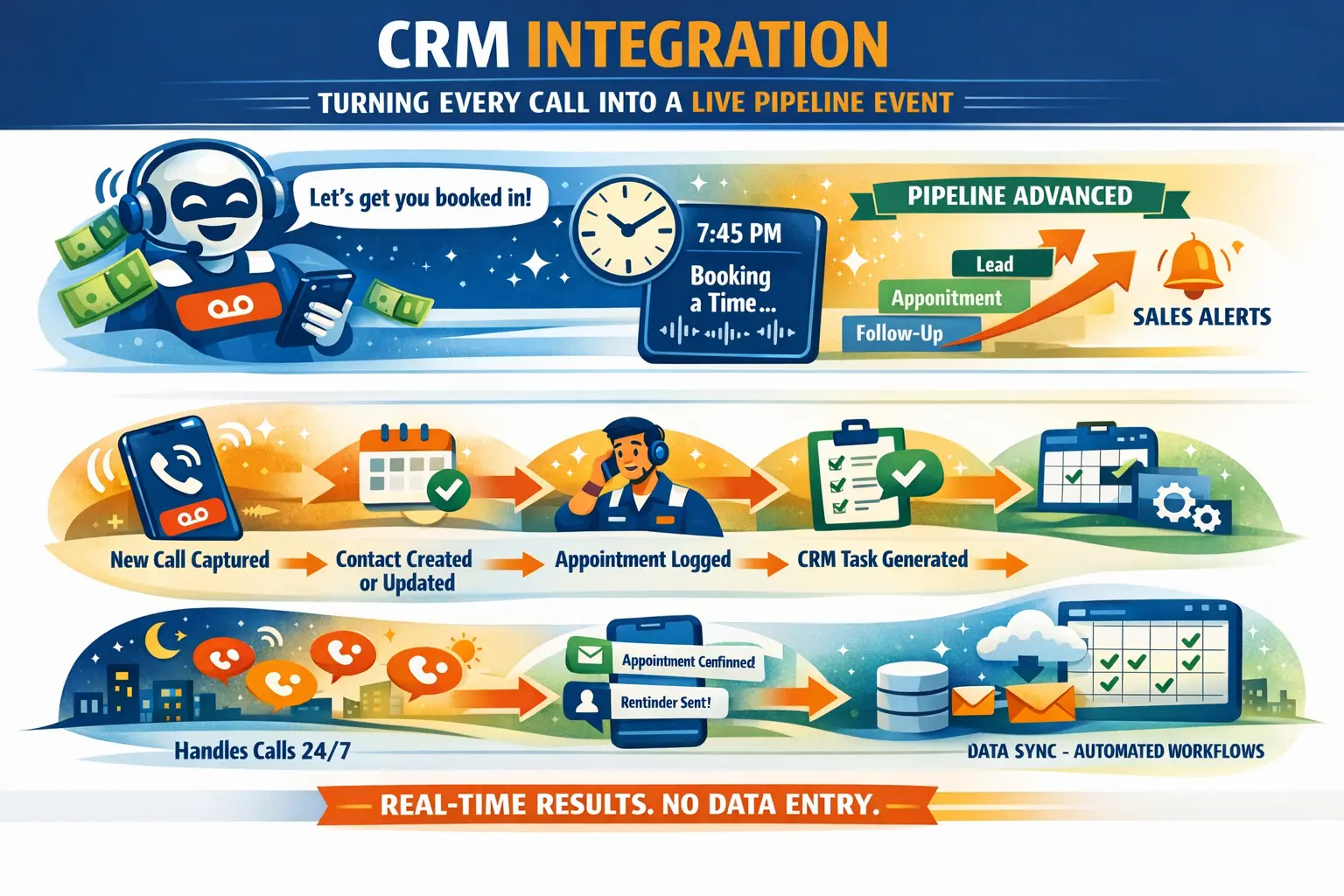
A Voice AI system that books appointments is valuable. A Voice AI system that books appointments and simultaneously updates your CRM, advances your pipeline, assigns follow-up tasks, and triggers automated sequences is transformative — and that is what C9 builds.
Every inbound call becomes a structured data event: a contact created, an activity logged, a pipeline stage advanced, a follow-up task generated. Companies are reporting up to an 80 per cent reduction in operational costs and a 75 per cent improvement in customer service efficiency through voice AI deployment when fully integrated with CRM — and these gains compound through automated workflows (Leaping AI, 2025).
Voice AI CRM integration completes up to 95 per cent of CRM fields accurately from voice data alone, eliminating manual data entry, preventing lead leakage, and giving your sales and service teams a real-time view of every customer relationship in progress (Leaping AI, 2025).
What Happens in Your CRM From the Moment the Call Connects
- Inbound call received → CRM searched for existing contact record. New callers: contact created in real time. Existing clients: record retrieved and call personalised with their history.
- Intent identified and captured → service type, urgency level, preferred time, and any special requirements logged as structured data to the CRM as the call progresses — not after.
- Appointment booked → CRM activity record created with booking details, full call transcript, and sentiment flag from Twilio Conversational Intelligence.
- Pipeline advanced → contact moves to 'Appointment Booked' stage; assigned team member notified; follow-up task auto-generated for post-appointment check-in or review request.
- Cancellation detected → CRM record updated; waitlist SMS triggered via Twilio Messaging; pipeline stage automatically adjusted.
Australian CRM Platforms C9 Integrates With Natively
|
CRM PLATFORM
|
PRIMARY APPLICATIONS — AUSTRALIAN MARKET
|
|
HubSpot
|
Professional services, B2B, marketing agencies, financial advisers
|
|
Salesforce
|
Enterprise healthcare groups, insurance, large real estate networks
|
|
Zoho CRM
|
SME retail, professional services, education, logistics
|
|
Go High Level
|
Digital marketing agencies, coaching, wellness, local service businesses
|
|
ActiveCampaign
|
E-commerce, subscription services, health and wellness brands
|
|
Cliniko
|
Allied health — physiotherapy, psychology, chiropractic, podiatry
|
|
ServiceM8
|
Australian trades — plumbing, electrical, HVAC, cleaning, landscaping
|
|
Rex CRM
|
Real estate agencies across Australia
|
|
Xero / MYOB
|
Financial data sync for invoicing post-appointment (advanced deployments)
|
✅ 49% of businesses report improved data quality when their CRM is fully integrated with other enterprise systems (Leaping AI, 2025). Voice AI CRM Integration makes this integration automatic — every call, every booking, every customer interaction captured without a single manual entry.
The No-Show Reduction Dividend
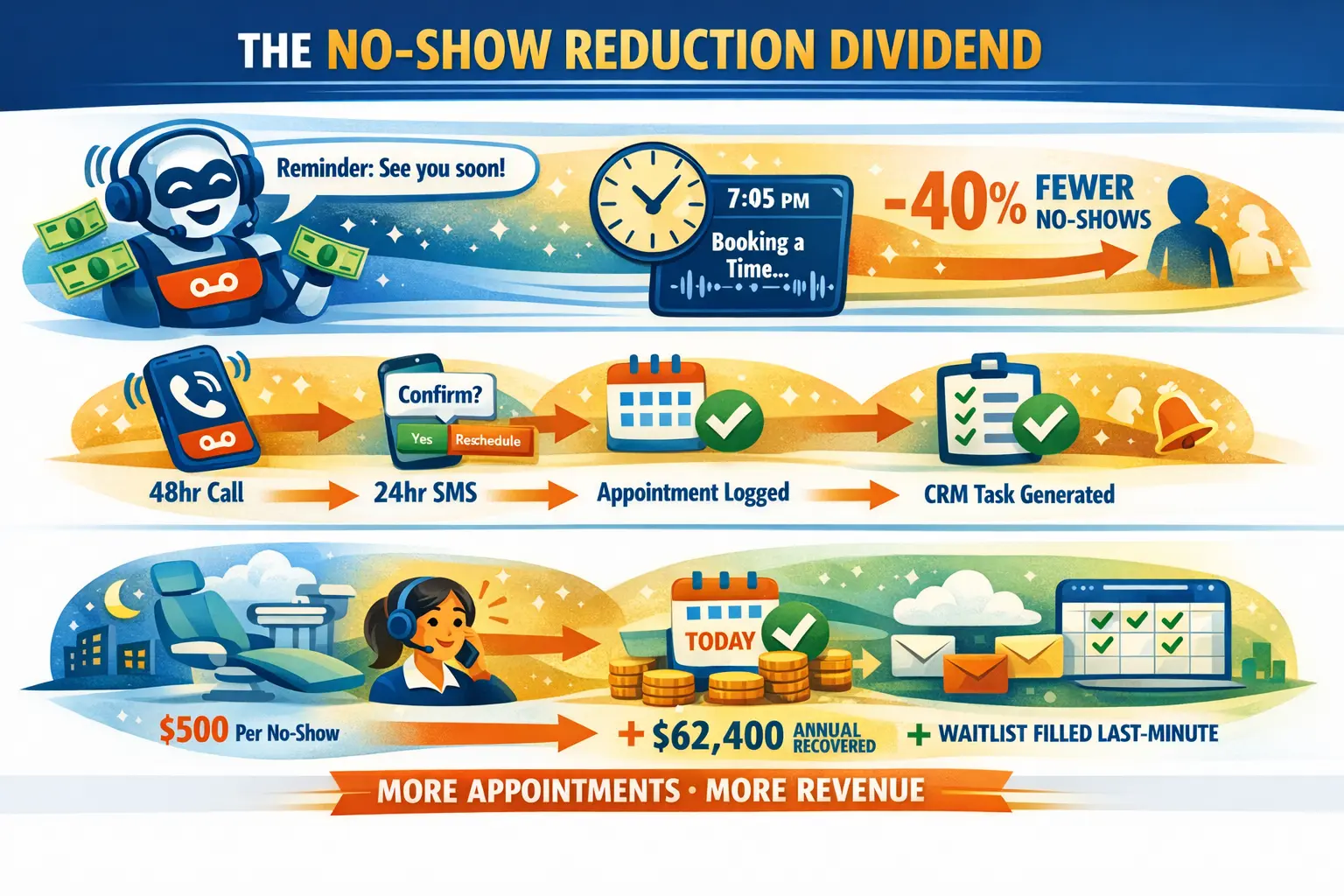
Capturing missed calls is the primary revenue lever. But a fully deployed Voice AI Automated Appointment system delivers a second, equally significant financial benefit: a dramatic reduction in appointment no-shows.
The multi-touch reminder sequence built into C9's systems — a 48-hour proactive voice call, a 24-hour SMS with one-tap confirm or reschedule, and a day-of nudge — creates a commitment chain that keeps appointments salient and makes rescheduling effortless. When cancellation does occur, the waitlist backfill SMS fills the slot within minutes.
|
40%
reduction in no-shows from automated appointment scheduling (Sameday, 2025)
|
28%
no-show reduction at Memorial Hospital Gulfport, generating $1M+ additional annual revenue (Health Catalyst, 2024)
|
87%
fewer missed calls reported by businesses deploying Voice AI appointment systems (Hostie AI, 2025)
|
For a dental practice losing $500 per no-show across six weekly missed appointments, a 40 per cent reduction in no-shows recovers $62,400 per year — an additional revenue outcome that stacks directly on top of the missed call recovery figure. Voice AI simultaneously fills your calendar from the front end and protects it from the back end.
Automated appointment scheduling can handle 70 per cent of scheduling-related inquiries autonomously — reducing workload for front desk staff and allowing your team to focus on high-value, relationship-intensive interactions rather than repetitive administrative tasks (Sameday, 2025).
Why Bespoke Voice AI Development Outperforms Off-the-Shelf Platforms
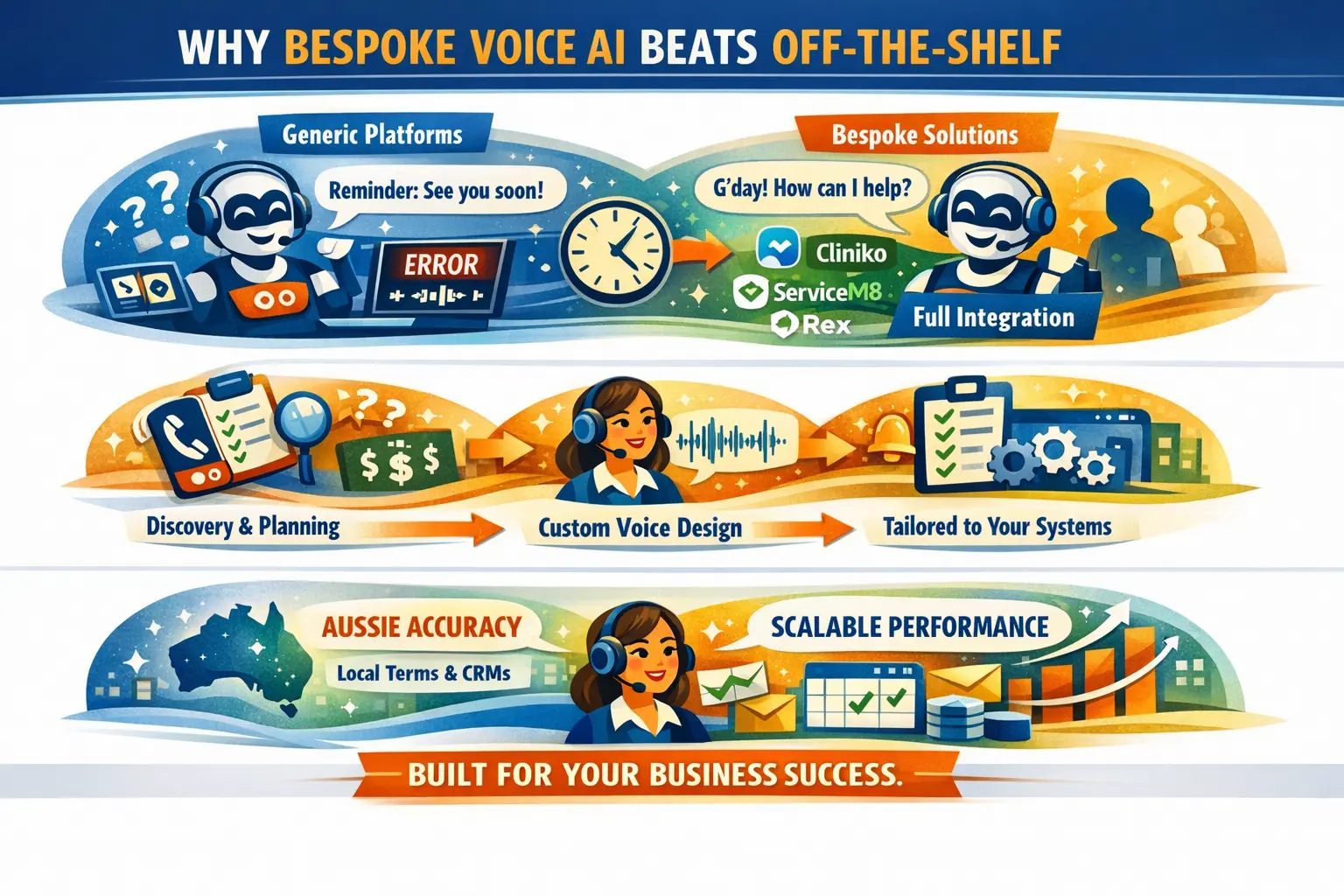
There is no shortage of generic Voice AI platforms available to Australian businesses in 2026. Most of them deliver a compelling demonstration and a disappointing real-world deployment. They handle the 20 most common call scenarios adequately, then fail completely on the 21st. They integrate with international CRMs but not with Cliniko, ServiceM8, or Rex. They offer generic pre-built voices that sound identical to every other business on the platform. And their per-minute pricing models become expensive precisely when your call volume grows.
|
GENERIC PLATFORM
|
C9 BESPOKE VOICE AI
|
|
Template conversation flows, fixed decision trees
|
Custom-engineered dialogue mapped to your actual booking scenarios
|
|
International CRM integrations only
|
Native integration with Cliniko, ServiceM8, Rex CRM, MYOB, Xero and more
|
|
Generic pre-built voices, no brand alignment
|
Custom voice character designed for your brand personality and Australian English
|
|
Per-minute pricing that scales against you
|
Predictable monthly infrastructure — costs stabilise as call volume grows
|
|
Shared offshore infrastructure, data sovereignty risk
|
Australian data residency options; Privacy Act 1988 compliant by design
|
|
Off-the-shelf, no workflow customisation
|
Full-stack engineering from ASR to CRM — nothing templated, nothing generic
|
C9 is Australia's leading custom software, apps, integration and database developer — and the bespoke approach is foundational to every Voice AI Agent Development Service we deliver. Each system begins with a clean-sheet discovery process: mapping your actual call scenarios, auditing your existing software stack, and designing a voice character that represents your brand as you intend it.
🏆 C9 Advantage: Every Voice AI system C9 builds is engineered on Twilio's enterprise infrastructure, integrated natively with your CRM and calendar platform, tuned for Australian English and local vernacular, and supported with ongoing analytics-based optimisation. No templates. No compromises.
The Return on Investment: Real Numbers for Australian Business Owners
Australian business owners are rightfully sceptical of technology promises. The Voice AI ROI case requires no optimistic assumptions — it is arithmetic based on your current call volume and booking value.
|
METRIC
|
CONSERVATIVE ESTIMATE (AUSTRALIAN SME)
|
|
Missed calls recovered per week
|
3–6 additional bookings captured
|
|
Average booking value — service business
|
$200 – $800 AUD
|
|
Annual incremental revenue (low end)
|
$31,200 AUD (3 bookings × $200 × 52 weeks)
|
|
Annual incremental revenue (high end)
|
$249,600 AUD (6 bookings × $800 × 52 weeks)
|
|
Annual cost — bespoke C9 Voice AI system
|
Predictable monthly infrastructure (contact C9 for scoping)
|
|
No-show revenue recovery (40% reduction)
|
$15,000 – $80,000+ additional, industry-dependent
|
|
Payback period
|
Typically days to weeks, not months
|
|
5-year compounding advantage
|
Early adopters build customer loyalty and reviews that late movers cannot recover
|
Beyond the direct revenue recovery, Voice AI CRM Integration generates a business intelligence asset of growing value: which marketing channels drive the highest-quality calls, what times of day generate peak booking intent, which customer segments have the highest no-show rates, and which conversation flows convert most effectively. This intelligence compounds over time, enabling smarter marketing spend and operational decisions that are simply unavailable to businesses relying on voicemail.
📊 Fact: Businesses with 24/7 reception coverage see customer retention rates improve by 24% or more. When customers know they can always reach you, they are more likely to remain loyal even when competitors offer lower prices (Ambs Call Centre, 2025). Retention gains compound annually — making Voice AI one of the highest long-term ROI technology investments available to Australian SMEs.
Frequently Asked Questions
Q: Will my customers know they are speaking to an AI?
In independent testing, 85 to 95 per cent of callers cannot distinguish a well-designed Voice AI agent from a human receptionist. C9's bespoke approach designs a voice character — accent, pace, warmth, formality — specifically to match your brand. The agent introduces itself by name (e.g., 'Hi, you've reached Emma from [Business Name] — how can I help today?') and handles natural Australian English conversation including interruptions, topic changes, and colloquialisms.
Q: What happens when the Voice AI encounters a call it cannot handle?
Every C9 Voice AI system includes configurable escalation protocols. When the agent detects a scenario outside its scope — a complex complaint, a genuine medical or safety emergency, or an unusual booking scenario — it transfers the call to a human staff member with a real-time context briefing, or fires an immediate SMS alert to your mobile with the caller's details for callback. After-hours urgent calls are never dropped — they are routed according to your specified escalation protocol.
Q: How does Twilio protect my customer data under Australian privacy law?
Twilio offers Australian data residency options for call recordings and metadata, supporting compliance with the Privacy Act 1988 (Cth) and the Australian Privacy Principles (APPs). C9's bespoke systems are architected with data sovereignty as a foundational requirement — specifying Australian server regions, implementing appropriate data processing agreements, and scoping AI processing to administrative and scheduling data only. Healthcare clients deploying HIPAA-eligible Voice AI via Twilio ConversationRelay receive custom compliance architecture as a standard component of the deployment.
Q: How quickly can a Voice AI system be deployed for my business?
C9's bespoke deployment process typically runs 4 to 8 weeks from signed agreement to go-live, depending on integration complexity. The four stages are: Discovery and Workflow Mapping (Weeks 1–2), Voice Design and AI Training (Weeks 2–4), Integration and Testing (Weeks 3–7), and Go-Live with Monitoring (Weeks 6–8). Simpler deployments — a single location with standard calendar integration — can be live in as few as 3 weeks.
Q: Can Voice AI integrate with the software my business already uses?
Yes. C9 builds native API integrations with Australia's most commonly used business platforms: HubSpot, Salesforce, Zoho CRM, Go High Level, ActiveCampaign, Cliniko, ServiceM8, Rex CRM, MYOB, Xero, and Google Calendar, among others. Every integration is engineered as a direct API connection — not a middleware workaround — ensuring reliability and maintainability as both your business and the platforms evolve.
CONCLUSION
The Revenue Leak Has a Name — and It Has a Fix
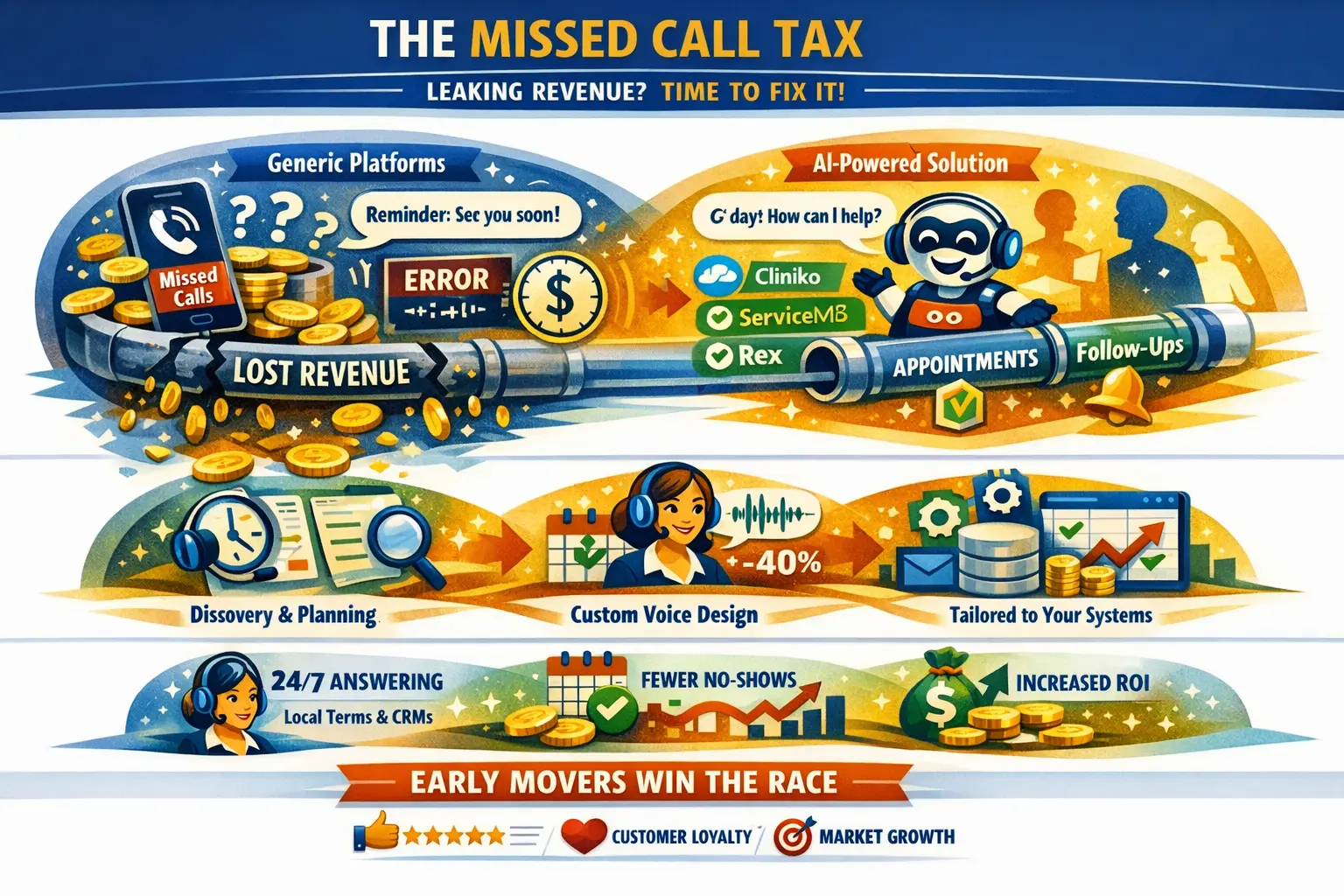
The Missed Call Tax is real, it is measurable, and for Australian businesses operating in 2026, it is entirely preventable. The combination of Voice AI Automated Appointments built on Twilio's enterprise infrastructure and integrated with your CRM creates a system that answers every call, books every appointment, reduces no-shows, and feeds every customer interaction directly into your pipeline — without hiring a single additional staff member.
The technology is mature. The Twilio infrastructure is battle-tested at global scale. The integrations with Australian business software are proven. The ROI is arithmetic, not aspiration. The only remaining question is how long your business continues paying the Missed Call Tax before acting.
Early adopters are not just recovering lost revenue. They are building a compounding competitive advantage — reviews earned, customer loyalty established, and market positioning cemented — that becomes harder for late movers to close every month that passes.
|
In short:
- Australian businesses lose an average of $126,000 per year to missed calls — most going unanswered because owners and staff are busy delivering their service.
- 85% of callers who reach voicemail never call back. They call a competitor who answers.
- Voice AI Automated Appointments, built on Twilio and integrated with your CRM, answer every call, complete every booking, and fire instant SMS confirmations — 24/7, 365 days a year.
- Automated reminder sequences reduce no-shows by up to 40%, recovering additional revenue on top of the missed call dividend.
- C9 builds bespoke Voice AI Agent Development Services for Australian businesses: custom flows, native integrations, Australian-tuned voice design, and a permanent competitive advantage.
|
|
What's next?
Contact C9 today for a no-obligation discovery conversation. In one call, we will map your current call gap, identify your integration requirements, and outline what a bespoke Voice AI system would look like for your business — so you can make a fully informed decision with complete confidence.
|
Stop Paying the Missed Call Tax. Start Capturing Every Lead.
C9 builds Custom Bespoke Voice AI Agent Development Services on enterprise-grade Twilio infrastructure,
natively integrated with your CRM — engineered for Australian businesses, from the ground up.
→ www.c9.com.au
REFERENCES & SOURCES
1. Australian Bureau of Statistics (ABS). (2025). Counts of Australian Businesses, Including Entries and Exits, July 2021 – June 2025. Canberra: ABS.
2. Australian Small Business and Family Enterprise Ombudsman (ASBFEO). (2025). Number of Small Businesses in Australia. ASBFEO Data Portal.
3. Ambs Call Centre. (2025, August). The Cost of a Missed Call: What Small Businesses Lose. Ambs Call Centre Research.
4. Autopilot Genie. (2025, June). Missed Calls Are Costing Australian Businesses Billions. Autopilot Genie Blog.
5. Graham, J. (2025, December). The Silent Profit Killer: Why 62% of Your Business Calls Go Unanswered. Medium / Sift Digital.
7. Twilio. (2025). SIGNAL 2025: Product Announcements — ConversationRelay & Conversational Intelligence Now Generally Available. Twilio Blog.
8. Twilio. (2025). ConversationRelay Product Page. Twilio.com
9. Twilio. (2025). Conversational Intelligence — AI Analysis. Twilio.com
10. WebRTC Ventures. (2025, May). Twilio's ConversationRelay GA Release Brings Voice AI to the Enterprise Mainstream.
11. Leaping AI. (2025, November). Voice AI Integration with CRM: The Complete Implementation Guide for Enterprise Success.
12. Sameday. (2025, November). Voice AI Answering Service with CRM Integration.
13. Hostie AI. (2025, October). Voice AI by the Numbers: 2025 Adoption, Accuracy & Revenue Impact.
14. Resonateapp. (2026, January). AI Receptionists 2025–2026: 50+ Statistics.
16. Jobs and Skills Australia. (2025). 2025 Occupation Shortage List — Key Findings. Service and Creative Skills Australia.
17. Money.com.au. (2026). Australian Business Statistics 2026: Facts & Industry Insights.
18. ScaleSuite. (2025). Australian Business Statistics 2025–2026: SME Revenue, Growth & Industry Data.
19. Robinson, B. (2025, May). Stop Losing $500+ a Month — The Mistake Starts With a Missed Call. Entrepreneur.
© 2026 C9 Digital · c9.com.au · Australia's Leading Custom Software, Apps, Integration & Database Developer · All rights reserved. Content is for informational purposes and reflects data available at time of publication.
AI Transparency Notice:
This article was produced with the assistance of artificial intelligence tools, including content drafting, visual asset creation, and audio generation. All content has been reviewed and approved by C9 prior to publication.