Generative AI for leaders is no longer a future consideration — it is today's most urgent strategic priority. Here is everything Australian business owners and executives need to know, and exactly what to do about it.
EXECUTIVE SUMMARY
Australia stands at a workforce inflection point. Generative AI and the future of work for leadership is the defining strategic topic for every CEO, COO, CTO, and business owner operating in Australia in 2026. This article explains the urgency, what AI readiness truly requires, and how to build it without wasting time or investment.
Key Takeaways
✅ 39% of core workforce skills will be substantially changed or obsolete by 2030 — the reskilling window is open now, not in 2028 (WEF, 2025).
✅ Only 1 in 50 AI investments delivers transformational value — the gap is not the technology, it is the absence of bespoke integration and workforce readiness (Gartner, 2026).
✅ Australian businesses using Amazon Web Services Sydney, AWS Brisbane, and Amazon cloud services Australia infrastructure have a sovereign, scalable foundation for enterprise Generative AI — when it is implemented correctly.
✅ AI readiness is not about technical training for every employee. It is about equipping your team to direct, validate, and amplify AI so your organisation moves faster and decides smarter.
✅ C9 builds bespoke AWS and Generative AI integration solutions purpose-built for Australian enterprises — not off-the-shelf deployments, but custom-engineered solutions that connect to your data, your systems, and your workflows.
In short:
✅ Australian business leaders face a clear choice in 2026: build an AI-ready workforce now or cede ground to competitors who already are.
✅ AI readiness is not about replacing people — it is about equipping your team to work alongside AI at a level that multiplies what every person in your organisation can achieve.
✅ The infrastructure layer — purpose-built on Amazon Web Services — is what converts AI strategy into measurable business outcomes. That is what C9 builds.
What's next?
Identify the single workflow in your organisation where Generative AI would deliver the highest immediate ROI. Then book a no-obligation discovery session with C9 at www.c9.com.au — we will scope a bespoke Proof of Concept built on AWS, connected to your real data, and ready for production in weeks.
BY THE NUMBERS — AUSTRALIA'S AI READINESS GAP IN 2026
|
39%
of core skills changing by 2030 — WEF
|
1 in 50
AI investments deliver transformational ROI — Gartner
|
$315B
AI's potential annual boost to Australian GDP — McKinsey
|
80%
of businesses increasing AI investment in 2026
|
The Conversation Every Australian Boardroom Is Having Right Now
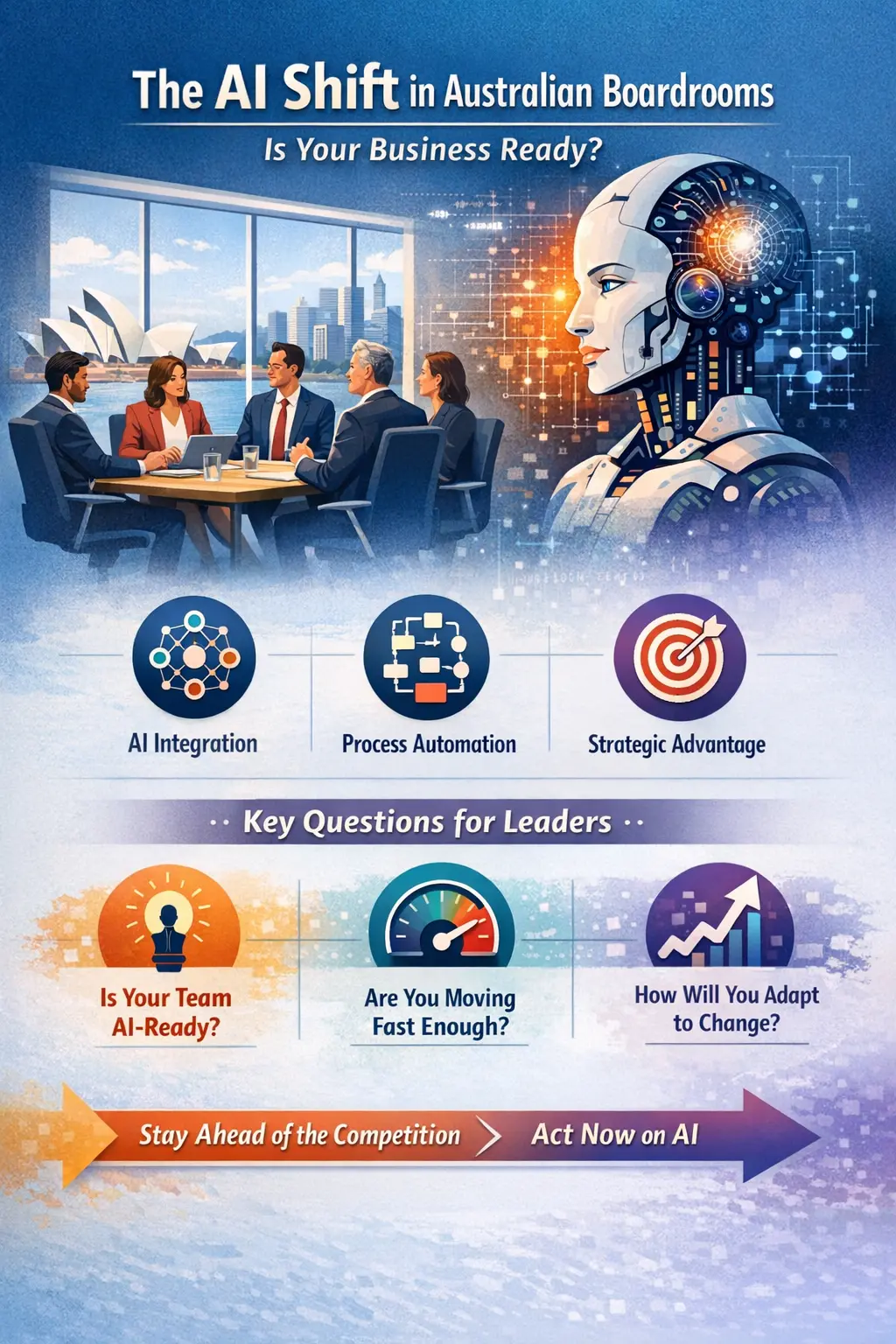
Something has shifted in Australian executive teams over the past two years, and if you have been in a senior leadership meeting recently, you have almost certainly felt it. The question is no longer whether Generative AI will reshape your industry. It already is. The question now — the one your competitors are asking at this very moment — is whether your workforce is positioned to capture that shift or absorb it as a disruption.
Generative AI and the future of work for leadership is not a technology conference topic any more. It is an operational reality that is changing how organisations process information, serve customers, manage workflows, and develop their people. The Australian businesses building AI-ready teams today are already operating at a different pace — making decisions faster, personalising services at scale, and freeing their best people for the high-judgement work that creates genuine competitive advantage.
This article is written specifically for Australian business owners and executives: CEOs, MDs, COOs, CFOs, CTOs, and senior HR leaders who understand the urgency but need a clear, evidence-based picture of what AI workforce readiness actually requires — and what the right implementation approach looks like for an Australian enterprise context.
The good news is that the window for first-mover advantage is still open. The less comfortable news is that it is narrowing. Let us look at exactly what is at stake and what to do about it.
The Workforce Capability Gap That Is Already Costing Australian Businesses
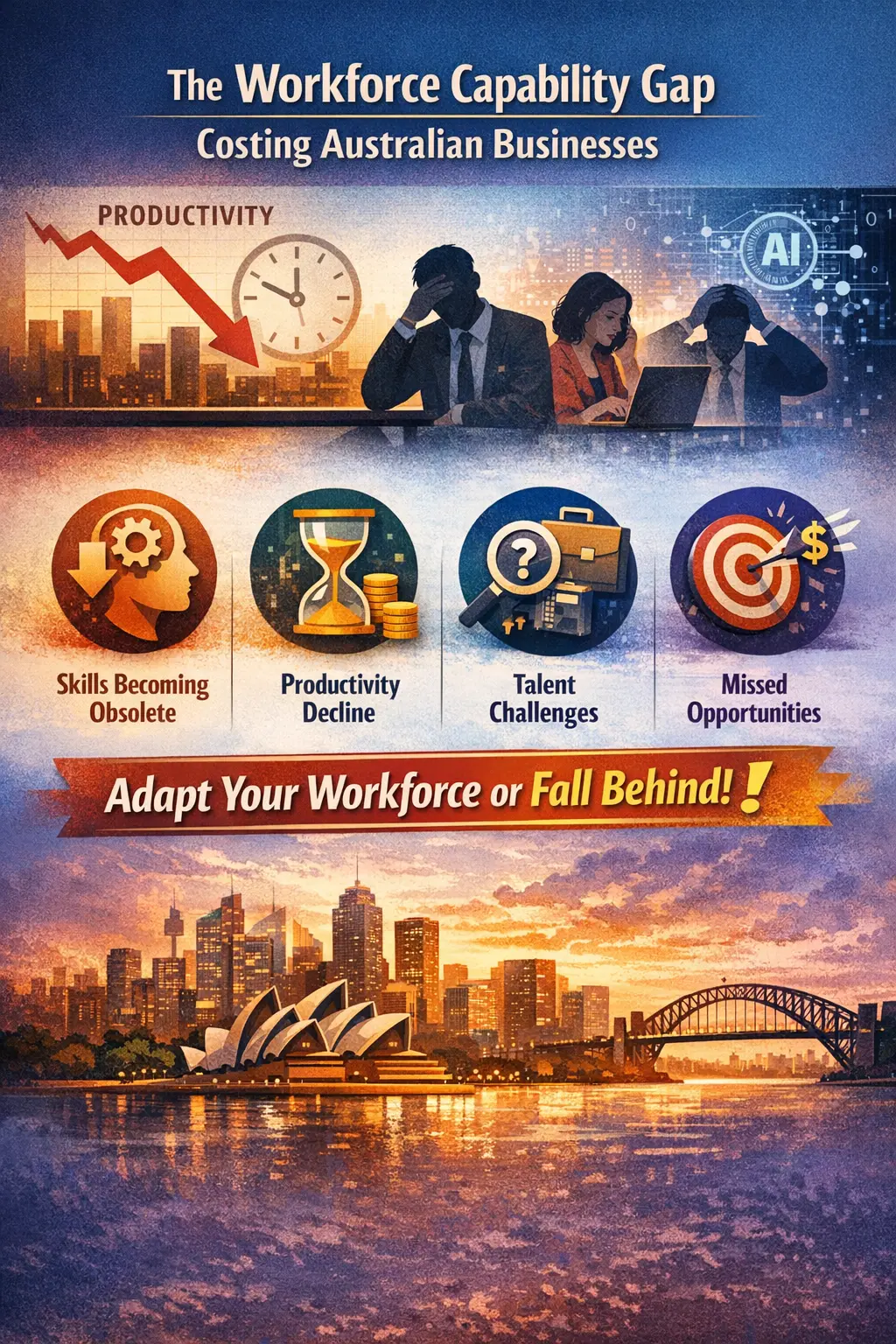
Australia's workforce is facing a structural transformation that is playing out faster than most organisations have planned for. The evidence is no longer speculative — it is in the research, in the productivity data, and in the talent market.
What the Data Tells Australian Leaders
The World Economic Forum's 2025 Future of Jobs Report delivers a sobering assessment: 39% of workers' core skills will be substantially changed or made obsolete by 2030.¹ For Australian business leaders, this is not a global average that happens to someone else. Australia's knowledge-intensive economy — financial services, professional services, technology, education, healthcare — is disproportionately exposed to the structural skills shift that Generative AI is accelerating.
McKinsey's analysis estimates that Generative AI could add up to $315 billion in annual value to Australia's economy — but only if Australian organisations develop the workforce capability to capture it.⁶ Without an AI-ready workforce, that potential stays in the economic model and never reaches the P&L.
What does the capability gap look like in practice for Australian executives? It shows up in four compounding ways:
- Productivity loss: Your team is spending hours per day on knowledge tasks that Generative AI handles in seconds — drafting communications, synthesising reports, analysing data sets, summarising research. That time is not coming back, and competitors who have automated these tasks are already ahead.
- Decision lag: Without AI-augmented insight and scenario modelling, decisions that should take hours take days. In fast-moving markets, that lag is a structural disadvantage that compounds quarterly.
- Talent pressure: High-performing professionals increasingly evaluate employers on the quality of their tools and the sophistication of their work environment. Organisations without a credible AI strategy are losing top talent to those that have one. The CSIRO has identified AI capability as a top-three factor in technology workforce attraction and retention in Australia.⁷
- Compounding disadvantage: Every quarter without AI workforce readiness is a quarter your competitors extend their structural lead. Unlike a single product launch, AI capability compounds — an organisation that has been building AI workflows for 18 months is not 18 months ahead of a late starter; it is structurally different.
Australia's Specific Context
Australian business leaders operate in a regulatory and operational context that adds important nuance to the global AI conversation. The Australian Privacy Act 1988 and its 2024 amendments impose specific obligations on how personal data is handled by AI systems.⁸ Industry-specific regulations in financial services (APRA), healthcare (TGA), and government add further layers of compliance that off-the-shelf global AI tools are not designed for.
This regulatory context is one of the most significant reasons why Australian enterprises need bespoke AI integration rather than global platforms — a point we will return to in Section 4.
What Happens to Australian Organisations That Wait
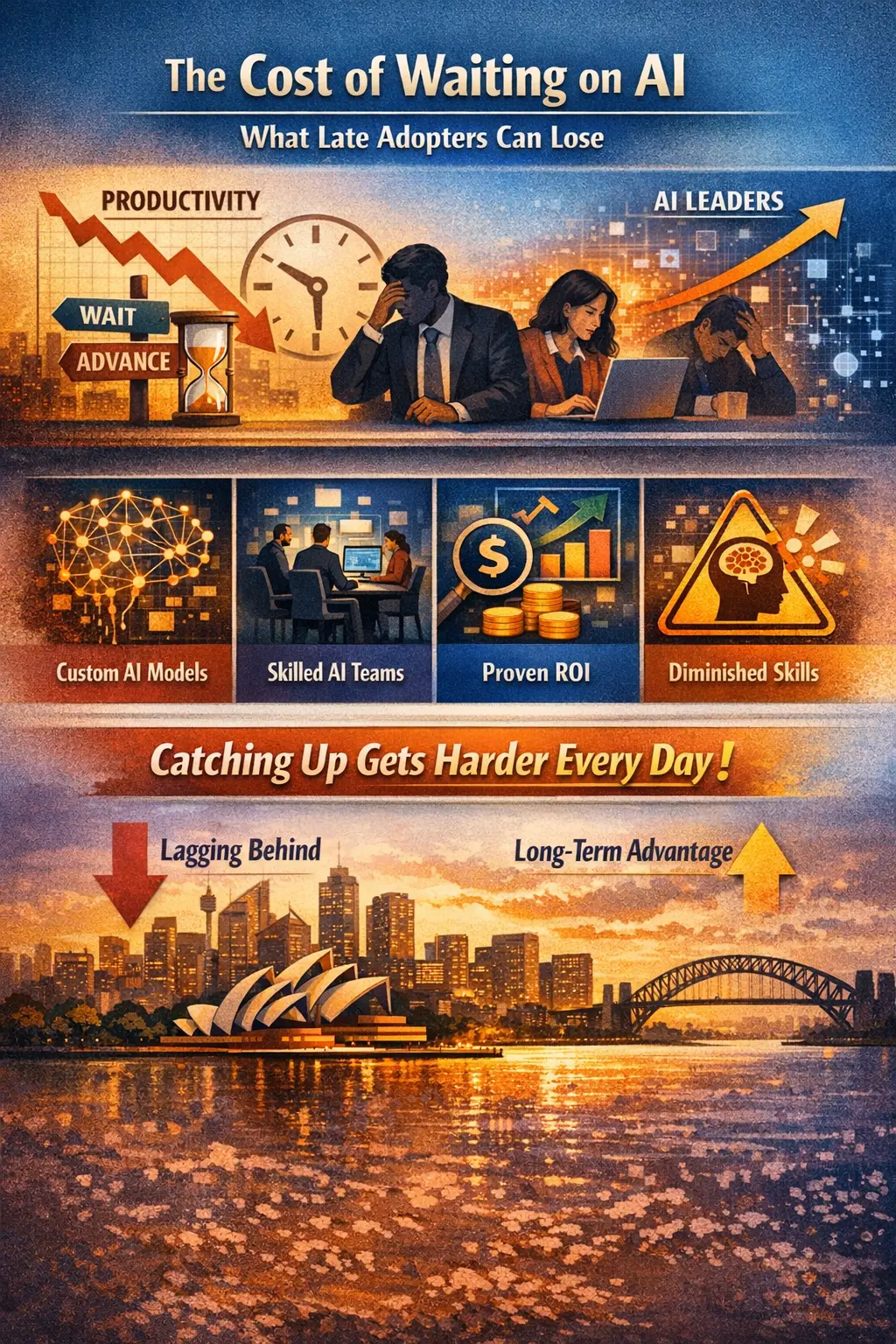
The strategic risk of delayed AI workforce investment is not well understood in Australian boardrooms. Most leaders frame the decision as 'we will do this later, once the technology matures.' That framing misunderstands the nature of the disadvantage being accumulated right now.
The First-Mover Structural Advantage Is Compounding
Early AI adopters are not simply gaining an efficiency edge. They are building organisational capabilities, data assets, and operational habits that become progressively harder for late movers to replicate. Consider what 18 months of AI-augmented workflow means for an organisation:
- A proprietary fine-tuned model that knows your business, your customers, and your industry context — built from 18 months of interaction data
- A team with deeply embedded AI fluency — people who have developed the judgement to direct, evaluate, and improve AI outputs across hundreds of real scenarios
- Operational processes redesigned around AI augmentation, not bolted onto legacy workflows
- A measurable ROI track record that unlocks further board-level AI investment
None of that is available to a late mover who 'waits until the technology matures.' The technology is already mature enough. What matures over 18 months is the organisational capability to use it — and that cannot be purchased in a catch-up sprint.
The 1-in-50 Warning: Why Most AI Investments Fail
Gartner's 2026 research delivers the most important statistic for Australian business leaders considering AI investment: only 1 in 50 AI investments delivers transformational value.² That is a 98% rate of underperformance at the transformational level. The 49 failures are not failures of the AI technology. They are failures of integration, workforce readiness, and implementation approach.
The gap between AI strategy and AI value is almost never the model. It is the absence of bespoke integration that connects AI capabilities to the specific workflows, data, and people of the organisation. That is precisely the gap that C9's approach is designed to close.
The IBM Institute for Business Value analysis reinforces this finding: organisations that deploy AI without investing in workforce readiness and systems integration consistently underperform those that invest in both.¹⁰ The technology is a necessary condition. It is not a sufficient one.
The Critical Thinking Risk
There is a quieter, slower-moving risk that deserves attention from Australian business leaders. Gartner predicts that 50% of organisations will require 'AI-free' skills assessments by 2026 because critical thinking — the capacity to interrogate, challenge, and improve outputs — atrophies when AI is used without discipline.²
For executives, this means that building an AI-ready workforce is not simply about adoption. It is about building a culture where AI amplifies human judgement rather than bypassing it. The organisations that get this right will have workforces that are simultaneously more efficient and more intellectually rigorous. The organisations that get it wrong will have workforces that are neither.
Generative AI for leaders is most powerful not when it replaces human thinking, but when it creates the conditions for better human thinking — removing the cognitive load of structured tasks so that leaders can focus on the judgement, creativity, and relationship work that only humans can do.
What AI Readiness Actually Means for Your Organisation
The most important reframe for Australian business leaders is this: building an AI-ready workforce is not the same as running a ChatGPT training session for your team. Genuine AI readiness is a deeper organisational transformation — one that changes how information flows, how decisions are made, how workflows are structured, and how your people spend their working hours.
The Four Dimensions of Genuine AI Readiness
Organisations that are genuinely AI-ready in 2026 demonstrate capability across four interconnected dimensions. Understanding these dimensions helps leaders assess where their organisation currently sits and where the gaps lie.
|
AI Fluency
|
Not AI expertise. Your people need to understand what Generative AI can and cannot do, and how to direct it effectively. A finance manager who can write a contextual prompt, evaluate the output critically, and identify where the model has over-generalised is AI-fluent. That skill is teachable in weeks, not years.
|
|
Critical Evaluation
|
The ability to interrogate AI outputs is as valuable as the ability to generate them. AI-ready teams do not accept model outputs uncritically. They question assumptions, test edge cases, verify against source data, and apply domain judgement to determine where AI is right and where it needs human correction.
|
|
Workflow Integration
|
AI tools used in isolation — outside your existing systems, separated from your real data — deliver a fraction of their potential value. Genuine AI readiness means AI capabilities are embedded inside the workflows where value is actually created. Not a separate tab, not a new portal — native capability inside your existing operational rhythm.
|
|
Governance Awareness
|
Under Australia's Privacy Act and industry-specific regulatory obligations, AI-ready organisations have clear protocols for when AI decisions require human oversight, how exceptions are escalated, and how audit trails are maintained. AI without governance is a liability. AI with governance is an asset.
|
The Human Skills Premium — What AI Cannot Replace
A well-designed AI readiness strategy does not diminish the value of your people — it elevates it. As Generative AI absorbs more structured knowledge work, the distinctly human capabilities your best people possess become exponentially more scarce and more valuable.³
Deloitte's 2025 analysis of Generative AI's impact on the workforce identifies five human capabilities that remain irreplaceable regardless of how AI develops:
- Emotional intelligence: The ability to understand, influence, and lead people through continuous change — the human dimension of transformation that no AI can replicate or substitute.
- Complex problem-framing: Defining the right problem — not just solving the stated one. The most valuable leadership contribution is often identifying that the stated problem is the wrong one, and that insight requires contextual judgement AI does not hold.
- Creative synthesis: Combining disparate domains, experiences, and intuitions into genuinely novel ideas. AI generates combinations of what exists; humans generate what has never existed.
- Stakeholder trust: Relationships built on shared history, earned credibility, and authentic accountability. No AI system carries the institutional trust that experienced leaders have built over careers.
- Ethical judgement under ambiguity: Making the right call in situations where the right call is genuinely unclear — where values, competing stakeholder interests, and incomplete information must be weighed without an algorithmic resolution.
The practical implication for Australian business leaders is that AI workforce readiness is not about training your team on AI tools in isolation. It is about simultaneously building AI fluency and deepening the human capabilities that AI cannot replicate. Both investments are required. Neither is optional.
Why AWS Integration Is the Foundation Australian Leaders Cannot Skip
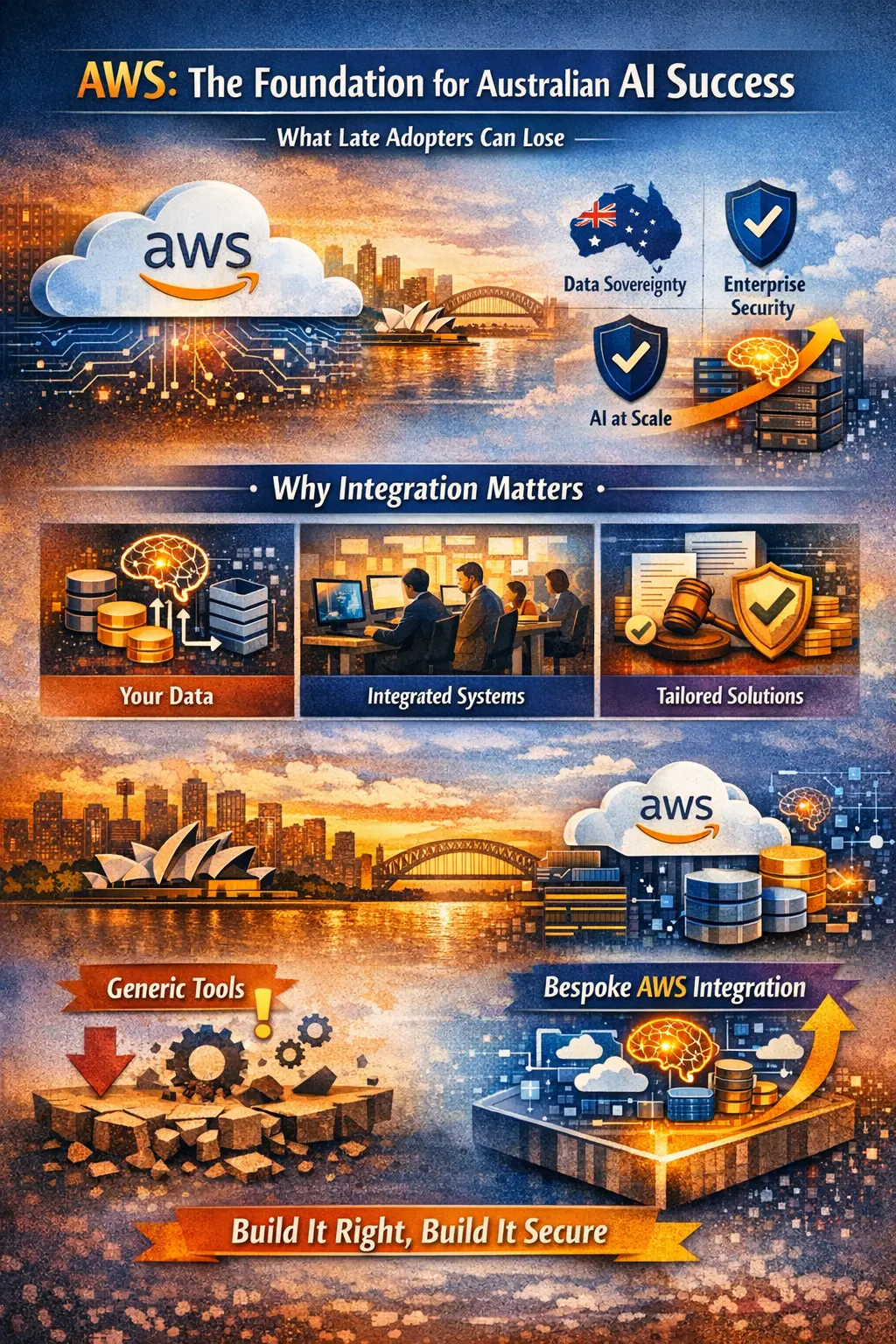
Building an AI-ready workforce without purpose-built technical infrastructure produces a predictable failure mode: capable people, inadequate tools, generic outputs, and an AI investment that delivers well below the 1-in-50 transformational threshold.
The infrastructure layer is where most Australian AI investments lose their potential. Understanding why Amazon Web Services is the right foundation — and why bespoke integration on top of that foundation is essential — is one of the most important decisions an Australian executive will make in 2026.
Why Amazon Web Services Is Australia's Enterprise AI Foundation
Amazon Web Services is the dominant enterprise cloud platform in Australia, with major infrastructure presence in the Asia Pacific (Sydney) region and rapidly expanding capability supporting businesses from AWS Brisbane to the major metropolitan centres.⁹ For Australian organisations building serious AI capability in 2026, Amazon cloud services Australia provides three foundational advantages:
- Data sovereignty: Amazon Web Services Sydney infrastructure keeps your data on Australian soil. For organisations handling sensitive customer information, financial data, or regulated health records, this is not a preference — it is a compliance requirement. AWS's Australian region satisfies the data residency obligations under the Australian Privacy Act and relevant industry regulations.
- Enterprise compliance: AWS is certified against ISO 27001, SOC 2, and the Australian Government's IRAP framework. For Australian businesses operating in regulated industries or supplying government, this certification foundation reduces the compliance burden of AI deployment significantly.
- AWS Bedrock — Generative AI at enterprise scale: Amazon Bedrock gives Australian organisations access to the world's leading foundation models — Anthropic's Claude, Meta Llama, Mistral, and Amazon Titan — within a governed, auditable environment. This means your Generative AI capability is built on models that meet enterprise security standards, not consumer-grade APIs.
Why Bespoke Integration Is Not Optional
There is a clear reason why off-the-shelf AI tools consistently underdeliver for Australian enterprises: they do not know your business. They hold no knowledge of your customer history, your operational data, your regulatory context, your pricing logic, or your institutional knowledge. They produce generic outputs because they have access to generic inputs.
When C9 builds a bespoke AWS and Generative AI integration for an Australian enterprise, the entire architecture is different:
- Your AI operates on your data: LLM integration layers connect your foundation model to your proprietary databases, your CRM, your operational systems, and your knowledge base. The model answers questions about your business using your data — not the internet at large.
- Your AI lives inside your workflows: Rather than a separate AI portal that your team has to consciously switch to, C9 embeds AI capabilities directly into the tools your people already use — inside your enterprise applications, your dashboards, your communication platforms.
- Your AI agents handle complex multi-step tasks: Agentic AI architectures built on AWS Bedrock allow your team to delegate entire workflows to AI agents that plan, execute, and iterate autonomously — freeing your people for the strategic and relational work that creates genuine value.
- Your AI is compliant by design: Every solution C9 builds is architected for Australian Privacy Act obligations, industry-specific regulations, and your organisation's own governance requirements — not retrofitted for compliance after deployment.
- Your AI is auditable and governed: Full audit logging, configurable human-in-the-loop oversight, and explainability layers mean your leadership team can see every AI decision and verify that AI-generated outputs meet your quality and compliance standards.
C9 does not deploy off-the-shelf AI. Every solution is bespoke — built around your specific workflows, data architecture, and business objectives, engineered in Australia for Australian enterprises operating under Australian law.
The MIT Sloan Validation: AI Factories and Compound Advantage
MIT Sloan Management Review's 2026 analysis introduces the concept of 'AI factories' — the internal infrastructure and operational capability that allows organisations to continuously build, deploy, and improve AI systems.⁵ Organisations that build AI factory capability now — establishing governed model registries, standardised integration layers, and continuous improvement pipelines — will be able to compound their AI advantages indefinitely.
Organisations that deploy AI as a series of disconnected point solutions will face constant re-procurement cycles, fragmented data, and an AI estate that grows more complex and less coherent over time. The architectural decision made in 2026 — bespoke integrated platform versus ad-hoc tool collection — will determine the AI trajectory of Australian enterprises for the next decade.
Your 90-Day AI-Readiness Roadmap: From Strategy to Production
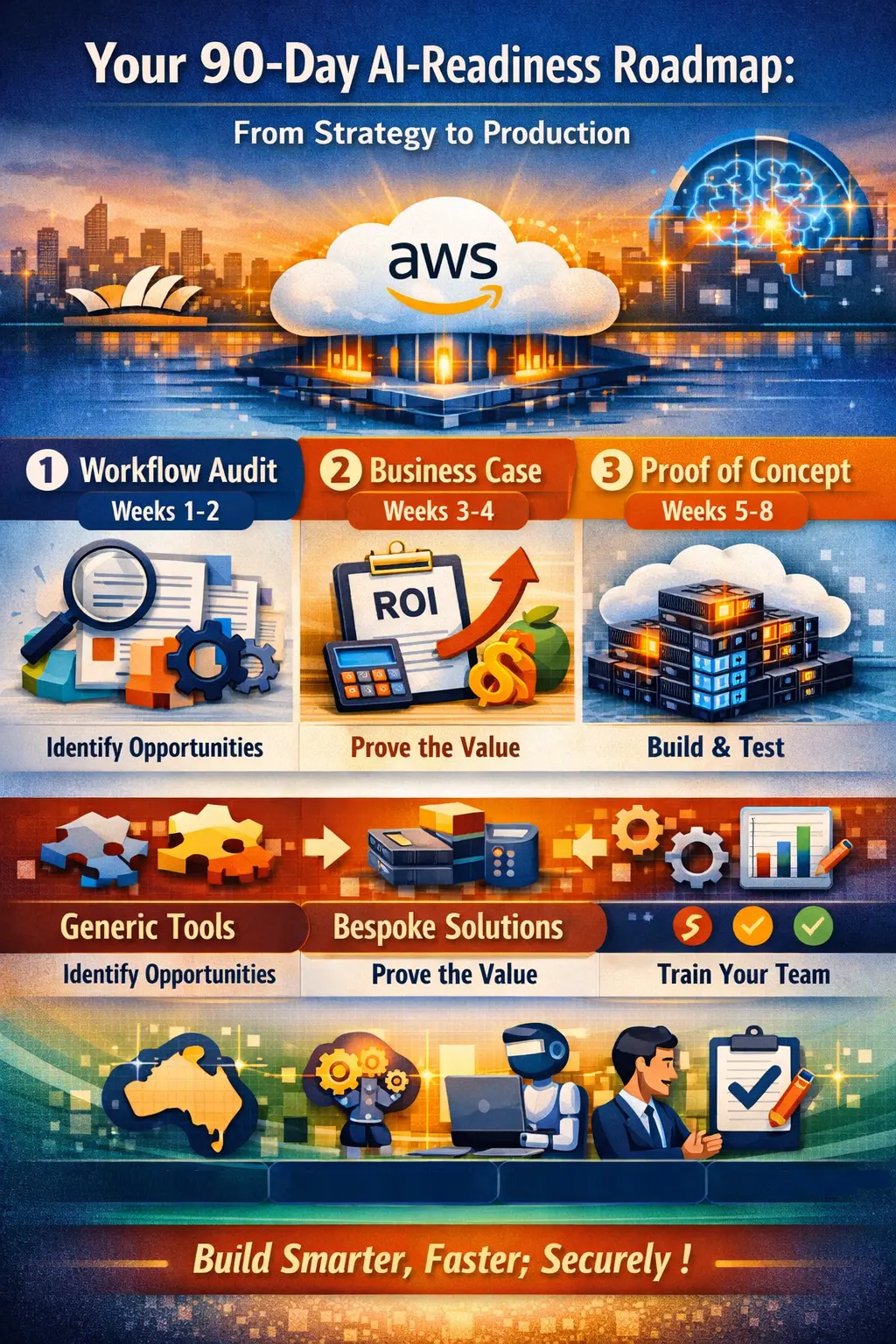
For Australian business leaders who understand the urgency but are not certain where to begin, the most effective approach is a disciplined, phased entry — not a full-enterprise transformation launched simultaneously, but a focused Proof of Concept that builds the evidence base, the organisational confidence, and the technical foundation for scale.
The following framework is how C9 guides Australian organisations from AI strategy to production deployment:
Phase 1 — Weeks 1 to 2: Workflow Audit
Map your ten highest-value workflows — the processes where your team spends the most time, where data synthesis is most labour-intensive, or where decision quality is most consequential. For each workflow, ask two questions: How much of this task is structured, repeatable, and data-driven? And what is the cost — in time, money, and quality — if this task is handled at suboptimal speed?
This audit produces your AI Opportunity Register: a prioritised list of use cases ranked by AI suitability and business impact. It is the foundation of every subsequent investment decision.
Phase 2 — Weeks 3 to 4: Prioritise and Build the Business Case
Select the single workflow with the highest combined score on AI suitability and business impact. Build the ROI case with specific, measurable metrics — time saved per week, error reduction rate, output throughput improvement. This is not a theoretical model: it is a commitment to what success looks like, built before the project begins.
The quality of this business case determines whether your AI investment joins the 1-in-50 success category or the 49 that fail to deliver meaningful ROI.
Phase 3 — Weeks 5 to 8: Bespoke Proof of Concept with C9
Commission a bespoke Proof of Concept built on your production AWS infrastructure, connected to your real data, and designed around your specific workflow. Not a demo environment. Not a sandbox. A working solution in your actual operational context.
This is the single most important differentiator between C9's approach and off-the-shelf AI deployment. The PoC is built production-ready from day one — which means the path from PoC to enterprise scale is architectural extension, not reconstruction.
Phase 4 — Weeks 9 to 10: Targeted Capability Building
Run focused AI fluency training for the team operating the live PoC workflow. Training anchored to a real tool solving a real problem is dramatically more effective than theoretical AI literacy programmes. Your team builds AI confidence in context — the environment where they will use it every day.
Phase 5 — Weeks 11 to 12: Measure, Report, and Scale
Capture the production data: time saved, error rates, output quality metrics, user adoption rates. Build the board-ready ROI report that establishes the evidence base for Phase 2 investment. The first deployment is not just a solution — it is the proof of concept for your organisation's AI strategy.
The organisations that begin this 90-day cycle in 2026 will have their first production AI deployment running mid-year, measurable ROI documented before the end of the year, and a scalable AI strategy in place before most of their competitors have completed their first strategy workshop.
The Decision Every Australian Leader Must Make in 2026
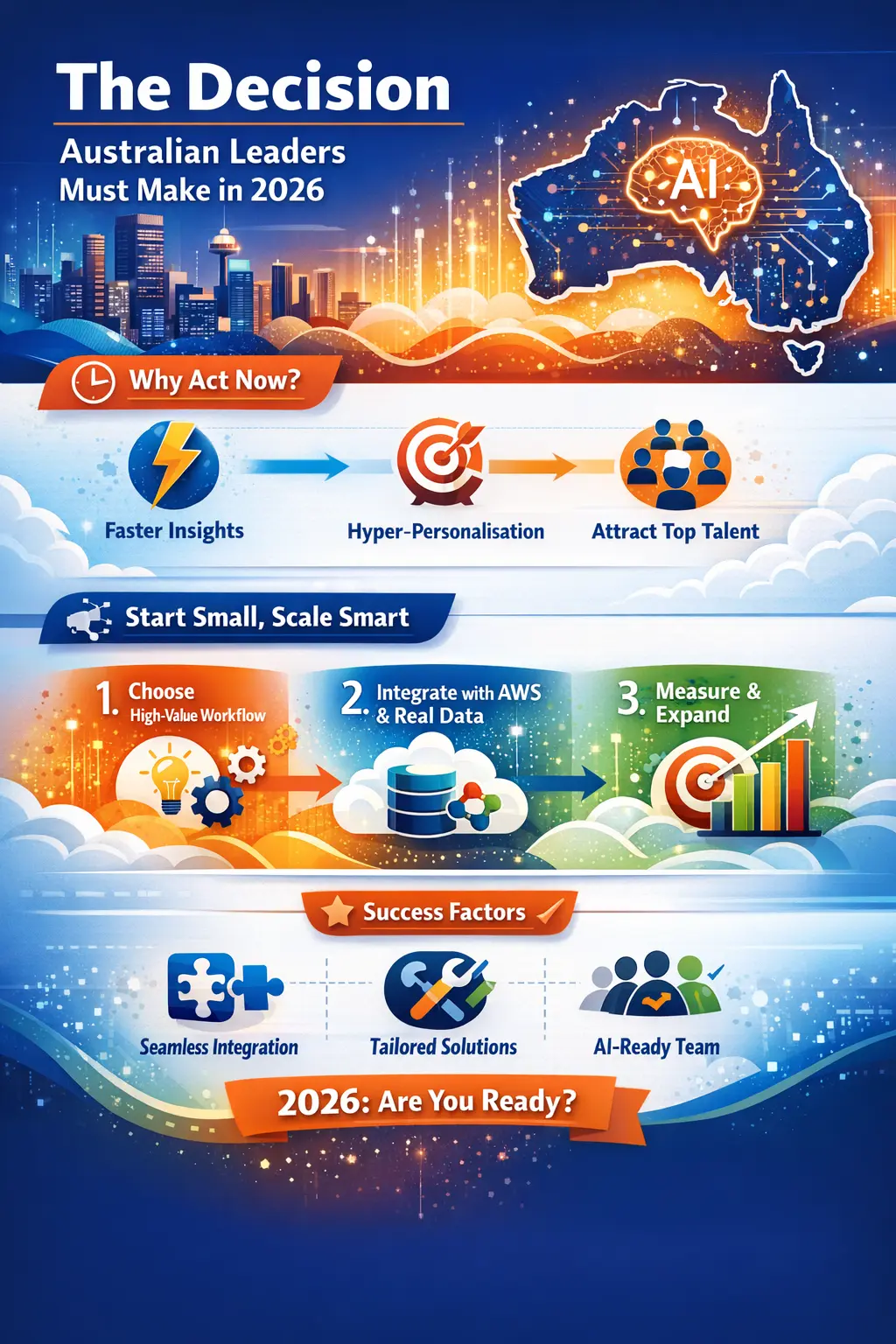
The data is unambiguous. The window for first-mover AI advantage in Australia is open but narrowing. The organisations that build AI-ready workforces in 2026 will not simply be more efficient — they will be structurally different organisations. They will process information faster, make better decisions under uncertainty, serve customers at a personalisation level that was previously impossible, and attract talent who want to work at the frontier of human-AI collaboration.
The barriers to entry are lower than most leaders realise. You do not need to transform your entire organisation overnight. You need to start with one high-value workflow, build it properly with bespoke AWS integration and real data, measure the outcome, and use that outcome to fund the next step.
What separates the 1-in-50 AI investments that deliver transformational value from the other 49 is not the AI model. It is the quality of the integration, the specificity of the solution to the organisation's actual workflows, and the readiness of the team to use it effectively. Those three factors are precisely where C9 focuses.
Generative AI and the future of work for leadership is not a technology question. It is a strategic readiness question. And 2026 is the year Australian business leaders answer it.
In short:
-
AI workforce readiness is the defining competitive advantage for Australian businesses in 2026.
-
The gap between AI strategy and AI value is integration and workforce readiness — not the technology itself.
- Bespoke AWS and Generative AI solutions, built specifically for your workflows and data, are what make the difference between the 1-in-50 successes and the 49 that deliver nothing.
- The 90-day roadmap exists. The infrastructure is available. The expertise is in Brisbane, Sydney, and Melbourne. The only variable is when you start.
What's next?
Book a no-obligation discovery session with C9 at www.c9.com.au. Our team will map your highest-value AI opportunity, scope a bespoke Proof of Concept on Amazon Web Services, and give you a clear path from strategy to production — in weeks, not months.
Ready to build your AI-ready workforce?
References
All statistics, findings, and frameworks cited in this article draw from the following primary and secondary sources. Links current as of March 2026.
[3] Deloitte (2025). Generative AI and the Future of Work.
[4] Harvard Business School (2025). The Importance of Change Fitness in Leadership.
[5] MIT Sloan Management Review (2026). Five Trends Shaping the Future of Data and AI in 2026.
[6] McKinsey & Company (2023). The Economic Potential of Generative AI.
[8] Australian Government — DISR (2024). Australia's AI Ethics Framework and Privacy Act Obligations.
[9] Amazon Web Services (2024). AWS Global Infrastructure — Asia Pacific (Sydney) Region.
[10] IBM Institute for Business Value (2023). AI and Automation: Closing the Value Gap.
ABOUT C9:
C9 is Australia's leading custom software, apps, integration and database developer. Our bespoke AWS and Generative AI Integration & Development Solutions are purpose-built for Australian enterprises across Brisbane, Sydney, and Melbourne. We build AI that works with your data, your workflows, and your compliance obligations — not around them. Explore our solutions at www.c9.com.au
AI Transparency Notice:
This article was produced with the assistance of artificial intelligence tools, including content drafting, visual asset creation, and audio generation. All content has been reviewed and approved by C9 prior to publication.