As an Australian business owner or executive, you're no stranger to the relentless pressure of staying ahead in a competitive market. With outdated legacy systems dragging down efficiency, high operational costs eating into profits, and competitors rolling out cutting-edge tech, the quest for innovative solutions feels endless. Enter vibe coding—AI-powered coding that's transforming how software is conceptualised and created. But while it promises rapid innovation, is it the silver bullet for your business challenges, or just another trend that could lead to costly pitfalls?
At C9, Australia's leading custom software, apps, integration, and database developer, we empower businesses like yours with tailored solutions that drive real results. In this blog, we'll unpack the trending insights on vibe coding for 2026, highlight its potential and perils, and reveal why partnering with experts for custom development—starting with a discovery call—is the smartest path to operational efficiency, cost reduction, and competitive advantage. Let's dive in.
The AI Coding Revolution on the Horizon

Imagine describing your business problem in everyday language—"Build an app that streamlines inventory tracking for my retail chain, integrating with our existing CRM"—and watching AI generate functional code in minutes. That's vibe coding, the intuitive AI-driven approach set to dominate 2026 discussions in software development. As AI tools evolve, they're democratising coding, making it accessible to non-technical leaders like you.
But here's the pain point: Off-the-shelf AI outputs often fall short for complex Australian businesses facing unique regulatory needs, supply chain intricacies, or data privacy demands under laws like the Privacy Act. Trending forecasts for 2026 predict a surge in AI adoption, with tools handling 40-50% of routine coding tasks—potentially up to 70-90% in some scenarios—yet experts warn of scalability issues, hidden costs, and the need for human oversight to avoid over-optimistic claims like AI writing 99% of code without supervision. This blog explores vibe coding's trends, limitations, and where it shines—while guiding you toward custom solutions that truly align with your goals of boosting revenues and outpacing rivals.
What is Vibe Coding? A Primer for Business Leaders
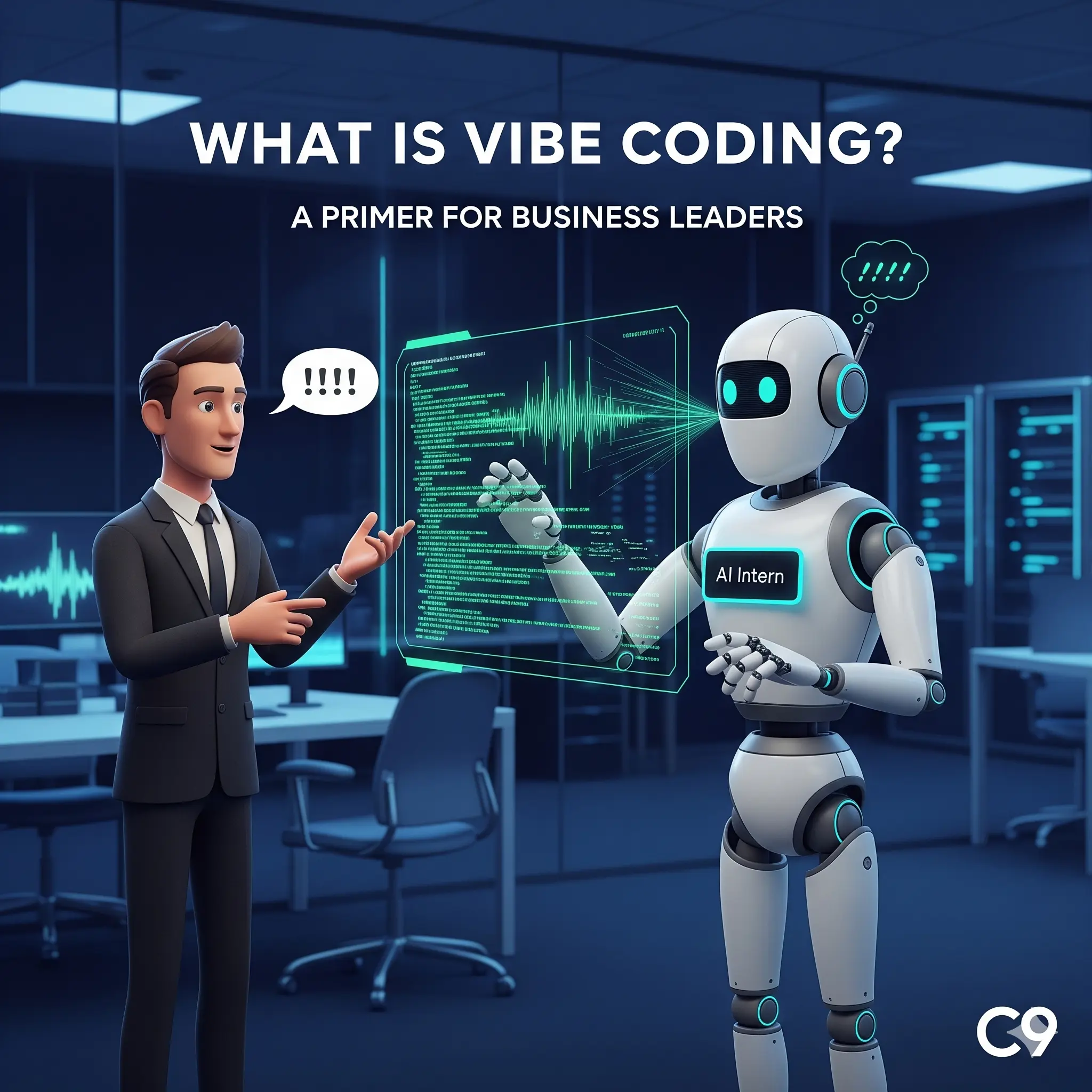
Vibe coding, also known as AI coding, flips traditional programming on its head. Instead of writing lines of code, you "vibe" your ideas through natural language prompts to AI models like those in GitHub Copilot or Cursor. It's like having a digital collaborator that interprets your vision and spits out code snippets, prototypes, or even full apps—often described as managing "the world's most capable intern" who needs explicit instructions to avoid wild assumptions.
For 2026, expect vibe coding to integrate deeper with enterprise tools, enabling seamless workflows in industries like retail, logistics, and finance. Predictions include a shift toward "agentic AI," where systems not only generate code but set goals, execute plans, and self-improve, potentially automating entire data ecosystems. However, as Australian executives, you must weigh its hype against reality—it's a tool, not a replacement for strategic, human-led development, especially when dealing with bespoke needs that AI alone can't fully grasp.
Trending Insights for 2026: Benefits, Limitations, Pitfalls, and Practical Applications

Drawing from the latest industry reports and expert analyses as of late 2025, vibe coding is poised for explosive growth in 2026, with AI potentially writing the majority of code in commercial settings. Here's an expanded breakdown to help you navigate, including emerging trends that could reshape your approach.
➡️ Benefits and Where It's Useful: Vibe coding excels in rapid prototyping and ideation, perfect for testing concepts without heavy upfront investment. For instance, it's ideal for creating minimum viable products (MVPs) like a simple customer dashboard or automation script. In 2026, trends point to its use in agile teams for boilerplate code, debugging, and basic integrations, saving time on repetitive tasks and accelerating go-to-market speed. Businesses can leverage it for quick wins, such as building internal tools that enhance operational efficiency—think automating report generation to reduce manual errors and free up your team for high-value work. With AI automating up to 70% of everyday tasks, it's a boon for boosting productivity in Australian organisations, potentially doubling developer speed in routine areas. Additional benefits include handling complex challenges faster, like generating unit tests or scanning for issues, which can streamline workflows and foster innovation in data-driven decisions.
➡️ Top Tools to Consider: Leading options for 2026 include Cursor for intuitive code suggestions, GitHub Copilot for enterprise-scale integration, Replit for collaborative environments and vibe-based app building, Claude for agentic coding, Tabnine for code autocompletion, and emerging tools like Windsurf (praised in 2026 showdowns for speed), Bolt.new, v0 by Vercel, and Lovable for non-coder-friendly prototyping. Other rising stars include LangChain for building AI apps, AutoGen for multi-agent systems, and Haystack for search-enhanced coding. Start with free tiers to experiment, but remember: these are starting points, not end-to-end solutions—pair them with custom expertise for Australian-specific compliance.
➡️ Limitations and Pitfalls: While promising, vibe coding's dark side looms large. It often produces inconsistent, "spaghetti" code that's hard to maintain, leading to technical debt that balloons costs over time. Security vulnerabilities from probabilistic AI outputs are a major risk, especially for Australian firms handling sensitive data, as AI may replicate bugs or introduce hidden flaws from trained-on bad code. Debugging becomes a nightmare when you don't fully understand the generated code, and scalability fails in complex projects—think enterprise apps integrating with legacy systems. Pitfalls include over-reliance causing skill erosion among teams (potentially creating "unemployable pseudo-developers"), endless tweaking due to AI hallucinations, and risks like outdated source code or replicated vulnerabilities leading to outages. For junior devs, it may hinder deep learning, and overall, it adds unnecessary complexity without always following instructions.
➡️ Reusability Potential: AI-generated code can be reused with heavy refactoring, such as modularising functions for future projects, complementing traditional reuse by ensuring reliability and performance. However, without expert oversight, it's rarely plug-and-play due to potential errors or lack of context. In 2026, trends suggest hybrid approaches—vibe for ideation, then custom refinement for reusability—will prevail, ensuring components like UI elements or APIs feed into long-term assets. Yet, AI's ease of generation might reduce traditional reuse, as regenerating code becomes cheaper, potentially compounding technical debt if not managed.
➡️ Emerging Trends Shaping 2026: Beyond basics, watch for better AI agents that plan and execute autonomously; AI-Driven Development (AIDD) for 10x productivity; widening gaps between casual AI users and systems adopters; increased automated testing to counter non-deterministic outputs; specifications-as-code where prompts become executables; and AI-driven metaprogramming for generating code that fits your style. These could automate 70-90% of coding but demand robust strategies to avoid pitfalls.
The key takeaway? Vibe coding is a powerful ally for ideation but a risky standalone strategy. Skipping professional guidance amplifies these pitfalls, potentially derailing your goals of cost reduction and revenue growth.
Why Custom Software Development Outshines AI-Only Approaches
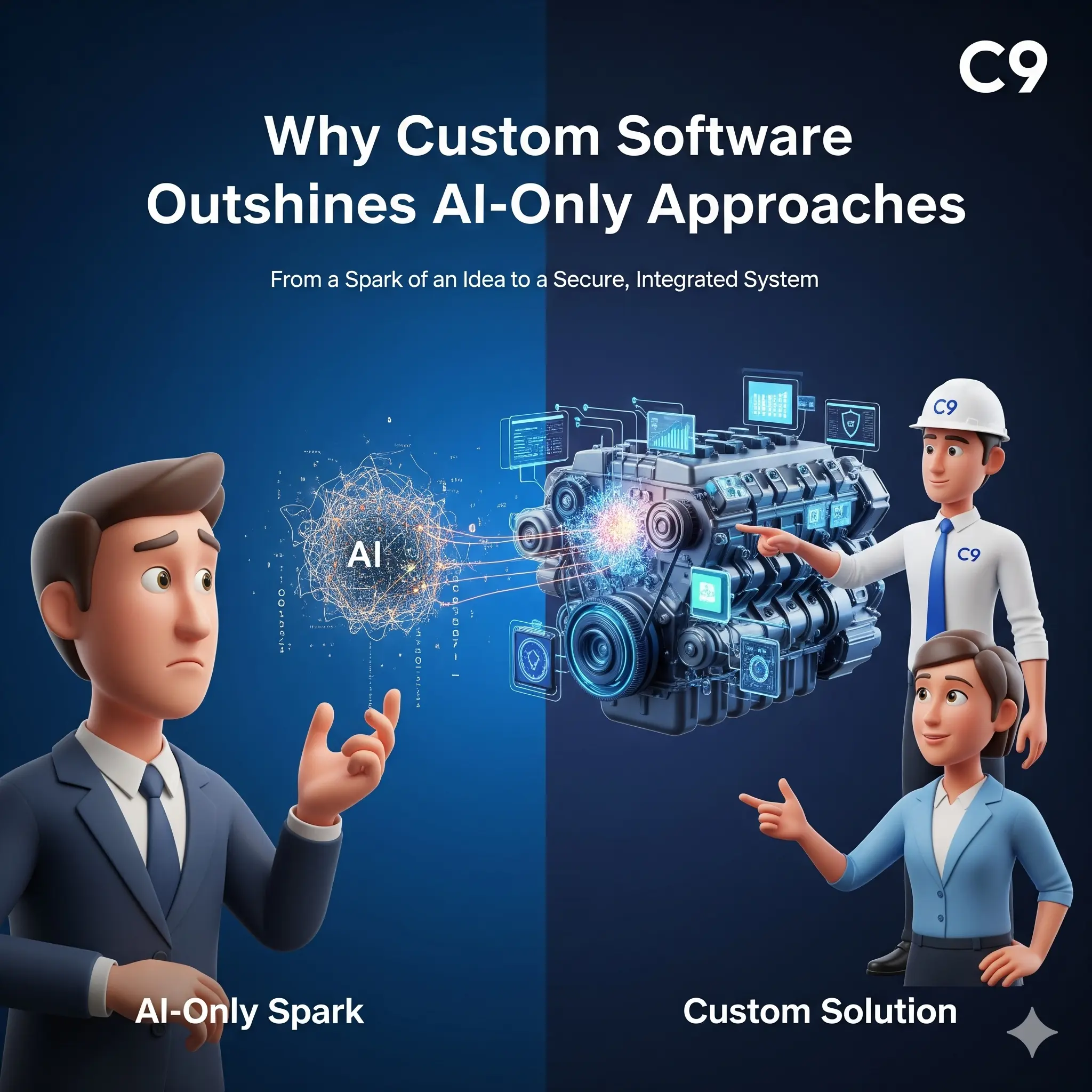
At C9, we see vibe coding as a spark, not the fire. Custom software, tailored to your unique Australian business landscape, integrates vibe-generated ideas with robust architecture. We handle the heavy lifting—ensuring security, scalability, and seamless integration with your existing systems—to deliver solutions that eliminate data silos and empower data-driven decisions. Unlike pure AI, our approach mitigates risks like vulnerabilities and debt, turning trends into tangible gains.
The Critical Role of Discovery Calls: Don't Skip This Step
In your rush to innovate, skipping a discovery call might seem efficient—but it's the worst idea you could have. Why? Without it, you're building on assumptions, leading to mismatched solutions, wasted budgets, and prolonged frustrations that exacerbate high operational costs and missed growth targets.
Discovery calls are your gateway to clarity. They're important because they uncover hidden pain points—like outdated systems hindering customer experience or internal resistance to change—allowing us to craft precise, value-driven proposals. Skipping them? It's like navigating Sydney traffic blindfolded: You'll hit roadblocks, overspend on revisions, and delay ROI.
How Discovery Calls Work: It's a collaborative 30-60 minute conversation where our experts at C9 dive deep into your business. We ask targeted questions about your goals (e.g., increasing efficiency by 30%), triggers (e.g., competitors' tech launches), and barriers (e.g., lack of expertise). We map your processes, identify integration needs, and outline a high-level roadmap. No sales pressure—just trustworthy insights.
Why It's Not a Waste of Time: Far from it! This step saves you months of trial-and-error. It aligns expectations, mitigates risks, and sets the stage for staged projects (more on that below). Clients often tell us it's the "aha" moment that transforms vague ideas into actionable plans, directly addressing your analytical, driven mindset.
Pitfalls of Indicative Pricing Proposals: Not Worth the Paper They're Written On

Indicative pricing—those quick quotes based on rough estimates—sounds appealing for busy executives. But they're fraught with pitfalls: They ignore nuances like your specific tech stack or compliance needs, leading to scope creep, budget overruns, and subpar results. In essence, they're not worth the paper they're written on because they promise certainty without foundation, often underestimating complexities and leaving you with inflated costs or incomplete projects.
Indicative vs. Discovery-Based Pricing: The Real Difference
Indicative pricing rounds to the nearest day or week, using broad assumptions (e.g., "a basic app takes 2-4 weeks"). It's vague and risky. Discovery-based pricing, post-call, is precise—to the nearest hour—factoring in every detail for accuracy.
Example Calculation: Imagine building a vibe-inspired inventory app. Indicative pricing might estimate 20 days at $150/hour (assuming 8-hour days: 160 hours = $24,000), but overlooks QA and integrations, ballooning to 30 days ($36,000) mid-project.
Post-discovery, we pinpoint: 100 hours dev, 40 hours QA, 20 hours PM, 30 hours UI/UX, 10 hours infrastructure = 200 hours at $150/hour = $30,000. If needs shift, it's adjusted hourly, not by weeks, saving you from overpaying.
Always prioritise discovery before pricing—it's the foundation for transparent, collaborative success.
Breaking Projects into Stages: Unlock Early ROI and Fuel Future Growth
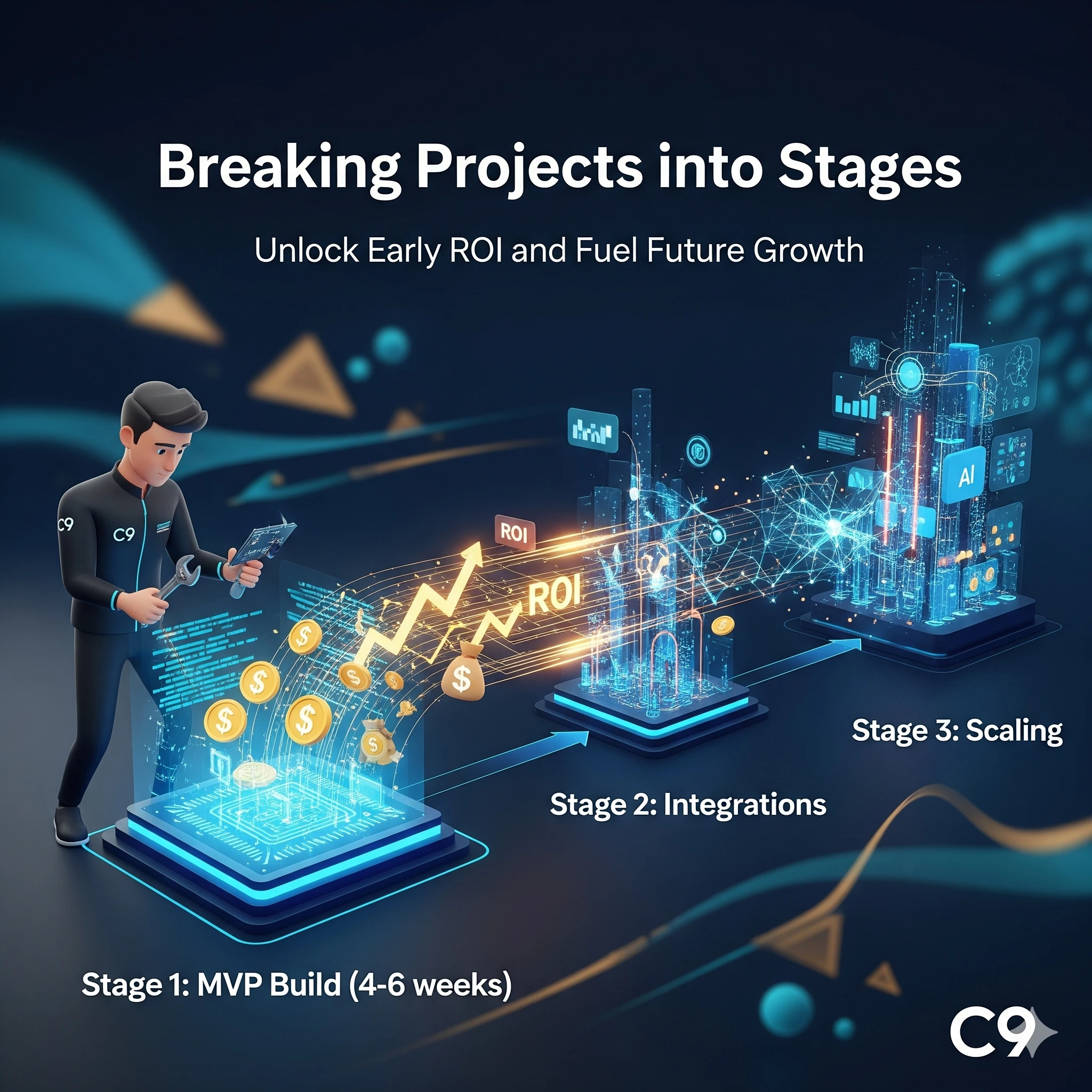
To maximise value, we break projects into stages: Start with a vibe-coded prototype (Stage 1: MVP build, 4-6 weeks), deliver early wins like streamlined processes for immediate efficiency gains, then reinvest savings into enhancements (Stage 2: Integrations; Stage 3: Scaling). This approach yields quick ROI—e.g., 20% cost reduction in operations—funding iterative improvements without upfront massive spends. It also incorporates 2026 trends like agentic AI for faster iterations while ensuring human-led quality.
Understanding the True Elements of Development Costs
Development isn't just coding; it's a symphony of elements ensuring reliability:
➡️ Development: Core coding (40% of costs).
➡️ QA/Testing: Bug hunting for security (20%), crucial for AI-generated code's non-deterministic nature.
➡️ Project Management: Keeping timelines on track (15%).
➡️ UI/UX Design: User-friendly interfaces (15%).
➡️ Infrastructure: Servers, cloud setup (10%).
Rough Calculation Example: For a 200-hour project (as above), variance shows indicative pitfalls:
➡️ At $100/hour: $20,000 (underestimates complexity, risks failure).
➡️ $125/hour: $25,000 (basic coverage, but skimps on QA).
➡️ $150/hour: $30,000 (balanced for Australian standards).
➡️ $175/hour: $35,000 (includes premium security).
➡️ $200/hour: $40,000 (enterprise-level with ongoing support).
Indicative quotes might lowball at $20,000-$25,000, but reality hits $30,000+ post-discovery, highlighting why vague estimates lead to variance and disappointment—especially with AI's added risks.
Harness Vibe Coding Wisely with Expert Partners
As 2026 approaches, vibe coding offers exciting possibilities for innovation, from agentic systems to metaprogramming, but its limitations demand a cautious, custom approach. By understanding its trends, pitfalls, and synergies with professional development, you can avoid common traps and achieve your goals of efficiency, cost savings, and growth. At C9, we're your collaborative partner in this journey—turning AI vibes into tangible business victories.
Ready to Unlock Your Potential?
Don't let outdated systems or AI hype hold you back. Book a free discovery call with C9 today. Let's collaborate on tailored solutions that propel your Australian business forward—contact us now and experience the difference.
AI Transparency Notice:
This article was produced with the assistance of artificial intelligence tools, including content drafting, visual asset creation, and audio generation. All content has been reviewed and approved by C9 prior to publication.