Executive Summary
Australian enterprises continue to make critical decisions on data that is hours or a full day old. Finance closes books late. Operations discover supply-chain issues after losses have already mounted. Analysts spend the majority of their time maintaining pipelines instead of generating insight.
Microsoft Fabric changes this by consolidating data engineering, real-time analytics, governance and Power BI into a single SaaS platform built on OneLake. Organisations that implement it properly report 30–40% infrastructure cost reductions, dramatically faster decision cycles and measurable operational gains. A 2024 Forrester Total Economic Impact study found a 379% ROI over three years, with payback in under six months. Australian examples such as Aurizon (up to 240 times faster queries) and Melbourne Airport (30% operational efficiency lift) confirm the local opportunity.
Yet technology alone is not enough. Skipping proper discovery, relying on cheap “AI Cowboy” developers, or treating knowledge transfer as optional turns promising projects into expensive technical debt. This guide explains how Australian enterprises can deploy real-time analytics successfully—and why a structured approach with the right partner is the difference between competitive advantage and a costly rebuild.
The Real Cost of Delayed Decisions
Most Australian mid-market and enterprise organisations still operate fragmented estates: separate warehouses, lakes, BI tools and spreadsheets. Overnight batch processes mean finance, operations and customer teams work with yesterday’s picture.
The business impact is concrete:
- Missed promotional windows and reactive inventory decisions
- Analysts spending up to 60% of their time on data plumbing
- Regulatory and audit friction caused by inconsistent lineage and siloed controls
- Competitive lag against peers who can sense and respond in near real time
Real-time analytics is no longer optional in financial services, retail, manufacturing, supply chain and customer-facing digital businesses. In these domains, speed of insight directly affects margin and market position.
Why Discovery Is the Highest-ROI Step
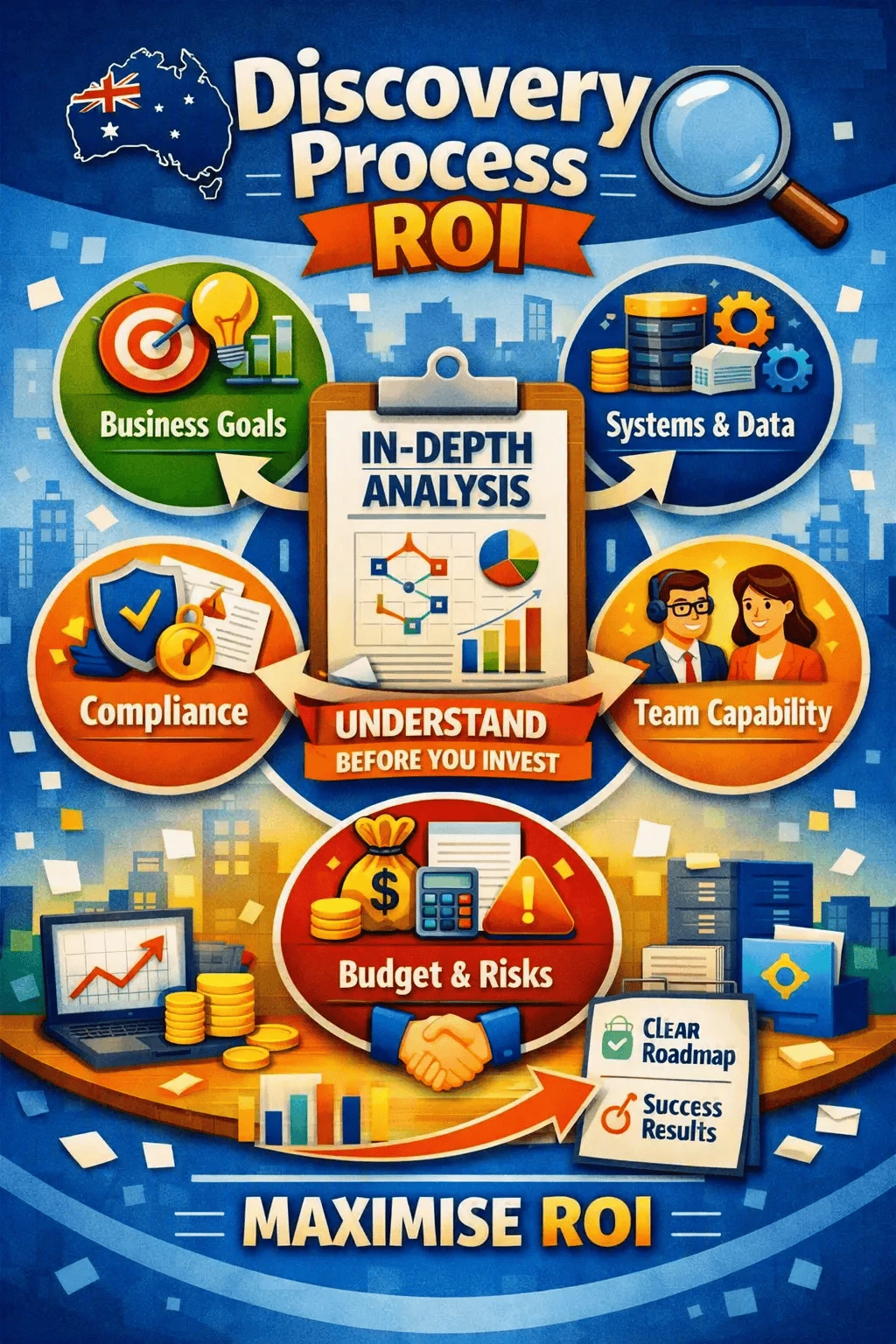
The most expensive mistake Australian executives make is asking “How much and how long?” before mapping the actual problem.
A proper discovery process examines five areas:
- The true business decisions that need faster insight and what “real-time” actually means for the organisation (seconds, minutes or hours).
- The full system landscape, data quality issues and which platforms must remain versus consolidate.
- Governance, Australian data residency and compliance requirements (including IRAP-aligned controls where relevant).
- Current team capability and the realistic skill-augmentation need.
- Budget reality, approval pathways and decision points that prevent later scope creep.
An anonymised Melbourne manufacturing example illustrates the difference. An initial informal estimate of $80k and eight weeks expanded, after discovery, to a $350k, six-month programme. Discovery also uncovered a previously invisible $200k-per-year inventory waste issue. The resulting system delivered both the intended real-time visibility and a substantial efficiency return that would have been missed by a quick-fix approach.
Discovery is diagnostic, not sales theatre. It produces a realistic roadmap, phased investment profile and clear success metrics before significant capital is committed.
What Microsoft Fabric Actually Delivers
Fabric is not another point tool. It provides a single SaaS platform in which:
- All analytical data lands in OneLake—one logical data lake for the organisation
- Security (row-, column- and object-level) and governance are defined once and enforced across workloads
- Real-time streaming and batch analytics share the same foundation
- Power BI connects via Direct Lake without unnecessary data movement or refresh lag
- AI capabilities (anomaly detection, predictive models, natural-language querying) sit on governed, consistent data
Documented outcomes include 25% productivity gains for data engineers, faster time-to-insight for business users, reduced infrastructure spend and lower staff attrition as teams work with modern tools.
Not every use case requires sub-second latency. Discovery clarifies where true real-time intelligence creates material value (fraud, inventory, production monitoring, demand sensing) versus where daily or hourly refresh remains sufficient.
The Hidden Cost of “Vibes Coding” and AI Cowboys
Cheap, rapid delivery that relies on intuition rather than architecture, documentation and knowledge transfer looks attractive on a spreadsheet. Within six to twelve months the costs appear:
- Inconsistent calculations that no one can explain
- Fragile pipelines that break on schema change
- Code that only the original developer can maintain
- Audit and compliance gaps that require expensive remediation
In regulated Australian environments the risk is higher still. Auditors expect documented lineage, change control, access trails and error handling. “It works on my machine” is not an acceptable control.
A sustainable approach includes:
- Architecture decisions captured with rationale
- Modular, well-commented code designed for change
- Structured knowledge-transfer sessions so the client team can maintain and evolve the solution
- Governance and security built in from the start, not bolted on later
The result is a system the organisation owns rather than one it rents from transient developers.
C9’s Hybrid Model for Australian Enterprises
Large consulting firms deliver quality at high cost and slow speed. Pure offshore “body shops” deliver low rates but frequently leave knowledge and accountability gaps. Permanent local hiring carries long recruitment cycles and fixed employment risk for time-bound projects.
C9’s hybrid model combines:
- Australia-based delivery management and QA working Australian business hours
- Highly capable architects and developers in the Asia-Pacific region with meaningful timezone overlap
- Flexible team configurations (full project teams or targeted skill augmentation)
- Explicit knowledge transfer so capability remains with the client
After an initial three-month commitment, engagements move to month-to-month flexibility. Most continue because value has been demonstrated. The model avoids both the rigidity of permanent headcount and the accountability vacuum of purely transactional offshore work.
Australian data residency and IRAP-aligned Azure regions are fully supported, giving enterprises confidence for both commercial and government-adjacent workloads.
Realistic Implementation Roadmap
A typical six-month programme follows four phases:
Phase 1 (Weeks 1–4) – Architecture & Foundation System inventory, data-quality assessment, target architecture, security model and a focused proof-of-concept. Client involvement is light (2–3 hours per week).
Phase 2 (Weeks 5–10) – Data Integration Pipelines into OneLake, transformation layers, governance implementation and validation. Client input rises to 3–4 hours per week for policy and security decisions.
Phase 3 (Weeks 11–16) – Analytics & Dashboards Priority real-time and near-real-time dashboards, user training and performance tuning. Business users become more active in validation and adoption.
Phase 4 (Weeks 17–24) – Transition & Optimisation Knowledge transfer, go-live support, legacy decommissioning and optional ongoing support retainer. Client involvement declines as internal ownership increases.
Timeline pressure points are almost always data complexity or late scope changes—both of which discovery surfaces early.
Microsoft Fabric and AI: From Visibility to Insight
Real-time dashboards show what happened. Fabric’s AI capabilities surface what matters and what is likely to happen next—anomaly detection, predictive models and natural-language querying over governed data. The combination multiplies the value of the underlying real-time foundation. C9 maintains dedicated guidance on responsible AI integration with Fabric.
Taking the Next Step
Real-time analytics is now table stakes for competitive Australian enterprises. The low-risk first move is a structured discovery conversation that maps actual requirements, realistic investment and the right team model.
Book a complimentary Discovery Call with C9. You will receive a clear written assessment of timeline, cost range, risks and recommended next steps—without obligation.
Most executives discover that their current architecture is leaving measurable value on the table. Thirty minutes of focused conversation can prevent six-figure mistakes and accelerate the path to genuine competitive advantage.
About C9 C9 is an Australian custom software, integration and analytics specialist serving mid-market and enterprise clients. We combine local delivery accountability with specialist Asia-Pacific capability, enterprise-grade quality standards and a non-negotiable focus on knowledge transfer. Our work centres on Microsoft technologies including Fabric, Azure and Power BI, with deep experience across financial services, retail, manufacturing, supply chain and regulated environments.
Related Resources
References & Sources
- Forrester Total Economic Impact™ of Microsoft Fabric (2024) – 379% ROI, infrastructure and productivity findings.
- Microsoft Customer Stories: Aurizon (up to 240× query performance), Melbourne Airport (operational efficiency gains).
- Microsoft Fabric documentation and Real-Time Intelligence capabilities (Microsoft Learn / Fabric Blog, 2024–2026).
- Azure IRAP assessments and Australian data residency guidance (Microsoft Compliance).
- Industry observations from Australian Fabric implementations (CG Tech, Professional Advantage, Agile Insights and C9 project experience).
AI Transparency Notice:
This article was produced with the assistance of artificial intelligence tools, including content drafting, visual asset creation, and audio generation. All content has been reviewed and approved by C9 prior to publication.