|
EXECUTIVE SUMMARY
In short:
- Australian businesses are collectively losing billions in productive hours each year to manual data handling, disconnected software platforms, and workflows that require human intervention at every step.
- The Australian digital transformation market reached USD 18.5 billion in 2024 and is projected to hit USD 84.7 billion by 2033 — the demand for integrated, automated systems is accelerating, not slowing.
- McKinsey research shows automation can cut operational costs by up to 30%, and 48% of businesses report a positive ROI within the first year of implementation.
- C9 has been solving this problem for Australian organisations across healthcare, government, financial services, education, agriculture, retail, and manufacturing for over 18 years.
- Every case study in this article follows the same pattern: a real operational challenge, a purpose-built integration or automation solution, and a measurable business outcome.
What's next?
If your organisation is managing manual processes, siloed data, or reporting delays that are limiting growth and decision-making, the next step is a focused conversation with C9. The case studies in this article show exactly what becomes possible — and how quickly.
|
The Invisible Cost of Manual Processes
Picture a typical Tuesday morning inside a growing Australian business. A finance manager is copy-pasting invoices from an accounting platform into a spreadsheet, because the two systems have never been connected. Across the office, an operations lead is manually compiling last week's performance data from three different databases into a single report — a task that takes two hours and will be repeated again next week. In the warehouse, a logistics coordinator is re-entering order data by hand because the ERP does not talk to the despatch system.
None of these people are doing their jobs poorly. They are doing the job their systems require of them. And that is precisely the problem.
Australia's digital transformation market reached USD 18.5 billion in 2024 and is forecast to reach USD 84.7 billion by 2033, growing at a compound annual rate of 18.4% [1]. Yet for many Australian businesses — particularly those operating at the mid-market and enterprise level — the investment in digital technology has produced a sprawl of platforms that do not integrate, rather than an ecosystem that works together. The result is what analysts refer to as the "integration gap": the operational and financial cost of systems that cannot communicate.
This blog is about that gap — and how C9, Australia's leading custom software, apps, integration and database developer, has been closing it for Australian organisations across every major industry sector for more than 18 years.
The Real Cost of Disconnected Systems in Australia
The financial case for automation and integration in Australia has never been stronger — or more clearly evidenced. Australian businesses' AI and automation-related spending grew by 20% in 2024, reaching an estimated AUD $3.5 billion [2], yet a substantial proportion of that investment is flowing into platforms that remain disconnected from one another. The cost of that disconnection is not always visible in a P&L — but it is always present.
|
30%
operational cost reduction possible through automation
McKinsey & Company [3]
|
|
48%
of businesses see positive ROI within 12 months of automation
Local Digital / National Survey [4]
|
|
70%
reduction in errors when manual workflows are replaced with automation
Capgemini / Gitnux Report [5]
|
According to McKinsey, nearly 60% of all business occupations contain tasks where at least one-third of daily work could be automated with current technology [3]. For Australian businesses, that represents an extraordinary opportunity — and an equally extraordinary amount of value currently being left on the table.
The Australian Bureau of Statistics (ABS) reported that business expenditure on digital transformation reached AUD $35.7 billion in 2022–23, representing a 13.2% year-on-year increase [6]. Yet investment alone does not produce integration. Organisations routinely find that deploying additional software platforms without a deliberate integration strategy results in more complexity, not less — systems that sit side-by-side but never communicate, and staff who bridge the gap manually.
|
The five most expensive manual processes in Australian businesses today:
- Manual data re-entry between disconnected software platforms (finance, operations, CRM, ERP).
- Manual report compilation from multiple data sources — producing information that is out of date before it reaches the decision-maker.
- Manual approval and workflow routing — email chains and spreadsheet-based processes that cannot enforce compliance or auditability.
- Manual file transfer and document management — particularly acute in healthcare, government, and financial services.
- Manual reconciliation between customer-facing systems and back-office infrastructure — generating errors that compound over time.
|
Why the Problem Is Getting Worse, Not Better
There is a compounding dynamic at work in the systems environments of most growing Australian businesses. Each new platform deployed without integration adds to the burden of manual coordination. Each additional data silo deepens the information asymmetry between the people doing the work and the executives who need to make decisions about it. And each passing month that the status quo is maintained makes the eventual remediation more complex and more costly.
A 2024 study found that 39% of companies report legacy system integration issues as a primary barrier to automation adoption [7]. This is not a technology problem in the narrow sense — it is a strategy and architecture problem. The question is not whether a company's systems can theoretically be connected. The question is whether someone with the experience to design and build that connection has been engaged to do so.
|
"The systems that got your organisation to where it is today are often the very systems standing between you and where you need to be."
|
The C9 Approach: Precision Integration, Not Generic Connectivity
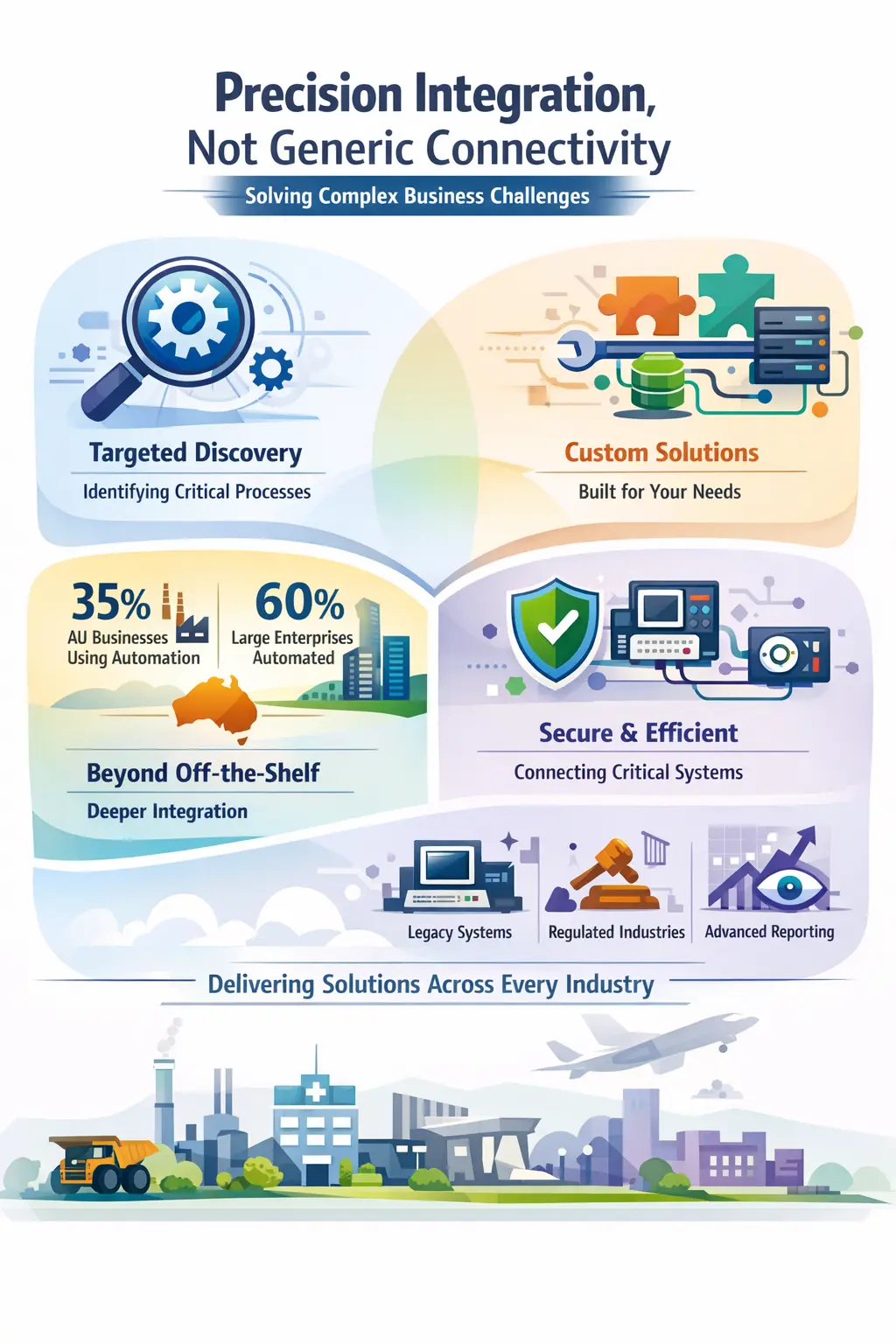
C9 does not approach automation and integration as a product sale. Every engagement begins with a structured discovery process that starts not with technology selection, but with the question: what is the most expensive, highest-risk, or most limiting manual process in this organisation — and what would it mean to automate it?
This distinction matters. Generic integration tools — iPaaS platforms, middleware connectors, low-code automation suites — are effective for standard workflows between standard platforms. But Australian businesses operating in regulated industries, with legacy infrastructure, or with genuinely complex operational requirements consistently find that off-the-shelf connectivity is insufficient. C9 builds the connections that off-the-shelf cannot — and has been doing so across virtually every industry in Australia since 2005.
Over 66% of businesses globally have automated at least one core business process as of 2024 [8]. In Australia, more than 35% of businesses have adopted some form of automation or AI technology, with larger enterprises (500+ employees) showing a 60% adoption rate [2]. But adoption statistics do not tell the full story. What matters is whether the automation is genuinely integrated — whether it connects the systems that need to connect, automates the workflows that most constrain the business, and produces reporting and visibility that did not previously exist.
Below are the real-world case studies that demonstrate exactly what this looks like in practice — across industries, across system architectures, and across the full range of operational challenges that Australian businesses face.
C9 Automation & Integration in Action: Australian Case Studies
The following case studies are drawn from C9's project portfolio across healthcare, government, education, financial services, agriculture, retail, manufacturing, and broadcasting. Each represents a genuine business problem — and a solution engineered specifically to address it.
CASE STUDY 01 · MEDICAL & HEALTH CARE
Healthcare referrals between general practitioners and specialists in Australia are subject to strict obligations under the Privacy Act 1988 and the Australian Privacy Principles (APPs), which require that health information be handled securely, with appropriate access controls, throughout its lifecycle [9]. When the referral process itself relies on manual faxes, phone calls, and email — as it did for a significant proportion of practices across Australia — both compliance and clinical quality are at risk.
The Australian Digital Health Agency's National Healthcare Interoperability Plan (2024) identifies HL7 FHIR as the central standard for clinical data exchange, and has been driving adoption across the sector since 2023 [10]. But for many practices using legacy clinical information systems, the path to interoperability requires a custom middleware layer that can translate between older HL7 V2 messaging formats and modern FHIR-based exchanges — precisely the kind of engineering that C9 specialises in.
|
Medical & Health Care · RHealth — ReferHealth
|
|
Challenge
|
GP-to-specialist referral workflows were fragmented and manual. Referrals sent from GP systems required manual re-entry at the specialist end. There was no reliable, auditable, or structured mechanism for bidirectional communication — creating clinical risk and administrative burden on both sides of every referral.
|
|
Solution
|
C9 built a custom middleware integration layer connecting the ReferHealth platform to GP practices via on-site data extraction agents. The middleware managed bidirectional referral message flow — ensuring referrals from GP clinical systems arrived at the specialist platform in structured, actionable form, and that status updates returned automatically. The architecture was compliant with Australian health privacy requirements and HL7 messaging standards.
|
|
Outcome
|
Referral communication became structured, reliable, trackable, and compliant. GPs gained confidence that referrals were received and acted upon. Specialists could manage incoming workload systematically. Clinical risk associated with lost or incomplete referrals was materially reduced.
|
CASE STUDY 02 · MEDICAL & HEALTH CARE
When a critical clinical system fails to be delivered, the consequences are not merely operational — they are clinical and legal. Monash Health, one of Victoria's largest public health networks, was left without a functional triage management system after a previous development engagement failed. The system was required to process high volumes of incoming specialist referrals, manage HL7 clinical messages, and provide multi-role tracking from referral receipt through to specialist assignment and completion.
The Privacy and Other Legislation Amendment Act 2024 — which received Royal Assent in December 2024 — significantly strengthened Australian enforcement powers for privacy breaches, with penalties now reaching up to AUD $50 million or 30% of adjusted turnover for serious or repeated contraventions [11]. For a health network of Monash's scale, the risk of operating without an auditable, compliant referral management system was substantial.
|
Medical & Health Care · Ozescribe — Triage Manager / Monash Health
|
|
Challenge
|
A previously commissioned triage system had not been delivered. Monash Health was processing large volumes of incoming specialist referrals via high-volume fax and HL7 messaging, with no system for structured tracking, assignment, or performance measurement. Clinical governance risk was significant.
|
|
Solution
|
C9 scoped and built a complete triage management system from the ground up. The platform integrated with high-volume fax intake and HL7 clinical messaging, providing multi-role specialist assignment with full patient tracking from receipt to completion. Role-based access ensured clinical, administrative, and management users each had appropriate visibility and controls.
|
|
Outcome
|
Monash Health gained a clinically governed, auditable triage system that processed thousands of referrals reliably. The platform delivered what the previous team could not — on time, within scope, and in compliance with Australian health privacy requirements.
|
CASE STUDY 03 · EDUCATION
Student transport management at national scale involves three distinct technical challenges: tracking vehicle locations in real time, communicating that information to parents instantly, and providing administrators with a consolidated operational picture across an entire fleet. No single off-the-shelf platform was designed for the specific operational model of a nationally distributed school network like One School Global — which required custom development of three tightly integrated applications that had to work together seamlessly and continuously.
|
Education · One School Global — Transport Management System
|
|
Challenge
|
Transport management across a national school network lacked real-time visibility, parent communication, and centralised administration. There was no reliable way for parents to track their child's journey in progress, and no single operational view for administrators managing fleets across multiple states.
|
|
Solution
|
C9 built a fully integrated transport management system comprising an in-vehicle tablet application for real-time GPS tracking, a parent-facing mobile app delivering live location updates during trips, and a national administration dashboard providing a consolidated operational view. All three applications were purpose-built and tightly integrated — sharing live data continuously.
|
|
Outcome
|
Student transport became trackable, transparent, and nationally managed from a single platform. Parents gained real-time reassurance during every journey. The architecture was designed to extend internationally as the One School Global network continues to grow.
|
CASE STUDY 04 · GOVERNMENT & COUNCILS
Government bodies in Australia are subject to obligations under the Privacy Act 1988 regardless of the size of their operations [9]. For Tasmanian Irrigation — the state authority responsible for managing water entitlements across Tasmania — the reliance on an Excel-based management system represented not only an operational risk but a governance and compliance vulnerability. Water entitlement records, once generated, needed to be automatically filed, tracked, and made retrievable in accordance with government records management obligations.
Australia's Digital Transformation Agency (DTA) reported in 2025 that Australia achieved a 98.5% score in the World Bank's GovTech Maturity Index, ranking in the global top five for digital government services [12]. The Tasmanian Irrigation project reflects the practical work behind that ranking — replacing manual government processes with integrated platforms built specifically for Australian public-sector requirements.
|
Government & Councils · Tasmanian Irrigation — Water Entitlements Register
|
|
Challenge
|
Tasmania's water rights were managed in a spreadsheet — with no automated document generation, no integration with the state's document management system, no reliable version control, and no access management appropriate for a multi-user government environment.
|
|
Solution
|
C9 developed a custom intranet web application replacing the spreadsheet entirely. The platform automated document generation for entitlement records, integrated directly with Tasmanian Irrigation's existing document management system, and enforced role-based access control appropriate for a government environment.
|
|
Outcome
|
The agency moved from a fragile manual process to an integrated, auditable government-grade platform. Document generation that previously required hours of manual preparation now completes automatically, with every record immediately filed and retrievable in the correct system.
|
CASE STUDY 05 · FINANCIAL SERVICES
Australian financial services operators are subject to compliance obligations under the Australian Securities and Investments Commission Act 2001 (ASIC), Anti-Money Laundering and Counter-Terrorism Financing Act 2006 (AML/CTF), and the National Consumer Credit Protection Act 2009. For a peer-to-peer lending platform — where the core product is the automated facilitation of financial transactions between regulated participants — the integration of payment systems, identity verification, and workflow automation must be architecturally correct from day one. There is no phased approach to financial compliance.
|
Financial Services · YouLend — SaaS Peer-to-Peer Lending Platform
|
|
Challenge
|
A fintech startup required a fully production-ready peer-to-peer lending platform with extensive payment gateway integrations, automated lending workflow and approval chains, and security hardening appropriate for an Australian regulated financial product — launched as a multi-user SaaS application.
|
|
Solution
|
C9 architected and built the complete platform, integrating multiple payment systems, designing and automating the full lender-borrower connection and transaction workflow, and applying end-to-end security hardening across the application stack — from authentication and 2FA through to data encryption and audit logging.
|
|
Outcome
|
YouLend launched as a production-ready, compliance-appropriate SaaS lending platform. The integration of payment systems and the automation of core lending workflows meant the platform could operate at scale from launch, without manual intervention at any critical process point.
|
CASE STUDY 06 · CONSTRUCTION & TRADES
For trades businesses and construction companies operating nationally, the gap between financial reality and financial visibility is often enormous. Time sheets, RDO tracking, and expense recording typically exist as separate, disconnected processes — and the profit-and-loss analysis that management needs to make project and resource decisions requires someone to manually assemble data from all three sources. In a business where labour allocation determines profitability, the inability to access just-in-time financial data is not a minor inconvenience. It is a strategic limitation.
|
Construction · SES Portal — Specialist Electrical Solutions
|
|
Challenge
|
A national electrical contractor managed timesheets, RDO balances, and expense tracking through disconnected manual processes. Producing a profit-and-loss analysis required hours of data gathering — meaning that actionable financial information was always retrospective, never current.
|
|
Solution
|
C9 built a custom management portal integrating timesheet management, RDO tracking, expense recording, and profit-and-loss reporting into a single connected platform, built around SES's existing operational workflows. The system was designed to generate reporting outputs automatically from integrated operational data.
|
|
Outcome
|
Reporting that previously required hours to produce now completes in seconds. Management gained just-in-time financial visibility — including real-time profit and loss analysis — as a live operational instrument rather than a weekly retrospective report. The platform continues to expand in staged development.
|
CASE STUDY 07 · ENTERTAINMENT & BROADCASTING
Australian broadcasting operates across geographically dispersed markets, each with its own sales operation and its own internal SQL database infrastructure. For a leadership team managing revenue forecasting, sales performance, and activity-based KPIs across an entire national network, the inability to consolidate that data in real time means decisions are made on incomplete information — or not made at all until a time-lagged report is manually produced.
|
Broadcasting & Entertainment · Grant Broadcasters — Sales Management Portal
|
|
Challenge
|
Sales performance data was distributed across geographically separate SQL systems in different broadcast markets with no central consolidation. There was no single platform for tracking sales activity, forecasting revenue allocation, or measuring staff performance across the national network.
|
|
Solution
|
C9 built a custom sales management portal integrating with disparate SQL databases across multiple markets via nightly synchronisation through web services. The portal provided activity-driven KPI tracking, revenue allocation against forward planning, and centralised performance reporting — all presented in role-appropriate dashboard views for different levels of the organisation.
|
|
Outcome
|
Grant Broadcasters gained a single, nationally consolidated view of sales performance across every market. Revenue forecasting became data-driven and consistent. The performance of sales teams in each market became visible, measurable, and comparable from a central platform.
|
CASE STUDY 08 · MANUFACTURING & DISTRIBUTION
The difference between data that refreshes daily and data that refreshes every five minutes may seem marginal in the abstract. In operational terms, it is the difference between managing by exception and managing in real time. For a distribution and equipment business, the ability to see sales performance, inventory movement, and operational KPIs as they happen — rather than as they were yesterday — changes how quickly issues are identified and how decisively they are addressed.
|
Manufacturing & Distribution · Tranex Equipment — Real-Time KPI Web Dashboard
|
|
Challenge
|
Tranex Equipment had no real-time visibility into daily sales and operational performance. KPI data existed within the business but was not consolidated, warehoused, or surfaced in a timely form for operational decision-making.
|
|
Solution
|
C9 built a custom web dashboard integrating with Tranex's data infrastructure to warehouse and surface critical KPI data with a five-minute automated refresh cycle. The dashboard was engineered for speed, clarity, and daily operational use — not quarterly reporting.
|
|
Outcome
|
Tranex management gained near real-time visibility into sales and operational KPIs. The five-minute refresh cycle enabled faster operational decisions and dramatically reduced the lag between performance events and management awareness and response.
|
CASE STUDY 09 · AGRICULTURE
Webster Limited is the third-oldest company in Australia and the largest exporter of walnuts in the southern hemisphere. Managing dual-crop export operations — walnuts and onions — from paddock through to export documentation involves a level of workflow complexity that generic ERP systems are not architected to handle. The existing production management system could not support the operational demands of a business at this scale and with this degree of product diversity.
|
Farming & Agriculture · Webster Limited — Agricultural Production Management System
|
|
Challenge
|
Webster's production and export management process was constrained by a legacy system that could not support the complexity, volume, or dual-crop workflow of their national operations. End-to-end production visibility was fragmentary and manual at critical points.
|
|
Solution
|
C9 built a fully custom production management system covering the complete end-to-end agricultural production and manufacturing process — with distinct workflow modules designed for walnut and onion export operations respectively — and integrated with related internal business systems.
|
|
Outcome
|
Webster Limited gained a purpose-built production management platform delivering full end-to-end operational visibility and control — replacing a system that was constraining the business with one engineered specifically for their operational reality and growth trajectory.
|
CASE STUDY 10 · INDUSTRY BODIES & ENGINEERING
Corporate mergers in Australia regularly produce technology environments that require immediate custom integration work. When a merger moves critical infrastructure — ERP systems, financial databases, reporting engines — offshore, the local business typically loses capabilities it depends on daily. For Atkins Global's Australian operations, a merger had rendered their local reporting and billing infrastructure unusable. Their ERP (JD Edwards) was now located in the United Kingdom, and their local team — serving major resources clients including BHP and Rio Tinto — had no viable pathway to billing or reporting data.
|
Industry Bodies & Engineering · Atkins Global — Reporting & Billing Portal
|
|
Challenge
|
A corporate merger had rendered Atkins Global's Australian reporting and billing capability unusable. JD Edwards ERP was now located in the UK, and the Australian team — serving major clients including BHP and Rio Tinto — had no viable local reporting or billing infrastructure.
|
|
Solution
|
C9 built a custom reporting and billing portal that integrated directly with JD Edwards ERP in the United Kingdom, providing Atkins Global's Australian team with accurate, timely access to the billing and reporting data required to serve their enterprise clients.
|
|
Outcome
|
Atkins Global's Australian operations regained full reporting and billing capability — cross-border ERP integration delivered, compliant with the accuracy and reporting standards demanded by major resources industry clients.
|
CASE STUDY 11 · PROFESSIONAL SERVICES — FRANCHISE
Franchise operations present a specific reporting challenge: performance data exists at the individual franchise level, but the decisions that matter most — investment, resource allocation, support priorities, expansion planning — are made at the network level. Without an integration architecture that consolidates franchise-level data into a centralised, real-time reporting platform, franchise leadership teams are perpetually making strategic decisions on the basis of incomplete information.
|
Professional Services — Franchise · Studio Pilates Portal — Franchise Dashboard
|
|
Challenge
|
Studio Pilates operated a franchise network nationally and internationally, but lacked a centralised, real-time reporting capability. Critical performance data was distributed across individual franchises and could not be consolidated in a timely, role-appropriate form for network leadership.
|
|
Solution
|
C9 designed and built an integrated reporting portal using Microsoft Power BI Embedded, connecting franchise-level data sources into a single consolidated dashboard. The portal included integration layers that surfaced value-added data alongside raw performance metrics, enabling multi-level decision-making from a single interface.
|
|
Outcome
|
Studio Pilates gained real-time consolidated visibility across their entire national and international franchise network. Decision-makers at every level — from individual franchise operators to senior leadership — now have access to the information they need, in the format appropriate to their role.
|
CASE STUDY 12 · RESEARCH & GOVERNMENT
Distributing large, sensitive research files to defined user groups at scale is a deceptively complex technical challenge. Standard file-sharing tools are not designed for controlled release workflows — where specific files must be made available only to specific users, with full audit trails, and where individual files may exceed 2GB in size. For CSIRO Data 61, the absence of such a system was both an operational constraint and a data governance risk.
|
Research & Government · CSIRO Data 61 — Ticketing & File Management System
|
|
Challenge
|
CSIRO required a bespoke system for the controlled release of sensitive research files to defined authorised users. Standard file-sharing tools could not handle the combination of access control requirements, audit obligations, and file sizes that exceeded 2GB.
|
|
Solution
|
C9 built a custom ticketing and file management system with extensive AWS S3 integration, including chunked upload handling for files exceeding 2GB. The system enforced access controls at the user level, maintained full audit trails, and validated transfer integrity for every file released.
|
|
Outcome
|
CSIRO Data 61 gained a fully auditable, access-controlled file release platform capable of handling large-scale sensitive data distribution — with AWS S3 integration delivering the performance and reliability that critical research infrastructure demands.
|
Five Integration Patterns That Consistently Deliver ROI for Australian Businesses
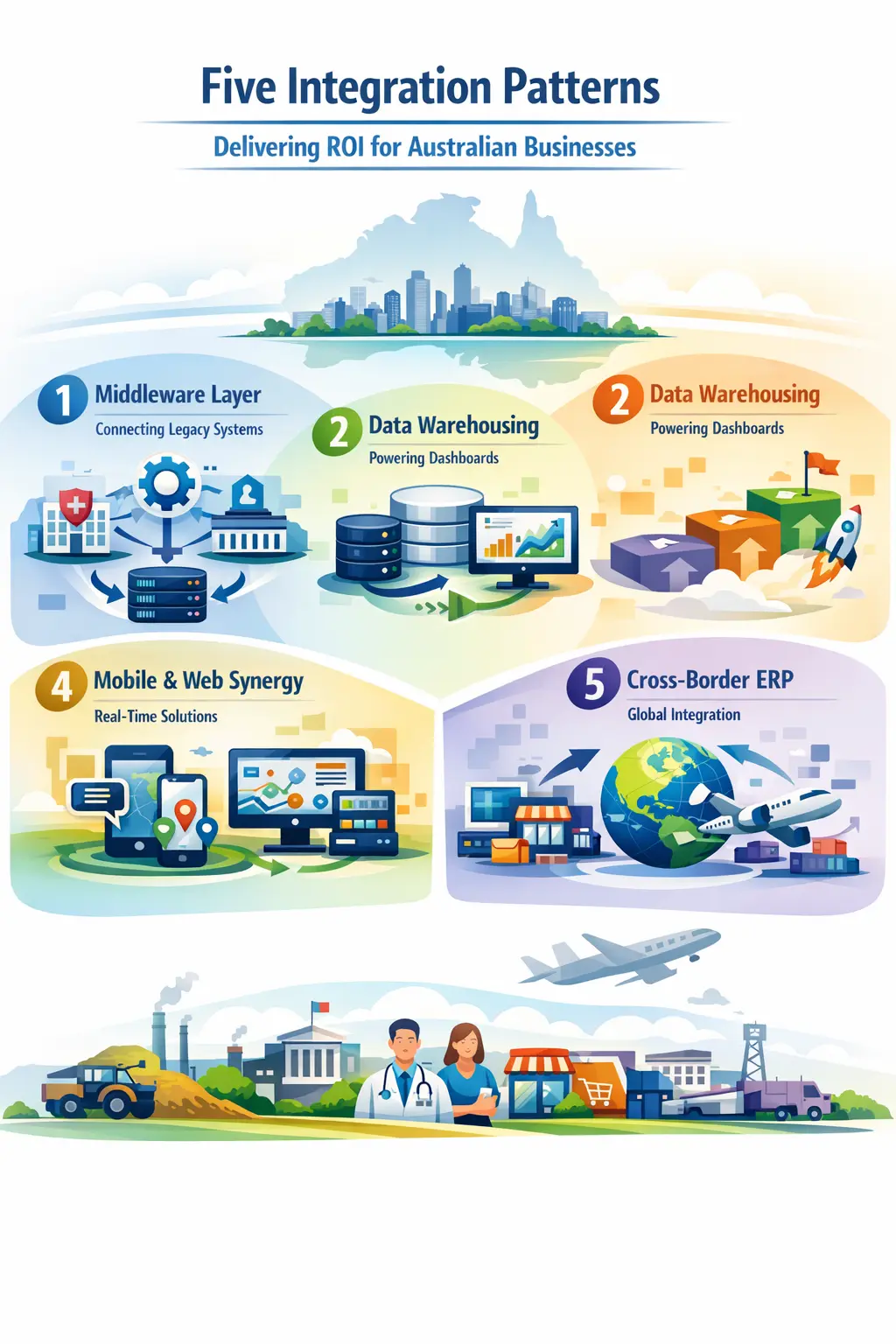
Across the case studies above — spanning healthcare, government, education, financial services, agriculture, retail, manufacturing, and broadcasting — a consistent set of architectural and strategic patterns emerges. Understanding these patterns helps Australian business leaders recognise the specific type of integration investment that will deliver the highest return in their own context.
Pattern 1: Middleware as the Intelligence Layer Between Existing Systems
In healthcare, government, and financial services — where the existing platform cannot be replaced and a new system needs to communicate with it — middleware is the most powerful and cost-effective integration approach. The RHealth project is the canonical example: rather than replacing the GP clinical system or the specialist platform, C9 built an intelligent layer between them that automated the flow of referral data in both directions. This pattern delivers transformative outcomes without the disruption or cost of full system replacement.
Pattern 2: Data Warehousing as the Foundation for Real-Time Dashboards
Dashboards that query live production databases directly are inherently fragile — they slow the underlying system and present data that can change mid-report. The Tranex Dashboard and Grant Broadcasters projects both demonstrate the architectural alternative: a warehousing layer that aggregates and normalises data on a scheduled cycle, against which dashboards can query safely and consistently. This pattern is the foundation of any real-time visibility capability that will remain stable as data volumes grow.
Pattern 3: Staged Development That Delivers Value Incrementally
The SES Portal project is built in stages — an initial production-ready module, followed by planned expansions that will deepen the platform's capability over time. This is not a compromise; it is a deliberate architecture strategy. Building integration platforms in stages allows the initial investment to deliver value immediately, lets users shape the next stage based on experience with the first, and ensures that expansion does not require rebuilding what was already built. It is also a more manageable risk profile for any organisation, regardless of size.
Pattern 4: Mobile and Web Working in Concert
The One School Global project required three distinct applications — in-vehicle, mobile, and web — to work together in real time at national scale. This pattern increasingly defines the architecture of modern operational systems, where staff in the field (drivers, healthcare workers, field technicians) generate real-time data that must be immediately visible to administrators and managers in back-office or executive roles. Building these systems requires both mobile development capability and the integration architecture to connect field-generated data to centralised dashboards — exactly the combination that C9 specialises in.
Pattern 5: Cross-Border and Cross-System ERP Integration
The Atkins Global project represents one of the more technically demanding integration scenarios in Australian business: a portal built in Australia that must retrieve and present data accurately from an ERP system located in the United Kingdom. This pattern is increasingly common in multinational businesses and in Australian companies that have been through mergers, acquisitions, or significant restructuring. It requires not only integration engineering capability but also a deep understanding of data security requirements, cross-border data transfer obligations, and enterprise-level performance requirements.
The Australian Regulatory Landscape: Why Compliant Integration Matters
Every integration and automation project in Australia operates within a regulatory context that directly shapes what is technically permissible and what is not. Understanding this context is not optional for Australian business owners and executives — it is a legal and operational requirement.
Privacy Act 1988 (Cth) — Amended November 2024
The Privacy Act 1988 is Australia's principal federal legislation governing the handling of personal information. Following the Privacy and Other Legislation Amendment Act 2024 — which received Royal Assent on 10 December 2024 [11] — penalties for serious or repeated privacy contraventions now reach up to AUD $50 million, three times the benefit obtained, or 30% of adjusted turnover, whichever is greater. For any integration project involving customer data, patient records, or personal financial information, compliance with the Privacy Act and the 13 Australian Privacy Principles (APPs) is not a secondary consideration — it is an architectural requirement. C9 builds this compliance into every integration project from the outset.
Healthcare: HL7 and the National Healthcare Interoperability Plan
The Australian Digital Health Agency's National Healthcare Interoperability Plan mandates the adoption of HL7 FHIR standards for clinical data exchange across the Australian health system, with active implementation milestones running from 2023 through 2028 [10]. Healthcare providers and digital health technology vendors building integration solutions must ensure their architectures support HL7 V2 and FHIR exchange standards. C9's healthcare integration work — including the RHealth middleware and the Monash Health triage system — demonstrates deep practical experience with these standards in live clinical environments.
Financial Services: ASIC, AML/CTF, and the NCCP
Australian financial services integration projects must comply with ASIC's technology and operational risk guidance, the AML/CTF requirements administered by AUSTRAC, and — for consumer credit products — the National Consumer Credit Protection Act 2009. For platforms like YouLend, which integrate multiple payment systems and automate the core lending workflow, this compliance architecture must be designed in from day one. C9's experience in building regulated financial products means that security hardening, audit logging, and compliance controls are embedded in the platform architecture — not added as an afterthought.
The Competitive Reality: Why 2026 Is the Pivotal Year for Australian Business Automation
Gartner forecasts Australian public cloud spending at nearly AUD $26.6 billion in 2025, up 18.9% from 2024, with 83% of ANZ CIOs ranking cloud among their top technology investments [13]. Microsoft has committed AUD $5 billion to expanding hyperscale cloud and AI infrastructure in Australia over the next two years — its single largest investment in its 40-year history in the country [1]. The Australian Government has allocated $124 million toward AI research and development to accelerate adoption [2].
These are not background statistics. They represent the competitive environment in which every Australian business owner and CTO is now operating. Organisations that invested in integration and automation three to five years ago are now operating with structural efficiency advantages — faster decisions, lower operational costs, more resilient processes — that are not easily or quickly reversed by competitors who begin investing later.
The National AI Centre reported that 40% of Australian SMEs had already adopted AI technologies as of late 2024, up five percentage points in a single quarter [14]. The pace of adoption is accelerating. Businesses that enter 2026 still managing critical processes manually — still waiting for reports that should be live, still moving data by hand between systems that should be connected — are not holding steady. They are falling behind.
|
"Over 35% of Australian businesses have adopted automation as of 2024, with larger enterprises showing a 60% adoption rate — and the gap between those organisations and those that haven't invested is widening every quarter."
|
How to Evaluate Whether Your Business Needs Custom Integration or Automation
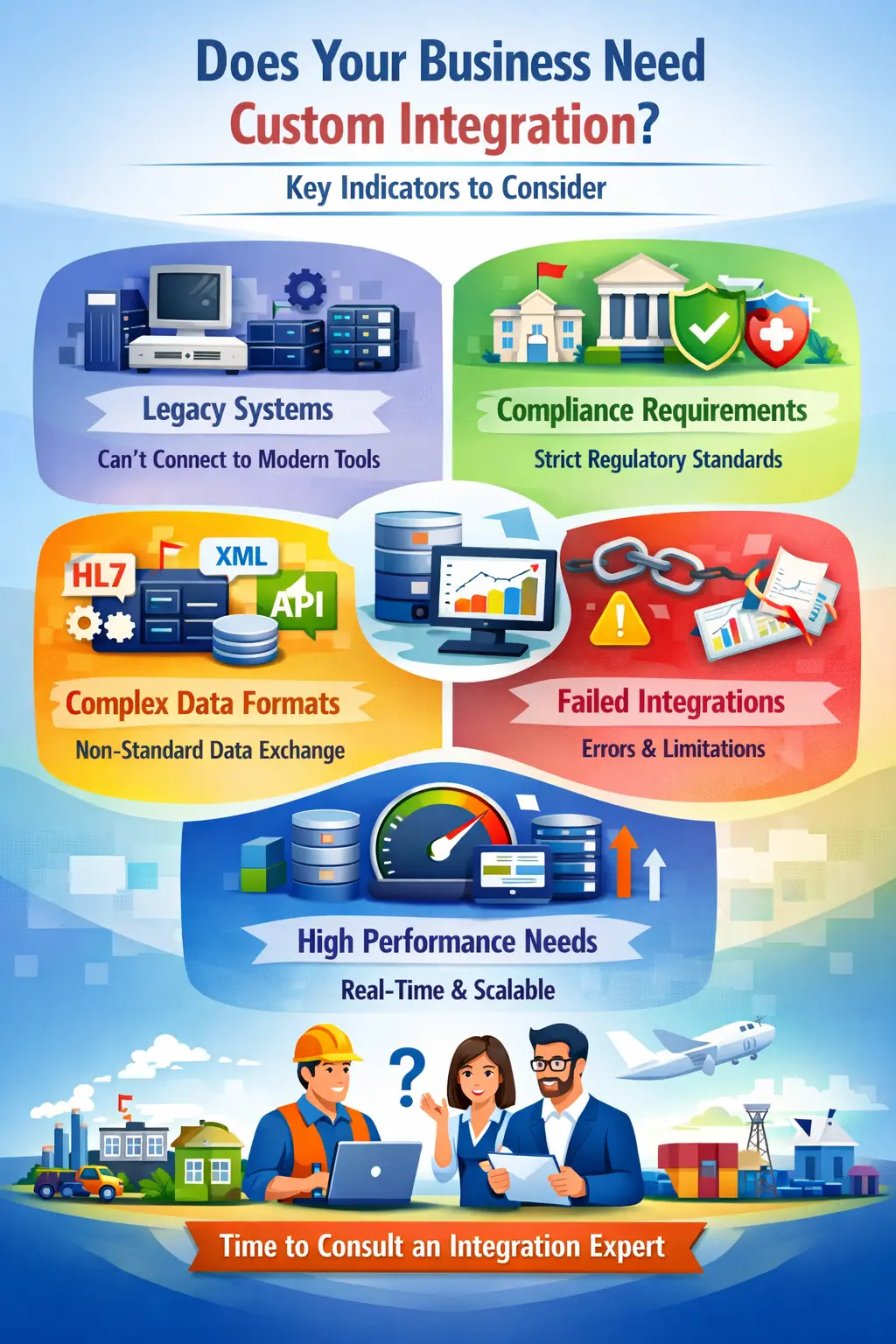
Not every integration challenge requires a custom solution. Some problems are well-served by commercial iPaaS platforms, low-code connectors, or off-the-shelf workflow tools. The case for custom development — which C9 makes honestly with every prospective client — arises when one or more of the following conditions applies:
- Your existing systems include one or more legacy platforms that commercial integration tools cannot connect to reliably.
- Your operational workflows involve compliance or governance requirements (healthcare, government, financial services) that require integration to be built to specific standards.
- You need to connect systems that exchange data in non-standard formats — HL7, custom database schemas, proprietary APIs, or legacy web services.
- You have attempted an off-the-shelf integration and it has failed, produced incorrect data, or been too limited to address the core business problem.
- Your integration needs involve real-time data flow, high transaction volumes, or performance requirements that commodity tools cannot reliably sustain.
- You are building a new SaaS product or platform that requires integration with multiple external systems as part of its core value proposition.
If any of these conditions describes your organisation's situation, the right starting point is not a product evaluation — it is a scoping conversation with an experienced custom integration developer. C9's discovery process is designed to assess the problem, identify the right architecture, and produce a clear scope that allows you to make an informed investment decision.
Conclusion: Integration Is a Business Strategy, Not an IT Project
Every organisation in this article made a decision at a specific moment: to stop tolerating the cost and risk of disconnected, manual systems and invest in building the integrations that should have existed from the beginning. The results — across sectors that are otherwise very different from one another — are remarkably consistent.
Healthcare organisations reduced clinical risk and improved patient pathways. Government agencies replaced fragile manual processes with auditable, integrated platforms. Financial services companies launched regulated products with architecturally correct compliance from day one. Agricultural exporters gained end-to-end visibility across operations spanning paddock to port. Trades businesses turned hours of manual reporting into seconds of automated insight. Franchise networks gained real-time consolidated visibility across every location. Broadcasting companies built data-driven sales cultures from a single integrated portal.
The common thread is not the technology. It is the strategic decision to treat integration and automation as a foundational business investment — one that compounds in value over time, builds operational resilience, and creates the visibility that allows good decisions to be made quickly.
Australia's digital transformation market will reach USD 84.7 billion by 2033 [1]. The businesses that will benefit most from that growth are not those that simply spend more on software — they are those that invest in connecting what they already have, automating what should not require human intervention, and building the operational infrastructure that will support their growth for the decade ahead.
C9 has been building that infrastructure for Australian businesses since 2005. The case studies in this article are not exceptional projects. They are representative of the standard that C9 applies to every engagement — regardless of industry, system complexity, or scale.
|
Is Your Business Ready to Stop Managing Processes Manually?
C9 builds custom automation and integration solutions for Australian businesses that eliminate operational bottlenecks, connect legacy systems, and deliver measurable outcomes — without disrupting what's already working.
→ Talk to C9 Today
|
|
In short:
- Australian businesses are losing measurable value daily to manual processes, data silos, and integration gaps — problems that grow with the organisation if left unaddressed.
- Custom automation and integration delivers 30% operational cost reduction potential (McKinsey), 70% error reduction (Capgemini), and 48% of implementations show positive ROI within 12 months.
- C9's case studies across 12 industries demonstrate that this is not theoretical — it is the documented outcome of solving real operational problems with precision-engineered solutions.
- The competitive window for gaining an integration advantage in Australia is narrowing. The organisations investing now will hold structural advantages that are difficult for competitors to close.
What's next?
Contact C9 at c9.com.au to begin a discovery conversation. No obligation — just a focused conversation about your operational challenge, your existing systems, and what a custom integration or automation solution could realistically deliver for your business.
|
Frequently Asked Questions
What is the difference between API integration and middleware?
An API integration connects two systems directly via their published interfaces — it works well when both systems support modern REST or SOAP APIs and the data exchange requirements are relatively straightforward. Middleware is an intermediary layer that sits between two or more systems, translating data formats, managing message queuing, handling errors, and orchestrating complex bidirectional workflows. Middleware is typically required when one or more systems uses a non-standard protocol (such as HL7 V2 in healthcare), when data transformation between systems is complex, or when the integration needs to handle high message volumes reliably. C9 builds both direct API integrations and complex middleware solutions, selecting the appropriate approach based on the specific technical and operational requirements of each engagement.
How long does a custom integration project take to deliver?
Project timelines vary significantly based on the complexity of the systems involved, the number of integration points, and whether the project involves a greenfield build or integration with existing legacy infrastructure. Simple API integrations between modern platforms can be delivered in weeks. Complex middleware integrations — particularly in healthcare or financial services, where compliance testing is required — typically take three to six months from scoping to production deployment. C9's agile methodology means that working software is delivered incrementally throughout the project, providing early validation and the opportunity to refine requirements based on real user experience rather than documentation.
Do we need to replace our existing systems to implement automation and integration?
In the majority of cases, no. The case studies in this article are representative: most successful integration projects connect and augment existing systems rather than replacing them. The Atkins Global project connected to a UK-based ERP. The RHealth project integrated with legacy GP clinical systems. The Tasmanian Irrigation platform connected to an existing document management system. C9's approach is specifically designed to work with what you already have — identifying the integration points, data flows, and automation opportunities within your existing infrastructure, and building the custom connections that make it all work together.
How does C9 ensure data security and Privacy Act compliance in integration projects?
C9 builds Privacy Act 1988 compliance and data security requirements into the architecture of every integration project from the outset. This includes access control design (role-based permissions, field-level security where required), data encryption in transit and at rest, audit logging for all data access and modification, and secure API authentication using modern standards including 2FA and MFA. For healthcare projects, C9's work conforms to HL7 messaging standards and the Australian Digital Health Agency's interoperability requirements. For financial services projects, security hardening addresses ASIC technology risk guidance and AML/CTF obligations as relevant to the specific product.
Explore Related Insights on Integrations Solutions.
How Custom Xero Integration Solves the #1 Challenge Facing Mixed Farming Operations in Australia
AI-Driven Automation and Real-Time Data Integration: Unlocking Efficiency for Australian Businesses
Beyond Automation: How a Strategic AI Integration Specialist Unlocks True Operational Efficiency
Seamless System Integration: Why Australian Firms Need Database Consultants Now
Real-World API Integration Success Stories: How Australian Businesses Transformed Their Operations with C9
API-First Development: Why Your Business Needs an API Integration Strategy for 2026
RPA + AI: The Intelligent Automation Combination Transforming Australian Businesses
Headless CMS & API-First Development in 2026: The Australian Guide to Faster, Flexible and Future-Proof Web Applications (Why C9 is Your Ideal Partner)
Why 37% of Enterprises Say Data Integration Is Their Biggest AI Barrier (And How to Overcome It)
Unlocking Real-Time Data Integration: How Seamless System-to-System Analytics Powers Smarter Business Decisions
Protecting Your Business from Money Runners: How Stripe + Xero Integrations and Smart APIs Stop Counterfeit AUD Conversion
Explore Related Insights on Process Automation Solutions.
Integrating Power Platform with Existing Business Systems: What Australian Business Owners & Executives Must Know
Revolutionise Your Operations: How Agentic Process Automation (APA) Drives Efficiency and Growth for Australian Businesses this coming 2026
How Generative AI is Revolutionising Affordable Productivity Tools Down Under
Revolutionising Australian Workflows: Power Platform vs UiPath vs Teams Apps—Which Delivers Superior ROI?
The Ultimate Guide to Implementing Business Process Automation in Sydney SMEs
Unlock Efficiency: How Autonomous AI Agents Are Revolutionising Power Automate Workflows in 2026
How Brisbane Construction Firms Can Automate Compliance Workflows to Avoid Costly Delays
Multi-Agent AI Orchestration: How Australian Enterprises Are Building Autonomous Workflow Systems in 2026
Autonomous AI Agents in Dynamics 365: What Australian Business Owners Must Know About Sales, Service & Finance Automation
AI Transparency Notice:
This article was produced with the assistance of artificial intelligence tools, including content drafting, visual asset creation, and audio generation. All content has been reviewed and approved by C9 prior to publication.