🎯 Executive Summary
For Australian Business Leaders in a Hurry:
Deploying AI is no longer optional—it's essential for competitive survival. Yet 75% of Australian businesses report measurable AI benefits, but only 6% say data is truly ready to support AI at scale. Even more concerning: most organisations can't quantify their AI returns because they never planned how to measure success upfront.
This comprehensive guide reveals how 50+ Australian enterprises measure AI success using a proven 7-metric framework. Whether you're a business owner, CTO, or financial decision-maker, this framework will help you:
- Calculate realistic AI ROI (not vendor promises)
- Justify AI investment to your board
- Avoid costly measurement failures that plague 50% of implementations
- Understand why discovery calls save millions in wasted spending
- Recognise "AI cowboys" selling cheap solutions that cost 10x more
- Deploy AI with flexible staffing options (month-to-month to 6-month contracts)
- Measure AI value from day 1 (not retrofitting later)
By the end of this guide, you'll have a practical, actionable framework to ensure every AI project delivers quantifiable business value.
The Australian AI Measurement Crisis
Here's what's keeping Australian business leaders awake at night:
"We're deploying AI. We see improvements. But can we actually prove it's working? Can we justify the investment to our board?"
This isn't theoretical anxiety. It's a genuine problem affecting 50% of Australian AI implementations. You invest $150K–$300K in AI deployment. Your processes become faster. Your team is more productive. Customers report better experiences.
Then your CFO asks: "What's our exact return on that $200K investment?"
And you struggle to answer with concrete numbers.
This gap between "we see benefits" and "we can prove benefits" is costing Australian businesses millions in:
Lost Funding Approvals: Can't justify Phase 2 expansion because Phase 1's ROI is unclear
Stalled Initiatives: Board won't approve next project without proof of first project's value
Wasted Implementation: Deployed AI that doesn't align with measurable business outcomes
Vendor Dependence: Can't demonstrate value to justify ongoing subscription costs
According to research, only 36% of Australian organisations have a formal process for measuring AI value. This means 64% of Australian businesses are flying blind—implementing AI without knowing if it's delivering results.
In Short:
You're deploying AI to stay competitive. You see benefits. But you can't quantify them in terms your board understands. Without concrete ROI metrics, you can't justify Phase 2 funding. Your competitive advantage stalls.
When you skip ROI measurement planning:
- Implementation costs $200K but delivers $0 measurable value (technically, but you can't prove it)
- Board rejects Phase 2 expansion because Phase 1's ROI is unclear
- You spend $50K+ retrofitting measurement infrastructure (should've been built in)
- Competitors who measure AI ROI gain measurable competitive advantage
- Your team loses confidence in AI if you can't demonstrate value
Strategic AI deployment requires measuring success before you start building, not after. C9's battle-tested 7-metric ROI framework—used by 50+ Australian enterprises—ensures every AI project delivers quantifiable business value. With proper measurement planning, you move from "we think AI helps" to "AI delivered $X in proven value."
What's Next?
Your competitors aren't guessing about AI ROI. They're measuring it. Proving it. Getting board approval for expansion. The question is: will you join them strategically, or scramble to catch up in 12 months?
Why 75% of Australian Businesses Can't Measure AI Success
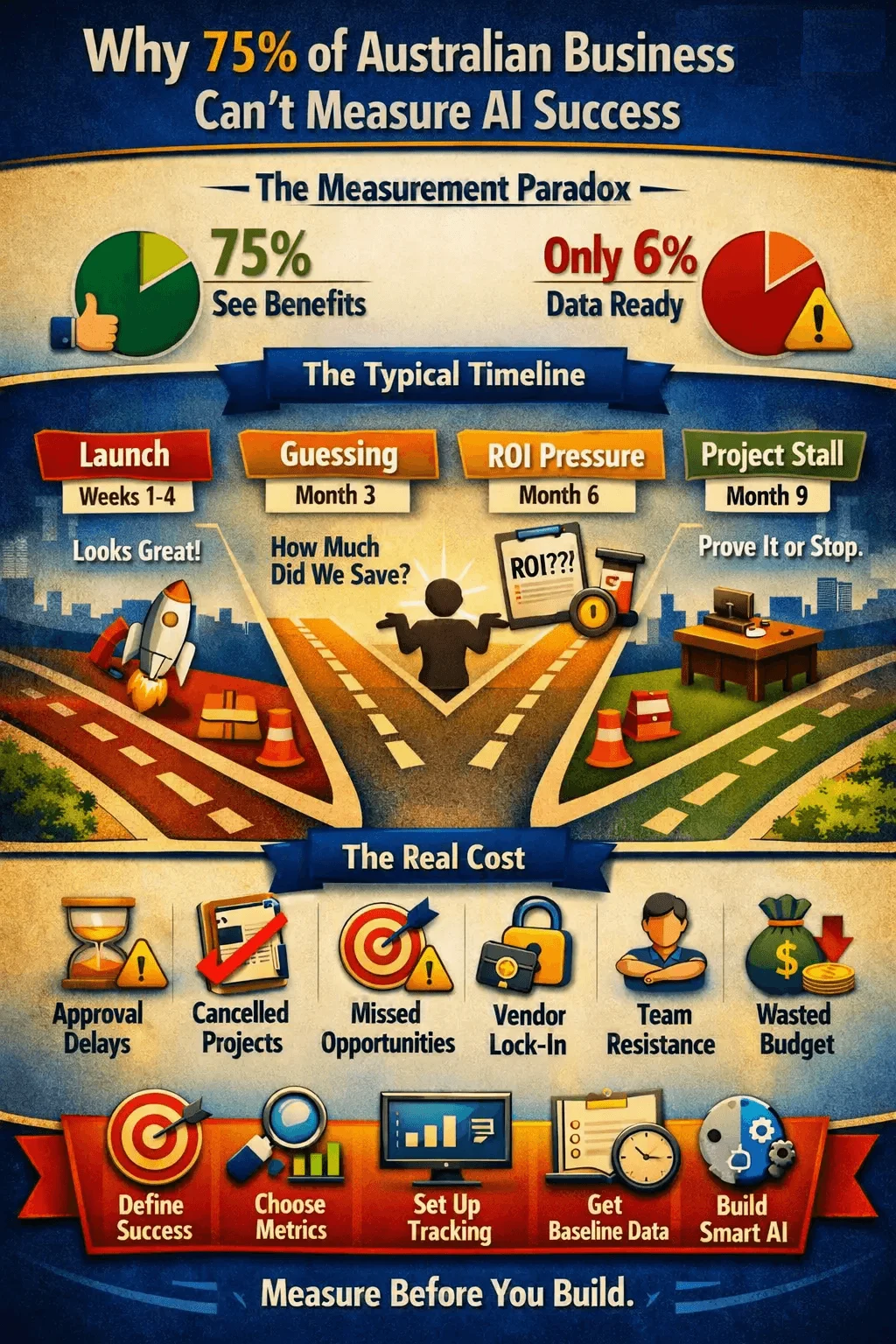
The Measurement Paradox: Seeing Benefits But Can't Prove It
Recent surveys confirm 75% of Australian businesses report measurable AI benefits. However, only 6% say data is fully ready to support AI at scale. This paradox reveals the core problem:
Most Australian businesses deploy AI without a measurement framework.
Here's the typical timeline:
Weeks 1-4: You deploy AI system. It works. Your team is more efficient.
Month 3: Someone asks, "How much time did we actually save?" You estimate. It's a guess.
Month 6: CFO requests ROI proof. You can't provide it. No baseline data was collected.
Month 9: You want to expand AI to other departments. Board says, "Prove the first implementation was worth it." You can't. Project stalls indefinitely.
The Real Cost of Poor Measurement
When Australian organisations skip measurement planning:
- ❌ Approval delays: Can't justify Phase 2, Phase 3 funding without baseline data
- ❌ Project cancellation: Board loses confidence mid-way through implementation
- ❌ Missed opportunities: Don't know where AI delivers highest value
- ❌ Vendor lock-in: Can't prove vendor's value, can't negotiate better terms
- ❌ Team resistance: Staff don't see business case, adopt AI reluctantly
- ❌ Wasted capital: Spent $200K on AI that delivers unmeasurable value
Each missed opportunity costs Australian enterprises tens of thousands in lost competitive advantage.
The Discovery Call Solution: Measure Before You Build
Strategic Australian businesses measure before deployment:
✓ Define what success looks like (cost reduction? speed? quality?)
✓ Identify metrics to track (hours saved? error rate? customer satisfaction?)
✓ Set up measurement infrastructure (automated tracking, dashboards)
✓ Get baseline data (how long does this process take today?)
✓ Then build AI with measurement in mind
This fundamental shift moves you from guessing to knowing—from hoping AI works to proving it works.
The 7-Metric AI ROI Framework (Detailed Breakdown)
This is the framework C9 uses with 50+ Australian enterprises. It separates genuine value from vendor marketing hype.
Metric 1: Labour Cost Reduction (Direct Savings)
What to measure: Hours saved per process × hourly labour cost
Calculation: (Hours saved per day) × (hourly rate) × (52 weeks) × (utilization rate)
Australian context: Account for award wages and on-cost rates specific to Australian employment. Professional services salaries average $80–$120/hour including overheads.
Example: Professional services firm reduced data entry time by 3 hours/day. At $90/hour × 250 working days = $67,500 saved annually. Over 3 years: $202,500 ROI on $100K implementation.
Timeframe: Measure monthly, report quarterly. Labour savings are immediate and measurable.
Metric 2: Revenue Uplift (Customer Impact)
What to measure: Incremental revenue from improved customer experience
Calculation: (# customers) × (revenue per customer) × (lift percentage)
Australian industry benchmarks:
- Retail: 2–5% conversion uplift typical
- SaaS: 5–10% uplift typical
- E-commerce: 3–7% uplift typical
- Financial services: 4–8% uplift typical
Example: Australian e-commerce company deployed AI recommendations. 3% conversion increase on $10M annual revenue = $300K additional revenue. At 40% margin = $120K incremental profit annually.
Timeframe: Requires 2–3 months of data (market sensitivity matters). Revenue uplifts compound over time.
Metric 3: Quality Improvement & Error Reduction
What to measure: Reduction in rework, errors, defects
Calculation: (# errors prevented) × (cost per error) + (quality time saved)
Australian context: Industry-specific error costs are substantial:
- Healthcare: Errors cost thousands per incident (compliance, liability)
- Finance: Regulatory penalties for errors (ASIC, APRA)
- Legal: Errors damage reputation, cost millions
- Manufacturing: Errors cost production delays, warranty claims
Example: Australian healthcare provider deployed AI for patient risk assessment. Prevented 12 serious care errors annually. Each error prevented = $500K+ in liability + reputation cost. Total value: $6M+ annually.
Timeframe: Measure quarterly (requires 2–3 months baseline data). Quality improvements compound.
Metric 4: Speed/Time Reduction (Operational Advantage)
What to measure: Process completion time reduction
Example: Australian bank reduced loan approval from 5 days → 1 day = 400% faster approval cycle
Calculation: (Faster approval) × (# applications per year) × (revenue per application)
Australian context: Financial services and healthcare value speed highly. Faster service = competitive advantage.
Real impact: Bank processed 10% more loan applications annually because of faster approval. Additional volume = $500K+ revenue annually.
Timeframe: Measure immediately post-launch. Speed improvements are immediate.
Metric 5: Customer Satisfaction & Retention
What to measure: NPS/CSAT improvement + churn reduction
Calculation: (Retention improvement %) × (customer lifetime value) × (customer base)
Australian example: SaaS company: 5% improvement in NPS = 2% lower churn. On 1,000 customers worth $10K LTV = $200K retained revenue annually.
Timeframe: Measure quarterly (sentiment requires time to reflect). Long-term value is highest.
Metric 6: Operational Efficiency (Beyond Direct Labour)
What to measure: Inventory reduction, waste reduction, resource optimisation
Example: Australian manufacturing company: Better AI demand forecasting → 15% inventory reduction → $500K working capital freed
Calculation: (Metric improvement) × (unit cost)
Real impact: Freed working capital can be redeployed to growth initiatives.
Timeframe: Measure monthly. Efficiency gains compound.
Metric 7: Competitive & Strategic Value
What to measure: Market share gains, deal wins, new capability enablement
Example: Australian company deployed AI-powered feature competitors don't have. Won $2M contract specifically because of this capability. ROI: Infinite (wouldn't have been possible without AI).
Timeframe: Annual review. Strategic value is long-term.
Why Discovery Calls Save Millions (Not a Waste of Time)
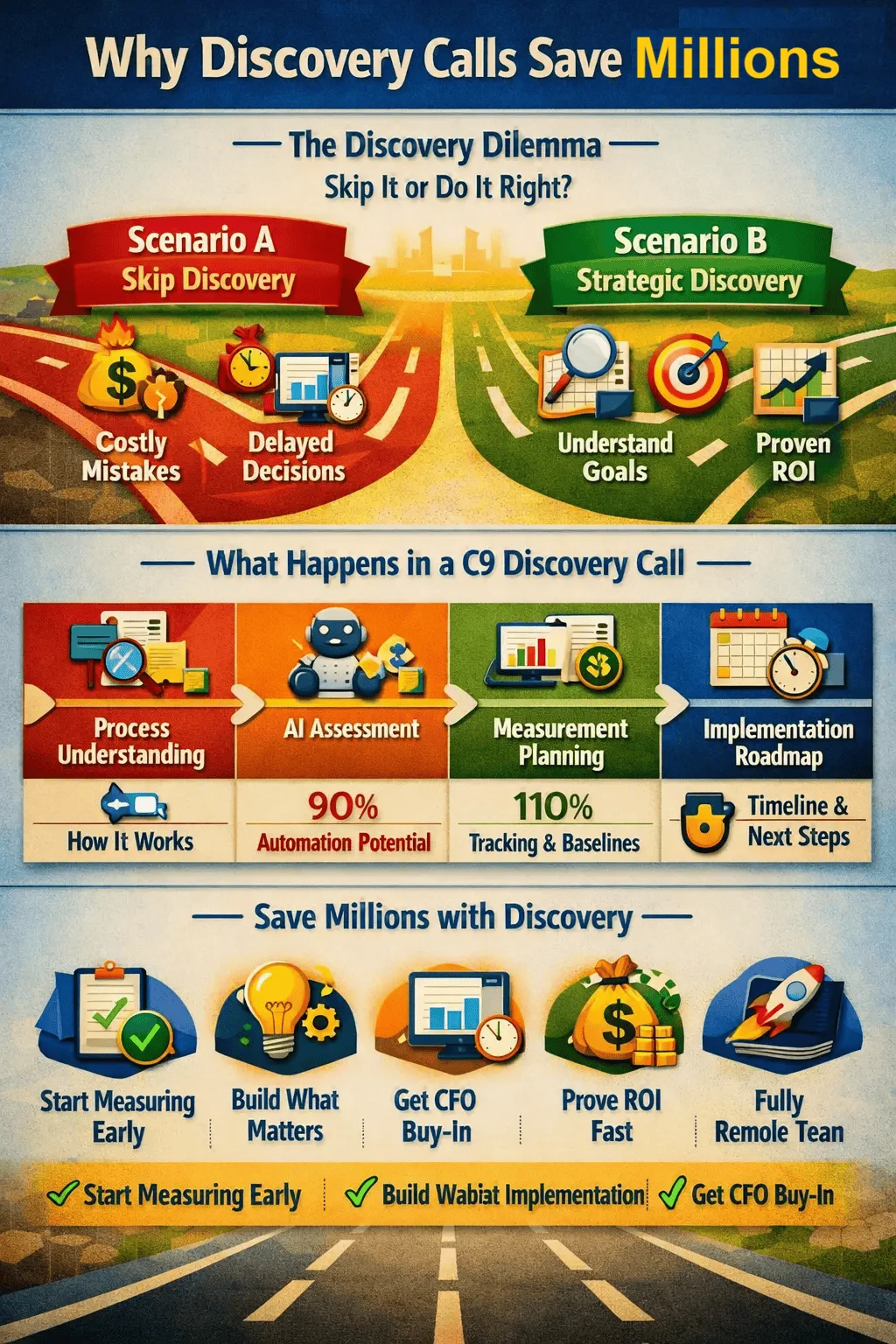
The Discovery Dilemma: Skip It or Do It Right?
Scenario A: Skip Discovery
- Weeks 1–4: You deploy AI without measurement plan
- Month 3: Realise you can't measure results (no baseline)
- Month 6: CFO asks for ROI proof. No data exists.
- Month 9: Spend $50K+ hiring consultants to retrofit measurement
- Month 12: Finally have incomplete data. Decisions delayed.
Total cost of skipping discovery: $50K+ remediation + lost opportunity
Scenario B: Do Strategic Discovery (90 Minutes)
- Discovery call: Understand business, identify metrics, plan measurement
- Cost: $0 (free)
- Result: Deploy AI with measurement built in. Track results from day 1.
- Outcome: Clear ROI proof, board confidence, Phase 2 approval
What Happens in a C9 Discovery Call
Phase 1: Process Understanding (20 minutes)
- Current workflow: How does this process work today?
- Pain points: Where are bottlenecks?
- Systems involved: What systems does data flow through?
- Team: Who does this work? How many people?
Phase 2: AI Opportunity Assessment (20 minutes)
- Automation potential: What % can AI automate?
- Business impact: What's the value of solving this?
- Metrics identification: Which of 7 metrics apply?
- Timeline: When do you need results?
Phase 3: Measurement Planning (20 minutes)
- Baseline data: Current performance metrics
- Success metrics: Which of 7 metrics apply to your business?
- Tracking: How will we collect data automatically?
- Dashboard: How will you see ROI over time?
Phase 4: Implementation & Timeline (15 minutes)
- Realistic timeline: 8–16 weeks for most implementations
- Realistic ROI: Conservative estimates based on your metrics
- Staffing: Fixed project? Staff augmentation? Combination?
- Next steps: If you proceed, what happens?
Phase 5: Q&A & Decision (15 minutes)
- Questions answered
- Budget clarity
- Timeline clarity
- Your decision point
Total time investment: 90 minutes Cost: $0 (free) Value received: Clear roadmap for ROI measurement + implementation strategy + risk prevention
Why Discovery Prevents Disasters
Discovery saves millions because:
✓ You understand ROI upfront (not guessing later)
✓ You measure from day 1 (not retrofitting)
✓ You avoid wasted implementation (only build what delivers value)
✓ You get CFO buy-in (board approves because ROI is clear)
✓ You can justify expansion (Phase 1 ROI is proven)
The "AI Cowboy" Trap—Why Cheap Builders Fail
The Pitch vs. Reality
The promise: "We'll deploy your AI in 4 weeks for $50K. No discovery needed. Just tell us what you want."
The reality:
- Weeks 1–4: They build fast. No measurement planning.
- Month 3: You realise you can't track benefits (no baseline, no infrastructure)
- Month 6: You've spent $50K + $30K on manual ROI calculation = $80K
- Month 9: You want to expand AI. Board says, "Prove Phase 1 worked." You can't. Expansion blocked.
Total cost: $80K+ + lost opportunity
What Gets Cut When Builders Offer "Cheap" AI
- ❌ Discovery process (saves vendor time)
- ❌ ROI measurement planning (complex)
- ❌ Baseline data collection (requires effort)
- ❌ Knowledge transfer (vendor disappears)
- ❌ Ongoing optimisation (no support)
What you get: A system that "works" but delivers unmeasurable value.
The Knowledge Transfer Advantage (C9 Difference)
Cheap builders: Build system, hand it over, disappear
C9: Build system, train your team, ensure you own ROI measurement
When C9 implements AI:
✓ Your team learns how to measure ROI
✓ Your team optimises based on data
✓ Your team justifies expansion to board
✓ You own measurement capability (not vendor-dependent)
This is rare. Most vendors want you dependent forever.
Why C9 Is Different From Other Australian Developers
Advantage 1: Blended Hybrid Team Model
Traditional onshore: Expensive overhead (Sydney/Melbourne salaries)
Traditional offshore: Communication chaos, quality variability
C9's model:
- Australian ROI architects (measurement strategy, Australian business context)
- Offshore execution team (implementation under Australian architect oversight)
- Australian point of contact (available during your business hours)
Why it matters: You get Australian expertise at 30–40% less cost without offshore communication issues.
Advantage 2: ROI Measurement Specialisation
C9 doesn't just deploy AI. We specialise in measuring AI value specifically.
This means:
✓ Measurement built into every implementation
✓ Dashboards for ROI tracking (not manual spreadsheets)
✓ CFO conversations (business language)
✓ Validation with data (not vendor claims)
Advantage 3: Knowledge Transfer Standard
Most vendors train on "how to use the system."
C9 trains on:
- How to interpret ROI metrics
- How to optimise based on data
- How to build Phase 2 business cases
- How to justify ongoing investment to board
Advantage 4: Multiple Resource Options
- Month-to-month ($12–16K/month)
- 3-month minimum ($10–14K/month, 15% discount)
- 6-month minimum ($9–13K/month, 20% discount)
Advantage 5: Integrated Team Approach
You don't get individual contractors. You get:
- Lead architect
- Execution team
- QA specialists
- Knowledge transfer specialist
Staff Augmentation & Flexible Engagement
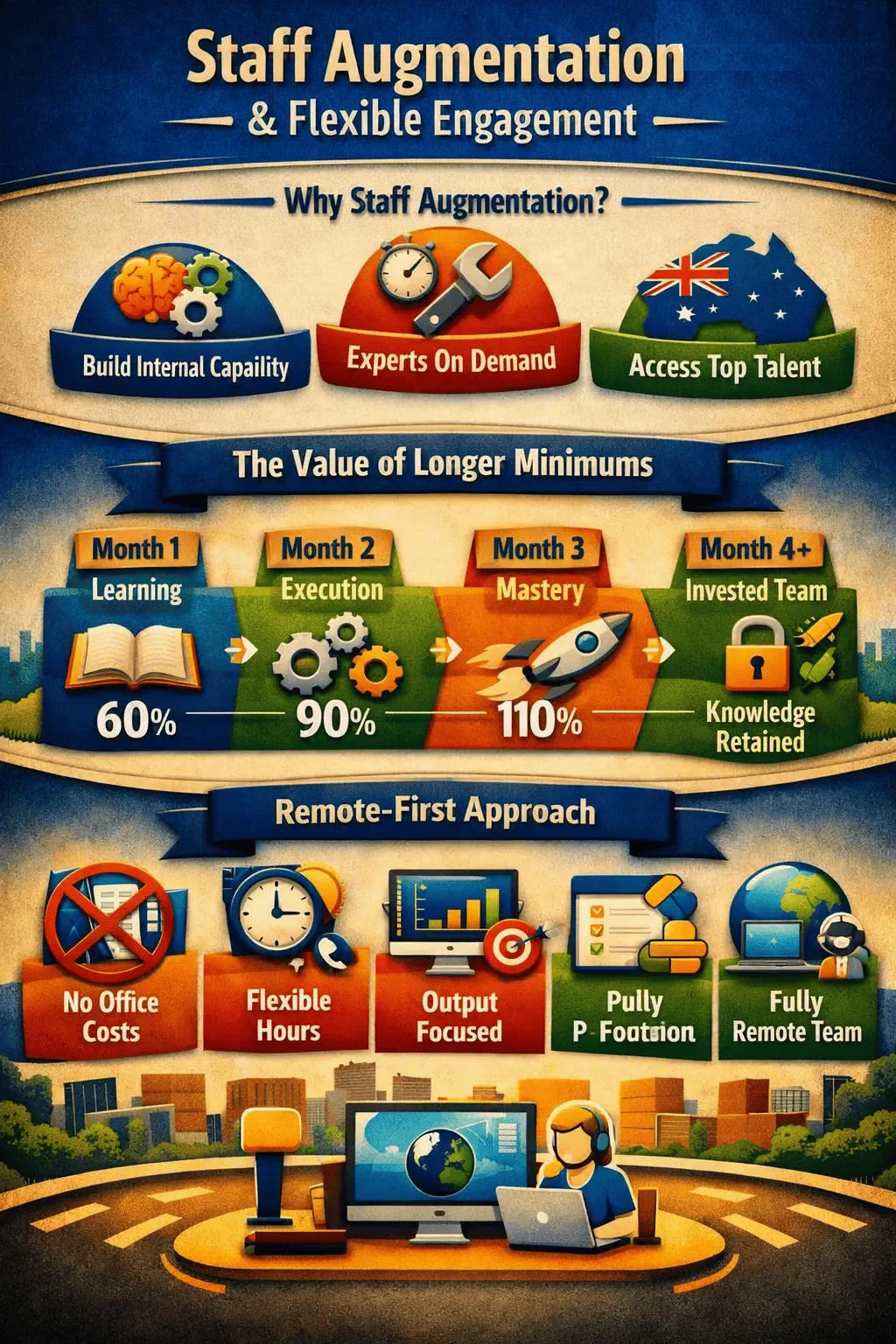
Why Staff Augmentation for AI ROI Measurement?
Reason 1: Build internal capability (not vendor-dependent)
Reason 2: Specialists during implementation only (not permanent hire)
Reason 3: Can't hire ROI experts in Australia's tight talent market
Why Longer Minimums Win
Month 1: Learning phase (60% productive). Paying to train them.
Month 2: Execution phase (90% productive). Delivering value.
Month 3: Mastery phase (110% productive). Training your team.
Month 4+: With month-to-month, knowledge walks out. With 3–6 month minimum, they're invested in your success.
Result: Ownership changes everything.
Important Note: Remote Workers, Not In-Office
C9 doesn't do in-house local hiring in Australia.
Our augmented team is remote-based:
✓ No expectation of office presence
✓ No office overhead for you
✓ Focus on output, not office attendance
✓ Flexibility in working hours
Getting Started With AI ROI Measurement
Step 1: Book Free Discovery Call
90-minute conversation. No obligation. Outcome: Clear metrics, timeline, measurement plan.
Step 2: Get Baseline Data
Measure current performance before implementation. Critical: Can't measure improvement without baseline.
Step 3: Implement With Measurement Built In
Dashboard for real-time tracking. Automated data collection. Monthly ROI reports.
Step 4: Track, Optimise, Expand
- Months 1–3: Track metrics. Optimise based on data.
- Months 4–6: Validate business case. Plan Phase 2.
- Month 12: Annual ROI reconciliation. Decide ongoing investment.
Common ROI Measurement Mistakes (And How to Avoid Them)
Mistake 1: Only Counting Direct Labour Savings
Misses 60% of value (revenue, quality, speed, satisfaction). Fix: Use all 7 metrics.
Mistake 2: Wrong Baseline Comparison
Credits AI for normal productivity gains. Fix: Use "business-as-usual" baseline.
Mistake 3: Measuring Too Soon
3-month measurement shows negative ROI. Fix: Measure quarterly for 12 months.
Mistake 4: Ignoring Intangible Benefits
40% of value is in satisfaction, advantage, risk reduction. Fix: Quantify using industry benchmarks.
Mistake 5: Attributing All Improvements to AI
Multiple factors influence outcomes. Fix: Use control groups or statistical analysis.
In Conclusion: The Strategic Choice
Path 1: Deploy Without Measurement → Can't prove value → No Phase 2 → Wasted investment
Path 2: Deploy With Strategic Measurement → Clear ROI proof → Phase 2 approved → Sustained competitive advantage
The choice is clear.
Book Your Free 90-Minute Discovery Call
🌐 Website: c9.com.au/Solutions/AI 📱 Message: "AI ROI DISCOVERY – [Your Business Name]"
Tell us:
- Your business type
- AI use case
- Measurement concern
- Preferred meeting time
We'll respond within 24 hours.
Key Takeaways
✓ 75% see AI benefits but only 6% can prove it (measurement gap is real)
✓ Strategic measurement planning prevents millions in wasted implementation
✓ Discovery calls save more than they cost (zero-cost risk prevention)
✓ C9's 7-metric framework is battle-tested across 50+ Australian enterprises
✓ Knowledge transfer separates strategic partners from cheap builders
✓ Blended hybrid model delivers quality at 30–40% less cost
✓ Flexible staff augmentation (month-to-month to 6-month options) fits your budget
✓ Proper ROI measurement justifies Phase 2, Phase 3 expansion
References & Sources
-
Australian AI Adoption & Measurement Research
- McKinsey AI Index Australia (2026)
- Gartner CIO Survey APAC Region
- Reference: 75% see benefits, 6% data-ready, 36% have formal measurement process
-
C9 Resources
- 7-Metric AI ROI Framework (battle-tested)
- 50+ Australian enterprise case studies
- Link: c9.com.au/Solutions/AI
-
AI ROI Measurement Best Practices
- Harvard Business Review: Measuring AI Value
- McKinsey: Value from AI Implementation
- Gartner: AI ROI Measurement Frameworks
-
Australian Business Context
- Australian Bureau of Statistics: Digital Economy Report
- CSIRO Data61: Australian AI Adoption Study
- Chamber of Commerce Australia: Digital Strategy Guide
About C9
Australia's Custom Software, AI Integration & Database Developer
We help Australian businesses deploy AI strategically—with clear ROI measurement, knowledge transfer, and flexible staffing options.
Specialising in:
Based in Australia | Serving 200+ Australian enterprises
🌐 c9.com.au 🔗 AI Integration Solutions
AI Transparency Notice:
This article was produced with the assistance of artificial intelligence tools, including content drafting, visual asset creation, and audio generation. All content has been reviewed and approved by C9 prior to publication.