In 2026, agentic AI is no longer experimental. It is becoming operational reality for organisations that treat it as a business capability rather than a technology experiment. Unlike traditional generative AI tools that answer questions, agentic systems pursue goals, take actions across systems, and escalate only when human judgement is required.
Gartner projects that 40% of enterprise applications will include task-specific AI agents by the end of 2026, up from less than 5% earlier. IDC forecasts that by 2030, 45% of organisations will orchestrate AI agents at scale. Australian businesses already show strong practical uptake of AI tools, yet many still struggle to convert experimentation into measurable workflow gains.
The gap between intention and results is wide. This guide clarifies what agentic AI actually does, where it delivers value, why many implementations fail, and how Australian leaders can approach it with lower risk and clearer ownership.
The Difference That Matters: Answers Versus Completed Work
Traditional AI tools respond to prompts. You ask for a summary or analysis; a human then acts on the output. Agentic AI receives a goal and executes the steps required to achieve it within defined boundaries.
Traditional approach Ask: “What are our top customers by revenue growth?” Receive information. Manually update systems, draft communications, and chase approvals. Time to value is measured in minutes to hours of human effort.
Agentic approach Set the goal: identify top customers by growth potential, flag at-risk accounts, prepare a prioritised list, and notify the relevant director. The agent accesses connected systems, applies rules, handles routine exceptions, and escalates only genuine edge cases. Time to value shrinks dramatically for the routine portion of the work.
This shift—from reactive information to proactive task completion—explains the rising interest. Agents can monitor inventory across multiple sites, generate purchase orders within contract parameters, handle standard customer requests, extract and validate data from documents, and route exceptions to the right person. Humans move from performing every step to overseeing outcomes and handling judgement calls.
Real Workflow Impact Across Australian Contexts
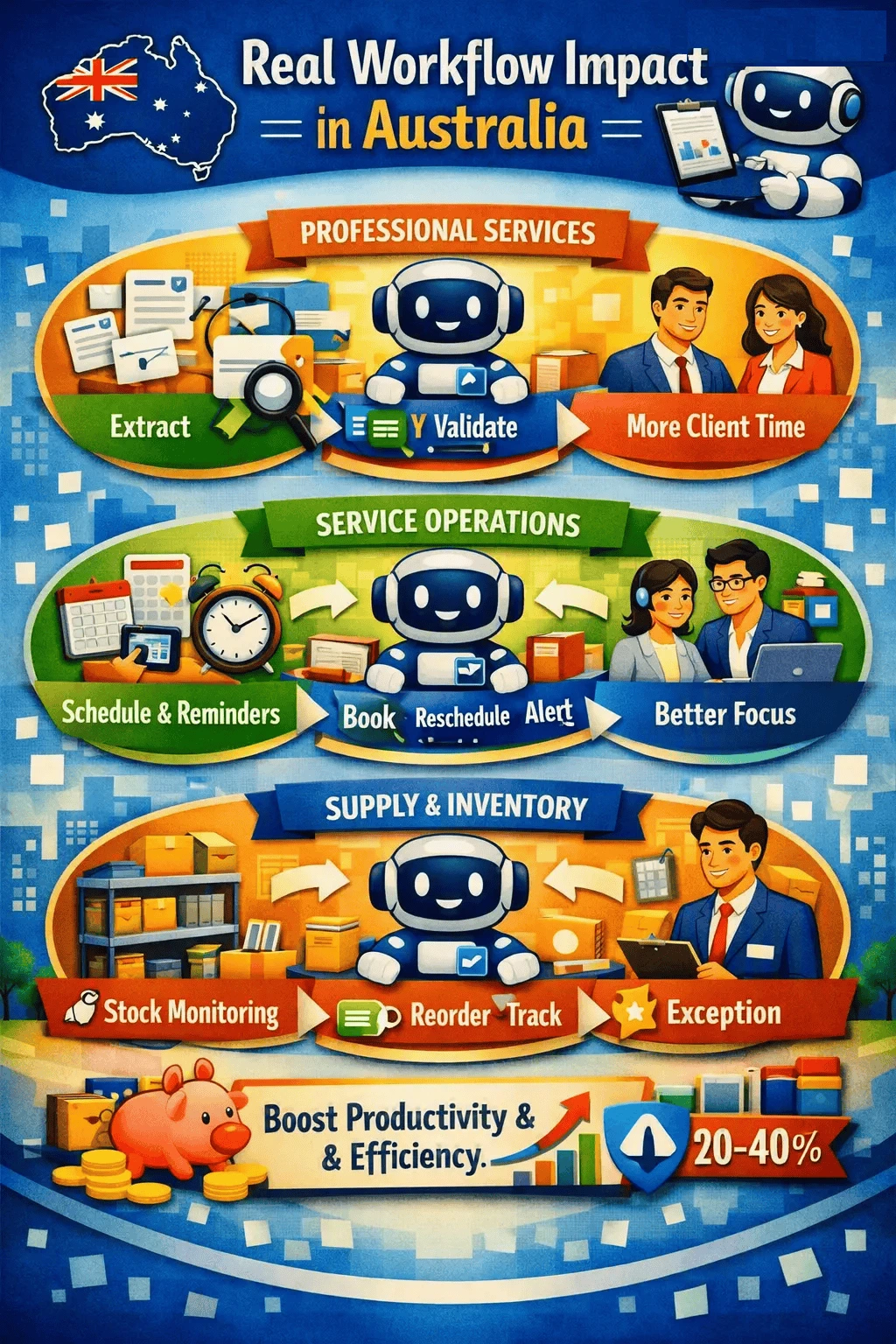
The strongest results appear in repetitive, rule-based processes with clear decision points.
In professional services, junior staff often spend hours on data entry and validation. An agent can extract information from incoming documents or emails, apply validation rules, flag anomalies, and prepare entries for light review. The result is fewer hours on low-value work and more capacity for client relationships.
In service-oriented operations, scheduling, reminders, and standard rescheduling create constant interruption. Agents can manage booking links, send reminders, fill cancellations, and escalate complex cases. Capacity utilisation improves and staff focus shifts toward higher-value interactions.
In supply chain and inventory settings, agents monitor stock levels across locations, generate orders according to agreed rules and lead times, and surface exceptions. Operations managers spend less time on reactive firefighting and more on planning.
Across these patterns the common outcome is the same: the bulk of routine work moves to the agent, decision cycles shorten, error rates fall on standard cases, and people are redeployed to work that requires judgement, relationships, or strategy. Productivity improvements in the 20–40% range for process-heavy teams are frequently reported when implementation is done carefully, though results always depend on process readiness and governance.
Australian data reinforces the opportunity. Research shows many SMEs already using AI report time savings and productivity lifts, and broader modelling points to substantial national productivity potential if adoption matures beyond tools into redesigned workflows.
Why Most Agentic Projects Struggle
Excitement is high. Execution is harder. Gartner has warned that more than 40% of agentic AI projects may be cancelled by the end of 2027 because of unclear business value, escalating costs, and inadequate risk controls. Only a minority of organisations report mature governance for autonomous agents.
Common failure modes include:
- Jumping straight to build without mapping the real process, including edge cases and exception paths.
- Treating agents as a technology purchase rather than a workflow redesign.
- Underestimating integration, data quality, and compliance requirements (including Australian Privacy Act considerations and industry rules).
- Receiving a system that works on the “happy path” but fails in production, leading to low adoption and expensive rework.
- Lack of knowledge transfer, leaving the organisation dependent on the original builder.
Cheap, rapid builds that prioritise demos over architecture create technical debt, compliance gaps, and systems no one fully understands. The apparent savings disappear once production issues, support costs, and eventual rebuilds are counted.
The Strategic Role of Discovery
Discovery is not a sales formality. It is the highest-leverage activity in an agentic project. A structured discovery conversation maps the actual workflow rather than the idealised version, identifies which steps are truly rule-based versus judgement-dependent, surfaces data and system constraints, and produces a realistic view of timeline, cost, and risk.
Without it, organisations often approve budgets based on optimistic assumptions and later discover complexity that doubles cost and triples timeline. With it, leaders can decide whether to proceed, phase the work, or prioritise process stabilisation first. The cost of a thorough discovery conversation is low; the cost of skipping it is routinely measured in hundreds of thousands of dollars of wasted spend and delayed value.
How C9 Approaches Agentic Implementation
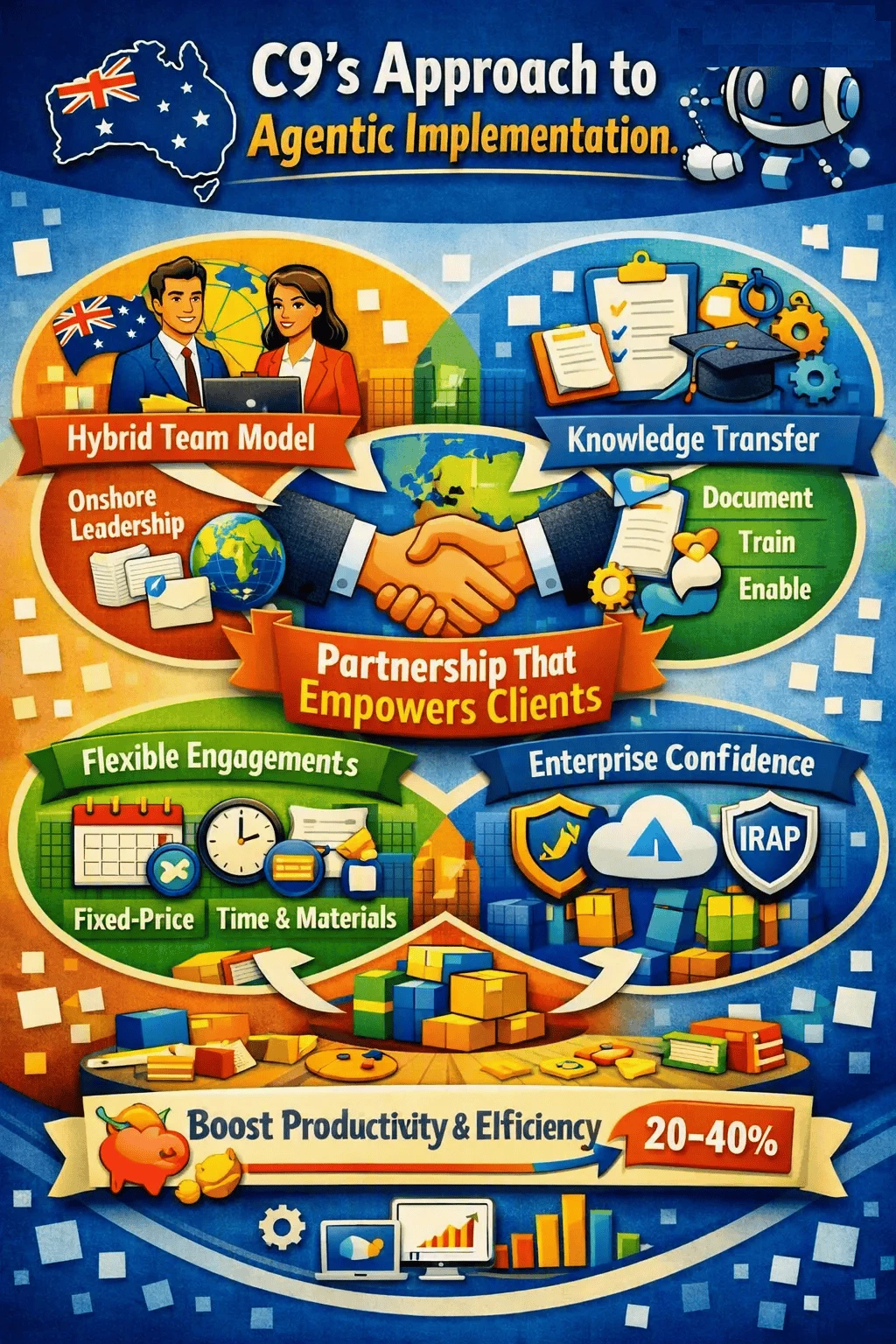
C9 specialises in tailored software, integration, and database solutions for Australian organisations. For agentic AI the same principles apply: understand the business first, design for ownership, and transfer capability.
Key elements of the approach include a blended hybrid team model (Australian-based architects providing oversight and client communication combined with experienced offshore execution capacity). This delivers enterprise-grade architecture at more accessible cost structures while maintaining clear accountability and local contact points.
Knowledge transfer is treated as a core deliverable rather than an optional extra. Documentation, training, and architectural transparency mean clients own and can evolve their systems rather than remaining permanently dependent on a vendor.
Flexible engagement models—fixed-price projects where scope is clear, time-and-materials for exploratory work, and staff augmentation with structured minimum terms—allow organisations to match commercial arrangements to the maturity of the initiative. Longer commitments support continuity and deeper knowledge transfer, which is particularly valuable for systems that require ongoing optimisation.
The emphasis is partnership that leaves the client stronger, not locked in.
Practical Next Steps for Australian Leaders
- Identify one high-volume, rule-heavy process that currently consumes significant team time and creates bottlenecks.
- Assess whether the process is stable enough to automate or whether clarification is needed first.
- Book a discovery conversation focused on mapping the real workflow, decision points, systems, and success metrics.
- Use the resulting clarity to evaluate options and partners on the basis of architecture quality, governance approach, and knowledge transfer rather than headline price alone.
C9 offers free discovery conversations for this purpose. The conversation itself creates value by surfacing constraints and opportunities that are otherwise easy to miss.
Closing Perspective
Agentic AI will reshape how work gets done. Organisations that treat it as a strategic capability—grounded in process understanding, clear governance, and genuine ownership—will capture productivity and competitive advantages. Those that chase speed without structure risk joining the substantial percentage of projects that stall or fail.
The technology is ready. The differentiator is disciplined implementation. For Australian business owners and executives the practical starting point is a clear-eyed assessment of one concrete workflow and a structured discovery conversation that turns ambition into a realistic plan.
Book a discovery conversation with C9 to explore whether agentic AI can deliver measurable improvement in your operations. Visit c9.com.au with a brief description of the workflow you are considering.
Sources and further reading Gartner projections on enterprise applications and agentic AI (2025–2026 reporting). IDC FutureScape 2026 on organisational orchestration of AI agents. Salesforce Agentic Enterprise Index data on agent scaling. Deloitte and other enterprise surveys on readiness and governance gaps. Australian sources including EY modelling of productivity impact, NAB and QuickBooks SME research, and related local analyses of AI adoption and time savings.
Full original references and primary reports are available via the publishers cited above. For the most current figures, consult the latest Gartner, IDC, and Australian industry publications.
AI Transparency Notice:
This article was produced with the assistance of artificial intelligence tools, including content drafting, visual asset creation, and audio generation. All content has been reviewed and approved by C9 prior to publication.