Executive Summary
For Busy Executives: The database administration burnout crisis is reaching critical levels across Australian enterprises. In-house database administrators (DBAs) are drowning in alert fatigue, reactive firefighting, and compliance demands—costing your organisation $550,000–$1.2 million annually in hidden costs. This comprehensive guide explores why traditional DBA hiring fails, how managed database services have become the fastest-growing MSP segment (18% annual growth through 2026), and why C9's hybrid offshore-onshore managed services model represents a fundamentally different approach to database administration and application maintenance in Australia.
Key Takeaway: Database burnout isn't a staffing problem you can solve by hiring another DBA. It's a structural problem requiring a managed services partnership with knowledge transfer, integrated teams, flexible contracts (3–6 month minimums), and discovery-driven planning. Start with a zero-risk discovery call to map your specific challenges and 6-month roadmap.
Understanding the Database Administration Crisis
If you manage technology infrastructure in an Australian enterprise, you've likely experienced this scenario: your database administrator (DBA) is overwhelmed. Not because they're incompetent—they're often highly skilled. They're drowning because modern database environments have become impossibly complex, and your in-house team is chronically undersized for the actual workload.
According to recent industry research, database management services are growing from $26.39 billion globally in 2025 to $29.42 billion in 2026—a compound annual growth rate of 11.5%.[1] This explosive growth is driven by organisations like yours recognising that traditional in-house database administration no longer works.
The problem is clear. The solution is less obvious.
This blog explores:
- Why your database team is burned out (and it's not their fault)
- The true cost of database burnout to Australian businesses
- Why hiring another DBA restarts the burnout cycle
- How managed database services work differently
- Why C9's hybrid offshore-onshore model changes the equation
- How discovery calls map your exact challenges and timeline
- Staff augmentation flexibility for Australian organisations
- Why 3–6 month contracts deliver better outcomes than month-to-month
Database Burnout is Real in 2026
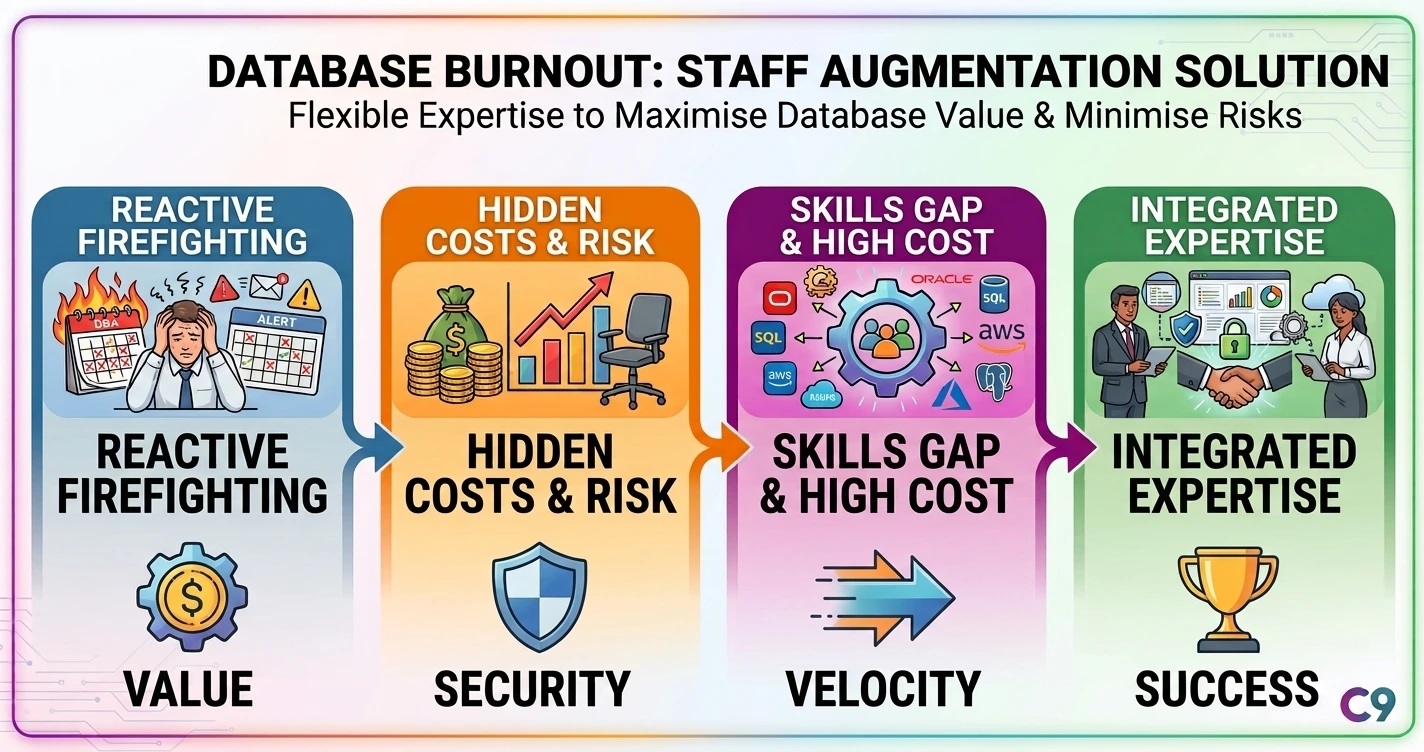
What Database Burnout Actually Looks Like
Your DBA's day starts at 7 AM, before they officially start work. They're checking email for overnight alerts.
There are 47 alerts waiting.
45 are noise—false positives from poorly configured monitoring. 1 is a warning (something to watch). 1 might be critical.
By 9 AM, after filtering through 47 alerts and finding nothing immediately broken, they've already lost focus. Their planned work—performance tuning, compliance audit preparation, disaster recovery testing—gets bumped to "this week." It always gets bumped.
By Wednesday, a developer reports that a database query is running slowly. The DBA drops their planned work (capacity planning for cloud migration) and spends 6 hours optimising the query. Crisis averted.
By Friday, at 4:55 PM, a backup job fails silently. No one notices until Monday morning. The backup from Friday didn't happen. If the primary database had failed over the weekend, recovery would have been from Thursday's backup.
This is database burnout: reactive firefighting disguised as database administration.
Alert Fatigue: The Silent Productivity Killer
A study by PagerDuty found that on-call engineers receive an average of 40+ alerts per week, with 40-80% classified as false positives.[2]
For database teams, the numbers are worse. Typical metrics:
- Average alerts per day: 50–150
- Percentage that are false positives: 60–80%
- Critical incidents requiring immediate action: 2–5 per week
- Time spent triaging alerts vs. strategic work: 60–70% alerts, 30–40% strategic
The result? Your highly skilled DBA spends most of their week doing triage work that doesn't move the business forward.
The Skills Gap: Finding Expertise in Australia is Nearly Impossible
Modern database administration requires mastery across:
- Multiple database platforms (Oracle, SQL Server, PostgreSQL, MongoDB, DynamoDB)
- Cloud platforms (AWS RDS, Azure SQL, Google Cloud SQL)
- Performance tuning and query optimisation
- Security hardening and encryption
- Compliance frameworks (IRAP, APRA, Privacy Act, PCI-DSS, ASX requirements)
- Disaster recovery and business continuity
- Cost optimisation across hybrid environments
- Infrastructure automation (Terraform, CloudFormation)
Finding a single person with expertise across all these areas in Australia? Nearly impossible.
And the cost is punitive. Senior database administrators in Sydney now command $180,000–$220,000 annually—plus superannuation, leave, equipment, and training costs (bringing total cost to $230,000–$270,000+).[3]
Hidden Costs No One Talks About
When your DBA is drowning, these hidden costs accumulate:
| Cost Factor |
Annual Impact |
| Single DBA salary + on-costs |
$220,000–$270,000 |
| Recruitment & onboarding (turnover) |
$50,000–$80,000 |
| Performance degradation (10–15% slower queries) |
$75,000–$150,000 |
| Unplanned outages (2–3 incidents × 3 hours × $10K/hour) |
$60,000–$90,000 |
| Compliance violation risk (audit failures) |
$100,000–$500,000+ |
| Lost developer productivity |
$50,000–$120,000 |
| Security patching delays (breach risk) |
Unquantifiable |
| Total Annual Hidden Cost |
$555,000–$1,210,000+ |
Most organisations don't track these costs separately. They just notice revenue is lower than expected, development velocity is slower than planned, and infrastructure projects always slip.
Why Traditional Database Administration Fails
The Hiring & Retention Trap
Australian CTOs face a brutal reality: finding and keeping good database administrators is one of the most difficult talent acquisition challenges in IT.
The Timeline Reality:
- Initiate recruitment (2 weeks)
- Advertise position, review CVs (3–4 weeks)
- Interview candidates (2–3 weeks)
- Negotiate offer, background check (2 weeks)
- Notice period from current employer (2–4 weeks)
- Onboarding & system learning (8–12 weeks)
Total timeline: 4–6 months from job posting to productive DBA.
Meanwhile, your current DBA is drowning. By the time the new hire is productive, your best DBA has already resigned due to burnout.
The turnover cycle continues. You spend $620,000–$1,000,000+ every 18 months on this cycle, and you're perpetually in crisis mode.
The Compliance & Security Nightmare
If you operate in regulated industries—financial services, healthcare, government—database administration involves strict compliance requirements:
- IRAP (Information Security Registered Assessors Program) for government/sensitive data
- APRA (Australian Prudential Regulation Authority) for financial institutions
- Privacy Act (Australian Privacy Principles) for any organisation handling personal data
- PCI-DSS for payment processing
- ASX/ASIC requirements for ASX-listed companies
Your DBA, drowning in alerts, hasn't:
- Audited database encryption in 6 months
- Updated access control policies
- Tested disaster recovery procedures (ever)
- Verified backup integrity through restoration testing
- Documented compliance evidence for auditors
This isn't negligence. It's the structural reality of understaffed database teams. There aren't enough hours in the week to handle crisis firefighting AND proactive compliance work.
Developer Productivity Leaks Away Silently
Here's a cost no one quantifies: your developers are supporting databases instead of building features.
When your dedicated DBA is overloaded, developers become database administrators by necessity:
- "Why is this query slow?" Developer spends 4 hours troubleshooting
- "Can we add this database index?" Developer implements it without DBA review
- "Database connection pool is exhausted" Developer investigates instead of DBA
Each hour your developer spends on database administration is an hour they're not delivering business value. At $150–$200 per hour (fully loaded cost), this easily reaches $50,000–$150,000 per year in lost productivity.
The Agitation Deepens: Cascade Effects
Performance Degradation You Haven't Noticed
Users today expect instant response. Your application might be running, but it's likely running slowly.
Without proactive performance tuning, database queries execute 30–50% slower than optimal. Users don't complain loudly—they just use your application less. Revenue leaks without anyone noticing the correlation.
Disaster Recovery: The Test You've Never Run
Here's a question that keeps IT directors awake: If your primary database failed today, could you recover it?
Most Australian organisations cannot answer "yes" honestly because:
- Disaster recovery procedures are documented but never tested
- When tested, recovery takes 8–12 hours instead of the promised 2–4 hours
- Backup verification isn't automated
- The person who understands recovery procedures is the one person you can't spare
Compliance Violations Accumulate Silently
Your compliance audit arrives. Auditors ask:
- "Demonstrate your database encryption implementation"
- "Prove access controls restrict data appropriately"
- "Show your disaster recovery procedure works"
- "Verify your backup retention and restoration capability"
If you can't answer confidently, you're looking at findings that lead to fines, corrective action plans, and board-level concern.
The Solution: Managed Database Administration & Application Maintenance Services
Why Managed Services Aren't "Outsourcing" (Breaking the Old Mental Model)
When Australian business owners hear "managed services," they often think: "We'd be losing control. Our data would be offshore. We need local expertise."
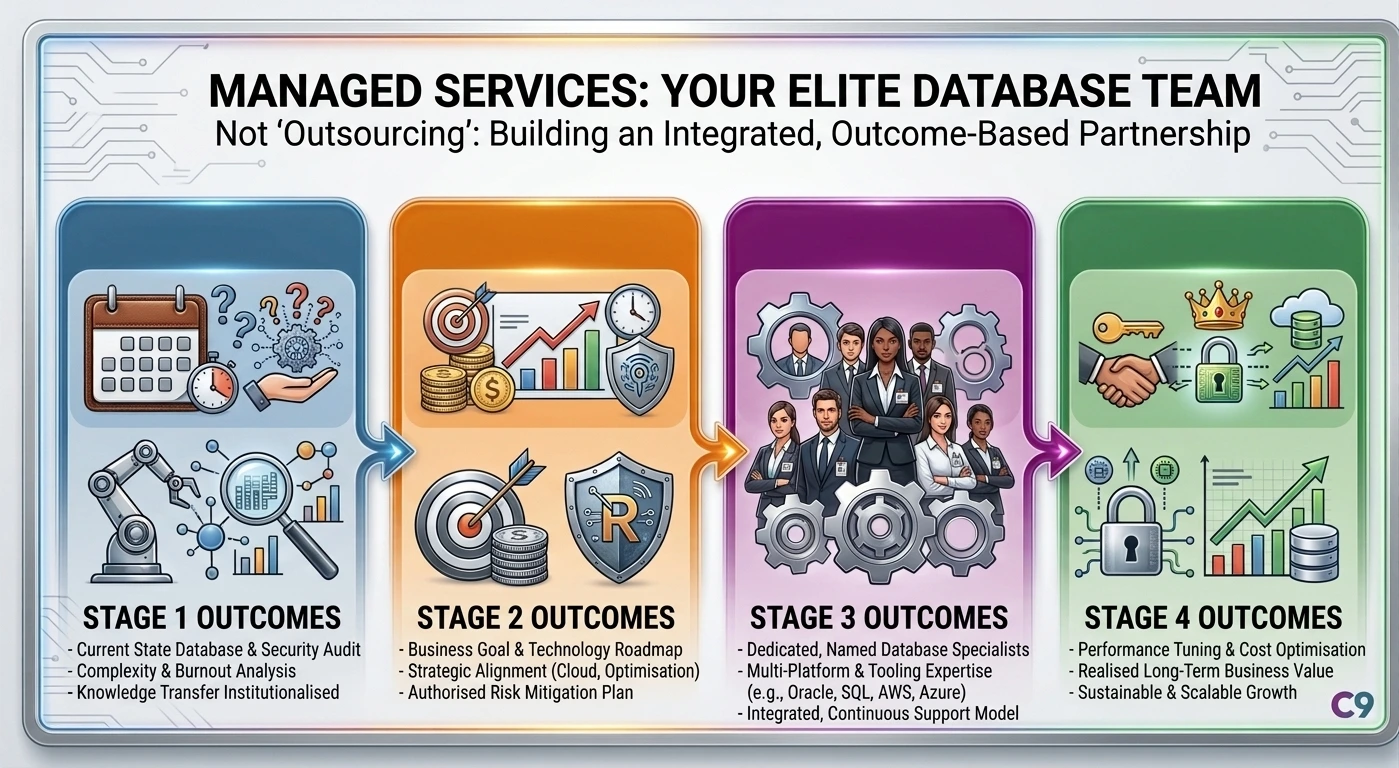
That's the outdated outsourcing model. Modern managed services—specifically C9's hybrid approach—isn't about handing off responsibility. It's about building a dedicated, integrated database team that works as an extension of your business.
Key Difference:
| Traditional "Outsourcing" |
C9's Managed Services |
| Faceless offshore team |
Dedicated, named team members |
| Generic, one-size-fits-all |
Customised to your environment |
| Cost-minimisation focus |
Outcome-based accountability |
| Knowledge walks away when engagement ends |
Knowledge transfer institutionalised |
| Minimal communication |
Regular strategy reviews & reporting |
The result: Your database infrastructure is managed by specialists who understand your business, your compliance environment, and your strategic goals—people who've invested time understanding your specific systems.
How C9's Managed Database Administration Works
Stage 1: Discovery Call (45–60 Minutes, Zero Obligation)
Before you commit to anything, you participate in a structured discovery call with C9's database architecture specialist. This isn't a sales pitch. It's a working session where you:
- Map your current database environment (platforms, complexity, hosting)
- Assess current DBA team capacity and burnout signals
- Identify specific pain points (performance, compliance, scaling)
- Clarify strategic goals (cloud migration, cost optimisation, modernisation)
- Understand decision points and timeline
Why Discovery Calls Matter (And Why Skipping Them Is Your Worst Idea):
A discovery call prevents costly mistakes. You avoid signing contracts for services you don't need. C9 avoids taking on clients where we can't deliver value. Both parties align on success metrics before engagement starts.
Think of it this way: Would you hire a surgeon without a consultation? Of course not. The discovery call is your consultation before committing to database administration management.
What Discovery Calls Accomplish:
-
Current State Assessment (15–20 minutes)
- Database platforms, versions, hosting environment
- Team size and current workload distribution
- Specific pain points (performance, compliance, staffing)
- Technology stack complexity
-
Goals & Challenges Mapping (15–20 minutes)
- Strategic initiatives (cloud migration, scaling, cost optimisation)
- Compliance/regulatory requirements specific to your industry
- Timeline constraints and decision points
- Budget parameters and ROI expectations
-
Engagement Model Discussion (10–15 minutes)
- Managed services vs. staff augmentation fit
- Team structure options based on your needs
- Contract flexibility (3–6 month vs. monthly)
- Investment level and ROI projections
-
Decision Timeline (5 minutes)
- What decisions need internal approval?
- When do you need services operational?
- Who else needs involvement?
- Next steps and follow-up timing
Outcomes: You leave with a written assessment of your database environment, clarity on specific issues, a proposed service model, investment level, and a concrete timeline for implementation.
This is not wasted time. It's the roadmap preventing $50,000+ mistakes.
Staff Augmentation Options & Contract Flexibility for Australian Organisations
Three Service Models
Model 1: Managed Database Services (Full Responsibility)
- Commitment: 3–6 month minimum recommended
- Includes: 24/7 monitoring, incident response, performance tuning, compliance management, proactive maintenance
- Best for: Organisations where DBA burnout is critical and you want to transfer ownership
Model 2: Staff Augmentation (Integrated Team Extension)
- Commitment: 3–6 month minimum recommended (month-to-month available at 20–25% premium)
- Includes: Dedicated team members working as part of your team, knowledge transfer, flexible scaling
- Best for: Organisations with existing database staff needing additional capacity
Model 3: Project-Based Augmentation
- Commitment: Per-project basis
- Includes: Specific initiatives (cloud migration, security audit, compliance remediation)
- Best for: Discrete projects or one-time initiatives
Why 3–6 Month Minimum Contracts Deliver Better Outcomes
Here's where most Australian organisations get this wrong: assuming month-to-month flexibility is always superior.
Reality: 3–6 month minimum contracts deliver substantially better value.
Knowledge Transfer Timeline:
- Weeks 1–2: Team learns your environment, systems, business context
- Weeks 3–4: Team starts delivering quick wins (performance improvements, process optimisations)
- Weeks 5–8: Team implements strategic improvements (automation, compliance hardening)
- Weeks 9–12: Proactive work, architectural improvements, knowledge transfer to your team
Month-to-month contracts mean the team never reaches strategic value. You only get reactive support.
Flexibility Within Contracts
Even with a 3–6 month commitment, flexibility exists:
- Scaling team size: Add specialists for sprints, reduce after completion
- Service model changes: Start with staff augmentation, transition to managed services
- Rotating focus: Database optimisation → cloud migration → compliance hardening
What Separates C9: Three Competitive Advantages
Advantage 1: Blended Hybrid Offshore-Onshore Team Model
C9 operates differently from traditional outsourcing. Instead of pure offshore or pure local, we deploy a hybrid team:
Onshore Component (Australia-based):
- Local account manager familiar with Australian regulatory environment
- Expertise in IRAP, APRA, Privacy Act compliance
- Direct communication with your executive team
- Timezone overlap for urgent escalations
Offshore Component (Globally distributed):
- 24-hour monitoring coverage (someone always watching your databases)
- Cost-effective specialist expertise not readily available in Australia
- Global technical depth across all database platforms
- Continuous knowledge development and certification
The Result: You get Australian business accountability combined with global technical expertise, 24/7 monitoring, and cost efficiency impossible with pure-local engagement.
Advantage 2: Knowledge Transfer & Multiple Resource Depth
This separates C9 from hiring a single DBA:
Knowledge Transfer:
- Your systems, architecture, and decisions are documented institutionally
- Your team learns alongside C9's team (not replacing knowledge)
- If a team member departs, someone else understands your environment
- You build organisational capability, not external dependency
Multiple Resource Availability:
- You're never dependent on a single person
- If your primary contact takes leave, backup coverage is seamless
- Specialised expertise available on-demand (cloud architect, security specialist, compliance expert)
- Your team can execute multiple database initiatives simultaneously
Advantage 3: Remote-First Team (Managing Modern Expectations)
C9 doesn't place consultants in your Sydney office expecting traditional 9-to-5 management. Instead:
- Remote-first approach: Your team works asynchronously with our team
- Timezone coverage: Our offshore team provides overnight monitoring
- Clear communication: Scheduled calls, comprehensive documentation, integrated tools
- Cost efficiency: You save on desk space, parking, and facilities overhead
Top FAQs: Staff Augmentation & Managed Services
FAQ 1: Isn't staff augmentation just expensive freelancers?
No. Key differences:
- Dedicated team member: Same person every week (not rotating contractors)
- Integration: Works within your team processes, tools, and communication
- Accountability: C9 is responsible for quality and delivery
- Continuity: Long-term engagement, not short-term fixes
- Scaling capability: Adds specialists (architect, security expert, cloud engineer) as needed
Freelancers are transactional. C9's augmented team is an extension of your business.
FAQ 2: What if we outgrow the service after 3 months?
Two options:
- Expand the team: Add specialised resources (cloud architect, security specialist)
- Transition to managed services: If database administration becomes central focus, move to full managed model
Both happen within existing contracts. You're never locked into stagnation.
FAQ 3: What happens if a team member leaves?
You're protected:
- C9 maintains bench depth (backup coverage within 2–3 business days)
- Another team member takes over (they know your environment through knowledge transfer)
- Transition is seamless and documented
Compare to hiring a single DBA who resigns: you restart recruitment from zero. With C9, bench depth ensures continuity.
FAQ 4: Do we get a dedicated person or are we shared?
Depends on engagement model:
- Managed services: Dedicated team with your database as priority
- Staff augmentation: Typically dedicated to your project for the contract term
Either way, you have a named primary contact.
FAQ 5: How is this different from hiring offshore directly?
Critical differences:
- Accountability: We're responsible for quality (we replace them if unsatisfied)
- Integration: We handle timezone management and escalations
- Communication: Proven processes for seamless collaboration
- Knowledge: Captured institutionally, not walking away when engagement ends
You're buying outcomes, not just hours.
FAQ 6: What about data security?
Data governance is central:
- Access is role-based and audited (only necessary personnel have access)
- All work is covered by strict NDAs (non-disclosure agreements)
- We comply with IRAP, Privacy Act, and APRA requirements
- You maintain 100% data ownership; we're custodians only
- Access doesn't extend to data analysis or secondary purposes
Think of it like healthcare: your doctor has access to sensitive health information, bound by strict confidentiality. Same applies here.
FAQ 7: Can we scale down if business changes?
Yes:
- Months 1–2: Proof-of-concept period; either party can exit with notice
- After 3–6 month commitment: Scale down (reduce team size, move to project-based)
- Flexibility: We work with you on transitions
No one wants throwing money at services that aren't delivering value.
FAQ 8: What if we want to hire someone in-house after the contract?
We encourage it (with transition period):
- After 6+ months, if you want to hire team members locally, we facilitate transition
- Typical timeline: 4-week knowledge handoff whilst they transition to your payroll
- We ensure knowledge transfer is complete
Building capability in your organisation is a success story.
Why C9 Is Different from Hundreds of Australian Developers
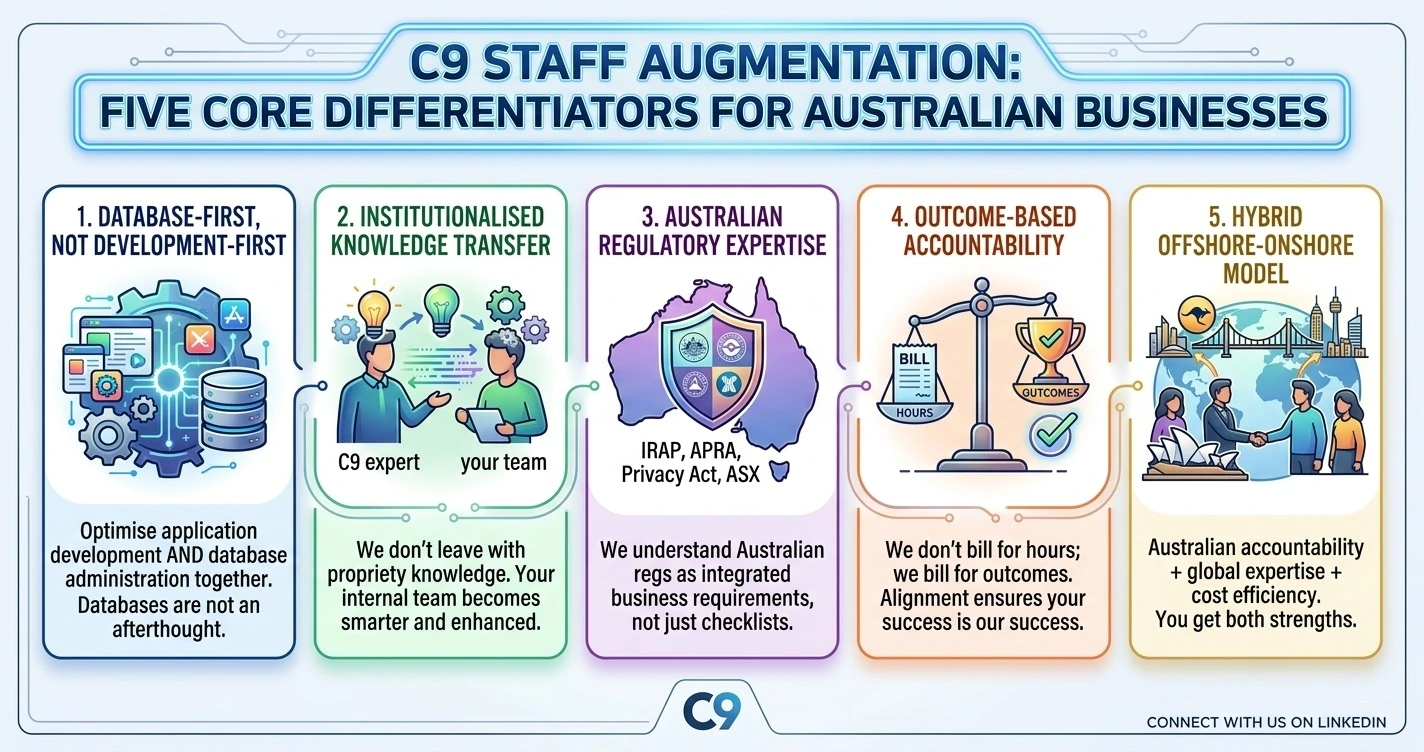
Core Differentiators
1. Database-First, Not Development-First
Most development shops treat databases as an afterthought. C9 was built on the intersection of application development AND database administration. We optimise both—together.
2. Knowledge Transfer Institutionalised
When C9's engagement ends, your team is smarter. We don't leave with proprietary knowledge—we leave with yours enhanced.
3. Australian Regulatory Expertise
We understand IRAP, APRA, Privacy Act, and ASX requirements—not as generic checklists but as integrated business requirements.
4. Outcome-Based Accountability
We don't bill for hours; we bill for outcomes. If your application becomes slow, we feel it. Alignment ensures your success = our success.
5. Hybrid Offshore-Onshore Model
We deliver Australian accountability + global expertise + cost efficiency. Not a choice between expensive local or cheap offshore—you get both strengths.
Book Your Discovery Call Today
Why Act Now?
Database burnout doesn't improve on its own. Every week your DBA remains overloaded:
- Risk: Unplanned outage ($5,000–$50,000+ per hour downtime)
- Risk: Compliance violation discovered in audit (regulatory fines)
- Risk: Your best DBA resigns (6-month recruitment cycle begins)
- Risk: Security vulnerability exploited (unpatched systems)
The discovery call is $0 cost. Not booking it? Potentially six figures in hidden costs.
Next Steps
Ready to act? Book a free 60-minute discovery call:
- Visit: https://www.c9.com.au/Company/Contact
- Select: Your preferred time (Australian business hours)
- Confirm: Within 24 hours
Who should attend?
- CTO or Head of Infrastructure (technical perspective)
- Finance/Operations Lead (business impact perspective)
- Current DBA (technical detail)
(One person is fine—we'll work with that.)
In Short
The Crisis: Your database team is drowning in alert fatigue and reactive firefighting. This isn't about hiring another DBA—it's about structural problems in how database administration is approached in modern enterprises.
Why It Matters: Database burnout costs Australian organisations $550,000–$1.2 million annually in hidden costs. Compliance violations, security vulnerabilities, and lost developer productivity accumulate silently.
The Solution: C9's managed database administration and application maintenance services, built on hybrid offshore-onshore teams, knowledge transfer, integrated team delivery, and flexible 3–6 month contracts. Start with a discovery call mapping your specific challenges and 6-month roadmap.
Your Move: 60 minutes on a discovery call. No strings, no pressure. Just clarity on what's broken, why it matters, and what fixing it looks like.
What's Next?
Database burnout won't improve on its own. Compliance gaps won't self-correct. Security vulnerabilities won't patch themselves.
But they will get more expensive the longer you wait.
The first step is clarity. Book your discovery call this week. Within 60 minutes, you'll have a clear picture of your situation, why it matters, and what fixing it costs.
Everything after that is your decision.
References & Sources
[1] Research and Markets. (2026). "Database Management Services Market Report 2026." Retrieved from https://www.researchandmarkets.com/reports/6215258/database-management-services-market-report
[2] PagerDuty. (2024). "Alert Fatigue Study: The Impact of False Positives on On-Call Engineering." Retrieved from https://www.pagerduty.com/research/
[3] Heidrick & Struggles. (2026). "Australian IT Talent Market Report 2026." Retrieved from https://www.hs.com/en/talent-reports
[4] Integris. (2026). "The 10 MSP Trends to Watch in 2026—and Beyond." Retrieved from https://integrisit.com/blog/the-10-msp-trends-to-watch-in-2026-and-beyond/
[5] PerformanceOne Data Solutions. (2026). "Solving the DBA Burnout Crisis – A Guide to Co-Managed Services." Retrieved from https://performanceonedatasolutions.com/white-papers/co-managed-database-services-solving-dba-burnout/
[6] Blue Crystal Solutions. (2026). "Your Guide to the Best Outsourced Database Administration Providers in Australia." Retrieved from https://www.bluecrystal.com.au/news/best-outsourced-database-administration-providers-in-australia/
[7] Naviant. (2026). "IT Trends 2026: How Managed Services Can Help." Retrieved from https://naviant.com/blog/managed-services-strategic-plan/
[8] Australian Information Security Association (AISA). (2026). "IRAP Compliance Guide for Australian Organisations." Retrieved from https://www.aisa.org.au/
[9] Australian Prudential Regulation Authority (APRA). (2026). "Information Security Requirements." Retrieved from https://www.apra.gov.au/
[10] Privacy Commissioner (Australia). (2026). "Australian Privacy Principles Guide." Retrieved from https://www.oaic.gov.au/privacy/privacy-principles/
[11] Australian Signals Directorate (ASD). (2026). "Essential Eight Maturity Model." Retrieved from https://www.cyber.gov.au/essential-eight
[12] PayScale. (2026). "Database Administrator Salary Australia." Retrieved from https://www.payscale.com/research/AU/Job=Database_Administrator/Salary
About C9
C9 is Australia's leading custom software, applications, integration, and database development company. Since 2010, we've delivered comprehensive managed services for database administration and application maintenance to enterprises across financial services, healthcare, government, and SaaS sectors.
Our hybrid offshore-onshore team combines Australian regulatory expertise with global technical depth, ensuring your database infrastructure is managed strategically, securely, and cost-effectively.
Learn More:
AI Transparency Notice:
This article was produced with the assistance of artificial intelligence tools, including content drafting, visual asset creation, and audio generation. All content has been reviewed and approved by C9 prior to publication.