Australian business owners and executives know artificial intelligence can deliver real operational efficiency, lower costs and a sharper competitive edge. The pressure is real. Competitors are moving. Boards are asking hard questions about growth targets, rising costs and outdated systems. Yet the gap between ambition and results remains stubbornly wide.
Research consistently shows that a large share of AI initiatives never leave the pilot stage. Organisations buy or adopt disconnected tools without first examining their database architecture, workflow processes or data quality. The result is fragmented data, unclear return on investment and stalled projects. Modern AI transformation is an architectural challenge, not a software subscription purchase.
This guide provides the structured roadmap that separates successful Australian implementations from the majority that fail. It follows a clear Pain–Agitate–Solution path so you can evaluate your technical foundation, map a realistic deployment timeline and move with confidence.
The AI Reality Check for Australian Leaders
The promise is compelling. AI can streamline processes, surface insights and free teams from repetitive work. Australian leaders recognise this potential. However, off-the-shelf tools and generic platforms routinely fall short of delivering tailored business outcomes.
The core problem is straightforward. Many organisations skip the foundational work. They introduce tools without a proper system and workflow audit, without verifying whether their data is clean, structured and governance-ready, and without mapping decision points or integration dependencies. Fragmented data, zero clear ROI and stalled initiatives follow.
Strategic context matters. True transformation requires understanding your unique operations, identifying precise pain points and building solutions that fit—not forcing your business into rigid templates. In Australia this also means navigating Privacy Act obligations, data residency expectations and the realities of legacy systems still common across many enterprises.
The “AI Cowboy” Trap and the Real Cost of Cheap Shortcuts
The market is currently flooded with low-cost “AI app builders” and quick-wrapper solutions built on generic third-party platforms. These offerings promise speed and low entry cost. They often deliver superficial results.
The hidden risk is significant. Cheap builders frequently produce fragile code, unscalable integrations and little or no structural technical knowledge transfer to your team. Your organisation becomes dependent on systems it does not fully understand or control. When the vendor relationship ends, or when the underlying platform changes, institutional capability walks out the door.
True custom development works differently. It prioritises complete knowledge transfer so your internal team understands, owns and can maintain the systems long after deployment. This is the difference between a temporary tool and a lasting capability that supports ongoing efficiency, cost control and competitive advantage.
Cheap AI wrappers leave you with fragile systems and zero institutional knowledge. A properly structured custom approach builds long-term capability into the business itself.
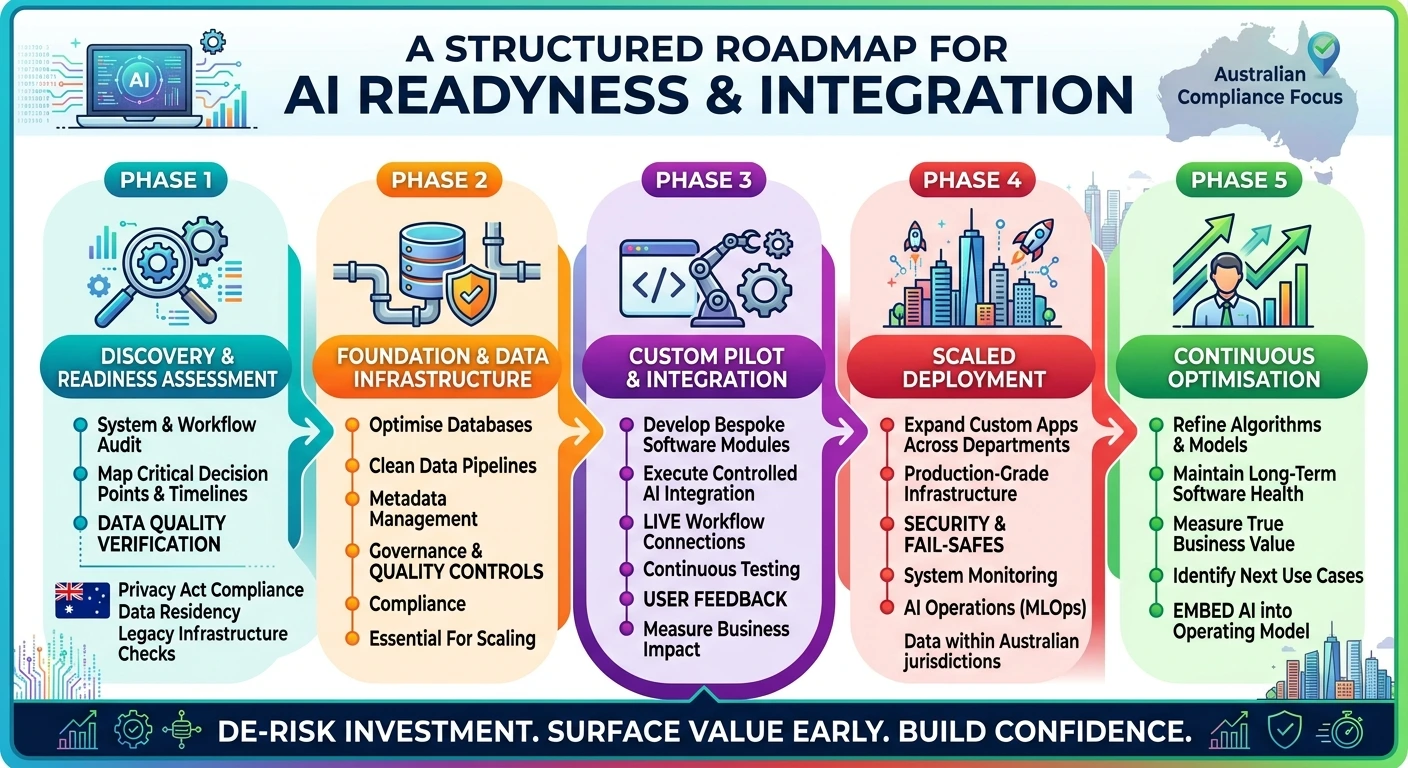
Phase 1 – The Discovery Call and AI Readiness Assessment
Skipping discovery is the fastest route to blown budgets, misaligned expectations and software that nobody uses. A structured discovery process is project insurance, not an optional extra.
A thorough discovery typically includes:
- System and workflow audit – A deep examination of existing databases, application pipelines and internal business rules.
- Decision points and timelines – Mapping critical gates, integration dependencies, key milestones and realistic delivery schedules.
- AI Readiness Assessment – Verification that underlying data quality is sufficiently clean, structured and governance-compliant to support automated systems.
This phase eliminates scope creep, aligns executive stakeholders and ensures every engineering dollar ties directly to a measurable operational metric. Organisations that invest here avoid the costly false starts that consume three to six months later when data quality or use-case viability problems surface.
For Australian businesses the assessment must also address local requirements: Privacy Act compliance, data residency preferences and the practical constraints of legacy infrastructure still operating in many mid-market and enterprise environments.
Phases 2 to 5 – From Foundation to Scaled Production
Once readiness is established, the roadmap moves systematically:
Phase 2: Database and Data Infrastructure
Optimise systems and build clean data pipelines so all automation remains strictly data-driven. Metadata management, governance frameworks, quality monitoring and compliance controls form the foundation. Without this layer, AI projects cannot scale effectively. Expect a substantial portion of budget and time here—organisations that under-invest discover quality issues later and pay for them in delays and rework.
Phase 3: Custom Integration and Pilot Execution
Develop bespoke software modules and execute controlled AI integration within isolated, real-world operational workflows. Connect to production systems rather than sandboxes. Establish measurement baselines, run continuous testing against human decisions, involve actual users early and monitor cost, accuracy and business impact. Pilots grounded in live workflows show markedly higher progression rates to production.
Phase 4: Scaled Deployment
Expand custom applications across operational departments with monitoring, fail-safes, continuous logging and production-grade infrastructure. Address uptime, security, disaster recovery and AI operations practices (model updates, version control, escalation procedures). Keep data within Australian jurisdictions where required by policy or customer expectation.
Phase 5: Continuous Optimisation
Refine algorithms, update database models and maintain long-term software health as business needs evolve. Measure true business impact against original investment. Identify the next high-value use cases, expand internal capability and embed AI into the operating model rather than treating it as a one-off project.
This phased approach de-risks investment, surfaces value early and builds organisational confidence. Large “big bang” deployments fail more often; controlled progression produces faster, more reliable wins.
Why Custom Development Outperforms Generic Approaches
Generic platforms assume clean, well-organised data and simple integration paths. Most Australian organisations do not operate that way. Legacy systems, distributed data and unique business logic create friction that off-the-shelf tools cannot resolve cleanly.
Custom development, by contrast, is designed around your precise operational logic. Solutions integrate with existing ERP, CRM and database environments. They scale without major rework and transfer IP and system knowledge directly to your team, avoiding vendor lock-in.
A blended model that combines strategic Australian project leadership with high-velocity specialist talent delivers both local accountability and cost efficiency. Clients gain access to a full suite of software engineers, database architects and integration specialists rather than a single freelanced resource. The outcome is tailored capability, not rigid templates.
Flexible Engagement and Knowledge Ownership
Custom software engineering requires context, team onboarding and sprint momentum. Structured engagements of three to six months typically deliver higher continuity, code quality and predictable milestone delivery than pure month-to-month arrangements. Integrated teams (developers, quality specialists and solution leads) outperform isolated individual programmers.
Remote professionals can integrate effectively when core hours align with Australian time zones and when onboarding frameworks and documentation are strong. Teams often begin productive contribution within a few business days. After the initial term, scale can be adjusted according to roadmap needs.
Throughout, the priority remains knowledge ownership. Systems and documentation stay with your organisation.
Common Strategic Mistakes and How to Avoid Them
Several patterns repeatedly undermine Australian AI projects:
- Buying tools before defining clear business problems.
- Assuming data is ready when it is not.
- Treating AI as a standard IT project without dedicated change management and governance.
- Measuring ROI only after go-live, with no baseline.
- Attempting one large-scale implementation instead of phased, high-impact use cases.
Each of these is avoidable with a structured readiness assessment, realistic budgeting for data work, early involvement of business stakeholders and built-in measurement from the pilot stage onward.
Next Steps: From Strategy to Execution
AI transformation succeeds when it is treated as an architectural and organisational challenge rather than a quick software purchase. Success requires custom integration, clear decision mapping and a partner committed to transferring knowledge to your team.
Do not gamble your technical foundation on superficial builds. Map your decision points, secure complete system ownership and begin with a proper AI Readiness Assessment.
Book a Discovery Call with C9 to evaluate your organisation’s technical foundation and map a realistic deployment timeline. The conversation focuses on practical guidance—whether and how AI can create measurable competitive advantage for your specific operations.
C9 specialises in custom software, apps, integration and database development for Australian businesses. We work as partners invested in long-term client success, delivering high-end, secure and reliable solutions that stand the test of time.
Sources and References
- S&P Global Market Intelligence findings on AI initiative abandonment rates.
- MIT NANDA / GenAI Divide research on pilot-to-production outcomes.
- Deloitte State of AI in the Enterprise (Australian and global comparisons).
- National AI Centre / Australian government AI adoption insights for SMEs.
- Gartner and related industry surveys on infrastructure and implementation challenges.
- C9.com.au public resources on custom software, AI agents and integration practice.
- Supporting industry commentary on data quality, legacy integration and knowledge transfer risks.
Published by C9.com.au | Custom Software, Apps, Integration & Database Development | September 2026
AI Transparency Notice:
This article was produced with the assistance of artificial intelligence tools, including content drafting, visual asset creation, and audio generation. All content has been reviewed and approved by C9 prior to publication.