EXECUTIVE SUMMARY
Customer service is the front line of every Australian business — and right now, that front line is overwhelmed. Contact centre agents spend the majority of their working day on repetitive, low-complexity tasks: order status checks, billing inquiries, password resets, account lookups, appointment scheduling. These interactions are predictable, high-volume, and perfectly suited to autonomous AI resolution.
Agentic AI changes the economics of customer support fundamentally. Unlike basic chatbots that match keywords to scripted responses, agentic AI systems understand intent, retrieve live data from your business systems, execute multi-step resolution workflows, and escalate to human agents only when genuine judgement is required. The result: dramatically lower cost-per-interaction, 24/7 coverage without proportional staffing cost, and human agents freed to do the high-value work they were hired to do.
This blog covers three things every Australian business owner and executive needs to understand in 2026:
- How agentic AI automates routine administrative tasks across e-commerce, telecommunications, financial services, and IT support — with sector-specific examples and documented ROI.
-
- How generative AI simulation training builds high-performing customer service agents for the escalated, complex interactions that do require a human.
-
- How C9.com.au's bespoke web application development capability delivers the infrastructure that makes both work — integrated, compliant, and built for Australian business.
The businesses deploying agentic AI in their support operations now will establish cost and quality advantages their competitors will take years to close.
|
In short:
- Australian businesses are losing revenue and burning through staff capacity on support tasks that agentic AI can resolve autonomously — faster, cheaper, and at any hour of the day.
- Agentic AI is not a chatbot. It executes complete, multi-step support workflows — from first customer contact through to resolution — without human intervention on routine tasks.
- Generative AI simulation training transforms how contact centre agents prepare for real interactions — using realistic AI-powered scenarios to build competency before going live.
- C9.com.au builds the bespoke web application infrastructure that powers both — purpose-built, integrated into your existing systems, and owned outright by your business.
|
Your Customer Service Team Is Solving Yesterday's Problem With Yesterday's Tools
Ask any customer service manager or operations leader about their biggest challenge in 2026 and you will hear the same answer: volume. The number of inbound support interactions is growing faster than headcount can keep up with, customer expectations for response speed and quality have never been higher, and the gap between what customers expect and what most operations can deliver is widening.
The painful irony is that a large proportion of this volume — research consistently suggests between 60% and 80% — consists of the same predictable, low-complexity queries answered the same way, dozens or hundreds of times per day. Order status. Account balance. How do I reset my password. What are your trading hours. Can I change my appointment.
These are not complex problems requiring human expertise. They are administrative tasks that consume the time, attention, and energy of skilled staff who could be doing something genuinely valuable if the routine work were handled another way. In 2026, that other way is agentic AI.
|
90% of practitioners in the business services sector say repetitive tasks prevent agents from focusing on high-value issues. In 2025, 53% of customer service practitioners identified managing ticket volume without growing headcount as their single top challenge.
— Freshworks CX 2025 Benchmark Report
|
The cost of this inefficiency compounds. When agents spend their days on predictable, repetitive queries, three things happen simultaneously: service quality for complex issues deteriorates because agents are too stretched to give them proper attention; agent burnout increases because repetitive work is demoralising for people who entered a people-focused profession; and operational costs scale linearly with volume, because the only solution available under a manual model is hiring more people.
Agentic AI breaks this cycle — and the return on investment is now thoroughly documented across every sector of Australian business.
Agentic AI vs. Chatbots: Understanding the Difference That Defines the ROI
The term 'AI in customer service' covers a broad spectrum — from the most basic keyword-matching FAQ bot to sophisticated autonomous systems that can navigate complex, multi-step support workflows without any human involvement. The distinction matters enormously, because the ROI differences between these categories are not marginal. They are structural.
Most Australian businesses that have experimented with AI-powered customer service have deployed rule-based chatbots. These tools have limited value: they handle a narrow range of scripted queries, fall apart the moment a customer asks something unexpected, and frustrate users who quickly learn to skip the bot and call a human. This experience has led many business leaders to conclude that AI in customer service 'doesn't really work' — a conclusion that is both understandable and incorrect.
|
Rule-Based Chatbot
|
Agentic AI System
|
|
Matches keywords to fixed, scripted answers
|
Understands intent and context in natural language
|
|
Breaks down on unexpected or multi-part queries
|
Generates accurate, contextually relevant responses
|
|
Requires constant manual content updates
|
Learns continuously from interactions and document changes
|
|
Cannot access your live business systems
|
Integrates with CRM, billing, inventory, ticketing platforms
|
|
Single-turn: one question, one response
|
Multi-step: executes complete resolution workflows autonomously
|
|
No escalation intelligence
|
Detects complexity and routes to the right human agent with full context
|
|
Business hours only without significant cost
|
24/7 at zero marginal cost per additional interaction
|
|
Average ROI: minimal — often negative
|
Average return: $3.50 per $1 invested; top implementations: 8× ROI
|
Agentic AI operates at a fundamentally different level. Powered by large language models and orchestration architecture, an agentic system understands what the customer is trying to accomplish, retrieves the information needed from your live business systems, takes action to resolve the issue — updating records, processing requests, sending notifications — and hands off to a human agent only when the situation requires genuine human judgement.
|
By 2029, agentic AI will autonomously resolve 80% of common customer service issues without human intervention, delivering a 30% reduction in operational costs. Companies implementing AI customer service today see an average return of $3.50 for every $1 invested, with leading organisations achieving up to 8× ROI.
— Gartner, March 2025 / Fullview.io Analysis
|
The Routine Tasks Agentic AI Should Already Be Handling in Your Business
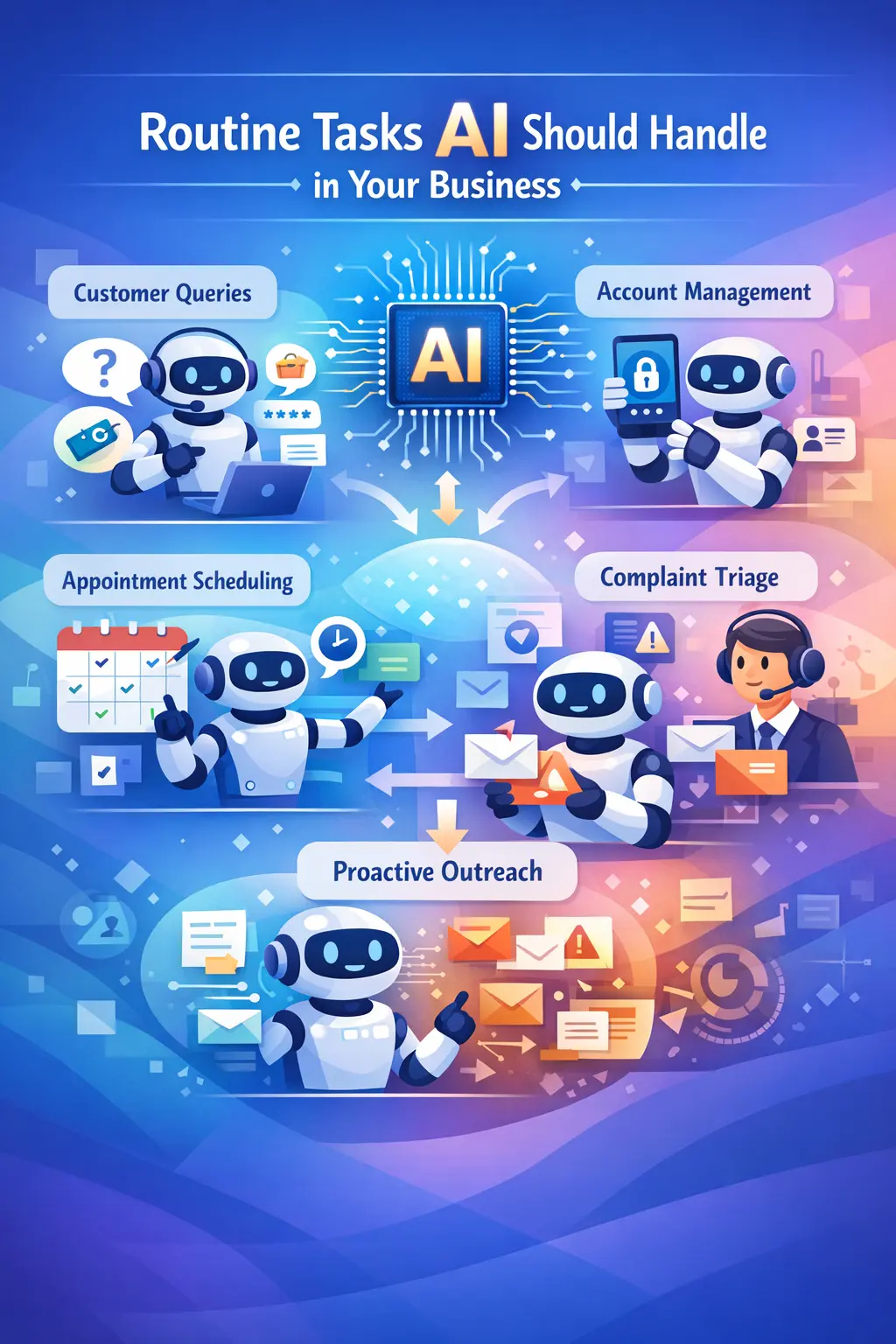
Before examining sector-specific applications, it is worth cataloguing the categories of routine administrative tasks that represent the highest-volume, lowest-complexity interactions across virtually every Australian business — and that are therefore the highest-priority candidates for agentic AI automation.
Tier-1 Query Resolution
The majority of inbound customer service contacts are answering the same questions with the same answers: business hours, pricing, product availability, order status, account balances, delivery estimates, terms and conditions. Agentic AI resolves all of these autonomously, 24 hours a day, with accuracy grounded in your live systems and verified business information.
Account and Identity Management
Password resets, account unlocks, contact detail updates, preference changes — these interactions follow predictable workflows and carry minimal risk when automated. Agentic AI handles them in seconds, with appropriate identity verification, eliminating the queue time that frustrates customers and the agent time wasted on tasks requiring zero judgment.
Appointment and Scheduling Automation
Booking, rescheduling, and cancelling appointments across service-based businesses generates enormous contact volume. Agentic AI connects to your scheduling system, checks real-time availability, confirms or modifies appointments, sends confirmation notifications, and handles the entire workflow without a staff member involved.
Complaint Triage and Ticket Routing
Agentic AI assesses incoming complaints, categorises them by type and urgency, retrieves relevant account history, and routes them to the appropriate team or specialist — with a full summary already prepared. Response times drop from hours to minutes. The right person receives the right case with the right context from the first moment.
Proactive Outreach and Follow-Up
Agentic AI does not wait for customers to make contact. It monitors your business systems for trigger events — overdue invoices, expiring contracts, unresolved tickets, approaching deadlines — and initiates proactive outreach autonomously. This turns a reactive support function into a proactive retention engine.
|
65% of incoming support queries were resolved without human intervention in 2025 — up from 52% in 2023. AI has reduced first response times from over 6 hours to under 4 minutes, and resolution times from 32 hours to just 32 minutes — an 87% improvement.
— LiveChatAI 2025 Dataset / Freshworks CX Benchmark 2025
|
Agentic AI in Action: Four Australian Industries Transforming Customer Support
E-Commerce: From Order Chaos to Autonomous Customer Lifecycle Management
E-commerce is the proving ground for agentic AI. Customer support volume is enormous, inquiry types are predictable and repeatable, and the cost per interaction using traditional staffing models is increasingly unviable at scale. Agentic AI is reshaping the economics of online retail support.
In a typical e-commerce support operation, 70–80% of inbound contacts relate to orders, deliveries, returns, and refunds — all of which follow defined workflows and can be resolved autonomously with live access to your order management system. Agentic AI handles all of these: checking order status in real time, initiating return authorisations, processing refund requests within your policy parameters, updating delivery addresses, and notifying customers of fulfilment milestones — all without agent involvement.
|
E-Commerce — Key AI Automation Opportunities
- Order tracking and status updates — integrated with Australia Post, Startrack, and third-party logistics APIs.
- Returns and refund processing — policy-aware automation that handles straightforward cases and escalates exceptions.
- Product recommendation engines — AI analyses purchase history and browsing behaviour to recommend complementary products during support interactions.
- Abandoned cart recovery — proactive AI outreach to customers who left the purchase funnel, offering assistance to complete the transaction.
- Inventory and availability notifications — automated alerts when backordered products return to stock.
|
|
AI-powered agents drove roughly 20% of retail sales during the 2025 holiday season. Retail companies adopting AI resolve 53% of all incoming queries autonomously, freeing human agents to focus on high-value customer relationships. Companies implementing AI chat assistants saw a 19% increase in repeat purchases within six months.
— Salesforce Commerce Data / Freshworks Retail Report / LiveChatAI 2025
|
Telecommunications: Managing Australia's Highest-Volume Support Operations
Telecom providers operate some of the largest customer support functions in Australia — managing millions of interactions across billing, technical support, plan changes, outages, and device management. The volume is extraordinary; the proportion that genuinely requires human expertise is a small fraction of that total.
Telecom is already one of the most advanced adopters of AI in customer service — 95% of telecom providers have integrated AI into customer support workflows. Agentic AI takes this further, moving beyond assisted responses to full autonomous resolution of the interactions that make up the bulk of contact centre volume.
|
Telecommunications — Key AI Automation Opportunities
- Bill explanation and dispute triage — AI explains billing line items in plain English, identifies discrepancies, and initiates dispute resolution workflows without agent involvement.
- Plan change and upgrade processing — customers express what they need in natural language; AI identifies the optimal plan, presents it, and processes the change end-to-end.
- Technical fault diagnosis — AI guides customers through structured troubleshooting, identifies fault type and likely cause, and either resolves the issue autonomously or schedules a technician with a full diagnostic summary.
- Outage management — proactive AI communication to affected customers during network incidents, reducing inbound contact volume precisely when capacity is most constrained.
- Service activation and porting — new connection setups, number porting, and SIM activation workflows handled autonomously with live integration to provisioning systems.
|
|
Telecom leads all industries with 95% of providers integrating AI into customer support workflows. Vodafone's AI chatbot achieved a 70% reduction in cost-per-chat, serving customers at under one-third the previous expense. TelOne processes over 20,000 queries monthly with zero human agent involvement for Tier-1 contacts.
— NextPhone AI Statistics Report 2026 / Medium CX ROI Analysis
|
Financial Services: Precision AI Automation in a Regulated Environment
Financial services present a more complex deployment environment for agentic AI — regulatory obligations, data sensitivity, and the high stakes of incorrect information all require careful architecture. When deployed correctly, however, the ROI in financial services customer support is among the strongest of any sector.
Australian financial institutions — banks, insurers, superannuation funds, mortgage brokers, and fintech platforms — face enormous support volumes around account management, transaction queries, and compliance disclosures. The vast majority of these interactions are routine; the sensitivity of the subject matter demands accuracy and auditability, not necessarily human delivery.
|
Financial Services — Key AI Automation Opportunities
- Account balance and transaction inquiries — real-time queries answered with live integration to your core banking or accounting system.
- Fraud alert triage — AI identifies flagged transactions, presents them to customers for confirmation or dispute, and initiates the appropriate resolution workflow based on the customer's response.
- Loan and product eligibility pre-screening — agentic AI conducts preliminary eligibility assessments, explains product terms clearly, and qualifies leads before any human advisor is involved.
- Insurance claim initiation — structured claim intake, document checklist generation, and status tracking handled autonomously, with complex assessments escalated to specialists with full context.
- Compliance disclosure automation — regulatory disclosures, cooling-off period notifications, and fee disclosure statements generated and delivered consistently, with complete audit trail.
|
|
Financial institutions project a 38% increase in profitability by 2035 from AI agent integration. Between 2024 and 2028, financial services will account for 20% of global AI spending growth. NIB Health Insurance (Australia) saved $22 million through AI-driven customer service, reducing human support requirements by 60%.
— Warmly AI Statistics 2026 / Smart Customer Service Report 2025
|
|
Australian Regulatory Note
All agentic AI deployments in financial services must operate within ASIC's regulatory guidance on automated advice and digital engagement, APRA's operational risk frameworks, and the Australian Privacy Act 1988. C9.com.au builds complete audit trail architecture, data sovereignty controls, and human oversight mechanisms into every financial services AI deployment from the ground up.
|
IT Support: Resolving the Tier-1 Backlog That's Slowing Your Business Down
Internal IT support — helpdesks and service desks serving employees and business systems — is one of the highest-ROI applications of agentic AI for Australian businesses of any size. The interaction types are highly predictable, the resolution steps are documentable, and the cost of slow resolution (lost employee productivity) is measurable and significant.
The vast majority of IT helpdesk ticket volume is Tier-1: password resets, software access requests, VPN troubleshooting, printer issues, account unlocks, software installation queries. An agentic AI system connected to your identity management platform, ITSM tool, and IT knowledge base resolves these autonomously — 24 hours a day, including weekends and public holidays when helpdesk staff are unavailable and employee productivity loss is just as costly.
|
IT Support — Key AI Automation Opportunities
- Password reset and account unlock — immediate, verified self-service through AI interaction, with multi-factor authentication integrated into the workflow.
- Software access and provisioning requests — AI captures the request, verifies the requester's role and entitlements, routes for approval if required, and initiates provisioning automatically upon approval.
- Guided troubleshooting — AI walks employees through structured diagnostic steps, resolving common issues and escalating genuine faults to Level-2 support with a full diagnostic summary.
- Incident logging and categorisation — AI creates structured, categorised tickets from natural language descriptions, routing them to the right team with priority assigned based on business impact.
- Knowledge base self-service — AI surfaces the most relevant knowledge base article or resolution guide for each specific issue, enabling employee self-resolution before a ticket is even created.
|
|
ServiceNow's AI agents achieved a 52% reduction in complex case handling time, generating $325 million in annualised productivity value. Microsoft's AI-powered support achieved 70% less human intervention and 90% first-call resolution rates. AI-enabled self-service cuts incidents by 40–50% with cost-to-serve reductions of over 20%.
— Smart Customer Service Report 2025 / NextPhone AI Statistics 2026 / McKinsey
|
Automating Call Centres with AI: The Strategy That Cuts Costs Without Cutting Service Quality
Call centres remain the highest-cost channel in most customer support operations — and they remain important. Customers with complex, time-sensitive, or emotionally charged issues still reach for the phone. The strategic objective for Australian businesses is not to eliminate call centre operations, but to ensure that every call handled by a human agent is one that genuinely warrants it.
Agentic AI voice systems achieve this by handling the routine voice interactions that constitute the majority of inbound call volume, while routing genuinely complex or sensitive calls to human agents — with full context already prepared so the agent can focus immediately on resolution rather than information gathering.
What AI Call Centre Automation Does
-
Natural language voice understanding — AI answers calls with conversational capability, not rigid IVR menus. Callers speak naturally; the AI understands intent and responds accordingly.
-
Intelligent authentication — voice biometrics and conversational verification replace the manual security-question process that consumes the first two to three minutes of every inbound call.
- Real-time system integration — while speaking with the caller, AI simultaneously retrieves account information, order history, and case records, providing accurate, personalised responses without placing the customer on hold.
- Sentiment-aware escalation — AI monitors tone and language for frustration, distress, or escalation signals, transferring to a human agent immediately when detected, with full conversation context and a recommended resolution path already prepared.
- After-hours coverage — AI handles the full scope of after-hours call volume, capturing detailed notes and scheduling callbacks without overtime costs or on-call staffing.
|
Conversational AI is projected to reduce contact centre labour costs by $80 billion globally by 2026. Organisations with AI-powered call handling see 40–60% reductions in human agent workload through call deflection. Brands implementing AI-first voice strategy have achieved up to 90% containment rates while maintaining 88% customer satisfaction.
— Gartner / McKinsey Contact Centre Crossroads / LivePerson
|
|
The Key Insight for Australian Business Leaders
Automating your call centre with AI is not about removing people from customer service. It is about ensuring that your people are always working on the interactions that benefit most from their empathy, expertise, and judgment — rather than answering 'What's my account balance?' for the fiftieth time that shift. AI handles the volume. Your team handles the value.
|
Training Customer Service Agents with Generative AI: Building Elite Teams for Complex Interactions
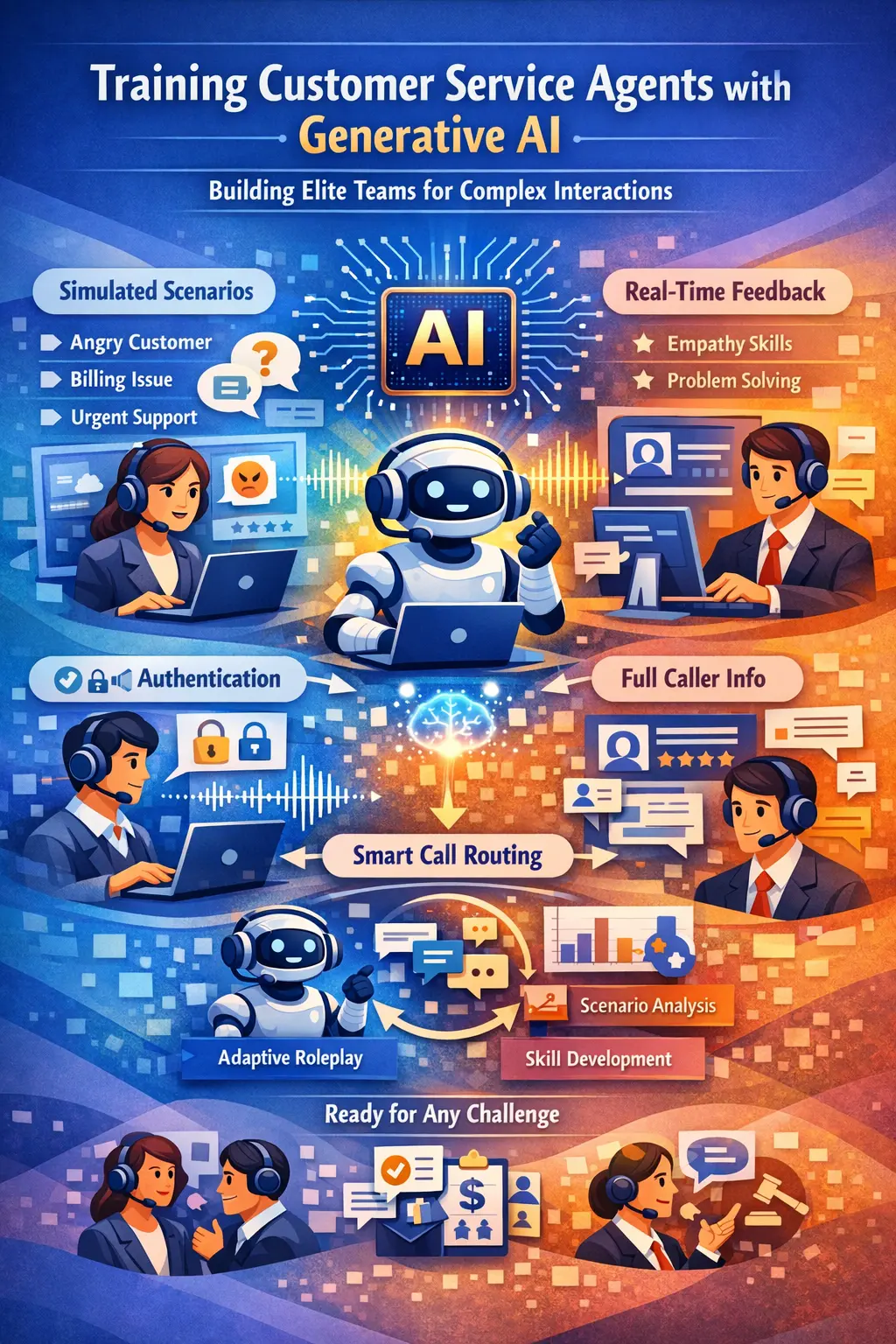
Agentic AI handles the volume. Your human customer service agents handle the complexity. The interactions that reach a human agent in 2026 — because agentic AI has already resolved the routine cases — are precisely the interactions that require the most skill: emotionally charged complaints, multi-faceted account issues, high-value retention conversations, compliance-sensitive disputes.
How do you build a team that is genuinely ready for these interactions, consistently, from their first week in the role? The answer increasingly used by leading Australian and global organisations is generative AI simulation training — and the results it delivers are among the most compelling in talent development.
What Generative AI Simulation Training Is
Generative AI simulation training uses large language models to create dynamic, realistic customer personas that interact with your agents in live training scenarios. Unlike static e-learning modules, scripted role-plays, or supervisor-observed calls, these simulations respond to the agent's actual words — adapting the conversation in real time, exactly as a real customer would.
The AI simulates the full spectrum of customer interactions your agents will encounter: the frustrated e-commerce customer whose order has not arrived and who has contacted support three times already, the telecom customer confused by a $200 bill they did not expect, the small business owner disputing a transaction with their bank under time pressure, the IT user escalating a system access issue that is preventing them from meeting a deadline. Each persona responds authentically and dynamically — rewarding accurate, empathetic responses and creating natural friction when the agent's approach is suboptimal.
|
AI-powered simulation training cuts agent onboarding time by up to 30% and improves KPI attainment by up to 20% across support teams. A landmark study of 5,179 customer support agents found generative AI assistance increases productivity by 14–15% on average — with the greatest gains accruing to newer and lower-skilled agents. Workers using generative AI are on average 33% more productive per hour.
— Second Nature 2025 / NBER Stanford-MIT Study / Federal Reserve Bank of St. Louis
|
How Organisations Build Realistic AI Training Scenarios
The methodology behind effective generative AI simulation training is specific and replicable. Here is how leading customer service organisations — and C9.com.au's implementation partners — build training environments that prepare agents for the real interactions they will face:
- Data-Driven Scenario Design — Your business's actual support ticket history, escalation logs, complaint records, and call recordings are analysed to identify the highest-frequency and highest-risk interaction types. These become the scenario library foundation. Agents practise what they will actually encounter, not hypothetical situations constructed without operational context.
- Dynamic Customer Persona Construction — Generative AI models are configured with specific customer archetypes: demographic profile, emotional state, account history, communication style, and patience threshold. A simulation might present an agent with a repeat-contact customer at the end of their tolerance, or a first-time caller who is confused and needs guiding. Each persona responds dynamically to whatever the agent says — not following a predetermined script.
- Business Knowledge Grounding — Simulation scenarios are anchored to your actual policies, product information, pricing, and operational procedures. An agent practising a billing dispute in a telecommunications context is tested against your specific billing logic, your escalation thresholds, and your compensation policy — not a generic template. This ensures direct transferability to live interactions.
- Real-Time Performance Scoring and Feedback — As the agent navigates each simulation, AI evaluates their responses against defined competency frameworks: accuracy of information, empathy and tone, first-contact resolution capability, correct escalation decision-making, and adherence to company policy. Feedback is immediate and specific — identifying precisely where the response fell short and presenting the optimal approach.
- Progressive Difficulty and Adaptive Scenarios — Simulations adjust complexity as agent competency develops. An agent who handles straightforward billing queries confidently progresses to high-emotion complaints, multi-issue cases, and edge-case escalations. No two sessions are identical — the AI continuously generates novel scenarios within your defined parameters, building genuine adaptability rather than script memorisation.
- Closed-Loop Integration with Live Operations — The highest-performing implementations connect the training environment directly to live AI operations. Interaction types that agentic AI regularly escalates to human agents are automatically incorporated into simulation training scenarios. Agents continuously build competency on exactly the situations arriving in their live queue — creating a self-reinforcing improvement cycle that compounds over time.
|
Why This Matters for Australian Customer Service Leaders
The contact centre industry has long suffered from a fundamental training problem: the traditional approach — classroom instruction followed by supervised live calls — is slow, expensive, inconsistent, and places agents in high-stakes interactions before they are genuinely ready. Customers bear the cost of this in the form of poor experiences. Businesses bear it in the form of repeat contacts, escalations, and churn.
Generative AI simulation training resolves this by giving agents a consequence-free environment to practise and fail before going live — and by giving team leaders objective, data-driven visibility into each agent's development needs rather than anecdotal observation. When agents reach the live queue, they are ready for the interactions that require them.
|
|
AI-driven coaching tracks agent performance in real time and helps supervisors identify coaching opportunities based on actual gaps — not time-consuming blanket training modules. Simulated learning environments allow agents to practise responses in low-risk settings, cutting training costs significantly while improving readiness. Well-trained AI-enabled teams achieve faster resolutions, higher CSAT scores, and stronger overall ROI.
— Sprinklr Customer Service ROI Report 2025
|
Why Australian Businesses Choose C9 for AI-Powered Web Application Development
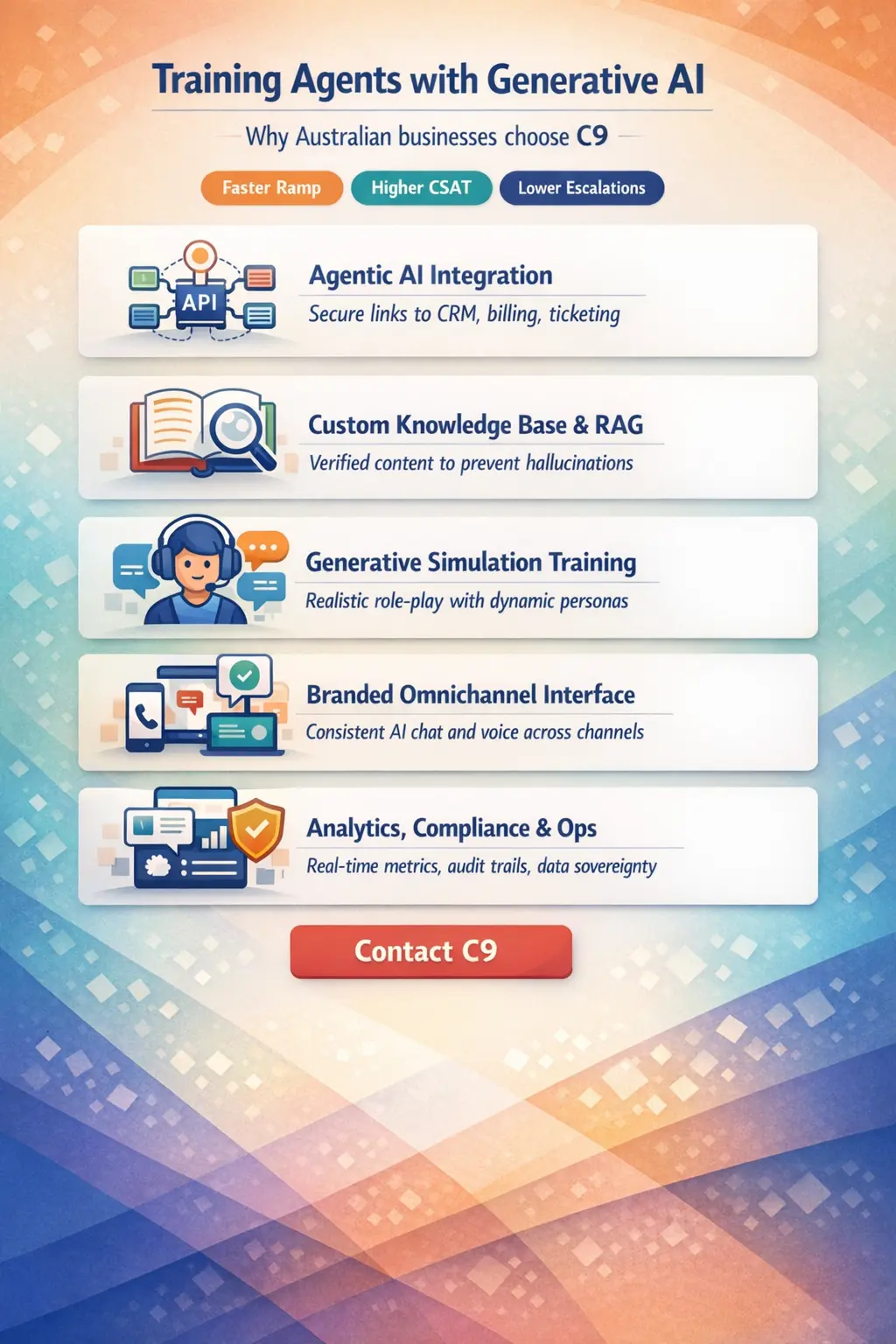
Agentic AI does not work in isolation. It requires a custom web application architecture that connects AI capabilities to your business systems — your CRM, your billing platform, your ticketing system, your product database, your communications infrastructure. Off-the-shelf AI platforms offer generic capabilities with limited integration, rigid workflows, ongoing licence costs, and vendor dependency that grows over time.
C9.com.au is Australia's leading custom software, apps, integration, and database developer. Our web application development services are purpose-built for Australian businesses that require more than template solutions can deliver — and agentic AI in customer support is precisely the kind of complex, integration-intensive challenge where bespoke development delivers its greatest return.
What C9 Builds for Customer Service Operations
-
Agentic AI Integration Layer — secure, purpose-built API connections between your AI engine and your business platforms (CRM, billing, inventory, ticketing, scheduling systems), enabling the AI to retrieve live data and take actions within those systems on behalf of customers.
-
Custom Knowledge Base and RAG Architecture — your business documentation, product information, policies, and FAQs ingested, structured, and made retrievable by your AI system in real time, ensuring every response is grounded in your verified content and eliminates hallucination risk.
- Generative AI Simulation Training Platform — a bespoke training environment where your customer service agents practise realistic customer interactions grounded in your actual business context, receive real-time performance feedback, and build the competency required for the escalated interactions that reach them.
- Branded Omnichannel Interface — a custom AI chat and voice interface reflecting your brand identity, deployed across your website, mobile application, and internal helpdesk — consistent, accessible, and integrated across every customer touchpoint.
- Analytics and Performance Dashboard — real-time visibility into inquiry volumes, AI resolution rates, escalation patterns, agent performance metrics, and customer satisfaction trends, presented in a management interface your team can act on.
- Compliance and Audit Architecture — complete interaction logging, Australian data sovereignty controls, encryption in transit and at rest, and audit trail generation aligned to Australian Privacy Act obligations and sector-specific regulatory requirements.
|
Built in Australia. Owned by Your Business.
Every solution C9 builds is developed by an Australian team that understands your regulatory environment, your operational context, and the standards your business is held to. Your organisation owns the platform outright — no vendor lock-in, no offshore data processing, no escalating licence fees. We build it; you own it; it works for your business, not a generic use case.
|
Website and Application Development Services — Available Australia-Wide
C9 web application development services extend across all sectors and all scales of Australian business. Whether your organisation requires a custom web app that integrates agentic AI into an existing enterprise platform, a greenfield web application development project connecting multiple business systems, or an integration layer that makes your current tools work intelligently together, our Brisbane-based development team delivers bespoke solutions that off-the-shelf products cannot replicate.
If your business requires website and application development that goes beyond what template products can deliver — particularly in customer service automation, AI integration, or complex multi-system environments — C9 is the web app development firm that builds it at the level your business requires.
The Future of Australian Customer Service Is Autonomous — and It Starts Now
Agentic AI in customer service is not a technology Australian businesses should be planning to adopt in two or three years. The technology is production-ready today. The ROI across e-commerce, telecommunications, financial services, and IT support is thoroughly documented. The competitive pressure from early adopters is real and accelerating.
The combination of autonomous AI support workflows — resolving routine administrative tasks at scale, 24 hours a day, with documented accuracy and measurable cost savings — with generative AI simulation training for your human support team creates a customer service operation that is fundamentally more capable, more cost-efficient, and more customer-centric than any manual alternative.
C9 builds the bespoke web application infrastructure that makes this possible — integrated with your existing systems, aligned to your business requirements, and built to last.
|
What's next?
Book a no-obligation discovery session with the C9 team. In 45 minutes, we will map your current support operation, identify your highest-value automation opportunities, and outline exactly what a bespoke agentic AI solution looks like for your business — before your competitors build theirs. Visit www.c9.com.au to get started.
|
Ready to Automate Your Customer Support Operations?
C9.com.au is Australia's leading custom software, apps, integration & database developer. We build bespoke agentic AI systems and web applications for Australian businesses — across e-commerce, telecom, financial services, and IT support.
www.c9.com.au
SOURCES & REFERENCES
All sources cited in this article. URLs current as of March 2026.
2. Gartner — Agentic AI Will Autonomously Resolve 80% of Common Customer Service Issues Without Human Intervention by 2029 (March 2025)
3. Gartner — 40% of Enterprise Apps Will Feature Task-Specific AI Agents by 2026 (August 2025)
4. OneReach.ai — Agentic AI Stats 2026: Adoption Rates, ROI & Market Trends (December 2025)
5. Master of Code Global — 150+ AI Agent Statistics 2026 (February 2026)
6. Warmly — 35+ Powerful AI Agents Statistics: Adoption & Insights 2026
8. LiveChatAI — The AI Revolution in Customer Support: 2025 Statistics
9. LivePerson — Maximise Contact Centre ROI with Conversational AI (August 2025)
10. Smart Customer Service — The Bright Spot for AI ROI in 2025 Is Customer Service (October 2025)
11. Typedef.ai — 7 Customer Support Automation ROI Statistics: Essential Data for Business Leaders in 2025
12. NextPhone — 75 AI Customer Service Statistics 2026 (January 2026)
13. Plivo — AI Agent Statistics for 2025: Adoption, ROI, Performance & More
15. Fortune Business Insights — Agentic AI Market Size, Share & Forecast Report 2026–2034
16. Sprinklr — How to Improve Customer Service ROI with AI in 2025 (April 2025)
17. Second Nature — AI Role-Play Training for Customer Service (2026)
19. TelcoNews Australia — AI Agents and Enterprise Transformation: Turning Hype into Measurable Value in 2026 (March 2026)
20. Google Cloud — AI Agent Trends 2026 Report
21. Brynjolfsson, Li & Raymond — Generative AI at Work, Quarterly Journal of Economics, Volume 140, Issue 2 (May 2025)
22. Medium / Devashish Mamgain — ROI of AI in CX: Prove Your Spend (June 2025)
23. AWS — Financial Institutions Advance Mission-Critical Workloads and Agentic AI at re:Invent 2025 (January 2026)
Explore Related Insights on Managed Services
Revolutionise Your Australian Business: Mastering Remote and Hybrid Staff Augmentation for Unmatched Growth
How to Upgrade IT Systems After Buying a Business in Australia
Why Melbourne Businesses Need a Managed Service Provider for Application Maintenance & Support
Explore Related Insights on AI Solutions
Why Australian Businesses Are Losing Thousands Weekly to Missed Calls — And How Voice AI Fixes It
How Agentic AI Chatbots Transform Lead Engagement: Stop Losing Leads
How Generative AI Is Revolutionising Custom BI Dashboards in Australia
Generative AI & Integration Strategy for Businesses Mobile Application
Why Australian Business Leaders Must Build an AI-Ready Workforce in 2026
AI Agents Are the New Form of Labour
Agentic AI in Customer Service: The Future of Autonomous Support Workflows
Agentic AI in HR: How Autonomous AI Systems Are Reshaping People Management in Australian Enterprises
Agentic AI in Australian Banking: How Custom AI Applications Are Replacing Manual Back-Office Work in 2026
The True Cost of AI Software Implementation in Australia: A Transparent Guide for 2026
What Is Bespoke AI? Why Custom AI Solutions Australia Beat Off-the-Shelf Tools in 2026
From Concept to AI Agent: Building Custom Agentic AI Solutions for Enterprise Workflows
RAG Systems: Stop AI Hallucinations | C9 Australia
AI-Orchestrated Integration Workflows: Transforming Australian Businesses Through Intelligent Connectivity
AI Race: Who's Leading the Pack?
Digital Darwinism: Why Multimodal AI Is the Next Extinction Event for Businesses
Left in the Digital Dust: The Looming Crisis for Businesses Resisting AI and LLMs
The Next Competitive Edge: Why Hybrid AI is the Game Changer for Australian Businesses
How to Calculate the ROI of AI Agents: A Guide for AU SMEs | C9
How Productivity Agents Are Revolutionising Australian Workplaces in 2026 and Beyond
Revolutionising Recruitment: How AI is Reshaping Entry-Level Developer Roles and Essential Skills for Australian Businesses in 2026
Is Your Business AI-Ready? 5 Critical Signs You're Falling Behind (And How to Catch Up)
Beyond the Hype: 5 Verifiable Strategies for Deploying Agentic AI Sales Workflows to Solve the Talent Shortage
AI Transparency Notice:
This article was produced with the assistance of artificial intelligence tools, including content drafting, visual asset creation, and audio generation. All content has been reviewed and approved by C9 prior to publication.