Executive Summary
In 2026, Laravel is not just the most popular PHP framework — it is the most commercially reliable, enterprise‑ready, and future‑proof choice for Australian businesses building mission‑critical web platforms. With 35.87% market share, 2.5M+ websites, and adoption by brands like Amazon, Walmart, Pfizer, and BBC, Laravel has moved beyond “developer favorite” into a primary enterprise standard.
Where cheaper frameworks or AI‑generated code often create brittle, unmaintainable systems, Laravel continues to deliver measurable ROI through stability, tooling, long‑term maintainability, and a massive developer talent pool in Australia. This guide explains the real business reasons behind Laravel’s dominance — performance, scalability, security, innovation — and shows why discovery-first development prevents the expensive rebuilds plaguing businesses who choose the wrong framework or the wrong development partner.
The Problem
Australian businesses are investing six‑figure budgets into applications built on outdated or poorly chosen frameworks, leading to high maintenance costs, limited scalability, and complete rebuilds within 18–24 months. Cheap freelancers and “AI Cowboy” developers promise shortcuts, but leave companies with fragile, insecure applications and ballooning technical debt.
The Solution
Laravel offers a modern, secure, scalable, enterprise‑tested PHP framework with a massive ecosystem, predictable development patterns, and long‑term maintainability. Its proven market dominance, built‑in tooling, and backwards compatibility make it the safest and most cost‑effective foundation for serious digital platforms in 2026.
What’s Next
Before building, businesses must run a structured discovery phase to define requirements, architecture, performance constraints, integrations, and risks. This ensures the Laravel application is engineered properly — not improvised. Organizations that start with discovery prevent six‑figure overruns and guarantee that their Laravel platform scales for 5–10 years.
You're about to invest six figures into a custom web application that will power your business for the next 5-10 years. Your technical advisor mentions Laravel. A freelancer on Upwork promises something cheaper using AI tools.
Here's the reality: The framework decision you make today will determine whether your application scales with your business or becomes an expensive liability requiring a complete rebuild in 18 months.
In 2026, Laravel isn't just surviving—it's dominating. With 35.87% market share among PHP frameworks and powering over 2.5 million websites globally, including platforms for Amazon, Walmart, and BBC, Laravel has evolved from a developer favourite into an enterprise-grade solution.
But beyond statistics lies a more critical question for Australian business owners: How do you ensure your Laravel investment delivers actual ROI rather than becoming another failed digital transformation project?
This guide reveals why professional Laravel development company services matter, how to avoid "AI cowboy" disasters, and why discovery calls prevent six-figure mistakes.
Laravel's 2026 Market Position: Why Enterprise Leaders Choose Proven Technology
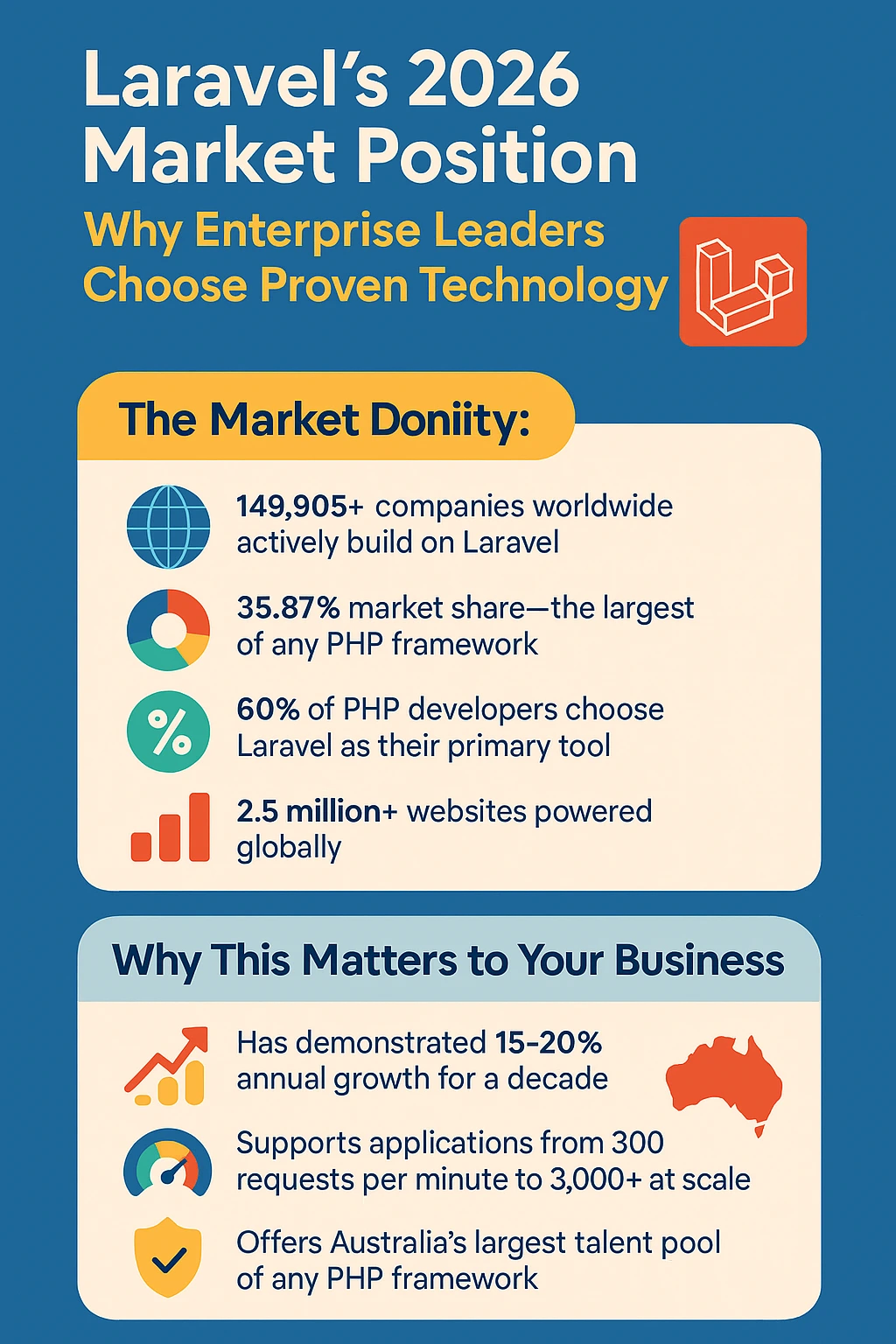
When Amazon, Walmart, and Pfizer build mission-critical applications, they don't gamble. They choose proven, enterprise-tested technology—Laravel.
The Market Reality
Laravel's Dominance:
- 149,905+ companies worldwide actively build on Laravel
- 35.87% market share—the largest of any PHP framework
- 60% of PHP developers choose Laravel as their primary tool
- 2.5 million+ websites powered globally
Why This Matters to Your Business
When you choose a PHP development company specialising in Laravel, you're not betting on experimental technology. You're investing in a framework that:
- Has demonstrated 15-20% annual growth for a decade
- Supports applications from 300 requests per minute to 3,000+ at scale
- Maintains backward compatibility, protecting your investment
- Offers Australia's largest talent pool of any PHP framework
The Australian Context: PHP powers 77.5% of websites with known server-side languages globally. In Australia's competitive digital landscape, Laravel has become the de facto standard for serious business applications because it balances rapid development with enterprise reliability.
Your competitors aren't asking "Should we use Laravel?" They're asking "How quickly can we launch on Laravel to capture market share?"
The Financial Case: ROI That CFOs Actually Care About
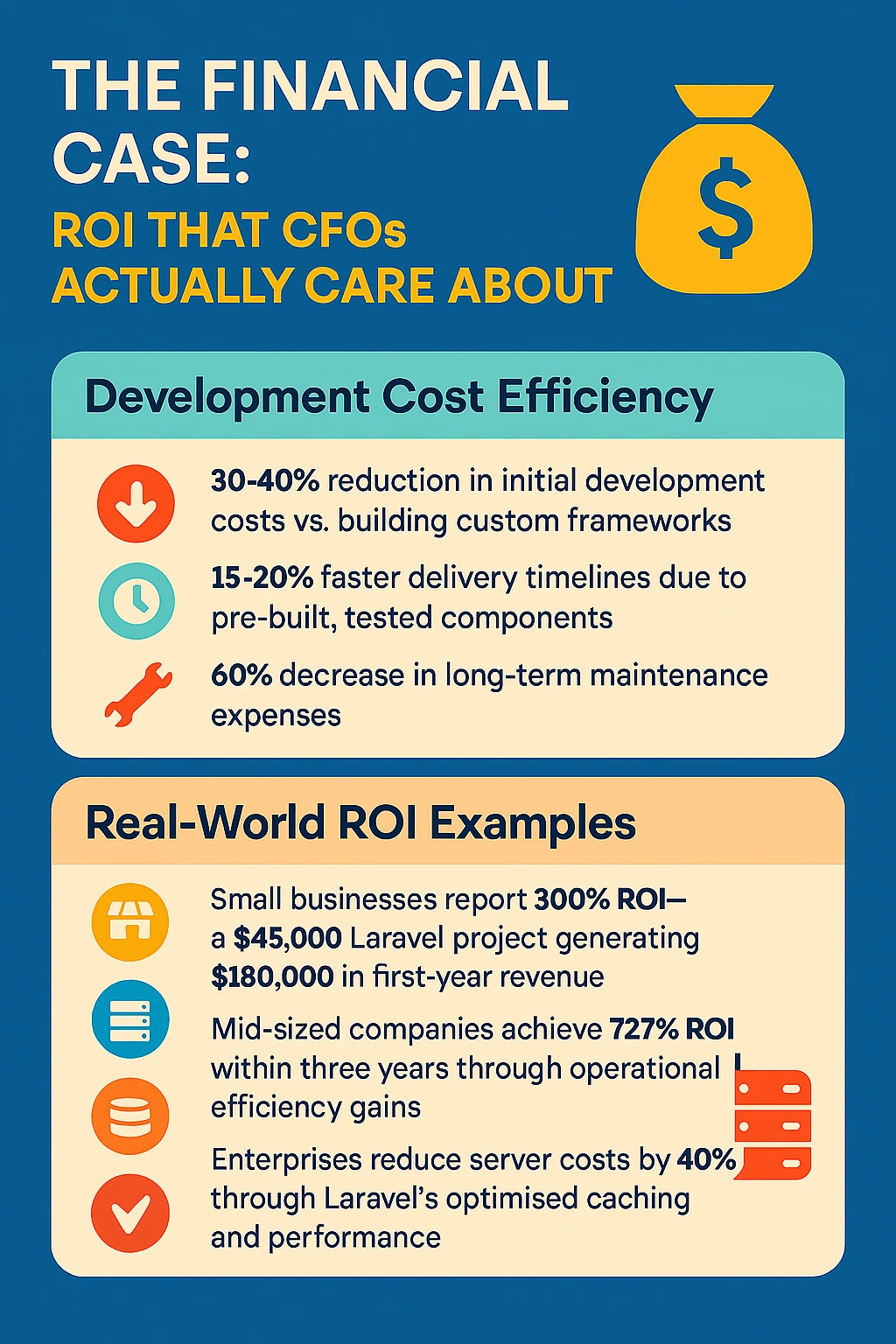
Quantifying Laravel's Business Impact
You've been burnt before. The last development project went 40% over budget, took eight months instead of four, and still doesn't deliver what you need.
Laravel delivers measurable, documented ROI through professional PHP development services.
Development Cost Efficiency
- 30-40% reduction in initial development costs vs. building custom frameworks
- 15-20% faster delivery timelines due to pre-built, tested components
- 60% decrease in long-term maintenance expenses
Real-World ROI Examples
- Small businesses report 300% ROI—a $45,000 Laravel project generating $180,000 in first-year revenue
- Mid-sized companies achieve 727% ROI within three years through operational efficiency gains
- Enterprises reduce server costs by 40% through Laravel's optimised caching and performance
Time-to-Market Advantage
In Australia's competitive markets, launching 3-4 months earlier than planned can mean:
- Capturing seasonal demand (retail, tourism)
- Beating competitors to market with new services
- Starting revenue generation whilst competitors are still building
Laravel's mature ecosystem—with 15,000+ pre-built packages—means your Laravel development company isn't reinventing wheels. They're assembling proven components into your unique solution.
Total Cost of Ownership (TCO) Comparison
| Cost Factor |
Custom Framework |
Laravel |
| Initial Development |
$150,000 |
$100,000 |
| Year 1 Maintenance |
$45,000 |
$20,000 |
| Year 2-3 Scaling |
$80,000 |
$30,000 |
| 3-Year Total |
$275,000 |
$150,000 |
| Developer Availability |
Limited |
Abundant |
| Risk of Rebuild |
High |
Low |
Enterprise Security & Compliance: Protecting What You've Built
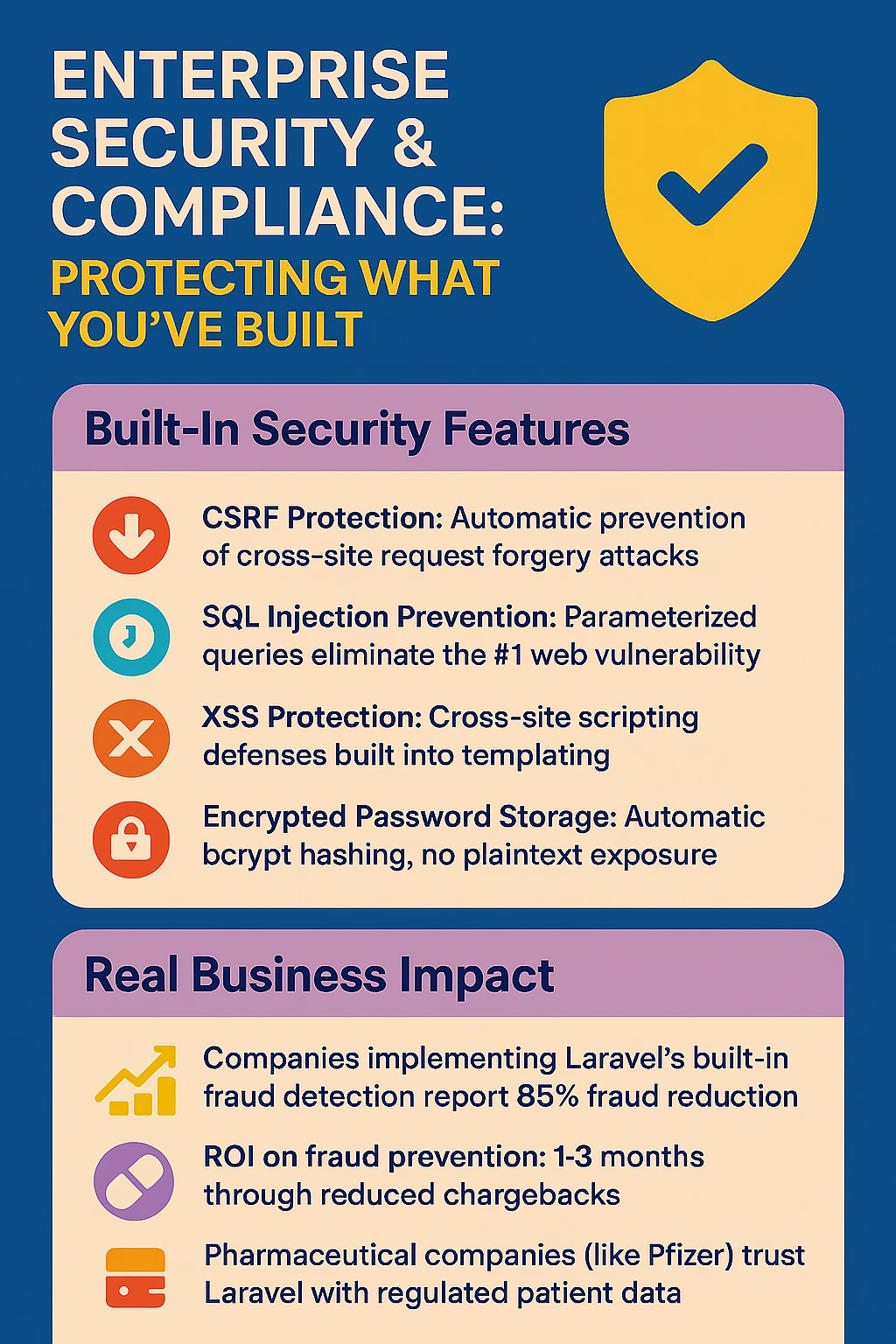
The Business Cost of Security Failures
Data breaches cost Australian businesses an average of $3.35 million per incident. Beyond immediate costs, you face regulatory penalties under the Privacy Act, customer trust erosion, and potential class-action exposure.
Generic frameworks force developers to build security from scratch—where 90% of breaches occur due to human implementation errors.
Laravel's security-first architecture protects your business with built-in enterprise features.
Built-In Security Features
- CSRF Protection: Automatic prevention of cross-site request forgery attacks
- SQL Injection Prevention: Parameterised queries eliminate the #1 web vulnerability
- XSS Protection: Cross-site scripting defences built into templating
- Encrypted Password Storage: Automatic bcrypt hashing, no plaintext exposure
- Secure Session Management: Industry-standard session hijacking prevention
Real Business Impact
- Companies implementing Laravel's built-in fraud detection report 85% fraud reduction
- ROI on fraud prevention: 1-3 months through reduced chargebacks
- Pharmaceutical companies (like Pfizer) trust Laravel with regulated patient data
When you hire a professional PHP development company like C9, you're buying a decade of security best practices, implemented correctly the first time. The alternative? Discovering vulnerabilities after launch when fixes cost 30x more than building it right initially.
Scalability: From Startup to Enterprise Without Rebuilding
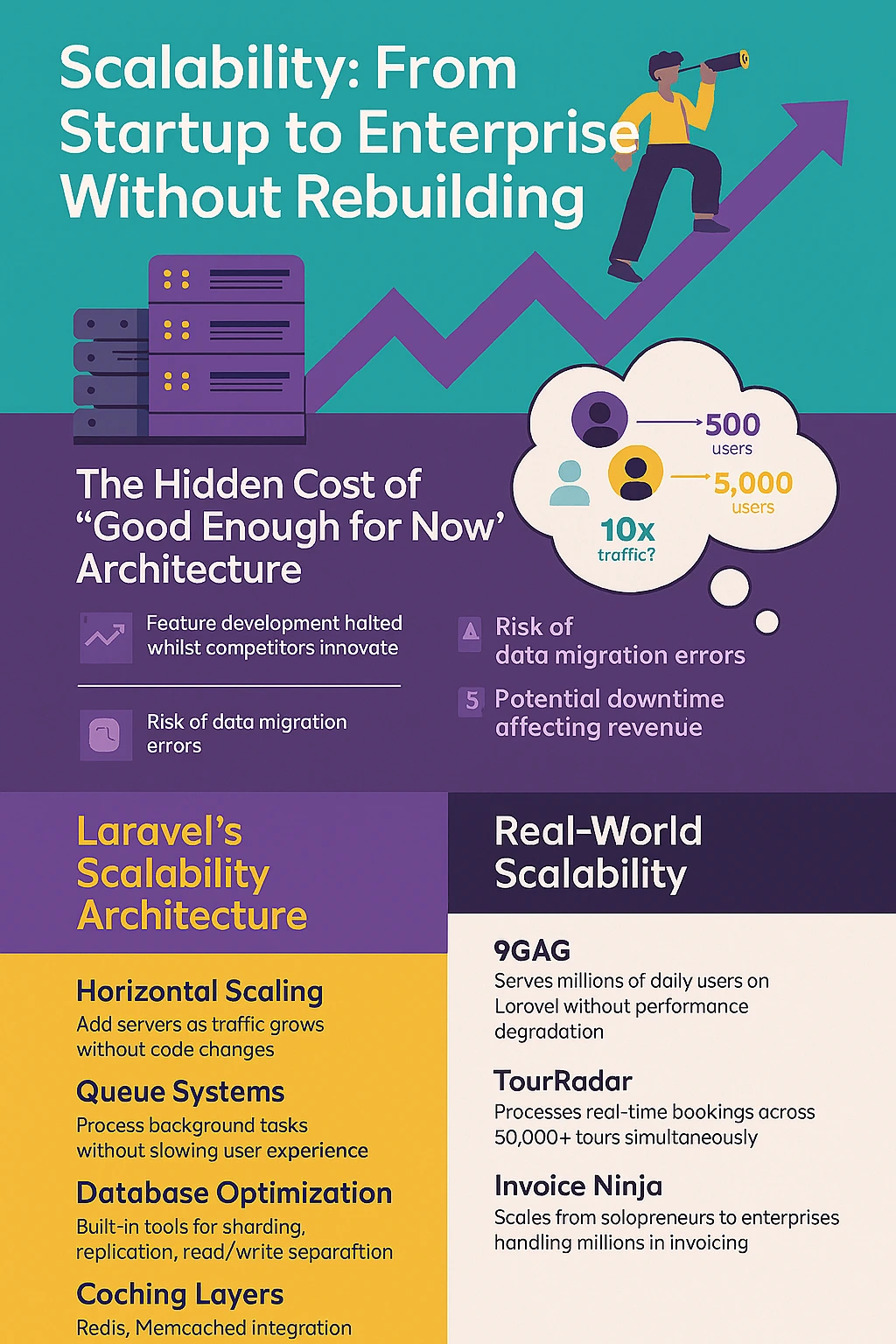
The Hidden Cost of "Good Enough for Now" Architecture
Your current platform works fine at 500 users. But your growth plan projects 5,000 users in 18 months. You're terrified to ask: "Can our platform handle 10x traffic?"
Rebuilding isn't just expensive (typically 2-3x your original investment). It's strategically devastating:
- 6-12 months with engineering resources frozen
- Feature development halted whilst competitors innovate
- Risk of data migration errors
- Potential downtime affecting revenue
Laravel's Scalability Architecture
Technical Scalability:
- Horizontal Scaling: Add servers as traffic grows without code changes
- Queue Systems: Process background tasks without slowing user experience
- Database Optimisation: Built-in tools for sharding, replication, read/write separation
- Caching Layers: Redis, Memcached integration for 40% server cost reduction
- Microservices Ready: Break monoliths into services as complexity demands
Real-World Scalability
- 9GAG: Serves millions of daily users on Laravel without performance degradation
- TourRadar: Processes real-time bookings across 50,000+ tours simultaneously
- Invoice Ninja: Scales from solopreneurs to enterprises handling millions in invoicing
The Laravel Growth Path
Phase 1: MVP Launch (Months 1-3)
↓ Single server, 500-1,000 users
↓ Cost: $50-100/month hosting

Phase 2: Growth (Months 4-12)
↓ Load balancer + 2-3 servers, 5,000-10,000 users
↓ Cost: $300-500/month hosting

Phase 3: Scale (Year 2+)
↓ Auto-scaling infrastructure, 50,000+ users
↓ Cost: $1,500-3,000/month hosting
No rebuild required. Same codebase, progressively enhanced infrastructure.
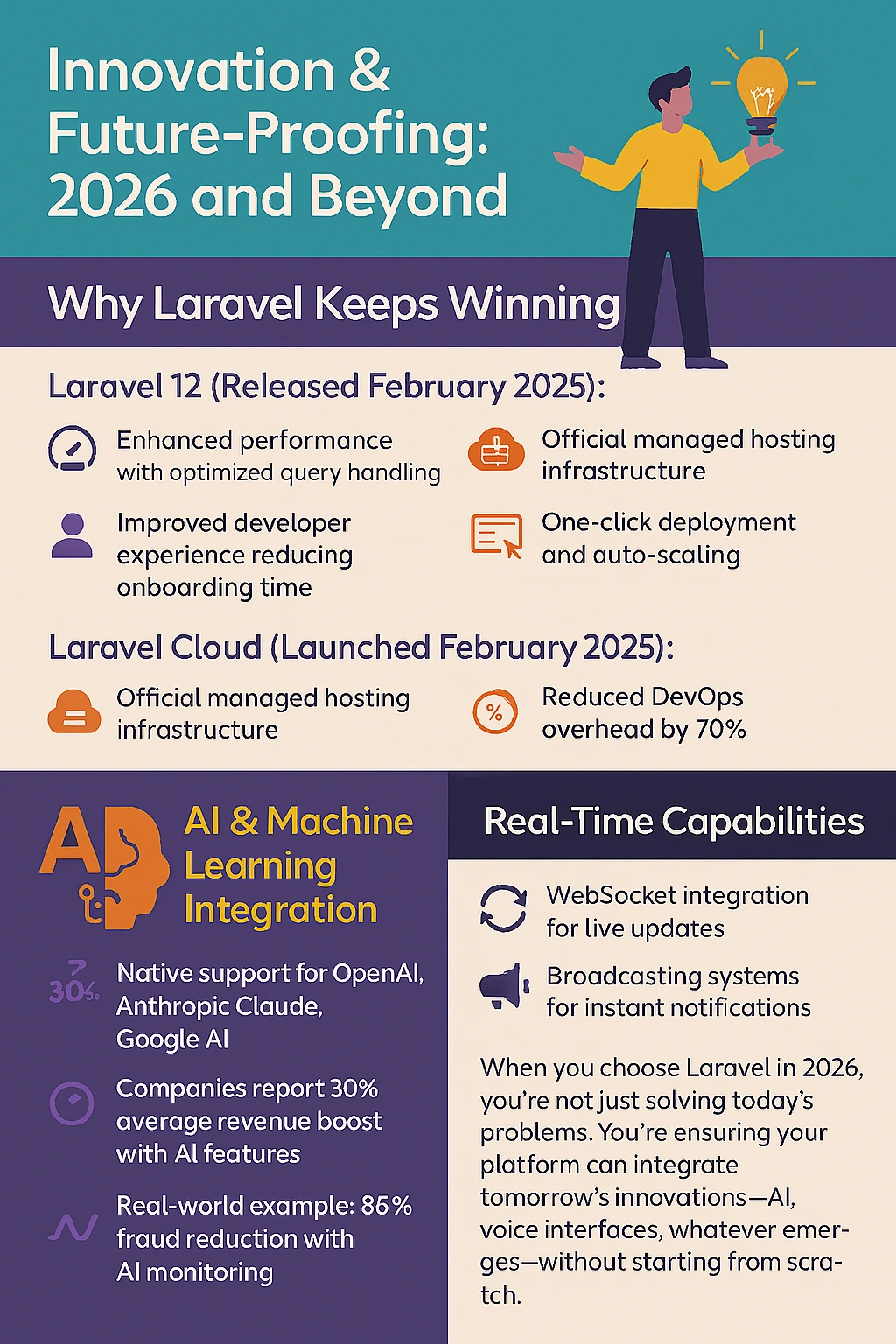
Innovation & Future-Proofing: 2026 and Beyond
Why Laravel Keeps Winning
Laravel 12 (Released February 2025):
- Enhanced performance with optimised query handling
- Improved developer experience reducing onboarding time
- Stability improvements for enterprise-grade applications
Laravel Cloud (Launched February 2025):
- Official managed hosting infrastructure
- One-click deployment and auto-scaling
- Reduced DevOps overhead by 70%
AI & Machine Learning Integration:
- Native support for OpenAI, Anthropic Claude, Google AI
- Companies report 30% average revenue boost with AI features
- Real-world example: 85% fraud reduction with AI monitoring
Real-Time Capabilities:
- WebSocket integration for live updates
- Broadcasting systems for instant notifications
- Critical for modern SaaS, booking systems, dashboards
When you choose Laravel in 2026, you're not just solving today's problems. You're ensuring your platform can integrate tomorrow's innovations—AI, voice interfaces, whatever emerges—without starting from scratch.
The "AI Cowboy" Problem: Why Cheap Alternatives Cost More
The Dangerous Rise of Vibes Coding and AI App Builders
You've seen the ads: "AI builds your app in 48 hours for $500!" or freelancers promising "full-stack applications" at 10% of agency costs.
Here's what happens 6-8 months after launching with an "AI Cowboy":
The Inevitable Collapse
-
Performance Degradation: The app worked with 10 test users. At 500 real users, pages take 8-12 seconds to load. Hosting costs triple.
-
Security Vulnerabilities: User passwords stored in plain text. Credit card data unencrypted. Privacy Act violations carrying $50 million penalties.
-
The Maintenance Nightmare: You need a simple feature addition. The original builder says it requires "complete refactoring" (translation: rebuild). Other developers quote rebuild costs at 3-4x your original investment.
-
Zero Documentation: The AI builder vanishes. No documentation exists. No knowledge transfer occurred. You own code nobody understands.
What Is "Vibes Coding"?
Vibes coding is development without engineering discipline:
- Copy-pasting AI-generated code without understanding it
- No testing beyond "it seems to work on my laptop"
- Ignoring security best practises because "it's too complicated"
- No architecture planning—just adding features until it breaks
Real Example: The $15,000 → $180,000 Disaster
An Australian e-commerce business hired a freelancer for $15,000 who used AI to build their platform in three weeks.
Eight months later:
- Site crashes during their first major sale event
- Customer data exposed due to SQL injection vulnerability
- Payment processing randomly fails (costing 15% of transactions)
- Rebuild quote: $180,000
- Lost revenue during downtime: $220,000
- Total cost of "cheap" solution: $415,000
Professional PHP Development Services: The C9 Difference
What Separates Professional Laravel Development Company Services
1. Engineering Discipline:
- Code reviews by senior developers
- Automated testing catching bugs before production
- Security audits using industry-standard tools
- Performance monitoring and optimisation
2. Knowledge Transfer (The C9 Advantage):
Unlike AI builders who leave you with mysterious code, C9 provides:
- Comprehensive Documentation: Every function, API, and business logic explained
- Architecture Diagrams: Visual representations of how your system works
- Training Sessions: Your team understands how to use and maintain the application
- Ongoing Support: Access to developers who built it
Why Knowledge Transfer Protects Your Investment:
When C9 delivers your Laravel application, you're not dependent on us. You could:
- Hire another Laravel developer to maintain it
- Bring development in-house eventually
- Get competitive quotes for new features
- Make informed decisions about technical direction
This is the opposite of vendor lock-in. We build transparency, not dependency.
3. Multiple Resources vs. Single Points of Failure:
AI cowboys and solo freelancers create risk:
- One person knows everything
- Sick days or departures halt your project
- Limited expertise across front-end, back-end, DevOps, security
Professional PHP development services provide:
- Multiple developers reviewing each other's work
- Backup resources if someone is unavailable
- Specialised expertise (security auditors, performance engineers, UX designers)
Why C9 vs. The Other 200+ Development Shops
What Separates https://www.c9.com.au/ in Australia's Crowded Market
1. Blended Hybrid Offshore & Onshore Team Model
C9 doesn't operate like traditional Australian agencies (expensive locals) or offshore outsourcers (communication nightmares). We built a hybrid model combining:
Onshore (Australian) Team:
- Project managers in your timezone
- Business analysts who understand Australian market context
- Senior architects providing technical leadership
Offshore (Directly Hired) Team:
- Experienced Laravel developers at sustainable rates
- Specialist roles (AI integration, DevOps, security)
- Extended coverage for around-the-clock development
Why This Model Wins:
| Traditional Agency |
Pure Offshore |
C9 Hybrid Model |
| $150-250/hour all roles |
$25-50/hour all roles |
$80-180/hour blended |
| 100% onshore costs |
Communication gaps |
Best of both worlds |
| Limited scalability |
Quality concerns |
Scalable + quality |
Important Clarification: We Don't Do In-House Local Hiring
C9 operates with remote workers, not staff who'll arrive at your office 9-5. This is intentional:
Benefits of Remote Model:
- Access to global talent, not just Sydney/Melbourne
- Lower overhead not passed to you in inflated rates
- Flexibility to scale teams up or down rapidly
What You Get Instead:
- Scheduled video calls in your timezone
- Collaborative tools (Slack, Jira, GitHub) for real-time communication
- Australian project managers as your single point of contact
2. Transparent, Skills-Based Pricing
Most agencies charge a single hourly rate ($150-200) regardless of whether you need a junior developer fixing CSS or a senior architect designing microservices.
The C9 Approach:
Our rates vary based on actual skillsets required:
FY25/26 Rate Structure:
| Role |
Blended Average |
| Junior Developer |
$60-75/hour |
| Mid-Level Developer |
$85-110/hour |
| Senior Developer |
$120-150/hour |
| Solutions Architect |
$150-190/hour |
| DevOps Engineer |
$135-165/hour |
Additional discounts for:
- Long-term contracts (6+ months)
- Multi-resource teams (3+ developers)
- Monthly packages with rollover hours
3. Proven Laravel Specialisation
While others claim "full-stack expertise in 12 frameworks," C9 focuses on Laravel excellence:
- 100+ Laravel projects delivered across e-commerce, SaaS, booking systems, CRMs
- Laravel certification for senior team members
- Active Laravel community participation
Staff Augmentation: Flexible Scaling for Growing Businesses
When You Need More Hands, Not More Overhead
Your in-house development team is stretched. New projects queue up whilst maintenance consumes their time. You need more developers, but:
- Hiring permanent staff takes 3-6 months
- Salaries + benefits = $120-150K+ per developer annually
- What happens when the project ends?
The Integrated Team Advantage
C9 provides integrated teams, not just individuals:
Option A: Single Specialist
- One Laravel developer augmenting your team
- Best for specific skill gaps
Option B: Mini-Team (2-3 Resources)
- Laravel developer + DevOps engineer
- Best for complete feature development
Option C: Full Development Pod (4-6 Resources)
- 2-3 Laravel developers + DevOps + QA + coordinator
- Best for large initiatives
Contract Flexibility
Model 1: Monthly Rolling Contract
- Month-to-month commitment
- 30-day notice to scale down
- Higher per-hour rates (10-15% premium)
Model 2: Minimum Lock-In (3-6 Months)
- 3-month or 6-month minimum commitment
- Standard rates
- Unused hours roll over monthly
Why Minimum Lock-Ins Are Better for You
Developer Productivity Curve:
Developers in monthly contracts spend 30-40% of mental energy worrying about renewal instead of solving your problems.
Cost Efficiency:
- Monthly model: $157-217 per productive hour (uncertainty premium)
- 3-6 month model: $100-135 per productive hour (stability discount)
You pay 35-40% less per unit of actual work delivered.
Staff Augmentation FAQs
Q: How quickly can augmented staff start?
A: 5-7 days for single developers, 10-14 days for integrated teams.
Q: Do augmented staff work our business hours?
A: We schedule core overlap hours with your team (typically 4-6 hours daily in Australian business hours).
Q: What if the developer doesn't fit our team culture?
A: First two weeks are probationary. If fit isn't right, we replace at no cost.
Q: Can we hire the augmented staff permanently?
A: Yes, with a recruitment fee (typically 15-20% of annual salary).
Q: What's included in the hourly rate?
A: Developer time, project management oversight, quality assurance reviews, ongoing Laravel training, replacement coverage for holidays.
The Discovery Call: Your Six-Figure Mistake Prevention System
Why Skipping Discovery Is the Worst Decision You Can Make
You're eager to start building. You want a quote now. The last thing you want is "another meeting" delaying everything.
Here's what happens when projects start without proper discovery:
The $280,000 Disaster Timeline
Month 1-2: False Start
- Development begins based on 30-minute scope conversation
- Developers build Feature A
- You review: "That's not what I meant at all"
- 120 hours wasted ($14,400-$28,000)
Month 3-4: Scope Creep Chaos
- "Just one more feature" mentioned casually
- Developer says "that's a major change requiring database restructure"
- Timeline slips 6-8 weeks
Month 5-6: Integration Nightmare
- "It needs to connect to our CRM" (first time mentioned)
- CRM has no API, requires custom integration
- Additional $45,000 and two months
Total Cost:
- Original budget: $120,000
- Actual spend: $280,000
- Outcome: Expensive failure
Root Cause: Skipping discovery to "save time."
What Actually Happens in Discovery
Phase 1: Initial Discovery Call (60-90 minutes)
What we cover:
- Business objectives: What problem are you solving?
- Success metrics: How will you measure success?
- Technical landscape: Existing systems, integrations
- Constraints: Budget ranges, timeline drivers
Investment: Free, no obligation
Phase 2: Deep Discovery Workshop (4-8 hours)
What we cover:
- Detailed user stories and use cases
- Technical architecture options
- Integration specifications
- Security and compliance requirements
- Risk identification
What you get:
- Comprehensive requirements document
- Technical architecture proposal
- Detailed project plan
- Accurate pricing (±10% accuracy)
Investment: $3,500-7,500 (credited toward project if we proceed)
Breaking Projects Into Stages
Discovery reveals staged opportunities for early ROI:
Example: E-Commerce Platform
Stage 1: Core Commerce MVP (3 months, $85,000)
- Product catalogue and shopping cart
- Payment processing
- Order management
- Launch and start revenue generation
Stage 2: Inventory & Fulfilment (2 months, $45,000)
- Real-time inventory tracking
- Shipping integration
- Funded by Stage 1 revenue
Stage 3: Multi-Vendor Marketplace (3 months, $95,000)
- Vendor onboarding
- Commission tracking
- Funded by accumulated revenue
Total Investment: Same overall cost, but:
- Revenue starts at month 3 instead of month 12
- Market validation with $85K investment, not full budget
- Later stages funded by sales
The Pricing Trap: Why "Indicative Pricing" Is Worthless
The Proposal That Cost $127,000 Extra
You request proposals from four development companies:
- Company A: $95,000
- Company B: $138,000
- Company C: $112,000
- Company D (C9): "We need discovery before accurate pricing"
You choose Company A because they gave you a number.
What Happened:
Month 1: Contract signed for $95,000 Month 2: Revised estimate: $127,000 ("scope changes") Month 4: Another revision: $158,000 Month 8: Final cost: $193,000 (103% over original)
Indicative pricing is fiction dressed as fact.
Indicative vs. Discovery-Based Pricing
Indicative Pricing Method:
- Listen to 30-minute description
- Think "this sounds like Project X"
- Quote based on vague similarity
- Add disclaimer: "Subject to change"
Accuracy: ±40-60% (could be $38,000-$57,000 off)
Discovery-Based Pricing Method:
- Conduct 4-8 hour discovery workshop
- Document all requirements
- Create work breakdown structure
- Estimate each component in detail
- Provide itemised breakdown
Accuracy: ±10% (means $8,000-$12,000 variance on $100K project)
Real-World Example
After discovery, we document:
| Component |
Hours |
Cost |
| Product Catalogue System |
64-72 |
$6,080-$8,640 |
| Inventory Management |
88-96 |
$8,360-$11,520 |
| Shopping Cart & Checkout |
52-60 |
$4,940-$7,200 |
| Payment Processing |
44-52 |
$4,180-$6,240 |
| Order Management |
56-64 |
$5,320-$7,680 |
| Customer Portal |
40-48 |
$3,800-$5,760 |
| Admin Dashboard |
72-80 |
$6,840-$9,600 |
| Integrations |
48-56 |
$4,560-$6,720 |
Total: $92,000-$104,000 (detailed breakdown provided)
Why Discovery-Based Pricing Protects You
- Scope Is Defined: No arguments about "I thought this was included"
- Timeline Is Realistic: Hours estimated = realistic timeline
- You Can Make Trade-Offs: "Let's skip Feature X to save $2,660"
- Change Orders Are Transparent: Clear processes for scope changes
The Laravel Decision Framework
Should You Choose Laravel + Professional Development?
Choose Laravel + C9 If:
✅ Your application is business-critical
✅ You need to scale from MVP to enterprise without rebuilding
✅ Security and compliance are non-negotiable
✅ You want platform ownership and avoid vendor lock-in
✅ Your budget supports $50,000+ investment
✅ You're willing to invest in discovery
Consider Alternatives If:
❌ Your needs fit existing SaaS platforms (Shopify, Salesforce)
❌ Your budget is under $20,000 total
❌ You need launch within 4-6 weeks regardless of quality
The Three Critical Truths
Truth #1: Laravel Remains the Smart Choice
With 35.87% market share and adoption by Amazon, Walmart, and BBC, Laravel has proven enterprise viability.
Truth #2: How You Build Matters More Than What You Build On
Professional development—discovery-driven, knowledge-transfer-focused, security-conscious—is the difference between a $100K asset and a $100K liability.
Truth #3: Discovery Isn't Optional
Every dollar spent on discovery prevents ten dollars wasted on building the wrong thing.
Take the Next Step with C9
Book Your Free Discovery Call
Ready to explore whether Laravel and C9 are right for your project?
Contact C9 Solutions:
🌐 Website: https://www.c9.com.au/
What to Prepare
- Business context: What problem you're solving
- Current state: Existing systems, pain points
- Success vision: What does success look like?
- Constraints: Budget ranges, timeline drivers
What You'll Receive
- Honest assessment of whether Laravel fits your needs
- Preliminary feasibility and risk analysis
- Ballpark timeline and budget ranges
- Clear next steps if we're a potential fit
- No obligation, no pressure
Final Thought
Every month you delay building the right solution, competitors gain ground. But rushing into the wrong solution is worse.
The solution isn't to move faster or slower—it's to move smarter.
Invest in discovery. Choose proven technology. Partner with professionals who transfer knowledge, not create dependency.
Laravel in 2026 isn't just about choosing a framework. It's about choosing a partnership approach that protects your investment, accelerates your growth, and positions your business to compete in an increasingly digital Australian economy.
C9 is ready when you are.
About C9 Solutions
C9 Solutions is Australia's leading custom software, apps, integration, and database developer, specialising in Laravel and PHP development services. With a blended hybrid model combining Australian leadership and global talent, we deliver enterprise-grade solutions at sustainable costs. Our discovery-driven methodology, knowledge transfer focus, and transparent pricing have made us the trusted Laravel development company for businesses across Australia.
Let's build something remarkable together.
Last Updated: December 2025 | Read Time: 9 minutes
Frequently Asked Questions
How much does Laravel development cost in Australia? Laravel development typically ranges from $60,000-$150,000 for e-commerce platforms, $80,000-$200,000 for custom CRMs, and $150,000+ for SaaS applications. Costs vary based on complexity, features, and integrations. C9's blended hybrid model provides 30-40% cost savings compared to traditional Australian agencies whilst maintaining enterprise quality.
Why is Laravel better than other PHP frameworks? Laravel leads with 35.87% market share because it combines rapid development speed, enterprise-grade security, extensive package ecosystem (15,000+ packages), and excellent documentation. Major companies like Amazon, Walmart, and BBC trust Laravel for mission-critical applications, validating its reliability and scalability.
How long does a Laravel project take? MVP launches typically take 2-4 months, full-featured applications require 4-8 months, and enterprise platforms need 8-18 months. Timeline depends on complexity, team size, and requirements clarity. Proper discovery reduces timeline risks significantly.
What is the difference between Laravel and WordPress? WordPress is a content management system ideal for blogs and simple websites. Laravel is a full-stack framework for building custom applications with complex business logic, integrations, and unique functionality. Laravel offers greater flexibility, security, and scalability for enterprise applications.
Do I need a discovery call before getting a quote? Yes, for projects over $50,000. Discovery prevents costly mistakes by clarifying requirements, identifying risks, and ensuring accurate pricing (±10% vs. ±40-60% with indicative quotes). Discovery typically costs $3,500-7,500 and is credited toward your project if you proceed.
Key Takeaways
✅ Laravel commands 35.87% market share and powers 2.5 million websites globally
✅ Professional Laravel development delivers 300-727% ROI with 30-40% cost savings
✅ "AI Cowboys" and vibes coding create expensive disasters—professional development matters
✅ C9's blended hybrid model provides enterprise quality at 30-40% lower costs than traditional agencies
✅ Discovery calls prevent six-figure mistakes and enable accurate project pricing
✅ Staff augmentation with 3-6 month minimum lock-ins provides 35-40% better value than monthly contracts
✅ Knowledge transfer and transparent pricing separate professional PHP development companies from vendors
Ready to discuss your Laravel project? Contact C9 Solutions today