Australian business owners and executives are navigating a perfect storm of technological advancement and operational pressure. The 5G rollout has achieved 95% coverage across major metropolitan areas, IoT devices are projected to reach 65 billion globally, and edge computing is surging at an impressive 26% compound annual growth rate. These aren't just impressive statistics—they represent a fundamental shift in how businesses must operate to remain competitive.
However, beneath this technological boom lies a troubling reality: legacy software systems are struggling to keep pace. The result? Latency issues that cripple real-time decision-making, data silos that prevent meaningful insights, and missed opportunities across critical sectors including mining, retail, and healthcare. For many Australian firms, system delays are costing millions in downtime, whilst a severe talent shortage—with a developer gap exceeding 50,000 professionals—is inflating software development budgets to unsustainable levels.
The question isn't whether your organisation needs to modernise its software infrastructure. The question is: how can you do it efficiently, cost-effectively, and without falling into the traps that have derailed countless digital transformation projects?
Edge Computing Boom Exposes Cracks in Traditional Software Development

Edge computing represents a paradigm shift in data processing. Rather than sending all information to centralised cloud servers, edge computing processes data at or near its source—on factory floors, in retail stores, at mining sites, or within healthcare facilities. This approach is essential for applications requiring instant responsiveness: augmented and virtual reality experiences, predictive maintenance systems, autonomous logistics, and real-time analytics.
The business case is compelling. Edge computing can reduce latency by up to 90%, decrease bandwidth costs by processing data locally, and enable operations in environments with limited connectivity. For Australian firms operating in remote locations—whether mining operations in the Pilbara, agricultural enterprises in regional Victoria, or logistics networks spanning the continent—edge computing isn't just an advantage; it's becoming a necessity.
Yet traditional custom software development approaches are failing to deliver edge-ready solutions at the speed and scale businesses require. The typical enterprise software project takes 6-12 months from initial requirements gathering to deployment. Costs can balloon to 23 times initial estimates when scope changes occur—and in edge computing projects, scope changes are virtually guaranteed as businesses discover new use cases and requirements during implementation.
The Competitive Gap Widens
Whilst your organisation navigates lengthy development cycles, competitors are deploying real-time applications that deliver immediate business value. The consequences are measurable and significant:
Operational efficiency losses of up to 40% have been documented in remote operations hampered by latency issues. When mining equipment decisions are delayed by even seconds, productivity suffers. When retail inventory systems can't provide real-time stock visibility, sales are lost. When healthcare monitoring systems experience lag, patient outcomes are compromised.
Integration challenges compound these problems. Legacy systems weren't designed to work with edge devices, IoT sensors, or modern data streams. Businesses find themselves trapped in integration hell—spending months and hundreds of thousands of dollars building custom bridges between incompatible systems.
Compliance vulnerabilities emerge as data governance becomes increasingly complex. The Australian Prudential Regulation Authority (APRA) has strengthened requirements around data security, operational resilience, and risk management. Slow, inflexible systems make compliance harder and more expensive, exposing organisations to regulatory fines that can reach millions of dollars.
Security risks multiply as attack surfaces expand. Australia has experienced a surge in ransomware attacks, with cybercriminals specifically targeting organisations with weak integration points and outdated software. When your systems can't be patched quickly or adapted to emerging threats, you're playing cybersecurity roulette with your organisation's future.
The Talent Shortage Crisis
Compounding these technical challenges is Australia's severe software development talent shortage. With over 50,000 unfilled developer positions across the country, competition for skilled professionals has driven salaries to unprecedented levels. Senior developers in Sydney and Melbourne now command packages exceeding $150,000-$200,000 annually, whilst even junior developers are receiving offers well above $70,000.
For mid-sized organisations, building and maintaining an internal development team capable of delivering edge computing solutions is financially prohibitive. Even when you can afford the salaries, finding developers with the specific skills required—edge computing architecture, IoT protocols, real-time data processing, low-code platforms—is extraordinarily difficult.
This perfect storm of technological demand, operational pressure, and talent scarcity has created an urgent need for alternative approaches to software development.
The Hidden Danger: AI Cowboys and Vibes Coding Nightmares

As Australian businesses search for faster, cheaper alternatives to traditional software development, a new threat has emerged: unqualified developers promising quick wins through "AI-powered" development and what industry insiders call "vibes coding."
What is Vibes Coding?
Vibes coding refers to the practice of using AI code generation tools—like GitHub Copilot, ChatGPT, or other large language models—to rapidly produce software without proper architectural planning, testing, or documentation. Proponents claim they can build applications in days rather than months, at a fraction of traditional costs.
The reality is far more troubling. These "AI cowboys"—freelancers and small agencies offering suspiciously cheap rates—are producing code that looks functional on the surface but is fundamentally flawed underneath. They're delivering what might be called "demo-quality" software: it works well enough for an initial presentation, but fails catastrophically when deployed in production environments.
The True Cost of Cheap Development
Australian businesses have learned painful lessons about vibes coding the hard way:
Scalability failures emerge within weeks or months of deployment. An application that works adequately for ten users collapses under the load of one hundred. A system that processes hundreds of transactions daily grinds to a halt when volume reaches thousands. The AI-generated code lacks the architectural considerations—caching strategies, database optimisation, asynchronous processing—that enable true scalability.
Security vulnerabilities are rampant in AI-generated code. Studies have shown that code produced by AI tools without human review contains significantly more security flaws than professionally developed software. These vulnerabilities—SQL injection points, authentication bypasses, data exposure risks—create doorways for cybercriminals. For Australian businesses handling customer data, the regulatory and reputational consequences of a breach can be catastrophic.
Maintenance nightmares materialise when you need to modify or extend the software. Vibes coding produces what developers call "spaghetti code"—tangled, inconsistent, poorly documented code that's nearly impossible to understand. Your internal team inherits a black box. Making even simple changes requires unravelling the entire mess, often costing 5-10 times more than proper development would have initially.
Integration impossibilities become apparent when you try to connect the system to other business tools. Proper software architecture includes well-designed APIs, standard data formats, and clear integration points. Vibes coding produces one-off hacks that work in isolation but can't communicate with other systems. The result: more data silos, more manual processes, and more frustration.
Knowledge transfer failures leave you dependent on the original developer. When there's no documentation, no architectural diagrams, no test suites, and no code comments, only the person who wrote it understands how it works. If they disappear—and cheap freelancers often do—you're left with an unmaintainable system and no choice but to rebuild from scratch.
The Real ROI Calculation
What appeared to be a $20,000 bargain becomes a $100,000+ disaster when you factor in:
- Rework costs to fix fundamental flaws: $40,000-$60,000
- Security audits and remediation: $15,000-$30,000
- Performance optimisation and scaling work: $20,000-$40,000
- Integration development to connect with other systems: $15,000-$25,000
- Ongoing maintenance premium due to poor code quality: $10,000-$20,000 annually
Australian businesses deserve better. The solution isn't avoiding modern development approaches—it's working with professionals who understand how to use these tools responsibly within proper software engineering frameworks.
The Solutions: Low-Code Custom Software via Proven Development Services
Low-code development platforms represent a genuine revolution in software creation—but only when implemented correctly by experienced professionals. Unlike vibes coding's haphazard approach, professional low-code development combines visual development tools with traditional coding to deliver the best of both worlds: speed and quality.
What Makes Low-Code Different?
Low-code platforms provide visual interfaces for building application components—user interfaces, workflows, data models, and integrations—without writing every line of code manually. However, professional low-code development differs fundamentally from AI cowboys' approaches:
Architectural planning comes first. Experienced developers design the system's structure before building anything, ensuring scalability, security, and maintainability from the foundation up.
Hybrid development combines low-code tools for appropriate components with traditional coding for complex logic, custom integrations, and performance-critical sections. This pragmatic approach delivers speed without sacrificing quality.
Testing and quality assurance are built into the process, not bolted on afterwards. Professional teams implement automated testing, security scanning, and performance validation throughout development.
Documentation and knowledge transfer ensure your team understands the system. Proper documentation, training, and handover processes mean you're never dependent on a single developer.
The C9 Approach: Low-Code Excellence for Edge Computing
C9, Australia's leading custom software, applications, integration, and database developer, has pioneered a distinctive approach to low-code development specifically optimised for edge computing requirements. What sets C9 apart from hundreds of other development firms?
Edge-native expertise: Deep understanding of edge computing architectures, IoT protocols, real-time data processing, and the specific challenges Australian businesses face in remote and distributed operations.
Hybrid delivery model: Combining Brisbane-based expertise with optimised offshore resources delivers 50-70% cost savings without sacrificing quality. The blended team structure ensures you receive local market understanding with global talent access.
Multi-resource scalability: Rather than depending on individual contractors, C9 provides integrated teams—developers, project managers, quality assurance specialists, and architects—who work together seamlessly. When projects need to scale quickly, additional resources integrate smoothly without knowledge gaps.
End-to-end ownership: From initial discovery through API development, database design, integration work, and business intelligence implementation, C9 owns the complete solution. No finger-pointing between multiple vendors when issues arise.
Flexible engagement models: Whether you need a specific project delivered or ongoing staff augmentation to expand your capabilities, C9 adapts to your requirements rather than forcing you into rigid packages.
Knowledge transfer commitment: Unlike agencies that jealously guard information to maintain dependency, C9 ensures your team gains deep understanding of implemented solutions, enabling you to maintain and evolve systems independently.
Real-World Results
Australian enterprises across industries are already experiencing the low-code advantage:
A Melbourne-based retail chain deployed an edge-enabled inventory management system in six weeks rather than the six months traditional development would have required. The system processes point-of-sale data locally in each store, synchronises with central systems for analytics, and enables real-time stock decisions.
Cost: 65% below initial custom development quotes.
A Western Australian mining operation implemented predictive maintenance solutions across remote sites, processing sensor data at the edge to predict equipment failures before they occur.
Deployment time: eight weeks.
Result: 30% reduction in unplanned downtime, saving millions in lost productivity.
A healthcare provider in Queensland launched patient monitoring applications that process data locally in clinics, ensuring privacy compliance whilst enabling real-time alerts for clinical staff. The solution integrated with existing electronic health records and delivered APRA-compliant audit trails.
Timeline: ten weeks from discovery to production deployment.
Why Discovery Calls Are Non-Negotiable: Mapping Your Success

The single biggest mistake organisations make when pursuing software development—whether traditional or low-code—is skipping thorough discovery. The eagerness to "just start building" is understandable. You're facing competitive pressure, operational challenges, and internal stakeholders demanding quick results. However, starting development without proper discovery is equivalent to constructing a building without architectural plans.
The Real Cost of Skipping Discovery
Industry data reveals that projects beginning without adequate discovery experience:
Scope creep in excess of 30% on average. What started as a defined project balloons as stakeholders realise important requirements weren't captured initially. Each addition extends timelines and inflates budgets.
Budget overruns averaging 40-60% beyond initial estimates. Without clear understanding of requirements, complexity, and dependencies, initial quotes are essentially guesses. As reality emerges during development, costs escalate.
Timeline delays of 50% or more. Unclear requirements lead to rework, debates about what was "supposed" to be included, and frequent direction changes that derail progress.
Misaligned solutions that technically work but don't solve the actual business problem. When developers don't deeply understand the business context, they build what was requested rather than what's actually needed.
C9's Discovery Framework
C9 has refined a discovery process specifically designed for edge computing and low-code projects, typically completed in 1-2 intensive sessions spanning 1-2 weeks:
Week 1: Needs Assessment and Edge Requirements
- Detailed interviews with key stakeholders across technical and business functions
- Current state analysis of existing systems, infrastructure, and processes
- Edge computing requirement identification: latency tolerance, data volume, connectivity constraints
- Integration needs mapping with existing systems and data sources
- Compliance and security requirement documentation
- User experience and interface requirement gathering
Week 2: Solution Design and Project Scoping
- Low-code platform evaluation and selection based on specific needs
- Architectural design of edge-enabled solution
- Prototype development demonstrating core functionality
- Detailed project breakdown into phases and milestones
- Risk identification and mitigation planning
- Precise timeline development with decision points
- Comprehensive cost estimation to the nearest hour
Discovery Unlocks Strategic Value
Far from being a time-waster, proper discovery unlocks 20-40% efficiency improvements through several mechanisms:
Phased delivery becomes possible when the full scope is understood. Rather than committing to a massive project with distant payback, you can structure delivery in phases that each deliver ROI. Early wins fund subsequent phases, reducing financial risk.
Resource optimisation occurs when you understand exactly what skills and capacity you need at each phase. Avoid paying for senior developers when junior resources suffice, or scrambling to find specialists mid-project.
Realistic expectations are established for all stakeholders. When everyone understands what will be delivered, when, and at what cost, political and interpersonal friction diminishes dramatically.
Risk mitigation happens proactively. Identifying potential issues during discovery—integration challenges, performance constraints, security requirements—allows addressing them architecturally rather than scrambling for fixes during development.
The Discovery Investment
C9's discovery process typically requires 20-40 hours of effort, translating to $2,000-$5,000 investment depending on project complexity. This investment:
- Eliminates 30-50% of typical scope creep and rework
- Prevents 40-60% of budget overruns
- Accelerates delivery by 20-30% through clear direction
- Improves solution fit by ensuring business needs drive technical decisions
The return on investment is typically 10:1 or greater. A $3,000 discovery investment that prevents $30,000 in rework and delays is one of the smartest investments an organisation can make.
C9 Staff Augmentation: Flexible Power for Your Organisation

Beyond project-based delivery, many Australian organisations need ongoing development capacity without the overhead and commitment of permanent hires. C9's staff augmentation model provides a compelling alternative.
The Augmentation Advantage
Rather than hiring individual contractors—with all the management overhead, knowledge gaps, and consistency challenges that entails—C9's augmentation provides integrated teams:
Full-stack capability in a single engagement. Your augmented team includes developers skilled in low-code platforms and traditional coding, project managers who coordinate work and communicate progress, quality assurance specialists who ensure reliability, and architects who maintain technical coherence.
24/7 development velocity through C9's hybrid model. With resources across time zones, work continues around the clock without requiring Australian team members to work unsustainable hours.
Seamless scaling up or down as project needs change. Launching a major initiative? Scale up resources within weeks. Entering a maintenance phase? Scale down without redundancy concerns or morale impacts.
No office-based constraints. C9's remote-first approach means you access global talent without geographic limitations, relocation costs, or expensive office space requirements.
Knowledge continuity. Unlike individual contractors who come and go, C9's team model ensures knowledge is retained organisationally, not locked in individual heads.
Engagement Models
C9 offers two primary augmentation structures:
Monthly Contracts: Maximum flexibility for organisations with variable needs or those wanting to trial the augmentation model. Scale resources up or down with 30 days' notice. Unused hours roll over within reasonable limits. Ideal for organisations in exploratory phases or with highly variable demand.
3-6 Month Lock-ins: Better for projects requiring continuity and stable team composition. Provides 15-20% cost savings compared to monthly rates through commitment discounts. Enables better talent retention as resources aren't juggled between clients. Recommended for substantial initiatives where team stability drives better outcomes.
Common Augmentation Questions
What's the minimum commitment?
3-6 months is recommended for substantial projects, allowing time for team ramp-up and meaningful ROI. Monthly contracts are available for trials or smaller initiatives, though expect slightly higher rates.
Individual developer or integrated team?
C9 strongly recommends integrated teams—developers, project managers, and QA specialists—for end-to-end delivery. Individual developer augmentation is available but typically works best when you have strong internal project management and quality assurance capabilities.
Why not hire local developers?
You certainly can, but expect 40-60% higher costs for comparable skills. Australia's talent shortage means even junior developers command premium salaries. C9's global talent access provides equivalent or superior skills at optimised rates whilst maintaining Australian project leadership for local market understanding.
What skills are covered?
Low-code platform development (OutSystems, Mendix, Microsoft Power Platform), edge computing and IoT architectures, traditional full-stack development (React, .NET, Python, Node.js), database design and optimisation, system integration and API development, cloud and edge infrastructure, business intelligence and analytics, and mobile application development.
FY25/26 Indicative Rates
C9's blended hybrid rates for FY2025/2026 (AUD per hour, CPI-adjusted):
- Junior Developer: $50-$70/hour (offshore-heavy blending)
- Mid-Level Developer/Low-Code Specialist: $80-$110/hour (hybrid mix)
- Senior Developer/Edge Computing Specialist: $120-$150/hour
- Project Manager/QA Specialist: $90-$130/hour
Volume and commitment discounts apply: 15% reduction for three or more resources, additional 5% for commitments of six months or longer.
These rates deliver substantial savings compared to typical Australian market rates whilst maintaining quality through C9's proven delivery methodologies and integrated team structures.
Indicative Pricing Pitfalls vs. Discovery-Based Precision
One of the most frustrating aspects of software procurement is vague, meaningless pricing. You've likely received proposals that promise to deliver "an edge computing application for $50,000" or "a custom software solution for $75,000." These indicative quotes are essentially worthless—and often deliberately so.
Why Indicative Quotes Fail
Vague scope alignment: The quote assumes a particular scope and complexity level, but these assumptions are rarely documented clearly. Your understanding of deliverables and the vendor's understanding often diverge significantly.
Hidden exclusions: Critical components—integration with existing systems, data migration, testing, training, documentation, post-launch support—may not be included but aren't explicitly called out as excluded.
Change order traps: When reality diverges from assumptions (which it always does), vendors issue change orders for additional costs. The $50,000 project becomes $75,000, then $100,000, then $150,000 as "unforeseen" requirements emerge.
No accountability: When estimates are vague to the nearest $10,000-$25,000, enormous variance is acceptable. Vendors can miss estimates by 50-100% and claim it's within the "indicative" nature of the quote.
Real-World Example: The Vibes Coding Disaster
Consider a scenario when a Melbourne manufacturing firm approached for help after a failed project:
A freelance developer quoted $20,000 for a low-code edge computing dashboard to monitor production equipment. The quote assumed 200 hours of work at $100/hour. The business proceeded, eager to launch quickly.
Post-build, the system technically worked—for the pilot deployment of three machines. When the firm attempted to scale to 30 machines across multiple facilities, performance collapsed. Edge data synchronisation failed under load. The user interface became unusable with increased data volume.
The required fixes—proper edge architecture, database optimisation, load balancing, caching strategies—required an additional 400 hours of work at $100/hour: $40,000 extra, tripling the total cost to $60,000. Even then, the system required ongoing performance tuning and lacked proper documentation, creating permanent maintenance overhead.
Had proper discovery occurred initially, C9 would have:
- Identified the scaling requirements upfront
- Architected for the full deployment from day one
- Priced the complete solution at approximately $45,000-$50,000
- Delivered a production-ready system without painful post-launch crises
The firm paid $60,000 for an adequate system when they could have paid $50,000 for a properly architected one—and saved months of frustration.
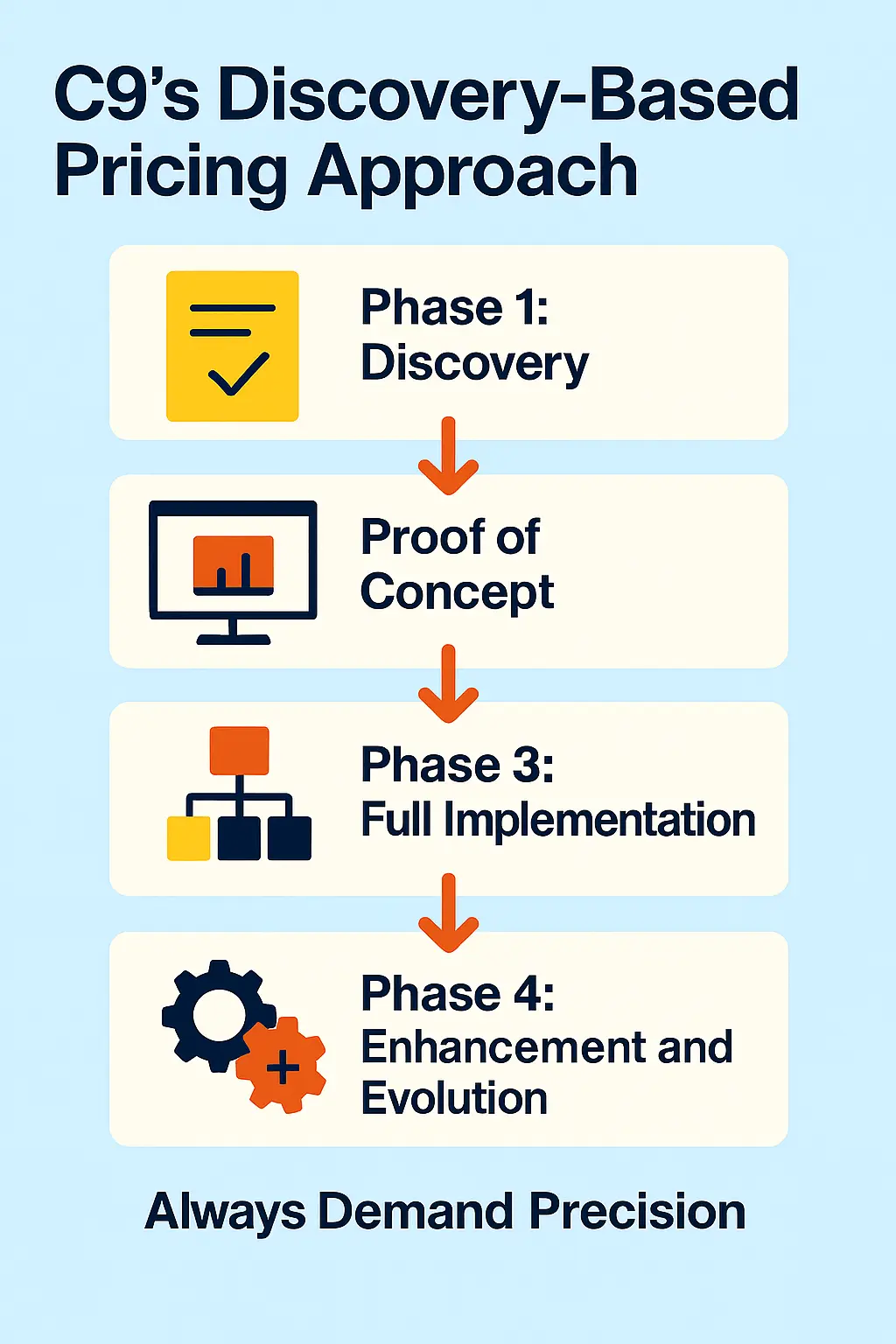
C9's Discovery-Based Pricing Approach
C9 provides pricing precision through phased discovery:
Phase 1: Discovery (quoted explicitly)
- Needs assessment, requirements gathering, architectural planning
- Deliverable: Comprehensive project plan with detailed specifications
- Investment: Typically $2,000-$5,000 depending on complexity
- Timeline: 1-2 weeks
Phase 2: Proof of Concept or Minimum Viable Product (quoted to nearest hour)
- Based on discovery outputs, build core functionality demonstrating value
- Example: Edge dashboard prototype with 3-5 key features, 80 hours at $100/hour blended rate = $8,000
- Deliverable: Working prototype demonstrating core functionality
- Timeline: 3-6 weeks
Phase 3: Full Implementation (quoted based on Phase 2 learnings)
- Scale from prototype to production, adding features, users, locations
- Pricing adjusted based on actual complexity revealed during Phase 2
- Staged further if project is large, ensuring each stage delivers ROI
Phase 4: Enhancement and Evolution (optional, quoted as needed)
- Additional features, integrations, or scaling beyond initial scope
- Funded by ROI delivered in earlier phases
This staged approach ensures:
- You never commit massive budgets before proving viability
- Pricing becomes more accurate as understanding deepens
- Each phase delivers tangible business value
- Financial risk is minimised through incremental investment
- The solution evolves based on real-world use rather than assumptions
Always Demand Precision
When evaluating software development partners, insist on detailed breakdowns:
- Exactly what features and functionality are included
- How many hours are estimated for each component
- What assumptions underpin the estimate
- What's explicitly excluded from scope
- How changes will be priced
- What milestones and payment terms apply
Vendors who resist this transparency are waving red flags. Professional development partners welcome detailed discussion because it prevents misunderstandings that damage both parties.
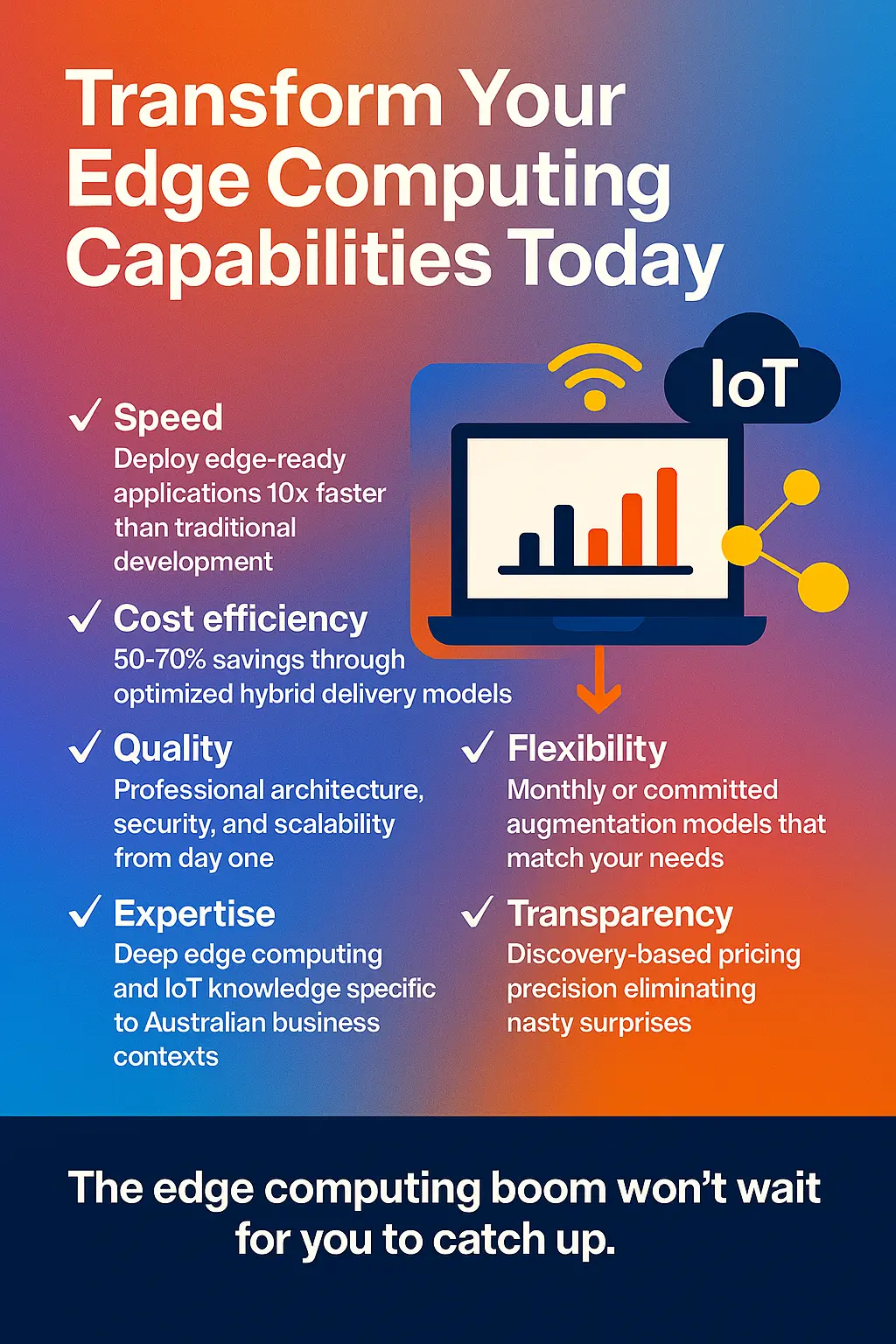
Transform Your Edge Computing Capabilities Today
Australian businesses cannot afford to wait whilst competitors deploy edge computing solutions that deliver real-time insights, operational efficiencies, and customer experiences that legacy systems simply cannot match. However, pursuing digital transformation through traditional development approaches—or worse, through unqualified "AI cowboys" offering vibes coding—leads to failed projects, wasted investments, and crushing disappointment.
Low-code custom software, implemented by experienced professionals who understand both the technology and your business context, represents your optimal path forward. C9's proven approach combines:
✓ Speed: Deploy edge-ready applications 10x faster than traditional development
✓ Cost efficiency: 50-70% savings through optimised hybrid delivery models
✓ Quality: Professional architecture, security, and scalability from day one
✓ Flexibility: Monthly or committed augmentation models that match your needs
✓ Expertise: Deep edge computing and IoT knowledge specific to Australian business contexts
✓ Transparency: Discovery-based pricing precision eliminating nasty surprises
✓ Partnership: Knowledge transfer and ongoing support ensuring long-term success
As Australia's bespoke software development experts, C9 has powered edge computing transformations for enterprises across mining, retail, healthcare, manufacturing, and logistics. Our integrated teams deliver Brisbane expertise at globally optimised rates, enabling you to compete with organisations ten times your size.
The edge computing boom won't wait for you to catch up. Every month you delay represents competitive ground surrendered to more agile rivals. Every quarter you struggle with legacy systems is another quarter of missed opportunities, operational inefficiencies, and frustrated customers.
Take the First Step: Book Your Free Discovery Call
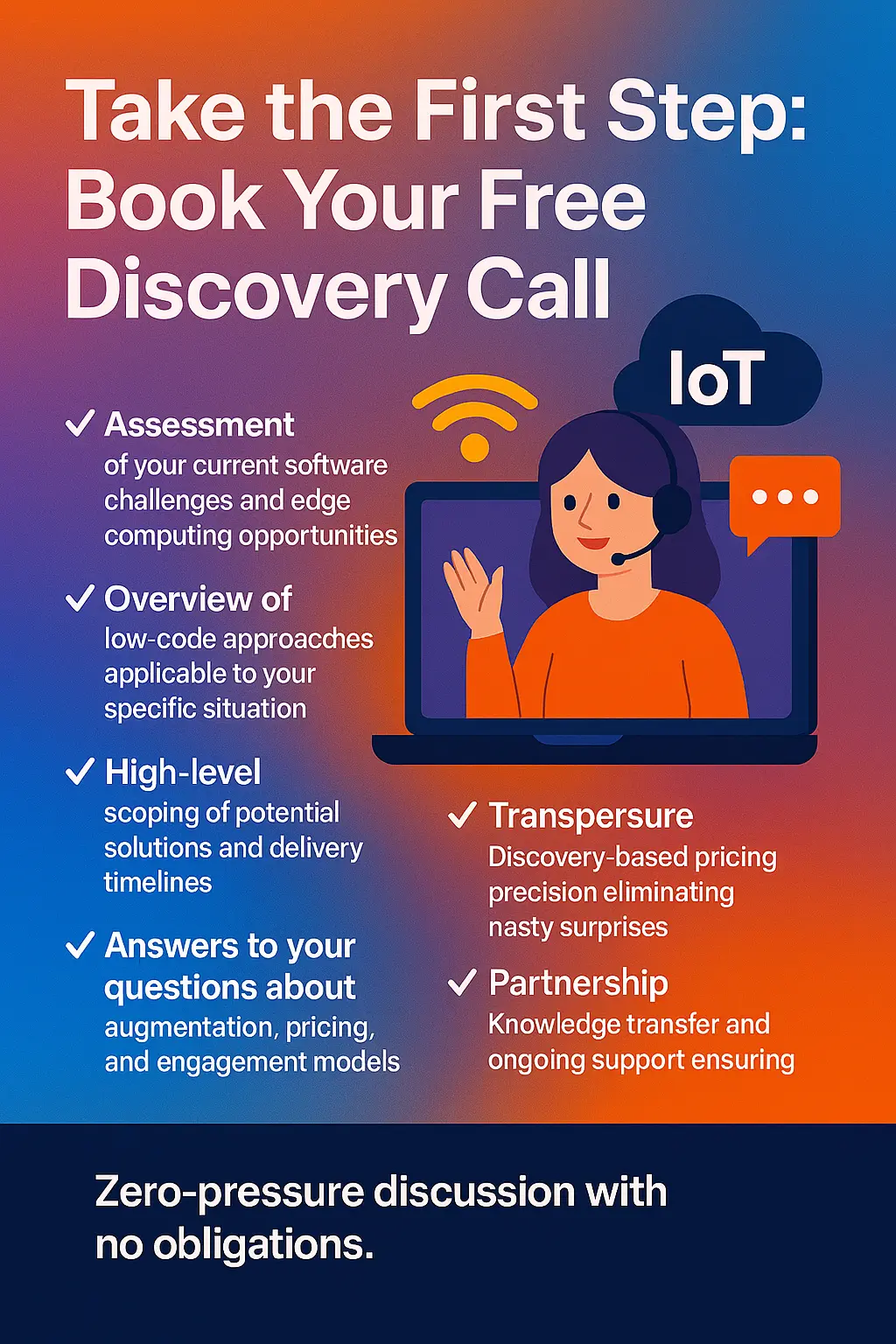
Transform your software development approach and capitalise on Australia's edge computing boom. C9's complimentary discovery call provides:
- Assessment of your current software challenges and edge computing opportunities
- Overview of low-code approaches applicable to your specific situation
- High-level scoping of potential solutions and delivery timelines
- Answers to your questions about augmentation, pricing, and engagement models
- Zero-pressure discussion with no obligations
Schedule your free Discovery Call today at https://www.c9.com.au/ and map your path to edge computing success.
Your competitors are already deploying real-time, edge-enabled applications that transform their operations. Isn't it time you joined them—or better yet, surpassed them?
About C9: C9 is Australia's leading custom software, applications, integration, and database development firm, specialising in low-code platforms and edge computing solutions for enterprises. With integrated teams spanning Brisbane and ASEAN talent centres, C9 delivers world-class software development at optimised rates, powering digital transformation for Australian businesses across all sectors.