Your website is costing you money—potentially tens of thousands of dollars monthly—and you probably don't even realise it. For the average Australian e-commerce business generating $2 million annually, a 3-second delay in page load time translates to $167,000 in lost revenue per year. Yet most business owners have no idea their React JS application is the silent profit killer lurking in their tech stack.
Here's the uncomfortable truth: your competitors are already moving to React Server Components, and every month you wait puts you further behind. This isn't another technical article filled with jargon. This is a business owner's guide to understanding why React Server Components (RSC) represents the most significant shift in web performance since mobile-responsive design—and why Australian businesses cannot afford to ignore it in 2026.
What you'll discover:
- Why traditional React applications cost 25-40% more in infrastructure whilst losing 15-35% in conversions
- How React Server Components deliver measurable ROI within 90 days
- The hidden dangers of "AI Cowboys" and cheap solutions that destroy digital investments
- Why working with an experienced React JS development company saves money long-term
- How C9's hybrid offshore/onshore model delivers enterprise results at 40-60% cost savings
The Hidden Cost of Your Current React Application
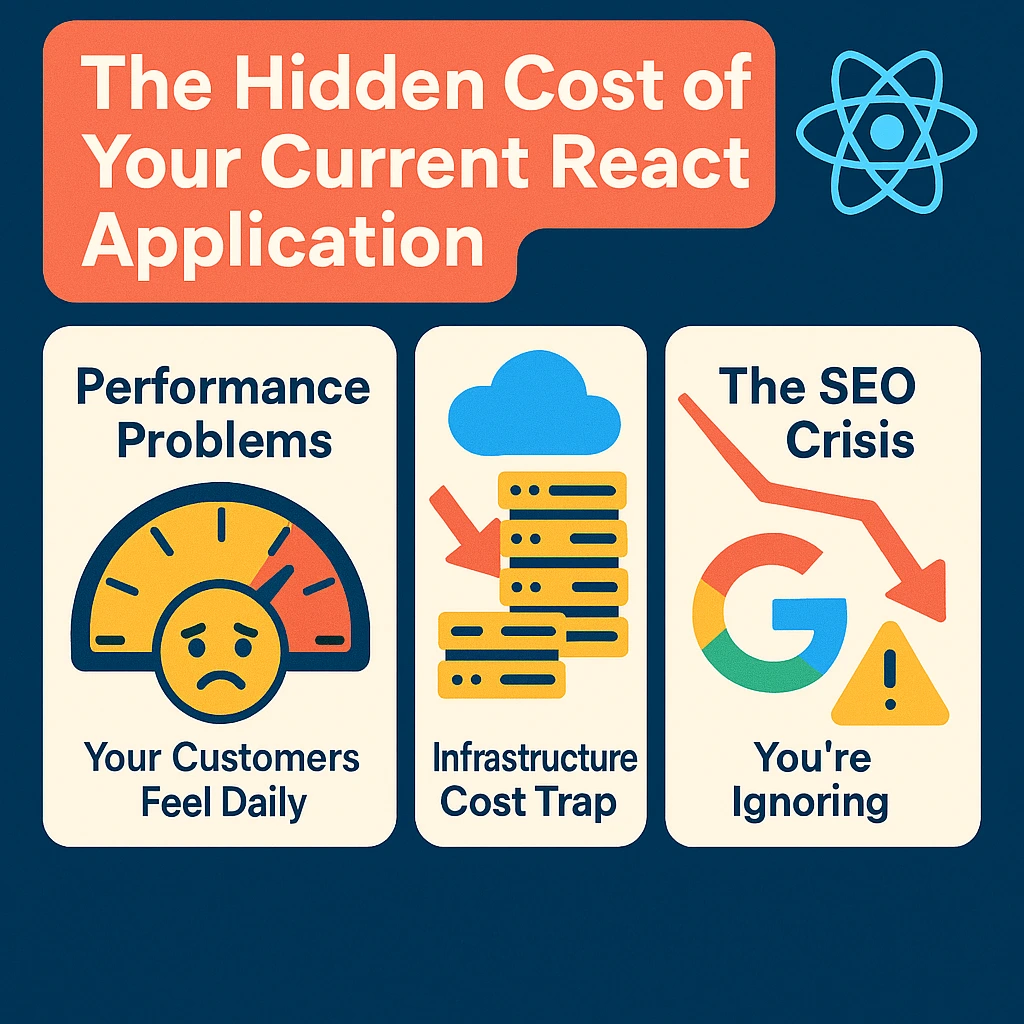
Most Australian businesses running React applications are sitting on a ticking time bomb. Your website might look modern and function adequately, but beneath the surface, you're bleeding money in ways you haven't measured.
Performance Problems Your Customers Feel Daily
Your traditional React application sends 2-5MB of JavaScript to every visitor's browser. That's like forcing someone to download an entire novel before they can read the first sentence. For your business, this means:
- Mobile users (67% of Australian traffic) wait 5-8 seconds for your site to become interactive
- 53% of users abandon sites taking longer than 3 seconds to load
- Every 100ms delay costs 1% in conversions—at $2M annual revenue, that's $20,000 per 100ms
A Melbourne-based SaaS company discovered their React dashboard had a Time to Interactive (TTI) of 8.2 seconds. They were losing 47% of potential trial signups before users even saw their product—$340,000 in annual recurring revenue evaporating due to performance issues they didn't know existed.
The Infrastructure Cost Trap
Your current React architecture forces you to overpay for infrastructure. Traditional client-side rendering requires excessive CDN bandwidth (serving 3-5MB per page instead of 200-500KB), higher server resources, and scaling that multiplies costs exponentially rather than linearly.
Australian context matters critically here. With local hosting costs 30-50% higher than US equivalents and CDN pricing that punishes distance from global hubs, you're paying a "geographic penalty" that Server Components can eliminate entirely.
The SEO Crisis You're Ignoring
Google's Core Web Vitals are no longer suggestions—they're ranking factors determining your visibility. Your traditional React application sabotages your search rankings through poor Largest Contentful Paint (LCP), high Cumulative Layout Shift (CLS), and terrible First Input Delay (FID).
The competitive reality: If your Melbourne or Sydney competitor adopts React Server Components whilst you stick with traditional client-side rendering, they'll outrank you within 3-6 months. Once they capture page 1 positions, reclaiming that territory costs 5-10x more in SEO investment.
Research shows that websites with good Core Web Vitals experience up to 61.13% increase in conversion rates and 26.09% boost in revenue per visitor. Every day your site underperforms is revenue walking out the door.
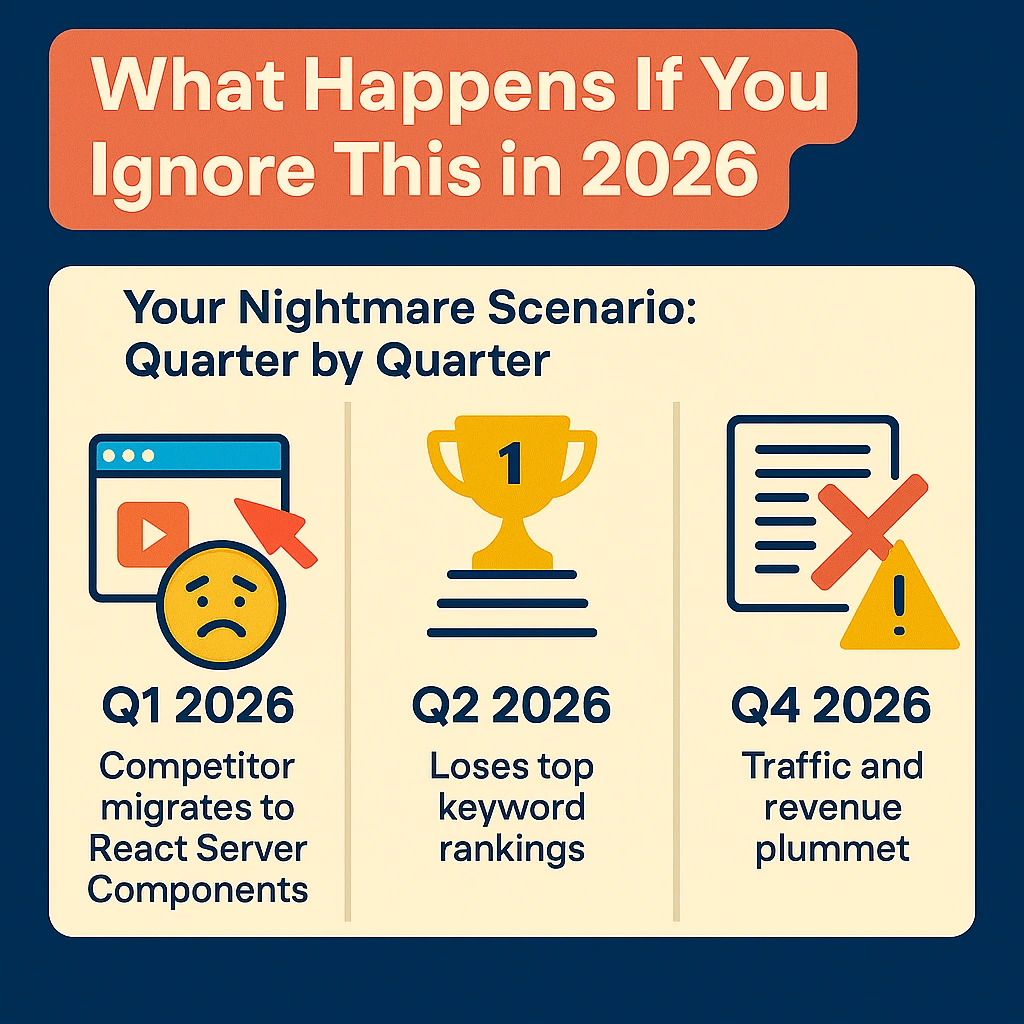
What Happens If You Ignore This in 2026
This isn't a technology trend you can safely ignore. React Server Components represent a fundamental architectural shift creating a widening performance gap between adopters and holdouts.
Your Nightmare Scenario: Quarter by Quarter
Q1 2026: Your competitor migrates to React Server Components. Within 60 days, their page load times drop from 4.2 seconds to 1.4 seconds, mobile conversion rates increase by 28%, and Google's algorithm detects improved Core Web Vitals. You notice nothing yet.
Q2 2026: Your competitor now occupies 3 of the top 5 positions for your most valuable keywords. Your organic traffic declines 18%. Meanwhile, their infrastructure costs drop 32%, allowing them to reduce prices or increase marketing spend.
Q3 2026: Your senior React developer gives notice to join a company using modern technology. Recruiting takes 12 weeks and costs $35,000. The new developer needs 8 weeks to understand your legacy architecture. Five months of development velocity lost.
Q4 2026: Your annual review reveals organic traffic down 34% year-over-year, conversion rates declining despite increased marketing spend, and infrastructure costs up 22%. The cost to catch up has tripled—what would have been a $120,000 strategic investment in Q1 is now a $380,000 emergency rescue mission.
The "Wait and See" Fallacy
Many executives think: "We'll wait until the technology matures." This reasoning would make sense if React Server Components were experimental. They're not. Meta has used Server Components in production since 2021. Next.js made them default in version 13 (2022) and refined them through versions 14 and 15.
This technology is production-proven, industry-standard, and being rapidly adopted. By the time you "wait and see," you'll be looking at competitors' backs.
Quantifying the Opportunity Cost
Every quarter you operate with legacy React architecture, you're actively falling behind. For a typical $3M annual revenue Australian business:
- Lost conversion improvements: $450,000-$1,050,000 annually
- Excess infrastructure costs: $60,000-$120,000 annually
- Reduced organic traffic value: $180,000-$400,000 annually
- Developer productivity loss: $90,000-$150,000 annually
Total opportunity cost: $780,000-$1,720,000 per year. After 12 months of "waiting," you've sacrificed enough profit to fund the migration three times over.
Understanding React Server Components: The Business Case
Before discussing implementation, let's ensure you understand what React Server Components actually do for your business—without the jargon.
The Simple Explanation
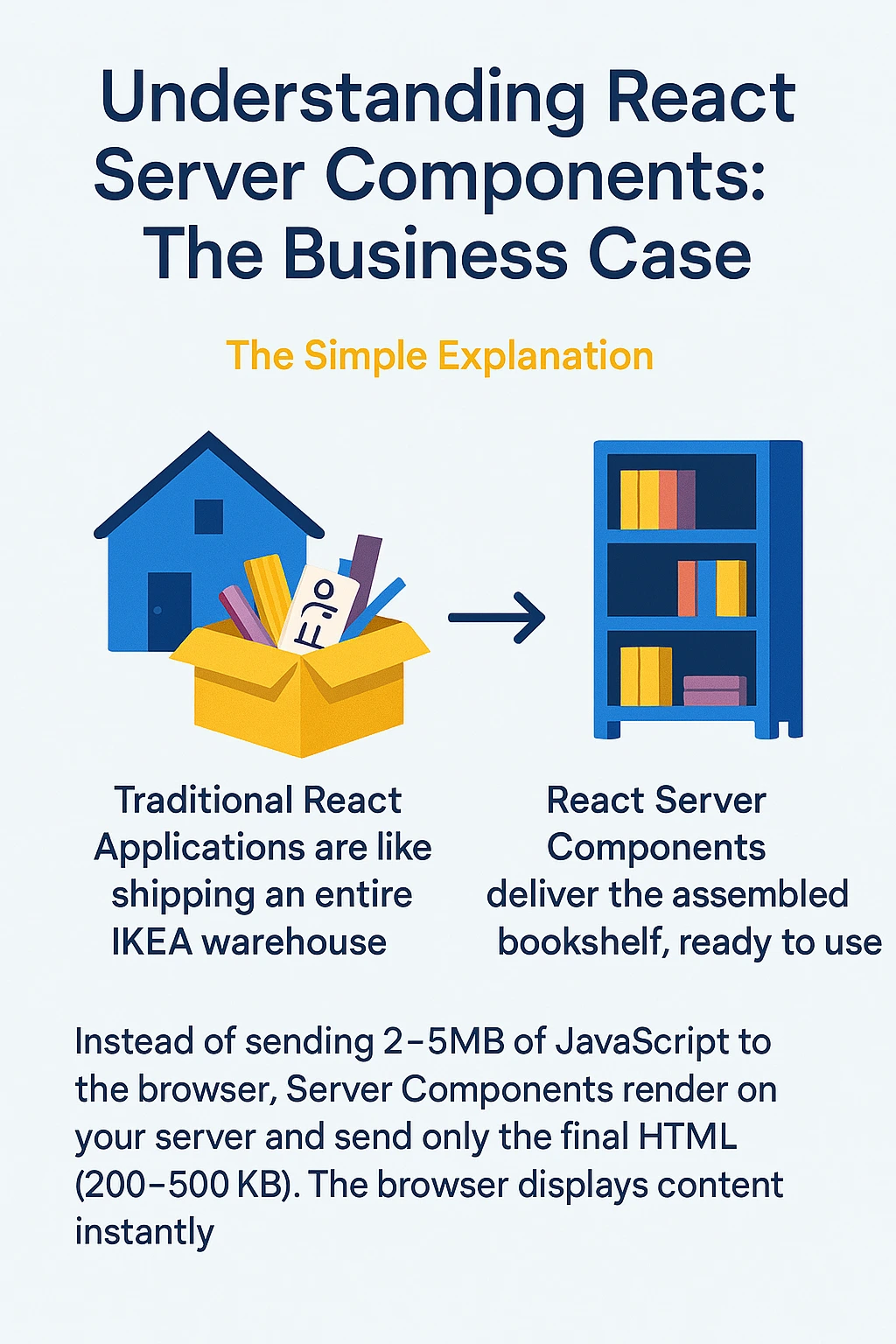
Traditional React applications are like shipping an entire IKEA warehouse to your customer's house when they order a bookshelf. They have to unpack everything, read instructions, and assemble it themselves.
React Server Components deliver the assembled bookshelf, ready to use. Your customer opens the door, and it's done.
Technical reality: Instead of sending 2-5MB of JavaScript to the browser, Server Components render on your server and send only the final HTML (200-500KB). The browser displays content instantly.
The Business Benefits That Matter
Revenue Increase Through Conversion Optimisation
Studies show that a 100ms improvement in load time can result in a 1.11% increase in conversion rates. React Server Components typically deliver 40-60% faster page loads, translating to 15-35% conversion rate improvements.
Real numbers: A $2M/year business typically sees $300,000-$700,000 in additional annual revenue after React Server Components migration.
Cost Reduction Through Infrastructure Efficiency
Server Components reduce computational requirements by rendering on the server where resources are cheap and connections to databases are fast. This delivers 25-40% lower hosting costs and 50-70% bandwidth savings.
Real numbers: A business spending $8,000/month on infrastructure typically reduces this to $4,800-$6,000/month, saving $14,400-$38,400 annually.
Competitive Advantage Through SEO Dominance
Core Web Vitals improvements boost Google rankings within weeks. Companies adopting Server Components commonly see 20-50% organic traffic increases within 6 months—traffic worth $150,000-$400,000 annually in advertising equivalent value.
Operational Efficiency Through Developer Productivity
Simplified architecture enables 30-50% faster feature development, reduced debugging time, and easier maintenance. This means shipping 3-5 additional features per quarter, each potentially worth $20,000-$100,000 in revenue impact.
The "AI Cowboys" Problem: Why Cheap Solutions Cost Everything

As React Server Components gain attention, a dangerous breed of developers is emerging: "AI Cowboys" who use AI tools to generate code they don't actually understand. This is "vibes coding"—development based on "it looks right" rather than "I understand why this works."
Why This Is Catastrophic for Your Business
AI Cowboys deliver quickly. Their code runs in development. Demos look impressive. You think you've found a bargain. Then reality hits:
- Week 4: Strange bugs appear under load
- Week 8: Performance degrades as users increase
- Week 12: Security vulnerabilities expose your database
- Week 16: New features break existing functionality
- Month 6: The entire codebase is unmaintainable
The financial damage: You've paid $40,000-$80,000 for a liability. Now you need $120,000-$200,000 to rebuild correctly. Your total cost is $160,000-$280,000—double what working with a professional React JS development company would have cost initially.
The Grey Areas of Vibes Coding
AI-generated code operates in dangerous grey areas:
- No architectural understanding - Code "works" but doesn't follow best practices, creating performance bottlenecks
- Security vulnerabilities - AI doesn't understand your security requirements, exposing sensitive data
- Technical debt from day one - Code isn't maintainable by human developers
- No knowledge transfer - When the AI Cowboy leaves, no one understands the codebase
Real-World Australian Example
A Brisbane fintech startup hired a freelancer offering React Server Components migration for $35,000 (market rate: $90,000). The freelancer used AI to generate code over 6 weeks.
The result: Application crashed under production load (Week 3), data leaks exposed customer information (Week 5), and performance was worse than the original (Week 8). The freelancer couldn't fix issues because he didn't understand his own code.
The cleanup: C9 audited and found 847 critical security issues, zero tests, no error handling, and inconsistent architecture. Total cost: $35,000 (initial) + $140,000 (rebuild) + $50,000 (lost revenue) = $225,000. Had they hired C9 initially for $95,000, they would have saved $130,000 and launched 4 months earlier.
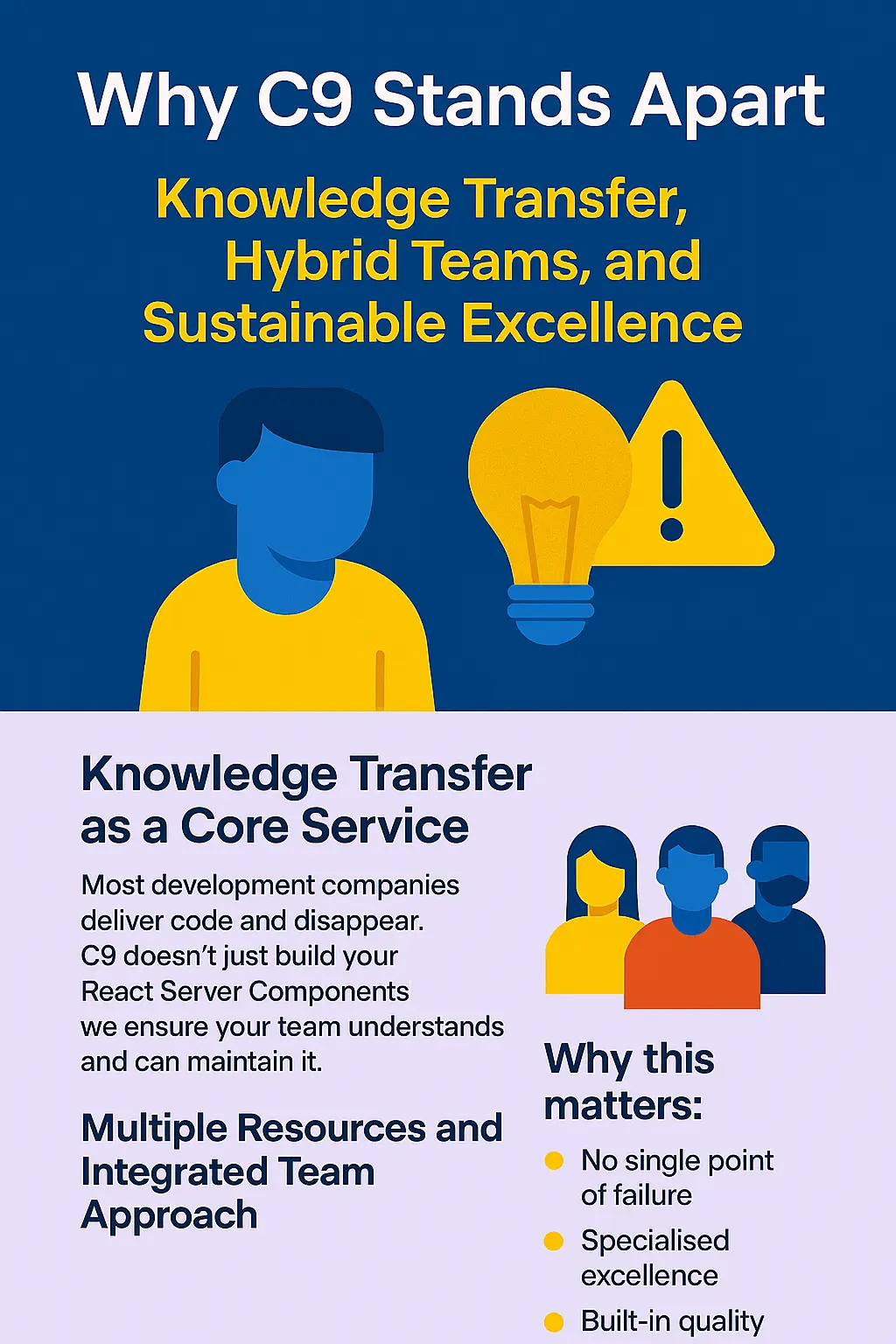
Why C9 Stands Apart: Knowledge Transfer, Hybrid Teams, and Sustainable Excellence
You have hundreds of choices when selecting a React JS development company in Australia. So why choose C9?
1. Knowledge Transfer as a Core Service
Most development companies deliver code and disappear. You're left dependent on external contractors forever. C9 doesn't just build your React Server Components application—we ensure your team understands and can maintain it.
Our Knowledge Transfer Process:
- Phase 1: Complete architecture documentation in plain English, video walkthroughs, and decision logs
- Phase 2: Live pair programming sessions, code review workshops, and customised training
- Phase 3: 30-day transition period with prioritised support and gradual handoff
- Phase 4: Quarterly architecture reviews and ongoing enablement
Business value: Your in-house team becomes competent in React Server Components, reducing external dependency by 60-80%. You own your digital infrastructure intellectually, not just legally.
2. Blended Hybrid Offshore & Onshore Team Model
C9's competitive advantage is our hybrid team structure delivering enterprise-grade quality at SME-friendly pricing.
How it works:
- Australian onshore team (30-40%): Senior architects, project managers, business analysts, QA specialists
- Offshore development team (60-70%): C9 direct employees (not contractors), senior/mid-level engineers, specialists
Cost efficiency (40-60% savings):
- Offshore rates: $50-$90 AUD/hour (fully loaded)
- Onshore rates: $120-$180 AUD/hour (fully loaded)
- Blended rate: $70-$120 AUD/hour
- Traditional Australian-only firms: $150-$250 AUD/hour
For a typical $150,000 React Server Components migration:
- Australian-only firm: $200,000-$250,000
- Offshore-only firm: $80,000-$100,000 (with quality/communication risks)
- C9 hybrid model: $120,000-$150,000 (best of both worlds)
Important note: We do not use in-house local hiring for standard development roles. All team members work remotely. Do not expect someone showing up at your office 9-5. This keeps costs efficient and gives you access to broader talent pools.
3. Multiple Resources and Integrated Team Approach
Unlike freelancers assigning 1-2 developers, C9 provides integrated teams with diverse specialisations. A standard project team includes: technical architect, project manager, 2-4 senior developers, frontend specialists, backend engineer, DevOps engineer, QA specialist, and security expert.
Why this matters:
- No single point of failure: If one developer is unavailable, the project continues
- Specialised excellence: Each team member focuses on their expertise
- Built-in quality assurance: Peer code reviews catch issues immediately
- Business continuity: You don't worry about recruitment or retention
Staff Augmentation Options & Flexibility
Sometimes you need to augment existing development capacity rather than commission a full project. C9 offers flexible staff augmentation tailored to Australian business needs.
Understanding Your Options
Minimum Lock-In Contract (3-6 Months) - RECOMMENDED
Structure: 3 or 6-month commitment, dedicated resources, fixed monthly rates, guaranteed availability
Pricing benefits: 15-25% discount vs monthly contracts, priority access to senior developers, no rate increases, hour rollover for feature stockpiling
Why this is better: Building software requires ramp-up time. Developers need weeks 1-2 to learn your codebase, weeks 3-12 to become productive, and month 4+ to reach peak performance. Monthly contracts create uncertainty, reduced commitment, and higher turnover risk.
Example calculation:
Monthly contract (6 months average): 52.5% average productivity due to learning curves and turnover
3-6 month contract: 76.7% average productivity with sustained excellence
Value difference: You get 46% more effective work from the committed contract, plus the discount rate.
Monthly Package (Flexible Scaling)
Structure: Month-to-month engagement, 2-week notice for scaling, shared resource pool, hour rollover
When this makes sense: Exploratory projects with uncertain scope, seasonal needs, budget constraints requiring monthly approvals, short-term specialised skills (3-8 weeks)
Honest assessment: Monthly packages work for specific situations but are typically 15-30% less cost-effective than committed contracts.
C9 Staff Augmentation Rates & Pricing
C9's rates vary based on skillsets, providing savings over inflated singular hourly rates. Many firms charge one rate ($150/hour) regardless of seniority. This is inefficient and overpriced.
C9's skill-based rate structure (FY25/26):
- Junior Developer (1-3 years): $55-$75 AUD/hour
- Mid-Level Developer (3-6 years): $75-$100 AUD/hour
- Senior Developer (6-10 years): $100-$140 AUD/hour
- Lead Developer/Architect (10+ years): $140-$180 AUD/hour
- Specialised roles: DevOps ($90-$130), UI/UX ($80-$120), QA ($70-$100)
Important disclaimers:
- Rates assume blended offshore/onshore teams. Local Australian resources only increase rates by 30-50%
- Rates subject to annual CPI adjustment (FY25/26 rates shown)
- Additional discounts: Long-term contracts (12+ months) 10-15% off, multi-resource (3+) 8-12% off
- Monthly packages scalable with 2-week notice, hour rollover available
Real-World Cost Comparison
Scenario: 2 developers for React Server Components work for 6 months
Australian-only firm: 2 seniors @ $180/hour = $57,600/month × 6 = $345,600
Offshore-only freelancers: 2 developers @ $50/hour = $16,000/month × 6 = $96,000 + hidden costs ($30,000-$60,000 rework) = $126,000-$156,000 with significant risk
C9 hybrid model: 1 senior offshore ($120/hour) + 1 mid-level offshore ($85/hour) + Australian PM (10 hours/month @ $130/hour) = $34,100/month with 15% discount = $28,985/month × 6 = $173,910
Value: $171,690 savings vs Australian-only (50% reduction) with quality assurance and knowledge transfer included.
Why Discovery Calls Are Non-Negotiable
Most Australian business owners see discovery calls as time-wasting sales pitches. Here's the brutal truth: skipping discovery is the #1 reason software projects fail, go over budget, or deliver the wrong solution.
What Happens When You Skip Discovery
The common scenario:
Root cause: No discovery to map requirements, technical constraints, integration challenges, and compliance needs.
What Discovery Actually Accomplishes
Discovery is a strategic planning session preventing disaster scenarios. C9's discovery process includes:
Session 1: Business Context & Goals (60-90 minutes)
- Current business model and revenue sources
- Digital platform's role in your business
- Performance problems you're experiencing
- Competitive pressures and growth plans
- Budget constraints and ROI expectations
Session 2: Technical Architecture Assessment (90-120 minutes)
Session 3: User Experience & Feature Requirements (60-90 minutes)
- Critical user journeys and interactions
- Performance-sensitive pages
- Mobile vs desktop usage patterns
- SEO priorities and content structure
- Analytics and tracking needs
Session 4: Project Planning & Risk Management (60 minutes)
- Detailed timeline with milestones
- Resource allocation plan
- Risk register with mitigation strategies
- Communication structure and governance
- Knowledge transfer plan
Total discovery investment:
- Time: 4-6 hours over 1-2 weeks
- Cost: $3,000-$6,000 (credited toward project)
- Value: Prevents $50,000-$200,000 in overruns
How Discovery Maps Decision Points & Timeline
Discovery creates a decision tree respecting your business realities:
Decision Point 1 (Week 2): Discover reveals whether RSC is right. Alternative approaches presented if appropriate.
Decision Point 2 (Week 4): Choose phased approach (lower risk, faster ROI) vs full migration (comprehensive but slower).
Decision Point 3 (Week 8): Evaluate build vs buy for components, with cost-benefit analysis.
Decision Point 4 (Ongoing): Regular milestone reviews allow scope adjustments based on emerging insights.
Timeline comparison:
Without discovery: Assumed 4 months becomes 7-8 months with problems, rework, and chaos.
With discovery: 2 weeks upfront planning + 5 months focused development = smooth launch, aligned stakeholders, satisfied outcome.
Discovery adds 2 weeks but removes 3-4 months of chaos. You launch faster and definitely cheaper.
Discovery Call ROI: Real Numbers
Discovery investment: $4,500 average
What discovery prevents:
- Scope creep: $30,000-$80,000 savings
- Technical rework: $20,000-$60,000 savings
- Timeline delays: $40,000-$100,000 opportunity cost savings
- Wrong technology choice: $50,000-$150,000 savings
Minimum ROI: 6x-10x return
Projects with comprehensive discovery have an 87% success rate. Projects without discovery have a 34% success rate.
The Pricing Reality: Why Indicative Quotes Are Worthless
You've received proposals with "indicative pricing" like "$80,000-$150,000" and "3-6 months timeline." These proposals aren't worth the paper they're written on.
How Indicative Pricing Is Done (The Dishonest Way)
Most companies generate indicative quotes through: read 2-page brief → make wild assumptions → pick a number that's low enough to get attention, high enough to cover overruns, vague enough to adjust later → add disclaimers allowing unlimited scope expansion.
Result: A number pulled from thin air, packaged professionally to seem authoritative.
Indicative Pricing: To the Nearest Week
When developers give indicative quotes without discovery, they're estimating to the nearest week or month.
Example: "React Server Components migration is probably 400-800 hours."
- Low: 400 hours × $150/hour = $60,000
- High: 800 hours × $150/hour = $120,000
- Quoted range: $60,000-$120,000
The problem: This is a 50-week range of uncertainty (400 hours = 10 weeks, 800 hours = 20 weeks).
Real outcome: Actual hours end up at 950 (assumptions were wrong), costing $142,500. You're over budget by $22,500-$82,500.
Discovery-Based Pricing: To the Nearest Hour
After discovery, C9 knows exact architecture details, integration requirements, and complexity. We provide detailed breakdowns:
| Task Category |
Hours |
Rate |
Cost |
| Architecture Planning |
24 |
$150 |
$3,600 |
| Server Components Setup |
16 |
$130 |
$2,080 |
| Data Layer Migration |
80 |
$120 |
$9,600 |
| Component Migration (12 screens) |
240 |
$110 |
$26,400 |
| API Optimisation |
64 |
$120 |
$7,680 |
| Integration Updates |
48 |
$110 |
$5,280 |
| Testing & QA |
96 |
$90 |
$8,640 |
| DevOps & Deployment |
40 |
$130 |
$5,200 |
| Documentation |
24 |
$100 |
$2,400 |
| Project Management |
48 |
$130 |
$6,240 |
| Total |
680 hours |
Blended |
$77,120 |
Add 10% contingency: $7,712
Total: $84,832 (±5% accuracy, not ±50%)
Timeline: 17 weeks precisely
This is discovery-based pricing to the nearest hour vs indicative guessing to the nearest week/month.
Real-World Example
Adelaide e-commerce business ($5M revenue): Migrate 15-page React application
Developer A (Freelancer): $45,000-$65,000 indicative, 2-4 months
Developer B (Agency): $80,000-$110,000 indicative, 3-5 months
C9 (After $4,800 discovery): $96,500 (±$4,825), 18 weeks
Client chose Developer A. Final outcome: $127,000 (2.8x initial estimate), 8 months (2x timeline), $35,000 lost revenue = $162,000 total damage
If they'd chosen C9: $96,500 as quoted, 18 weeks as planned, $0 damage
Net savings with C9: $65,500 + 4 months faster
Discovery ROI: $65,500 ÷ $4,800 = 13.6x return
Why Breaking Projects Into Stages Is Critical
Discovery reveals opportunities to phase projects for early ROI:
Stage 1: High-Impact Pages (Weeks 1-6) - $28,000 investment, 8-15% conversion improvement = $40,000-$75,000 annual revenue, 4-6 month payback
Stage 2: Customer Journey Optimisation (Weeks 7-12) - $34,000 investment, improved retention = $60,000-$90,000 annual value, 5-7 month payback
Stage 3: Complete Migration (Weeks 13-18) - $34,500 investment, full SEO benefits + infrastructure savings = $50,000-$80,000 annual, 6-8 month payback
Key advantages: Pause after Stage 1 if priorities change, fund later stages from early wins, validate approach before full commitment, reduce risk dramatically.
Why C9 Is Your Strategic Partner
You've seen the full picture: the technology, the risks, the process, and the pricing reality. Here's why C9 is the React JS development company Australian businesses trust:
- Proven React Server Components expertise - Next.js 15 specialists with production deployments across e-commerce, SaaS, and fintech
- Knowledge transfer as core service - Your team becomes independent, no vendor lock-in
- Hybrid offshore/onshore model - 40-60% cost savings with enterprise quality
- Integrated team approach - Multiple specialised resources, not lone freelancers
- Flexible engagement models - Staff augmentation or fixed-price projects with skill-based pricing
- Discovery-first methodology - Accurate pricing (±5%) not indicative guessing (±50%)
- Australian market understanding - Sydney, Melbourne, Brisbane presence with local compliance knowledge
- Long-term partnership mindset - We recommend against projects that don't serve you
What You Get Working With C9
Technical excellence: 40-60% faster loads, 15-35% conversion improvements, 25-40% infrastructure cost reductions, superior SEO performance
Business outcomes: Measurable ROI within 90 days, competitive advantages compounding over time, reduced technical debt, 30-50% faster feature delivery
Peace of mind: Accurate timelines and budgets, transparent communication, risk management, quality assurance, partnership with professionals who care about your success
Your Path Forward in 2026
You stand at a critical decision point. React Server Components represent the most significant shift in web application architecture since responsive design. Businesses acting decisively in 2026 will establish advantages compounding for years.
The ROI of Acting Now
Conservative scenario (typical Australian SME):
- Current revenue: $2M annually
- Conversion improvement: +20% = $400,000
- Infrastructure savings: $25,000 annually
- SEO traffic improvement: $80,000 equivalent
- Total benefit: $505,000 annually
C9 investment: $95,000-$150,000
Payback period: 2-4 months
3-year ROI: 10x-16x
Aggressive scenario (high-growth business):
- Current revenue: $5M annually
- Conversion improvement: +30% = $1,500,000
- Infrastructure savings: $60,000 annually
- Competitive positioning: $200,000 value
- Total benefit: $1,760,000 annually
C9 investment: $150,000-$250,000
Payback period: 1-2 months
3-year ROI: 21x-35x
These aren't theoretical—they're conservative estimates based on actual client outcomes.
Your Next Steps
Step 1: Book Your Free 30-Minute Consultation
No sales pitch. No obligation. Honest conversation about your challenges, whether RSC is right, realistic timelines, and alternatives if RSC isn't the fit.
Book consultation:
Step 2: Invest in Discovery (If We're a Good Fit)
Comprehensive discovery engagement: 4-6 hours over 1-2 weeks, $3,000-$6,000 (credited toward project), detailed assessment with accurate pricing and strategic roadmap. You keep all deliverables even if you don't proceed.
Step 3: Make an Informed Decision
Armed with discovery insights, you'll know exactly what success looks like, have accurate budget and timeline, understand risks and management, and can present compelling cases to stakeholders.
Step 4: Execute With Confidence
Fixed-price contract, clear milestones, regular updates, knowledge transfer throughout, launch with celebration.
Australia's Leading React JS Development Company
C9 is Australia's premier custom software, apps, integration, and database developer. We specialise in helping Australian businesses leverage modern web technologies for measurable business outcomes. Our hybrid offshore/onshore model delivers enterprise-grade quality at SME-friendly pricing, with knowledge transfer ensuring your team gains capability, not dependency.
What Happens After Contact
Within 24 hours: Confirmation and initial questionnaire, scheduled consultation
During consultation: Discuss goals and challenges, honest assessment, overview of C9's approach, next steps if mutual fit
If proceeding to discovery: 1-2 week engagement, technical audit and business analysis, detailed proposal with accurate pricing, decision points and stage opportunities identified
You're in control at every step. No pressure, no games, no surprises.
Final Thoughts: The Future Belongs to the Fast
Technology doesn't wait. Markets don't pause. Competitors don't take breaks.
React Server Components aren't coming—they're here. Your competitors are reading articles like this too. Some will act, most will procrastinate. The ones who act will build advantages that compound monthly.
Will you lead, follow, or get left behind?
The choice—and the future of your digital business—is entirely in your hands.
From Sydney to Perth, from startups to enterprises, we're the React JS development company that Australian businesses trust when success matters.
Let's build something amazing together.
Contact us today
Published: December 2026
Author: C9 Development Team
Last Updated: December 2026
Reading Time: 10 minutes
Category: React Development, Web Performance, Business Strategy
Tags: #ReactServerComponents #NextJS #WebPerformance #AustralianBusiness #DigitalTransformation #ReactDevelopment #C9Australia
About C9: C9 is Australia's leading custom software, apps, integration, and database developer, specialising in React JS development, Next.js applications, and modern web technologies. With offices in Sydney, Melbourne, and Brisbane, we serve Australian businesses from startups to enterprises with our proven hybrid offshore/onshore model, delivering enterprise-grade results at competitive pricing while ensuring comprehensive knowledge transfer and long-term partnership success.