As a business owner or executive in Australia, you're navigating a perfect storm in 2025. Digital transformation has accelerated beyond talent acquisition, with 43% of Australian SMEs finding hiring costs prohibitively expensive and 47% saying the hiring process is too lengthy and complex. On top of that, 53% report increased operational stress from recent industrial relations reforms.
Perhaps most concerning: 65% of Australian business leaders cite cost and margin pressure as their biggest challenge, with 31% forced to dip into personal funds to keep operations running. Here's the uncomfortable truth: while you're struggling with these pressures, your competitors are discovering a solution that's transforming how they operate—Robotic Process Automation (RPA) enhanced with Artificial Intelligence (AI).
Traditional RPA—those rule-based bots that automate repetitive tasks—is rapidly becoming obsolete. The businesses winning in 2025 aren't using yesterday's automation. They're deploying intelligent automation: RPA combined with AI elements that can think, adapt, and make decisions. The RPA market tells the story: valued at $22.79 billion in 2024, it's projected to explode to $178.55 billion by 2033—a staggering 25.7% compound annual growth rate. The primary driver? GenAI integration transforming basic bots into intelligent assistants.
The stakes are clear: 60% of Australian businesses are either already using AI or planning integration within two years. The question isn't whether you'll automate with intelligence—it's whether you'll be a first-mover capturing competitive advantage or a late adopter fighting to catch up.
As Australia's leading custom software, apps, integration, and database development company, C9 has guided dozens of Australian businesses through intelligent automation transformation. In this comprehensive guide, we'll show you:
- Why combining RPA with AI elements delivers 60% faster processing and 30-40% cost reduction
- How the integration with automation actually works in Australian businesses
- Why the discovery process is critical (and skipping it is catastrophic)
- The hidden dangers of "AI Cowboys" and cheap vibes coding
- How to choose the right development service and automation partner
- Real-world pricing frameworks that protect your investment
The Evolution - From Basic Bots to Thinking Assistants
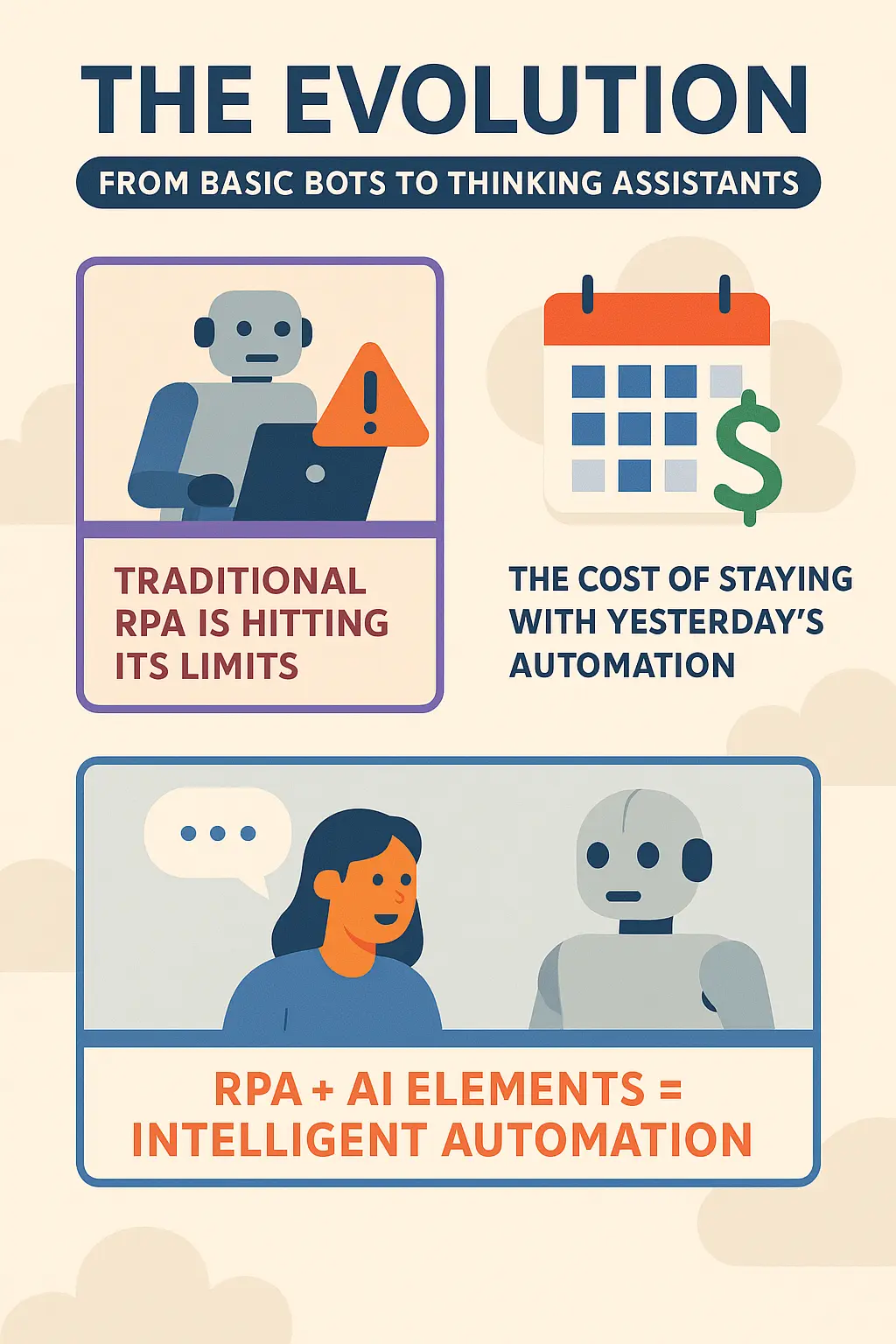
Traditional RPA is Hitting Its Limits
You've probably encountered traditional RPA, even if you didn't call it that. It's the automation that handles repetitive, rule-based tasks: data entry, invoice processing, report generation, moving information between systems.
And it worked... until it didn't.
Traditional RPA operates on strict if-then logic: "If Field A equals X, then do Y." It's perfect for structured data and predictable processes. But here's where it fails spectacularly:
When your invoice arrives in a new format → The bot breaks. When a customer sends an email inquiry → The bot can't understand natural language. When an exception occurs outside the rules → The bot freezes and requires complete reprogramming.
For Australian businesses dealing with complex Award system interpretations, varied compliance requirements, and increasingly sophisticated customer expectations, these limitations aren't just inconvenient—they're deal-breakers.
The Cost of Staying with Yesterday's Automation
While you're managing traditional RPA that breaks every time something changes, here's what's happening:
Your competitors are processing documents 60% faster using intelligent document processing that reads handwritten notes, scanned forms, and emails with perfect accuracy.
They're serving customers 24/7 with AI-powered assistants that understand context, detect sentiment, and route urgent issues instantly—while your team fields calls during business hours.
They're making smarter decisions in real-time with automation service platforms that analyse patterns, predict outcomes, and adapt to exceptions—while you're still reviewing spreadsheets from last week.
They're scaling without proportional cost increases—handling 3x the workload with the same headcount—while you're struggling to justify new hires at inflated salary expectations.
RPA + AI Elements = Intelligent Automation
This is where integration with automation transforms from a "nice-to-have" efficiency play into a competitive necessity.
What AI Elements Actually Add to RPA:
-
Unstructured Data Processing (The Game-Changer) Traditional RPA: "I can only read structured forms with data in exact positions." AI-Enhanced RPA: "I can extract information from handwritten notes, scanned documents, emails, PDFs, images, and even voice recordings."
A logistics company deployed AI-powered RPA to analyse bills of lading, invoices, and shipment documents. Result: 60% reduction in processing time and virtual elimination of human error. They're now processing 824,000 documents annually with 93% straight-through without manual inspection.
-
Context-Aware Decision Making Traditional RPA: "I follow the rules exactly as programmed." AI-Enhanced RPA: "I understand context, recognise patterns, and make informed decisions based on multiple factors."
Practical Australian Business Applications:
- Finance: Detecting suspicious expense claims that technically meet policy but show unusual patterns.
- Customer Service: Understanding emotional tone in complaints and prioritising urgent issues.
- HR: Interpreting complex Award requirements and calculating correct penalty rates, allowances, and minimum wages automatically.
- Supply Chain: Analysing demand patterns, supplier performance, and inventory levels to generate customised procurement strategies.
-
Natural Language Understanding Traditional RPA: "I need structured commands." AI-Enhanced RPA: "I understand natural language, intent, and can respond conversationally."
Your customers can now describe problems in their own words via chat, email, or voice—and receive intelligent, contextual responses instantly. No more "I didn't understand that, please select from these options."
-
Continuous Learning and Adaptation Traditional RPA: "When the process changes, I break." AI-Enhanced RPA: "I learn from exceptions, adapt to changes, and optimise myself continuously."
Machine learning models identify patterns in exceptions and edge cases. The system gets smarter with every transaction, eventually handling scenarios it wasn't explicitly programmed for.
The Integration Service Reality This isn't about replacing your existing systems. It's about creating an intelligent automation layer that connects everything you already have—your CRM, accounting software, inventory systems, HR platforms—and makes them work together seamlessly with intelligence baked in.
Real ROI for Australian Businesses:
The question facing Australian business owners isn't "Can we afford intelligent automation?" It's "Can we afford NOT to automate intelligently?"
But here's the critical part most businesses get catastrophically wrong: They skip the discovery process and jump straight to implementation. Let's talk about why that's a disaster waiting to happen.
Why Discovery Calls Are Critical - And Skipping Them is the Worst Decision You'll Make
The "Quick Quote" Trap That Destroys Projects
We see it constantly at C9. A business owner calls: "We need automation service for our invoice processing. Can you just send me a quote?"
It sounds reasonable. You want to know what it costs. You want to compare options. You want to make a decision quickly and get started.
But here's what happens when you skip proper discovery:
Project A: Melbourne Manufacturing Company. They went with the cheapest quote: $15,000 for "complete automation" from an offshore team. No discovery. Just specifications sent via email and a fixed price.
3 months later:
- The automation didn't integrate with their existing ERP system
- It couldn't handle their specific Award requirements
- Exception cases (30% of their invoices) still required manual processing
- The offshore team disappeared after "completion"
- Total wasted investment: $15,000 + $23,000 to rebuild it properly
Project B: Sydney Professional Services Firm. They invested in proper discovery with C9: 2 weeks, $4,500 investment.
Discovery revealed:
- Their invoice processing was actually fine
- Their real bottleneck was client onboarding (taking 12 days on average)
- Automating onboarding would save $180,000 annually vs $50,000 for invoices
- They needed integration with 3 existing systems they hadn't mentioned
- Compliance requirements that would have killed any solution built without discovery
Result: They automated the RIGHT process, achieved 70% time reduction in onboarding, and generated ROI in 4 months instead of wasting money on the wrong solution.
What You're Really Risking Without Discovery
-
Building the Wrong Solution to the Wrong Problem You think you need invoice automation. Discovery reveals your real problem is delayed customer payments because your invoicing has no automated follow-up. You would have spent $30,000 solving 20% of the problem instead of $25,000 solving 100% of it.
-
Missing Critical Integration Requirements Your quote doesn't account for integrating with your specific CRM, accounting system, or compliance platforms. Suddenly your $20,000 project needs another $15,000 in "unexpected" integration work.
- Ignoring Exception Handling 80% of your process is straightforward. 20% has exceptions that weren't discussed in your "quick quote." Your automation handles the easy 80% but breaks on the 20%, meaning you've automated... nothing. You still need full-time staff to handle exceptions.
- Compliance Landmines Australian businesses face complex regulations: Privacy Act requirements, industry-specific compliance, IR reforms, Award system complexity. Your "quick solution" doesn't account for these, exposing you to regulatory risks and potential fines that dwarf your automation investment.
- No Change Management Strategy Your team resists the new automation. They find workarounds. They continue manual processes "just to be safe." Your $40,000 investment sits unused because nobody planned for adoption.
The harsh truth: Skipping discovery doesn't save time—it guarantees expensive failures, project restarts, and wasted months.
How C9's Discovery Process Actually Works (And Why It's Not a Waste of Time)
At C9, we've refined discovery for Australian businesses through hundreds of integration service and development service projects. Here's exactly how it works:
Phase 1: Discovery Kick-Off (Week 1, Days 1-2) What Happens:
- 2-hour workshop with your key stakeholders
- We map your current processes end-to-end
- Identify pain points, bottlenecks, and hidden issues
- Document your existing systems and technology stack
- Understand your compliance requirements and constraints
What You Get:
- Clear problem definition (often different from what you initially thought)
- Stakeholder alignment (everyone agrees what needs solving)
- Initial scope boundaries
- Red flags identified early (integration challenges, compliance issues)
Deliverable: Discovery Charter (5-8 pages)
Phase 2: Deep Dive Analysis (Week 1, Days 3-5) What Happens:
- Our team analyses your workflows in detail
- We use AI-powered process mining tools to identify automation opportunities
- Interview end-users who actually do the work (management often doesn't know the real process)
- Review sample data, documents, and edge cases
- Map integration points with existing systems
What You Get:
- Process maps showing current state vs future state
- Identification of quick wins (high impact, low complexity)
- Risk assessment (technical, compliance, change management)
- Alternative approaches you hadn't considered
Deliverable: Process Analysis Report (12-20 pages)
Phase 3: Solution Design (Week 2, Days 1-3) What Happens:
- Our architects design the technical solution
- We create integration architecture showing how everything connects
- Define data flows, security protocols, and compliance measures
- Identify which tasks require AI elements vs standard RPA
- Plan exception handling and human-in-the-loop workflows
What You Get:
- Technical architecture diagrams
- Integration specifications
- Security and compliance framework
- Performance metrics and success criteria
- Technology stack recommendations
Deliverable: Solution Design Document (15-25 pages)
Phase 4: Project Roadmap & Accurate Pricing (Week 2, Days 4-6) What Happens:
- Break the project into stages (more on this later)
- Define detailed timeline with milestones
- Identify dependencies and decision points
- Map resource requirements (onshore vs offshore mix)
- Calculate accurate, hour-based pricing (not "day" or "week" estimates)
What You Get:
- Phased implementation roadmap
- Clear decision points where you approve next stage
- Accurate pricing breakdown by stage
- Risk mitigation strategies
- ROI projections by phase
Deliverable: Project Proposal with Accurate Pricing (20-30 pages)
Why This Mapping of Decision Points & Timeline Matters Decision Point Mapping Protects Your Investment: Instead of committing $100,000 upfront for the entire project, discovery lets you:
Stage 1 (Months 1-2): Proof of Concept - $15,000
- Automate ONE critical workflow
- Prove the concept works in your environment
- Measure actual results vs projections
- Decision Point: Go to Stage 2 or adjust approach?
Stage 2 (Months 3-4): Core Automation - $45,000
- Automate 5-8 related processes
- Full integration with existing systems
- Train your team
- Decision Point: Expand further or optimise current automation?
Stage 3 (Months 5-6): Scaling & Optimisation - $35,000
- Extend automation to additional departments
- Add advanced AI elements
- Implement continuous improvement
- Decision Point: Continue expansion or pause and measure?
Total Investment: $95,000 - but spent in stages with validation at each step, not $100,000 upfront gambling on success.
Timeline Mapping Enables Realistic Planning: Without Discovery: "This should take 3 months" Reality: Takes 7 months, with 2 months of rework. With Discovery: "This will take 5 months with these specific milestones" Reality: Takes 5 months as planned, because we identified dependencies, resource requirements, and approval cycles upfront.
The Discovery Investment C9's Discovery Process:
- Duration: 2 weeks
- Investment: $3,500 - $7,500 depending on complexity
- Deliverables: 4 comprehensive documents, technical architecture, accurate pricing
- ROI: Typically prevents $15,000-$50,000 in wasted spending on wrong solutions
What happens after discovery?
- You have complete clarity on what you're buying
- You've eliminated 80% of project failure risks
- If you proceed with C9, discovery cost is credited against Stage 1 development
Real Client Example: Brisbane Logistics Company Initial Request: "Quote us for warehouse automation" Discovery Investment: $5,500 (2 weeks)
What Discovery Revealed:
- Warehouse processes were actually efficient
- Real problem: Delayed shipments due to manual documentation
- Customs paperwork taking 4 hours per shipment
- Missing compliance checks causing delays and fines
- Integration needed with their WMS, carrier systems, and customs platforms
Solution: Intelligent document processing for customs documentation Cost: $38,000 (vs estimated $75,000 for warehouse automation they initially requested) Result: 85% reduction in documentation time, zero compliance errors, $240,000 annual savings Discovery ROI: Saved $37,000 by solving the right problem + generated $240,000 annual benefit
Without discovery, they would have spent $75,000 automating the wrong thing.
Why Skipping Discovery Guarantees Problems You can't accurately price what you don't fully understand. Any developer or development service provider who gives you a fixed price without thorough discovery is either:
- Padding the price 50-100% to cover unknowns (you overpay)
- Under-pricing and will hit you with endless "change orders" (you overpay)
- Planning to deliver the minimum and disappear (you get nothing useful)
Discovery isn't overhead. It's insurance against expensive failures. At C9, we refuse to provide "quick quotes" for integration with automation or complex development service projects. Not because we're difficult—but because we protect our clients from expensive disasters. Bottom line: Invest 2 weeks and $3,500-$7,500 in discovery—or risk wasting $20,000-$100,000 on the wrong solution built the wrong way. The choice is obvious.
The AI Cowboys & Vibes Coding Danger - Why Cheap Can Cost You Everything
The Rise of "AI App Builders" and the Vibes Coding Problem
2025 has seen an explosion of what we at C9 call "AI Cowboys"—individuals and small operations marketing themselves as automation service and development service providers based on one key differentiator: they're cheap.
The pitch sounds attractive: "I can build your automation using ChatGPT and no-code tools for $5,000!" "Why pay $50,000 when I can do it for $8,000?" "AI does all the coding now, so it's faster and cheaper!"
And technically, they're not lying. AI tools like ChatGPT, Claude, and Copilot can generate code. No-code platforms like Make, Zapier, and UiPath can create automations without programming knowledge.
But here's what they're not telling you...
The Gray Areas of "Vibes Coding" That Destroy Businesses
What is "Vibes Coding"? Vibes coding is when someone uses AI to generate code or build automation using no-code tools without deeply understanding:
They're coding on "vibes"—it seems to work, so it must be fine.
Here's why this is catastrophic for Australian businesses:
-
The Security Time Bomb An AI Cowboy uses ChatGPT to generate integration code connecting your CRM to your accounting system. It works! Data flows between systems.
What they didn't consider:
- The code stores API keys in plain text (massive security vulnerability)
- There's no input validation (injection attack risk)
- Error handling is missing (crashes expose sensitive data)
- No audit logging (you can't prove compliance)
Six months later: You suffer a data breach. Customer information is compromised. The Privacy Act violations cost you $122,000 in fines and remediation (the average cost for Australian SMBs). Your reputation is destroyed.
The AI Cowboy? They've moved on to their next victim.
-
The Technical Debt Nightmare A freelancer builds your automation using no-code tools and AI-generated scripts. It automates your invoice processing perfectly!
What happens 6 months later:
- Your business grows and needs to process 10x more invoices → The automation can't scale
- You need to add a new approval workflow → The architecture doesn't support it
- You want to integrate with a new system → Everything is hardcoded, no API standards
- The original developer is unavailable → Nobody can understand or modify the "spaghetti code"
You have three options:
- Rebuild everything from scratch ($40,000+)
- Hire expensive specialists to untangle the mess ($25,000+)
- Continue limping along with broken, unscalable automation (opportunity cost: incalculable)
-
The Compliance Catastrophe An AI App Builder creates customer service automation using AI chatbots and integrations.
What they didn't know:
- Your industry requires specific data retention policies
- Australian Privacy Act mandates certain data handling procedures
- Your customer contracts have specific SLA requirements
- Award system complexity requires specific calculation methods for employee data
The automation violates multiple regulations because the builder didn't understand compliance requirements.
Result: Regulatory fines, contract breaches, legal liability—all because someone "vibed" their way through development without domain expertise.
-
The "It Works on My Machine" Problem The AI Cowboy tests the automation on their laptop with sample data. Perfect!
Production reality:
- Your actual data has inconsistencies AI didn't account for
- Your network configuration differs from the test environment
- Your security protocols block certain operations
- Your peak loads cause performance issues
- Exception cases (20% of transactions) crash the system
You're live with an automation service that works 80% of the time—which means it doesn't work at all.
Knowledge Transfer & True Expertise - The C9 Advantage
What Separates Real Development Service Providers from AI Cowboys:
-
Knowledge Transfer is Core to Our Service At C9, every integration service and automation service project includes comprehensive knowledge transfer:
During Development:
- Regular technical reviews explaining architectural decisions
- Documentation of why specific approaches were chosen
- Training sessions for your technical team
- Code review sessions building your internal understanding
At Project Completion:
- Comprehensive technical documentation
- Architecture diagrams and data flow maps
- Training for administrators and users
- Runbooks for common scenarios and troubleshooting
- Ongoing support and optimisation guidance
Why This Matters: You're not dependent on us forever. You understand what was built, why it was built that way, and how to maintain and extend it. You own the knowledge, not just the code.
AI Cowboys leave you with a black box you can't understand, modify, or maintain. When they disappear, you're dead in the water.
-
We Gain Knowledge, Not Just Generate Code Our development service approach:
AI Cowboys:
- Prompt ChatGPT: "Write code to automate invoice processing"
- Copy/paste the result
- Charge you
- Hope it works
C9's Approach:
- Understand your invoice processing workflow deeply
- Analyse your existing systems and integration requirements
- Research your industry compliance requirements
- Design architecture that's secure, scalable, and maintainable
- Use AI tools as productivity enhancers, not replacements for expertise
- Code review every AI-generated component
- Test extensively in environments matching your production setup
- Document everything comprehensively
We use AI to work faster and smarter—not as a substitute for expertise and accountability.
-
Real-World Example: The $60,000 Lesson Client: Perth-based healthcare services provider Initial Approach: Hired AI Cowboy for $12,000 to automate patient intake and scheduling Result After 4 Months:
- System worked for 70% of cases
- 30% of appointments had errors (wrong dates, double bookings, missed follow-ups)
- No audit trail for compliance
- Data breaches due to insecure API calls
- Patient complaints increased 200%
Recovery with C9:
- Complete system rebuild: $35,000
- Compliance remediation: $15,000
- Reputation management: $10,000
- Total cost: $72,000 ($60,000 more than if they'd started with proper development service)
What proper implementation delivered:
- 98% straight-through processing
- Full HIPAA/Privacy Act compliance
- Audit trails for every transaction
- Secure, encrypted data handling
- Patient satisfaction increased 40%
- Staff time reduced by 300 hours monthly
The Thought-Provoking Reality AI tools are incredible productivity multipliers for experts. They're incredibly dangerous weapons in the hands of amateurs.
Ask yourself: Would you hire someone who watched YouTube videos on surgery to operate on you because they're 80% cheaper than a trained surgeon?
Then why would you trust "AI Cowboys" with your business automation—the digital surgery on your company's operations?
Cheap doesn't mean value. Often, cheap means expensive disasters waiting to happen.
At C9, we embrace AI elements and cutting-edge tools. But we combine them with:
- 18+ years of development service experience
- Deep understanding of Australian business requirements
- Proven integration service methodologies
- Comprehensive knowledge transfer
- Accountability and ongoing support
You're not buying code. You're buying expertise, accountability, and long-term success.
Why C9 - What Separates Us from Hundreds of Other Developers
The Australian Development Landscape is Crowded and Confusing
You're not short on options for automation service and development service providers. A Google search returns hundreds of companies in Australia promising:
They all sound similar. Many show impressive portfolios. Most claim 10+ years experience.
So how do you choose? More importantly, how do you avoid making an expensive mistake?
The Hidden Risks in "Standard" Development Services
Risk #1: The Pure Offshore Model Many Australian companies are just sales fronts for overseas development teams. You pay Australian prices for offshore work with:
Risk #2: The Pure Local Model Some providers insist on 100% local Australian developers at $150-$250/hour. You get:
- Local expertise and communication
- Understanding of Australian business
- But costs 3-5x comparable quality work
- Puts projects out of reach for many SMBs
- Makes ongoing maintenance prohibitively expensive
Risk #3: The Single-Developer Model Freelancers and small boutiques rely on one or two key people:
- What happens when they're on holiday?
- What if they get sick or leave?
- Can they handle your project scope alone?
- Do they have diverse skill sets (backend, frontend, integration, database, AI)?
- Bus factor = 1 (if they get hit by a bus, your project dies)
Risk #4: The "Everything to Everyone" Model Large consulting firms claim expertise in everything:
- Junior developers learning on your dime
- Expensive project managers creating Gantt charts instead of delivering value
- Methodology-heavy, results-light
- Massive overhead baked into hourly rates
- Minimum engagement sizes (often $200,000+) putting projects out of reach
The C9 Advantage - Blended Hybrid Offshore & Onshore Teams
At C9, we've engineered a service delivery model specifically designed for Australian businesses that eliminates these risks while maximising value.
-
The Blended Hybrid Model: Best of Both Worlds
- Onshore Australian team for strategy, discovery, compliance, and client-facing work
- Offshore expert developers for implementation (supervised by onshore leads)
- Result: Australian quality and understanding at 40-60% lower cost than pure local
- Full compliance with Australian regulations (we handle it onshore)
- 24/7 productivity through timezone leverage
- Proven Track Record in Australian-Specific Challenges
- 18+ years solving Australian business problems
- Deep expertise in Privacy Act, IR reforms, Award interpretations
- Industry-specific solutions for healthcare, logistics, professional services, manufacturing
- Transparent, Value-Based Pricing
- No hidden fees
- Hour-based accurate pricing after discovery
- Phased delivery with ROI at each stage
- Knowledge transfer so you're not locked in
- Comprehensive Service Beyond Code
- Custom software and app development
- Complex integrations
- Database optimisation
- Ongoing support and scaling
-
We're not the cheapest. We're not the most expensive. We're optimised for your long-term success.
The Reality
The best time to start intelligent automation was 2 years ago. The second-best time is right now. The worst time is 12 months from now when you're desperately trying to catch up to competitors who started today.
You have a choice. Make it wisely.
Start Your Intelligent Automation Journey with C9
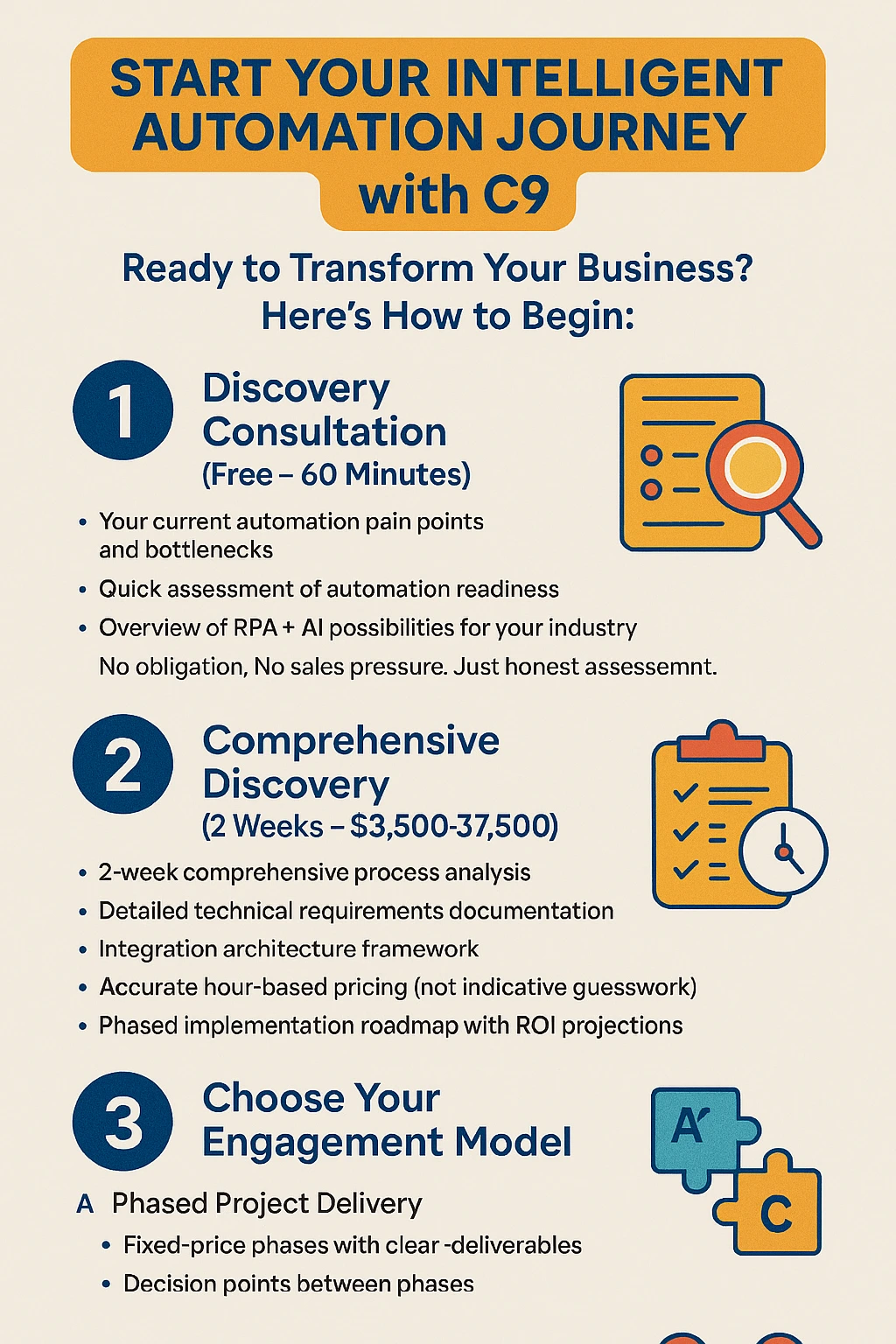
Ready to Transform Your Business? Here's How to Begin:
Step 1: Discovery Consultation (Free - 60 Minutes)
Before any commitment, let's talk about your specific situation:
No obligation. No sales pressure. Just honest assessment.
Step 2: Comprehensive Discovery (2 Weeks - $3,500-$7,500)
If your free consultation reveals genuine automation opportunities: What You Get:
Investment: $3,500-$7,500 (credited toward Phase 1 if you proceed) Deliverables: Discovery Charter (8-10 pages), Process Analysis Report (15-20 pages), Solution Design Document (20-25 pages), Project Proposal with Accurate Pricing (25-30 pages)
Step 3: Choose Your Engagement Model
After discovery, you have options:
Option A: Phased Project Delivery
- Fixed-price phases with clear deliverables
- Decision points between phases
- Early ROI funds later phases
- Full C9 team managing delivery Best For: Businesses wanting turn-key automation solution
Option B: Staff Augmentation
- Dedicated resources working on your projects
- 3-6 month lock-in contracts (best value)
- Flexible scaling with hour rollover
- You direct the work, we provide expertise Best For: Businesses with internal PM capability wanting flexible resources
Option C: Hybrid Model
- Combination of project delivery and staff augmentation
- C9 handles complex integration work
- Your team manages ongoing enhancements with our staff aug resources Best For: Businesses building internal capability while leveraging C9 expertise
Frequently Asked Questions
Q: Do we need to commit to the full project if we do discovery?
A: Absolutely not. Discovery gives you the information to make an informed decision. If you choose not to proceed with C9, you keep all deliverables and can use them however you wish. No hard feelings.
Q: How is C9 different from using Zapier, Make, or UiPath directly?
A: Those are tools. We're strategic partners who:
- Determine which tools are right for YOUR needs (sometimes it's custom, sometimes it's platforms)
- Handle complex integrations these platforms can't do alone
- Ensure security, compliance, and scalability
- Provide knowledge transfer so you understand what's built
- Offer ongoing support and optimisation
Q: Can we start with just one small automation to test C9?
A: Yes! Our phased approach is designed for exactly this. Start with one quick win ($8,000-$15,000 typically), prove value, then expand. We'd rather you test us on something small than commit to something large you're uncertain about.
Q: What if our business processes are too complex or unique?
A: Complex and unique is what we do best. If your processes were simple and standard, you'd use out-of-the-box tools. Our expertise is in handling the complexity that generic solutions can't address.
Q: Do you sign NDAs and protect our confidential information?
A: Absolutely. We sign NDAs before any discovery begins. We also carry professional indemnity insurance and cyber liability coverage. Your information security is non-negotiable.
Q: Can we see references from similar businesses in our industry?
A: Yes. During your free consultation, we'll connect you with 2-3 references from similar industries and project scopes (with their permission, of course). We have nothing to hide.
Q: What happens if the automation doesn't work as expected?
A: Our phased approach includes success metrics at each stage. If Phase 1 doesn't meet agreed-upon metrics, we fix it before Phase 2 (no additional cost). This is why discovery and clear scope definition matter—both parties know exactly what "success" looks like.
Q: Do you lock us into using C9 for ongoing maintenance?
A: No. We provide comprehensive documentation and knowledge transfer specifically so you CAN maintain systems yourself or use any provider you choose. Many clients choose to continue with C9 because of value and relationship—but you're never locked in.
Contact C9 Today
C9 - Australia's Leading Custom Software, Apps, Integration & Database Developer
Website: https://www.c9.com.au
Locations: Melbourne | Sydney | Brisbane (Remote teams nationwide)
Business Hours: Monday - Friday: 9:00 AM - 5:00 PM AEST
Follow Us: LinkedIn: linkedin.com/company/c9/
YouTube: C9 Australia Channel
One Final Thought
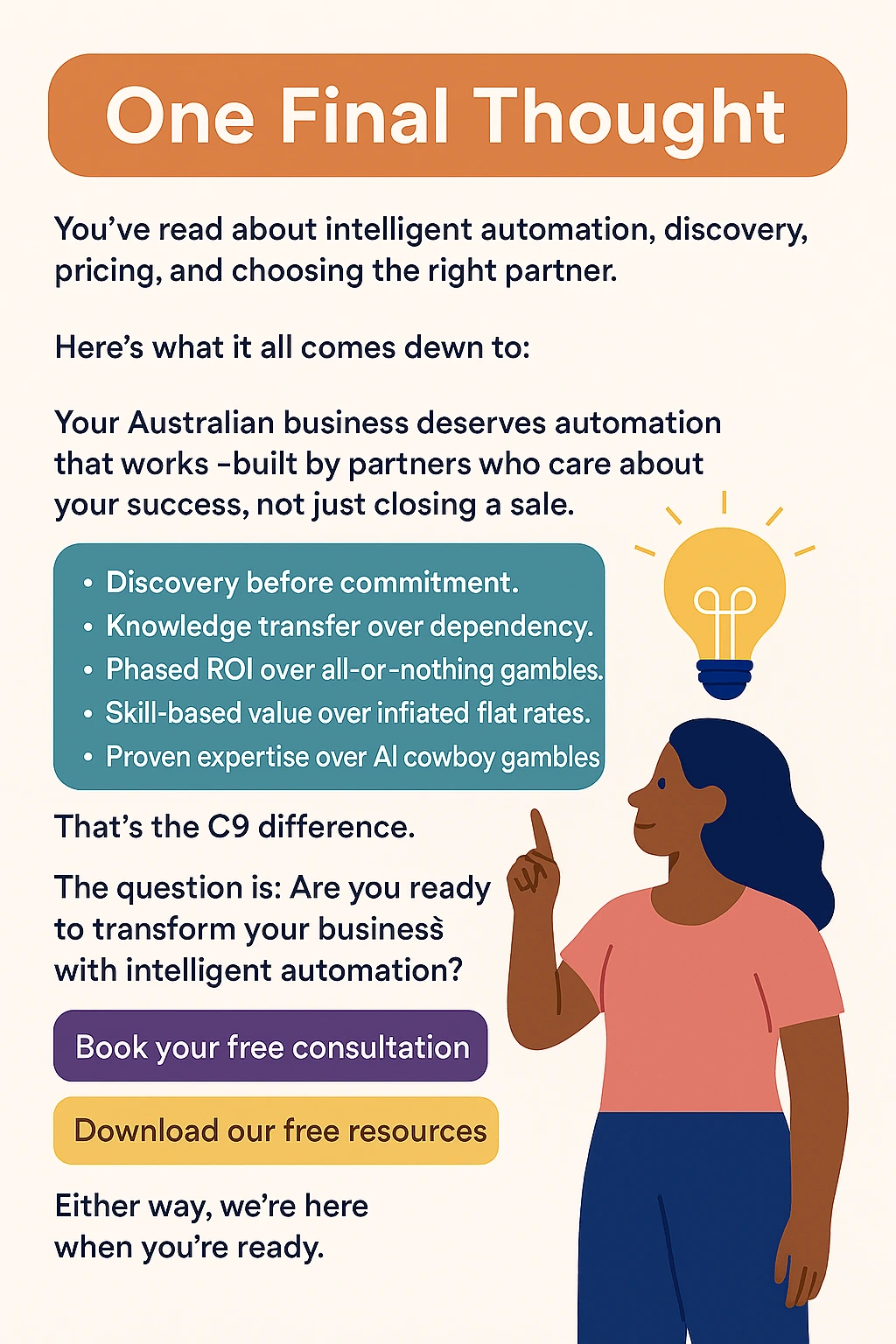
You've read about intelligent automation, discovery, pricing, and choosing the right partner.
Here's what it all comes down to:
Your Australian business deserves automation that works—built by partners who care about your success, not just closing a sale.
Discovery before commitment. Knowledge transfer over dependency. Phased ROI over all-or-nothing gambles. Skill-based value over inflated flat rates. Proven expertise over AI Cowboy gambles.
That's the C9 difference.
The question is: Are you ready to transform your business with intelligent automation?
If yes, book your free consultation today, we're here when you're ready.
Three Ways to Start Right Now:
- Fast Track (Ready to Explore Seriously) Book free 60-minute discovery consultation [Book Now] →
- See Proof (Want to Review Case Studies) Browse real Australian business automation success stories [View Case Studies] →
Don't let another quarter pass watching competitors automate while you evaluate.
The Australian businesses winning in 2025 started their automation journey in 2024.
Where will your business be in 12 months?
That depends on what you do today.
Transform Your Business with Intelligent Automation. Start with C9.
Book Your Free Consultation: https://www.c9.com.au/About/Contact
This blog was written by the C9 automation team with 18+ years of experience delivering custom software, integration services, and intelligent automation to Australian businesses. We understand your challenges because we solve them every day.
Ready to discuss your specific automation needs? We're here to help.