In 2025, a Melbourne-based manufacturing company discovered they were trapped. After three years building their entire operation on a single cloud vendor's database platform, they wanted to expand their AI capabilities. The quote? $2.4 million and 18 months to migrate their data.
This isn't unique. Across Australia, businesses are confronting a harsh reality: vendor lock-in is silently destroying profitability and stifling innovation.
The encouraging news? Australian enterprises are fighting back. Most forward-thinking companies are now adopting hybrid models (combining on-premises and cloud infrastructure) or multi-cloud strategies to maintain flexibility and avoid being held hostage by database companies.
But here's what major vendors won't tell you: transitioning to hybrid or multi-cloud architecture isn't straightforward. Without proper strategy and expert execution, you could end up with exponentially higher costs and complexity.
Understanding Vendor Lock-In: The Silent Profit Killer
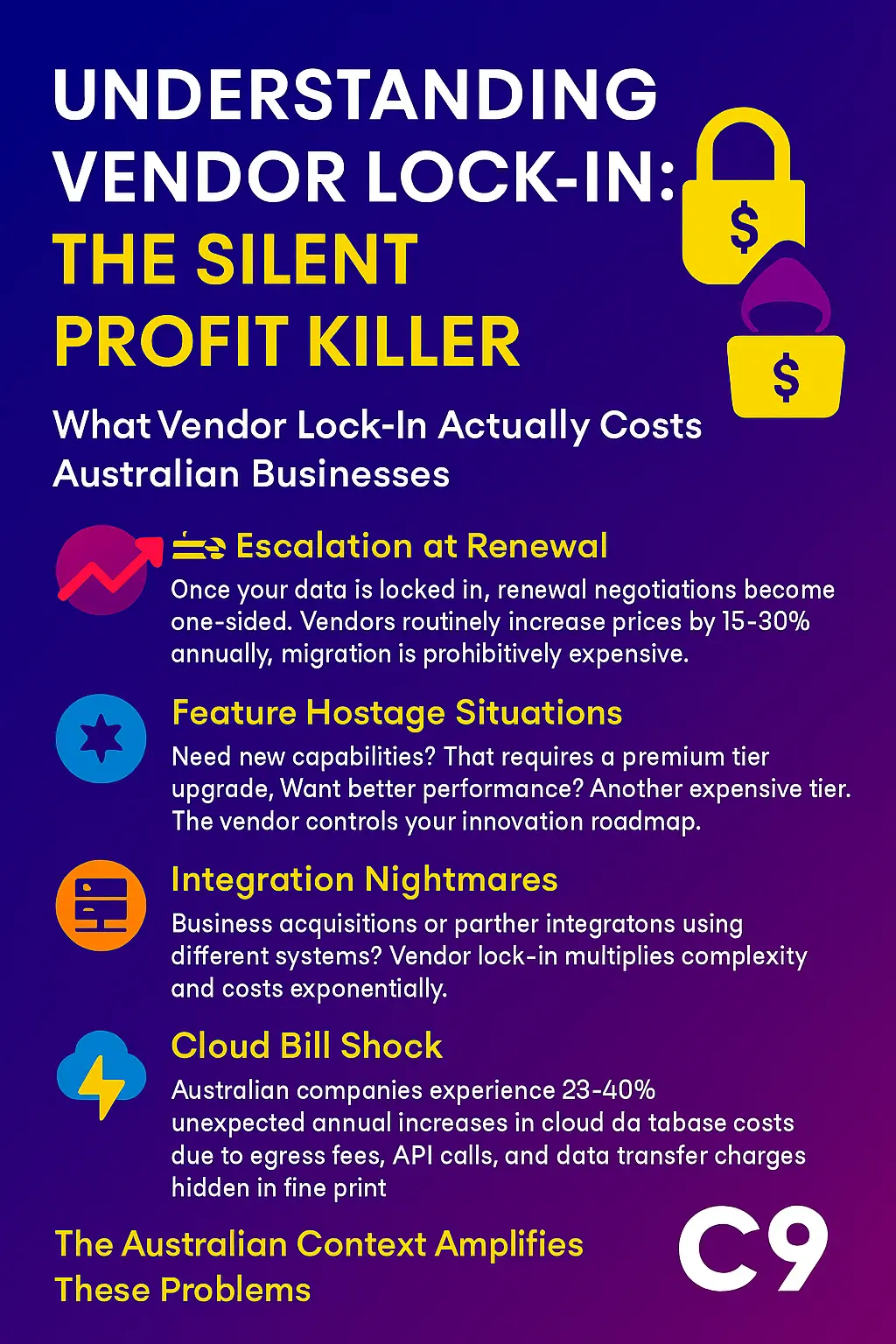
What Vendor Lock-In Actually Costs Australian Businesses
When you commit exclusively to a single database vendor, hidden costs start accumulating:
Price Escalation at Renewal Once your data is locked in, renewal negotiations become one-sided. Vendors routinely increase prices by 15-30% annually, knowing migration is prohibitively expensive.
Feature Hostage Situations Need new capabilities? That requires a premium tier upgrade. Want better performance? Another expensive tier. The vendor controls your innovation roadmap.
Integration Nightmares Business acquisitions or partner integrations using different systems? Vendor lock-in multiplies complexity and costs exponentially.
Cloud Bill Shock Australian companies experience 23-40% unexpected annual increases in cloud database costs due to egress fees, API calls, and data transfer charges hidden in fine print.
The Australian Context Amplifies These Problems
For Australian businesses, vendor lock-in carries additional penalties:
- Data Sovereignty Requirements: Regulations demanding Australian data remain on Australian soil limit your compliance options with single-vendor strategies
- Geographic Premium: Global vendors often charge Australian businesses premium rates whilst delivering slower support across time zones
- Limited Competition: Fewer vendor options in APAC means reduced negotiating power compared to US or European enterprises
The Three Dangerous Myths Paralysing Australian Executives
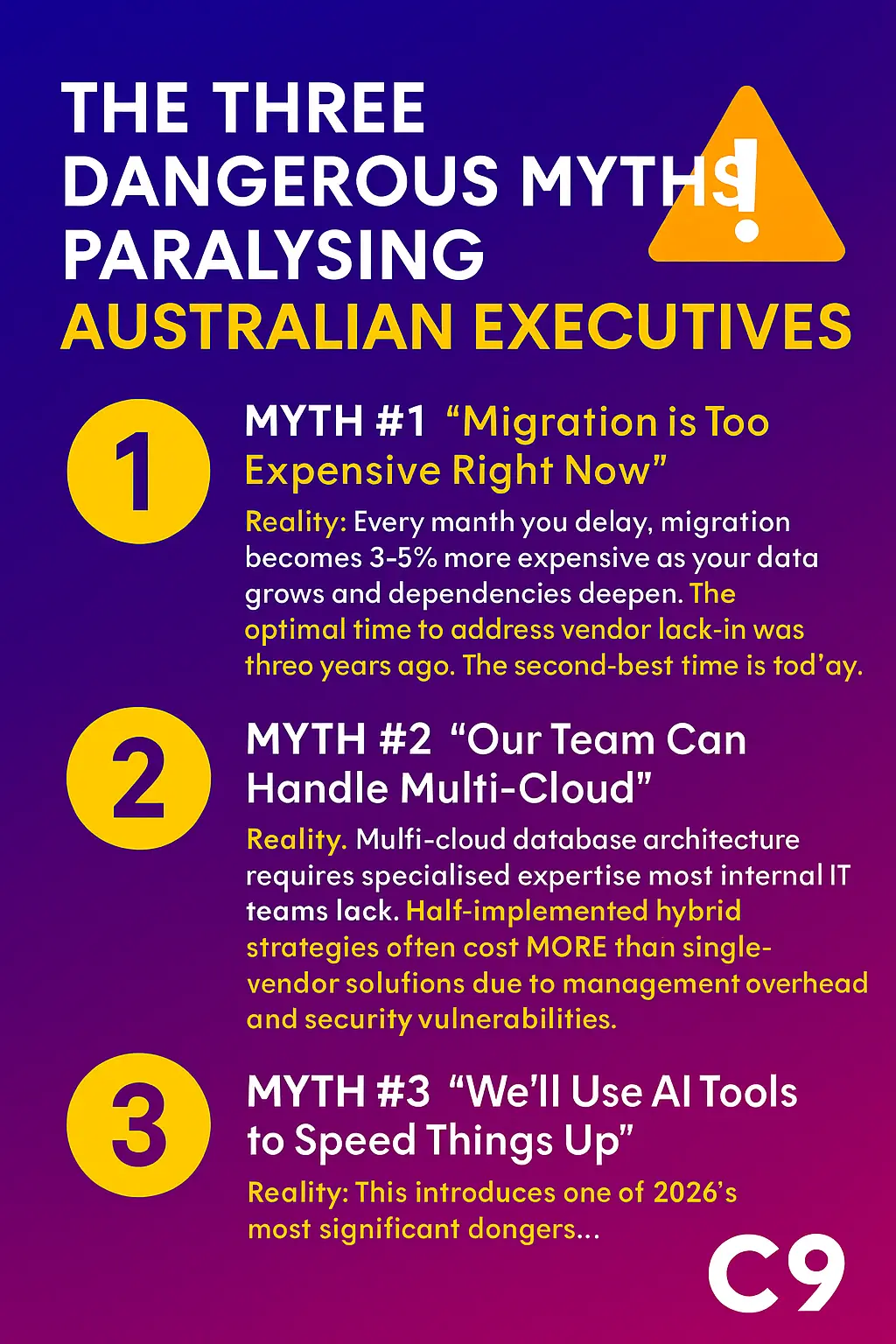
Myth #1: "Migration is Too Expensive Right Now"
Reality: Every month you delay, migration becomes 3-5% more expensive as your data grows and dependencies deepen. The optimal time to address vendor lock-in was three years ago. The second-best time is today.
Myth #2: "Our Team Can Handle Multi-Cloud"
Reality: Multi-cloud database architecture requires specialised expertise most internal IT teams lack. Half-implemented hybrid strategies often cost MORE than single-vendor solutions due to management overhead and security vulnerabilities.
Myth #3: "We'll Use AI Tools to Speed Things Up"
Reality: This introduces one of 2026's most significant dangers...
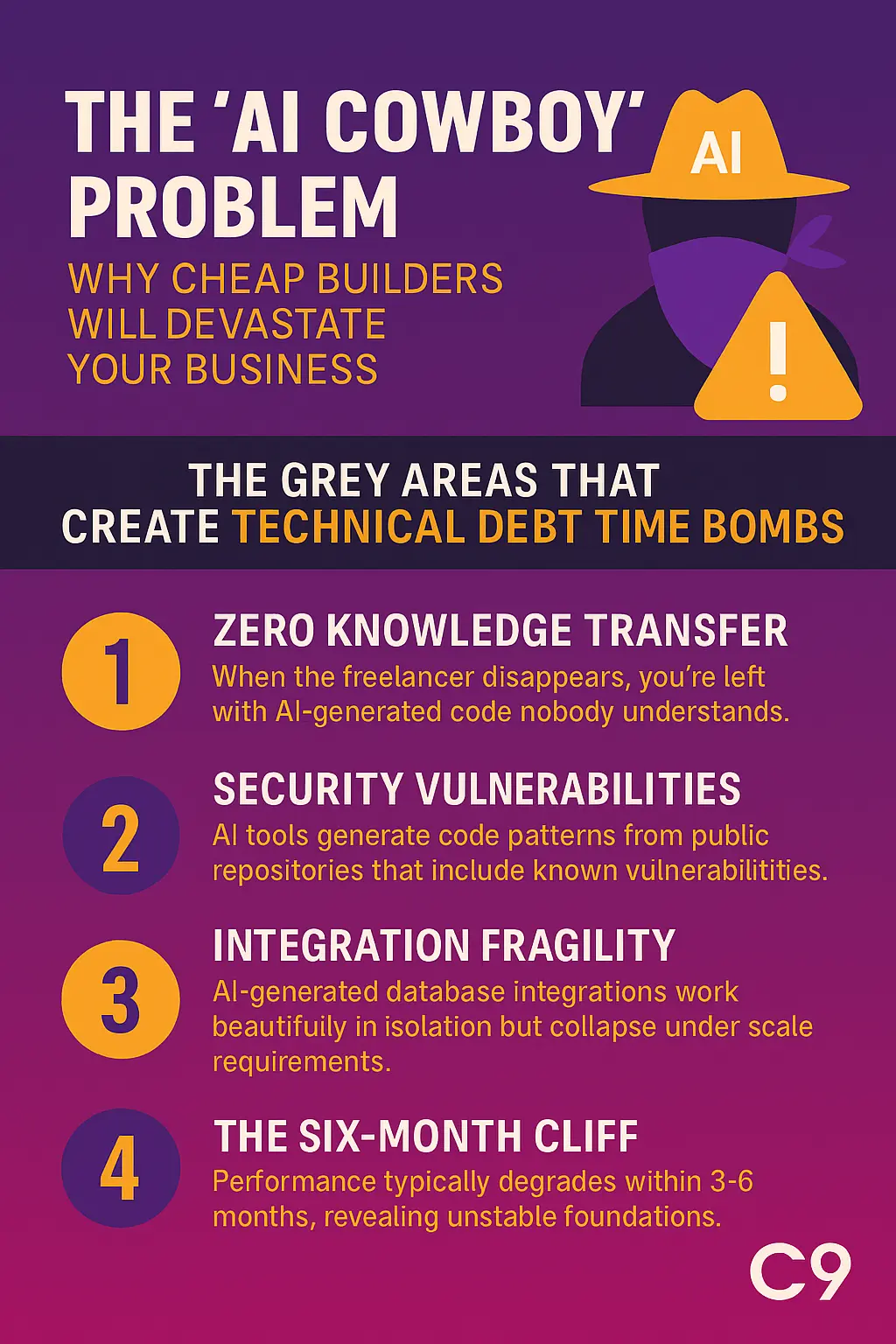
The "AI Cowboy" Problem: Why Cheap Builders Will Devastate Your Business
The market is flooded with what industry experts call "AI Cowboys"—freelancers and budget app builders using AI tools to generate code they barely understand. This "vibes coding" approach seems attractive:
- Lower hourly rates ($50-80/hour versus $150-250/hour for experienced developers)
- Promises of "AI-powered speed"
- Impressive demonstrations built within days
The Grey Areas That Create Technical Debt Time Bombs
These AI-generated solutions create catastrophic problems:
1. Zero Knowledge Transfer When the freelancer disappears, you're left with AI-generated code nobody understands—not even the person who commissioned it.
2. Security Vulnerabilities AI tools generate code patterns from public repositories, including known security flaws. Without deep expertise, these vulnerabilities slip through undetected.
3. Integration Fragility AI-generated database integrations work beautifully in isolation but collapse under real-world edge cases and scale requirements.
4. The Six-Month Cliff Most AI Cowboy projects seem functional for 3-6 months. Then performance degrades, bugs multiply, and you discover the "foundation" is actually a house of cards.
A Sydney retail company recently saved $40,000 using an AI app builder for their database migration. Eighteen months later, they spent $340,000 fixing problems and rebuilding properly. That's an 850% "savings" penalty.
Vibes coding might feel modern, but it contradicts what database architecture requires: deep understanding of data relationships, performance optimisation, security protocols, and long-term maintainability.
The Solution: Strategic Hybrid & Multi-Cloud Database Architecture
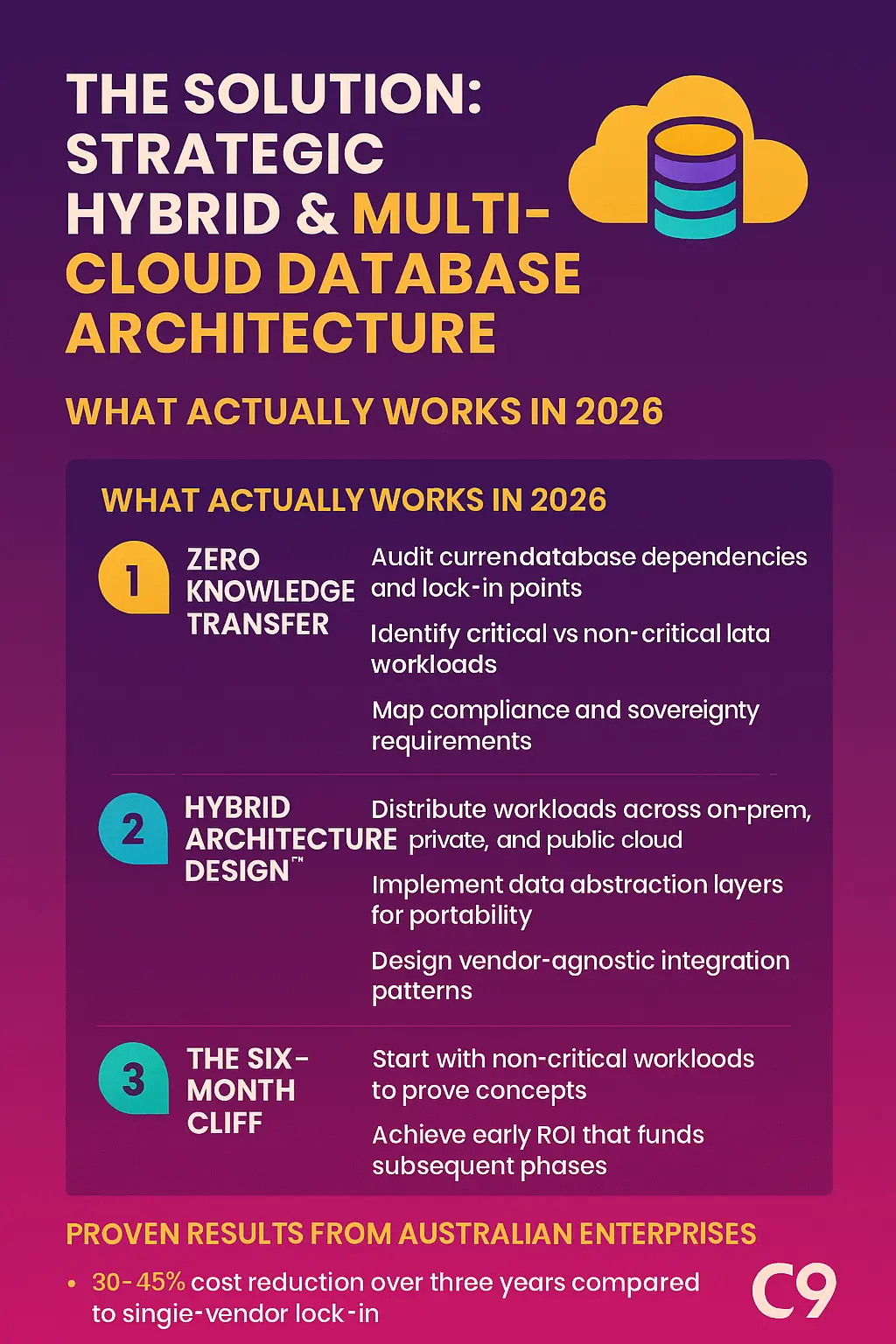
What Actually Works in 2026
Australian enterprises successfully avoiding vendor lock-in follow a proven three-phase approach:
Phase 1: Strategic Assessment
- Audit current database dependencies and lock-in points
- Identify critical versus non-critical data workloads
- Map compliance and sovereignty requirements
- Calculate true cost of current vendor relationships
Phase 2: Hybrid Architecture Design
- Distribute workloads across on-premises, private cloud, and public cloud
- Implement data abstraction layers for portability
- Design vendor-agnostic integration patterns
- Build multi-cloud governance frameworks
Phase 3: Staged Migration
- Start with non-critical workloads to prove concepts
- Achieve early ROI that funds subsequent phases
- Transfer knowledge to internal teams throughout
- Maintain operational continuity with zero downtime
Proven Results from Australian Enterprises
When implemented correctly, hybrid and multi-cloud strategies deliver:
- 30-45% cost reduction over three years compared to single-vendor lock-in
- 60% faster feature deployment by choosing optimal platforms for each workload
- 90% improvement in negotiating leverage with vendors
- Complete elimination of vendor lock-in risk for future growth
Why Discovery Calls Are Your Most Important Investment
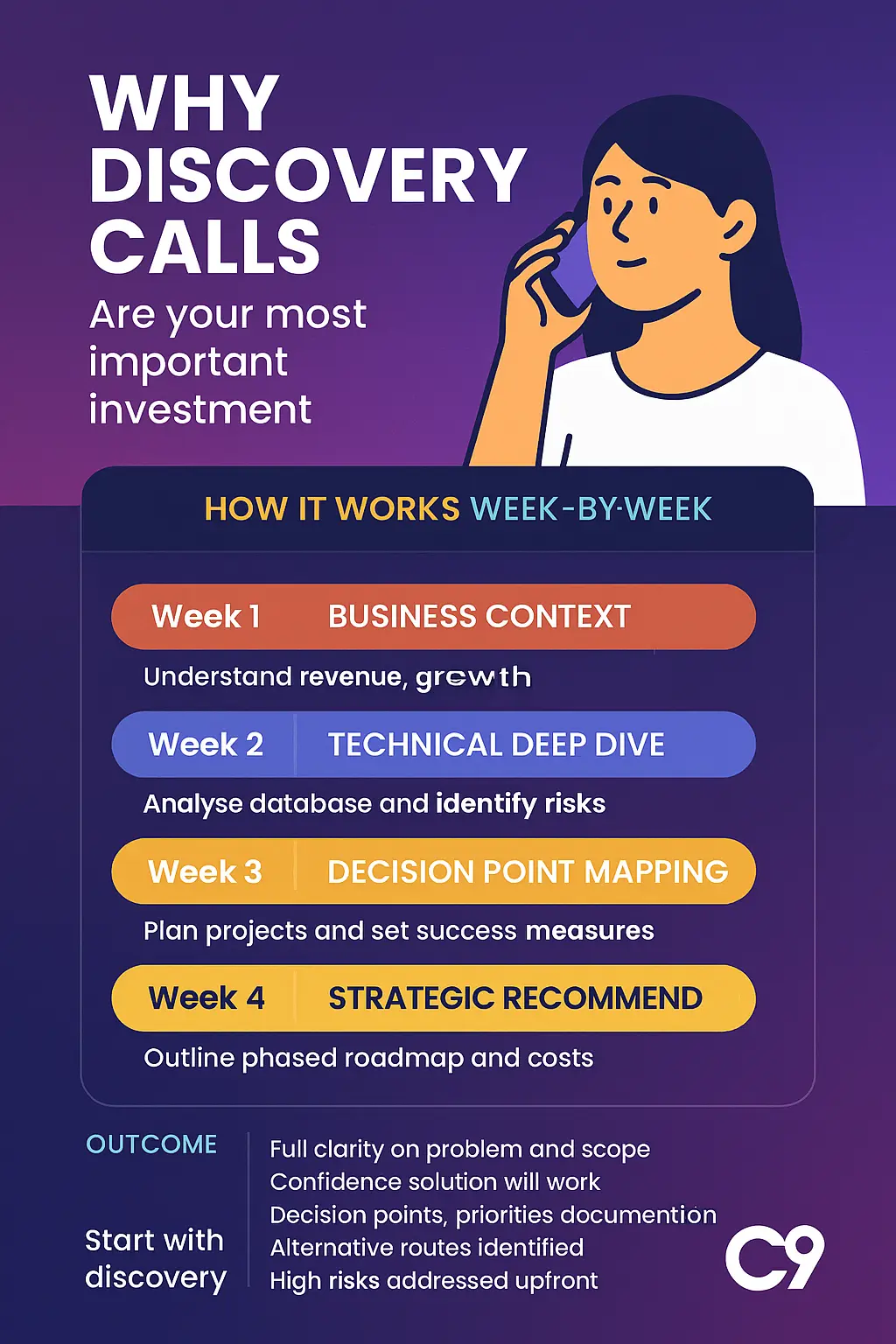
Here's an uncomfortable truth: Most database projects fail before the first line of code is written.
Why? Because businesses skip discovery and jump straight to implementation.
How C9's Discovery Process Actually Works
Our discovery process isn't a sales pitch—it's a strategic mapping exercise preventing disaster:
Week 1: Business Context Discovery (4-6 hours) Understanding your business model, revenue drivers, growth plans, and stakeholder priorities whilst documenting compliance and security requirements.
Week 2: Technical Deep Dive (6-8 hours) Auditing existing database architecture, analysing data flows, assessing technical debt and scalability limits, and identifying security vulnerabilities.
Week 3: Decision Point Mapping (3-4 hours) Creating detailed project timelines with critical milestones, mapping decision points requiring business input, and establishing success metrics.
Week 4: Strategic Recommendation (2-3 hours) Presenting phased implementation roadmaps with accurate timelines, transparent cost breakdowns, and knowledge transfer plans.
What You Actually Receive
At discovery conclusion, you have:
✅ Clarity: Complete understanding of scope, timeline, and costs
✅ Confidence: Knowledge the solution will actually work
✅ Control: Decision points mapped so you drive the project
✅ Alternatives: Multiple implementation pathways to choose from
✅ Protection: Risk mitigation strategies documented upfront
Cost of discovery: $15,000-$35,000 depending on complexity
Cost of skipping discovery: $250,000-$2,000,000+ in failed projects, scope creep, and rework
Discovery isn't a cost—it's the highest ROI investment in your entire project.
Why Choose C9 Over 500+ Database Companies in Australia
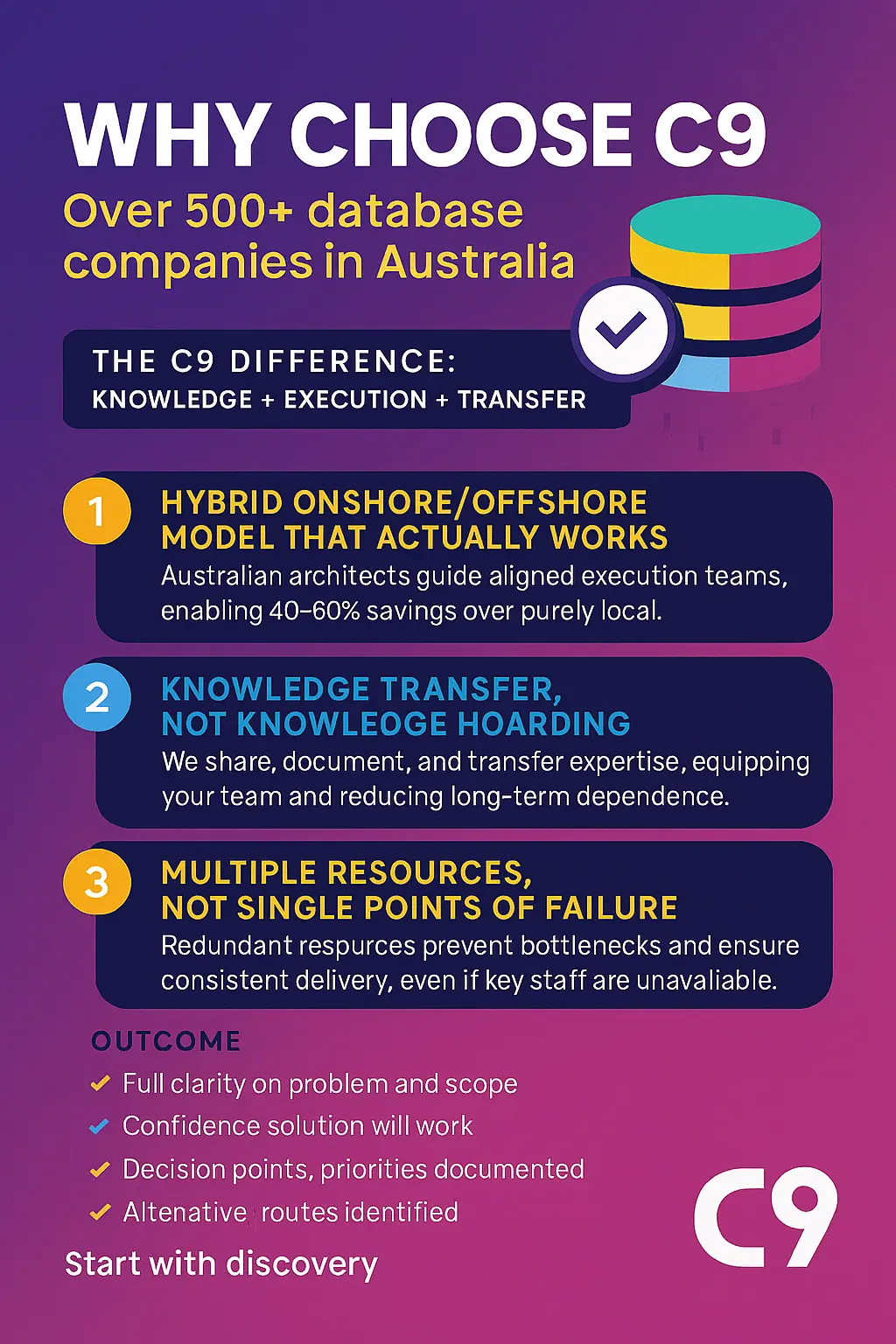
Australia has no shortage of developers offering database services. So why do enterprise clients choose C9 for their most critical projects?
The C9 Difference: Knowledge + Execution + Transfer
1. Hybrid Onshore/Offshore Model That Actually Works
C9 operates a blended hybrid model:
- Onshore Strategic Layer: Senior architects and project managers in Australian time zones providing strategic direction and quality oversight
- Offshore Execution Layer: Highly skilled developers in aligned time zones delivering efficient implementation at optimised rates
- Integrated Communication: Daily standups, weekly reviews, and real-time collaboration tools
This model delivers 40-60% cost savings compared to purely local teams whilst maintaining communication quality and strategic oversight.
2. Knowledge Transfer, Not Knowledge Hoarding
Unlike typical database companies that want you dependent forever, C9 provides comprehensive knowledge transfer:
- Complete documentation of architecture decisions and reasoning
- Training sessions for your internal IT team
- Recorded walkthroughs of critical system components
- Architecture decision records explaining the "why" behind every choice
Why? Because confident clients become reference clients, worth far more than dependency clients.
3. Multiple Resources, Not Single Points of Failure
C9 provides team redundancy:
- Multiple developers familiar with your codebase
- Cross-trained resources across frontend, backend, and database layers
- Documented processes enabling seamless resource transitions
- Bench strength to scale rapidly when needed
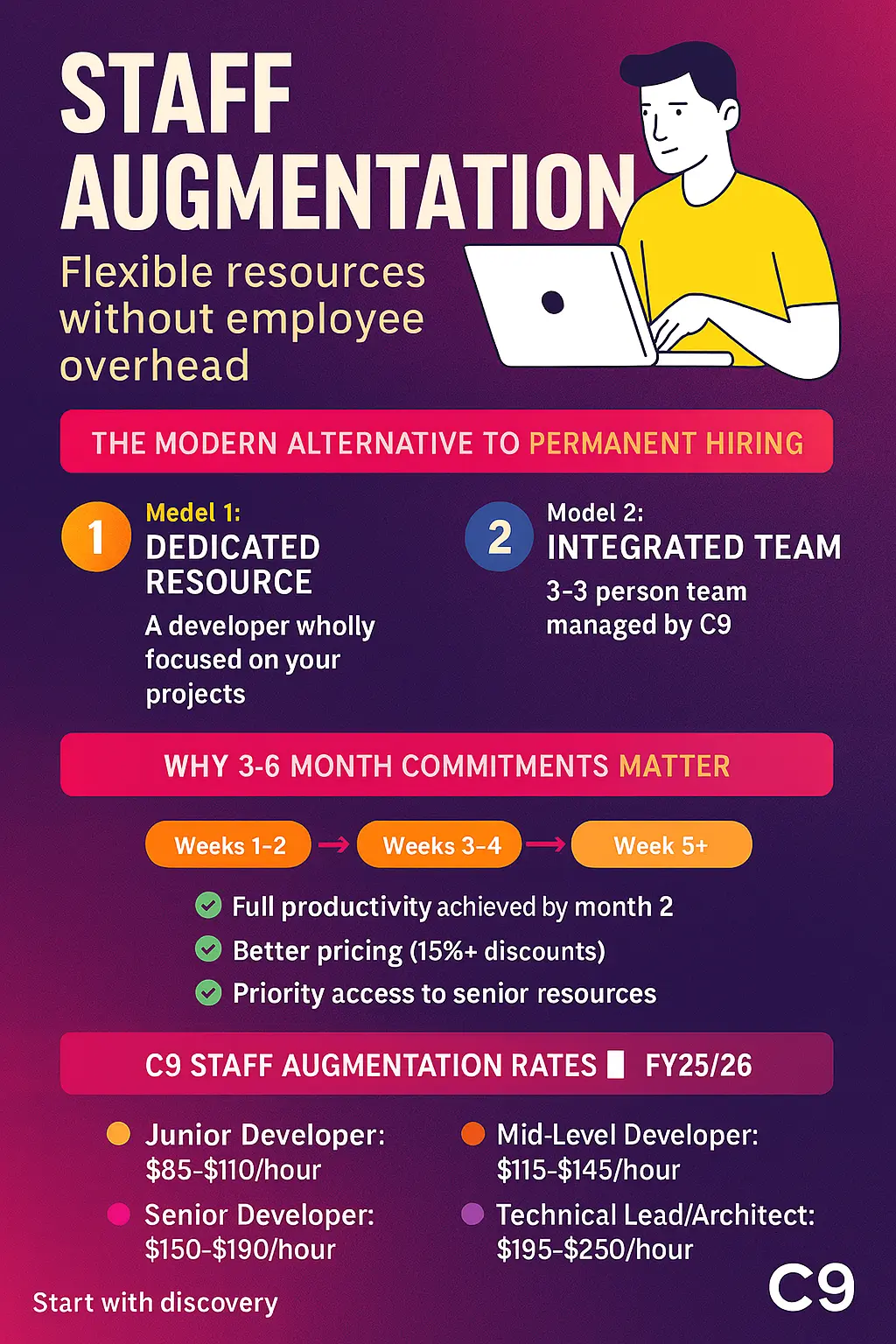
Staff Augmentation: Flexible Resources Without Employee Overhead
The Modern Alternative to Permanent Hiring
Senior database developers cost $180,000-$250,000 annually plus 30% in benefits and overhead. And that's if you can find them.
C9's Staff Augmentation model provides a smarter path with two options:
Model 1: Dedicated Resource A skilled developer integrated into your team, working exclusively on your projects with flexible contract lengths.
Model 2: Integrated Team A complete 3-8 person team with complementary skills, managed by C9 but integrated with your processes.
Important: C9 uses remote workers, not in-house local hiring. Don't expect someone appearing at your office for a 9-5 role.
Why 3-6 Month Minimum Commitments Deliver Better Outcomes
The Ramp-Up Reality:
- Week 1-2: Onboarding and architecture review
- Week 3-4: First meaningful contributions
- Week 5-8: Full productivity achieved
- Week 9+: Deep expertise in your specific codebase
With 3-6 month commitments, you receive:
✅ Resources becoming true team members understanding context
✅ 2-3 months of peak productivity, not just ramp-up
✅ Better pricing (15-25% discounts)
✅ Priority access to senior resources
C9 Staff Augmentation Rates: FY25/26
Our pricing reflects actual skill requirements:
- Junior Developer: $85-$110/hour
- Mid-Level Developer: $115-$145/hour
- Senior Developer: $150-$190/hour
- Technical Lead/Architect: $195-$250/hour
- Specialised Roles: $160-$280/hour
Notes: Rates assume blended onshore/offshore talent, subject to annual CPI adjustment. Multi-resource contracts (3+ people) receive 10-15% discounts. Long-term contracts (12+ months) receive additional 15-25% discounts.
The Indicative Pricing Trap (And Why It's Worthless)
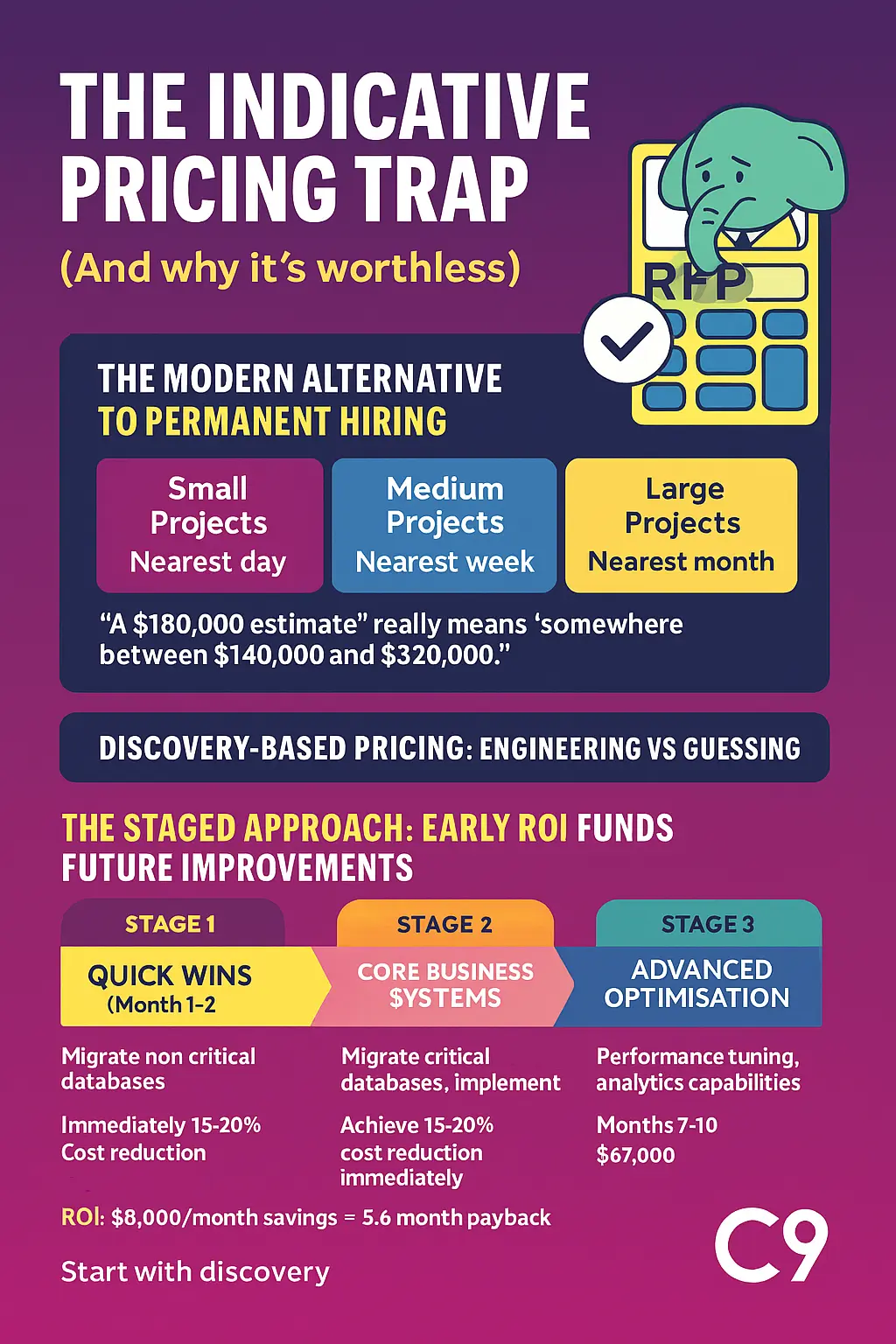
Let's address the elephant in every RFP: indicative pricing.
Why "Ballpark Estimates" Fail
Indicative pricing is typically calculated to:
- Nearest day for small projects ($20,000-$50,000)
- Nearest week for medium projects ($50,000-$200,000)
- Nearest month for large projects ($200,000+)
This means a "$180,000 estimate" really means "somewhere between $140,000 and $320,000."
Discovery-Based Pricing: Engineering vs Guessing
After 3-4 weeks of discovery, C9 provides pricing accurate to the nearest 4-hour block with specific resource types, rates, and contingency budgets (usually 10-15%, not 50-100%).
The Staged Approach: Early ROI Funds Future Improvements
Breaking projects into value-driven stages:
Stage 1: Quick Wins (Month 1-2, $45,000) Migrate non-critical databases, implement basic multi-cloud abstraction, achieve 15-20% cost reduction immediately.
ROI: $8,000/month savings = 5.6 month payback
Stage 2: Core Business Systems (Month 3-6, $95,000) Migrate critical operational databases, implement full redundancy.
ROI: Additional $18,000/month savings = 5.3 month payback
Stage 3: Advanced Optimisation (Month 7-10, $67,000) Performance tuning, advanced analytics capabilities.
The Magic: Stages 1-2 savings fund Stage 3 development. Total monthly savings after completion: $38,000 with 5.4-month payback period.
Take Action: Your Discovery Call with C9
If vendor lock-in is costing your business flexibility, money, or competitive advantage, let's have a conversation.
What happens on a C9 discovery call:
- 30-Minute Initial Consultation (No cost, no obligation)
- Discuss your current database architecture
- Identify potential lock-in risks
- Explore multi-cloud opportunities
- Full Discovery Engagement (If mutually beneficial)
- 3-4 week comprehensive analysis
- Deliverable: Complete strategy with accurate timeline and transparent pricing
Book your consultation:
🌐 Visit: www.c9.com.au
Conclusion: The Strategic Choice for 2026
Vendor lock-in isn't theoretical—it's a competitive handicap worsening every month you ignore it.
Australian enterprises breaking free from vendor lock-in in 2026 are doing something different:
✅ They invest in discovery before committing to solutions
✅ They choose partners who transfer knowledge, not hoard it
✅ They implement staged approaches delivering early ROI
✅ They reject vibes coding for engineered solutions
✅ They demand transparency in pricing, timeline, and risk
The question isn't whether you'll eventually address vendor lock-in. The question is whether you'll do it strategically now or desperately later when you have no leverage remaining.
Don't wait until vendor lock-in costs you millions. Contact C9 today for your discovery consultation.