In Short:
Agentic AI is revolutionising Australian enterprises, yet 95% of implementations fail to move beyond experimental pilots. The critical difference between success and failure isn't the technology itself—it's the strategic approach to implementation. This comprehensive guide reveals how leading Australian organisations are achieving 10-times return on investment by building custom agentic AI solutions that automate complex workflows whilst maintaining rigorous security and regulatory compliance.
You'll discover why budget 'AI Cowboys' using 'vibes coding' create technical debt costing 5-10 times more to rectify, how C9's innovative blended offshore-onshore model delivers enterprise-grade solutions at 40-60% cost savings compared to traditional approaches, and why skipping proper discovery represents the single costliest mistake executives make when embarking on AI transformation. We'll also expose indicative pricing traps that plague the industry and demonstrate exactly how discovery-based pricing protects your investment whilst accelerating return on investment.
What's Next?
By 2027, businesses operating without sophisticated agentic AI capabilities will face severe competitive disadvantages in speed, efficiency, and customer experience. The organisations investing strategically now in properly architected, custom AI solutions will capture substantial market share whilst competitors struggle with abandoned pilots and mounting technical debt. Schedule a discovery consultation with C9 to map your comprehensive agentic AI roadmap and identify high-value use cases delivering measurable ROI within 6-12 months.
The Agentic AI Opportunity Australian Enterprises Can't Afford to Ignore
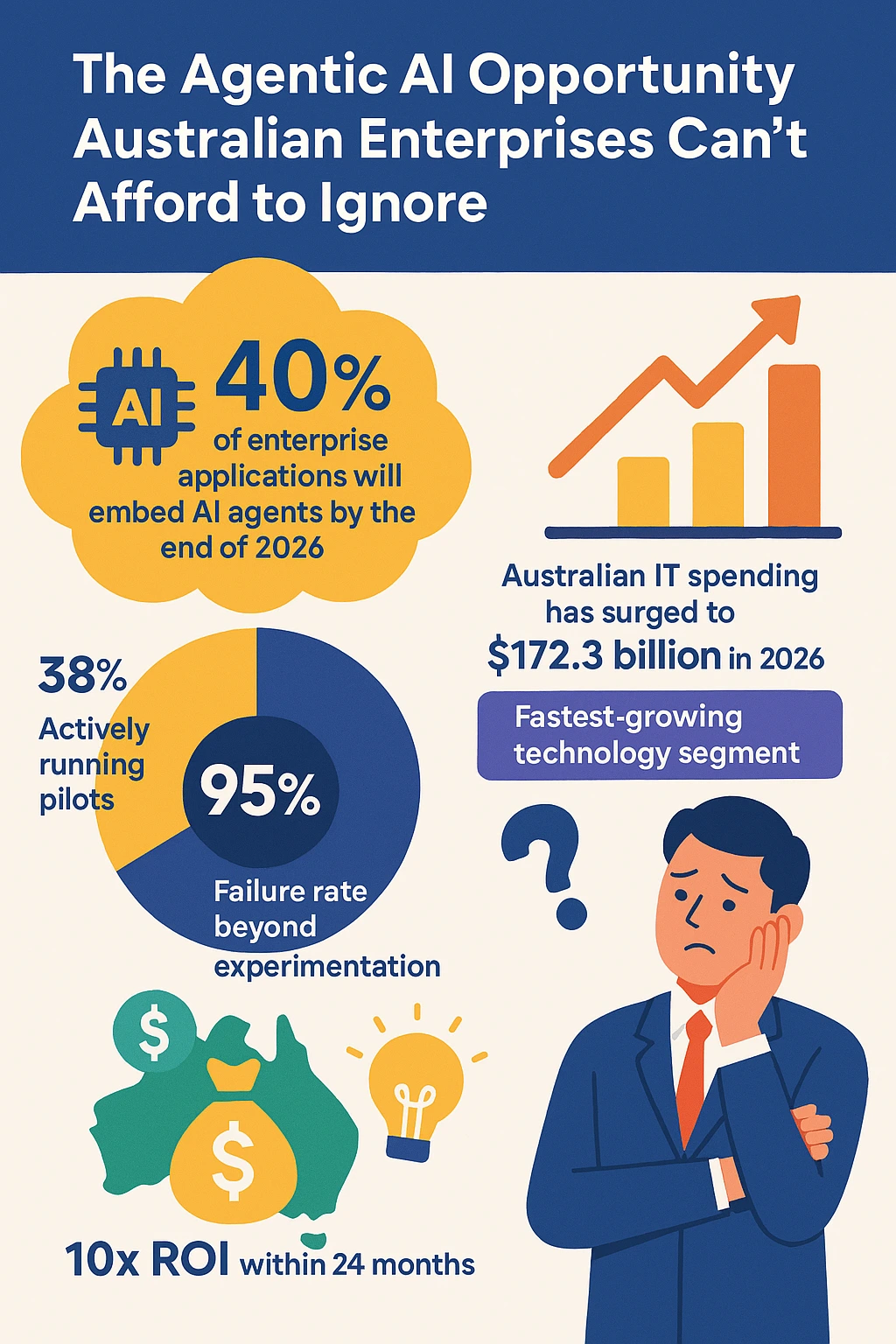
Forty percent of enterprise applications will embed AI agents by the end of 2026, according to Gartner's latest research. Australian IT spending has surged to $172.3 billion in 2026, with agentic AI representing the fastest-growing technology segment. Yet here's the sobering reality: whilst 38% of organisations are actively running agentic AI pilots, only 11% have successfully reached production deployment. That's an alarming 95% failure rate for initiatives moving beyond experimentation.
The companies achieving breakthrough success report 10-times ROI within 24 months, transforming operations and establishing commanding competitive positions. Meanwhile, the vast majority waste millions on abandoned pilots, accumulating technical debt and losing precious time whilst AI-native competitors surge ahead.
Every Australian business owner and Chief Technology Officer faces an increasingly urgent dilemma: agentic AI promises unprecedented automation capabilities and operational efficiency, yet the path from concept to production-ready AI agents is treacherous, riddled with expensive pitfalls that can derail entire digital transformation initiatives.
The market has become flooded with three problematic categories of vendors: 'AI Cowboys'—freelancers and budget app builders employing what industry insiders call 'vibes coding' to create superficially impressive but fundamentally fragile solutions that collapse under real-world operational conditions; platform vendors making grandiose promises about plug-and-play solutions that invariably fail to integrate with organisations' unique legacy systems and proprietary workflows; and consultants delivering 'indicative pricing' proposals that bear virtually no relationship to actual implementation costs, creating budget crises mid-project.
The wrong implementation approach doesn't merely waste financial resources—it creates compounding technical debt that research shows costs 5-10 times more to remediate than building correctly from inception. Perhaps more critically, it sets back your competitive positioning by 12-18 months whilst competitors who selected experienced partners and proven methodologies establish market advantages that become increasingly difficult to overcome.
This definitive guide reveals how C9, Australia's premier consulting firm for software, apps, integration, and database development, helps enterprises successfully navigate the journey from initial concept through to production-ready agentic AI solutions. You'll learn precisely what separates the successful 5% from the failing 95%, why comprehensive discovery represents a non-negotiable investment rather than optional overhead, and how our innovative blended offshore-onshore delivery model provides enterprise-quality outcomes at a fraction of traditional Australian consulting costs.
Understanding Agentic AI: What Distinguishes It From Previous Automation Waves
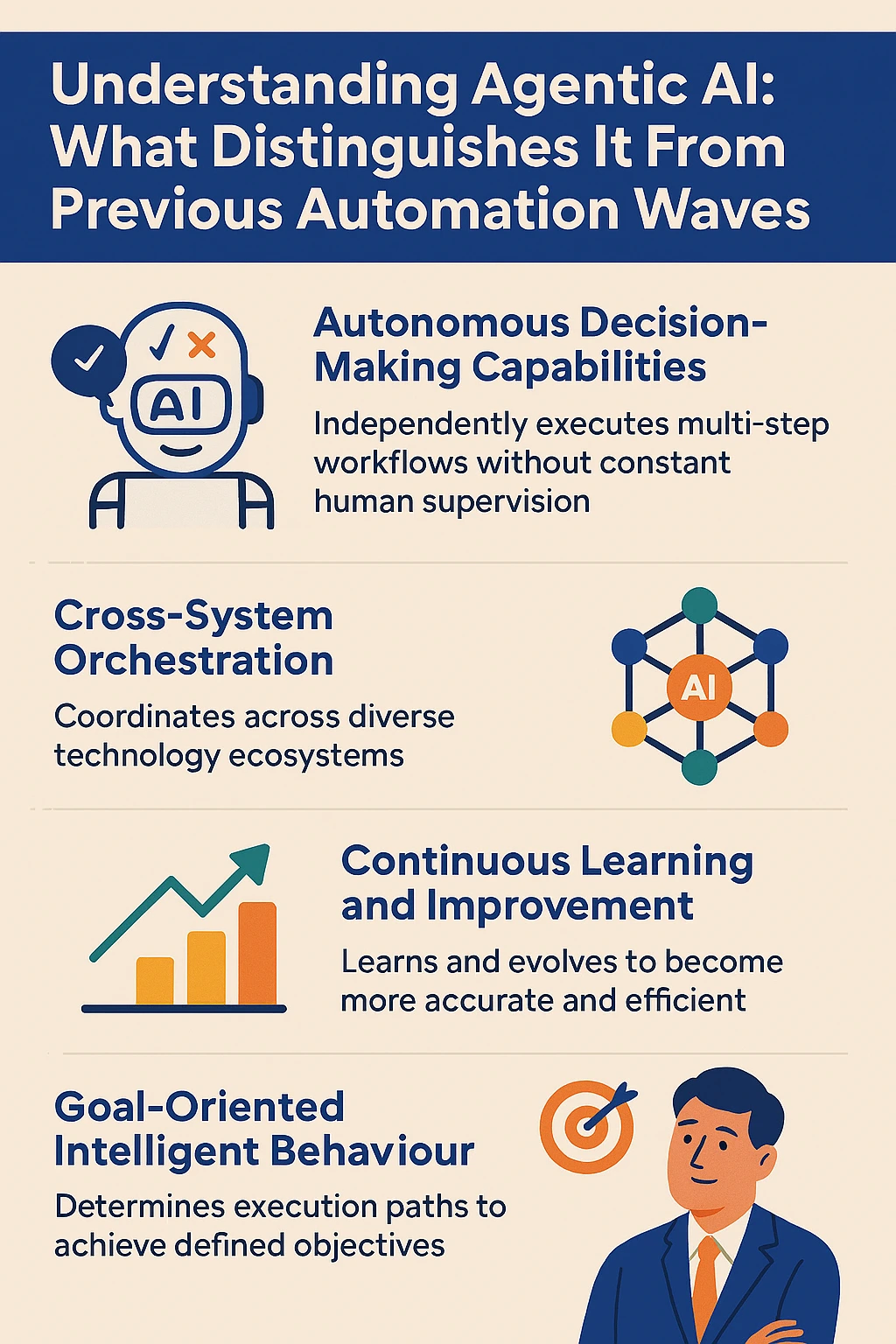
Let's cut through the marketing hyperbole and establish clear, business-focused definitions. Agentic AI differs fundamentally from chatbots, robotic process automation (RPA), and basic AI-powered automation tools because of four distinctive characteristics that create exponentially greater business value.
Autonomous Decision-Making Capabilities: Unlike traditional automation requiring explicit programming for every scenario, AI agents independently execute multi-step workflows without constant human supervision. They make contextual decisions based on real-time data, adapt to changing operational conditions, and handle exceptions intelligently rather than failing when encountering situations outside predetermined parameters. Research from Deloitte's 2026 AI survey demonstrates that properly implemented agents improve decision accuracy by 15-25% annually as they continuously process more data and learn from outcome patterns.
Cross-System Orchestration: This represents perhaps the most transformative capability. Rather than functioning as point solutions addressing isolated tasks, agentic AI coordinates seamlessly across your entire technology ecosystem—CRM platforms, ERP systems, proprietary databases, legacy mainframes, cloud applications, and external APIs—to complete comprehensive end-to-end business processes. A single customer service interaction might require the agent to access customer relationship management data, verify account status in financial systems, check inventory availability, coordinate with logistics platforms, and update multiple record systems—all autonomously coordinated without human intervention.
Continuous Learning and Improvement: Traditional software remains static until explicitly updated. AI agents improve organically through reinforcement learning mechanisms, becoming measurably more accurate and efficient over time. IBM's recent implementation research tracked agents improving operational efficiency by 23% in the first year, 41% by year two, and 67% by year three—compounding improvements that traditional automation simply cannot achieve.
Goal-Oriented Intelligent Behaviour: Given high-level business objectives, agents determine optimal execution paths rather than following rigid predetermined rules. They evaluate multiple approaches, consider trade-offs, and select strategies that best serve defined business goals within established constraints and policies.
Real-World Applications Delivering Measurable Business Impact
Financial Services Transformation: Australia's leading banks are deploying fraud detection agents that analyse transactions in real-time across 15-20 disparate systems simultaneously, autonomously flagging suspicious patterns, initiating investigation workflows, and even temporarily suspending potentially fraudulent activities—all within milliseconds. One major Australian bank reported 47% improvement in fraud detection accuracy whilst reducing false positives by 62%, dramatically improving customer experience whilst strengthening security.
Healthcare Administration Revolution: Patient care coordination agents are eliminating the administrative burden that historically consumed 40-50% of healthcare professionals' time. These agents autonomously manage appointment scheduling, coordinate follow-up communications, verify insurance coverage across multiple providers, process prior authorisation requests, and maintain comprehensive patient communication logs. Melbourne's Royal Children's Hospital reduced administrative processing time from an average of 4.2 weeks to 18 hours—a 95% reduction—whilst improving accuracy and patient satisfaction scores by 34 percentage points.
Retail and E-Commerce Optimisation: Sophisticated inventory management agents continuously monitor demand patterns across hundreds or thousands of SKUs, automatically triggering reorders based on predicted demand curves, negotiating optimal pricing with approved suppliers within established parameters, and coordinating with logistics systems to optimise warehouse space utilisation. Woolworths Group reported 23% reduction in inventory carrying costs whilst simultaneously decreasing stockout incidents by 41%.
Manufacturing Supply Chain Visibility: Toyota Australia's widely publicised implementation demonstrates the transformative potential. Their supply chain visibility agent eliminated manual navigation across 50-100 different mainframe screens that previously required extensive human labour, proactively identifying and resolving supply chain disruptions before they impact production schedules. This single agent implementation delivered $4.7 million in annual savings whilst improving on-time delivery performance by 28 percentage points.
The Compelling Business Case for Australian Enterprises
Productivity Multiplication: PwC's 2026 Global AI Survey found that 39% of organisations implementing agentic AI successfully report productivity gains exceeding 100%—effectively doubling output without proportional increases in headcount or operational costs. Tasks requiring teams multiple days now complete within minutes or hours.
Non-Linear Cost Reduction: Perhaps most compellingly, agents handle 10-times query or transaction volume without proportional cost increases. One customer service agent can autonomously manage the workload previously requiring 8-12 human agents for routine enquiries, whilst the human team focuses on complex issues requiring empathy, creativity, and sophisticated judgment.
Competitive Positioning Imperative: By 2027, industry analysts project that businesses operating without mature agentic AI capabilities will face insurmountable disadvantages in response speed, personalisation sophistication, and operational cost structures. The window for establishing first-mover advantages in your industry vertical is rapidly closing.
Scalability Without Proportional Investment: Traditional business scaling required roughly linear increases in operational costs—growing revenue 3-times typically meant growing headcount and infrastructure costs proportionally. Agentic AI fundamentally changes this equation, enabling 3-5 times revenue growth whilst operational costs increase only 30-60%, dramatically improving profit margins.
The Agentic AI Failure Trap: Why 95% Never Reach Production
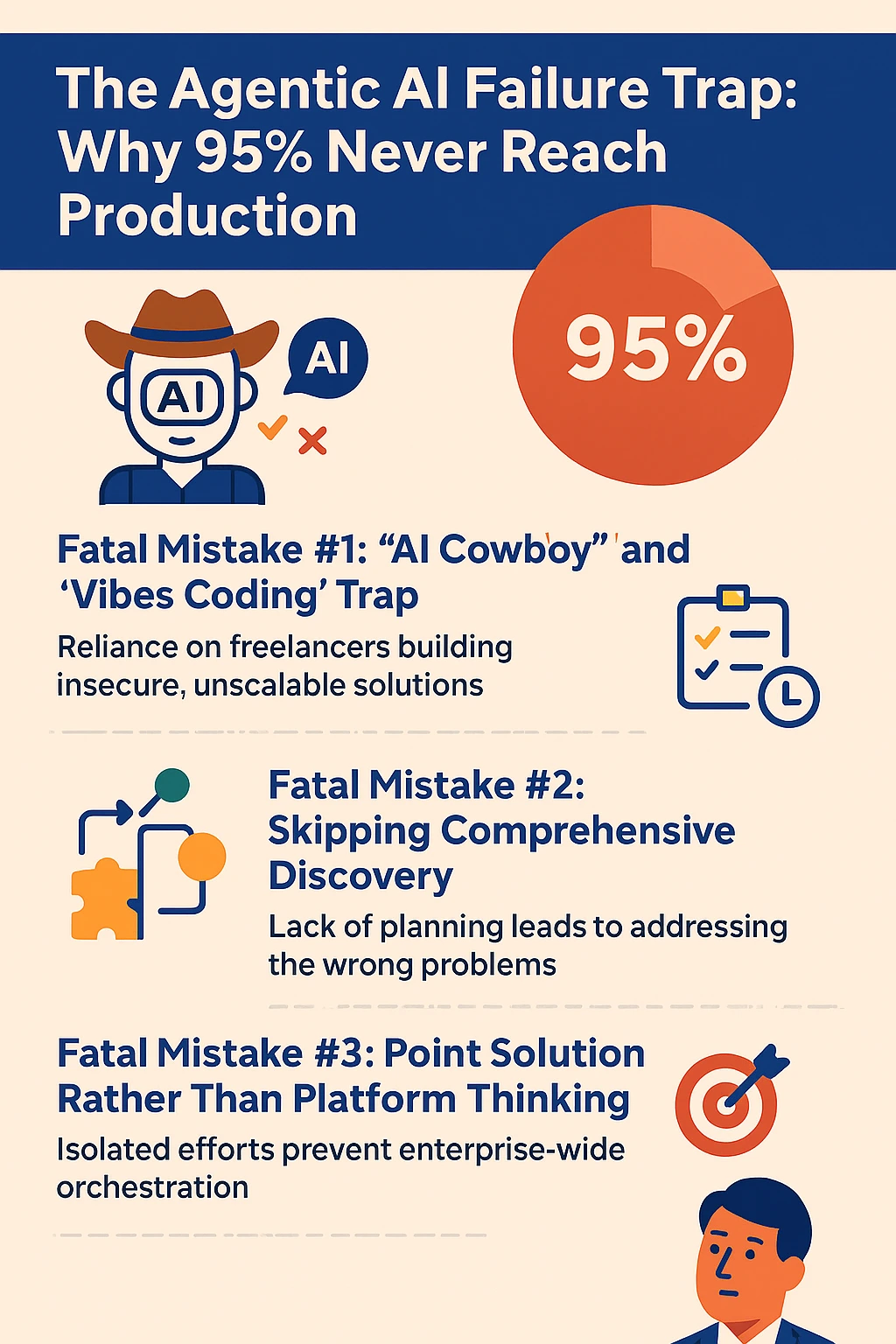
Let's confront the uncomfortable statistical reality: only 11% of organisations running agentic AI pilots successfully reach production deployment. Even more concerning, only 25% of CEO-sponsored AI initiatives deliver expected return on investment. Research from MIT Sloan Management Review reveals that average AI projects return merely 7%—below the 10% cost of capital threshold that economically justifies technology investments. This means the majority of organisations are literally destroying shareholder value through poorly executed AI initiatives.
Fatal Mistake #1: The 'AI Cowboy' and 'Vibes Coding' Trap
The explosive growth of AI capabilities has spawned thousands of overnight 'experts'—freelancers and budget app development shops claiming sophisticated AI expertise based on several months of experimentation. They employ what seasoned technology professionals sardonically call 'vibes coding'—hacking together demonstrations that appear impressive in controlled environments but lack the architectural rigour, security foundations, and scalability required for enterprise production environments.
The Gray Areas Creating Long-Term Catastrophe:
Architectural Documentation Vacuum: These practitioners build solutions through trial-and-error iteration without creating architectural blueprints, technical specifications, or system integration documentation. The code works—initially—but represents an incomprehensible black box. When business requirements inevitably evolve six months later, organisations discover there's no foundation for modification or enhancement. You're completely dependent on the original developer, who now commands premium rates with the leverage of being the sole person understanding the undocumented system.
Security as Afterthought Rather Than Foundation: Vibes coding prioritises 'making demonstrations work' over implementing enterprise security controls. These practitioners grant AI agents excessive system permissions, store authentication credentials directly in code repositories, skip proper encryption implementations, and ignore authentication best practices. The security vulnerabilities only surface when exploitation occurs—typically after the developer has moved to their next client.
Zero Knowledge Transfer Protocols: AI Cowboys deliver functioning code and promptly disappear to their next engagement. There's no comprehensive documentation, no training programmes for your technical team, no explanation of architectural decisions or system integration patterns. When they're gone, you're completely hostage to their proprietary implementation—unable to modify, troubleshoot, or enhance the system without rehiring them at significantly elevated rates under emergency conditions.
Impressive Demonstrations, Production Failures: They'll deliver visually impressive demonstrations within 2-3 weeks that completely collapse when exposed to production data volumes, edge cases that occur in real-world operations, and the complexity of integrating with your actual enterprise systems rather than sanitised test environments. One Australian financial services company spent $680,000 over nine months attempting to salvage a $45,000 vibes-coded system before abandoning it entirely and restarting from proper architectural foundations.
Fatal Mistake #2: Skipping Comprehensive Discovery
This represents the single most expensive mistake executives make across industries. Understandably eager to commence building and demonstrate progress, they skip or severely compress discovery phases, treating them as bureaucratic overhead rather than essential strategic foundation work.
The Catastrophic Consequences:
You invest 3-6 months and $100,000-$500,000 building the wrong solution addressing the wrong business problem because requirements weren't properly validated. You miss critical integration requirements during initial planning, forcing expensive mid-project rework when technical dependencies surface. You dramatically underestimate data quality issues—discovering in month four that the customer data required for AI training is fragmented across seven legacy databases with inconsistent formatting and 40% missing records. You overlook regulatory compliance requirements that prevent production deployment, discovering after substantial investment that your implementation violates industry regulations or privacy legislation.
We'll explore the discovery process comprehensively in subsequent sections, but understand this: discovery-based approaches achieve 90%+ cost accuracy compared to 40-60% accuracy for indicative pricing without discovery. The organisations that invest 2-3 weeks and $15,000-$25,000 in proper discovery save $200,000-$500,000 in avoided rework, accelerate time-to-value by 4-6 months, and dramatically increase implementation success probability.
Fatal Mistake #3: Point Solution Rather Than Platform Thinking
Organisations pilot agents for isolated tasks—customer service chatbots, document processing automation, data entry replacement—without architecting for enterprise-wide orchestration. The predictable result? Fragmented capabilities that don't deliver compounding value or achieve transformative business impact.
Research from Harvard Business Review's AI Leadership Survey demonstrates that top-performing organisations build integrated agent platforms supporting coordinated multi-agent systems. Pfizer's widely studied implementation created an agent infrastructure supporting 47 specialised agents working in sophisticated concert—analysing research data, coordinating clinical trials, managing regulatory compliance, optimising supply chains, and providing real-time intelligence to research teams. This architecture was impossible for organisations building agents as disconnected point solutions.
Fatal Mistake #4: Inadequate Infrastructure Foundation
Agentic AI demands modern data architecture—real-time data pipelines replacing nightly batch processing, unified data layers providing consistent access across siloed systems, and secure API frameworks enabling autonomous agent operations. Yet Gartner research reveals that only 2% of enterprises have successfully integrated more than 50% of their business applications.
Attempting to deploy sophisticated AI agents on fragmented, batch-processed, siloed data infrastructures virtually guarantees failure. One Australian retailer invested $380,000 developing customer experience agents before discovering their decades-old point-of-sale systems couldn't provide real-time inventory data—rendering the agents unable to provide accurate product availability information. The project was abandoned after nine months.
Fatal Mistake #5: Indicative Pricing Illusions
Vendors routinely provide superficially attractive 'ballpark estimates' based on 30-minute phone calls and cursory requirements documents. These indicative prices create dangerous illusions of certainty whilst bearing minimal relationship to actual implementation complexity. When real-world challenges inevitably emerge, costs explode 3-5 times beyond original estimates, triggering budget crises, executive disappointment, and frequent project cancellations.
We'll expose indicative pricing traps comprehensively later, but understand this fundamental truth: accurate pricing requires actual knowledge of your specific systems, data quality, integration requirements, and organisational constraints—knowledge that can only emerge through proper discovery.
Why Discovery Represents Your Most Valuable Investment
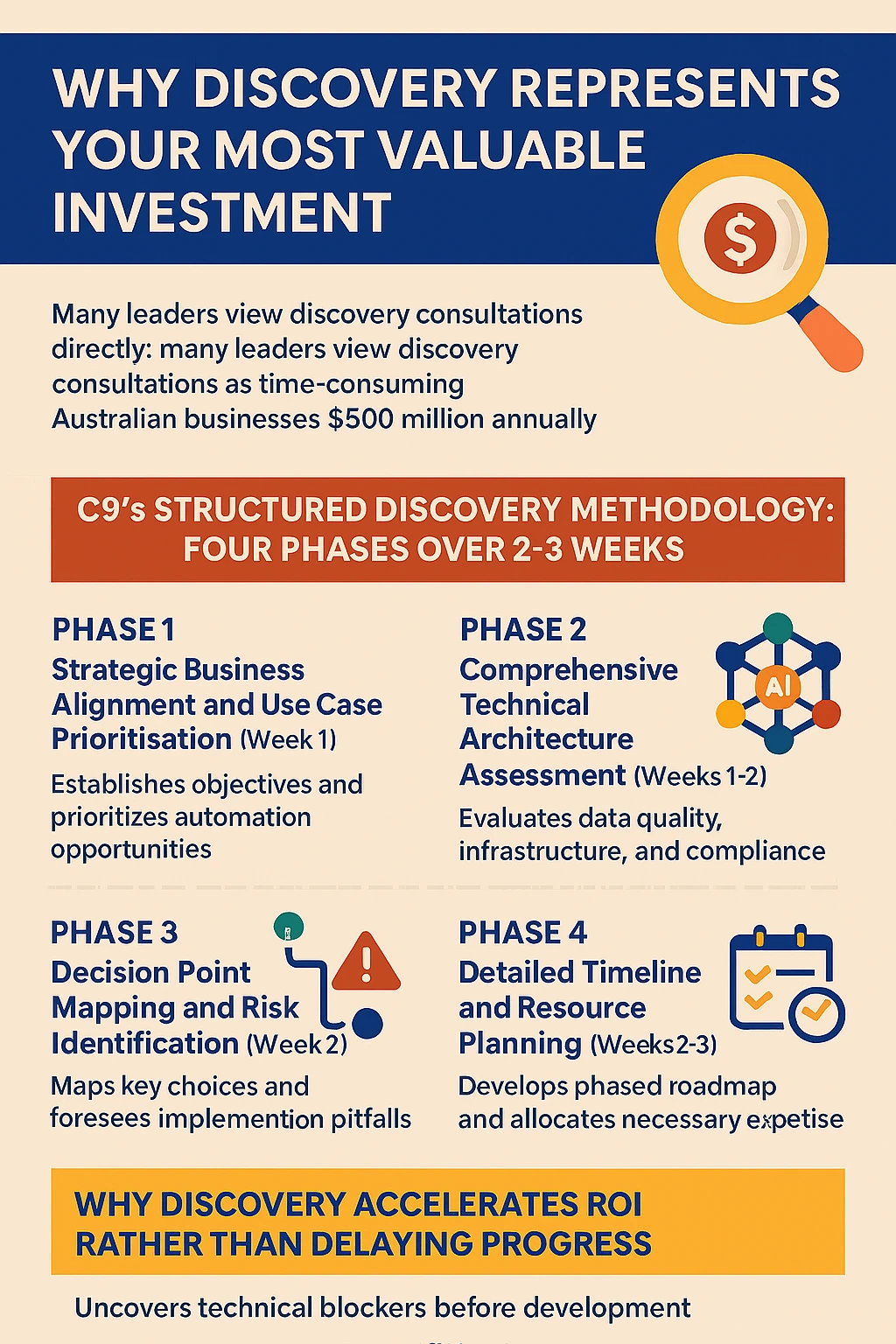
Let's address the common executive perception directly: many leaders view discovery consultations as time-consuming sales theatre or unnecessary overhead delaying 'real progress.' This fundamental misunderstanding costs Australian businesses conservatively $500 million annually in failed implementations, abandoned pilots, and massive budget overruns.
Professional discovery isn't about vendors methodically extracting requirements to inflate subsequent proposals. It represents essential strategic architecture work that statistically determines whether your agentic AI initiative joins the successful 5% or failing 95%.
C9's Structured Discovery Methodology: Four Phases Over 2-3 Weeks
Phase 1: Strategic Business Alignment and Use Case Prioritisation (Week 1)
We commence with intensive workshops involving your executive leadership team, operational managers, and technical stakeholders to establish crystal-clear understanding of business objectives, operational pain points, and quantifiable success metrics. What does 'success' actually mean for your organisation? Is the primary driver cost reduction, revenue growth, customer satisfaction improvement, compliance risk mitigation, or competitive market positioning? These fundamentally different objectives require dramatically different implementation approaches.
We then document your current workflows with end-to-end granularity. Where do humans currently make decisions? At what points do systems hand off information to each other? Where do delays consistently occur? Where do errors originate? This detailed process mapping reveals high-value automation opportunities that remain invisible from executive-level perspectives.
Finally, we evaluate potential use cases across three critical dimensions: automation potential (how much of the current manual work can agents reliably handle), business impact (what's the quantifiable value delivery), and implementation complexity (what technical challenges must be overcome). This structured framework creates your phased roadmap—not merely 'what to build' but 'in precisely what sequence' to accelerate return on investment.
Phase 2: Comprehensive Technical Architecture Assessment (Weeks 1-2)
We catalogue every system your agents must interact with—CRM platforms, ERP systems, financial databases, HR systems, legacy mainframes, cloud applications, and external APIs. We map integration points, document data flows, evaluate authentication mechanisms, and identify technical constraints.
Critically, we conduct rigorous data quality audits. AI agents are fundamentally limited by data quality—brilliant algorithms processing fragmented, inconsistent, or incomplete data deliver poor business outcomes. We assess data completeness (are critical fields populated?), accuracy (do records match reality?), freshness (is data current enough for real-time decisions?), and accessibility (can systems actually provide required data to agents?). This prevents the classic failure pattern: building technically sophisticated agents that can't function because underlying data quality doesn't support AI operations.
We evaluate infrastructure readiness against agentic AI requirements. Can your existing systems handle real-time AI workloads? Are APIs designed to support autonomous agent access patterns? Does network infrastructure provide the low-latency connectivity agents require? Do you have the cloud computing capacity to scale during peak demand periods?
We conduct comprehensive security and compliance reviews, identifying regulatory requirements (Australian Privacy Act mandates, industry-specific regulations), data sovereignty constraints affecting where processing must occur, and security controls required before agents access sensitive customer or financial data.
Phase 3: Decision Point Mapping and Risk Identification (Week 2)
This phase delivers exceptional strategic value: we systematically map every significant decision point throughout your implementation journey, ensuring you understand the choices ahead and their consequences before making irreversible commitments.
Technical decisions: Which foundation AI models best suit your specific requirements? Should processing occur in cloud, on-premise, or hybrid environments? Do workflows require real-time processing or can batch operations suffice? These aren't universal answers—optimal choices depend entirely on your specific requirements, existing infrastructure, regulatory constraints, and strategic priorities.
Integration approaches: How will agents connect to legacy systems lacking modern APIs? Which integration patterns align with your technical architecture? What middleware platforms or custom API development is required? What authentication and authorisation frameworks must be implemented?
Governance frameworks: Where should agents operate fully autonomously versus requiring human approval for specific actions? What escalation paths should exist when agents encounter ambiguous situations? How will you monitor agent actions and maintain comprehensive audit trails for compliance and continuous improvement?
Phase 4: Detailed Timeline and Resource Planning (Weeks 2-3)
We create phased implementation roadmaps where each stage delivers independently valuable business outcomes. Stage 1 might deploy a single high-impact agent within 8-12 weeks. Stage 2 expands capabilities to related workflows. Stage 3 scales enterprise-wide. This approach protects investment by ensuring each phase generates measurable value before committing to subsequent phases.
We specify exactly which C9 team members—AI/ML engineers, integration specialists, database architects, security experts, DevOps engineers—will work on each phase and when. We also document what's required from your organisation: subject matter experts for process knowledge, IT personnel for system access and integration support, and executive involvement for scheduled decision gates.
Critically, we identify dependencies and potential roadblocks before they can derail timelines. If a critical API doesn't exist, we discover this reality in week two during discovery, not week twelve when it blocks development progress. If data quality requires cleanup, we schedule this foundational work appropriately rather than discovering the problem when agent training fails.
Why Discovery Accelerates ROI Rather Than Delaying Progress
Executive time represents precious organisational resources. Here's the quantifiable evidence demonstrating why investing 8-15 hours across 2-3 weeks in comprehensive discovery delivers exponential returns:
Prevents Expensive Pivots: Discovering fundamental technical blockers during discovery consumes 2-3 weeks. Discovering identical issues in month four of active development wastes 4-6 months and hundreds of thousands in aborted work requiring complete restart.
Accelerates Development Velocity: Development teams work 40-60% faster when requirements, technical architecture, and integration patterns are comprehensively defined upfront. Developers execute against proven blueprints rather than iteratively 'figuring out' approaches mid-project, dramatically reducing expensive rework cycles.
Delivers Budget Certainty: Discovery-based pricing achieves 90%+ accuracy compared to 40-60% accuracy for indicative pricing without discovery. No budget surprises, no scope creep battles consuming executive time, no project cancellations triggered by cost overruns.
Identifies Quick-Win Opportunities: Discovery frequently uncovers 'Stage 0' opportunities—smaller improvements delivering immediate measurable value whilst foundational infrastructure work progresses. These quick wins often generate operational savings that fund subsequent implementation phases, dramatically improving financial business cases.
One Melbourne financial services firm skipped discovery to 'move fast,' investing four months and $380,000 before discovering their regulatory compliance framework prevented the proposed agent architecture from accessing required customer data without implementing additional security controls adding $120,000 and three months. Project cancelled. Six months wasted. Zero return on investment. Had they invested three weeks in proper discovery, we would have identified the compliance constraint in week one and designed alternative architectures working within established regulatory frameworks. They would be operating production agents today instead of restarting from nothing.
What Separates C9 From Hundreds of Generic Developers
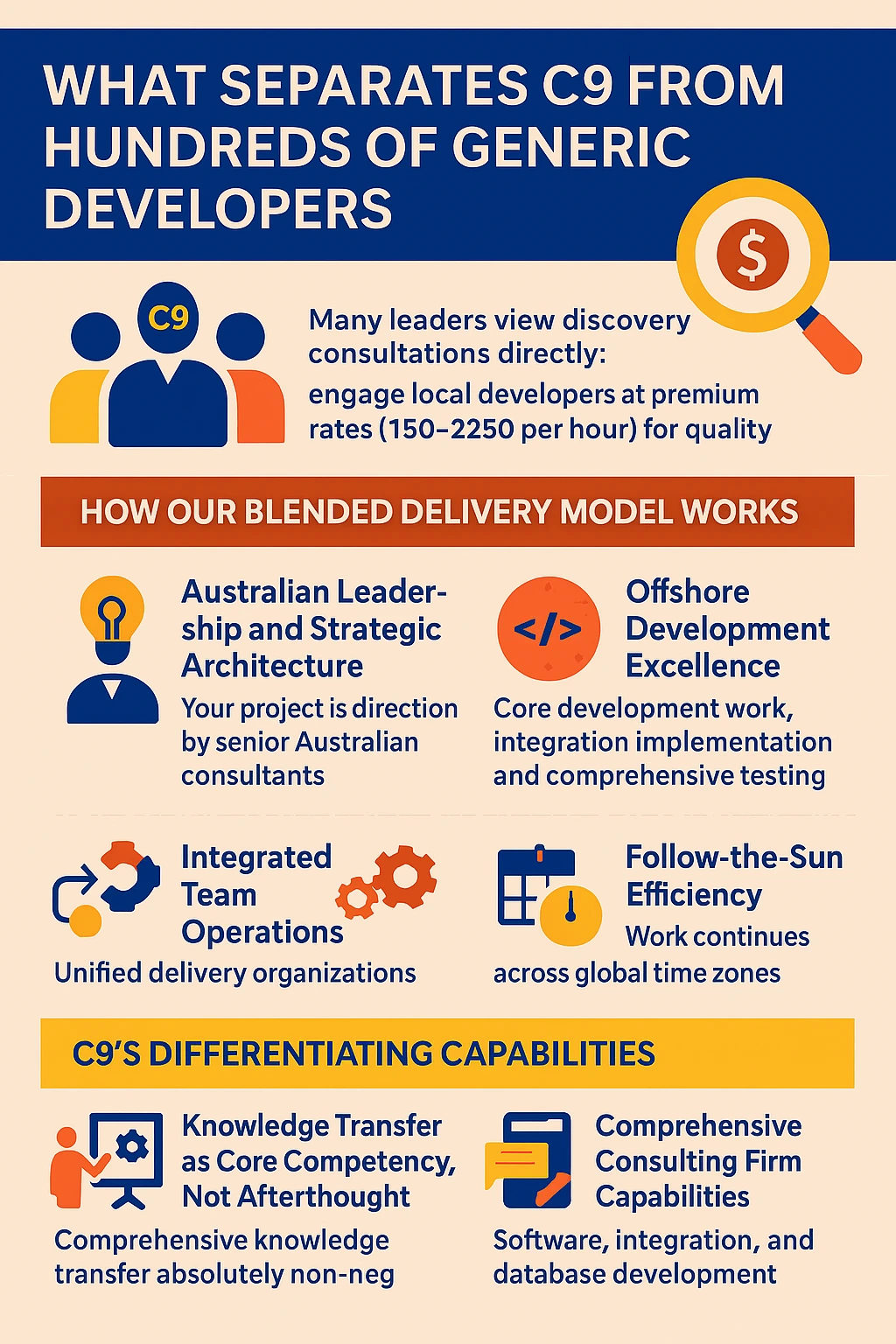
Australian businesses historically faced an impossible choice: engage local developers at premium rates ($150-$250 per hour) for quality delivery, or offshore everything to achieve cost savings but sacrifice quality, communication effectiveness, and accountability.
C9's innovative blended offshore-onshore model eliminates this false dichotomy, delivering enterprise-grade quality at 40-60% cost savings compared to traditional all-Australian consulting teams.
How Our Blended Delivery Model Works
Australian Leadership and Strategic Architecture: Your project is directed by senior Australian consultants who intimately understand local business context, regulatory compliance requirements, and professional communication norms. They design technical architecture, make strategic decisions, maintain direct client relationships, and ensure delivery aligns with your business objectives.
Offshore Development Excellence: Core development work, integration implementation, and comprehensive testing leverage our directly-hired offshore technical talent based in regions with exceptional engineering expertise and rigorous technical education systems. These aren't independent contractors—they're full-time C9 employees with multi-year tenure building deep institutional knowledge and product expertise.
Integrated Team Operations: Our onshore and offshore teams function as unified delivery organisations, not disconnected silos requiring coordination overhead. Daily standups, shared code repositories, unified project management systems. You receive seamless delivery without coordination headaches.
Follow-the-Sun Efficiency: Work continues productively across global time zones. Australian team members define requirements and make strategic decisions during your business hours. Offshore development teams progress implementation work overnight. Morning reviews and refinements accelerate overall progress by approximately 40% compared to single-location teams constrained by sequential 8-hour workdays.
C9's Differentiating Capabilities
Knowledge Transfer as Core Competency, Not Afterthought
Unlike AI Cowboys who deliver code and vanish to their next client, C9 makes comprehensive knowledge transfer absolutely non-negotiable. We provide exhaustive technical documentation including architecture diagrams, system integration maps, API specifications, deployment procedures, troubleshooting guides, and operational runbooks—everything your technical team requires to maintain and enhance solutions independently.
We deliver structured training programmes including hands-on workshops for your technical personnel covering system operations, common troubleshooting scenarios, performance monitoring approaches, and enhancement processes. We deliberately avoid creating vendor lock-in—our goal is empowering your team's long-term independence whilst ensuring expert support remains available when complex challenges arise.
Integrated Multi-Disciplinary Teams Versus Individual Contractors
Agentic AI implementations demand diverse specialised expertise—AI/ML engineers, integration architects, database specialists, security experts, DevOps engineers, and user experience designers. Individual freelancers provide single-skill capabilities. C9 delivers full-stack teams pre-assigned to your project, deep specialisation for complex technical challenges, institutional knowledge preventing key-person risk, and scalable capacity to add specialists rapidly as requirements evolve.
Comprehensive Consulting Firm Capabilities
We're not merely AI developers—C9 is a full-service consulting firm specialising in software, apps, integration, and database development across the complete technology stack. This comprehensive breadth matters profoundly for agentic AI because agents must integrate seamlessly with your existing software ecosystem, database architecture determines agent performance and reliability, and modern API frameworks enable sophisticated agent orchestration. Visit www.c9.com.au to explore our complete capabilities from legacy system modernisation through cloud-native architecture to enterprise integration frameworks.
Important Operational Clarification: Remote-First Organisation
C9 operates as a remote-first distributed organisation. We don't maintain expensive city-centre offices or employ traditional in-house local hiring models with 9-5 office presence. Our Australian leadership team and offshore technical resources work remotely via sophisticated collaboration platforms, scheduled video conferences, and asynchronous communication systems. This operational model enables our cost-efficient delivery whilst maintaining quality and responsiveness. Please don't anticipate team members appearing at your office for traditional 9-5 on-site collaboration—this isn't our delivery model and affects pricing substantially if required.
Transparent Skill-Based Pricing That Delivers Value
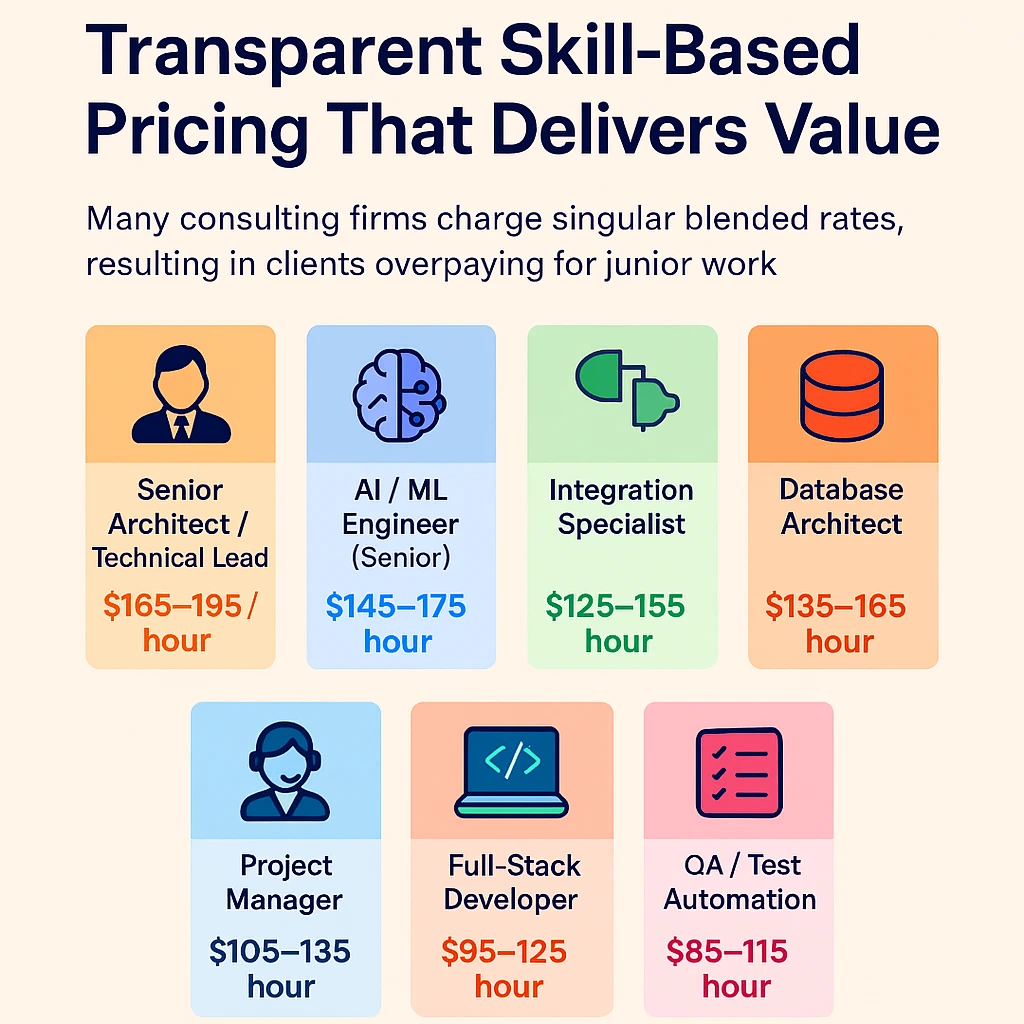
Many consulting firms charge singular blended rates—$180/hour universally for everyone from junior developers through senior architects. This apparent simplicity creates perverse economic incentives: clients overpay substantially for junior work (testing, documentation, routine coding) whilst potentially underpaying for genuine expert work (strategic architecture, complex integrations). Firms maximise profit by assigning junior resources at senior rates.
C9 employs transparent skill-based pricing reflecting actual expertise deployed:
- Senior Architect / Technical Lead: $165-195/hour (Discovery, architecture design, strategic technology decisions)
- AI/ML Engineer (Senior): $145-175/hour (Agent development, model selection, algorithm training)
- Integration Specialist: $125-155/hour (API development, system connectivity, middleware implementation)
- Database Architect: $135-165/hour (Data modelling, performance optimisation, knowledge graph design)
- Full-Stack Developer: $95-125/hour (User interface development, business logic, comprehensive testing)
- DevOps Engineer: $115-145/hour (CI/CD pipelines, infrastructure, monitoring, deployment automation)
- QA / Test Automation: $85-115/hour (Testing strategy, automation frameworks, quality assurance)
- Project Manager: $105-135/hour (Coordination, stakeholder management, delivery oversight)
Critical Pricing Context: These FY25/26 rates assume our standard blended offshore-onshore delivery model. If organisational requirements mandate Australian-only resources (rare and generally inadvisable), rates increase 60-80%. Rates are subject to annual CPI adjustments. Volume discounts of 5-10% apply for long-term contracts (6+ months) and multi-resource engagements (3+ team members).
Value Comparison for 3-Month Agentic AI Project:
- All-Australian consulting team: $270,000
- C9 blended delivery model: $155,000
- Your savings: $115,000 (43%)
That's $115,000 available for additional features, accelerated Phase 2 development, or other strategic technology initiatives.
Schedule Your Discovery Consultation
The organisations succeeding with agentic AI aren't moving fastest—they're moving smartest with experienced partners and proven methodologies.
Contact C9 today to schedule your no-obligation discovery consultation: Our Australian team to discuss your specific requirements and opportunities.
During this strategic consultation, we'll assess your agentic AI readiness, identify high-value use cases aligned with your business objectives, provide initial implementation approaches and realistic timelines, and answer your questions about our discovery process, transparent pricing, and flexible engagement models.
This isn't a sales pitch—it's strategic consultation helping you make informed decisions regardless of whether you ultimately engage C9 for implementation.
The window to establish competitive advantages through agentic AI is rapidly closing. The organisations investing strategically now in properly architected custom solutions will dominate their markets whilst competitors struggle with failed pilots and mounting technical debt.
Choose the right partner. Choose the right process. Choose lasting success.
About C9: Australia's leading consulting firm for custom software, apps, integration, and database development. We deliver enterprise-grade agentic AI solutions through our innovative blended offshore-onshore model, providing exceptional quality at 40-60% cost savings compared to traditional consulting approaches. Learn more at www.c9.com.au