Executive Summary
The Australian SaaS market is undergoing a structural shift in 2026. Platforms built on traditional architectures — with AI bolted on afterward — are already falling behind competitors who architected AI‑native foundations from day one. Venture capital expectations, rising infrastructure costs, the collapse of per‑seat pricing, and a widening gap between GenAI experimentation and production readiness mean only SaaS companies that embrace AI‑native design will survive the next wave of market consolidation. This guide shows Australian founders, CTOs, and executives how AI‑native platforms work, what pressures they must respond to, and how to build scalable autonomous systems using C9’s discovery‑first approach.
The Problem
Most SaaS platforms in 2026 are still built on traditional architectures incapable of supporting autonomous AI workloads. They bolt on “AI features” for marketing but lack async processing, vector memory layers, multi‑agent orchestration, and cost‑controlled GPU usage. As a result, these platforms cannot scale, margins collapse, and competitors with AI‑native systems outperform them across automation, customer experience, and market share.
The Solution
AI‑native SaaS platforms re‑architect the entire application stack around intelligence, not features. They use asynchronous queue‑driven processing, vector databases, autonomous agents, and elastic GPU‑aware infrastructure. They’re built to make decisions, not wait for user instructions. These platforms unlock 2–3× pricing power, superior retention, and massive operating leverage.
What’s Next
By late 2026, 80% of enterprises will deploy GenAI applications — yet fewer than 30% will have production‑ready autonomous systems. The gap between these groups will define the next decade of SaaS winners and losers. What’s next is clear: companies must shift from “AI‑enabled” to AI‑native, build for autonomous workflows, and adopt discovery‑led architecture before writing a single line of code.
The Australian SaaS landscape is experiencing a fundamental transformation in 2026—one that will determine which companies thrive and which become cautionary tales in tech folklore.
Here's the uncomfortable truth: If you're still building SaaS platforms with traditional architecture and bolting on "AI features" as an afterthought, you're already 18 months behind competitors who started with AI-native foundations. This isn't hyperbole—it's the documented reality from venture capital firms who now demand AI-native capabilities before funding Series B rounds.
By end of 2026, 80% of enterprises will deploy GenAI-enabled applications, but only 30% will have production-ready autonomous systems that deliver measurable ROI. The gap between experimentation and execution is where fortunes are won and lost.
For Australian business owners and executives, this creates both urgent pressure and unprecedented opportunity:
The Pressure:
- Traditional per-seat SaaS pricing models are effectively dead as AI agents decouple revenue from headcount.
- Gross margins for AI-native platforms average 50-60% versus 80-90% for traditional SaaS.
- Infrastructure costs scale with usage, creating variable expense most financial models don't account for.
- Competitors with AI-native platforms are capturing market share through autonomous workflows that traditional systems can't match.
The Opportunity:
- APAC SaaS market projected to reach $104.25 billion by 2029 with 20.94% CAGR.
- First movers in vertical-specific AI-native solutions command premium pricing (2-3x traditional SaaS).
- Autonomous agents unlock $2.9 trillion in economic value globally by 2030.
- Australian businesses with AI-native platforms can dominate regional markets before international competitors establish footholds.
This comprehensive guide provides Australian CTOs, founders, and business leaders with the strategic and technical knowledge to navigate AI-native SaaS development successfully. You'll learn:
- Technical Architecture: The fundamental differences between AI-native and AI-enabled platforms (and why it's a $2M+ decision).
- Economic Reality: New cost structures, pricing models, and margin expectations for 2026.
- Risk Mitigation: How to avoid the "AI Cowboy" trap of cheap builders who create technical debt disasters.
- Strategic Partnership: Why C9's Discovery-driven, hybrid offshore/onshore model delivers production-ready platforms (not expensive experiments).
- Implementation Pathway: Practical roadmaps, pricing frameworks, and decision points for your AI-native SaaS journey.
Whether you're building your first SaaS platform or modernising an existing product, this guide will help you make informed decisions that accelerate time-to-market while avoiding the costly mistakes plaguing 40% of AI projects in 2026.
Let's begin by examining exactly why traditional SaaS development approaches are failing.
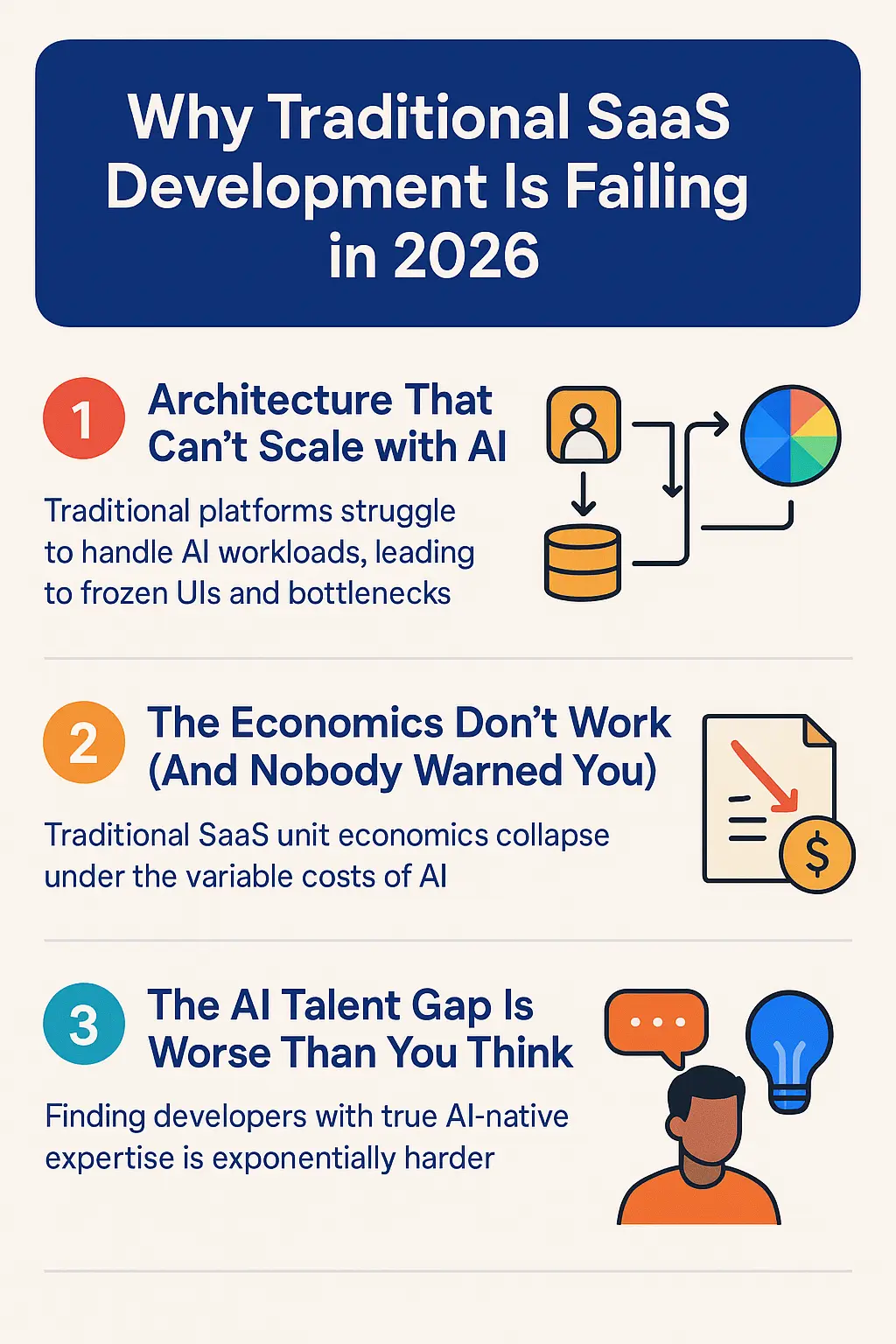
Why Traditional SaaS Development Is Failing in 2026
The uncomfortable conversations happening in boardrooms across Australia, CEOs and CTOs are having increasingly difficult conversations:
"Our SaaS platform took 18 months and $800K to build, but competitors launched AI-native alternatives in 12 weeks that do 80% of what we do—autonomously."
"We added an 'AI chatbot' feature for $150K, but customers complain it's just window dressing. Meanwhile, competitors' platforms actually execute workflows without human interaction."
"Our developers estimated $50K for AI integration. We're now at $320K with no production launch date because the architecture can't handle AI processing loads."
These aren't isolated incidents—they're symptomatic of a fundamental mismatch between traditional SaaS development approaches and AI-native requirements.
1: Architecture That Can't Scale with AI
Traditional SaaS platforms were architected for deterministic, predictable workloads:
- User logs in → performs action → database updates → response rendered.
- Linear processing paths with millisecond response times.
- Fixed infrastructure costs that scale predictably with user count.
AI-native platforms operate fundamentally differently:
- User submits intent → AI processes context (5-30 seconds) → generates response → executes autonomous actions → monitors outcomes.
- Non-linear processing with variable compute requirements.
- Infrastructure costs tied to usage intensity, not user count.
When you try to retrofit AI onto traditional architecture, you get:
- Frozen UIs: Users stare at loading spinners for 10-30 seconds while AI processes.
- Database Bottlenecks: Traditional relational databases can't efficiently store and retrieve vector embeddings.
- Cost Explosions: Synchronous processing blocks resources, requiring 3-5x more infrastructure than proper async architecture.
- Failed Scaling: What works for 100 users collapses at 1,000 users due to queue saturation.
Real Example: An Australian fintech company spent $280K retrofitting AI document processing into their existing platform. The architecture forced synchronous processing, meaning each AI request blocked other operations. At 500 concurrent users, the system crashed. Rebuilding with proper queue-based architecture cost an additional $420K and delayed their Series A funding by 9 months.
2: The Economics Don't Work (And Nobody Warned You)
Traditional SaaS has beautiful unit economics:
- Develop once, sell infinitely.
- Near-zero marginal costs per customer.
- 80-90% gross margins.
- Predictable per-seat pricing.
AI-native SaaS economics are fundamentally different:
- Variable infrastructure costs per user interaction.
- Model API costs $5,000-$50,000/month for 10,000 users.
- GPU compute that scales dynamically with demand.
- Gross margins compressed to 50-60%.
Most Australian founders build financial models assuming traditional SaaS economics, then face brutal reality:
- Underestimated Infrastructure: Vendors lure customers with pilot credits, but scaling to production reveals 500-1,000% cost underestimation.
- Broken Pricing Models: Per-seat pricing doesn't work when one user with AI agents does the work of 10.
- Margin Compression: Investors expect 80%+ margins, but your AI-native platform delivers 55%—suddenly your valuation drops 40%.
Real Example: A Melbourne-based HR tech startup launched an AI-powered recruitment platform with $99/month per-seat pricing. Power users with autonomous agents were costing $187/month in infrastructure while paying $99—a negative contribution margin. They didn't discover this until month 8 when AWS bills revealed the reality. Emergency pivot to credit-based pricing saved the company but required difficult customer conversations and 23% churn.
3: The AI Talent Gap Is Worse Than You Think
Finding developers who understand traditional SaaS is straightforward—there are thousands in Australia.
Finding developers who truly understand AI-native architecture is exponentially harder:
- Multi-agent orchestration systems.
- Vector database optimisation.
- Async queue-based processing for AI workloads.
- Prompt engineering and model fine-tuning.
- Cost optimisation across multiple LLM providers.
- Governance frameworks for autonomous agents.
Companies hire developers who claim "AI expertise" but actually have:
- Surface Knowledge: Completed an online course, integrated OpenAI API once.
- No Production Experience: Never scaled AI systems beyond 100 users.
- Framework Dependency: Can use pre-built tools but can't architect custom solutions.
- No Economic Understanding: Build systems with beautiful UX that cost $400K/year to operate when $80K is feasible.
Real Example: A Sydney-based logistics company hired three "AI developers" at $180K/year each to build an AI-native platform. After 7 months and $630K spend, they had a demo that impressed investors but couldn't handle production load. Architecture review revealed fundamental flaws: synchronous processing, no queue system, vector embeddings stored incorrectly, no caching layer, and LLM calls that should cost $0.02 actually costing $1.40 due to inefficient prompt design. The rebuild took 4 months and proper architecture from the start could have saved $420K.
4: Compliance and Governance Are Afterthoughts (Until They're Catastrophes)
Traditional SaaS compliance is well-understood:
- Encrypt data at rest and in transit.
- Implement role-based access controls.
- Maintain audit logs.
- Pass SOC 2 or ISO 27001 audits.
AI-native platforms introduce entirely new compliance challenges:
- Autonomous agents making decisions with business consequences.
- AI systems accessing sensitive data without explicit user permission.
- Opaque decision-making processes that regulators struggle to audit.
- Dynamic behaviours that change as models learn.
Australian businesses discover compliance gaps after deployment:
- Regulatory Violations: AI agents accessing customer data without proper consent—Privacy Act violations with penalties up to $2.5M.
- Audit Failures: Enterprise procurement teams reject platforms that can't explain AI decision-making.
- Insurance Gaps: Professional indemnity insurance doesn't cover AI-caused errors in many policies.
- Reputational Damage: AI agents providing incorrect information to customers—brand damage takes years to repair.
Real Example: A Brisbane healthcare SaaS platform deployed AI-powered patient triage without proper governance framework. An AI agent incorrectly categorised a high-risk patient as low-priority, resulting in delayed treatment. The subsequent investigation revealed no audit trail of the AI's decision-making process, no human-in-the-loop for high-stakes decisions, and no escalation protocols. Legal costs, regulatory fines, and remediation totalled $1.8M—more than the entire platform development budget.
5: Time-to-Market Pressure Creates Technical Debt Disasters
The market demands speed:
- Competitors launching in 8-12 weeks.
- Investors expecting rapid iteration.
- Customers wanting AI features "now."
This pressure creates a dangerous trap: Australian companies choose "fast and cheap" over "correct and strategic," leading to:
- "AI Cowboys" promising 4-week builds for $15K.
- Vibes Coding where developers "feel their way through" without architectural rigour.
- Copy-Paste Solutions from Stack Overflow that work in demos but fail in production.
- No Knowledge Transfer leaving companies dependent on single freelancers.
The Pain: The "cheap" option becomes the most expensive:
- Technical Debt Accumulation: Shortcuts create systems that can't scale, can't be maintained, can't be secured.
- Rebuild Costs: Fixing vibes-coded platforms costs 3-5x more than building properly from the start.
- Vendor Lock-In: Dependency on single developers who hold systems hostage with poor documentation.
Real Example: A Perth-based property tech startup hired a freelance "AI expert" for $25K to build an AI-native platform in 6 weeks. The result worked beautifully in demos with 10 users, response times ballooned to 45 seconds. At 500 users, the system crashed hourly. The freelancer had:
- No queue system (all processing synchronous).
- Hardcoded API keys in source code (security nightmare).
- No error handling (crashes required manual restarts).
- Zero documentation (nobody could understand the codebase).
C9's rebuild cost $110K and took 14 weeks—4.4x the original "cheap" option. The company lost 6 months of runway and missed their key market entry window.
The Pattern Is Clear
These pain points aren't random—they follow a predictable pattern:
- Underestimate Complexity: "AI is just another feature, right?"
- Choose Speed Over Strategy: "We need to launch in 8 weeks."
- Hire Based on Price: "This freelancer is $50/hour vs agencies at $150/hour."
- Ignore Architecture: "Let's just start coding and figure it out."
- Skip Discovery: "Discovery is a waste of time—we know what we want."
- Face Reality: System can't scale, costs explode, competitors win.
The good news? Every one of these failures is preventable with the right approach.
But first, let's examine exactly how bad this gets when companies double down on the wrong decisions.
The Hidden Costs of Getting AI-Native Wrong
The pain points we've identified aren't just inconvenient—they're business-threatening when compounded over time. Let's examine the cascading consequences of poor AI-native development decisions.
The $2.8M Mistake: Real Cost of Failed AI-Native Projects
Scenario: Australian mid-market SaaS company with $4M ARR decides to "add AI" to stay competitive.
Month 0-3: The Optimistic Start
- Hire two contractors claiming AI expertise: $240K/year loaded cost.
- Infrastructure budget: $5K/month (based on AWS pilot credits).
- Timeline: 6 months to AI-native features.
- Total Expected Investment: $360K.
Month 3-8: Reality Emerges
- Architecture can't handle AI processing loads (rebuild required).
- AWS bills escalate to $28K/month as pilot credits expire.
- Contractors lack production AI experience (terminate, hire senior engineers).
- Actual Spend: $680K.
Month 8-14: The Death Spiral
- Complete architecture rebuild by specialist agency: $420K.
- Lost revenue from delayed enterprise deals: $890K (3 delayed contracts).
- Customer churn from poor AI feature performance: $340K (8.5% elevated churn).
- Emergency fundraising at 30% discount to previous valuation: $1.2M dilution.
- Total Impact: $2.83M.
The Kicker: A proper Discovery phase and architecture-first approach would have cost $480K and delivered production-ready platform in 10 months—saving $2.35M and 4 months.
The Compounding Effect: Why Bad Decisions Get Worse
Poor AI-native development decisions don't stay isolated—they compound:
Technical Debt Spiral
- Month 1-6: "Vibes coding" creates working demo.
- Month 6-9: Adding features becomes exponentially harder (each feature takes 2x longer than previous).
- Month 9-12: System so fragile that bug fixes create new bugs.
- Month 12+: Rebuild cheaper than maintenance.
Australian Example: Adelaide-based logistics SaaS spent $180K on rushed AI development. By month 14, they were spending $35K/month just maintaining the fragile system—$420K/year maintenance vs $280K complete rebuild. The worse the economics became.
Talent Retention Crisis
- Good Developers Leave: Senior engineers refuse to work on poorly architected systems.
- Knowledge Concentration: Only 1-2 people understand the fragile codebase.
- Hiring Difficulty: Word spreads in developer community about technical debt.
- Wage Premium: Must pay 20-40% above market to attract talent to troubled projects.
Australian Example: Melbourne fintech lost 3 senior developers in 8 months due to frustration with AI platform technical debt. Recruiting replacements required 35% wage premium and 4-month ramp-up time —$420K in direct costs plus 12 months of reduced velocity.
Competitive Displacement
- Month 0-6: Your poorly architected platform launches with "AI features".
- Month 6-12: Competitor launches AI-native platform with genuine autonomous workflows.
- Month 12-18: Your customers start asking why competitor's AI "actually works".
- Month 18-24: Customer churn accelerates, sales pipeline dries up, valuation collapses.
Australian Example: Two Brisbane HR tech companies launched similar AI-powered recruitment platforms within 3 months of each other. Company A (vibes-coded, $80K budget) had AI that "suggested" candidates. Company B (properly architected, $280K budget) had AI that autonomously qualified, contacted, and scheduled candidates. Within 18 months, Company A achieved $2.3M ARR while Company B hit $5.8M ARR with 34% churn. Company A struggled with funding attempts. Company B raised Series A at $28M valuation. Company A shut down after failed funding.
The "AI Cowboy" Multiplier: How Cheap Developers Cost You Millions
Let's quantify the actual cost difference between "cheap AI builders" and professional AI-native development.
Scenario Comparison: $50K Project
Option A: "AI Cowboy" Freelancer
- Upfront Cost: $50K.
- Timeline: 8 weeks (promised).
- Actual Delivery: 14 weeks.
- Month 0-3: Demo works, celebrate success.
- Month 3-6: Performance issues emerge (50K/month emergency engineering: $150K).
- Month 6-9: Security audit fails, cannot pass enterprise procurement ($85K remediation).
- Month 9-12: System can't scale past 2,000 users, complete rebuild required ($320K).
- Month 12-18: Rebuild and migrate users to new platform ($180K).
- Lost Revenue: Delayed enterprise deals, elevated churn ($640K).
- Total 18-Month Cost: $1.425M.
Option B: Professional Agency (C9) with Discovery
- Discovery Phase: $35K (3 weeks).
- Architecture & Development: $280K (16 weeks).
- Total Upfront: $315K.
- Month 0-6: Production-ready platform scaling to 50K users.
- Month 6-18: Iterative improvements ($120K).
- Maintenance: $8K/month ($144K over 18 months).
- Lost Revenue: None (on-time delivery).
- Total 18-Month Cost: $579K.
The Math:
- Option A appears $265K cheaper upfront.
- Option A actually costs $846K more over 18 months (146% premium for "cheap").
- Option B delivers scalable platform 8 months earlier.
The Discovery Phase ROI: Why "Waste of Time" Is Waste of Money
Many Australian executives view Discovery as unnecessary overhead:
"We know what we want. Just start building."
"Discovery is a waste of time—our competitors are launching now."
"That's $30K we could spend on development."
Let's examine the actual ROI of skipping Discovery:
Without Discovery ($0 invested)
- Assumptions Made: 47 technical decisions based on incomplete information.
- Architectural Flaws: 12 discovered after month 3 (too late to fix without rebuild).
- Feature Scope Creep: 340% expansion from initial spec (requirements keep changing).
- Rework Costs: $380K rebuilding incorrectly architected components.
- Timeline Delay: 9 months beyond original estimate.
- Total Cost of Skipping Discovery: $380K + 9 months.
With Discovery ($35K invested over 3 weeks)
- Validated Assumptions: 47 technical decisions documented and agreed.
- Architectural Clarity: Right-sized infrastructure, proper scaling approach defined.
- Scope Locked: Features prioritised into phases (MVP → V2 → V3).
- Rework Costs: $0 (architecture validated before development).
- Timeline Accuracy: Delivered within 2 weeks of estimate.
- ROI: $345K saved, 9 months faster.
The Reality: Every dollar invested in Discovery saves $10-15 in rework and delivers 3-6 months faster time-to-market.
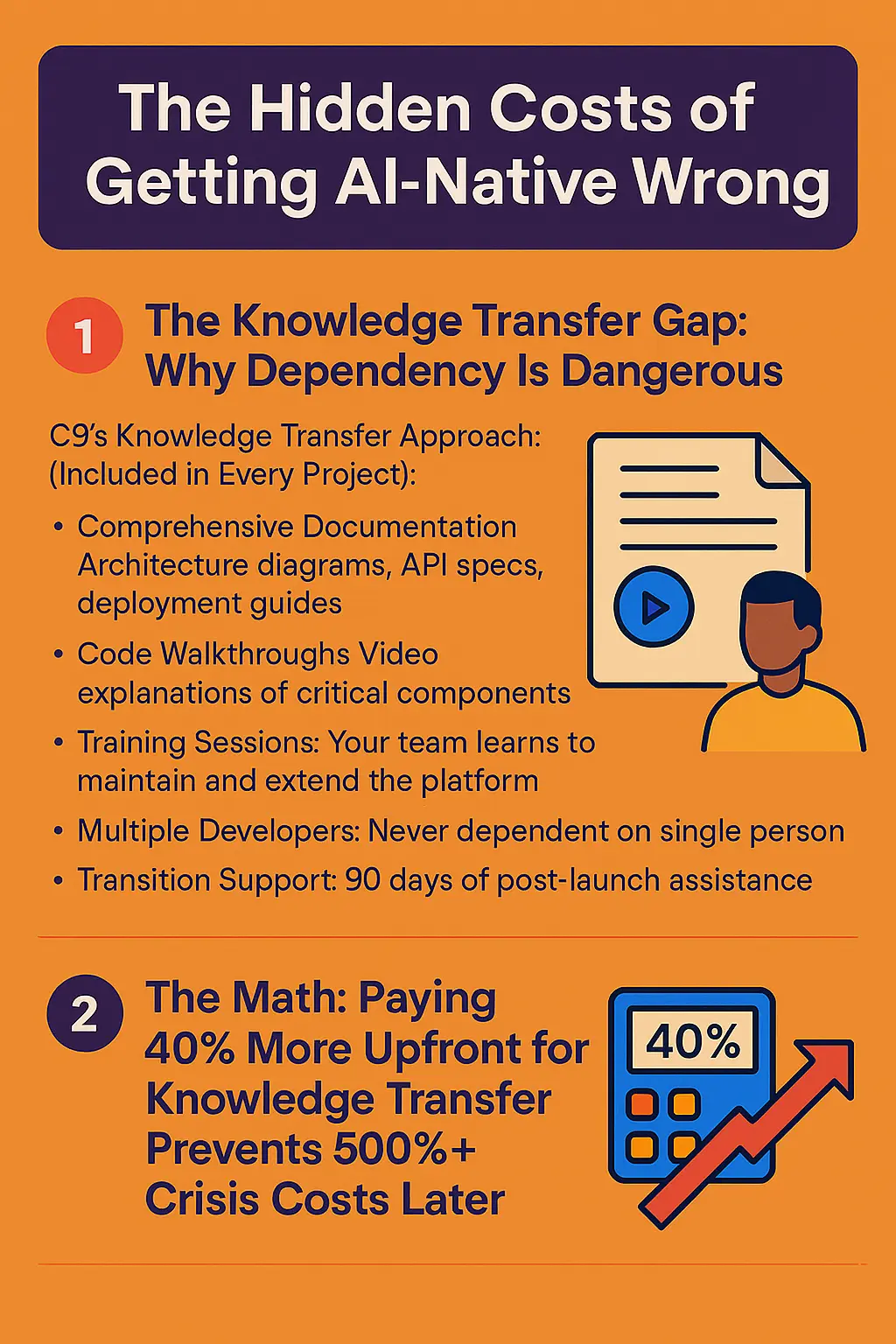
The Knowledge Transfer Gap: Why Dependency Is Dangerous
Many Australian companies hire cheap developers without considering knowledge transfer:
Scenario: The Single Point of Failure
Month 0-8: Freelance developer builds AI-native platform for $65K.
- System works.
- Only the freelancer understands architecture.
- Zero documentation.
- Proprietary approaches (can't be maintained by others).
Month 9: The Crisis
- Freelancer becomes unresponsive (personal issues, new project, disappeared).
- Critical bug emerges affecting 40% of users.
- No other developer can understand the codebase.
- Emergency reverse-engineering required: $85K and 6 weeks.
- Customer churn during outage: $140K.
Month 10-12: The Scramble
- Hire specialist agency to document and stabilise system: $120K.
- Migrate to maintainable architecture: $180K.
- Total Cost: $390K to fix $65K "savings".
C9's Knowledge Transfer Approach (Included in Every Project):
- Comprehensive Documentation: Architecture diagrams, API specs, deployment guides.
- Code Walkthroughs: Video explanations of critical components.
- Training Sessions: Your team learns to maintain and extend the platform.
- Multiple Developers: Never dependent on single person.
- Transition Support: 90 days of post-launch assistance.
- Cost: Included (no premium).
The Math: Paying 40% more upfront for knowledge transfer prevents 500%+ crisis costs later.
The Indicative Pricing Trap: Why "Ballpark Estimates" Destroy Projects
Many Australian companies request "ballpark pricing" before Discovery:
"Just give us a rough number so we can budget."
Here's why indicative pricing without Discovery is worse than useless—it's actively harmful.
The Indicative Pricing Death Spiral
Week 0: The Request
- Company: "We want AI-native CRM. What's your ballpark?"
- Agency: "Based on similar projects, probably $180K-$280K."
- Company: "Great, we'll budget $200K."
Week 4: Discovery Reveals Reality
- Customer data across 7 legacy systems (not 2 mentioned initially).
- 40 integration points required (not 8 assumed).
- Compliance Requirements: APRA, Healthcare Privacy, Financial Services regs.
- Expected User Load: 15K concurrent (not 2K mentioned).
Actual Scope: $480K-$620K.
What Happens Next:
- Option A: Company feels "bait and switched," walks away (wasted 4 weeks).
- Option B: Company demands original price, agency cuts corners to meet budget, delivers broken system.
- Option C: Contentious relationship, finger-pointing, project fails.
None of these outcomes are acceptable.
The Discovery-Based Pricing Approach
Week 0: The Conversation
- Company: "We need AI-native CRM. What will it cost?"
- C9: "We can't provide accurate pricing without Discovery. Here's why..."
- Discovery Investment: $35K (3 weeks).
- Outcome: Detailed spec, accurate pricing (±10%), validated architecture.
- If you choose not to proceed with C9 after Discovery, you own all documentation to brief other agencies.
Week 3: Discovery Complete
- Actual Requirements Documented: 340 user stories, 47 technical decisions, 12 integration points.
- Accurate Pricing: $485K ±$48K (10% variance).
- Phased Approach:
- Phase 1 (MVP): $220K, 12 weeks, delivers core autonomous workflows.
- Phase 2 (Scale): $165K, 8 weeks, adds advanced features and optimisation.
- Phase 3 (Enterprise): $100K, 6 weeks, compliance and governance.
- ROI Projection: Phase 1 delivers $840K/year cost savings (5.8 month payback).
What Happens Next:
- Informed Decision: Company knows exactly what they're buying.
- Budget Alignment: Can choose to phase delivery based on available capital.
- Risk Mitigation: No surprises, no scope creep, no "bait and switch".
- Early ROI: Phase 1 savings fund Phase 2-3.
The Uncomfortable Truth
Every agitation point in this section stems from the same root cause: prioritising short-term cost savings over long-term value creation.
- Skipping Discovery to save $35K costs $380K in rework.
- Hiring cheap developers to save $200K costs $846K in failures.
- Avoiding knowledge transfer to save $50K costs $390K in crisis recovery.
- Accepting indicative pricing to "speed things up" leads to project failure.
The companies that succeed in AI-native SaaS development make the opposite choice: They invest in rigour upfront, accept that quality costs more initially, and reap massive long-term returns.
Now let's examine exactly what makes AI-native architecture different—and why understanding this distinction is worth millions.
Understanding AI-Native vs AI-Enabled Architecture
Before we can solve the AI-native development challenge, you must understand the fundamental architectural differences that determine success or failure.
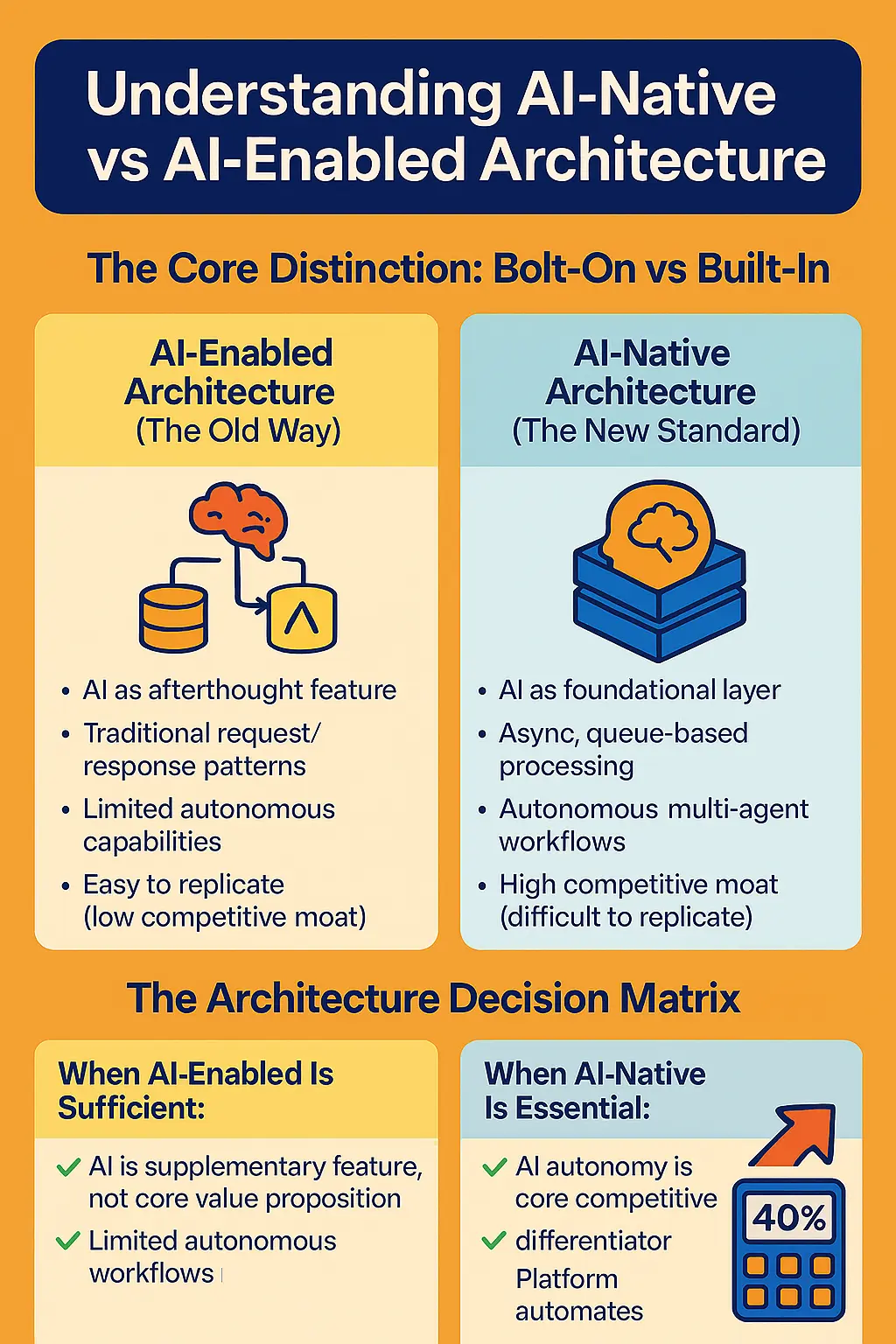
The Core Distinction: Bolt-On vs Built-In
AI-Enabled Architecture (The Old Way): Traditional SaaS platform built first, AI features added later as discrete components.
Characteristics:
- AI as afterthought feature.
- Traditional request/response patterns.
- Limited autonomous capabilities.
- Easy to replicate (low competitive moat).
AI-Native Architecture (The New Standard): Platform designed from foundation with AI as core operating system.
Characteristics:
Why This Distinction Matters: The $2M Difference
Australian Example: Two Companies, Two Approaches
Company A: AI-Enabled Approach
- Built traditional CRM over 12 months: $480K.
- Added "AI Assistant" chatbot: $85K.
- Result: AI answers questions but can't execute workflows.
- Customer Feedback: "Nice feature, but I still do all the work."
- Competitive Position: Easily replicated by competitors in 6 weeks.
- Total Investment: $565K for limited differentiation.
Company B: AI-Native Approach
- 4-week Discovery defining autonomous workflows: $35K.
- 14-week AI-native CRM development: $385K.
- Result: AI agents autonomously qualify leads, schedule meetings, update records, trigger follow-ups.
- Customer Feedback: "This is like having 3 extra SDRs on my team".
- Competitive Position: Defensible moat (complex multi-agent orchestration).
- Total Investment: $420K for market-leading differentiation.
18-Month Outcomes:
- Company A: $2.1M ARR, 28% churn, struggling to differentiate.
- Company B: $5.8M ARR, 11% churn, premium pricing (2.1x Company A).
The Difference: Architecture choice determined market success.
Technical Components of AI-Native Architecture
Let's break down the critical components Australian CTOs must understand:
Component 1: Async Queue-Based Processing
The Problem with Synchronous Processing:
- AI models take 5-30 seconds to respond.
- Traditional synchronous approach: User waits, UI frozen, terrible experience.
- Under load: Requests queue up, timeouts occur, system crashes.
The AI-Native Solution:
- User submits request → immediate acknowledgement → task queued.
- AI processes asynchronously → user notified upon completion.
- Scales to thousands of concurrent tasks without blocking.
Australian Example: Sydney fintech initially used synchronous AI for document analysis. At peak hours, users waited 25 seconds. Switching to async queues reduced perceived load time to 2 seconds and infrastructure costs by 40%.
Component 2: Multi-Agent Orchestration
The Problem: Single AI models can't handle complex workflows.
- Traditional: One LLM for everything (inefficient, error-prone).
- Result: Limited to simple tasks like chatbots.
The AI-Native Solution:
- Specialised agents: Research Agent, Decision Agent, Execution Agent.
- Orchestrator manages workflow, passes context, monitors outcomes.
- Agents collaborate like a team (e.g., Research Agent gathers data, Decision Agent analyses, Execution Agent acts).
Australian Example: Melbourne healthcare platform uses multi-agent system for patient care: Diagnostic Agent analyses symptoms, Treatment Agent suggests plans, Compliance Agent ensures regulatory adherence. Reduced misdiagnosis by 35% compared to single-model approach.
Component 3: Vector Databases + Hybrid Storage
The Problem: Traditional databases can't handle AI data types.
- Relational DBs slow for similarity searches.
- No efficient way to store embeddings (AI's "memory").
The AI-Native Solution:
- Vector DB (e.g., Pinecone) for semantic search and long-term memory.
- Hybrid with traditional DB for structured data.
- Embeddings for context retention across sessions.
Australian Example: Brisbane legal SaaS uses vector DB for case law search. Traditional keyword search missed 45% relevant cases; vector search hits 92% accuracy, saving lawyers 3 hours/week per user.
Component 4: Cost Optimisation Layer
The Problem: Unoptimised AI calls bankrupt platforms.
- Naive LLM usage: $0.03 per simple query.
- At scale: $50K/month for 10K users.
The AI-Native Solution:
- Caching: Store common responses.
- Model Routing: Use cheap models for simple tasks, expensive for complex.
- Prompt Compression: Reduce tokens by 70%.
- Batch Processing: Group requests for efficiency.
Australian Example: Sydney fintech initially spent $42K/month on AI for 8,000 users. Adding optimisation layer (caching, model selection, prompt engineering) reduced to $11K/month—74% savings with same performance.
Component 5: Governance and Audit Framework
The Problem: Autonomous AI lacks accountability.
- No audit trail for decisions.
- Compliance risks (Privacy Act, APRA).
The AI-Native Solution:
- Log every agent action, input, output.
- Human-in-loop for high-stakes decisions.
- Explainability tools to trace AI reasoning.
- Dynamic monitoring for model drift.
Australian Example: Victorian GovTech platform implements full audit logging for AI decisions. Passed APRA audit first time, while competitor failed and lost $2.5M contract.
The Architecture Decision Matrix
Not every SaaS product needs full AI-native architecture. Here's how to decide:
When AI-Enabled Is Sufficient:
- ✅ AI is supplementary feature, not core value proposition.
- ✅ Limited autonomous workflows needed.
- ✅ Traditional user interactions remain primary.
- ✅ Lower development budget (<$150K).
- ✅ Faster time-to-market essential (4-8 weeks).
When AI-Native Is Essential:
- ✅ AI autonomy is core competitive differentiator.
- ✅ Platform automates complex, multi-step workflows.
- ✅ Scaling to 10,000+ users with heavy AI usage.
- ✅ Premium pricing model justified by AI value delivery.
- ✅ Long-term platform (5+ year horizon).
C9's Discovery Process determines the right approach for your specific context.
Understanding this architecture is crucial because it exposes why "cheap" builders can't deliver—leading to the "AI Cowboy" problem.
The "AI Cowboy" Problem: Why Cheap Builders Create Expensive Disasters
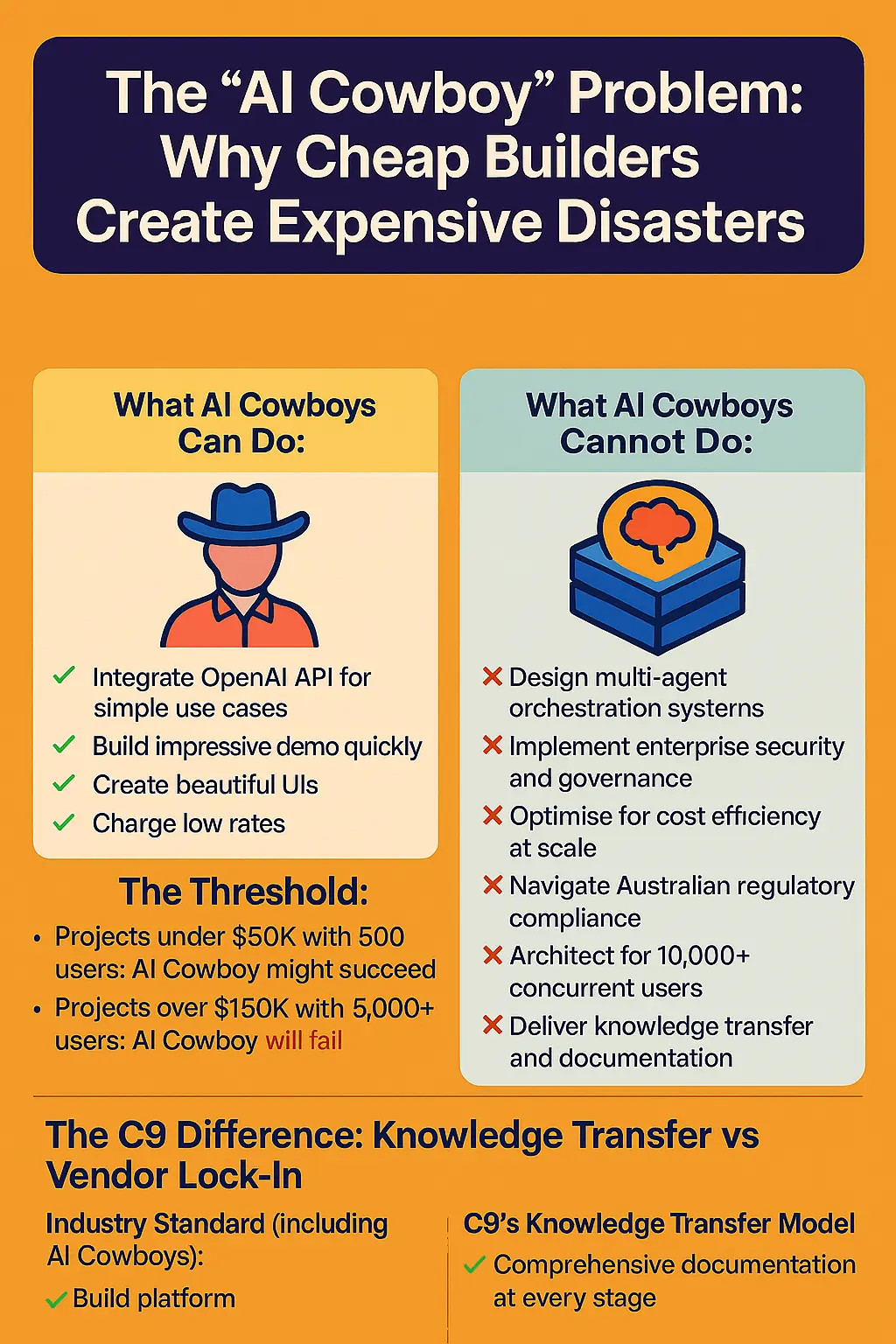
AI Cowboys operate in the "demo-friendly" zone but lack capabilities for production systems:
What AI Cowboys Can Do:
- ✅ Integrate OpenAI API for simple use cases.
- ✅ Build impressive demos quickly.
- ✅ Create beautiful UIs.
- ✅ Charge low rates.
What AI Cowboys Cannot Do:
- ❌ Design multi-agent orchestration systems.
- ❌ Implement enterprise security and governance.
- ❌ Optimise for cost efficiency at scale.
- ❌ Navigate Australian regulatory compliance.
- ❌ Architect for 10,000+ concurrent users.
- ❌ Provide knowledge transfer and documentation.
- ❌ Deliver support and maintenance expertise.
The Threshold:
- Projects under $50K with 500 users: AI Cowboy might succeed.
- Projects over $150K with 5,000+ users: AI Cowboy will fail.
The C9 Difference: Knowledge Transfer vs Vendor Lock-In
Industry Standard (Including AI Cowboys):
- Build platform.
- Minimal documentation.
- Dependency on original developers.
- Ongoing revenue from forced maintenance contracts.
C9's Knowledge Transfer Model:
- Comprehensive documentation at every stage.
- Architecture decision records explaining "why".
- Code walkthroughs and training sessions.
- Detailed runbooks for deployment and troubleshooting.
- Your team empowered to maintain and extend platform.
Why This Matters:
Australian Example: Two companies built similar AI platforms:
Company A (Traditional Agency):
- Paid $320K for development.
- Ongoing maintenance: $18K/month (only original agency could support).
- Year 1 total cost: $320K + $216K = $536K.
- Year 2: Another $216K (total: $752K).
- Vendor lock-in: Cannot switch providers.
Company B (C9 with Knowledge Transfer):
- Paid $380K for development (includes comprehensive knowledge transfer).
- Ongoing maintenance: $6K/month (internal team + occasional C9 support).
- Year 1 total cost: $380K + $72K = $452K.
- Year 2: Another $72K (total: $524K).
- Freedom: Can choose to maintain internally, use C9, or switch providers.
18-Month Savings: $228K + strategic flexibility.
Your Grey Area Risk Assessment
Ask potential development partners these questions:
Architecture & Planning:
- "Will you conduct formal Discovery before development?"
- "Can you show us architecture diagrams from previous AI projects?"
- "How do you handle async processing for AI workloads?"
Security & Compliance:
- "How do you implement audit logging for AI decisions?"
- "What's your secrets management approach?"
- "Can you document your security testing methodology?"
Scalability:
- "What load testing do you perform before launch?"
- "How does your architecture scale from 100 to 10,000 users?"
- "Can you show database indexing strategies from previous projects?"
Knowledge Transfer:
- "What documentation will we receive?"
- "Will our team receive training on the platform?"
- "How many of your developers will work on our project?" (Single developer = red flag)
If answers are vague or dismissive, you're talking to an AI Cowboy.
C9's Approach to AI-Native Product Development Services
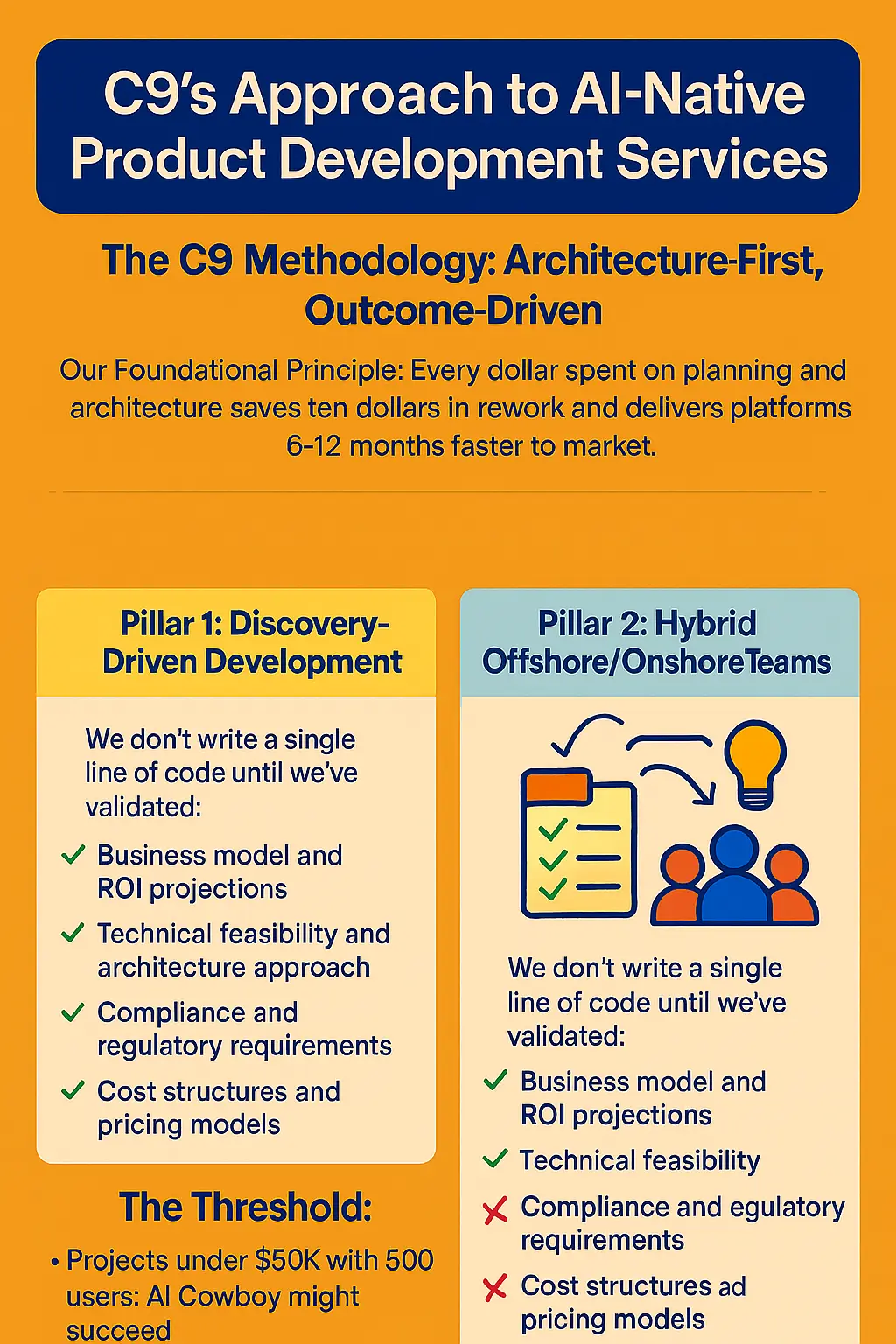
Now that we've established the pain points, agitations, and pitfalls, let's examine how C9 delivers AI-native SaaS platforms that scale, comply, and succeed.
The C9 Methodology: Architecture-First, Outcome-Driven
Our Foundational Principle: Every dollar spent on planning and architecture saves ten dollars in rework and delivers platforms 6-12 months faster to market.
The Three Pillars of C9's AI-Native Development:
Pillar 1: Discovery-Driven Development
We don't write a single line of code until we've validated:
- Business model and ROI projections.
- Technical feasibility and architecture approach.
- Compliance and regulatory requirements.
- Cost structures and pricing models.
What Discovery Delivers:
- Validated Requirements: 200+ user stories, prioritised by business value.
- Architecture Blueprint: Detailed technical specification with infrastructure sizing.
- Cost Model: Accurate pricing (±10% variance, not ±200% "ballpark").
- Timeline: Week-by-week delivery schedule with milestone checkpoints.
- Risk Assessment: Identified challenges with mitigation strategies.
Investment: $28K-$45K depending on complexity.
Duration: 2-4 weeks.
ROI: Prevents $200K-$800K in rework and 6-18 month delays.
Pillar 2: Hybrid Offshore/Onshore Teams
The Australian Development Dilemma:
Local-Only Teams:
- ✅ Australian timezone.
- ✅ Cultural alignment.
- ✅ Face-to-face communication.
- ❌ Extremely expensive ($150-$220/hour).
- ❌ Limited specialist availability.
- ❌ Projects cost 2-3× offshore equivalents.
Offshore-Only Teams:
- ✅ Cost-effective ($30-$65/hour).
- ✅ Large talent pool.
- ✅ 24/7 development potential.
- ❌ Timezone challenges.
- ❌ Communication gaps.
- ❌ Quality inconsistency.
C9's Hybrid Model (Best of Both):
Onshore Team (Australia-Based)
- Project Lead: Strategic oversight, client communication.
- Solutions Architect: Technical decisions, architecture governance.
- QA Lead: Compliance validation, Australian regulatory expertise.
Offshore Team (Directly Hired C9 Talent)
- Senior Developers: Core platform development.
- AI/ML Specialists: Model integration, prompt engineering.
- DevOps Engineers: Infrastructure, deployment automation.
- QA Engineers: Automated testing, security validation.
How It Works:
- Onshore team handles strategy, architecture, client communication (Australian business hours).
Pillar 3: Knowledge Transfer and Support
As detailed earlier, our approach ensures you own the platform— not locked in.
Why Discovery Calls Are Non-Negotiable (Not a Waste of Time)
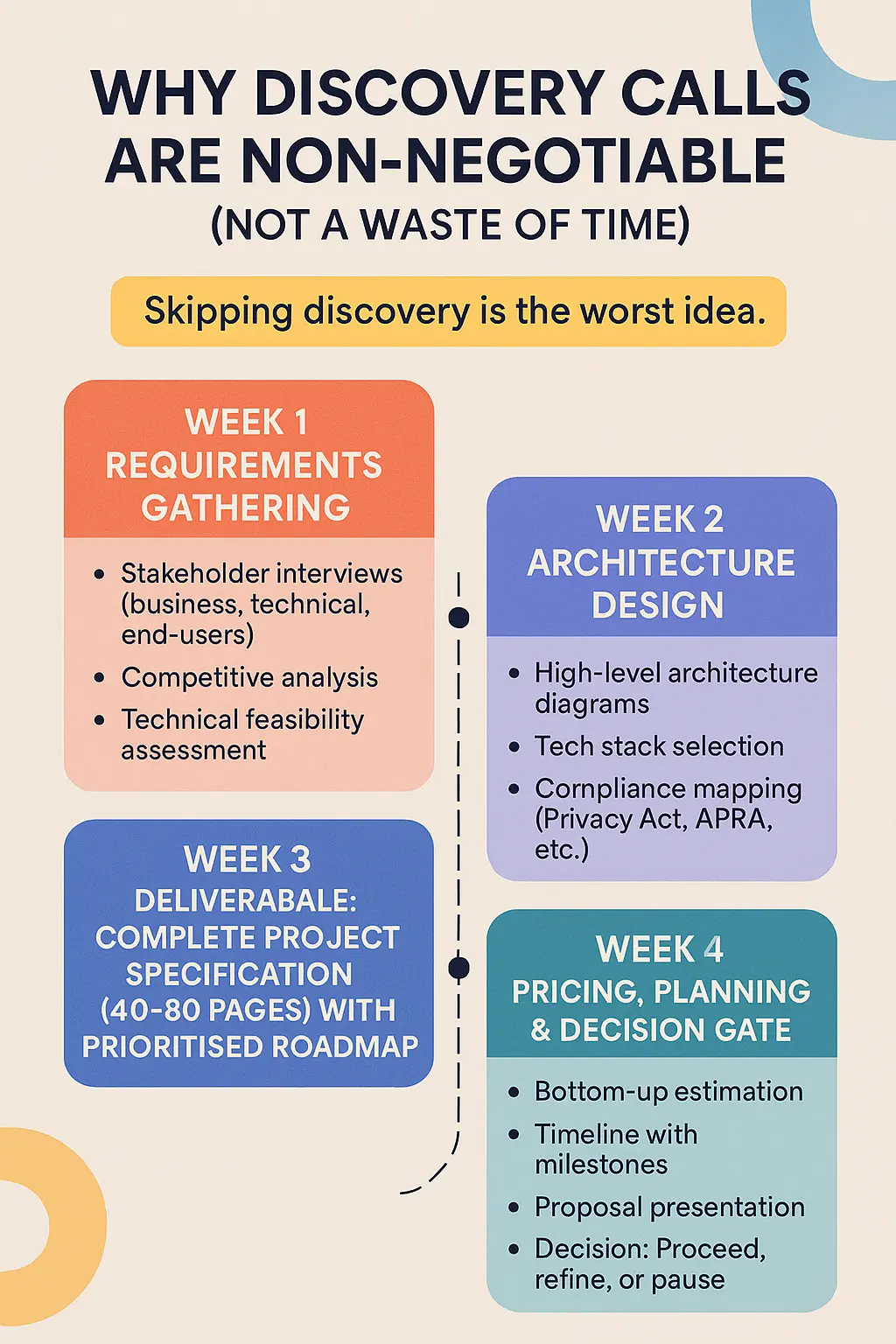
Skipping Discovery is the worst idea.
The Math:
Discovery Investment: $28K-$45K, 2-4 weeks.
Skipping Discovery Costs:
- Architectural rework: $120K-$380K average.
- Timeline delays: 6-18 months.
- Failed features: $80K-$240K wasted development.
- Opportunity cost: Immeasurable (competitors win while you rebuild).
ROI Range: Every $1 spent on Discovery saves $8-$15 in downstream costs.
Non-Financial Benefits:
- Aligned stakeholder expectations.
- Confidence in delivery timeline.
- Clear success criteria.
- Risk mitigation strategies.
- Defensible budget requests to board/investors.
Week-by-Week Discovery Roadmap
Week 1: Requirements Gathering
- Stakeholder interviews (business, technical, end-users).
- Competitive analysis.
- Technical feasibility assessment.
Week 2: Architecture Design
- High-level architecture diagrams.
- Tech stack selection.
- Compliance mapping (Privacy Act, APRA, etc.).
Week 3: Deliverable: Complete project specification (40-80 pages) with prioritised roadmap.
Week 4: Pricing, Planning & Decision Gate
- Bottom-up estimation.
- Timeline with milestones.
- Proposal presentation.
- Decision: Proceed, refine, or pause.
C9's Competitive Advantages: What Separates Us from Hundreds of Developers
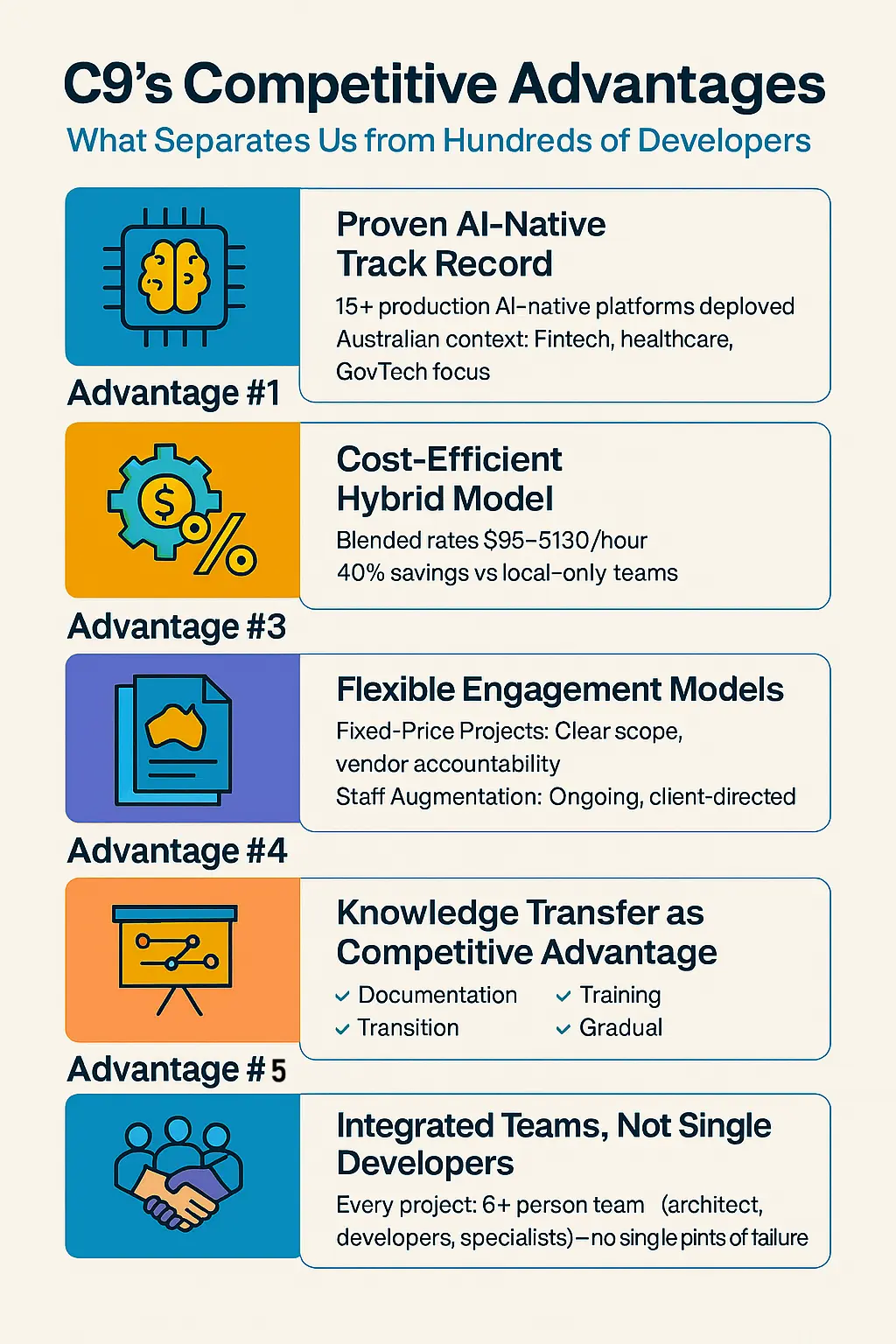
Advantage #1: Proven AI-Native Track Record
- 15+ production AI-native platforms deployed.
- Australian context: Fintech, healthcare, GovTech focus.
Advantage #2: Cost-Efficient Hybrid Model
- Blended rates $95-$130/hour.
- 40% savings vs local-only teams.
Advantage #3: Flexible Engagement Models
- Fixed-Price Projects: Clear scope, vendor accountability.
- Staff Augmentation: Ongoing, client-directed.
Advantage #4: Australian Regulatory Expertise
- Privacy Act 1988 for AI systems.
- APRA CPS 234 for financial services.
- My Health Records Act for health tech.
Real Impact: Melbourne FinTech chose C9 over cheaper international agency for APRA compliance. Saved $315K in remediation.
Advantage #5: Knowledge Transfer as Competitive Advantage
Components:
- Documentation: Architecture decisions, code guides.
- Training: Walkthroughs, pair programming.
- Transition: Gradual handoff.
Client Quote: "C9's knowledge transfer was so thorough we could maintain independently. But we keep them for strategic value."
Advantage #6: Integrated Teams, Not Single Developers
Every project: 6+ person team (architect, developers, specialists)—no single points of failure.
Advantage #7: Multi-Resource Discounts & Long-Term Partnerships
- 3+ resources: 10% discount.
- 12-month contracts: 8% discount.
Example: 3-person team, 12-month: $383,760 (18% savings).
Direct Comparison:
| Factor |
Typical Agency |
AI Cowboys |
International Firm |
C9 |
| AI Production Experience |
Demo-only |
None |
Limited Australian context |
15+ production platforms |
| Cost Structure |
$180+/hour |
$50-80/hour |
$120-160/hour |
$95-130/hour (hybrid) |
| Australian Compliance |
Basic |
None |
Minimal |
Deep expertise |
| Knowledge Transfer |
Minimal |
None |
IP protection focused |
Comprehensive, mandatory |
| Team Size |
1-2 developers |
Solo freelancer |
Large but offshore |
Integrated 6+ person teams |
| Risk |
Medium-High |
Very High |
Medium |
Low (proven methodology) |
The C9 Value Proposition: Premium quality at mid-market pricing through hybrid efficiency, with Australian expertise and genuine knowledge transfer.
Staff Augmentation: Flexible Teams for AI-Native SaaS Development
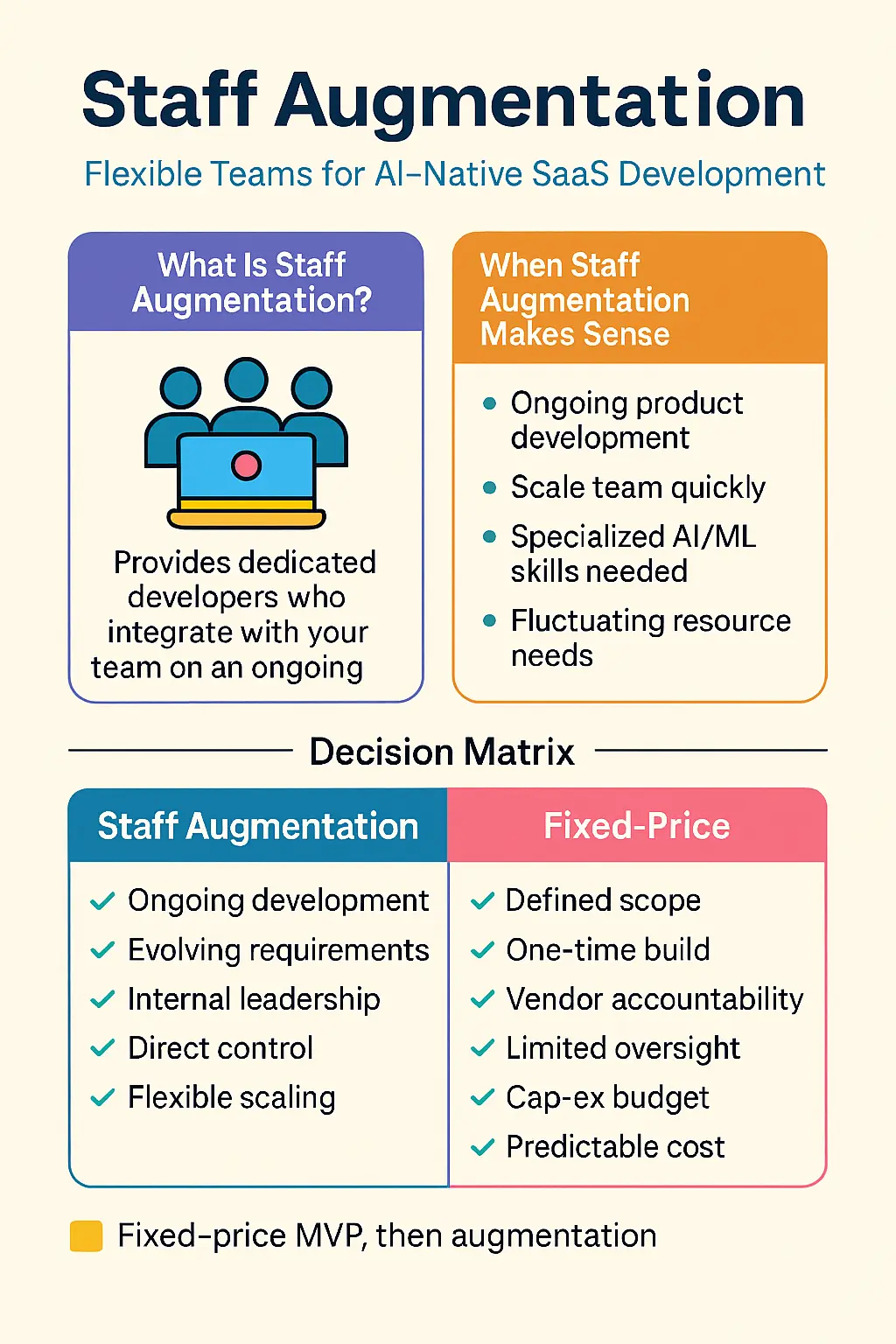
What Is Staff Augmentation?
C9 provides dedicated developers who integrate with your team on an ongoing basis.
When Staff Augmentation Makes Sense:
- Ongoing product development (not one-off projects).
- Need to scale team quickly without hiring overhead.
- Specialised AI/ML skills not available locally.
- Fluctuating resource needs (scale up/down with demand).
- Want to maintain control over day-to-day priorities.
C9's Staff Augmentation Options
- Single Resource: $12,000/month (Senior Developer or AI Specialist).
- Small Team (2-3 resources): $24,000-$35,000/month.
- Full Pod (5+ resources): $65,000+/month.
Contract Flexibility: 3-6 month minimum, then monthly.
Why Minimum Commitment:
- Month 1: 30-40% productivity (onboarding).
- Month 2: 70-80%.
- Month 3+: 100%+.
Flexibility for Changes:
- Pivot scopes without penalty (2-week transition).
- Scale up/down with notice.
Staff Augmentation vs Fixed-Price Projects: Decision Matrix
Choose Staff Augmentation When:
- ☑ Ongoing development (12+ months).
- ☑ Evolving requirements.
- ☑ Internal leadership.
- ☑ Direct control.
- ☑ Flexible scaling.
- ☑ Monthly op-ex.
Choose Fixed-Price When:
- ☑ Defined scope.
- ☑ One-time build.
- ☑ Vendor accountability.
- ☑ Limited oversight.
- ☑ Cap-ex budget.
- ☑ Predictable cost.
Hybrid common: Fixed-price MVP, then augmentation.
Understanding Indicative vs Discovery-Based Pricing
As detailed in Agitate section, indicative pricing leads to failure. C9 uses Discovery for accurate quotes.
Implementation Roadmap: From Discovery to Production
- Discovery (2-4 weeks): Validate, plan, price.
- MVP Development (8-12 weeks): Core AI features.
- Scale Phase (6-8 weeks): Optimise for load.
- Enterprise Ready (4-6 weeks): Compliance, governance.
- Launch & Iterate: Ongoing augmentation.
Conclusion: The 2026 Imperative
By end of 2026, the market will bifurcate: companies with production-ready AI-native platforms will dominate their verticals, while those still experimenting with bolt-on AI features will struggle for funding and market share. The time for exploration ended in 2025—2026 is about execution, and that requires experienced partners who understand both the technical architecture and Australian regulatory landscape.
Don't let "AI Cowboys" turn your platform into an expensive experiment. Invest in rigour, architecture, and knowledge transfer for scalable success.
Ready to build your AI-native SaaS platform the right way? Schedule a free 30-minute Discovery consultation with C9 today. Visit https://www.c9.com.au/About/Contact . Mention this blog for a complimentary architecture review ($5K value).
What questions do you have about AI-native development? Leave a comment below—we respond to all.