Mobile shopping is booming in Australia, and nowhere is this more evident than in Melbourne. Melbourne retailers and service providers are racing to improve mobile user experience (UX) as more customers browse and buy on smartphones. But many local businesses feel the pain of slow, clunky mobile sites or the high cost of developing native apps. As a result, a new solution is catching on: Progressive Web Apps (PWAs).
What's the buzz about PWAs? These web-based apps deliver an app-like experience right in the mobile browser – fast, engaging, and reliable.
As a web application development agency in Melbourne, we've seen first-hand how PWAs are solving mobile UX pains for retailers. In this blog, we'll explore why Melbourne businesses are embracing PWAs, and how doing it the right way – with a proper discovery process – is key to success. Skipping steps like discovery calls or rushing quotes can lead to costly mistakes. We'll break down how a discovery call works, why it's essential (not a time-waster!), and how it ties into accurate project pricing and early ROI. If you're a Melbourne business owner or executive looking to boost mobile sales and avoid project pitfalls, read on.
Poor Mobile UX Is Hurting Retailers
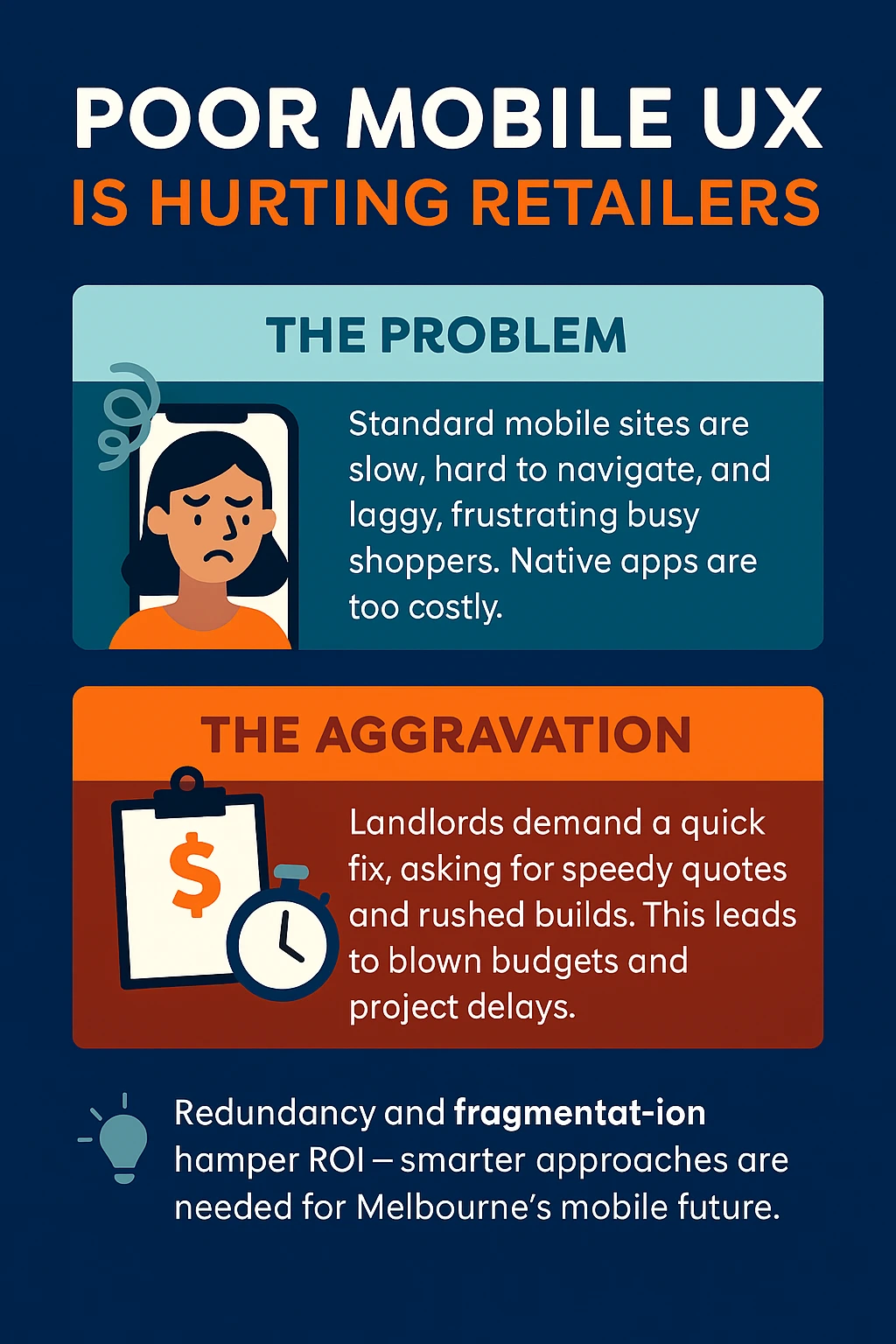
Imagine a customer trying to buy from your online store during their tram ride home. Your standard mobile site loads slowly, the layout is hard to navigate, and each tap seems to lag. Frustrated, the customer gives up and goes to a competitor or forgets about the purchase. This scenario is all too common – and it's a pain point for many Melbourne retailers.
Mobile users today expect fast, seamless experiences. If your website isn't up to scratch, you're likely losing sales and damaging your brand reputation. Native mobile apps could be a solution for better UX, but they're expensive to develop and maintain, and customers don't always bother to download an app for a one-time purchase. The result? Business owners feel stuck: they know their mobile UX is a problem, but traditional solutions seem out of reach or too slow to implement.
To compound the issue, some businesses try to fix this by rushing into development. They might ask for a quick quote on a new app or instruct a developer to "just build a mobile solution fast." Unfortunately, skipping careful planning and jumping straight into coding often leads to expensive rework, missed requirements, and disappointing results. The pain of poor mobile UX is now aggravated by a blown budget or a delayed project – exactly what no retailer can afford in today's competitive market.
Missed Opportunities and the Cost of Rushing In
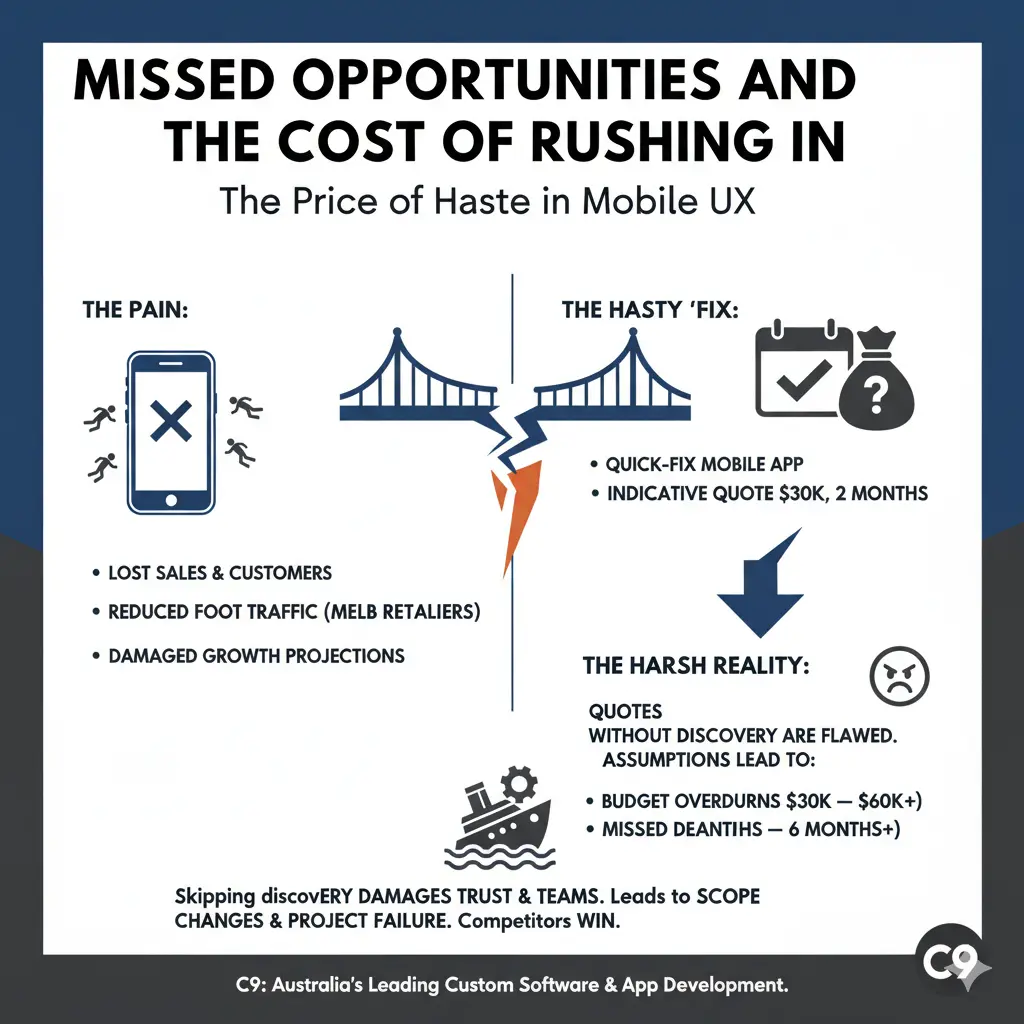
Let's agitate this pain a bit more to see its full impact. When your mobile experience causes visitors to bounce, you're not just losing one sale – you could be missing out on a long-term customer relationship. Studies show that users are far less likely to return after a bad experience. For Melbourne retailers, this means lost revenue, lower foot traffic (as online experiences often drive in-store visits), and a hit to your growth projections.
Now think about the consequences of reacting hastily to this pain. Say you, as a business owner, decide to commission a quick-fix mobile app without proper planning. You might approach a development firm and demand an "indicative quote" right away – basically asking, "How much to build this app? I need a number now." To appease you, some firms will throw a number together based on minimal information. Perhaps they estimate "around $30,000 and two months" to build the app. That quote might make you feel better initially – it sounds like the pain will be resolved soon.
But here's the harsh truth: indicative quotes given without discovery are often not worth the paper they're written on. Why? Because they're built on assumptions and incomplete details. In our experience at C9, Australia's leading custom software and app development company, we've seen projects where an un-researched $30,000 quote balloons into a $60,000 expense. Or a "two-month" build stretches into six months of frustration. The initial quick quote, meant to soothe your worries, actually sets you up for bigger headaches: budget overruns, missed launch dates, and features that don't truly solve the customer's problem.
Skipping a proper discovery not only risks your money and time – it can damage trust within your team as well. Stakeholders begin to doubt the project vision when things go off track. Departments blame each other for missing details. What started as a well-intentioned rush to fix the mobile UX pain can spiral into a nightmare of scope changes and finger-pointing. And all the while, customers are still clicking away to competitors with smoother mobile sites or apps.
Ignoring the root problem (poor UX) or trying to band-aid it with rash decisions leads to missed opportunities and potential project failure. The question then becomes, how do you effectively solve the mobile UX pain without falling into these traps? The answer lies in both modern technology and disciplined planning.
Progressive Web Apps – A Game Changer for Mobile UX
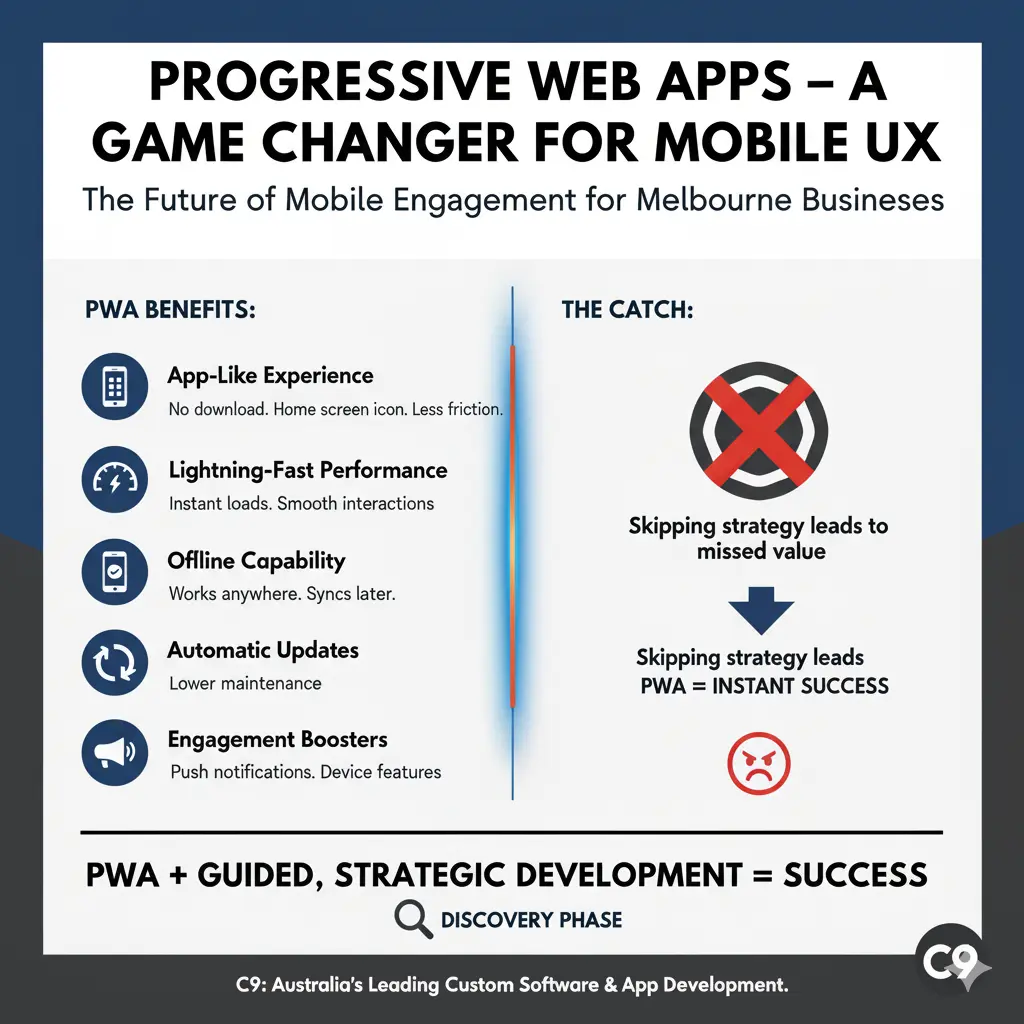
Thankfully, Melbourne retailers have a powerful solution available: Progressive Web Apps (PWAs). This technology is gaining popularity because it directly tackles the pain of subpar mobile UX without the heavy costs of native app development. Let's look at why PWAs are the solution so many businesses are turning to:
App-Like Experience, No Download Required: PWAs load in a mobile browser but look and feel like a native app. Users can even add them to their home screen without an app store. This means less friction – customers get a fast, immersive experience without the barrier of installing an app. For busy shoppers, that convenience can make the difference between completing a purchase or abandoning the cart.
Lightning-Fast Performance: One hallmark of a well-built PWA is that it's optimised for speed. Techniques like advanced caching and selective data loading enable near-instant page loads and smooth interactions, even on modest devices. For Melbourne service providers (think restaurants, salons, gyms), a PWA that quickly shows schedules or menus can massively improve customer engagement.
Offline Capability: Ever tried to use a shopping app in a subway or an elevator in the CBD and it just wouldn't load? PWAs have offline functionality. They can work even with shaky or no internet connection, allowing users to browse content and save data that will sync later. Retailers with underground stores or customers on the move love this – it keeps customers engaged regardless of connectivity.
Automatic Updates & Lower Maintenance: Unlike native apps, which force users to download updates, PWAs refresh themselves in the background. Your customers always get the latest version without any effort on their part. Plus, you maintain one web application that works everywhere, instead of juggling separate codebases for iOS, Android, and your website. Lower maintenance costs and easier updates are the result, which is a big win for many businesses watching their bottom line.
Engagement Boosters: PWAs offer features that boost engagement, like push notifications for sales or new content, and access to device features (camera, GPS, etc.) when needed. These were once the exclusive domain of native apps. Now, your boutique shop in Melbourne can send a push notification about a weekend sale directly through the PWA – reaching customers who opted in with a single tap.
It's no wonder that from local boutiques on Chapel Street to larger retail chains in Melbourne's shopping centres, many are embracing PWAs as the future of mobile engagement. The playing field is being levelled – you don't need the budget of a tech giant to deliver a world-class mobile experience anymore.
However, here's an important insight: Implementing a PWA successfully isn't just about choosing the right technology; it's about executing the project correctly. This is where process becomes as critical as the tech itself. We've seen businesses jump into developing a PWA (excited by the benefits above) but without proper planning or strategy. The result? They fail to capture the full value of the PWA, or the project stalls because of unexpected complexities.
So what ensures that your PWA project will actually solve the mobile UX pain and deliver those great benefits? The solution isn't just "PWA" as a product – it's PWA + a guided, strategic development approach. And that approach starts with something too many skip: the discovery call and discovery phase.
The Power of Discovery Calls (Why Skipping Them Is a Bad Idea)
Picture this: you wouldn't build a new store without planning the layout, understanding your customers' flow, and ensuring you have all the materials on hand. Similarly, you shouldn't dive into building a progressive web app (or any software) without a discovery process. A discovery call is usually the first step in that process – an initial conversation between you (the business owner/executive) and the development experts (like our team at C9).
Why is this call so important, and what happens during it?
A discovery call is far from a wasted hour; it's the foundation of a successful project. In this call (or series of calls and workshops for larger projects), we:
Listen to Your Pain Points and Goals: You get to explain the issues you're facing – e.g., "Our mobile conversion rate is low," or "Customers complain our site is slow". We also ask about your business goals, like "We want to increase mobile sales by 20% in the next year," or "We need an online booking system for our services." This ensures we understand what success looks like for you.
Ask Probing Questions: As a seasoned Web Application Development Agency in Melbourne, we've solved similar problems before. We'll ask questions you might not have thought of: "What kind of phones do your customers use most?" "Do you have in-house tech staff to maintain the app post-launch?" "Are there specific integrations needed (like your inventory or point-of-sale system)?" These questions start uncovering the full scope of what a PWA implementation would involve.
Brainstorm Solutions (High-Level): We'll discuss possible approaches. Maybe a PWA is indeed ideal, or perhaps a responsive website upgrade could suffice as a quick win. We explore scenarios: "What if the PWA could let users browse your catalog offline?" or "We could integrate a loyalty program into the app." This is the exciting part where your vision starts to take shape with our technical input.
Outline the Roadmap & Next Steps: By the end of a good discovery call, both you and we have a clearer picture of the project's direction. We'll typically outline the next steps – often a more in-depth discovery workshop or a proposal to do a Discovery Phase. The discovery phase might include detailed requirements gathering, user research, technical prototyping, and defining the project scope in writing.
Skipping this discovery call (and phase) is one of the worst mistakes you can make. Why? Because without discovery, you're essentially gambling on the project. It's like trying to build a house without blueprints – you might end up with something, but will it be what you needed or wanted? Probably not. Here are the key reasons a discovery call is not a waste of time:
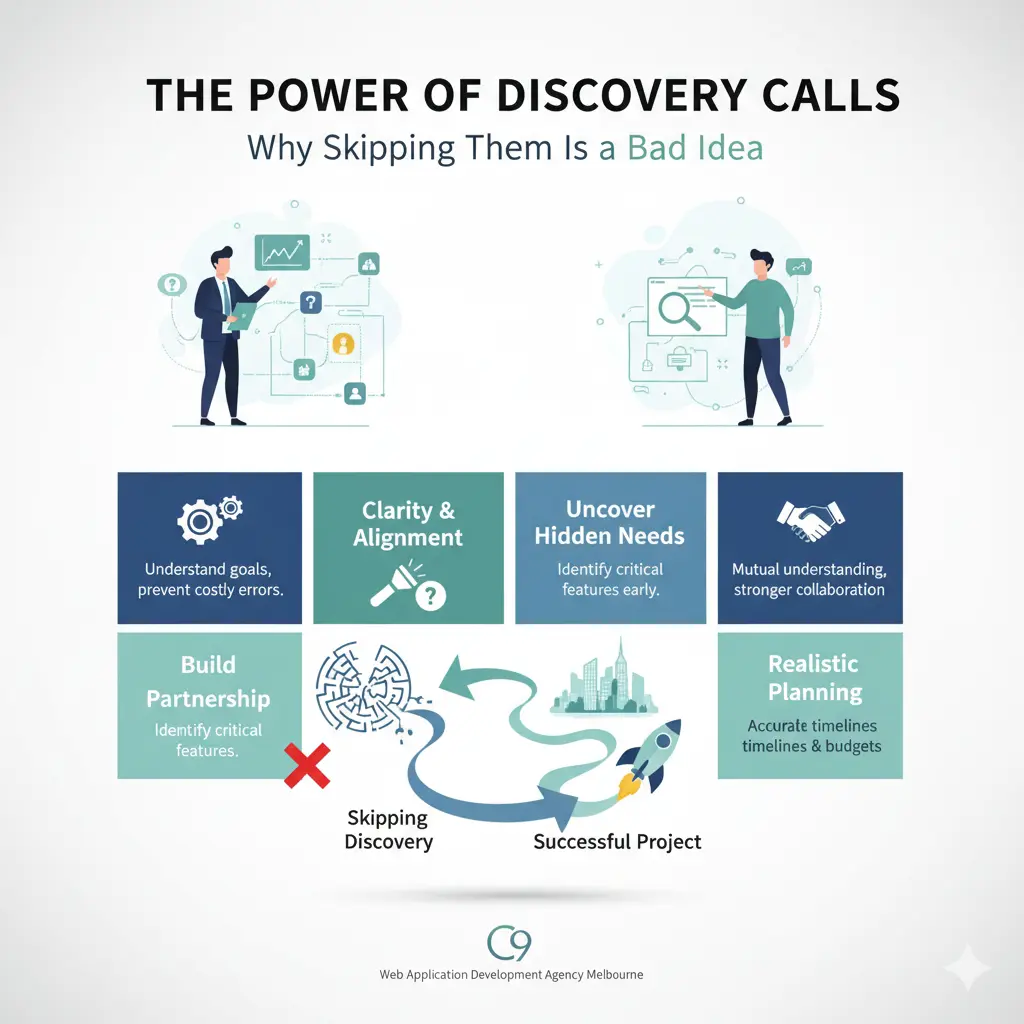
Clarity and Alignment: It ensures that you and the development team are on the same page. Misunderstandings at the start can lead to costly changes later. Five minutes clarifying a goal in discovery can save five days of redevelopment down the track.
Uncovering Hidden Requirements: Often, critical features or constraints only surface during discovery. Maybe your retail PWA needs to work with a legacy inventory database – if that's not discussed early, it could throw a huge wrench mid-project. Discovery is the time to surface these needs. Skipping it means important details get overlooked until they explode as problems later.
Building Trust and Partnership: A discovery call lets you gauge if the agency truly understands your business. You're not just buying code; you're investing in a partnership. If an agency isn't interested in doing discovery, that's a red flag – it might mean they'll treat your project as a cookie-cutter job, which is risky. Conversely, going through discovery with an agency builds mutual trust. You see their expertise and communication style, they learn about your domain – it sets the stage for smoother collaboration.
Realistic Planning and Budgeting: Perhaps most importantly for you as an executive, discovery leads to a realistic plan and budget. Without it, any delivery timelines or costs are shots in the dark. A discovery phase produces tangible outputs – e.g., a requirements document, user flow diagrams, or wireframes – that make the true size of the project clear. With that, you get a project plan you can actually count on.
In short, skipping discovery is a false economy. You might think you're saving time or money by jumping straight in, but you will almost certainly pay for it later – through scope creep, missed objectives, or even project failure. The pain of a failed project or a delayed launch far outweighs the perceived inconvenience of a discovery call.
Now, having stressed the critical nature of discovery, let's talk about one area deeply connected to it: pricing. Many businesses are anxious to get a quote as early as possible – which is understandable, you need to plan budgets. But without discovery, pricing is another potential pitfall. Let's see why that is and how we handle it.
The Pitfalls of Indicative Pricing (or, Why Quick Quotes Lie)
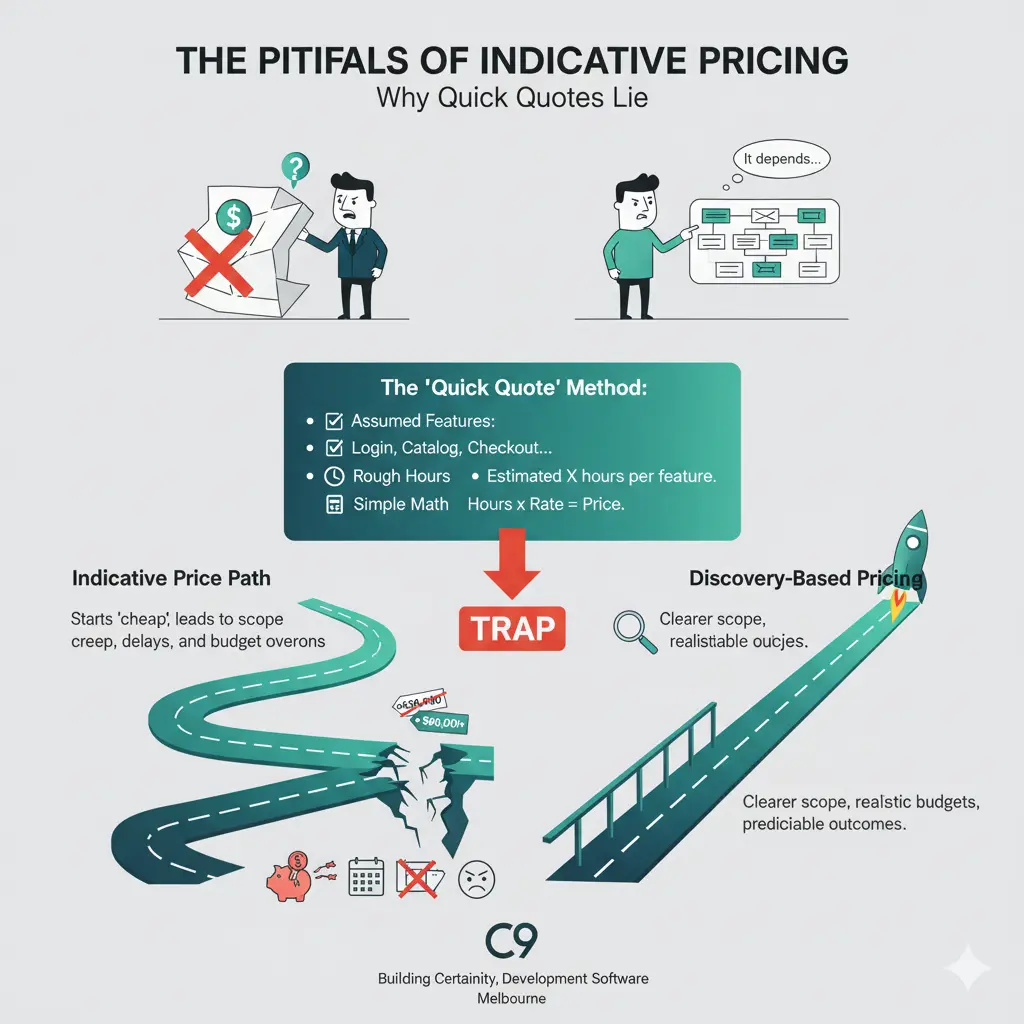
We touched on this earlier: asking for an "indicative price" before doing the homework (discovery) is risky. Let's dive deeper into why quick quotes can be so misleading.
When you, as a business owner, ask a software agency, "How much will a PWA cost me?" the honest answer is "It depends – let's discuss it further." If someone instantly replies, "It'll be $50,000" after a 30-minute chat, that number is almost certainly a guess. It might be an educated guess based on past projects, but without understanding your unique requirements, it's not reliable.
Here's how indicative pricing is often done by agencies pressed to give a number: They'll list out a few assumed features (perhaps login, product catalog, checkout for a retail PWA) and then assign a number of hours to each based on superficial knowledge. It might look something like:
- User login & profile – estimated 40 hours
- Product catalog browsing – estimated 80 hours
- Shopping cart & checkout – estimated 60 hours
- Push notification setup – estimated 20 hours
- Total = 200 hours. If their rate is $120/hour, they'll say, "We estimate about $24,000."
On paper (or in an email), that breakdown looks reasonable. But notice all the assumptions: Are we talking 100 products or 10,000? Is the checkout integrating with a complex third-party payment and inventory system? What about design, user testing, revisions, deployment, etc.? An indicative quote often leaves these critical details out, or vastly underestimates them, because they haven't been discovered yet!
Let's illustrate with a made-up real-world example to show how misleading this can be:
Quick Quote Example: A Melbourne fashion retailer asks for a quote on a PWA for their online store. Without deep discussion, an agency might calculate: "We think it's around 300 hours of work." At $120/hour, that's $36,000. The retailer, excited by this affordable number, signs the contract. But as development kicks off, new facts come up – they need integration with their point-of-sale system, a custom product filter for styles and sizes, and offline support for browsing the catalog. The project swells to 500 hours. The actual cost now becomes $60,000 (or the scope gets cut severely to stay on budget, resulting in a poor solution). The quick quote, in hindsight, was not worth the paper it was written on.
Relying on an indicative price can double your budget unexpectedly or force you into a corner of cutting features, which undercuts the whole point of the project (solving your original pain!). It's stressful for you and the development team alike.
Now, to be fair, indicative quotes aren't given with bad intent; agencies want to help prospective clients get a feel for costs. The problem is the false sense of security or expectation they create. Software development isn't buying a product off a shelf – it's more like designing a custom building. You wouldn't expect an architect to quote a building to the nearest dollar after one short meeting. You'd expect a range and a lot of questions first, right? Yet, in software, people often expect instant, precise quotes.
So how do we avoid this trap? This is where discovery-based pricing comes into play, which we'll explain next.
Discovery-Based Pricing – Accuracy, Transparency, and Value
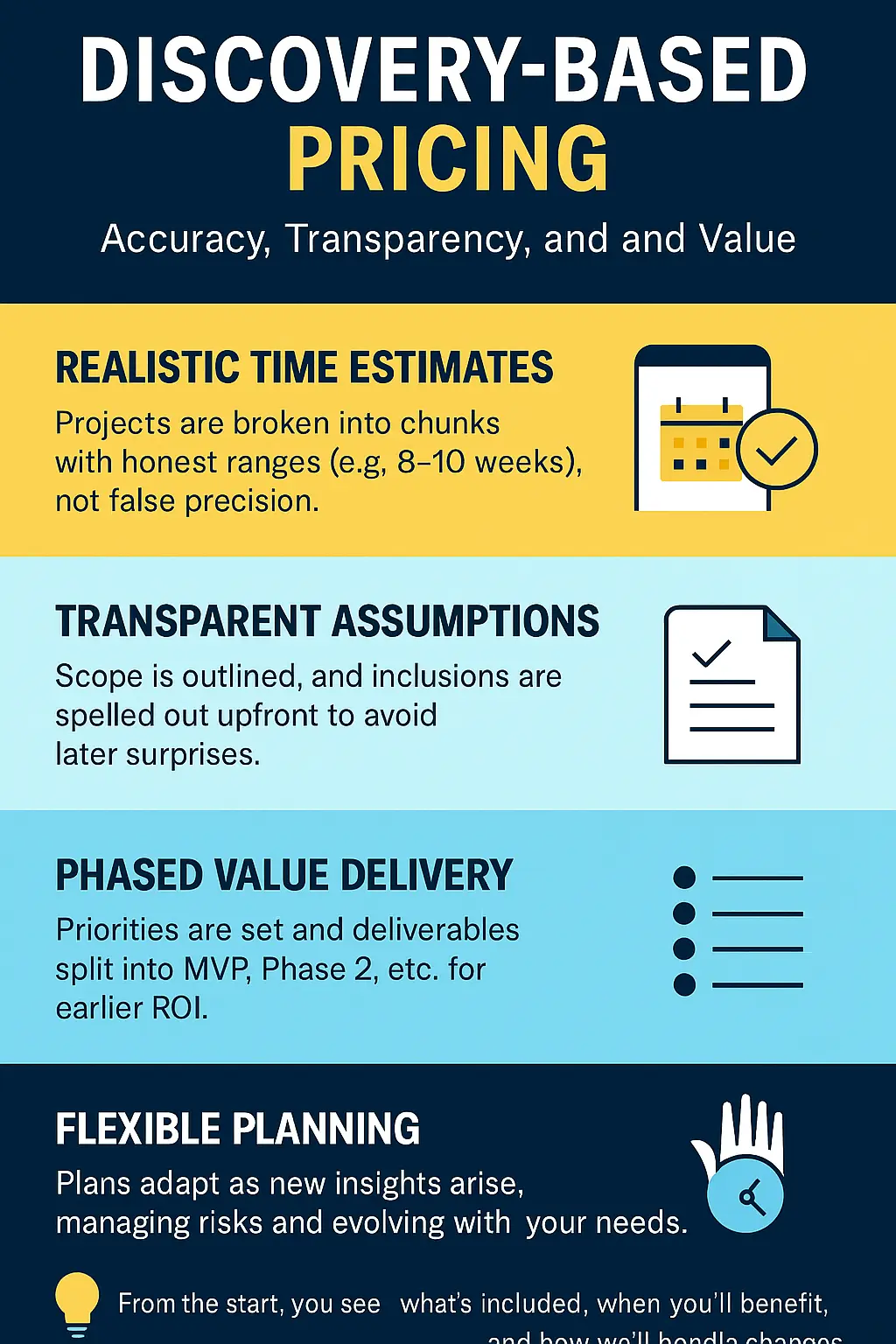
Unlike a blind quick quote, discovery-based pricing means we derive cost estimates from real understanding. It's a practice we follow at C9, and it's built on the foundation laid during the discovery process. Here's how it works and why it's better:
Estimates to the Nearest Day/Week, Not Hour: During discovery, we gather enough detail to break the project into chunks (often called user stories or features). Instead of saying "Feature X = 37.5 hours" which implies a false precision, we might say "Feature X will take about 1 week to design and build." By estimating in larger blocks (days or weeks), we acknowledge there are uncertainties but also give a realistic timeframe. This might look like: "Phase 1 of the PWA will take roughly 8-10 weeks with 2 developers." That's a far more useful picture for everyone than "300 hours", because it factors in testing, meetings, and buffers for the unexpected.
Transparent Assumptions: We spell out what we're including in those estimates. For example, "Our estimate assumes up to 500 products in the catalog and integration with one payment gateway (e.g., Stripe). If your needs exceed these, we'll adjust accordingly." This way, you know exactly what the estimate covers (and what it doesn't). There are far fewer nasty surprises later because the groundwork has been laid openly.
Phased Approach with Priorities: Discovery-based planning often reveals a logical way to break the project into stages for early ROI. Instead of delivering one big product after many months, we identify a Phase 1 (or MVP – Minimum Viable Product) that delivers the core value sooner. For a retailer's PWA, Phase 1 might be "online catalog + shopping cart + basic checkout" which addresses the immediate pain (customers can easily buy on mobile). Nice-to-have features (like advanced search filters, customer reviews, or a wish list) might be slated for Phase 2. By doing this:
- You start earning ROI sooner: Phase 1 goes live in, say, 2-3 months. Customers start using it, sales come in, and you're already better off than before.
- Feedback guides Phase 2: You'll learn from real users what features to refine or add next, making Phase 2 (and 3, etc.) even more effective.
- Budget can be managed incrementally: Perhaps you budgeted $50k for Phase 1. Once it starts bringing in revenue, that money can help fuel the next phase. You're not shelling out one massive amount without seeing any return for a long time.
Example – Phased Pricing: Let's revisit our fashion retailer example, but this time with discovery-based (phased) pricing:
After a discovery workshop, we identify the project will roughly require 500 hours (as we found out before). Instead of quoting "500 hours = $60,000" upfront, we plan it like this:
- Phase 1 (Core PWA): 300 hours = ~$36,000. Deliverables: PWA with product listing, product details, cart, and online checkout – all the basics to start selling. Timeframe: ~10 weeks.
- Phase 2 (Enhancements): 200 hours = ~$24,000. Deliverables: Add user login for order tracking, push notification system for promos, product search filters, etc. Timeframe: ~6-7 weeks (after evaluating Phase 1 impact).
- Total Planned Investment: ~$60,000, same as the "quick quote" scenario, but now it's split into manageable stages with clear outcomes.
In this approach, after spending the $36k on Phase 1, the retailer has a functioning app that's bringing in customers and revenue. Maybe that boosts sales by 15% in the first few months – real money that helps justify and fund the Phase 2 investment. Moreover, if priorities change or some features prove unnecessary, the business can pivot in Phase 2 rather than having locked everything in from the start with a big fixed quote.
Flexibility and Risk Management: Discovery-based planning and pricing also acknowledge that businesses evolve. If half-way through Phase 1 we learn something new (say, customers heavily use an iPad app, so maybe a tablet optimisation jumps in priority), we can adapt the plan. Traditional indicative quotes and rigid plans don't allow this – they treat the project like a fixed recipe, and any change is a "change order" with extra cost. Our approach is more collaborative: since you're involved throughout and we priced with buffers and clarity, we can adjust within the project scope smartly. This reduces risk of project failure because we won't march blindly off a cliff if conditions change.
In summary, discovery-based pricing turns the unknown into the known. It produces estimates you can trust, phased deliverables that drive early value, and a transparent view of your investment. Yes, it takes a bit more time upfront (to do the discovery and planning), but the payoff is huge: you avoid the scenario of a doubled budget or a half-baked product. Instead, you get a well-thought-out plan for implementing your PWA – one that sets you up for success, technically and financially.
Breaking Projects into Stages for Early ROI
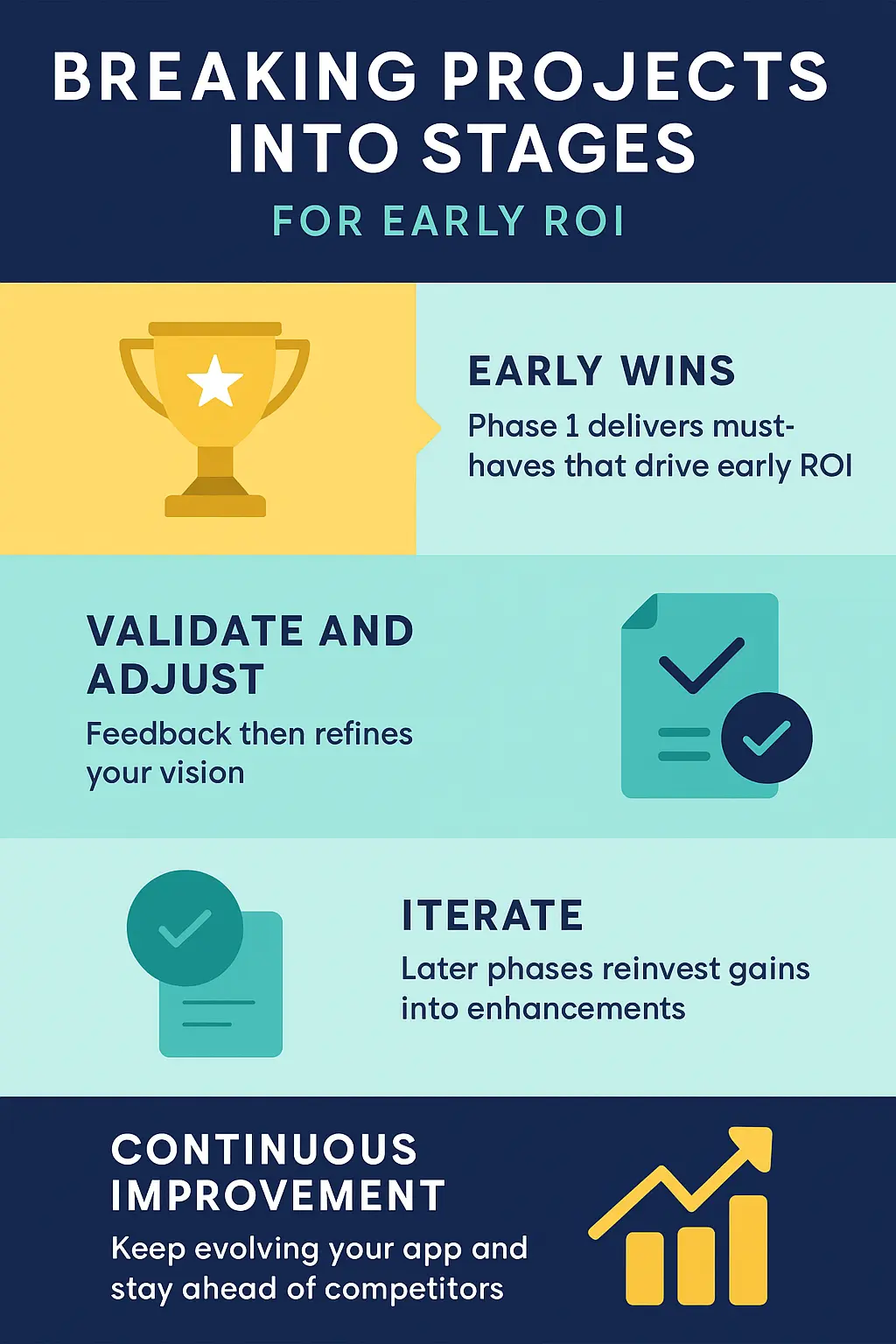
Let's highlight this concept of breaking into stages, because it's one of the best strategies for maximising returns and minimising pain in any software project:
1. Early Wins (Phase 1 – "Must Haves"): In the first stage, focus on the core features that directly address your biggest pain and have the highest impact on ROI. For Melbourne retailers, that might be ensuring customers can browse products easily, add to cart, and check out without friction on mobile. This alone can dramatically increase sales if previously customers were dropping off. By zeroing in on these must-haves, you're solving the primary problem quickly. Early wins boost team morale as well – your staff see the new app live and customers using it, which generates excitement and buy-in for the project.
2. Validate and Adjust: Once Phase 1 is live, take time to gather data and feedback. Are users engaging with the PWA as expected? Did mobile conversion jump 20%, or are there still bottlenecks? This real-world insight is invaluable. Maybe you discover that mobile users love the new PWA but are asking for a store locator feature. Great – that can be prioritised in the next phase. Conversely, perhaps a feature you thought was critical isn't being used – you might drop it from future plans, saving time and money. This validation step ensures you invest in the right things moving forward.
3. Iterate with Phase 2, 3, … ("Nice-to-Haves" and Enhancements): In subsequent stages, you add those nice-to-have features or new ideas that emerged. Because these phases come after seeing ROI, they often essentially pay for themselves. For example, Phase 1 of your PWA cost $36k but brought in $50k of new sales in the first quarter. Using part of that profit for Phase 2 is a no-brainer – you're reinvesting gains to get even more gains. It's a virtuous cycle. Additionally, by breaking things up, you reduce the upfront budget strain. Smaller chunks are easier to fund and approve than one massive project that demands a big leap of faith.
4. Continuous Improvement: Technology and customer expectations evolve, so think of your PWA (or any software) as an evolving asset. Breaking into stages means you've already structured your approach to accommodate improvement. You're not delivering and then neglecting the app; you're continuously fine-tuning it. Melbourne retailers who adopt this mindset stay ahead of the curve, using periodic enhancements as a way to outpace competitors. Early ROI from each stage feeds the next, creating a sustainable growth path.
This staged approach is essentially agile development aligned with business strategy: deliver value, get ROI, learn, improve, repeat. It turns software development from a scary all-or-nothing gamble into a controlled, feedback-driven investment. And it's only possible if you start with discovery and planning – otherwise, how would you know how to slice the project effectively?
Conclusion
In the fast-moving Melbourne retail scene, delivering a top-notch mobile user experience is no longer optional – it's mission-critical. Progressive Web Apps have emerged as the ideal solution to this challenge, offering consumers a slick, app-like journey without the usual hurdles. They load fast, work offline, engage users, and cost a fraction of building separate native apps. It's clear why retailers and service providers across Melbourne are excited about PWAs as the future of mobile commerce.
However, as we've explored, the technology alone isn't a magic wand. The success of a PWA project (or any custom software) hinges on the approach you take. Jumping in without a plan can turn your innovative idea into an expensive lesson. On the other hand, taking the time to do things right – starting with a discovery call, collaborating on a well-defined scope, insisting on discovery-based pricing, and phasing the project for quick wins – ensures that your investment truly pays off.
The pain of poor mobile UX, the agitation of rushing or skipping steps leading to bigger problems, and the solution of combining PWA technology with strategic planning. The takeaway is simple but powerful: Melbourne business owners can solve their mobile UX pains and boost their bottom line by embracing PWAs, but they must do so wisely. Wise means understanding your users, planning thoroughly, and partnering with the right experts.
If you're a Melbourne-based business owner or executive reading this, chances are you're looking to improve your digital customer experience. Don't let your competition siphon away mobile customers because of outdated technology or avoidable project mistakes. Take action on what you've learned:
Book a free discovery call with C9 – Australia's leading custom software, apps, integration & database developer. Let's discuss your goals, be it a PWA or any tailored software solution, and chart the smartest path forward. As a seasoned web application development agency in Melbourne, we're here to guide you from that first conversation all the way to a successful launch and beyond.
Ready to embrace the future of mobile UX and drive growth for your business? Contact C9 today to schedule your discovery session. Together, we'll turn your pain points into opportunities and craft a solution that delights your customers – and delivers you a measurable ROI. Don't skip the steps that matter; let's do it right, and let's do it now. Your customers are on mobile – it's time to meet them there with the experience they deserve.
Explore Related Insights on Mobile App Solutions.
From Idea to Launch: The Ultimate Guide to Custom App Development for Australian Executives
How Custom Mobile Apps Can Transform E-Commerce for Australian Retailers
Unlocking Melbourne's Mobile Edge: Mastering Cross-Platform App Development with Flutter and React Native
The Real Cost of Custom App Development in Sydney: A 2025 Price Breakdown
Why Flutter and React Native Are Dominating Cross-Platform App Development in 2026: A Guide for Australian Businesses
5G-Enabled Native Apps: Unlocking New Possibilities for Australian Enterprises
AI Transparency Notice:
This article was produced with the assistance of artificial intelligence tools, including content drafting, visual asset creation, and audio generation. All content has been reviewed and approved by C9 prior to publication.