|
⭐ Executive Summary
Australia's AI market reached USD 2.39 billion in 2025 and is projected to grow at 14.4% annually through 2034. Yet an estimated 80% of AI projects fail to progress beyond pilot stage — double the failure rate of conventional IT projects. For Australian business owners and executives, the uncomfortable truth is that most of this failure is not a technology problem. It is a fit problem. Off-the-shelf AI platforms were designed for the global average. They were not built for your workflows, your data, your regulatory obligations, or your competitive environment. Bespoke AI — purpose-built for your organisation — is how Australian businesses in 2026 are finally closing the gap between AI ambition and AI outcomes.
In short:
- Off-the-shelf AI (ChatGPT, Copilot, generic SaaS platforms) is built for the broadest possible audience — not for your specific business data, workflows, or compliance obligations. Most Australian organisations hit a hard ceiling within the first six months of deployment.
- Bespoke AI is purpose-designed, custom-trained, and deployed within your own data environment — delivering performance, accuracy, and governance that generic tools structurally cannot match.
- For Australian businesses in 2026, choosing between off-the-shelf and custom AI is not a budget conversation. It is a strategic decision about whether your AI investment will stall in pilot or compound into a lasting competitive advantage.
What's next?
By 2027, the productivity and data gap between Australian businesses running custom AI and those relying on generic tools will be measurable and difficult to close. The organisations acting in 2026 gain 12–18 months of compounding advantage. The question is no longer whether to invest in AI solutions in Australia — it is whether your AI investment is built to last.
|
The AI Investment Australian Businesses Are Getting Wrong
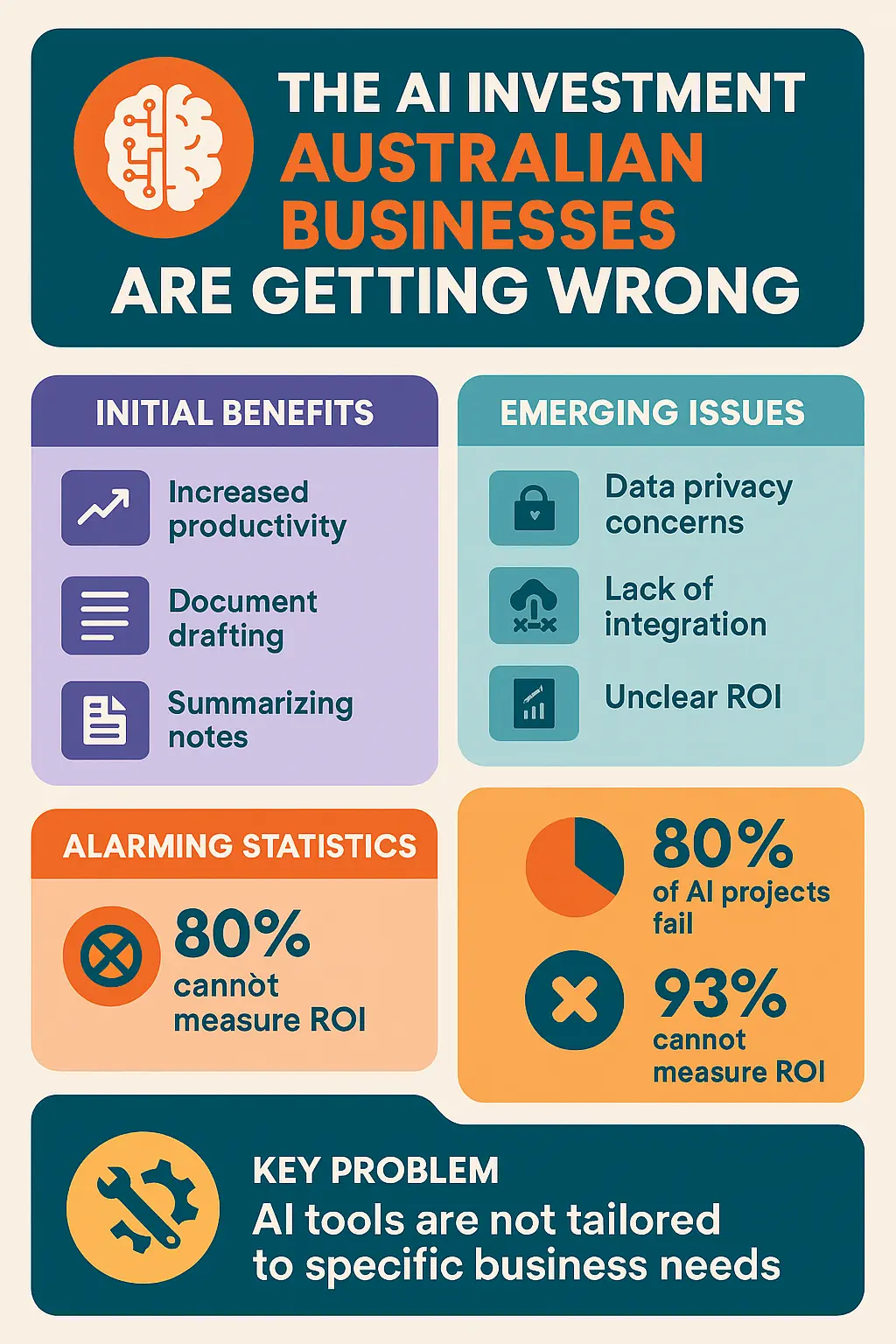
Six months ago, you made what felt like a sensible AI investment. Your team had access to a leading generative AI platform — one of the globally recognised tools you had read about in the Australian Financial Review. Productivity ticked up. Documents were drafted faster. Meeting notes were summarised in seconds. For a brief period, it felt like you had solved the AI question.
Then the questions arrived from your own organisation.
Your head of legal wanted to know where your client contracts were being processed and whether your data was being used to train the vendor's models. Your IT team raised a flag about integration — the AI sat beside your CRM and ERP, not inside them, which meant every workflow still required a human bridge. Your CFO asked for a concrete ROI report, and the numbers were harder to defend than expected. And somewhere in the middle of it, one of your team's AI-generated compliance summaries went to a client with a factual error that your client's own legal team identified first.
This scenario is not hypothetical. It is the pattern playing out across Australian businesses in 2026.
According to the National AI Centre's AI Adoption Tracker and Fifth Quadrant research, an estimated 80% of AI projects fail to progress beyond the pilot stage — double the failure rate of conventional IT projects. The Governance Institute of Australia found that 93% of business survey respondents report having no effective method for measuring ROI from AI initiatives. And Deloitte's 2026 State of AI in the Enterprise report, which surveyed 3,235 global leaders, found that Australian organisations are increasing AI investment but falling behind global peers in realising transformation at scale.
The problem is consistent across industries, company sizes, and geographies. And its root cause is almost always the same: the AI tool was built for everyone, which means it was built for no one in particular.
The State of AI in Australia in 2026: Opportunity and Underperformance Side by Side
To understand why bespoke AI matters, you first need to understand the landscape Australian businesses are operating in. The numbers are significant.
|
USD 2.39B
AU AI market value, 2025 (IMARC Group)
|
14.4%
Projected CAGR, 2026–2034 (IMARC Group)
|
80%
AI pilots that fail to reach production (NAIC / Fifth Quadrant)
|
|
49%
Australians who have used generative AI in the past 12 months (ROI.com.au 2026)
|
93%
Businesses with no effective AI ROI measurement method (Governance Institute AU 2025)
|
60%
Australian SMEs planning to use AI by 2026 (NAIC Ecosystem Report 2025)
|
The headline data tells a story of accelerating adoption. The operational data tells a story of structural under-performance. IBISWorld places the Australian AI industry market size at AUD 2.6 billion in 2026, with 958 businesses operating in the sector. Grand View Research projects the market reaching USD 80 billion by 2033. The Statista AI Market Outlook puts the 2025 figure at USD 3.99 billion, with 26.25% annual growth to 2031.
These figures represent real investment, real activity, and real competitive pressure. But investment in AI and value from AI are two different things — and the gap between them is exactly where bespoke AI solutions become the decisive variable.
Deloitte's 2026 survey is particularly instructive: while 66% of organisations globally report productivity gains from AI, revenue growth through AI remains largely aspirational — only 20% of organisations are already achieving it, versus 74% hoping to in future. For Australian businesses specifically, the report notes that the gap with global peers is growing when it comes to realising transformation at scale.
The organisations closing that gap are not using better off-the-shelf tools. They are using AI that was built around their specific operating environment.
What Is Bespoke AI? A Plain-English Definition
The term bespoke originates in tailoring — a bespoke garment is one cut and constructed to the exact measurements of a single individual, as opposed to a ready-to-wear item produced in standard sizes for a mass market. In the context of artificial intelligence, the distinction is identical and equally consequential.
|
Bespoke AI is an artificial intelligence system designed, built, trained, and deployed specifically for one organisation — around its data, its workflows, its systems architecture, and its operational objectives — rather than adapted from a general-purpose model built for a broad market.
|
An off-the-shelf AI product — whether that is ChatGPT Enterprise, Microsoft Copilot, Salesforce Einstein, or any number of SaaS AI automation platforms — is engineered to serve the widest possible user base. Its training data is drawn from publicly available internet content. Its features are designed to work adequately for thousands of different business types, industry contexts, and use cases. It is a product built for volume and market share.
Bespoke AI is the inverse. It is built for depth and specificity. The model is trained on your historical business data — your transaction records, your client communications, your document library, your operational logs. It is integrated directly into the systems your team already uses. It is hosted within your chosen infrastructure, under your governance, within Australian data residency boundaries. And it evolves as your business evolves, retrained on new data as it accumulates.
The result is not simply a more powerful version of an off-the-shelf tool. It is a fundamentally different category of system — one that knows your business because it was built from your business.
The Difference That Matters for Business Leaders
|
|
Bespoke AI vs Off-the-Shelf AI
|
|
Training Data
|
Your proprietary business data, documents, and history | Publicly available internet data; no business-specific context
|
|
Workflow Integration
|
Built into your CRM, ERP, and databases from Day 1 | Sits beside your systems; manual copy-paste workflows remain
|
|
Data Sovereignty
|
Hosted in Australia; your data never leaves your control | Processed on overseas servers (typically US-based infrastructure)
|
|
Output Governance
|
Grounded in verified data with human-review checkpoints | Hallucination risk in high-stakes or regulated output
|
|
AU Compliance
|
Australian AI Ethics Framework embedded in design | Built for global markets; AU compliance retrofitted at additional cost
|
|
IP Ownership
|
You own the system and its intellectual property | You pay for access; the vendor owns the model and its architecture
|
|
Scalability
|
Retrained as your data grows; improves over time | Fixed product roadmap; your needs adapt to the vendor's priorities
|
Why Off-the-Shelf AI Fails Australian Businesses at the Enterprise Level
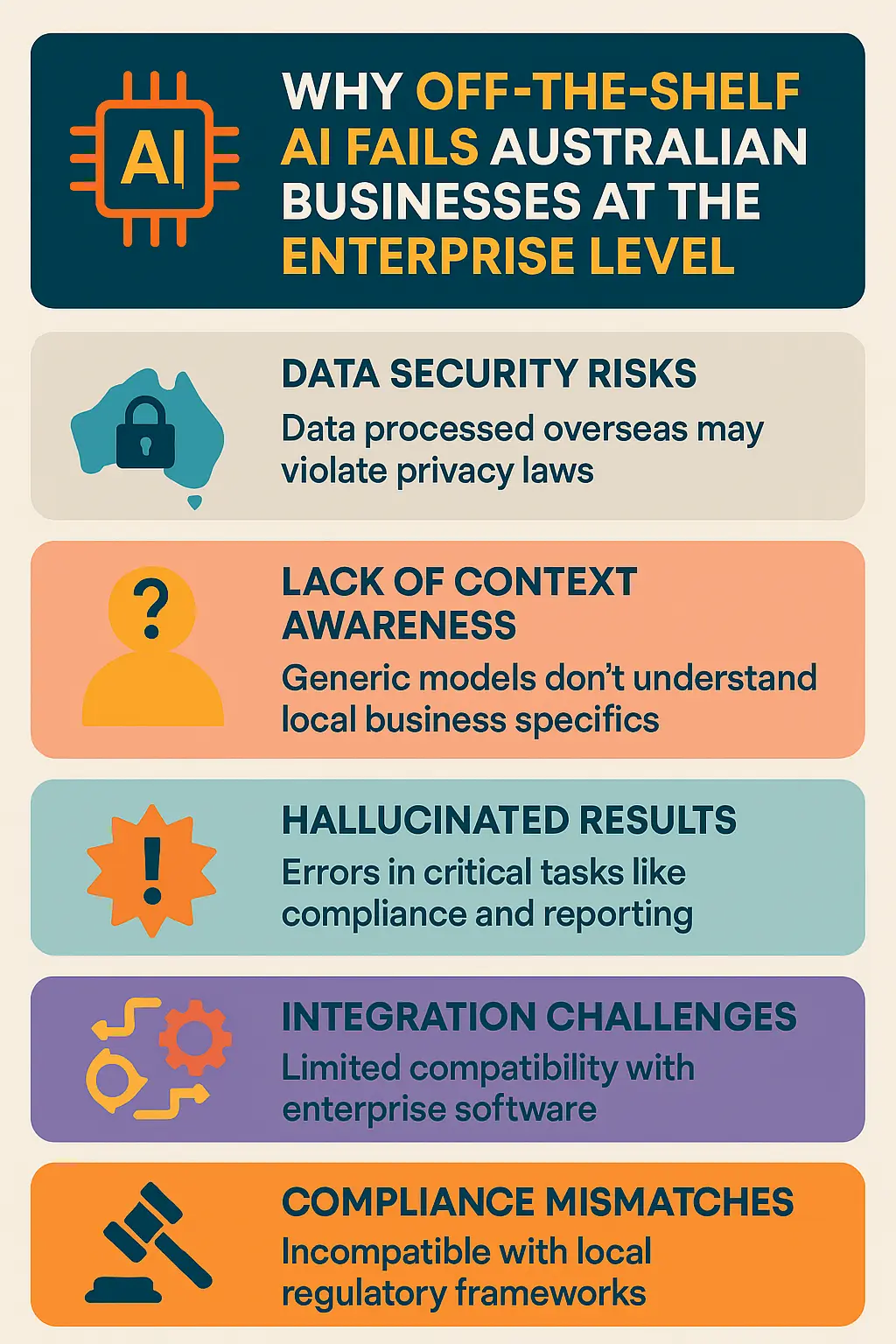
Understanding why generic AI consistently underperforms in Australian business contexts requires examining five structural failure modes — each of which is a predictable consequence of the product design choices made by global AI vendors targeting a mass market.
1. Your Data Leaves Australia
Every query, document, and dataset submitted to a US-based AI platform is processed on infrastructure outside Australian jurisdiction. For businesses handling customer personal information, financial records, commercially sensitive intellectual property, or health data, this creates direct and ongoing exposure under the Privacy Act 1988 (Cth) and its Australian Privacy Principles (APPs).
This is not a theoretical concern. The Office of the Australian Information Commissioner (OAIC) has been explicit about the obligations organisations carry when transferring personal information overseas — obligations that extend to AI vendors processing data on your behalf. In regulated sectors such as financial services, healthcare, and legal, the exposure is compounded by sector-specific requirements under the Corporations Act, the My Health Records Act, and applicable ASIC and APRA guidance.
|
Key Question for Your Organisation:
Do you know, with certainty, where every piece of data your team submits to your current AI platform is processed, stored, and potentially used for model training? If the answer is anything other than a confident yes, the risk is live.
|
2. Generic Models Cannot See Your Business Context
Off-the-shelf AI has no knowledge of your pricing structure, your client history, your internal policies, your terminology, or the way your industry specifically operates. It generates responses based on the statistical patterns found in public internet text — which produces output that is plausible in general but frequently incorrect in the specific context of your business.
A bespoke AI trained on your actual business data knows your product catalogue, your standard contract terms, your operational procedures, and the specific language your team and clients use. It is not guessing from general knowledge — it is applying your institutional knowledge at machine speed, with the accuracy that specificity enables.
The practical difference is significant. An off-the-shelf AI asked to analyse your sales pipeline will produce a generic analysis. A bespoke AI trained on your CRM history, your seasonal patterns, and your individual client relationships will produce analysis that reflects your actual business reality.
3. Hallucination Risk in High-Stakes Output
Large language models generate confident-sounding text by predicting the most statistically likely sequence of words given a prompt. This mechanism — which produces the fluency and apparent intelligence that makes these systems impressive — is also the source of what the industry calls hallucination: the confident production of factually incorrect information.
In consumer applications, hallucination is an inconvenience. In a legal document, a financial compliance report, a medical summary, a regulatory submission, or a client-facing recommendation, it is a liability. McKinsey's 2024 global AI survey identified output inaccuracy as one of the most widely recognised risks of generative AI in business contexts, alongside intellectual property infringement and cybersecurity vulnerabilities.
A custom AI system addresses this structurally, not superficially. Retrieval-augmented generation (RAG) architecture grounds the model's responses in your verified, curated data sources rather than probabilistic text generation. Human-in-the-loop review checkpoints are designed into the workflow. Output governance rules constrain the model's responses to validated content domains. These are design decisions that cannot be retrofitted onto a generic product — they must be architected from the outset.
4. Broken Integration With Your Existing Systems
Your business operates on a stack of interconnected systems — a customer relationship management platform, an enterprise resource planning system, custom databases, project management tools, financial software, and industry-specific applications. Off-the-shelf AI platforms sit beside this stack. They do not integrate into it.
The result is a persistent manual layer: copy-pasting context into the AI interface, re-entering outputs into your systems, and maintaining human bridges between tools that should communicate automatically. This is the layer that erodes the efficiency gains AI is supposed to deliver. The productivity improvements that were promised in the vendor's sales process are offset — sometimes entirely — by the friction of manual integration.
A bespoke AI solution is integrated directly into your existing architecture from the outset. It reads from and writes to your operational systems in real time. Your team interacts with AI through the interfaces they already use, in the workflows they already follow, without a separate tool to manage.
5. Australian Compliance Is an Afterthought, Not a Design Principle
Australia has one of the most developed voluntary AI governance frameworks in the Asia-Pacific region. The Australian AI Ethics Principles — first established in 2019 and evolved through the Voluntary AI Safety Standard launched in September 2024 and the updated Guidance for AI Adoption published in October 2025 — specify clear principles for the responsible design, development, and deployment of AI systems operating in Australia.
The eight core principles that governed the original framework include human wellbeing, human-centred values, fairness, privacy protection and security, reliability and safety, transparency and explainability, contestability, and accountability. These principles were not design inputs for global AI platforms built for the US or European markets. They were designed for Australian organisations — and aligning with them requires architectural decisions that must be made at the outset of a build, not bolted on afterwards.
For businesses operating in regulated industries — financial services, healthcare, legal, education, government supply — the trajectory of AI regulation in Australia is clear. The Department of Industry, Science and Resources is actively consulting on high-risk AI frameworks, and proactive businesses that have already embedded governance into their AI architecture will be in a substantially stronger position when mandatory requirements arrive than those who relied on off-the-shelf tools and assumed compliance would be managed by the vendor.
|
Important:
The Australian Government updated and simplified AI governance guidance in October 2025, publishing six essential practices for safe and responsible AI adoption. Off-the-shelf AI vendors are not obligated to align their products with these practices for your organisation. A bespoke AI build can embed them by design.
|
Bespoke AI in Practice: What It Looks Like for Australian Businesses
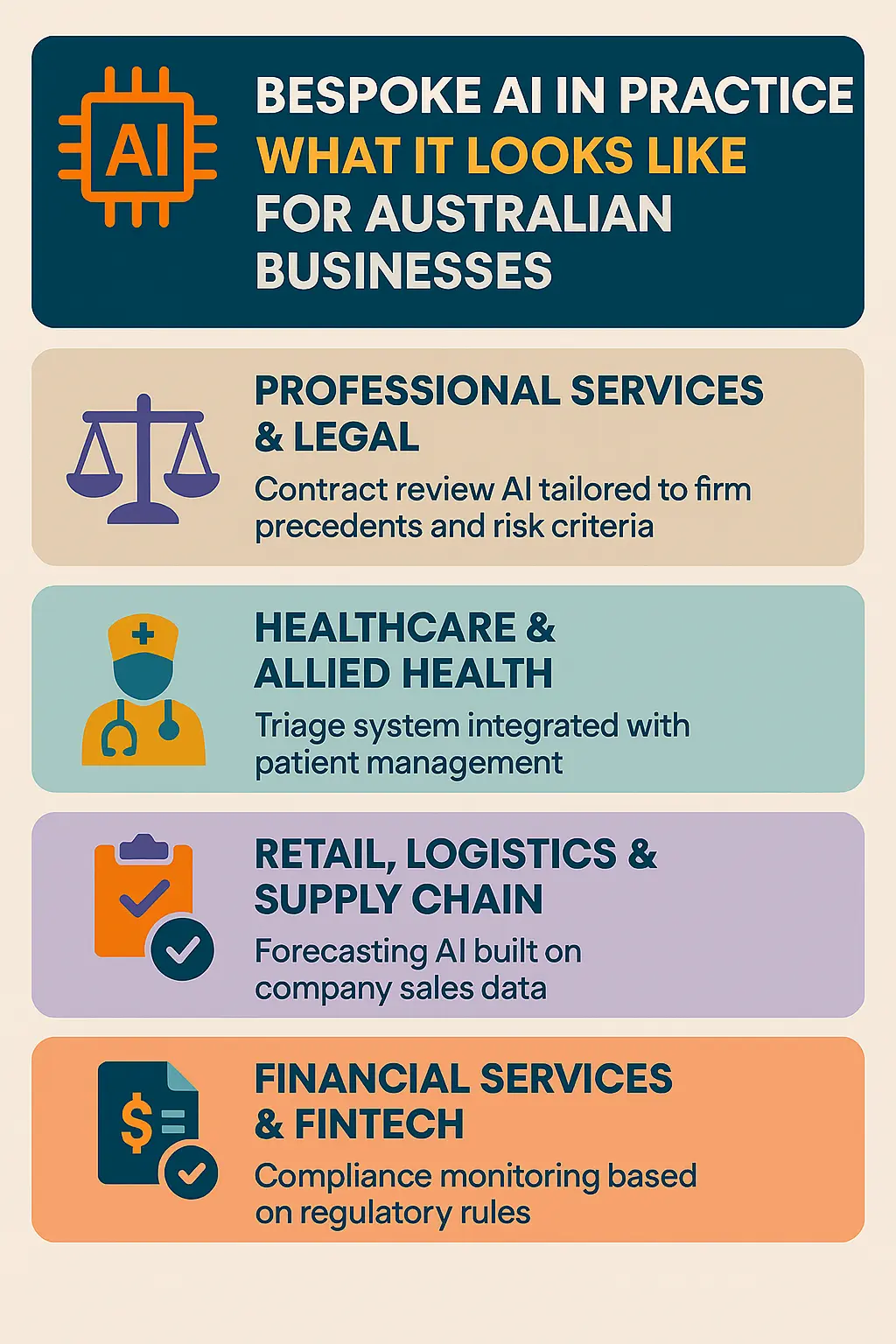
Bespoke AI is not an abstract concept. It has a concrete, tangible form in operational business environments. The following examples illustrate how Australian organisations are deploying custom AI solutions across four industries — and what differentiates these deployments from generic tool adoption.
Professional Services and Legal
A mid-sized Australian law firm processing hundreds of commercial contracts each month deploys a bespoke AI system trained on the firm's own contract precedent library, standard clause database, and risk categorisation framework. The system reviews incoming contracts, identifies clauses that deviate from the firm's benchmarks, flags high-risk provisions, and generates suggested amendments aligned to the firm's established positions — not a generic legal AI's approximation of standard practice.
The system operates entirely within the firm's own infrastructure, with a full audit trail for every AI-assisted review. It integrates directly with the firm's document management system and matter management platform, eliminating manual file transfer and re-entry. Partners receive output that reflects the firm's specific institutional knowledge — not a generalised legal analysis that requires significant partner review to contextualise.
Healthcare and Allied Health
An Australian healthcare network handles thousands of patient intake interactions per week across multiple facilities. A bespoke AI triage and scheduling system integrates directly with the network's patient management software, categorising incoming inquiries by clinical urgency, routing them to the appropriate provider type, and pre-populating intake documentation based on the nature of the inquiry.
Critically, the system operates within a private, AU-hosted infrastructure environment. No patient data is transmitted to third-party AI vendors. The network's obligations under the Privacy Act, the My Health Records Act, and applicable state health privacy legislation are met by architecture rather than by contractual assurance from an overseas vendor. The AI's behaviour is governed by clinical protocols specific to the network's patient population and service model — not generic triage logic from a mass-market product.
Retail, Logistics and Supply Chain
A national Australian retailer with a complex supplier network and significant seasonal demand variation deploys a demand-forecasting AI trained on three years of the company's own sales data, supplier lead times, warehouse throughput history, and promotional campaign performance. The system updates daily, surfaces procurement recommendations directly into the operations team's existing planning dashboard, and flags anomaly signals — unusual demand spikes, supply chain risk indicators, seasonal forecast deviations — before they become stock events.
The model is retrained quarterly as new data accumulates, meaning it becomes more accurate over time rather than remaining static. It provides a competitive advantage that grows with the business — not a subscription to a generic forecasting product that every competitor can access on identical terms.
Financial Services and Fintech
An Australian financial services firm subject to ASIC and APRA reporting obligations deploys a bespoke AI compliance monitoring and reporting system integrated with its transaction processing and risk management platforms. The system monitors transactions in real time against the firm's specific regulatory thresholds, flags potential compliance issues before reporting deadlines, and automatically generates structured data for regulatory submissions in the required format.
The system's behaviour is fully auditable — every decision, every flag, and every output is logged to a tamper-evident audit trail that satisfies the firm's obligations under applicable financial services legislation. Because the AI was designed for this specific firm's compliance environment — not adapted from a generic financial AI product — the outputs are defensible in a regulatory examination in a way that generic tool outputs frequently are not.
Building the Business Case: An ROI Framework for Australian Executives
The most consistent internal barrier to a bespoke AI investment in Australian organisations is not scepticism about the technology. It is the challenge of building a quantified, defensible business case for a board or CFO who reasonably requires evidence before approving a material capital expenditure.
The following three-bucket framework gives Australian executives the structure needed to model the return from a bespoke AI investment — drawing on the specific value levers that custom AI activates for Australian businesses.
|
ROI Bucket 1 — Cost Reduction (Hard ROI)
Cost reduction is the most immediately quantifiable return from bespoke AI deployment. The calculation requires three inputs: the number of FTE hours currently spent on the target process, the fully-loaded cost per hour, and the realistic AI-driven reduction in that time.
- Document processing, data entry, and compliance reporting are typically reducible by 60–80% through well-implemented custom AI — compressing hours-long workflows to minutes.
- Error rate reduction eliminates the downstream cost of rework, correction, and escalation — costs that rarely appear explicitly in process cost models but are substantial when measured.
- In professional services contexts, this translates directly to billable hour recapture — time previously consumed by administrative AI-adjacent work redirected to client-facing activity.
ROI Bucket 2 — Revenue Upside (Soft ROI)
Revenue upside from bespoke AI is less immediately quantifiable than cost reduction but frequently represents the larger long-term return. The most significant levers are:
- Accelerated sales cycles through AI-powered lead qualification, personalised outreach, and intelligent follow-up — shortening average time-to-close and improving conversion rates.
- Improved client retention through consistently personalised, data-informed service delivery at scale — reducing churn and increasing lifetime value.
- New capability unlocked by AI-enabled operations — service lines, product features, or delivery models that were not commercially viable without the AI system.
ROI Bucket 3 — Risk Reduction (Compliance and Governance ROI)
Risk reduction ROI is often the most important consideration for Australian businesses in regulated industries — and the most frequently underweighted in AI investment models.
- Audit trail automation reduces both the labour cost of regulatory reporting and the financial exposure from non-compliance penalties — which, in financial services, healthcare, and legal contexts, can be material.
- Data sovereignty architecture eliminates the ongoing privacy and reputational risk of sensitive data being processed by third-party overseas AI platforms.
- Governance-by-design reduces the likelihood of AI-generated errors reaching clients, regulators, or the public — protecting both the direct cost of error remediation and the less quantifiable but significant cost of reputational damage.
|
When these three buckets are modelled against the phased cost of a bespoke AI engagement — typically structured as discovery, pilot, and production phases — the business case for organisations with meaningful data volume, complex workflows, or regulated operations is consistently compelling. The organisations that have made this calculation in 2025 are already seeing the results in 2026.
How C9 Builds Custom AI Solutions for Australian Businesses
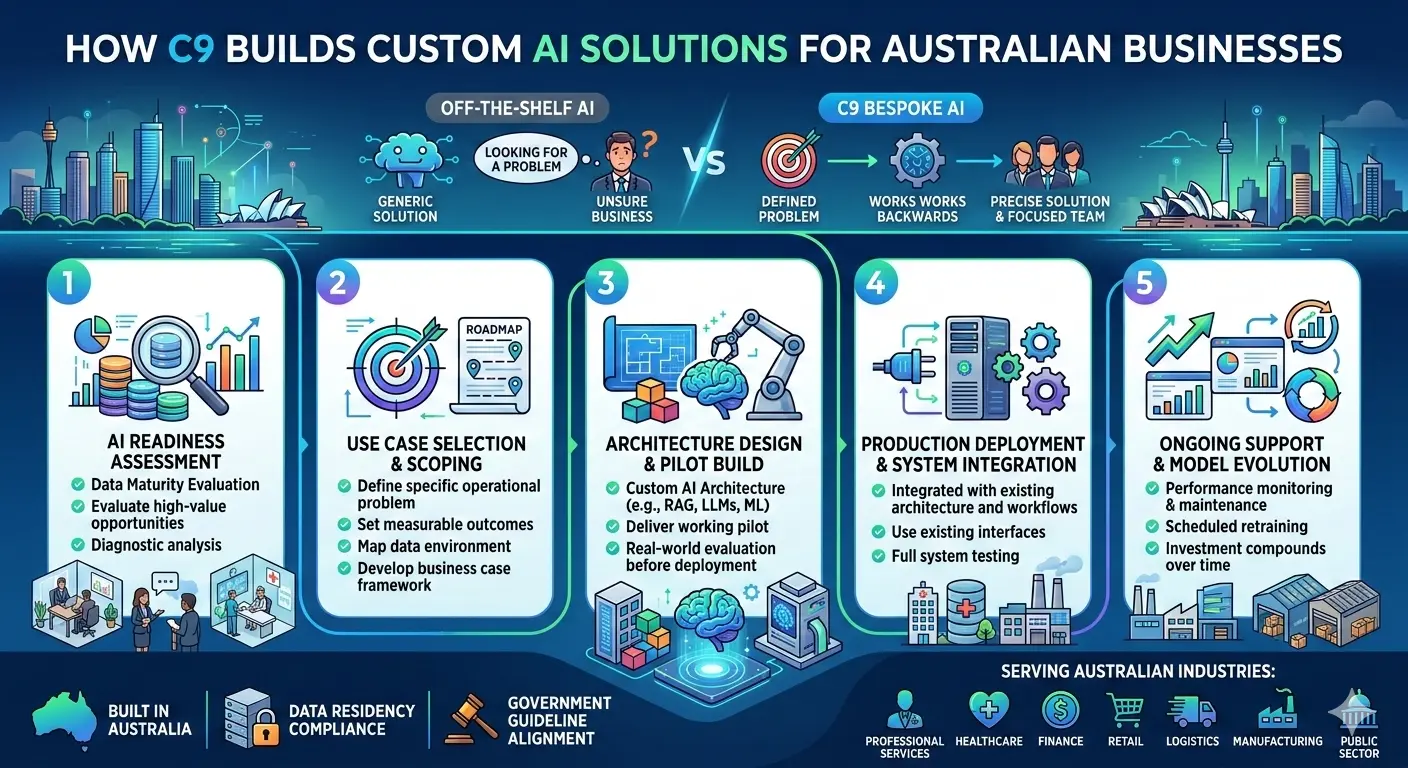
C9 is Australia's leading custom software, applications, integration, and database developer. Custom AI solutions sit at the centre of our work — not as a new product offering, but as the natural extension of two decades of experience building bespoke, production-grade systems for Australian businesses that need more than standard market products can provide.
Our approach is grounded in a principle that rarely features in AI vendor conversations: the problem must be defined before the solution is designed. Off-the-shelf AI is a solution in search of your problem. Bespoke AI starts with your problem and works backwards to the precise system required to solve it. The difference in outcome is substantial.
Our Five-Phase Engagement Model
- AI Readiness Assessment. Before any architecture decision, we assess your data maturity, systems environment, and the highest-value AI opportunities available to your organisation. This phase is diagnostic, not commercial — its purpose is to give you an accurate picture of where custom AI can deliver genuine value, and where it is not yet the right tool.
- Use Case Selection and Scoping. We define the specific operational problem to solve, the measurable outcome expected, and the data environment available. Bespoke AI built on a precise, well-scoped use case consistently outperforms AI built on general ambition. This phase also produces the business case framework needed for internal approval — giving you the numbers before committing to a build.
- Architecture Design and Pilot Build. We design the AI architecture appropriate to your requirements — whether that is a retrieval-augmented generation system grounded in your document library, a fine-tuned language model trained on your operational data, a custom machine learning pipeline, or a hybrid architecture. We then deliver a working pilot that you can evaluate against real business criteria before committing to full production deployment.
- Production Deployment and System Integration. We deploy the production system integrated directly into your existing architecture. Your team accesses AI capabilities through the interfaces and workflows they already use — not a new tool that requires change management and adoption effort. Every integration is tested against your live systems environment before handover.
- Ongoing Support and Model Evolution. A bespoke AI system is not a one-time delivery. We provide ongoing model maintenance, performance monitoring, and scheduled retraining as your business data evolves. This is what prevents the system from becoming stale — and what ensures the investment compounds rather than depreciates over time.
Every C9 custom AI solution is built in Australia, hosted to your chosen data residency requirements, and aligned with the Australian Government's guidance for safe and responsible AI adoption from the first design decision. Governance and compliance are not features we add at the end. They are design principles we apply at the beginning.
We work with Australian businesses across professional services, healthcare, financial services, retail, logistics, manufacturing, and the public sector. Our engagements range from targeted AI pilots addressing a single operational bottleneck to enterprise-scale AI systems that reshape how entire functions operate.
Frequently Asked Questions
What is the difference between bespoke AI and off-the-shelf AI?
Bespoke AI is designed and built specifically for one organisation — trained on its data, integrated with its systems, and governed by its compliance requirements. Off-the-shelf AI is a generic product built for a broad market, designed to work adequately across many different business contexts but optimised for none of them specifically. The practical differences include data sovereignty, output accuracy, system integration, AU compliance alignment, and IP ownership.
Is custom AI more expensive than off-the-shelf AI?
The upfront investment in a bespoke AI system is higher than a monthly SaaS subscription. However, the total cost of ownership calculation must account for: the cost of the manual integration layer that off-the-shelf tools require; the cost of compliance retrofitting; the opportunity cost of a tool that delivers inadequate accuracy for your specific context; and the ongoing subscription cost of a generic product compounded over years. For organisations with meaningful data volume and process complexity, bespoke AI consistently delivers superior ROI within a 12–24 month horizon.
Does Australian law require businesses to use AI that complies with local regulations?
There is currently no AI-specific legislation in Australia that mandates a particular compliance framework. However, existing laws — including the Privacy Act 1988 (Cth), the Australian Privacy Principles, the Corporations Act, sector-specific ASIC and APRA requirements, and state-based health privacy legislation — apply fully to AI systems processing data on behalf of Australian organisations. The Australian Government's Voluntary AI Safety Standard (September 2024) and updated Guidance for AI Adoption (October 2025) provide the current governance framework. High-risk AI regulation with mandatory requirements is under active consultation. Businesses that build compliance in now are better positioned for the regulatory environment ahead.
How long does it take to build a custom AI solution?
A focused bespoke AI pilot addressing a well-defined use case can be delivered in eight to twelve weeks. A production-ready system with full integration into existing infrastructure typically requires sixteen to twenty-four weeks from scoping to deployment, depending on the complexity of the integration environment and the volume of data requiring preprocessing. C9 operates on a phased engagement model — the pilot phase is evaluable before full production commitment is required.
What industries in Australia are leading AI adoption?
According to the NAIC AI Adoption Tracker (Q1 2025), retail trade and health and education maintain their position as the leading sectors for AI adoption in Australia, with services and hospitality close behind. Primary industries — construction, manufacturing, and agriculture — show higher levels of unawareness around AI's value, representing significant untapped opportunity. Financial services and legal sectors are increasingly active, driven by compliance automation and document processing requirements.
The Decision That Determines Whether Your AI Investment Works
Australia's AI market is not speculative in 2026. It is operational, growing, and increasingly competitive. The organisations making the most of it are not distinguished by the sophistication of their AI ambitions. They are distinguished by the specificity of their AI implementations.
Off-the-shelf AI will continue to improve. Global platforms will add features, refine their models, and expand their integration libraries. But they will always be designed for the global average — optimised for breadth, not for the specific data environment, compliance obligations, and workflow context of your organisation.
For Australian businesses with complex operations, sensitive data, or meaningful scale, the question in 2026 is not whether to invest in AI. It is whether to invest in AI that is actually built for your business — and whether to make that decision before your competitors do.
|
Is Bespoke AI the Right Choice for Your Organisation?
You are well-positioned for a custom AI investment if your organisation:
- Has attempted AI with off-the-shelf tools and consistently encountered integration, accuracy, or compliance limitations.
- Handles sensitive client data that cannot be processed by third-party overseas AI platforms.
- Operates complex, high-volume workflows that generic automation cannot adequately address.
- Is in a regulated industry where AI output governance is a requirement, not a preference.
- Has accumulated proprietary data over years of operation — data that a custom AI model can be trained on to deliver advantages no generic product can replicate.
|
|
Start with One Honest Conversation
C9 offers a no-obligation AI Readiness Session for Australian businesses — a focused, practical assessment of your highest-value AI opportunity, your data environment, and whether a bespoke AI solution is the right fit for where your organisation is today and where it needs to go.
There is no commitment required. Just clarity.
Book your AI Readiness Session at c9.com.au
|
References & Sources
All data, statistics, and regulatory references cited in this article are drawn from the following published sources.
[1] IMARC Group — Australia Artificial Intelligence Market Report (2025)
[3] Grand View Research (Horizon Databook) — Australia AI Market Outlook (2026)
[4] Statista — Artificial Intelligence Market Forecast: Australia (2025–2031)
[5] Deloitte Australia — State of AI in the Enterprise 2026 (Survey: 3,235 leaders, 24 countries)
[6] National AI Centre (NAIC) & Fifth Quadrant — AI Adoption Tracker Q1 2025
[7] NAIC — Australia's Artificial Intelligence Ecosystem: Growth and Opportunities (June 2025)
[9] Appinventiv — AI Implementation in Australia (2026): Use Cases, Costs & Strategy
[10] Department of Industry, Science and Resources — Australia's AI Ethics Principles (updated October 2025)
[11] Department of Industry, Science and Resources — Guidance for AI Adoption: 6 Essential Practices (October 2025)
[12] LegalVision Australia — How Do I Comply With the AI Ethics Framework? (August 2025)
[13] Australian Government Architecture (AGA) — Australia's 8 AI Ethics Principles
[14] Nemko Digital — AI Governance Australia: Policy, Compliance & Responsible AI (2025)
[15] Department of Finance — Implementing Australia's AI Ethics Principles in Government
[16] US Commercial Service — Australia Artificial Intelligence Market
Explore Our Localised Software & Integration Services
Streamline Your Brisbane Operations with Tailored Digital Solutions
Solution Services in Sydney: Digital Systems Architecture & Engineering
Custom Software Development in Melbourne: Engineering Your Strategic Business Advantage
AI Transparency Notice:
This article was produced with the assistance of artificial intelligence tools, including content drafting, visual asset creation, and audio generation. All content has been reviewed and approved by C9 prior to publication.