What Australian Business Owners and Executives Must Know Before Committing Budget to AI
EXECUTIVE SUMMARY
The Australian AI market is on a growth trajectory few industries have witnessed before. Yet the conversation most business owners are having — "what does AI cost?" — is still the wrong one. The right question is: what is the full picture of this investment, what are the risks of getting it wrong, and what happens to your business's competitive position if you delay? This guide answers all three, without the vendor spin.
In short:
- AI implementation in Australia costs between AUD $70,000 and $700,000+ depending on complexity, integration depth, and governance requirements.
- The costs that derail most AI projects are the ones rarely quoted upfront: data engineering, integration, change management, and ongoing maintenance.
- Bespoke, purpose-built AI software consistently outperforms off-the-shelf platforms for Australian businesses with specific workflows, compliance obligations, or proprietary data.
- 67% of Australian CEOs plan to invest in AI in 2026 — but only 28% believe that investment will be sufficient to meet their strategic goals. The gap is strategy, not budget.
What's next?
After reading this guide, you will have a clear, board-ready framework for evaluating AI investment with confidence — and a direct path to engaging C9 as your AI software consultancy partner.
Why the AI Investment Conversation Is Broken — and What It Is Costing You
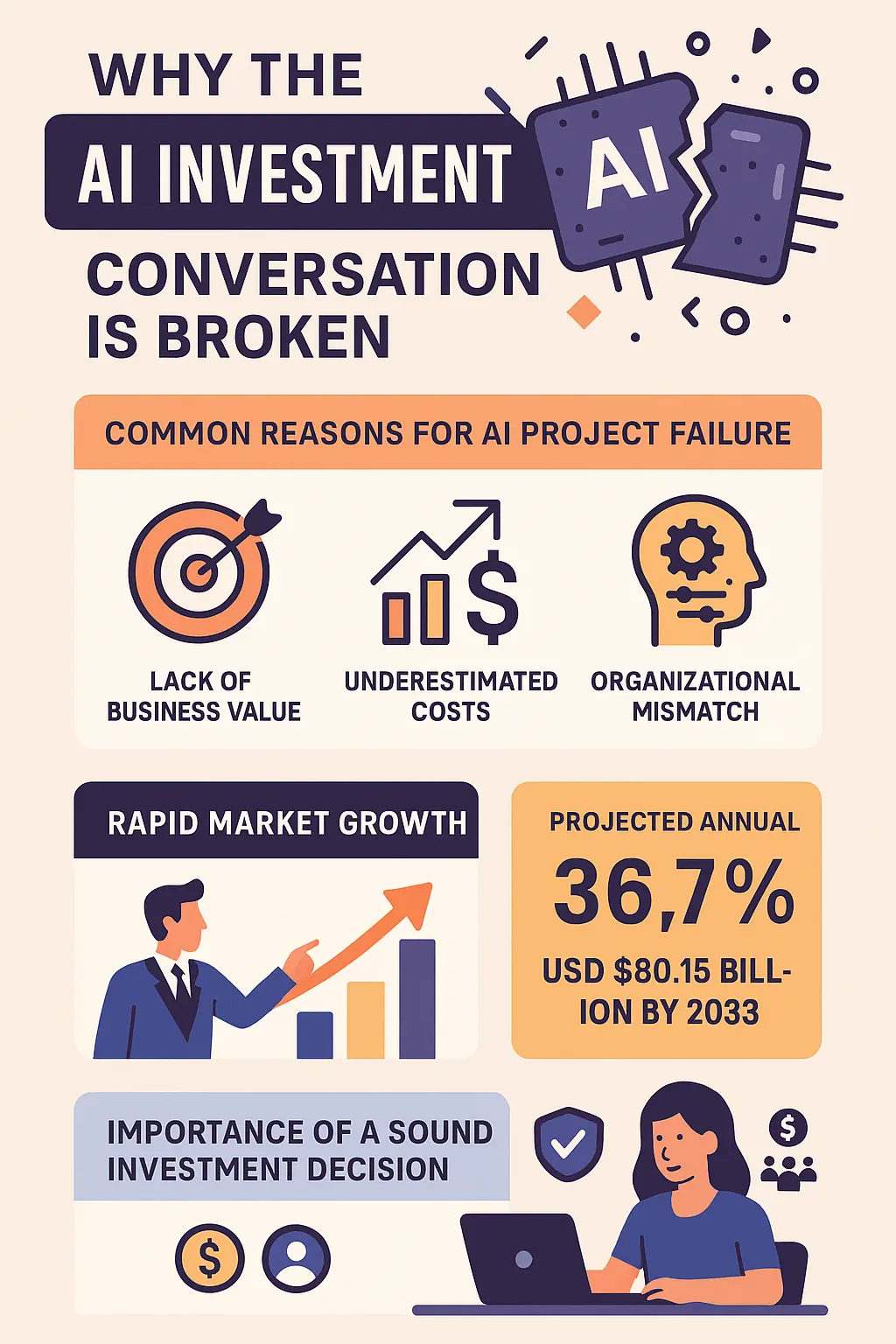
Every vendor in the Australian AI market is telling the same story. Faster decisions. Fewer errors. Competitive advantage. And yet, fewer than 13% of AI projects globally make it from proof-of-concept to production. In Australia, the rate is even lower in sectors with heavy compliance obligations. Billions of dollars in AI investment is producing pilots that never scale.
This is not a technology problem. The models exist. The infrastructure exists. The failure almost always traces back to the same root causes: use cases chosen for their impressiveness rather than their business value; cost estimates that capture the platform and nothing else; and AI systems deployed into environments that were never prepared to receive them.
The Australian market is accelerating regardless. According to Grand View Research, the Australian AI market is projected to grow at a compound annual rate of 36.7% from 2026 to 2033, reaching USD $80.15 billion. The Australian Government's AI Opportunities Report 2025 estimates that AI could add up to $142 billion annually to Australia's GDP by 2030. For business owners and executives, this is not background noise — it is a competitive clock.
MARKET CONTEXT
Over one-third of Australian businesses are already using or trialling AI, with adoption highest among large enterprises. A further 23% plan implementation within the next 12 months. The window for first-mover advantage is narrowing.
The purpose of this guide is not to sell you AI. It is to give you the information you need to make a sound, defensible investment decision — one that your board, your CFO, and your team can stand behind. That begins with understanding what AI implementation actually costs, why so many projects exceed their budgets, and what the businesses achieving strong returns are doing differently.
What AI Software Implementation Actually Costs in Australia
The most frequently cited figure for AI implementation in Australia is a range: AUD $70,000 to $700,000 or more. That range is accurate — and almost entirely unhelpful without the context that determines where on that spectrum your project will land.
The primary cost driver is almost never the AI model itself. The costs that determine your total investment are the surrounding infrastructure, integration work, data preparation, compliance architecture, and the change management required to make the system operational inside a real business environment.
Indicative Investment Ranges for Australian Businesses
|
Project Type
|
Investment Range (AUD)
|
Typical Timeline
|
Best Suited For
|
|
Discovery & Strategy Engagement
|
$15,000 – $40,000
|
2–4 weeks
|
Any business beginning their AI journey
|
|
AI Proof of Concept / MVP
|
$40,000 – $120,000
|
6–12 weeks
|
SMEs validating AI before full investment
|
|
Mid-Scale Bespoke AI System
|
$120,000 – $350,000
|
3–6 months
|
Businesses with defined, high-value use cases
|
|
Enterprise Custom AI Platform
|
$350,000 – $700,000+
|
6–14 months
|
Large enterprises with complex requirements
|
|
Ongoing Support & Optimisation
|
$2,000 – $8,000/month
|
Ongoing
|
All clients post-deployment
|
These ranges reflect Australian market conditions, including the cost of local AI engineering talent — which ranges from AUD $85,000 for entry-level roles to over $200,000 for senior AI specialists. Offshore estimates are almost always lower, and almost always exclude the integration, compliance, and governance work that Australian businesses actually require.
$39.9M committed by the Australian Government over 5 years for AI policy and capability development. (Source: Dataclysm, 2025)
The Five Costs That Determine Your Real Budget
Understanding why projects exceed their initial estimates requires looking at each cost category honestly.
1. Data Preparation and Engineering
Research consistently shows that 60 to 80 per cent of AI project time is spent preparing data, not building models. For Australian businesses operating legacy systems, disparate databases, or platforms that have grown through acquisition, data engineering can consume a significant proportion of total project cost. This includes data extraction, transformation, quality remediation, governance documentation, and the infrastructure required to make data accessible to AI systems in a secure, auditable way.
2. System Integration
AI systems do not operate in isolation. Connecting your AI to your ERP, CRM, accounting software, document management platform, and industry-specific tools is frequently the most complex and time-consuming component of an implementation. Legacy systems without modern APIs, data formats that require transformation, and security requirements that govern data flows between systems all add cost and timeline to integration work. This component is almost never fully costed in initial vendor proposals.
3. Cloud Infrastructure and Compute
AI model training and inference require compute resources. For cloud-hosted systems, this typically costs AUD $12,000 to $60,000 per year depending on data volume and inference frequency. This is an ongoing operational cost that must be modelled for the full investment lifecycle, not just the build phase.
4. Change Management and Training
Gartner's research shows that AI projects with structured change management programmes are six times more likely to achieve adoption targets. For any AI system that changes how staff work — which is most of them — budget 10 to 15 per cent of total project cost for communication, training, process documentation, and adoption support. This is consistently the most underestimated line item in AI budgets, and the most commonly cited reason for deployment failures that are attributed to the technology.
5. Ongoing Maintenance and Governance
AI models are not static assets. They degrade as data distributions shift, business conditions change, and regulatory requirements evolve. Budget for at least one model retrain per year, quarterly performance monitoring, and annual compliance and governance reviews. These costs typically represent 15 to 25 per cent of the original build investment annually — and are essential to sustaining the returns that justified the initial investment.
Why Australian Compliance Is a Cost You Cannot Afford to Skip
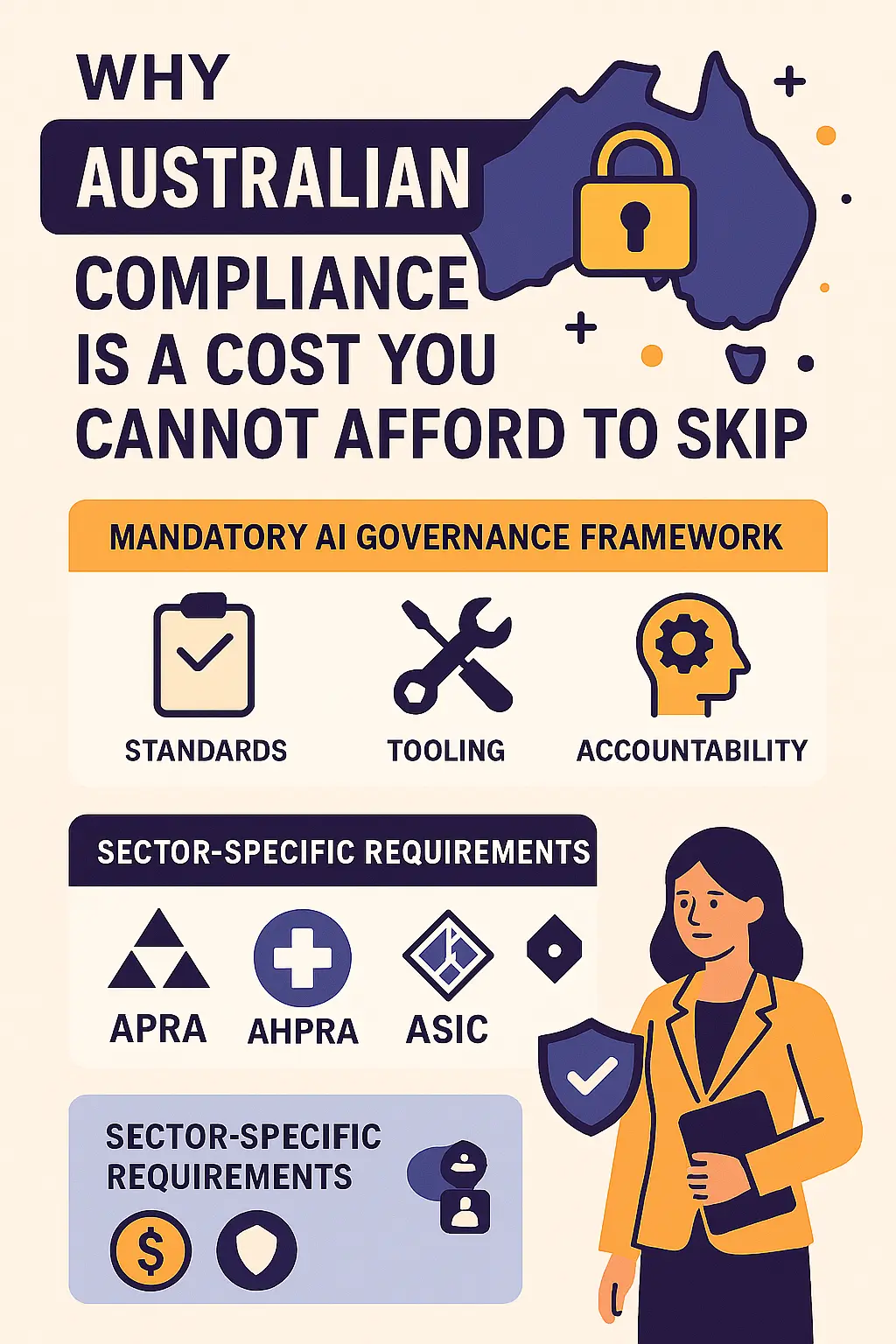
Australia's AI regulatory landscape is one of the most important differentiators between offshore AI vendors and local specialists — and it is consistently underestimated by businesses that treat compliance as an afterthought.
The National AI Plan, released in December 2025, sets Australia's long-term framework for safe, responsible AI adoption. It introduces mandatory governance standards, secure tooling requirements, and accountability expectations that increasingly shape enterprise standards across every sector. The $17 million Responsible AI Adopt Program supports businesses in deploying AI with strong governance, data controls, and accountability structures.
In addition to the national framework, sector-specific obligations apply. APRA's prudential standards govern AI in financial services and superannuation. AHPRA and the My Health Record Act impose requirements on clinical AI applications. ASIC's product design and responsible lending obligations extend to AI-driven customer decisions. The Privacy Act 1988 and the Australian Privacy Principles govern how AI systems collect, process, and store personal data.
COMPLIANCE REALITY
AI systems deployed without compliance architecture built in from the start are not just operationally risky — they create legal and regulatory exposure for directors and boards. Retrofitting compliance after deployment is consistently more expensive and more disruptive than building it correctly from day one.
C9 builds compliance architecture into every AI solution as standard. This means privacy-by-design data flows, explainability layers that satisfy APRA and ASIC expectations, audit trails for every AI-assisted decision, and governance documentation that meets the ATO's evidentiary standards for R&D claims. These are not optional additions — they are the foundation of every system we deliver.
How to Measure ROI on AI Investment: The Framework That Gets Board Approval
In 2026, 67 per cent of Australian CEOs plan to invest in AI tools. Only 28 per cent believe that investment will be sufficient to meet their strategic goals. The gap between intention and confidence is almost entirely explained by the absence of a rigorous ROI framework.
A board-ready AI investment case begins not with the technology, but with a precise quantification of the problem being solved. What does the current state cost — in labour, errors, delays, compliance risk, and missed revenue? That figure becomes your investment benchmark. It transforms the question from "is AI worth $250,000?" to "will this $250,000 investment eliminate $400,000 in annual operating cost?" — a question that answers itself.
$142B estimated annual contribution of AI to Australia's GDP by 2030 if the nation invests strategically. (Source: OpenAI / NEXTDC AI Opportunities Report 2025)
A Practical ROI Example for Australian SMEs
Consider an operations function with eight administrative roles at a combined payroll cost — including superannuation and overhead — of approximately AUD $720,000 per year. An AI workflow automation system implemented at a total cost of $85,000, addressing document processing, compliance reporting, and data reconciliation, delivers a net operational reduction of $310,000 annually. Payback period: four months.
This is not a hypothetical. This is the kind of outcome that well-engineered, purpose-built AI systems are delivering for Australian businesses today. The differentiating factor is not the AI technology itself — it is the precision of the use case definition, the quality of the integration, and the rigour of the implementation.
Key ROI Metrics to Track
|
Metric Category
|
Example KPIs
|
Typical Improvement
|
|
Labour Efficiency
|
Hours saved per week, cost per transaction
|
20–65% reduction
|
|
Error and Rework Reduction
|
Error rate, rework cost, complaint volume
|
30–80% reduction
|
|
Decision Speed
|
Time to insight, report generation time
|
50–90% reduction
|
|
Customer Experience
|
NPS, response time, first-contact resolution
|
15–40% improvement
|
|
Risk and Compliance
|
Audit findings, compliance incidents
|
40–70% reduction
|
|
Revenue Growth
|
Conversion rate, sales cycle length, upsell rate
|
5–25% improvement
|
The R&D Tax Incentive: Australia's Most Underutilised AI Investment Lever
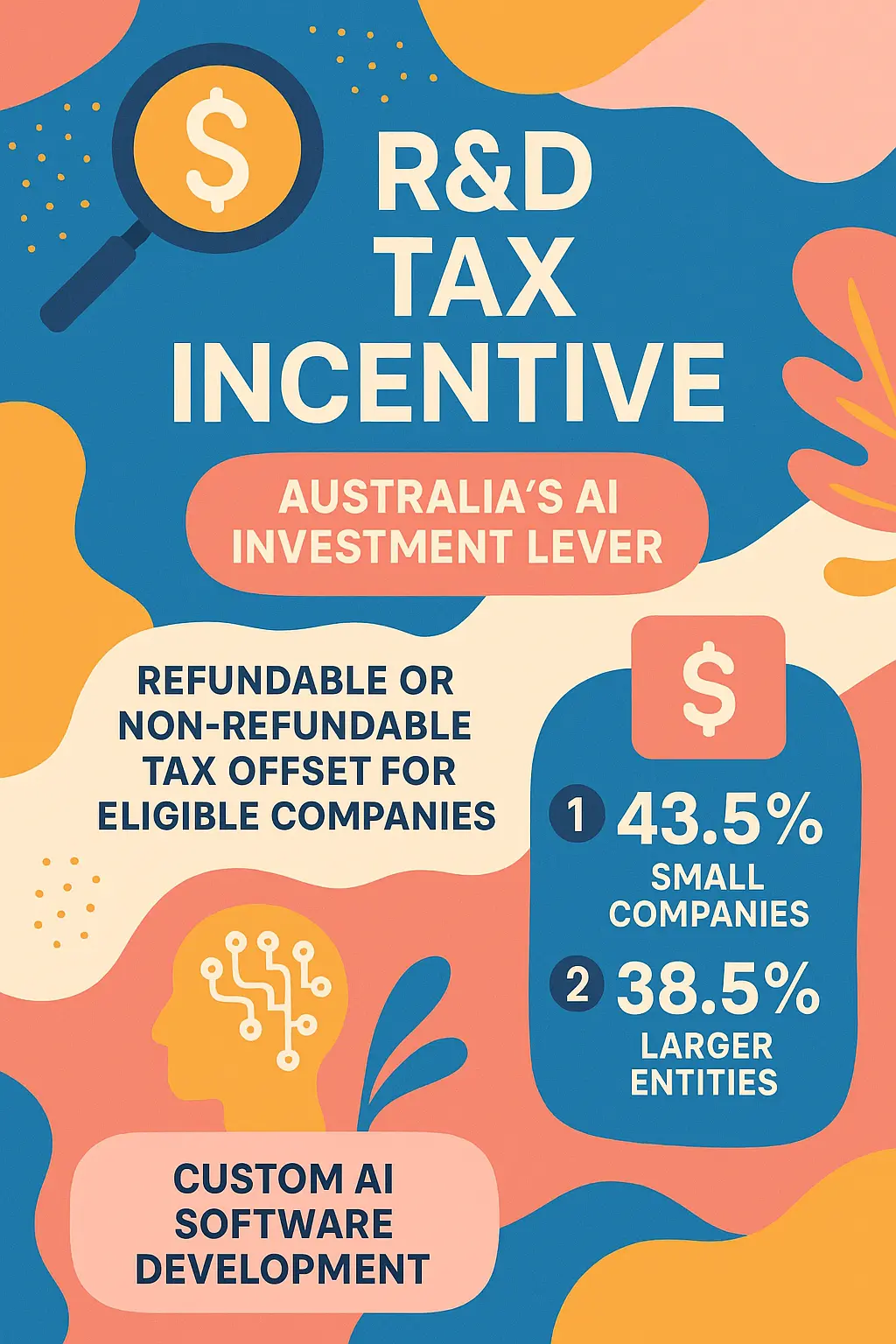
One of the most significant financial advantages available to Australian businesses investing in custom AI software is the Research and Development Tax Incentive — and most eligible businesses either do not know about it or do not claim it.
The Australian Government's R&D Tax Incentive provides a 43.5 per cent refundable tax offset for eligible small companies with annual turnover under $20 million, and a 38.5 per cent non-refundable offset for larger entities. Custom AI software development — including machine learning model development, novel algorithm design, experimental data pipeline engineering, and the development of AI governance frameworks — typically qualifies as eligible R&D activity.
For a bespoke AI project with a build cost of $300,000, an eligible R&D claim could return $130,500 to a qualifying business — reducing the net investment to under $170,000. Over a three-year lifecycle that delivers $300,000 in annual operational savings, the net return on that investment exceeds $700,000.
R&D ADVANTAGE
The Australian Government has allocated $39.9 million over five years to AI policy and capability development. This policy commitment signals that AI R&D claims are supported at the highest level. C9's project documentation is structured from day one to support R&D claims — including experiment logs, hypothesis records, and technical documentation that meets ATO evidentiary standards.
Bespoke AI Software vs Off-the-Shelf Platforms: The 5-Year Investment Reality
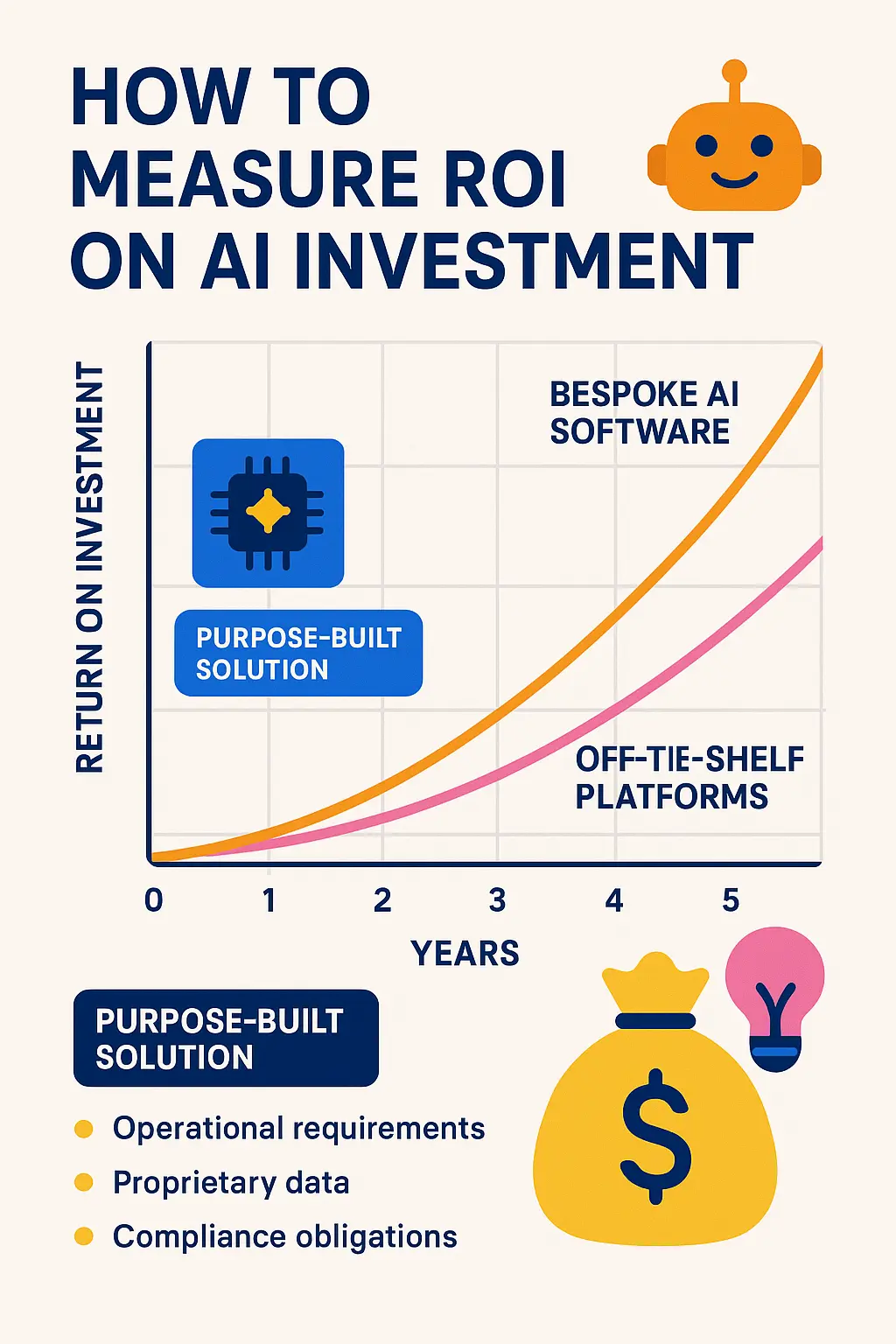
The most important financial decision in any AI implementation is not which AI technology to use — it is whether to build a purpose-built solution or deploy a generic platform. For Australian businesses with specific operational requirements, proprietary data, or compliance obligations, this decision has a clear answer when modelled correctly.
Generic AI platform licences for a mid-size Australian enterprise typically range from AUD $50,000 to $300,000 per year. Over five years, that is $250,000 to $1.5 million in licence fees — before integration, customisation, change management, and the inevitable cost of trying to make a generic tool fit a specific business environment.
A bespoke AI system is a capital asset. You own it. There are no recurring licence fees, no vendor lock-in, no risk of the platform being repriced, discontinued, or restructured by a vendor whose priorities do not align with yours. The total five-year cost of a $250,000 custom build with $30,000 per year in support is $400,000. The equivalent generic platform costs $750,000 to $1.5 million for the same period — and frequently delivers less operational value for your specific context.
The businesses achieving the strongest AI returns in Australia in 2026 are those that moved from experimenting with generic tools to committing to infrastructure engineered for their environment. As PwC Australia CEO Kevin Burrowes noted in early 2026: "The AI opportunity is massive, but Australia risks falling behind on execution. Those who see AI as a growth engine can focus freed resources on revenue-generating initiatives, such as innovation, customer relationships and strategic thinking."
How to Make a Sound AI Investment Decision in 2026: The Four Pillars
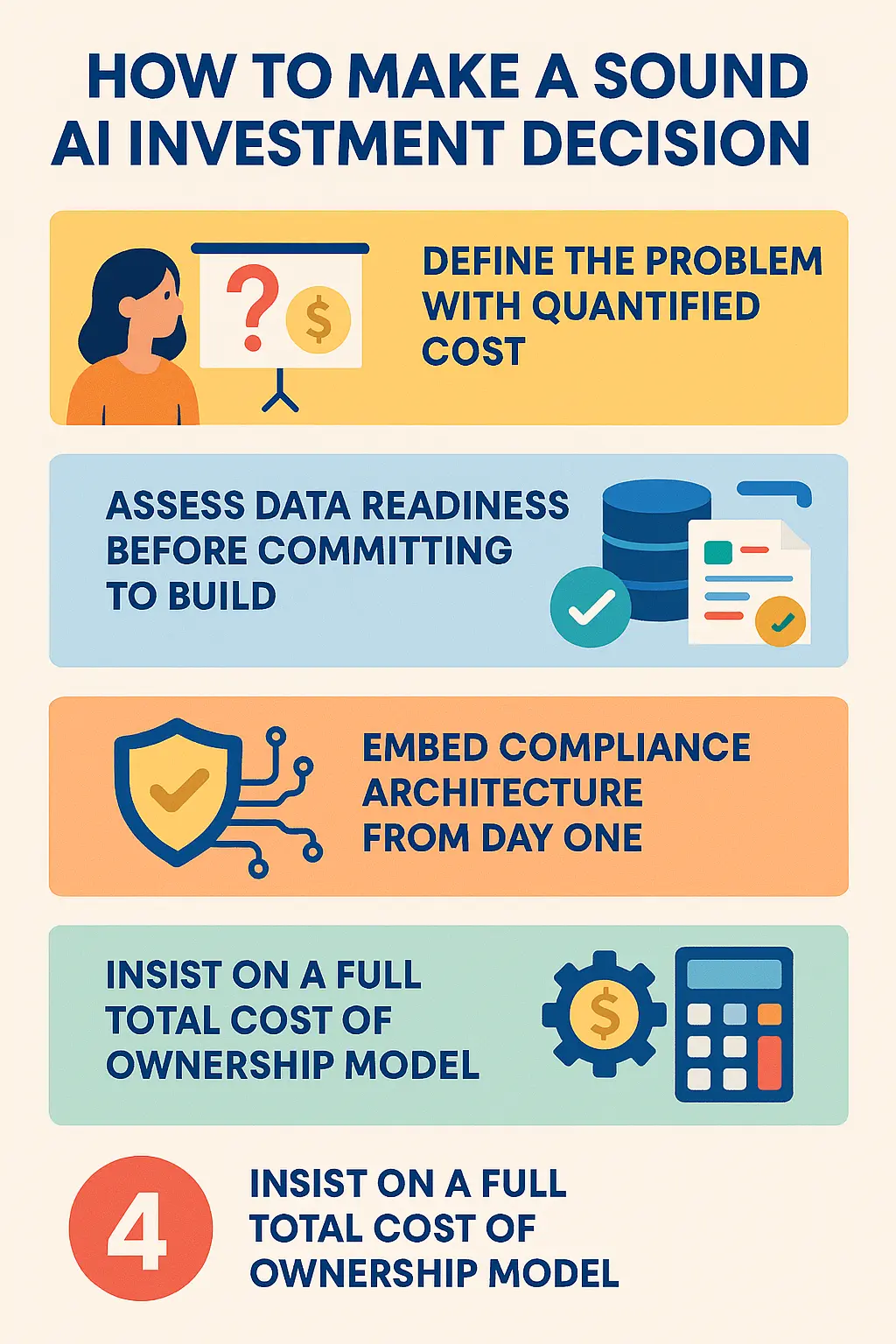
Regardless of your industry, organisation size, or the specific AI application you are evaluating, every well-structured AI investment decision in Australia rests on four pillars. These are not theoretical principles — they are the practical decisions that separate successful deployments from expensive experiments.
Pillar 1: Define the Problem With Quantified Cost
The starting point for every AI investment is not a technology selection — it is a precise definition of the operational problem being solved and a quantified cost of the current state. This creates your investment benchmark, your ROI baseline, and the language your board and CFO will use to evaluate the decision. Without it, you cannot determine whether the investment is rational.
Pillar 2: Assess Data Readiness Before Committing to Build
AI capability is capped by data quality. A structured data readiness assessment — evaluating quality, completeness, governance, and accessibility of your existing data assets — is essential before any build begins. This step prevents the most common cause of AI project budget overruns and timeline failures. If your data is not ready, the first investment is in data infrastructure — not in AI models.
Pillar 3: Embed Compliance Architecture From Day One
Australian regulatory obligations are design requirements, not deployment considerations. Privacy Act compliance, APRA or AHPRA governance where applicable, explainability standards, audit trail requirements, and data sovereignty obligations must be embedded in system architecture from the first design session. The cost of building compliance in from the start is a fraction of the cost of a regulatory investigation, a product recall, or a customer dispute resolution process after deployment.
Pillar 4: Insist on a Full Total Cost of Ownership Model
A complete investment decision accounts for every cost category: design and build, data engineering, system integration, cloud infrastructure, change management, staff training, ongoing maintenance, model retraining, and annual governance reviews. A reputable AI software consultancy will scope and cost each category transparently and provide fixed-price proposals for clearly defined deliverables. If a vendor cannot offer cost certainty for a scoped engagement, that is a material risk signal.
What to Look for in an AI Software Consultancy in Australia
The Australian AI consulting market is crowded. The variance in capability, commercial integrity, and genuine engineering depth is significant. These are the questions that separate credible AI software consultancy partners from the noise.
- Can they show you production AI systems they have built and deployed — not demonstrations, not configured third-party platforms, but running, production-grade custom-built systems?
- Do they have documented knowledge of Australian compliance requirements in your sector — Privacy Act, APRA, AHPRA, ASIC, or relevant industry standards?
- Does the contract explicitly assign all intellectual property — code, models, data pipelines, and documentation — to your organisation on completion?
- Do they provide fixed-price proposals with defined deliverables and acceptance criteria, or do they only offer time-and-materials arrangements with no outcome accountability?
- Do they offer structured post-deployment support agreements with defined response times — or do they deliver and depart?
- Do they raise the R&D Tax Incentive as part of their scoping process, and structure their documentation to support a claim?
C9 meets every one of these criteria. Our engagements begin with a complimentary scoping workshop that maps your use case, your data environment, your integration requirements, and your compliance obligations. From that workshop, we produce a transparent, fixed-price proposal with clear deliverables, timelines, and acceptance criteria — before you commit to anything.
The Cost of Waiting: Why 2026 Is the Year That Defines the Next Five
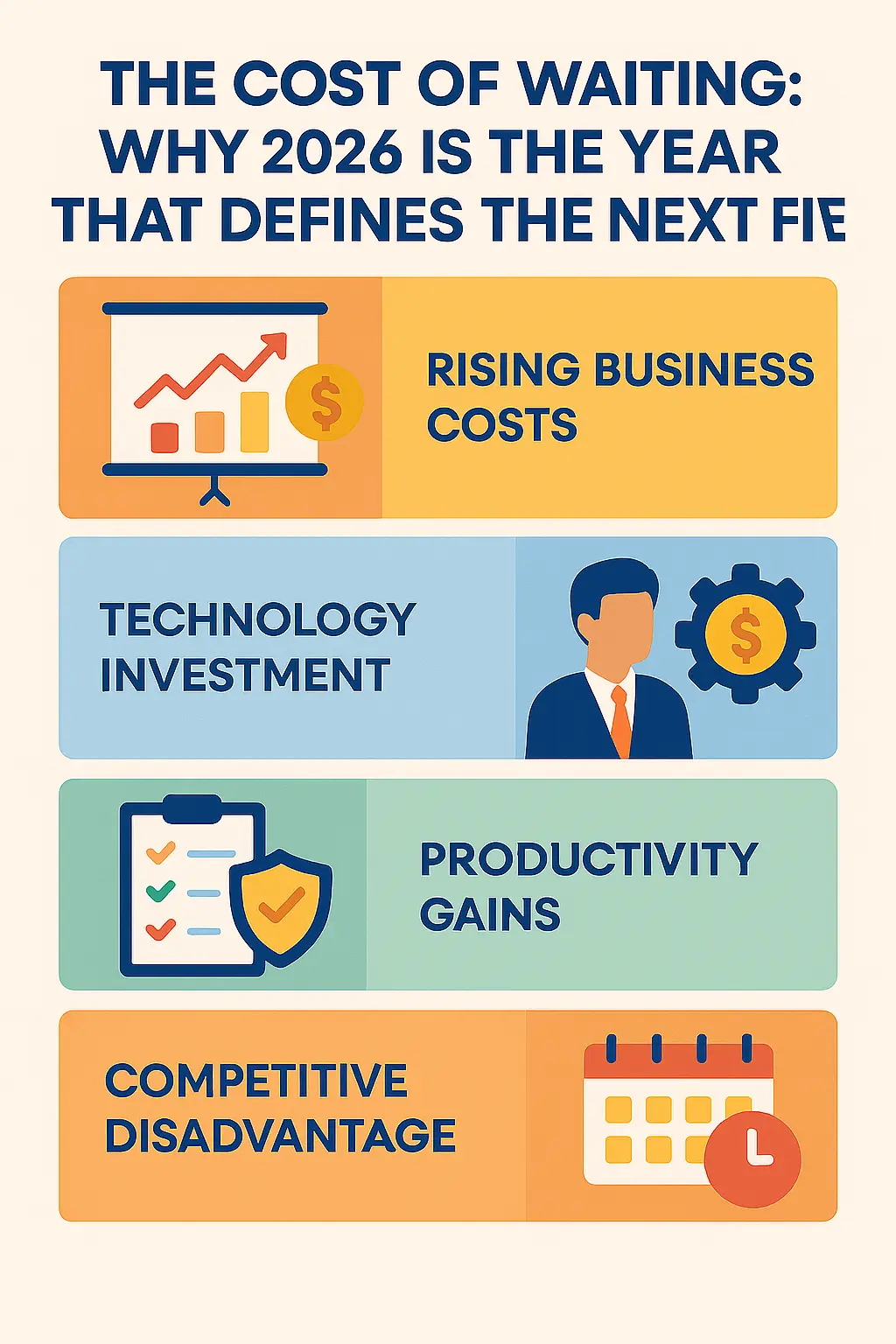
The 2026 Australian Business Outlook report from the Australian Industry Group surveyed more than 200 business leaders. Ninety per cent expected business costs to climb further in 2026. Technology investment was the only investment category to increase — 49 per cent of leaders were investing in technology upgrades. Fifty per cent were prioritising process improvement.
The businesses that will emerge from 2026 with structural competitive advantage are not those with the largest AI budgets. They are those that made clear, well-structured investment decisions — defined the right problems, invested in bespoke software engineered for their environments, and committed to implementation with the same discipline they would apply to any significant capital project.
The AI opportunity for Australian businesses is real and quantified. The AI Opportunities Report 2025 projects that SMEs will achieve productivity growth 22 per cent faster than larger firms between 2025 and 2030. AI is already adding an estimated $21 billion per year to Australia's economy through productivity improvements. That figure could grow sevenfold by 2030.
For individual businesses, the calculation is more direct. Every month of delay is a month of competitive ground ceded to businesses that are investing now. Every generic platform licence is budget that could be building an asset you own. Every AI project that stalls in the pilot phase is an operational cost that continues unabated.
THE OPPORTUNITY COST
49% of Australian business leaders are investing in technology upgrades in 2026 — the only investment category to increase year on year. The businesses investing strategically now will not wait for you to catch up.
Conclusion: The Transparent Answer Australian Executives Deserve
The true cost of AI software implementation in Australia is real, significant, and knowable. It ranges from $70,000 for a focused proof-of-concept to $700,000 or more for an enterprise-scale custom platform. The factors that determine where on that spectrum your project lands — data readiness, integration complexity, compliance requirements, and the quality of your implementation partner — are all within your control.
What is not within your control is the competitive environment. The Australian AI market is growing at 36.7 per cent per year. Sixty-seven per cent of your CEO peers are investing in AI this year. The businesses that invest with clarity, rigour, and the right partner will build capabilities that compound. The businesses that wait, or that invest in generic tools without a proper framework, will find themselves closing that gap under increasingly difficult conditions.
The transparent guide for 2026 is this: AI investment, structured correctly, is one of the highest-return capital decisions available to an Australian business right now. The cost of getting it right is calculable. The cost of getting it wrong — or of not starting — is far greater.
In short:
-
The true cost of AI implementation in Australia is AUD $70,000 to $700,000+. Data preparation, integration, and governance are the costs that determine your real budget — not the model.
-
Bespoke AI software delivers stronger long-term ROI than generic platforms for businesses with specific requirements — you own the IP, avoid recurring licence fees, and build a competitive asset.
-
The R&D Tax Incentive can reduce net investment cost by up to 43.5% for eligible Australian SMEs. Most businesses do not claim it. C9's documentation supports every claim from day one.
-
The cost of waiting compounds. 49% of Australian businesses are investing in technology upgrades now. 2026 is the year that defines the next five.
What's next?
Book a complimentary scoping workshop with C9. Bring your highest-cost operational challenge, your questions about data readiness, and your timeline. We will give you a transparent, fixed-price assessment and a clear picture of what the right AI investment looks like for your business. No obligation. No sales pressure. Just clarity.
Ready to Invest in AI the Right Way?
We build bespoke AI solutions engineered for your business — compliant with Australian regulations and built to deliver measurable ROI.
Book a Complimentary Scoping Discovery → www.c9.com.au
Frequently Asked Questions
How much does AI software implementation cost in Australia?
AI software implementation in Australia typically costs between AUD $70,000 and $700,000 or more, depending on the complexity of the use case, the depth of system integration required, data preparation needs, and compliance obligations. A focused proof-of-concept or MVP can be delivered for $40,000 to $120,000. Mid-scale bespoke AI systems range from $120,000 to $350,000. Enterprise-grade custom AI platforms range from $350,000 to $700,000 and above.
What are the hidden costs of AI implementation that vendors don't quote?
The most commonly underquoted costs in AI projects include data preparation and engineering (which can consume 60–80% of project time), system integration with existing platforms, cloud infrastructure and compute costs, change management and staff training, ongoing model maintenance and retraining, and annual compliance and governance reviews. These costs should be explicitly scoped and quoted before any AI project is approved.
Can Australian businesses claim the R&D Tax Incentive for AI development?
Yes. Custom AI software development — including machine learning model development, novel algorithm design, and experimental data engineering — frequently qualifies as eligible R&D activity under the Australian Government's R&D Tax Incentive. Eligible small companies (turnover under $20 million) can receive a 43.5% refundable tax offset. C9's project documentation is structured to support R&D claims from the outset.
Is bespoke AI software better than off-the-shelf platforms for Australian businesses?
For businesses with specific operational requirements, proprietary data, or compliance obligations, bespoke AI software consistently delivers stronger long-term ROI than generic platforms. You own the intellectual property, avoid recurring licence fees, and benefit from a system engineered for your specific environment. Over a five-year total cost of ownership model, bespoke solutions almost always outperform generic platforms for mid-to-large Australian enterprises.
How do I measure ROI on an AI investment?
Begin by quantifying the current cost of the problem being solved — in labour, errors, delays, compliance risk, and missed revenue. This creates your investment benchmark. Then model the expected improvement from the AI system and calculate the net present value over three years against the total cost of ownership. Well-engineered bespoke AI systems in Australia typically achieve full cost recovery within 12 to 18 months, with ongoing annual savings that significantly exceed the initial investment.
References and Sources
The following sources were used in the research and preparation of this article. All statistics and market data cited are drawn from these primary and secondary sources.
- Grand View Research (2025). Australia Artificial Intelligence Market Size & Outlook, 2033.
- Dataclysm (2025). AI Development Costs in Australia: Complete 2025 Guide.
- OpenAI / NEXTDC (2025). Australia's AI Opportunity Report 2025: Building the Intelligence Economy.
- Employment Hero (2026). Why AI Will Be Keeping Australian Businesses Afloat in 2026.
- Appinventiv (2026). AI Implementation in Australia (2026): Use Cases, Costs & Strategy.
- ITBrief Australia (2025). AI Spend to Focus on Cost, Outcomes & Data in 2026 Shift.
- Digital One Agency (2026). How Australian Businesses Are Replacing $300,000 in Admin Costs With AI in 2026.
- Appinventiv (2026). 15 Profitable AI Business Ideas in Australia for 2026 and Beyond.
- Australian Government (2024). Research and Development Tax Incentive.
- Australian Industry Group (2026). 2026 Business Outlook Report.
- PwC Australia (2026). CEO Survey 2026 — AI Trust and Execution Gap.
- Gartner (2025). AI Adoption and Change Management Benchmarks.
Explore Related Insights on AI Solutions
Why Australian Businesses Are Losing Thousands Weekly to Missed Calls — And How Voice AI Fixes It
How Agentic AI Chatbots Transform Lead Engagement: Stop Losing Leads
How Generative AI Is Revolutionising Custom BI Dashboards in Australia
Generative AI & Integration Strategy for Businesses Mobile Application
Why Australian Business Leaders Must Build an AI-Ready Workforce in 2026
AI Agents Are the New Form of Labour
Agentic AI in Customer Service: The Future of Autonomous Support Workflows
Agentic AI in HR: How Autonomous AI Systems Are Reshaping People Management in Australian Enterprises
Agentic AI in Australian Banking: How Custom AI Applications Are Replacing Manual Back-Office Work in 2026
The True Cost of AI Software Implementation in Australia: A Transparent Guide for 2026
What Is Bespoke AI? Why Custom AI Solutions Australia Beat Off-the-Shelf Tools in 2026
From Concept to AI Agent: Building Custom Agentic AI Solutions for Enterprise Workflows
RAG Systems: Stop AI Hallucinations | C9 Australia
AI-Orchestrated Integration Workflows: Transforming Australian Businesses Through Intelligent Connectivity
AI Race: Who's Leading the Pack?
Digital Darwinism: Why Multimodal AI Is the Next Extinction Event for Businesses
Left in the Digital Dust: The Looming Crisis for Businesses Resisting AI and LLMs
The Next Competitive Edge: Why Hybrid AI is the Game Changer for Australian Businesses
How to Calculate the ROI of AI Agents: A Guide for AU SMEs | C9
How Productivity Agents Are Revolutionising Australian Workplaces in 2026 and Beyond
Revolutionising Recruitment: How AI is Reshaping Entry-Level Developer Roles and Essential Skills for Australian Businesses in 2026
Is Your Business AI-Ready? 5 Critical Signs You're Falling Behind (And How to Catch Up)
Beyond the Hype: 5 Verifiable Strategies for Deploying Agentic AI Sales Workflows to Solve the Talent Shortage
AI Transparency Notice:
This article was produced with the assistance of artificial intelligence tools, including content drafting, visual asset creation, and audio generation. All content has been reviewed and approved by C9 prior to publication.