Executive summary
Custom Robotic Process Automation (RPA) delivers faster, measurable ROI when engineered around your systems, compliance and growth plan. This long‑form guide explains why bespoke RPA outperforms off‑the‑shelf tools, why discovery calls are essential (and skipping them is costly), the risks of cheap “AI cowboy” builders and vibe‑coding, and how C9’s blended inshore/offshore teams, knowledge transfer and staff augmentation options reduce risk while accelerating value. Practical pricing guidance and an illustrative indicative vs discovery pricing example are included so executives can make confident decisions.
In short
Generic RPA and low‑cost AI app builders often fail to integrate, scale or deliver predictable ROI, that failure creates hidden costs: rework, vendor lock‑in, compliance gaps and stalled projects.
Solution: Start with a structured discovery, deliver in stages for early ROI, and insist on knowledge transfer and integrated teams.
Why bespoke RPA matters for Australian businesses in 2026
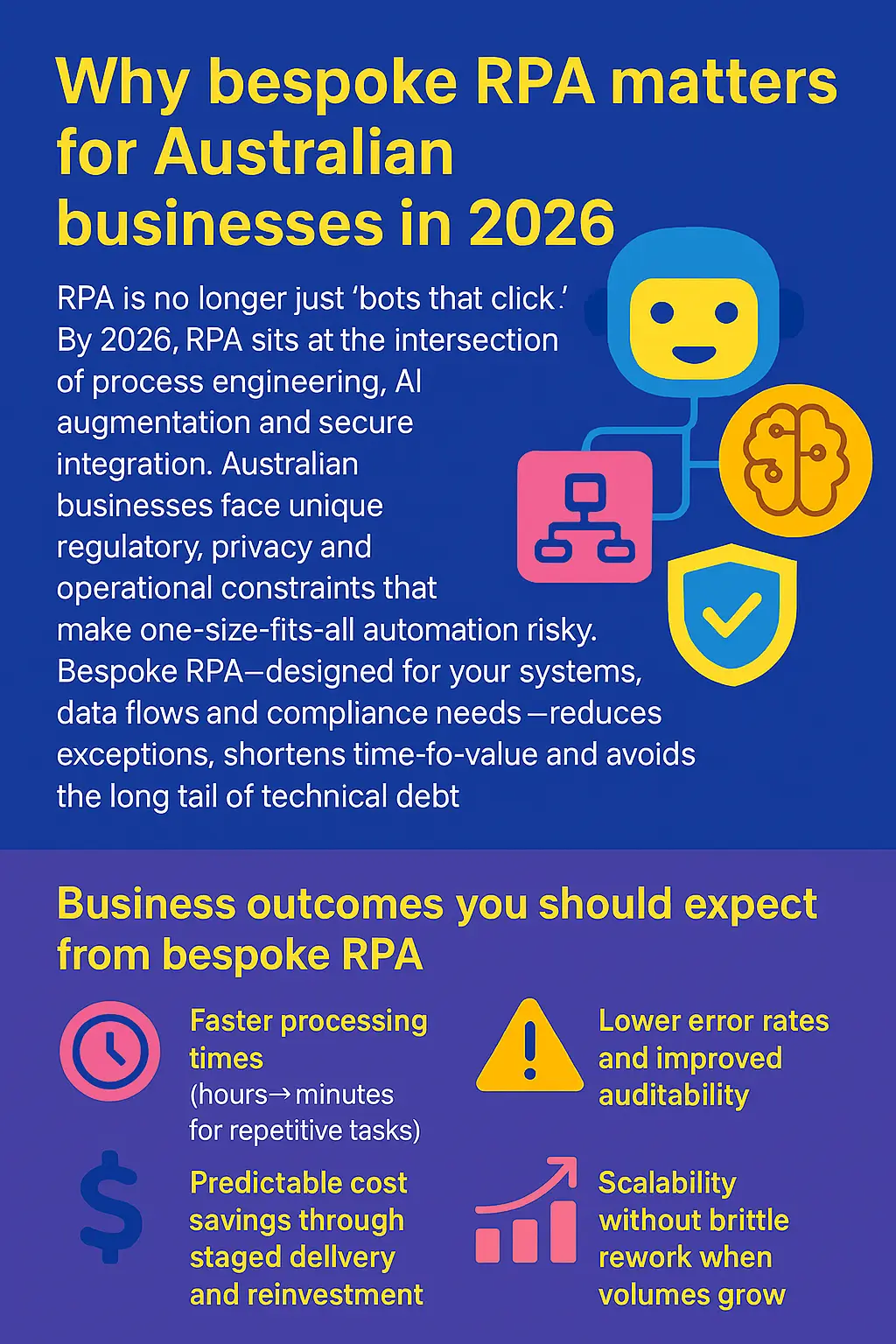
RPA is no longer just “bots that click.” By 2026, RPA sits at the intersection of process engineering, AI augmentation and secure integration. Australian businesses face unique regulatory, privacy and operational constraints that make one‑size‑fits‑all automation risky. Bespoke RPA — designed for your systems, data flows and compliance needs — reduces exceptions, shortens time‑to‑value and avoids the long tail of technical debt.
Business outcomes you should expect from bespoke RPA
- Faster processing times (hours → minutes for repetitive tasks).
- Lower error rates and improved auditability.
- Predictable cost savings through staged delivery and reinvestment.
- Scalability without brittle rework when volumes grow.
These outcomes are measurable and repeatable when projects follow a disciplined discovery → design → build → transfer approach.
What goes wrong when you skip Discovery
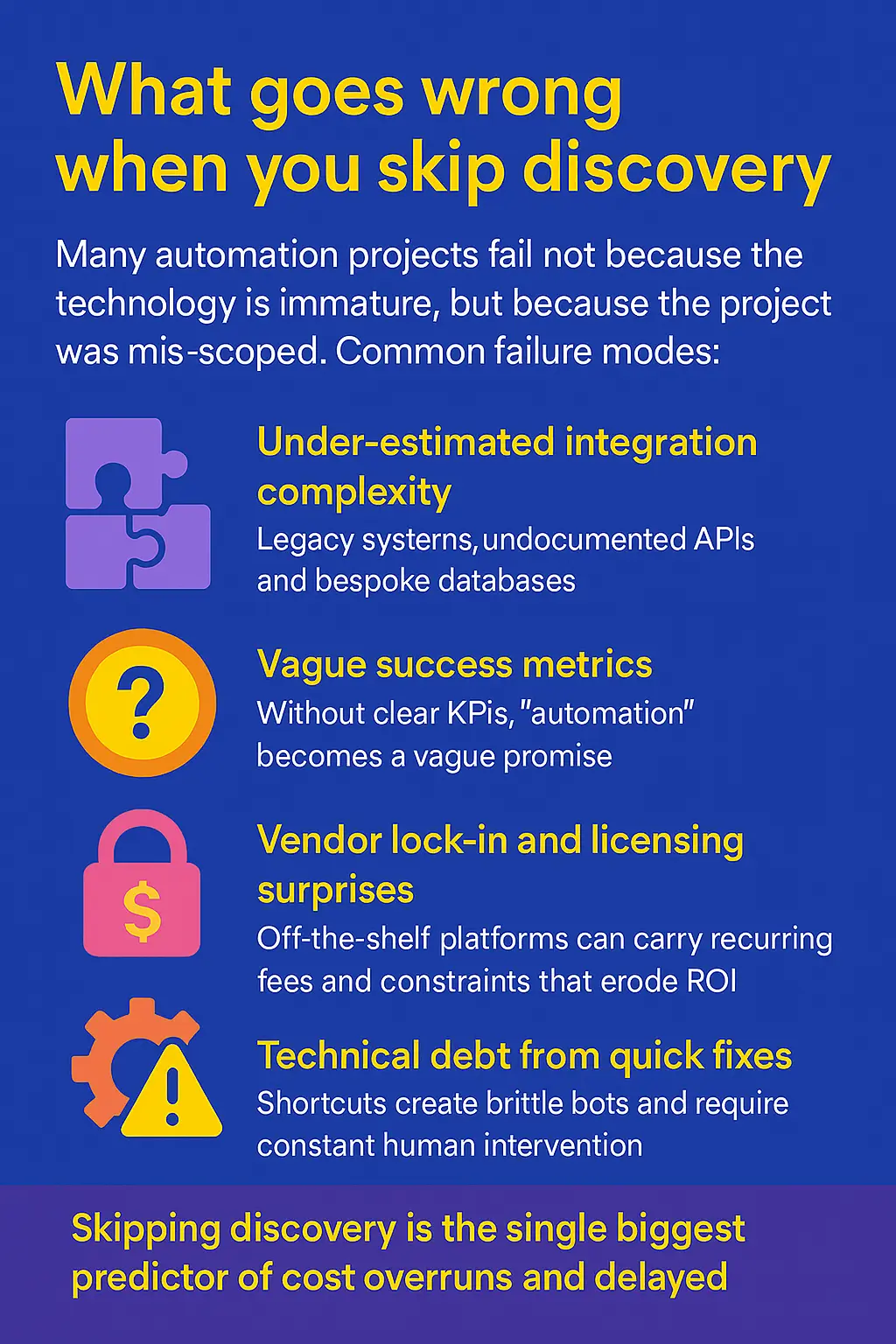
Many automation projects fail not because the technology is immature, but because the project was mis‑scoped. Common failure modes:
- Under‑estimated integration complexity. Legacy systems, undocumented APIs and bespoke databases add hours of hidden work.
- Vague success metrics. Without clear KPIs, “automation” becomes a vague promise rather than a measurable programme.
- Vendor lock‑in and licensing surprises. Off‑the‑shelf platforms can carry recurring fees and constraints that erode ROI.
- Technical debt from quick fixes. Shortcuts create brittle bots that require constant human intervention.
Skipping discovery is the single biggest predictor of cost overruns and delayed benefits.
The “AI cowboy” problem and the grey areas of vibes coding
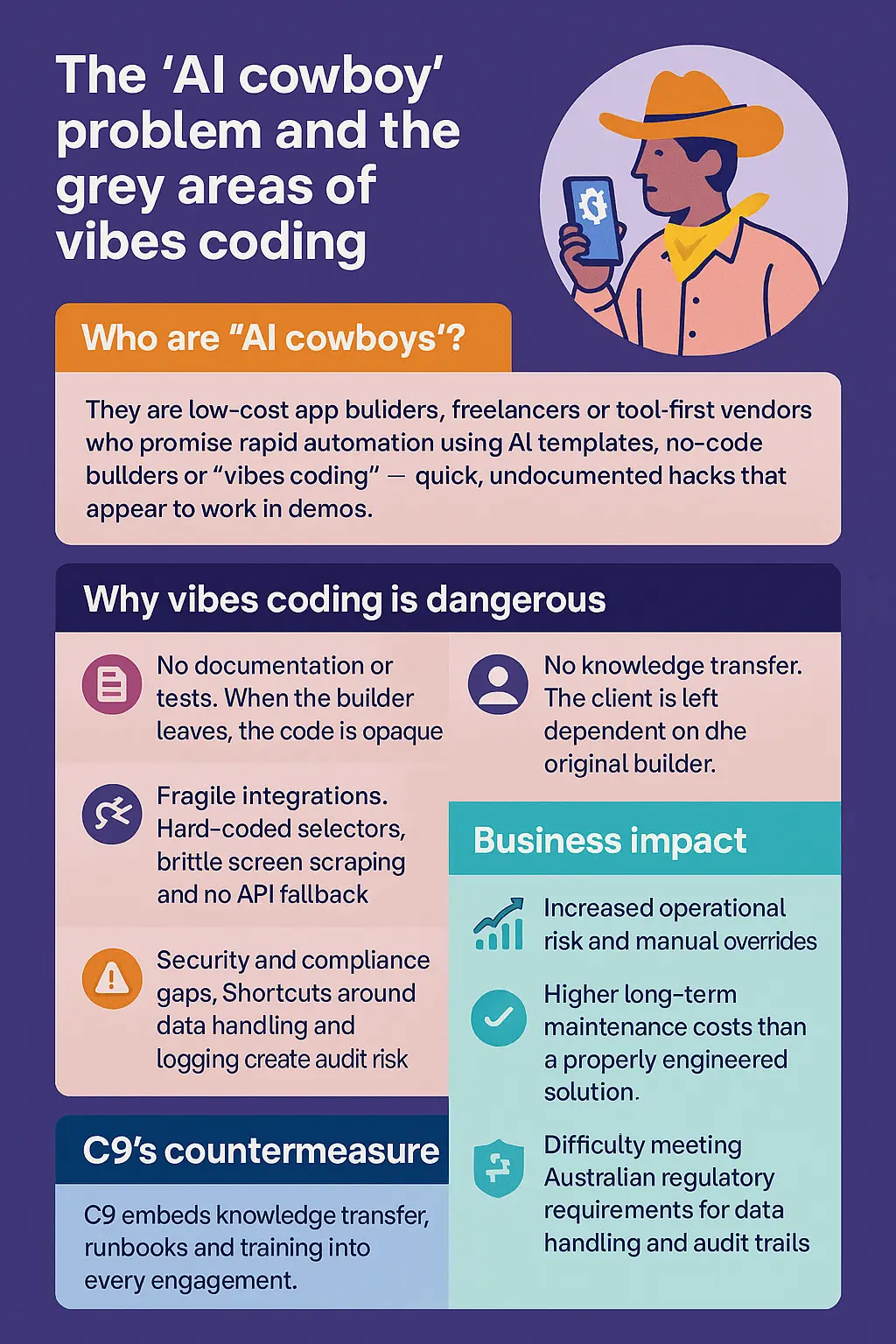
Who are “AI cowboys”?
They are low‑cost app builders, freelancers or tool‑first vendors who promise rapid automation using AI templates, no‑code builders or “vibes coding” — quick, undocumented hacks that appear to work in demos.
Why vibes coding is dangerous
- No documentation or tests. When the builder leaves, the code is opaque.
- Fragile integrations. Hard‑coded selectors, brittle screen scraping and no API fallback.
- Security and compliance gaps. Shortcuts around data handling and logging create audit risk.
- No knowledge transfer. The client is left dependent on the original builder.
Business impact
- Increased operational risk and manual overrides.
- Higher long‑term maintenance costs than a properly engineered solution.
- Difficulty meeting Australian regulatory requirements for data handling and audit trails.
C9’s countermeasure
C9 embeds knowledge transfer, runbooks and training into every engagement. We deliver maintainable code, test coverage and formal handover so your team owns the automation.
How Bespoke RPA delivers measurable ROI
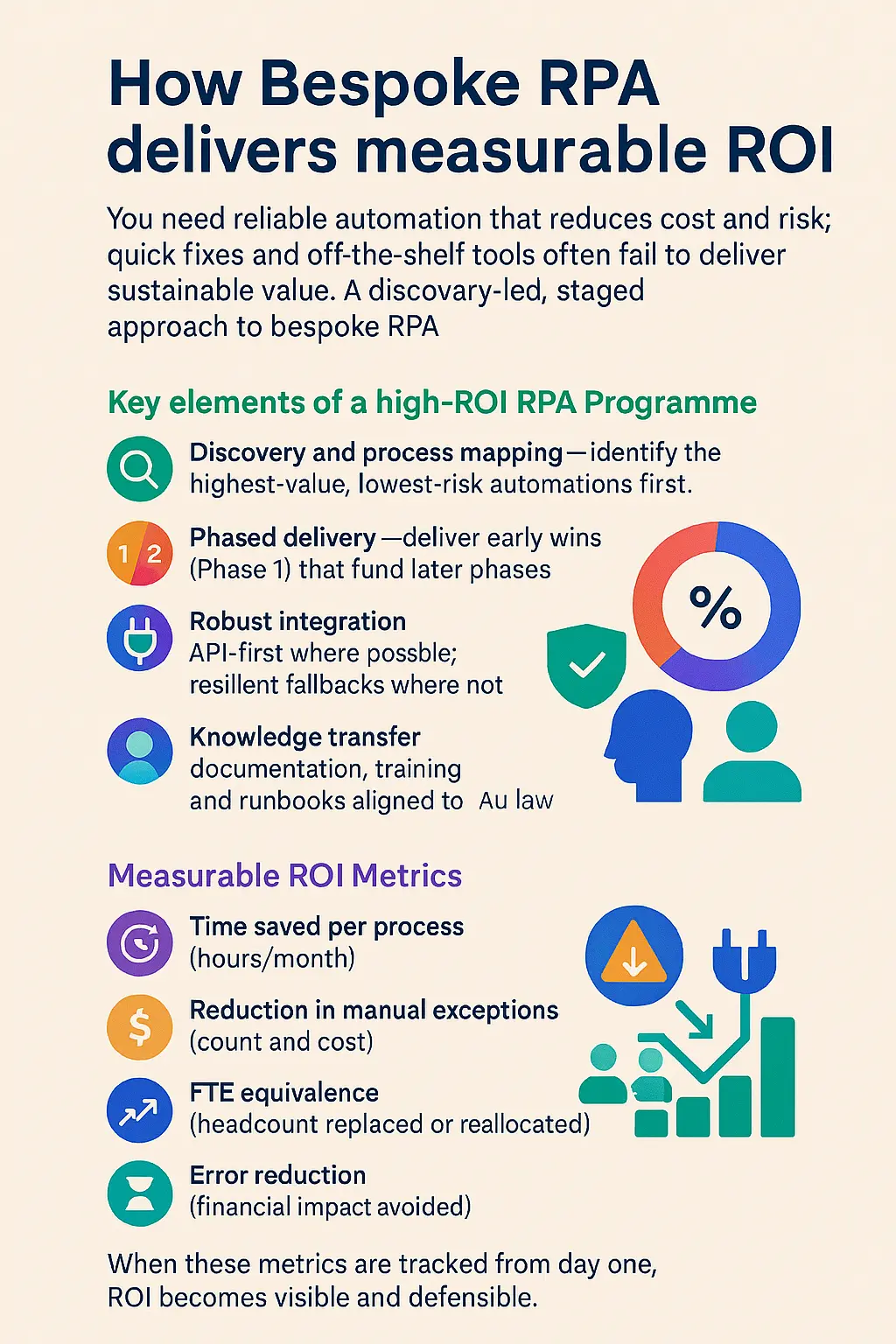
You need reliable automation that reduces cost and risk, quick fixes and off‑the‑shelf tools often fail to deliver sustainable value. A discovery‑led, staged approach to bespoke RPA.
Key elements of a high‑ROI RPA programme
- Discovery and process mapping — identify the highest‑value, lowest‑risk automations first.
- Phased delivery — deliver early wins (Phase 1) that fund later phases.
- Robust integration — API‑first where possible; resilient fallbacks where not.
- Security and compliance by design — logging, role‑based access and data handling aligned to Australian law.
- Knowledge transfer — documentation, training and runbooks so your team can operate and extend bots.
Measurable ROI metrics
- Time saved per process (hours/month).
- Reduction in manual exceptions (count and cost).
- FTE equivalence (headcount replaced or reallocated).
- Error reduction (financial impact avoided).
- Time to compliance (audit readiness improvements).
When these metrics are tracked from day one, ROI becomes visible and defensible.
Discovery Calls: What they are, How they work and Why they’re essential
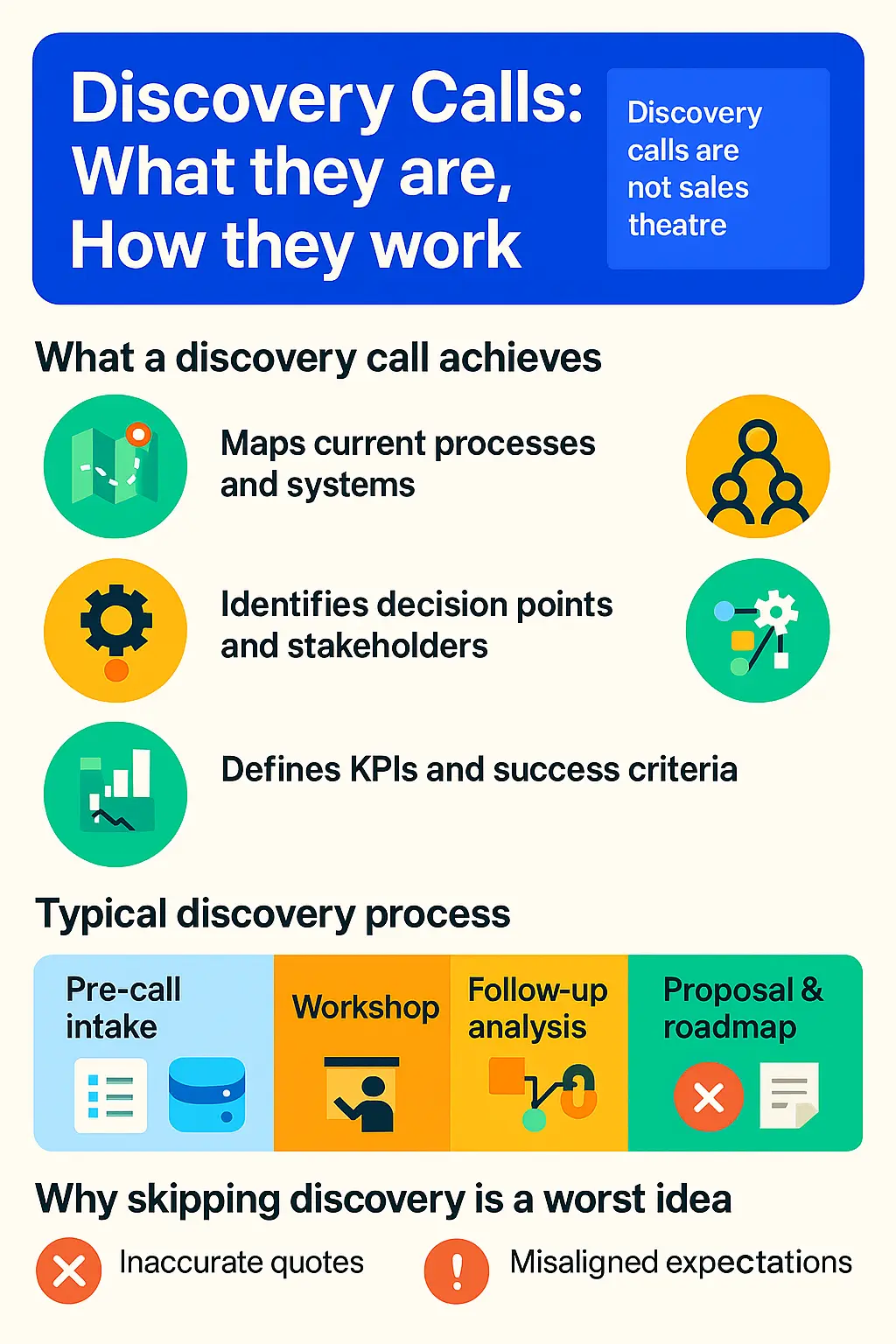
Discovery calls are not sales theatre — they are risk mitigation and alignment.
What a discovery call achieves
- Maps current processes and systems. Who does what, where and why.
- Identifies decision points and stakeholders. Who signs off, who tests, who owns exceptions.
- Surfaces integration complexity. APIs, databases, legacy systems and third‑party services.
- Defines KPIs and success criteria. What “done” looks like and how ROI will be measured.
- Establishes timelines and dependencies. Procurement, security reviews and data access windows.
Typical discovery process (practical breakdown)
- Pre‑call intake (1–2 days)
- Short questionnaire; system inventory; sample data.
- 60–90 minute workshop
- Process walkthrough with stakeholders; identify exceptions and edge cases.
- Follow‑up analysis (2–5 days)
- Integration map, risk register, high‑level architecture and recommended phases.
- Proposal & staged roadmap (3–7 days)
- Phased scope, early‑win targets, resource plan and discovery‑based pricing.
Why skipping discovery is a worst idea
- Inaccurate quotes lead to scope creep and disputes.
- Missed compliance issues create remediation costs later.
- Misaligned expectations cause delays and poor adoption.
Discovery reduces uncertainty and enables pricing to the nearest day or week rather than the nearest hour.
Staff Augmentation and Resourcing: Options and Why 3–6 month minimums work
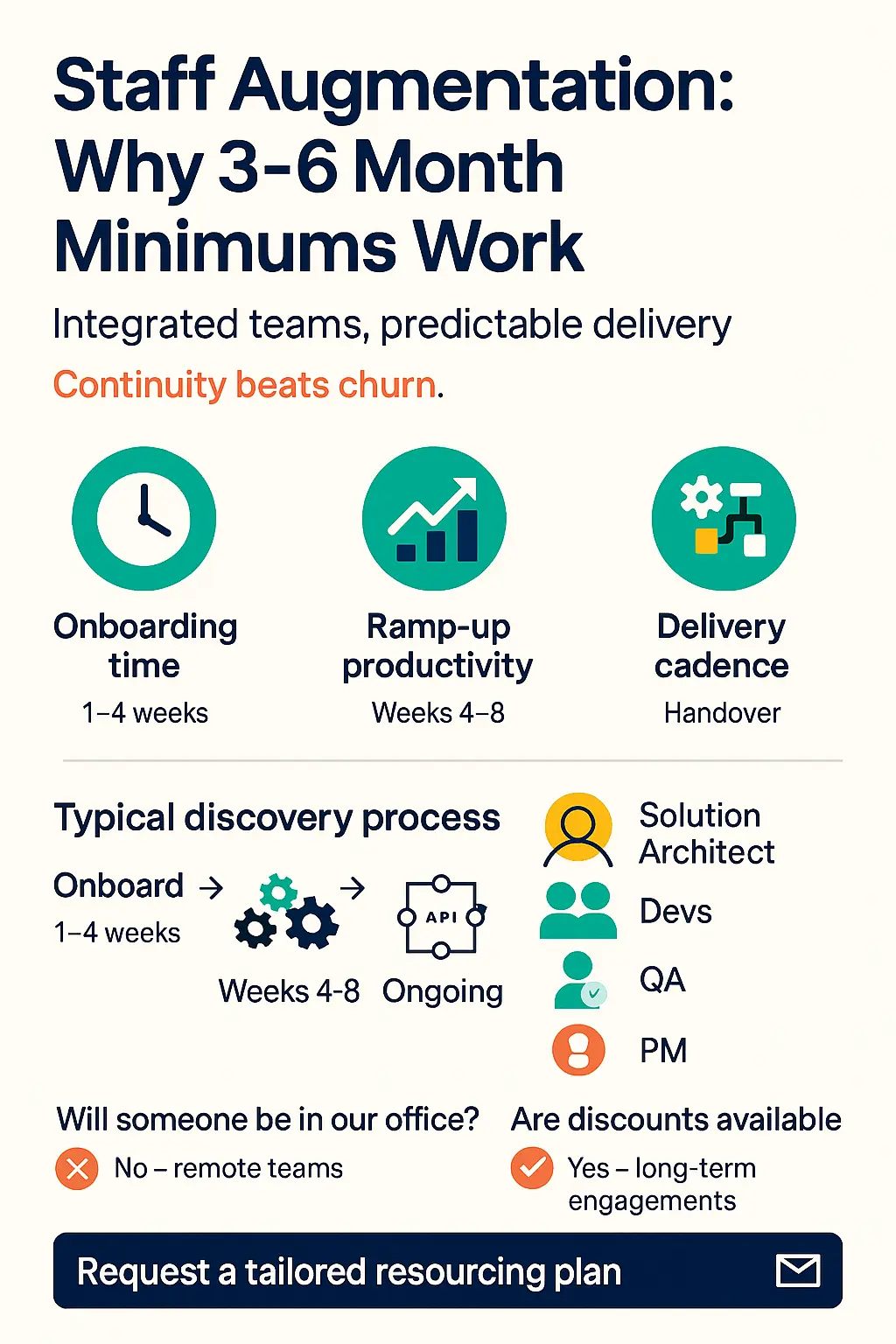
C9 offers flexible staff augmentation tailored to project needs. We do not supply a single contractor; we provide integrated teams.
Resourcing options
- Monthly rolling contracts — flexible, scale up or down with notice.
- Minimum lock‑in (3–6 months) — recommended for continuity and delivery.
- Long‑term multi‑resource contracts — discounts for >3 resources and extended terms.
Why a 3–6 month minimum is better
- Onboarding time: domain knowledge and system access take weeks.
- Ramp‑up productivity: developers and QA become productive after an initial learning curve.
- Delivery cadence: meaningful features and knowledge transfer require sustained engagement.
- Cost efficiency: reduces churn and rework; improves velocity.
What you get from C9’s augmentation
- Integrated team composition: solution architect, developers, QA, and project manager.
- Blended hybrid model: onshore client‑facing leads + offshore engineering for cost efficiency.
- No expectation of local 9–5 office presence: remote collaboration aligned to your hours.
- Knowledge transfer: formal handover, documentation and training sessions.
Top FAQs (short answers)
- Will someone be in our office? No — we operate remote teams but align to your working hours for collaboration.
- Can we scale down quickly? Yes — monthly packages can be scaled with notice; longer contracts offer better rates.
- Do you provide local PM oversight? Yes — onshore PM oversight is included for hybrid teams.
- Are discounts available? Yes — for long‑term and multi‑resource engagements.
Pricing Transparency: Rates, Savings and How we price
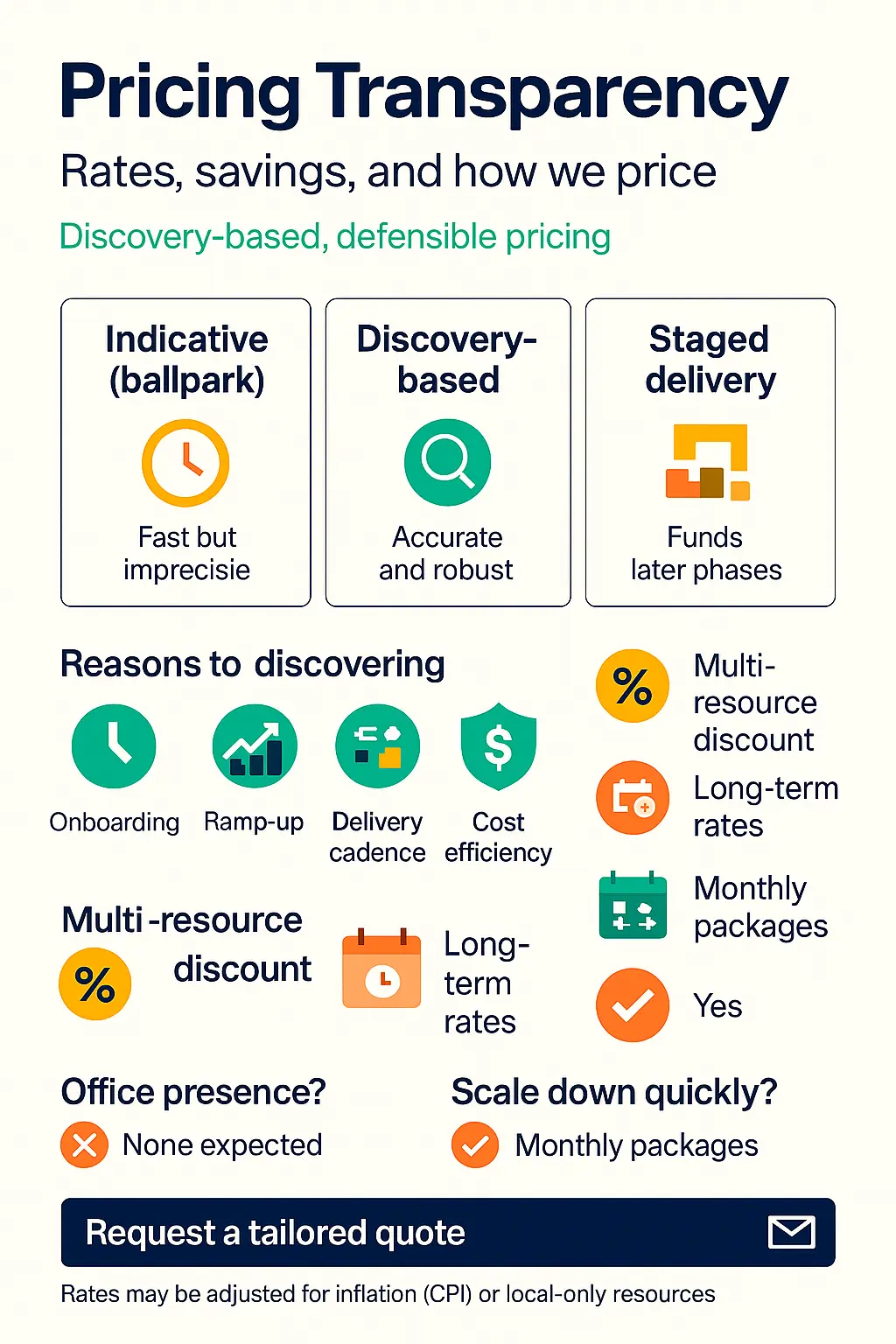
C9’s FY25/26 rates vary by skillset and the mix of onshore/offshore resources. Rates are subject to CPI adjustments and will increase if local‑only resources are mandated.
Pricing principles
- Discovery‑based pricing is accurate and defensible.
- Indicative pricing (ballpark) is useful only for early conversations — it is often inaccurate without discovery.
- Staged delivery allows early ROI to fund later phases.
- Discounts for multi‑resource (>3) and long‑term contracts.
- Monthly packages can be scaled and include roll‑over hours for feature stockpiling.
Indicative Pricing Pitfalls — a worked example
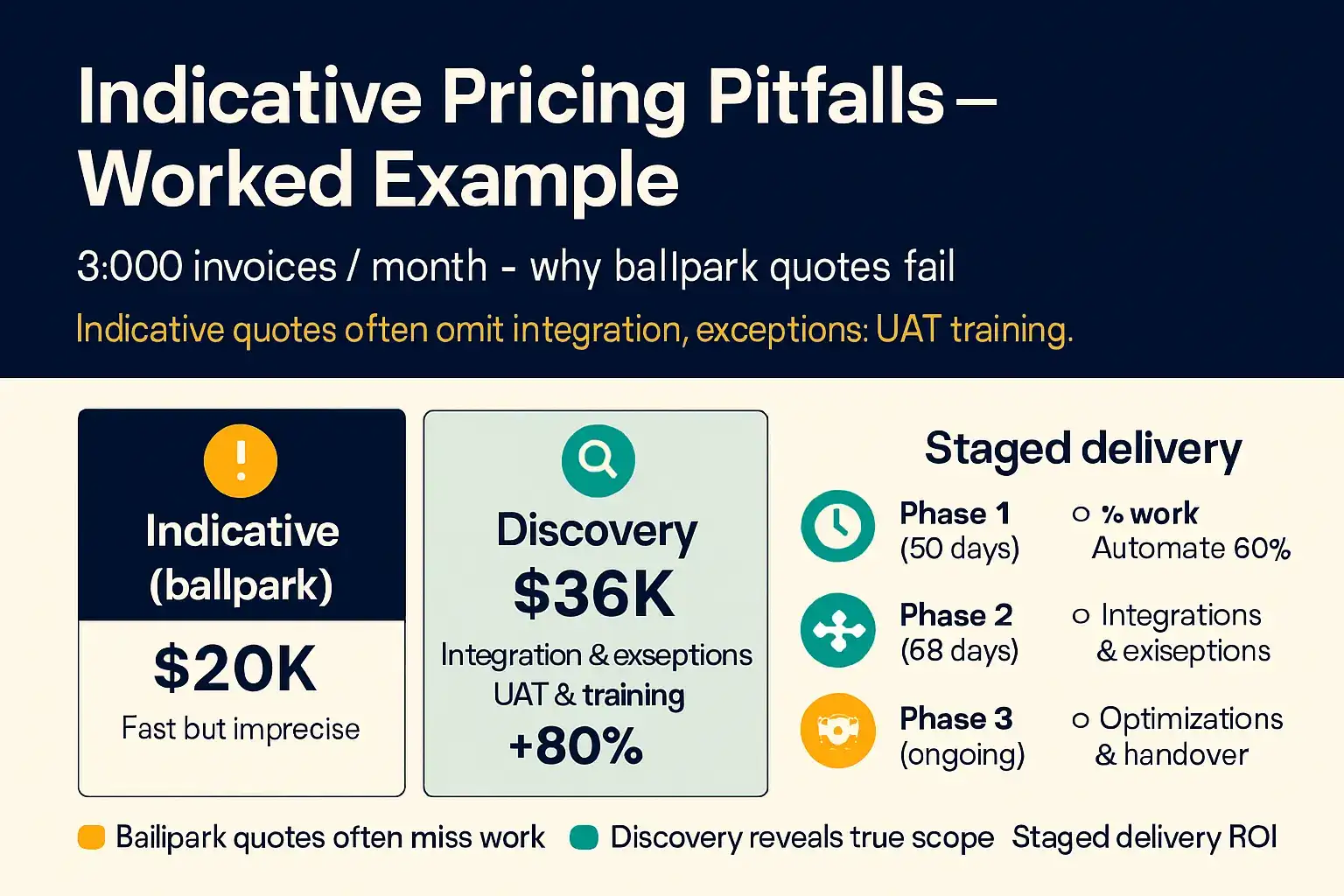
Scenario: Automate invoice processing for 3,000 invoices/month.
Indicative quote (nearest hour)
- Vendor A: 200 hours × $100/hr = $20,000 (ballpark).
Why this is risky: It often excludes API integration, exception handling, UAT, remediation and training.
Discovery‑based estimate (nearest day/week, staged)
Discovery reveals:
- API integration with ERP: 40 hrs
- Exception handling and rules: 60 hrs
- UAT and remediation: 40 hrs
- Documentation & training: 20 hrs
- Core automation development: 200 hrs
Total: 360 hrs
Cost at $100/hr: 360 × $100 = $36,000
Staged delivery for early ROI
- Phase 1 (30 days): Automate 60% of invoices (120 hrs) → early ROI in month 2.
- Phase 2 (45 days): Integrations and exception workflows (160 hrs).
- Phase 3 (ongoing): Optimisations and knowledge transfer (80 hrs).
Why staged works
- Phase 1 delivers immediate savings that can fund Phase 2.
- Discovery reduces surprises and aligns expectations.
Why choose C9 over other RPA companies
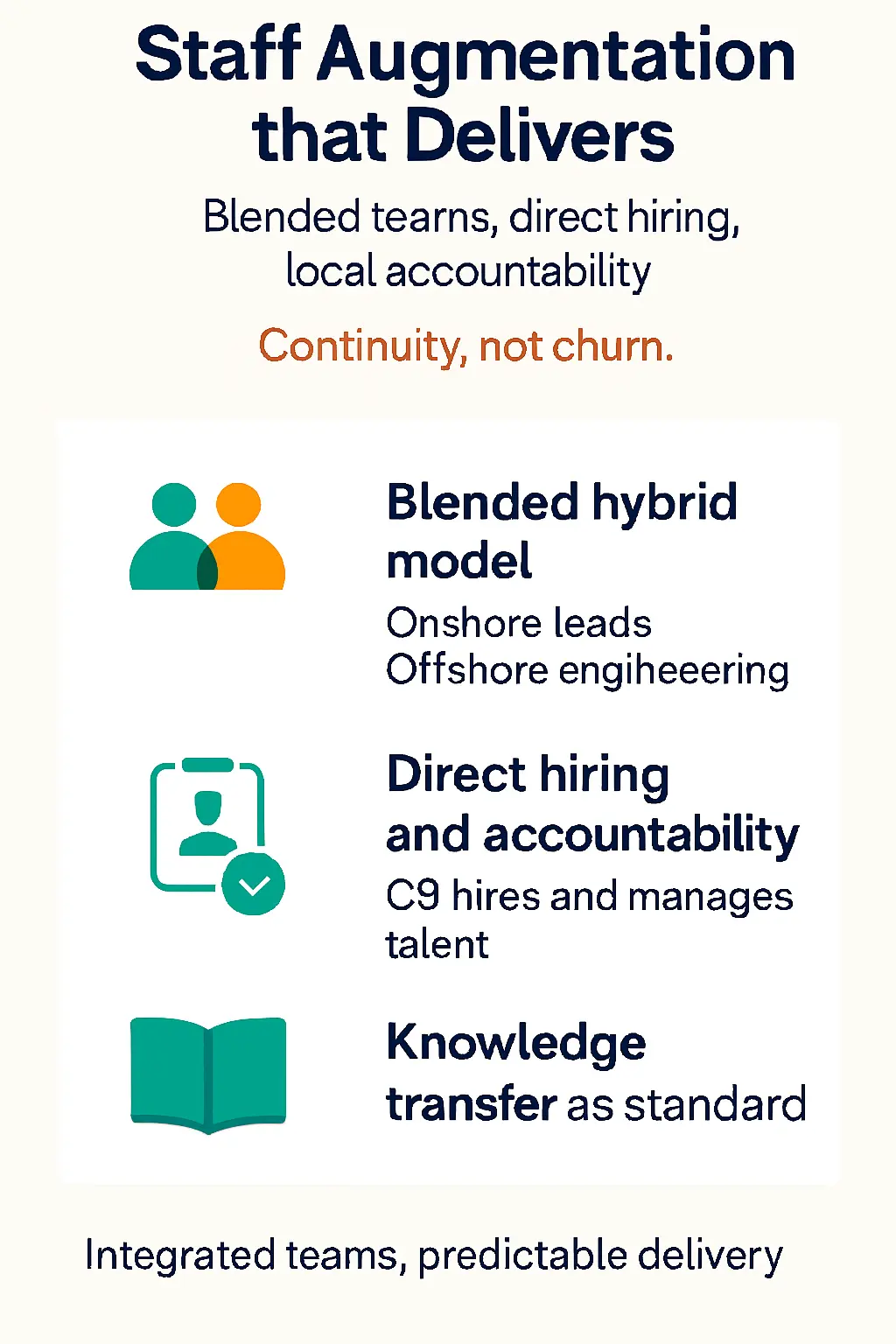
Blended hybrid model
- Onshore architects and client leads for local accountability.
- Offshore engineering for cost efficiency and scale.
Direct hiring and accountability
- C9 hires and manages talent directly — not a marketplace of unknown freelancers.
Knowledge transfer as standard
- Documentation, runbooks and training sessions included in delivery.
Integrated teams, not single heads
- Developers, QA, architects and PMs working together to reduce single‑point failure.
Local Australian focus
- Understanding of Australian compliance, privacy and business culture.
Visit / for service pages, case studies and contact details.
Frequently asked questions (RPA, pricing & staff augmentation)
Q: How long does an RPA project take?
A: Typical small‑to‑medium automations (single process) take 4–8 weeks from discovery to Phase 1 delivery. Larger, integrated programmes are staged over months.
Q: What is included in discovery?
A: Process mapping, stakeholder interviews, integration inventory, risk register and a phased roadmap with ROI targets.
Q: Do you use local staff?
A: C9 uses a blended onshore/offshore model. We do not promise local 9–5 office presence; instead we provide onshore client‑facing leads and remote engineering aligned to your hours.
Q: Can we scale resources up or down?
A: Yes — monthly packages can be scaled with notice. Longer contracts provide better rates and continuity.
Q: What guarantees do you provide?
A: We provide delivery milestones, acceptance criteria and knowledge transfer. Contractual SLAs are available for production support.
Book a Discovery Call
If you are evaluating rpa services, rpa solutions or comparing rpa companies, don’t buy on price alone. Book a 60–90 minute discovery call with C9 to map your processes, identify early‑win automations and receive a staged roadmap with realistic ROI targets.
Book now: Visit / or reply to this post to arrange a discovery session with a solutions architect.
Custom RPA is an investment that pays back quickly when executed with discipline: discovery, staged delivery and knowledge transfer. Avoid the “AI cowboy” trap and the false economy of cheap, undocumented builds. Choose a partner that delivers measurable ROI, local accountability and the ability to scale.
Appendix: Executive Checklist for Discovery (one‑line bullets)
- Map the end‑to‑end process you want to automate.
- Identify systems and data sources involved.
- List decision points and approvers.
- Define compliance and audit requirements.
- Agree success metrics and early‑win targets.
- Schedule a 60–90 minute discovery workshop.
References & Further Reading
- C9 — Services and case studies: /
- Australian Cyber Security Centre — guidance on secure development: https://www.cyber.gov.au/
- Industry reports on RPA and intelligent automation (search for latest vendor and analyst reports for up‑to‑date statistics)
AI Transparency Notice:
This article was produced with the assistance of artificial intelligence tools, including content drafting, visual asset creation, and audio generation. All content has been reviewed and approved by C9 prior to publication.