Executive Summary
In short:
Australian businesses are losing thousands each month to outdated database management. In-house DBA administrator teams now carry fully loaded costs of A$180,000–A$230,000+ per year (base salaries A$120,000–A$155,000 plus 12% superannuation, payroll tax, recruitment, training and downtime), while Australia’s persistent IT skills shortage and rapid shift to AI-driven databases and cloud platforms make it almost impossible to keep pace. Professional database management services deliver predictable monthly fees, 24/7 certified expertise, seamless integration, proactive optimisation and up to 40–60% lower total cost of ownership — freeing capital for revenue-generating initiatives and delivering the operational efficiency and competitive advantage you need in 2026.
What’s next?
This detailed 2026 Australia-specific analysis gives you the exact numbers, side-by-side comparisons and decision framework to choose confidently — then shows how a tailored, collaborative partner can turn your database into a genuine growth engine.
The Database Dilemma Facing Australian Executives in 2026
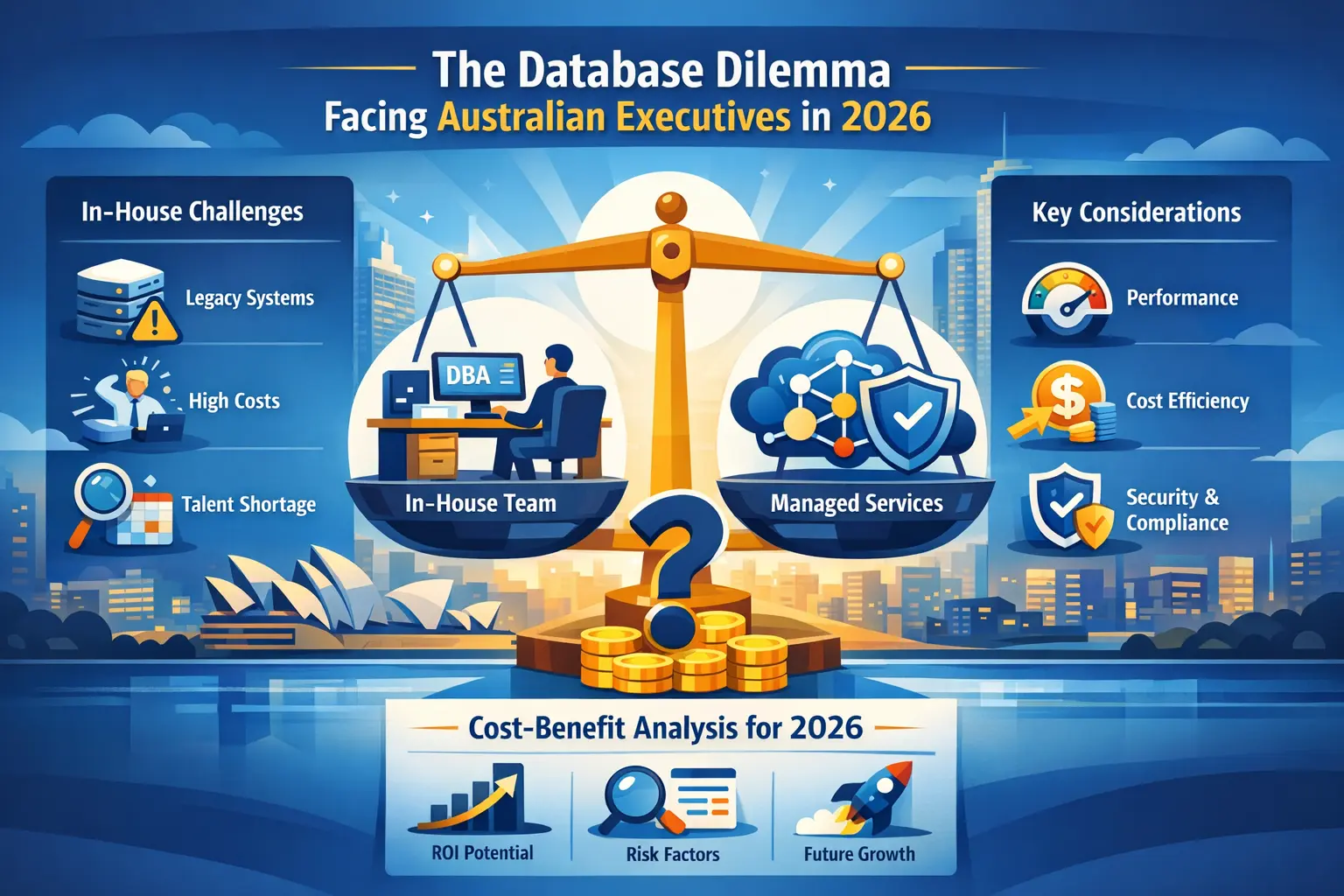
Running a growing Australian business in 2026 means your data is the single most valuable asset you own. Yet for many owners, CEOs, CTOs and executives, the database infrastructure quietly draining resources is the one challenge you’d rather not think about — until an outage, slow reporting or compliance breach forces the issue.
You need reliable DBA administrator support. You know legacy systems are holding your team back, customer experience is suffering and competitors are pulling ahead with real-time insights. But building or maintaining an in-house team feels like an expensive gamble in a market where talent is scarce, costs keep rising and technology evolves faster than most internal teams can track.
This is the exact pain point for thousands of Australian businesses right now.
In short: The choice between an in-house database team and professional database management services is no longer just an IT decision — it directly affects your operational efficiency, cost base, revenue potential and ability to outpace competitors.
What’s next? This comprehensive 2026 cost-benefit analysis breaks down the real Australian numbers, hidden risks and strategic implications so you can make a confident, data-driven decision that aligns with your growth goals.
The True Cost of an In-House Database Team in 2026
Let’s talk numbers — the kind that matter to detail-oriented, analytical executives.
According to the latest 2026 Robert Half and SEEK data, the average base salary for a DBA administrator in Australia ranges from A$120,000 to A$155,000, with mid-level roles in Sydney and Melbourne often sitting at A$144,000–A$152,600. Add the now-mandatory 12% superannuation (effective from 1 July 2025), payroll tax (typically 4.75–5.45% depending on your state), recruitment fees (A$10,000–A$25,000 per hire), onboarding, training, tools, annual leave loading, workers’ compensation and productivity losses during vacancies — and the true Total Cost of Ownership (TCO) per in-house DBA administrator easily exceeds A$180,000–A$230,000 annually.
That’s money that could be reinvested in product development, marketing or customer acquisition.
Worse, Australia’s digital skills gap is projected at more than 370,000 professionals by 2026. IT roles — especially data and database expertise — remain on the national shortage list. Vacancies take months to fill, turnover is high and the cost of a single bad hire can run into six figures when you factor in lost productivity and knowledge gaps.
Add the 2026 technology reality: AI-optimised databases, autonomous cloud platforms, real-time analytics and stringent compliance under the Notifiable Data Breaches scheme and Australian Privacy Principles. A single in-house team member simply cannot stay current across all these areas without constant (and expensive) upskilling.
In short: An in-house DBA administrator is not just an employee — it’s a six-figure overhead with built-in risk, limited scalability and constant pressure to keep pace with innovation.
What’s next? Compare this with the predictable, expert-driven alternative that removes the burden entirely.
Outsourced Database Management Services – The 2026 Reality
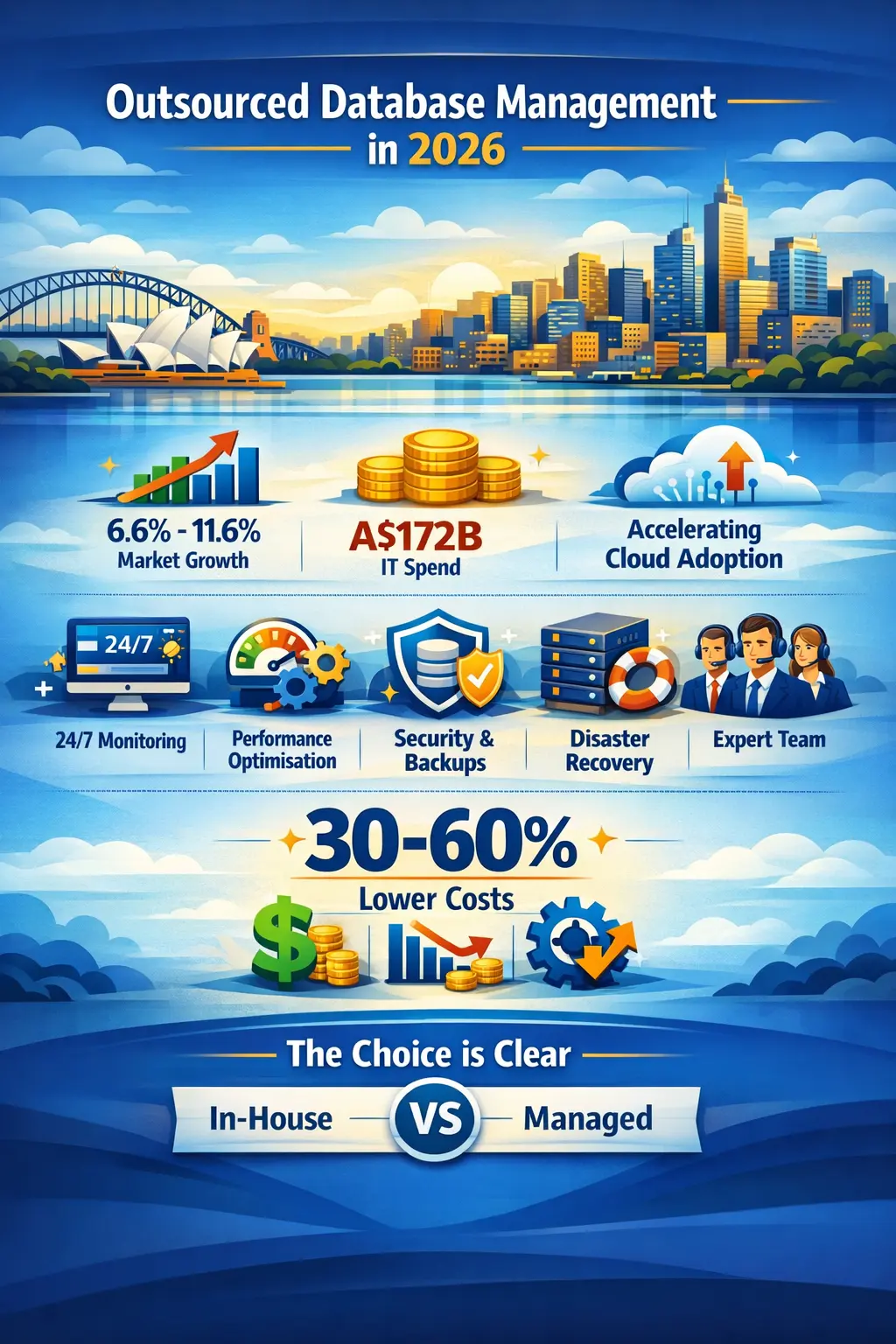
Professional database management services have matured into a strategic advantage for Australian businesses. Instead of one or two internal staff handling everything from backups to performance tuning, you gain immediate access to a whole team of certified specialists — many with decades of experience across Oracle, SQL Server, PostgreSQL, cloud-native platforms and AI-enhanced databases.
You pay a predictable monthly fee that covers 24/7 monitoring, proactive optimisation, security patching, disaster recovery, performance tuning and seamless integration with your existing systems and custom applications. No recruitment headaches. No training budgets. No downtime when someone is on leave.
Australia’s managed services market is growing strongly (CAGR 6.68–11.6% through 2033), driven by exactly these pressures: rising IT spend forecast to exceed A$172 billion in 2026, accelerating cloud adoption and the need for AI-ready infrastructure.
Independent industry analysis shows organisations that outsource IT and database functions typically reduce operational and labour-related costs by 30–60% compared with fully in-house operations.
In short: Database management services replace fixed, high-overhead costs with flexible, expert capacity that scales with your business — delivering enterprise-grade performance without the enterprise-grade price tag.
What’s next? See the head-to-head comparison that makes the choice clear.
Head-to-Head 2026 Cost-Benefit Analysis
| Factor |
In-House Database Team |
Outsourced Database Management Services |
Winner for Most Australian Businesses |
| Annual Cost (TCO) |
A$180k–A$230k+ per DBA |
Predictable monthly fee (typically 40–60% lower TCO) |
Outsourced |
| Access to Specialist Skills |
Limited to 1–2 people; constant upskilling |
Whole team of certified experts (AI, cloud, security) |
Outsourced |
| Scalability |
Rigid — hire/fire cycle |
Instant scale up/down with demand |
Outsourced |
| 24/7 Coverage & Response |
Business hours only (or expensive on-call) |
Built-in 24/7 proactive monitoring |
Outsourced |
| Risk & Compliance (NDB, APPs) |
Single point of failure |
Enterprise-grade security & compliance baked in |
Outsourced |
| Time to Value |
3–6 months to recruit & onboard |
Immediate expertise and results |
Outsourced |
| Impact on Efficiency & Revenue |
Drains budget; slows innovation |
Frees capital for growth initiatives |
Outsourced |
For most mid-sized Australian organisations, the outsourced or hybrid model wins on cost, risk and agility. Very large enterprises with highly bespoke, on-premise needs may still justify a core in-house team — but even then, augmenting with specialist database management services for peak loads or specialised projects is now standard practice.
In short: For the majority of Australian businesses in 2026, professional database management services deliver measurable savings, lower risk and greater agility while directly supporting your goals of operational efficiency, cost reduction and competitive advantage.
What’s next? Use this simple decision framework to determine the best path for your business.
Decision Framework: Which Model Is Right for Your Business?
Ask yourself these five questions:
- Is your annual database-related spend already exceeding A$150,000–A$200,000 when all hidden costs are included?
- Are you struggling to recruit or retain DBA administrator talent with current AI/cloud expertise?
- Do you need 24/7 coverage and rapid response to incidents?
- Are legacy systems or data silos limiting your ability to generate real-time insights and drive revenue?
- Would redirecting even 30–40% of your current database budget into customer-facing initiatives move the needle on growth?
If you answered “yes” to three or more, a professional outsourced or hybrid model is almost certainly the smarter 2026 choice.
Conclusion
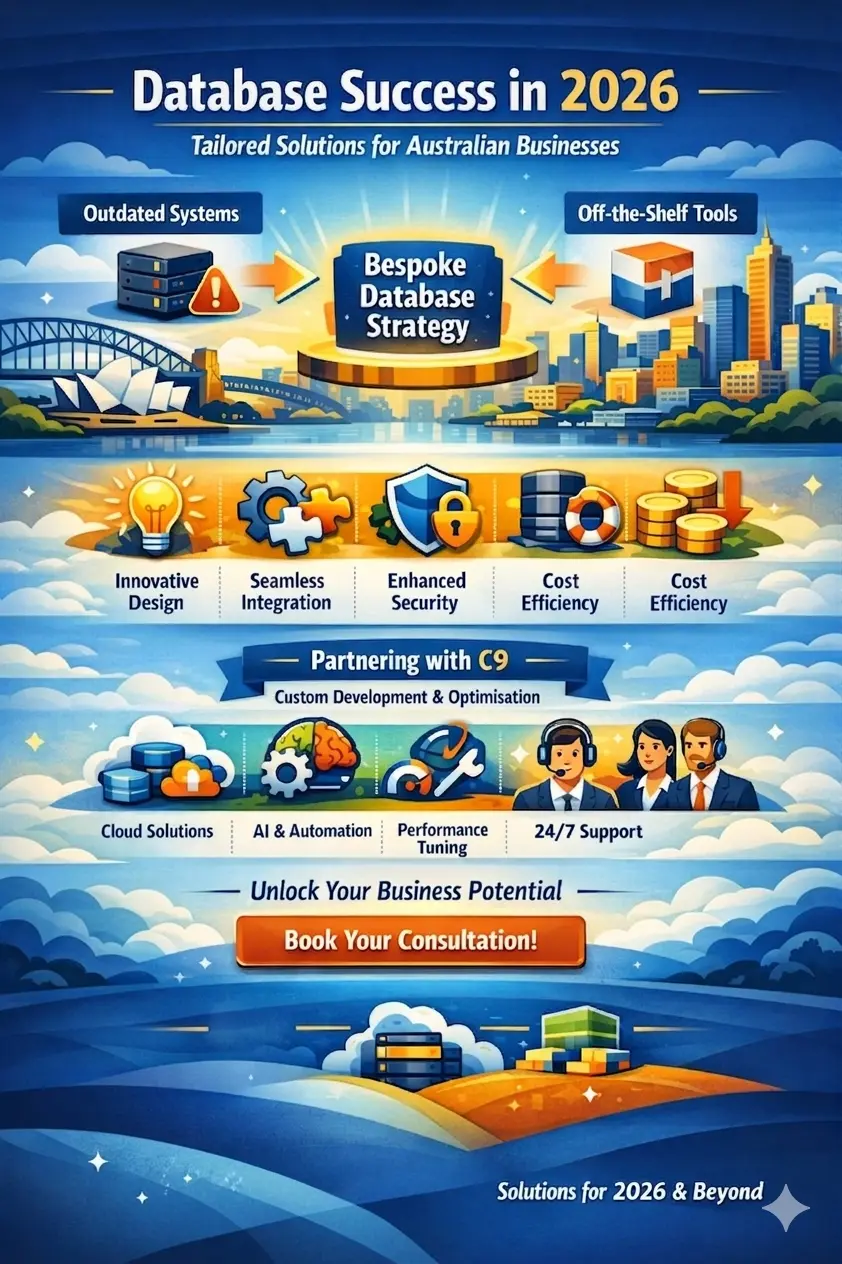
Your database strategy should accelerate your business — not hold it back. In 2026, settling for outdated in-house approaches or generic off-the-shelf tools is no longer viable for ambitious Australian organisations.
The clear path forward is a tailored, expert-led approach to database management that combines innovation, reliability, security and cost control.
At C9, Australia’s leading custom software, apps, integration and database developer, we partner with business owners and executives exactly like you. We don’t just manage databases — we design, optimise, integrate and future-proof them so they become a genuine competitive advantage.
In short: Stop letting database overhead quietly erode your profitability. Choose the model that drives efficiency, slashes costs and positions you for sustainable growth.
What’s next? Contact the C9 team today for a no-obligation discussion about your current database environment. We’ll show you exactly how a custom, collaborative solution can deliver the efficiency, cost savings and performance your business deserves in 2026 and beyond. Book your consultation now and take the first step toward a truly tailored database strategy that works as hard as you do.
References & Sources
Explore Related Insights on Database Development Solutions
Custom SQL Dashboards vs Generic BI Tools: Which Delivers Better ROI for Australian Companies?
Outsourced DBA vs. In-House Database Team: The 2026 Cost-Benefit Analysis
AI-Powered Database Cleaning: How Australian Businesses Save 30-50% on Data Management in 2026
AI-Powered Database Cleaning: How Machine Learning is Revolutionising Data Quality in 2026
Unlock Game-Changing Insights: How SQL Server 2025's Horizontal Fusion and DAX Upgrades Supercharge Your Business Analytics
AI Transparency Notice:
This article was produced with the assistance of artificial intelligence tools, including content drafting, visual asset creation, and audio generation. All content has been reviewed and approved by C9 prior to publication.