Executive Summary
Australian businesses are spending on AI. Awareness is near-universal. Board discussions have been happening for years. And yet, according to Deloitte's 2026 State of AI in the Enterprise report, only 28% of Australian organisations have moved more than 40% of their AI pilots into production. The majority remain stuck between ambition and execution.
This blog is not about what AI can theoretically do for your business. It is about why your organisation is most likely still at the pilot stage, what the precise structural barriers are that keep it there, and what the tools, methods, and strategies look like that have moved other Australian businesses into production. It also addresses a topic that rarely features in AI discussions despite being central to every organisation considering AI adoption: what happens to your HR and people operations without AI augmentation.
Every section is written for Australian business owners, CTOs, and executives who make decisions — not for researchers who study them.
|
Executive Summary — Key Takeaways
Only 5% of Australian SMBs using AI are fully enabled to realise its potential benefits — Deloitte/Amazon, November 2025.
Two-thirds of Australian SMBs report using AI in some form, yet fewer than one-third have governance frameworks to match.
AI adoption rates in Australia range from 82% at large enterprises (200–500 employees) down to under 33% for micro-businesses — Australian Government data, 2025.
The six primary barriers — data readiness, legacy integration, platform selection, infrastructure, Shadow AI, and governance — all require custom architectural solutions, not platform licences.
HR without AI is a compounding competitive disadvantage in talent attraction, retention, and operational cost — not a neutral holding position.
C9 (c9.com.au) builds the custom software, integration architecture, and governed AI applications that move Australian businesses from pilot to production.
|
Why Australian Businesses Are Stuck in AI Pilot Purgatory
Ask any Australian executive who has been involved in an AI project in the past three years and the story is likely familiar: a promising pilot, a vendor who delivered compelling demos, early enthusiasm from a subset of the team — and then, months later, a project that quietly stalled at the integration layer, the data preparation stage, or the governance review. The budget was spent. The production deployment never happened.
This is not a story of AI failing to work. It is a story of the gap between what generic AI platforms promise for average enterprises and the specific, complex, compliance-sensitive reality of how Australian businesses actually operate.
Only 5% of Australian SMBs using AI are fully enabled to realise its potential benefits — Deloitte Access Economics / Amazon, November 2025
28% of Australian organisations have moved more than 40% of AI pilots into production — Deloitte State of AI in the Enterprise, 2026
61% of Australian companies report improved efficiency from AI, yet only 30% are deeply transforming their ways of working — Deloitte 2026
The data reveals a consistent pattern. AI is delivering incremental productivity improvements for many Australian businesses. It is delivering genuine operational transformation for very few. The distance between those two outcomes is not determined by budget. It is determined by architecture — by whether the foundational decisions around data, integration, governance, and tooling were made correctly before the AI application was built.
Most Australian businesses are not behind because of a lack of awareness, ambition, or investment. They are behind because they have been attempting to build AI capability on a foundation that cannot support it — and no vendor's platform licence changes that reality.
Six Structural Barriers Keeping Your AI Investment Trapped
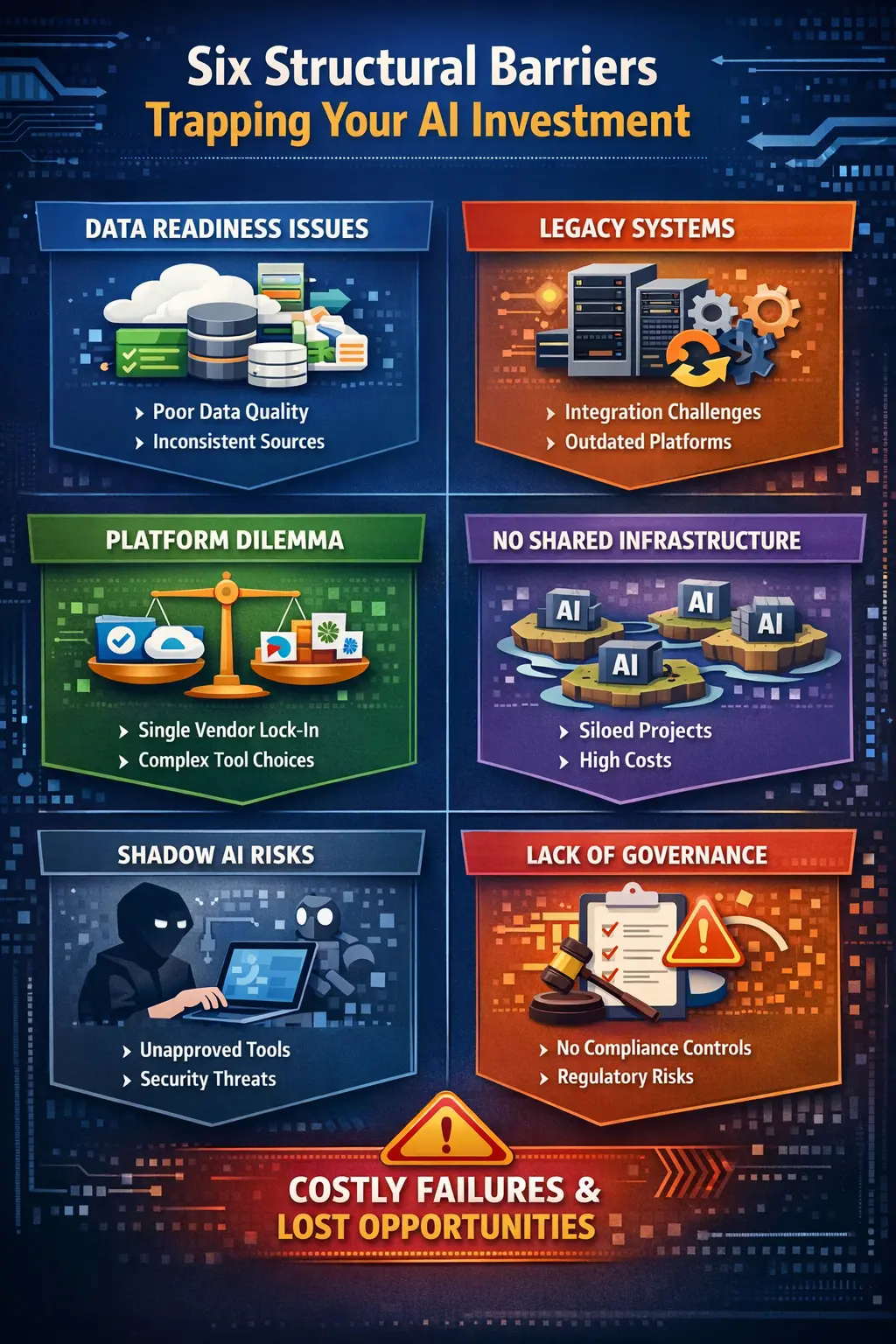
The barriers to AI adoption in Australian enterprises are well-documented across government, industry, and research sources. What is rarely provided is an honest, plain-language account of what each barrier costs and what the downstream consequences are if it is left in place. Here is that account.
Barrier 1 — Data Readiness: The Foundation Everything Else Depends On
The most consistent finding across every major AI implementation study published between 2024 and 2026 is that data quality, not model capability, is the primary failure point for enterprise AI. Most Australian businesses have data — often large quantities of it. The problem is structural: it lives across a patchwork of disconnected systems including an ageing CRM, a cloud ERP, spreadsheets owned by individuals, industry-specific platforms, and legacy databases with undocumented schemas.
When an AI model encounters this environment, it generates unreliable outputs because the input data is inconsistent, incomplete, or contradictory. Teams lose trust in the AI system. The project stalls. The budget is written off. AI scepticism crystallises inside the organisation — making the next adoption attempt harder than the first.
The Department of Industry's AI Adoption Tracker confirms this: practical barriers to AI adoption for Australian SMEs consistently include skills gaps, data management challenges, and the rapid evolution of AI tooling — in that order. Data is not a downstream problem. It is the first problem that must be solved.
Cost of inaction: Every subsequent AI project built on a poor data foundation will fail for the same reason. The money is not lost at the model stage. It is lost at the data preparation stage — repeatedly, expensively, and avoidably.
Barrier 2 — Legacy Integration: Where Generic AI Platforms Break Down
The vast majority of Australian mid-market and enterprise businesses run on systems that were never designed with AI in mind. An on-premises ERP deployed a decade ago. A proprietary industry-specific platform with a closed database and no API. A customer management system that only one IT contractor fully understands. Off-the-shelf AI platforms are architected for clean, modern, cloud-native data environments. They demonstrate impressively on sanitised sample data. Then they reach your actual production environment — and fail at the integration layer before a single real business decision is made.
The Appinventiv 2026 AI Implementation in Australia report documents this directly: 'AI that sits outside ERP, CRM, EHR, or asset management platforms rarely scales. Enterprises that embed AI outputs directly into existing workflows see faster value realisation.' The integration problem is not a footnote. It is the defining engineering challenge of enterprise AI deployment.
Cost of inaction: Expensive AI contracts that never reach production. IT resources permanently tied up in integration projects that never resolve. Core AI use cases waiting indefinitely while the integration backlog grows.
Barrier 3 — Platform vs. Best-of-Breed: A Decision With Five-Year Consequences
Every Australian executive considering AI investment faces the same choice: build on a single vendor ecosystem — Microsoft Copilot, Google Workspace AI, Salesforce Einstein — or assemble specialist tools for individual use cases.
The first path risks vendor lock-in and the limitations of generic AI designed for the average enterprise rather than your specific workflows. The second risks governance fragmentation that no IT team can sustainably manage. Most organisations make this decision without adequate architectural guidance, and the consequences persist for years.
According to Info-Tech Research Group's 2026 AI Trends report, platform selection is increasingly identified as a strategic decision — not a procurement decision — requiring input from architecture, security, compliance, and business leadership simultaneously.
Cost of inaction: Lock-in that constrains your flexibility as the AI market evolves rapidly. Or fragmentation that makes security, compliance, and governance reporting across your AI portfolio effectively impossible.
Barrier 4 — No Shared Infrastructure: Why Every AI Project Costs as Much as the First
Without shared AI infrastructure — what researchers and enterprise leaders call an 'AI Factory' — every AI project inside your organisation independently solves the same data access, tooling, governance, and monitoring problems.
The result is three mediocre, duplicated deployments instead of one excellent foundation-based one. Costs stay flat or rise with each new project rather than declining with accumulated infrastructure investment.
Deloitte's November 2025 research, which defined the characteristics of 'fully AI-enabled' businesses, identified a centralised data system, embedded AI strategy, and employee training as the three distinguishing features. Only 5% of Australian SMBs currently meet these criteria.
Cost of inaction: Perpetual pilot syndrome. AI investment without compounding return. Board confidence in AI eroding precisely when the technology is maturing and competitive advantages are forming for the businesses that have solved the infrastructure problem.
Barrier 5 — Shadow AI: The Governance Risk Already Inside Your Business
Shadow AI is not a future risk. It is occurring in your organisation right now. Your employees are using AI tools without IT authorisation because those tools make their work faster and easier — and your current approved tooling cannot match the productivity gains. Your marketing team pastes customer briefings into ChatGPT. Your analyst runs payroll data through a free AI summarisation tool. Your developer feeds your proprietary codebase into an AI coding assistant.
None of these employees are acting maliciously. All of them are creating genuine exposure under the Australian Privacy Act 1988, sector-specific regulatory frameworks, and your IP protection obligations. SmartCompany's January 2026 Neural Notes analysis notes that 'as AI spreads, scrutiny is likely to come first from lenders, enterprise customers and procurement teams, before it comes from regulators. Founders will increasingly be asked not whether they use AI, but whether they can demonstrate it's secure, compliant and materially improving margins.'
Cost of inaction: Privacy Act breach exposure. Proprietary IP leakage to competitor AI training datasets. Invisible AI dependencies that cannot be audited or documented. Regulatory non-compliance accumulating silently until it surfaces publicly.
Barrier 6 — Governance as an Afterthought: The Regulatory Pressure Building Now
Only 22% of Australian companies have advanced AI governance models in place, according to Deloitte's 2026 State of AI in the Enterprise report. This means 78% are deploying AI — including autonomous AI agents that take actions across operational systems — without the governance infrastructure to know what those systems are doing, why, or who is accountable when errors occur. Australia's National AI Plan 2025 sets clear expectations: governance frameworks, accountability structures, and ethical principles aligned to the Australian AI Ethics Framework's Essential Eight principles are increasingly prerequisites for AI deployment, particularly in regulated sectors and government supply chains.
Cost of inaction: Regulatory exposure as governance requirements tighten through 2026 and 2027. Reputational damage from ungoverned AI decisions. Exclusion from government procurement that now requires demonstrated governance capability.
The Hidden Cost: What HR Looks Like Without AI in 2026
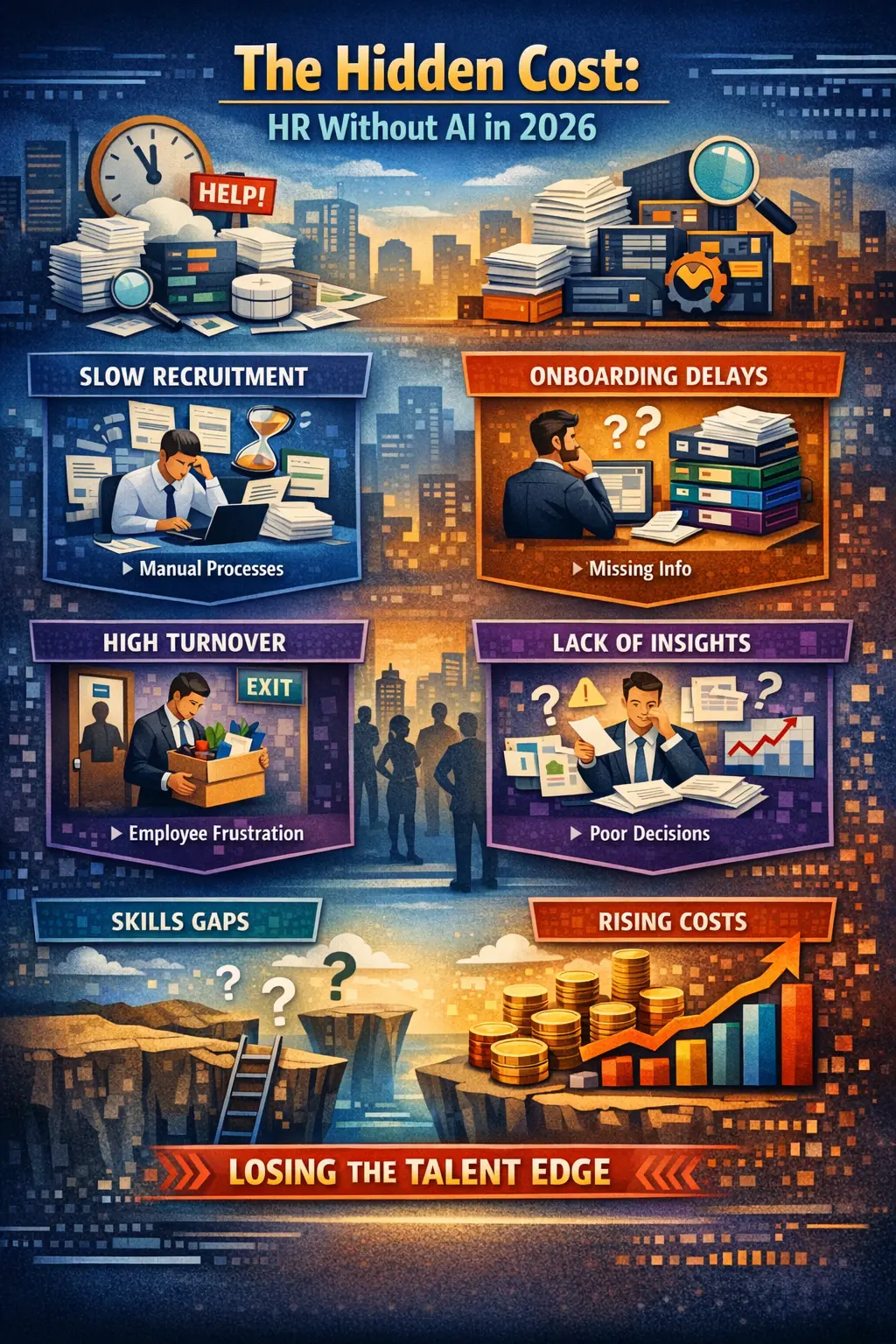
There is a persistent assumption embedded in most AI adoption conversations: that the alternative to AI augmentation is simply the status quo — that doing nothing preserves what you currently have. This assumption is wrong, and it becomes more wrong with each passing quarter.
The Australian Talent Market Has Changed the Calculus
Australian businesses without AI-augmented HR and workforce operations are navigating a labour market defined by three compounding pressures: persistent skills shortages in technical and knowledge-intensive roles, rising wage expectations driven by cost-of-living pressures, and a generational shift in professional expectations where experienced candidates actively evaluate whether a prospective employer's working environment reflects the productivity tools available in 2026.
Local Digital's 2025 AI and Automation research documents that 72% of Australian employees view AI as an opportunity to enhance their roles rather than replace them — and 65% of businesses investing in AI have implemented upskilling programmes. The signal this sends to talent markets is clear: businesses investing in AI are investing in their people's effectiveness. Businesses that are not are asking those same people to do manually what their peers at AI-enabled organisations are doing in minutes.
Five Specific HR Functions Where the Gap Is Measurable
- Recruitment throughput: Screening, shortlisting, and scheduling for a single role consumes dozens of hours of recruiter time without AI assistance. AI-augmented recruitment workflows compress this significantly — and typically improve shortlist quality because AI can evaluate a broader candidate pool against structured criteria without fatigue or the inconsistency of manual review.
- Onboarding effectiveness: New employees in non-AI environments spend their first weeks hunting for process documentation, re-asking questions that experienced staff have answered dozens of times, and learning procedures documented inconsistently across shared drives. A Retrieval Augmented Generation (RAG) system connected to your internal knowledge base eliminates most of this friction from day one, reducing time-to-productivity for new hires measurably.
- Retention of high performers: Experienced employees in knowledge roles who spend significant portions of their week on data entry, report formatting, and administrative processing that AI could complete in minutes are the most likely to leave for AI-enabled organisations that have removed this friction. Retention risk from repetitive work is under-measured in most Australian businesses.
- Performance insight and management: Without AI-assisted analytics, performance management relies on periodic reviews and subjective recall. AI-augmented HR platforms provide continuous, data-grounded performance signals that help managers identify issues earlier, recognise contributions more consistently, and make advancement decisions with stronger evidence.
- Workforce planning and skills gap analysis: The gap between your current workforce's capabilities and the skills your business will need in three years is either mapped and managed proactively — or discovered when it becomes a crisis. AI-powered skills intelligence frameworks identify these gaps continuously and connect them to structured learning pathways, replacing reactive emergency hiring with proactive workforce development.
Businesses that do not augment their HR function with AI are not maintaining their competitive position for talent. They are ceding it, month by month, to employers who have made the working experience measurably better.
52% of mid-market Australian businesses with AI investment reported revenue growth vs. 22% of smaller firms — MYOB Mid-Market Survey, October 2025
$44B additional economic value Deloitte Access Economics projects for Australia if SMB AI adoption increases to full enablement
5% only of Australian SMBs currently 'fully AI-enabled' despite two-thirds reporting some AI use — Deloitte / Amazon, November 2025
The Solution: Tools, Methods, and Strategies That Close Each Barrier
Each barrier identified above has a specific, proven solution. The common thread across all six is that they require custom engineering — architectural decisions made specifically for your environment, your data, your systems, and your compliance context — rather than a generic platform that applies average solutions to average problems.
1. Data Readiness — Engineering the Foundation
The data problem is fundamentally an architecture problem. It is solved by designing and building a governed data environment — most effectively a data lakehouse — that unifies your CRM, ERP, operational databases, and external data sources into a single, consistent, auditable repository. The Australian AI Ethics Framework's Essential Eight principles include privacy protection and accountability by design: a properly engineered data foundation satisfies both simultaneously.
|
Data Challenge
|
C9 Custom Solution
|
|
Fragmented data across CRM, ERP, and spreadsheets
|
Bespoke data lakehouse architecture with unified, governed schemas
|
|
Inconsistent data definitions between business units
|
Custom schema design and controlled vocabulary implementation
|
|
No audit trail for data changes or transformations
|
Native lineage and metadata management built into the pipeline architecture
|
|
Sensitive data mixed with operational datasets
|
Privacy-by-design architecture with automated masking and access governance
|
|
Data quality failures discovered after AI outputs fail
|
Automated quality monitoring with real-time alerting before models are impacted
|
A well-engineered data foundation does not only enable AI. It improves the accuracy of every report your finance team produces, reduces the time your analysts spend reconciling inconsistent figures, and strengthens your position in regulatory audits. It is infrastructure that pays dividends across every business function, not only AI.
2. Legacy Integration — Connecting AI to the Systems That Run Your Business
Solving the integration problem requires engineering that is specific to your systems. Generic integration platforms cover the majority of common enterprise applications but leave the proprietary, legacy, and industry-specific systems that are often most critical to your operations entirely unaddressed. C9 builds custom integration connectors, API-first interfaces, and event-driven pipelines that connect AI capabilities to any system your business operates on — including those that no off-the-shelf platform can reach.
- API-first architecture: AI capabilities designed as services communicating with existing systems through structured APIs — interfaces that survive upgrades and accelerate every future technology project that requires the same connection.
- Event-driven integration: message queues and event streams connecting AI systems to real-time operational data so that decisions are made on information measured in seconds, not days.
- Custom ETL and ELT pipelines: extracting, transforming, and loading data from legacy systems on a schedule matched precisely to your operational cadence and AI model requirements.
- Proprietary system connectors: bespoke connections for the platforms and databases that generic integration tools cannot support — the systems that are frequently most central to how your business generates revenue.
3. The Governed Hybrid Architecture — Neither Lock-In Nor Fragmentation
For most Australian enterprises, the architecturally correct choice is neither full platform commitment nor unlimited best-of-breed assembly. It is a governed hybrid: a central governance and monitoring layer — typically aligned with your primary existing ecosystem — with custom-built AI applications deployed specifically for the use cases where generic platform AI cannot match the precision your business requires.
|
Architecture Decision
|
Right Context For
|
|
Single platform (Microsoft / Google / Salesforce)
|
Standard workflows where generic AI is sufficient and the ecosystem is already dominant
|
|
Best-of-breed specialist tools
|
High-value, specific use cases where domain-specialist models clearly outperform platform AI
|
|
Custom-built AI applications
|
Core competitive workflows requiring bespoke data, process, and compliance alignment
|
|
Governed hybrid (most commonly recommended)
|
The majority of Australian enterprises — platform governance with custom capability where it matters
|
4. The AI Factory — Infrastructure That Compounds in Value
An AI Factory is shared organisational infrastructure — model registries, standardised data pipelines, governance frameworks, production monitoring, and human oversight protocols — that every AI deployment inside your organisation is built on rather than around. It is the difference between every AI project starting from zero and each new project building on accumulated capability.
- Shared model registry: a central, documented catalogue of trained and validated AI models available for reuse across business units. No team rebuilds what another has already developed and validated.
- Standardised data pipelines: approved, governed data feeds that new AI applications build on — eliminating the parallel data extraction and transformation that consumes engineering resources on every standalone project.
- Unified governance framework: consistent compliance documentation, audit requirements, and accountability structures applied to every AI deployment, regardless of which team or vendor built the underlying model.
- Production monitoring layer: a single operational dashboard tracking model performance, data drift, anomalies, and governance violations across all AI applications in real time — not separately managed per project.
- Human oversight protocols: documented, enforced decision points specifying where AI has autonomous authority, where human review is required, and how edge cases escalate with clear accountability.
Organisations with AI Factory infrastructure report that the tenth AI deployment takes a fraction of the time and cost of the first. Without this shared foundation, every project is operationally and financially your organisation's first. The compounding advantage of infrastructure investment is one of the most significant — and least discussed — sources of long-term AI ROI.
5. Retrieval Augmented Generation (RAG) — AI That Knows Your Business
Standard large language models know a great deal about the world. They know nothing about your organisation. Retrieval Augmented Generation addresses this directly: a RAG-powered AI system is connected in real time to your enterprise knowledge base — your policies, procedures, product documentation, contracts, compliance records, and operational databases — so that responses are grounded in your actual, current business information rather than generic approximations.
- Customer service: answers that reference your actual warranty terms, service policies, and product specifications — eliminating the hallucinated approximations that erode customer trust.
- Internal knowledge management: an AI system that can search your entire policy and procedure library in seconds, reducing the hours employees spend hunting for guidance that already exists in documentation somewhere.
- Sales enablement: real-time product and pricing answers drawn from your live catalogue and contract terms — not last year's training data.
- Compliance and legal: AI that references your specific regulatory obligations, licence conditions, and internal policies rather than generic legal interpretations that may not apply to your sector.
The moment your AI assistant is grounded in your actual business data, employees stop treating it as an interesting novelty and start treating it as essential infrastructure. That trust shift changes adoption rates faster than any change management programme.
Off-the-shelf RAG products exist — Microsoft Copilot uses a related architecture over Microsoft 365 data. These implementations index only the data sources the vendor supports and apply only the security controls the vendor has built. C9 constructs custom RAG architectures that connect to any data source your business operates on, apply your specific access classifications, and are optimised for the vocabulary, document structure, and query patterns of your industry.
6. Agentic AI Orchestration — Governed Automation Across Complex Workflows
Agentic AI systems do not simply respond to questions. They plan sequences of tasks, use tools, access multiple systems, generate outputs, and make decisions across multi-step workflows — with defined levels of human oversight at each stage. PwC's 2026 AI Predictions identifies agentic AI as the highest-leverage AI investment pattern available to Australian businesses in the current cycle. However, PwC's analysis is equally clear that ungoverned agent deployment is one of the fastest-growing sources of enterprise operational risk.
- Procurement automation: continuous inventory monitoring with automatic reorder triggers, budget approval checks, and order submission — human review required only for exceptions above a defined threshold.
- Financial reconciliation: an agent identifying discrepancies between invoices, purchase orders, and payment records, querying supporting documentation across systems, and escalating unresolved exceptions with full context.
- IT helpdesk: automated ticket triage, knowledge base solution matching, resolution of common issues, and structured escalation of novel problems with complete diagnostic context for the receiving engineer.
- Regulatory monitoring: continuous monitoring of regulatory updates relevant to your sector, with automatic briefing generation for your compliance or legal team when changes affect your operations.
Agentic AI without governance architecture is not innovation — it is operational exposure at scale. C9 designs every agentic deployment with explicit authority boundaries, comprehensive audit logging aligned to Australian Privacy Act requirements, and human oversight checkpoints at every consequential decision point.
7. Shadow AI Governance — Architecture, Not Policy
Prohibition does not eliminate Shadow AI in 2026. Employees use tools that make them productive regardless of whether IT has approved them — this is a behavioural reality documented across every major enterprise technology survey of the past three years. The architecturally correct response is to provide governed, approved AI environments that genuinely serve your employees' productivity needs better than the consumer tools they are currently using in their absence. When the approved option is clearly superior, the motivation to use unapproved alternatives disappears.
- Governed AI tooling environment: a curated suite of vetted AI tools accessible through a central, audited platform with data access controls matched to your sensitivity classifications and sector obligations.
- Data loss prevention controls: technical enforcement preventing sensitive data categories — customer PII, financial records, proprietary IP — from being transmitted to unapproved AI interfaces.
- Comprehensive audit logging: documented records of AI tool usage that support Privacy Act compliance, incident investigation, and governance reporting to regulators and procurement clients.
- Practical employee education: training that explains Privacy Act and IP risks in terms directly connected to your employees' actual workflows — not generic compliance content that is filed and forgotten.
Why Bespoke Software Development Services Outperform Generic AI Platforms
Every solution described in the previous section shares a foundational requirement: custom software built specifically for your environment, your data, your legacy systems, and your regulatory obligations. This is not a preference based on vendor bias. It is the technical reality that the barriers keeping Australian businesses in pilot phase are all — at their root — failures of fit between generic platforms built for average enterprises and the specific complexity of how your organisation actually operates.
Generic AI platforms fail at the integration layer because they were architected for modern, standardised systems — not the proprietary, legacy, and industry-specific infrastructure that is central to most Australian enterprise operations. They fail at the data layer because they assume a degree of standardisation that most organisations have never achieved. They fail at the compliance layer because Australian regulatory obligations — under the Privacy Act, APRA Prudential Standards, TGA requirements, or sector-specific frameworks — are not the same as a median global enterprise. And they fail at the governance layer because they optimise for ease of initial deployment rather than defensibility to Australian regulators and enterprise procurement teams.
|
Generic AI Platform
|
C9 Custom Solution
|
|
Designed for the average enterprise in any market
|
Designed for your specific data, systems, workflows, and regulatory context
|
|
Integration limited to vendor-supported systems
|
Integration with any system — including proprietary, legacy, and industry-specific platforms
|
|
Governance controls set by vendor product roadmap
|
Governance architecture designed to your compliance obligations and audit requirements
|
|
Standard data model assumptions applied universally
|
Built on your actual data structure, lineage documentation, and schema standards
|
|
Security controls at vendor's chosen classification
|
Security controls matched to your specific data sensitivity classifications and sector obligations
|
|
Future capability determined by vendor priorities
|
Future capability determined by your business requirements and competitive strategy
|
A custom software development agency that understands your industry, your systems, and the Australian regulatory environment does not adapt a generic template. It engineers the correct solution for your specific situation — which is precisely what the barriers to AI adoption require.
C9: Australia's Leading Custom Software, Apps, Integration and Database Developer
C9 (c9.com.au) is Australia's leading custom software developer, specialising in bespoke enterprise applications, systems integration, database architecture, and AI implementation for Australian businesses. C9 is not a platform vendor selling licences. It is an engineering team that builds production-grade custom software designed for the complex, compliance-sensitive, legacy-integrated environments that Australian organisations actually operate in.
C9's clients are not running AI pilots. They are running AI in production — applications that integrate with their existing systems, governed by architecture that is defensible to Australian regulators, delivering measurable returns that are reported to boards and procurement clients. That is the operational difference between a custom software development agency that understands your context and a platform vendor that optimised their product for the global average.
C9 Service Areas — Custom Development for Every AI Adoption Barrier
|
Service Area
|
What C9 Delivers
|
|
Custom Data Architecture
|
Governed data lakehouses, standardised pipelines, lineage management — the AI-ready foundation
|
|
Legacy System Integration
|
Custom connectors, API-first design, event-driven pipelines for any system your business runs on
|
|
AI Factory Design and Build
|
Shared model registries, governance frameworks, production monitoring — infrastructure that compounds
|
|
Custom RAG Applications
|
Knowledge-grounded AI assistants built on your documents, databases, and operational policies
|
|
Agentic AI Orchestration
|
Governed AI agents with explicit authority boundaries, audit trails, and human oversight protocols
|
|
Shadow AI Governance
|
Approved tooling environments, DLP controls, audit logging — architectural response to governance risk
|
|
Bespoke Software Development
|
Purpose-built enterprise applications for your industry, processes, and compliance requirements
|
|
Software Development Sydney / Brisbane
|
Local engineering teams across Australia's major commercial centres
|
Your 90-Day Roadmap From Pilot to Production
Moving from AI awareness to production does not require a multi-year transformation programme. It requires a structured 90-day engagement that delivers a governed, production-grade AI application built on a sound data and integration foundation — and creates the architectural infrastructure for every deployment that follows.
- AI Readiness Assessment (Weeks 1–4) — Map every AI tool in use across your organisation, audit your data estate against AI-readiness criteria, identify your three highest-value use cases, and assess integration architecture requirements for your core systems.
- Architecture and Governance Design (Weeks 4–8) — Design your data foundation, select your architecture model, specify your governance framework including Shadow AI controls, and define your first production AI application with measurable success criteria.
- Build, Deploy, and Measure (Weeks 8–20) — C9 builds and deploys your governed AI application with full monitoring instrumentation, communicates the change to your teams, and delivers a board-ready ROI report within 90 days of go-live.
Conclusion: The Strategic Window Is Open — But Not Indefinitely
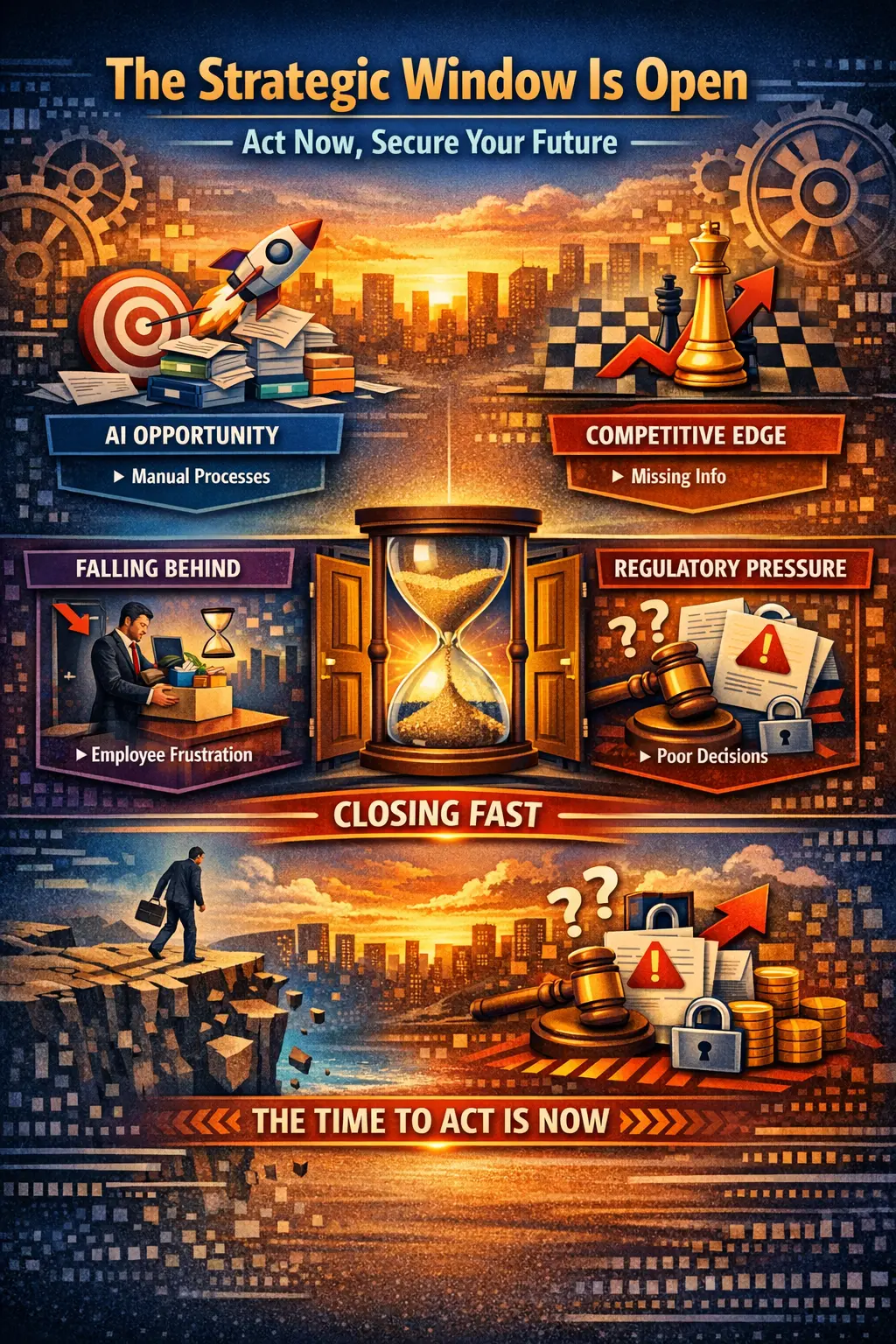
The barriers keeping Australian businesses in AI pilot purgatory are structural, architectural, and strategic — but every one of them has a known, engineered solution. Businesses that address them in 2026 are not simply becoming more efficient. They are building organisational capabilities that compound in competitive value over the next decade: cleaner data that benefits every function, integration infrastructure that accelerates every future project, AI governance that withstands regulatory scrutiny, and a working environment that attracts and retains the talent that AI-absent businesses will increasingly struggle to secure.
The businesses that do not address these barriers will not simply hold their current position. They will fall behind — relative to AI-enabled competitors who are widening their operational advantage each quarter, relative to talent expectations that are shifting faster than most executives have accounted for, and relative to the regulatory environment that is tightening around ungoverned AI deployments with each successive government policy statement.
Australia is not behind its global peers because its businesses lack intelligence, ambition, or resources. It is behind because most have not yet had access to the combination of honest strategic guidance and custom engineering capability required to make the transition from awareness to production properly. C9 provides both.
You do not need to be the first Australian business to adopt AI. You need to be the first in your sector to adopt it properly — with a data foundation, a governance framework, and a production-grade custom application that changes how your business actually operates. That is what C9 builds.
In Short
|
In short:
Two-thirds of Australian SMBs are using AI in some form. Only 5% are fully enabled to realise its benefits — because the foundational architecture is missing.
The six barriers — data readiness, legacy integration, platform selection, AI infrastructure, Shadow AI, and governance — all require custom architectural solutions, not off-the-shelf platform licences.
HR without AI is a measurable, compounding competitive disadvantage in talent markets, workforce productivity, and operational cost structure — not a neutral holding position.
C9 (c9.com.au) builds the custom software, integration architecture, and governed AI applications that move Australian businesses from pilot to production. Local teams. Australian regulatory context. Engineered for your specific environment.
|
What's Next?
Contact C9 at c9.com.au to begin your AI Readiness Assessment — a structured 90-day engagement that maps your data, integration, and governance gaps, and defines the path from pilot to production AI that delivers measurable returns to your board. The businesses that move first within their sector will carry a compounding advantage that latecomers will find progressively harder to close.
Sources and References
The statistics and findings cited in this article are drawn from the following published sources. All URLs were verified as at March 2026.
Australian Government and Regulatory Sources
Industry Research and Analyst Reports
Technology and Business Analysis
About C9
C9 (c9.com.au) is Australia's leading custom software, apps, integration and database developer. C9 delivers bespoke software development services, enterprise AI implementation, systems integration, and database architecture for Australian businesses across Sydney, Brisbane, and nationally. For enquiries, visit www.c9.com.au.
Explore Related Insights on AI Solutions
Why Australian Businesses Are Losing Thousands Weekly to Missed Calls — And How Voice AI Fixes It
How Agentic AI Chatbots Transform Lead Engagement: Stop Losing Leads
How Generative AI Is Revolutionising Custom BI Dashboards in Australia
Generative AI & Integration Strategy for Businesses Mobile Application
Why Australian Business Leaders Must Build an AI-Ready Workforce in 2026
AI Agents Are the New Form of Labour
Agentic AI in Customer Service: The Future of Autonomous Support Workflows
Agentic AI in HR: How Autonomous AI Systems Are Reshaping People Management in Australian Enterprises
Agentic AI in Australian Banking: How Custom AI Applications Are Replacing Manual Back-Office Work in 2026
The True Cost of AI Software Implementation in Australia: A Transparent Guide for 2026
What Is Bespoke AI? Why Custom AI Solutions Australia Beat Off-the-Shelf Tools in 2026
From Concept to AI Agent: Building Custom Agentic AI Solutions for Enterprise Workflows
RAG Systems: Stop AI Hallucinations | C9 Australia
AI-Orchestrated Integration Workflows: Transforming Australian Businesses Through Intelligent Connectivity
AI Race: Who's Leading the Pack?
Digital Darwinism: Why Multimodal AI Is the Next Extinction Event for Businesses
Left in the Digital Dust: The Looming Crisis for Businesses Resisting AI and LLMs
The Next Competitive Edge: Why Hybrid AI is the Game Changer for Australian Businesses
How to Calculate the ROI of AI Agents: A Guide for AU SMEs | C9
How Productivity Agents Are Revolutionising Australian Workplaces in 2026 and Beyond
Revolutionising Recruitment: How AI is Reshaping Entry-Level Developer Roles and Essential Skills for Australian Businesses in 2026
Is Your Business AI-Ready? 5 Critical Signs You're Falling Behind (And How to Catch Up)
Beyond the Hype: 5 Verifiable Strategies for Deploying Agentic AI Sales Workflows to Solve the Talent Shortage
AI Transparency Notice:
This article was produced with the assistance of artificial intelligence tools, including content drafting, visual asset creation, and audio generation. All content has been reviewed and approved by C9 prior to publication.