Executive Summary
In short:
- Australian enterprises are losing tens of thousands of dollars annually through manual processes, disconnected systems, and staff time consumed by tasks that should be automated — costs that never appear as a single line item but quietly drain profitability.
- A bespoke web portal — purpose-built by specialist web portals developers — centralises operations, automates workflows, integrates your existing Australian systems, and delivers real-time self-service access for your team and clients, with no ongoing per-seat licensing.
- Unlike off-the-shelf software, a custom portal is owned entirely by your business, built around your exact workflows, hosted in Australian cloud infrastructure, and compliant with the Privacy Act 1988 from day one.
- Australian enterprises that invest in bespoke web portals development typically recover their investment within 9-18 months through direct operational savings alone.
What's next?
Read this guide to understand exactly where your operational costs are being lost, how a bespoke portal addresses each one with quantified outcomes, and what to expect from C9 — Australia's leading custom web portal and dashboard developers. When you're ready to act, we're ready to build.
|
The Quiet Profit Drain Inside Your Business
Your business is generating revenue. Your team is working hard. And yet, somewhere between the overflowing email inboxes, the spreadsheets that are always one version behind, and the clients who keep calling for information they should be able to access themselves, your profitability is quietly eroding.
This is not a people problem. It is an infrastructure problem — and it is costing Australian enterprises far more than most business owners and executives realise.
According to the National Australia Bank's SME Business Insights Report (January 2025), three in four Australian businesses expect the cost of doing business to continue rising in 2025. [1] The Australian Industry Group's 2025 Industry Outlook found that 44% of businesses identified improving in-house operational processes as their leading cost management strategy. [2] The competitive advantage in 2026 belongs to businesses that automate their infrastructure — not those that add headcount to manage growing complexity.
A bespoke web portal is that infrastructure upgrade. Custom-built by specialist web portals developers, it eliminates the recurring manual costs silently draining your enterprise — with a measurable, finite payback period. This article shows you exactly how.
|
What is a Bespoke Web Portal?
A bespoke web portal is a secure, custom-built, authenticated digital environment — developed specifically for a business — where staff, clients, partners, or suppliers log in to interact with operational data and processes in real time. Unlike off-the-shelf software, a bespoke portal is designed around your specific workflows, integrated with your existing systems, and owned entirely by your business.
|
The Hidden Operational Costs Most Australian Executives Cannot See
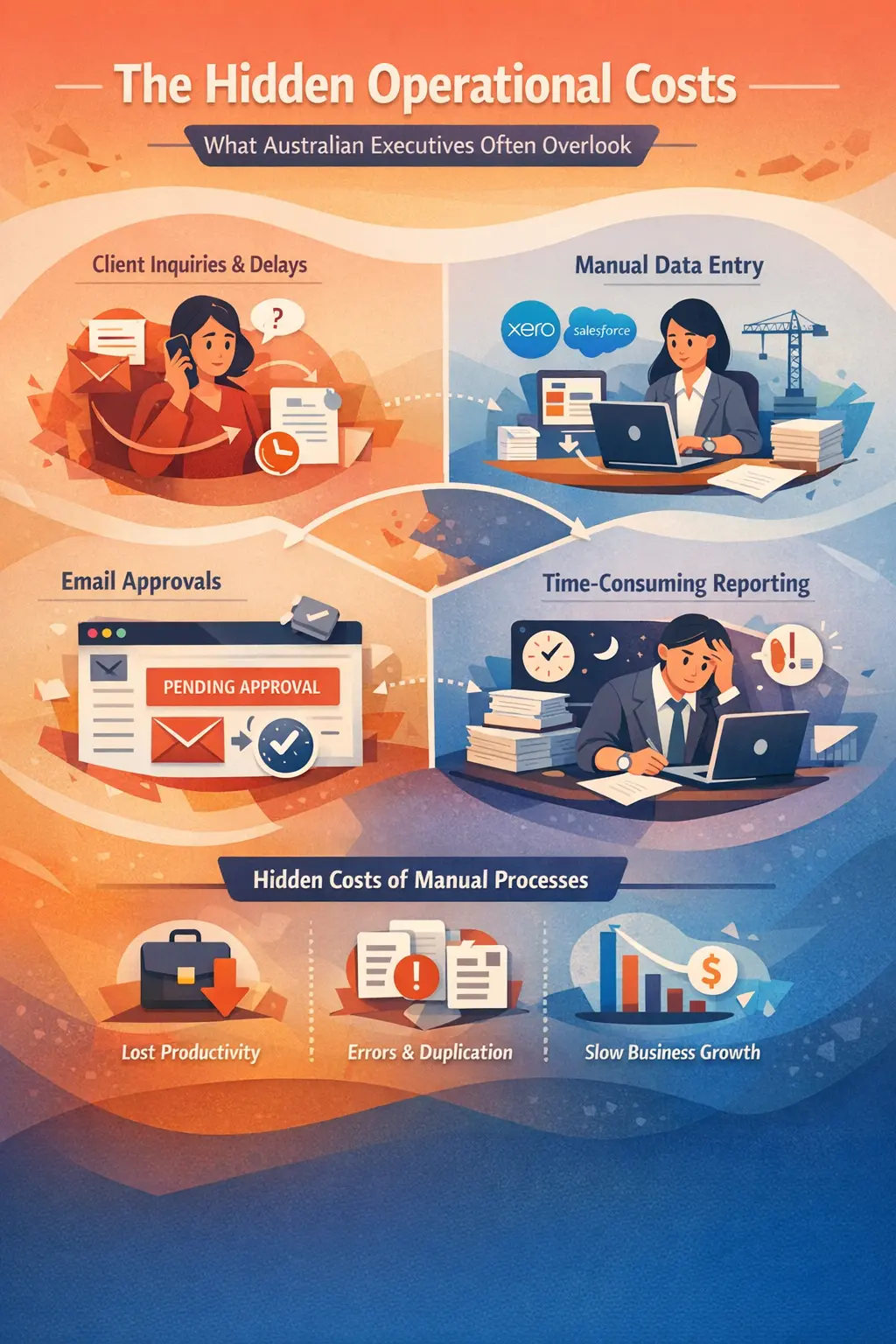
Ask any Australian business owner where their biggest costs are, and they will name wages, rent, and marketing. What they rarely identify — because it never appears as a single line item — is the cumulative cost of doing things manually.
Manual processes are the silent tax on business growth. They hide inside payroll as absorbed overhead. They appear in client satisfaction scores as unexplained friction. They surface in productivity reports as hours spent on administration that should take seconds. Research cited by McKinsey shows office workers spend more than 50% of their time manually hunting for files or managing repetitive data tasks. [3]
Here is what operational inefficiency looks like in measurable terms across a typical Australian enterprise:
|
80%
Still Use Manual Processes
for expenses — OFX/Ipsos survey, 500+ Australian SME finance decision-makers [4]
|
44%
of Businesses
name improving operational processes as their top cost strategy in 2025 [2]
|
30%
Cost Reduction
achievable through workflow automation — Gartner hyper-automation research [5]
|
18 mths
Typical Payback
for custom portal/ERP investment in Australian businesses [6]
|
The most consistent sources of this drain — across professional services, construction, healthcare, logistics, and financial services — are predictable and preventable:
- Clients calling or emailing to ask for project status, invoice copies, and document access that they should be able to retrieve themselves, 24 hours a day, seven days a week.
- Staff manually re-entering the same data across Xero, Salesforce, and project management platforms because those systems were never designed to communicate natively with each other.
- Approval workflows living in email inboxes, where decisions stall, context is lost across long threads, and no reliable audit trail exists.
- Senior managers spending 15-20 hours per week building reports from data that already exists in multiple disconnected systems — reformatted rather than generated.
- New clients and suppliers onboarded through email attachments, PDF forms, and phone calls — a process that simply cannot scale without adding administrative headcount.
These are not symptoms of poor management. They are the predictable consequence of a business that has grown beyond its original operational infrastructure. And in 2026, they represent both an escalating cost and a measurable competitive disadvantage.
Why Adding More Software Tools Makes It Worse
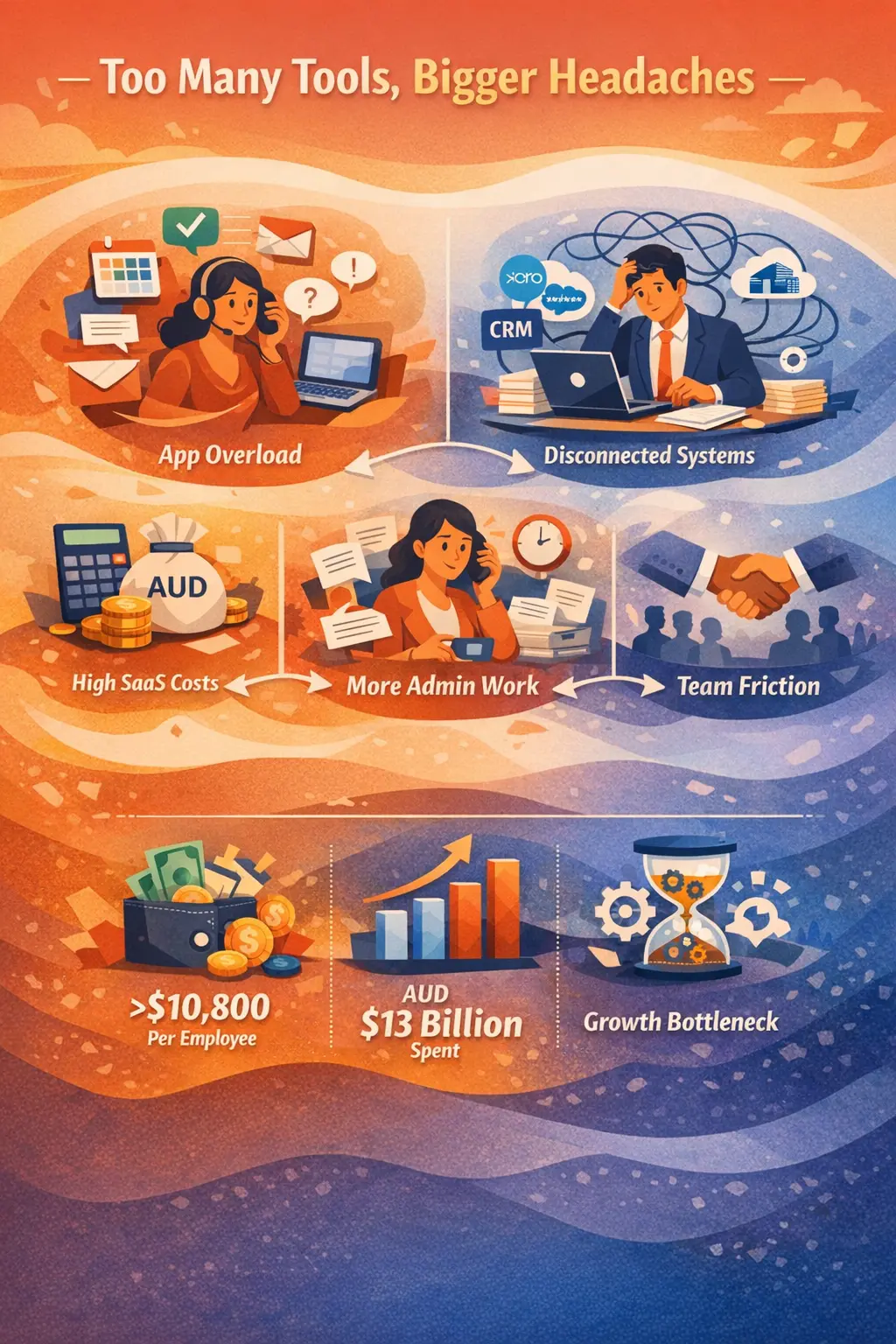
When Australian business owners recognise these operational problems, the instinctive response is to add another tool. A new project management platform. A CRM upgrade. A helpdesk subscription. A document management system.
Each tool solves one part of the problem in isolation — and creates new problems in doing so. By the time an enterprise has patched together five or six SaaS platforms to approximate a unified workflow, the combined annual licensing cost routinely exceeds AUD $10,800 per employee — a figure projected for 2026 by CloudNuro's SaaS benchmarking research. [7] Australian businesses collectively spent nearly AUD $13 billion on SaaS alone in 2025, up 15.5% year-on-year, according to Gartner. [8]
|
The Off-the-Shelf Trap
Off-the-shelf software is built for the average business — not your business. Customising it to fit your specific workflows is either impossible or prohibitively expensive, and vendor updates frequently break customisations. Your data often lives on overseas servers, creating potential conflicts with Australian Privacy Act 1988 obligations. And per-seat licensing costs grow directly with your team, whether or not every seat delivers proportional value.
|
The defining challenge for growth-stage Australian enterprises is the scalability ceiling. As the business expands, every new client, supplier, and staff member added to the operation creates proportional administrative overhead. The instinctive response — hire more people to manage the workload — simply shifts the cost without solving the cause. Every additional hire adds payroll, superannuation, onboarding burden, and management complexity.
The businesses that break through this ceiling are not the ones that hire faster. They are the ones that automate their operational infrastructure — and that begins with a purpose-built bespoke web portal.
What a Bespoke Web Portal Delivers
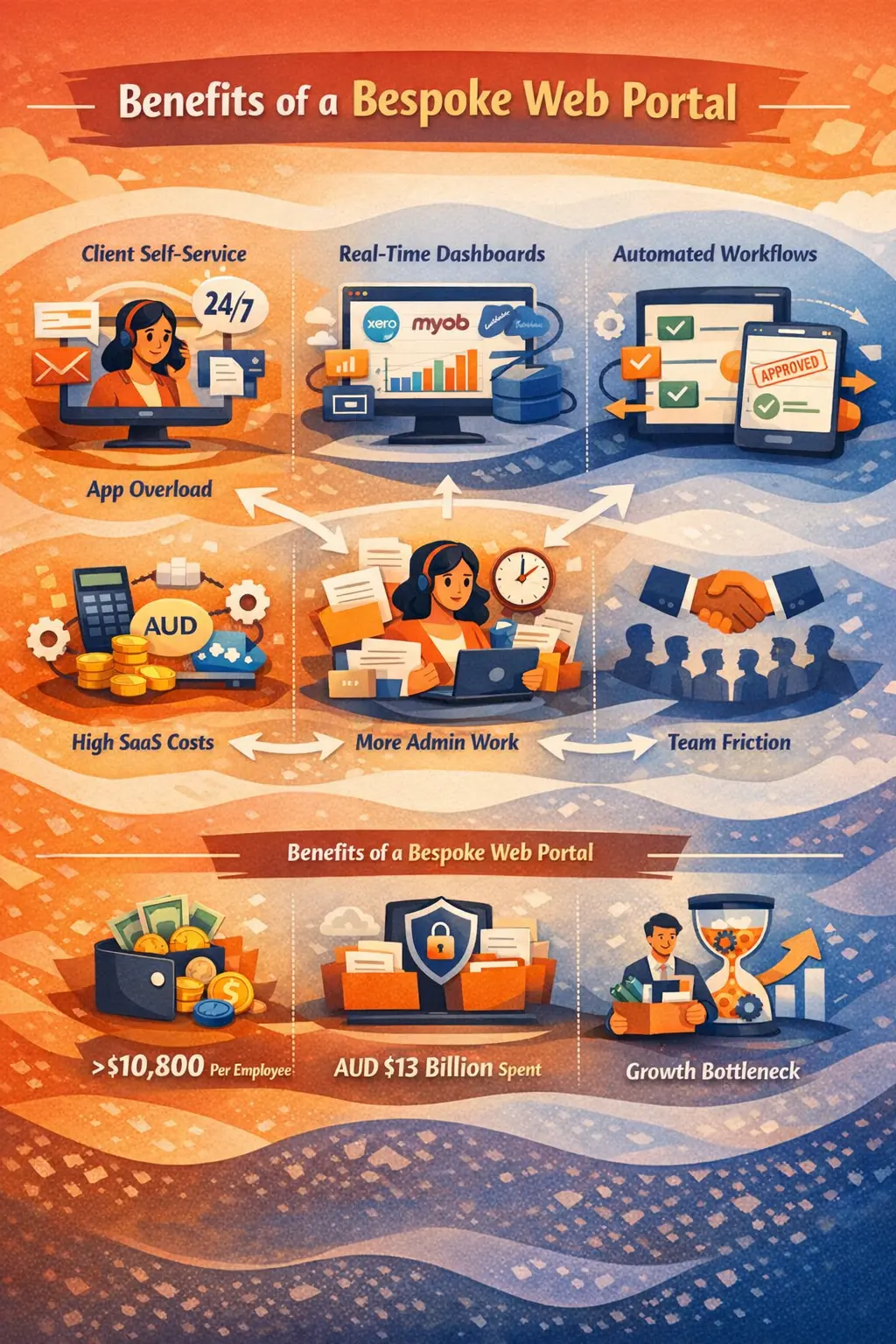
A bespoke web portal is fundamentally different from the SaaS tools you have tried before. It is not a product you purchase and attempt to configure around your workflows. It is a solution built around your business — your data, your systems, your compliance obligations — and owned entirely by you, with no ongoing licensing fees and no vendor dependency.
Where an off-the-shelf tool is designed for every business, a bespoke portal is designed for one business: yours. It is developed by specialist Australian web portals developers, integrated with your existing platforms, branded with your identity, hosted in Australian cloud infrastructure, and engineered to evolve as your business grows.
Here is how it addresses each operational cost driver with concrete, measurable outcomes.
1. Customer Self-Service Portals Eliminate High-Volume Inbound Contacts
A bespoke customer portal gives your clients 24/7 authenticated access to their own account — project status, invoices, documents, support requests, and communications — without contacting your team. The result is a direct, measurable reduction in inbound support volume.
For a business handling 40 client status queries per day at an average cost of AUD $10 per handled contact, that represents AUD $146,000 in annual support cost for information already in your systems. A 50% self-service deflection rate — a conservative benchmark for well-designed customer portals — returns AUD $73,000 per year to your bottom line. This is not a product feature. It is a financial outcome.
|
Internal Linking Opportunity
See also: 'The 2026 Complete Guide to Building a Self-Service Customer Portal for Australian Businesses' — c9.com.au/blog/
|
2. Integrated Dashboards Development Replaces Manual Reporting
Custom dashboards development, built as part of your bespoke portal, connects directly to your existing data sources — Xero, Salesforce, MYOB, industry-specific ERPs, and operational databases. Data that previously required a senior manager to spend 15-20 hours per week pulling, formatting, and distributing is now available in real time, to the right people, updated automatically without human intervention.
The strategic shift this enables is significant. Decisions that were being made on last week's data are now made on data current to the minute. According to Gartner, integrating hyper-automation technology with operational procedures can reduce operational expenses by 30%. [5] For Australian enterprises, real-time dashboard intelligence is one of the most direct and measurable paths to that outcome.
3. Workflow Automation Compresses Approval Cycles from Days to Hours
When approval workflows live in email inboxes — purchase orders, contract sign-offs, leave requests, compliance authorisations — they stall. A bespoke portal automates task assignment, enforces escalation timers, captures every decision with a timestamp, and immediately notifies the next party in the chain.
The compounding effect on project delivery is significant. Faster approvals mean projects progress without bottlenecks. Fewer approval delays reduce holding costs, client frustration, and the administrative overhead of chasing sign-offs. When applied systematically across workflow management, Gartner's research estimates businesses can reduce operational costs by up to 30%. [5]
4. System Integration Ends the Data Re-Entry Tax
Bespoke web portals development includes deep API integration with your existing Australian platforms. When your portal connects Xero to Salesforce to your project management system to your compliance database, data entered once flows automatically to every system that needs it. No re-entry. No version mismatches. No error correction cycles burning staff time.
The error reduction impact is immediate and compound. Financial automation can save up to 90% of the operational costs associated with manual data handling, according to published workflow automation research. [3] For Australian enterprises managing data across multiple disconnected platforms, a single integrated portal is one of the highest-return operational investments available.
|
Internal Linking Opportunity
See also: 'Custom vs Off-the-Shelf: What Australian SMEs Really Need in 2026' — c9.com.au/blog/
|
5. Centralised Document Management Eliminates Version Control Risk and Compliance Exposure
A bespoke portal replaces the scattered document infrastructure — email attachments, Dropbox folders, local desktop saves — with a single, version-controlled, permission-managed document repository. Every file has one authoritative version. Every access is logged. Document retention is enforced automatically in compliance with your Australian regulatory obligations.
The compliance dimension has become materially more consequential. In October 2025, the Federal Court ordered Australian Clinical Labs to pay AUD $5.8 million — the first civil penalty under the Privacy Act 1988 — following a data breach affecting 223,000 individuals. [9] Under the current regime following the 2022 and 2024 amendments, penalties for serious or repeated breaches can reach AUD $50 million, three times the benefit obtained, or 30% of annual turnover — whichever is greater. [10] A bespoke portal with built-in access controls, audit logging, and Australian data hosting is not a compliance nice-to-have. It is risk management.
6. Scalable Onboarding Grows Revenue Without Growing Headcount
Every new client, supplier, or staff member added to your business generates onboarding workload: document collection, system provisioning, induction, communications. A bespoke onboarding portal automates the entire process — the new party completes documentation, submits required information, accesses training or resources, and provisions their own system access automatically, at any hour, without consuming internal staff time.
Businesses that deploy bespoke onboarding portals consistently report onboarding three to five times more clients with the same administrative headcount. That is the definition of scalable, profitable growth — expanding revenue without expanding overhead proportionally.
The ROI Reality: What the Numbers Look Like for Australian Enterprises
.webp)
The most common question Australian business owners and executives ask before committing to bespoke web portals development is straightforward: when does this pay for itself?
The answer is more accessible than most executives expect. A Brisbane-based manufacturing SME with 40 staff that implemented a custom system in 2024 reported a 25% reduction in administrative workload and achieved ROI within 18 months — consistent with broader Australian implementation benchmarks. [6] The Australian ERP and portal market, valued at AUD $2.52 billion in 2024, is projected to grow at a CAGR of 15.20% through 2034, driven by exactly this ROI story: automation that pays for itself in reduced manual overhead. [11]
The ROI framework for a bespoke portal operates across three distinct and measurable categories:
- Financial ROI: Direct cost savings from reduced manual reporting hours, eliminated support contacts, and lower error-correction overhead.
- Operational ROI: Efficiency gains from faster approval cycles, automated workflows, and real-time data access reducing decision latency.
- Strategic ROI: Competitive advantage from scalable onboarding, improved client experience, and reduced compliance exposure under the Privacy Act 1988.
|
Worked Example — Australian Professional Services Firm
A 75-person Australian professional services firm identifies the following addressable annual costs: manual reporting (15 hours per week at AUD $85 per hour = AUD $66,300); inbound client status queries (30 per day at AUD $10 each = AUD $109,500); and data re-entry error correction (40 per week at AUD $18 average = AUD $37,440). A conservative 40% deflection rate across all three cost centres returns direct annual savings of approximately AUD $85,300. Against a mid-complexity bespoke portal development investment, the payback period is approximately 12-16 months.
|
Bespoke vs Off-the-Shelf: An Honest Comparison for Australian Decision-Makers
A credible web portals developer will tell you when off-the-shelf software is the right answer. If your requirements are simple, your budget is under AUD $8,000, and your go-live urgency is measured in days, a SaaS tool may serve you adequately in the short term.
For Australian enterprises with complex workflows, integration requirements, data sovereignty obligations, or growth ambitions, bespoke development is the only architecture that delivers without compromise:
|
Factor
|
Off-the-Shelf SaaS
|
Bespoke Portal (C9)
|
|
Upfront Cost
|
Lower initial spend
|
Higher upfront; zero ongoing licensing
|
|
Customisation
|
Limited to vendor feature set
|
Unlimited — built to your exact spec
|
|
Australian Integration
|
Generic connectors only
|
Native: Xero, MYOB, Salesforce, ERPs
|
|
Data Sovereignty
|
Often stored on overseas servers
|
Australian cloud hosting by default
|
|
Privacy Act 1988
|
Vendor compliance — not your control
|
Built-in compliance, audit trails
|
|
IP Ownership
|
Vendor owns the platform
|
You own the codebase outright
|
|
Scalability Cost
|
Per-seat fees grow with headcount
|
No per-seat cost — scale freely
|
|
3-Year TCO (30+ users)
|
Licensing often exceeds custom build
|
Typically equal to
|
Australian Compliance: The Boardroom Imperative in 2026
Technology investment decisions for Australian business owners and executives have always included a compliance filter. Following the Privacy and Other Legislation Amendment Act 2024, which received Royal Assent on 10 December 2024, that filter has become materially more consequential. The Act introduced a new statutory tort for serious invasions of privacy effective June 2025, meaning individuals can now sue directly for privacy violations without going through the OAIC. [12]
Under the current penalty regime, serious or repeated breaches can attract penalties of up to AUD $50 million, three times the benefit obtained, or 30% of annual turnover — whichever is greater. [10] The first civil penalty issued under the Privacy Act — AUD $5.8 million against Australian Clinical Labs in October 2025 — makes clear that regulators are willing to act and courts are willing to impose significant penalties. [9]
A bespoke web portal built addresses these obligations by design, not by afterthought:
- Role-based access control ensuring staff and clients access only the data relevant to their specific role.
- Multi-factor authentication (MFA) across all portal user and administrator accounts.
- Full audit logging of every user action — a tamper-proof, legally defensible record of all data interactions.
- Data hosted exclusively in Australian cloud regions (AWS Sydney, Azure Australia East and Southeast) — satisfying OAIC data residency expectations.
- Automated document retention schedules aligned with your specific legal and regulatory obligations.
- Alignment with the Australian Cyber Security Centre (ACSC) Essential Eight framework.
What to Look for in an Australian Web Portals Developer
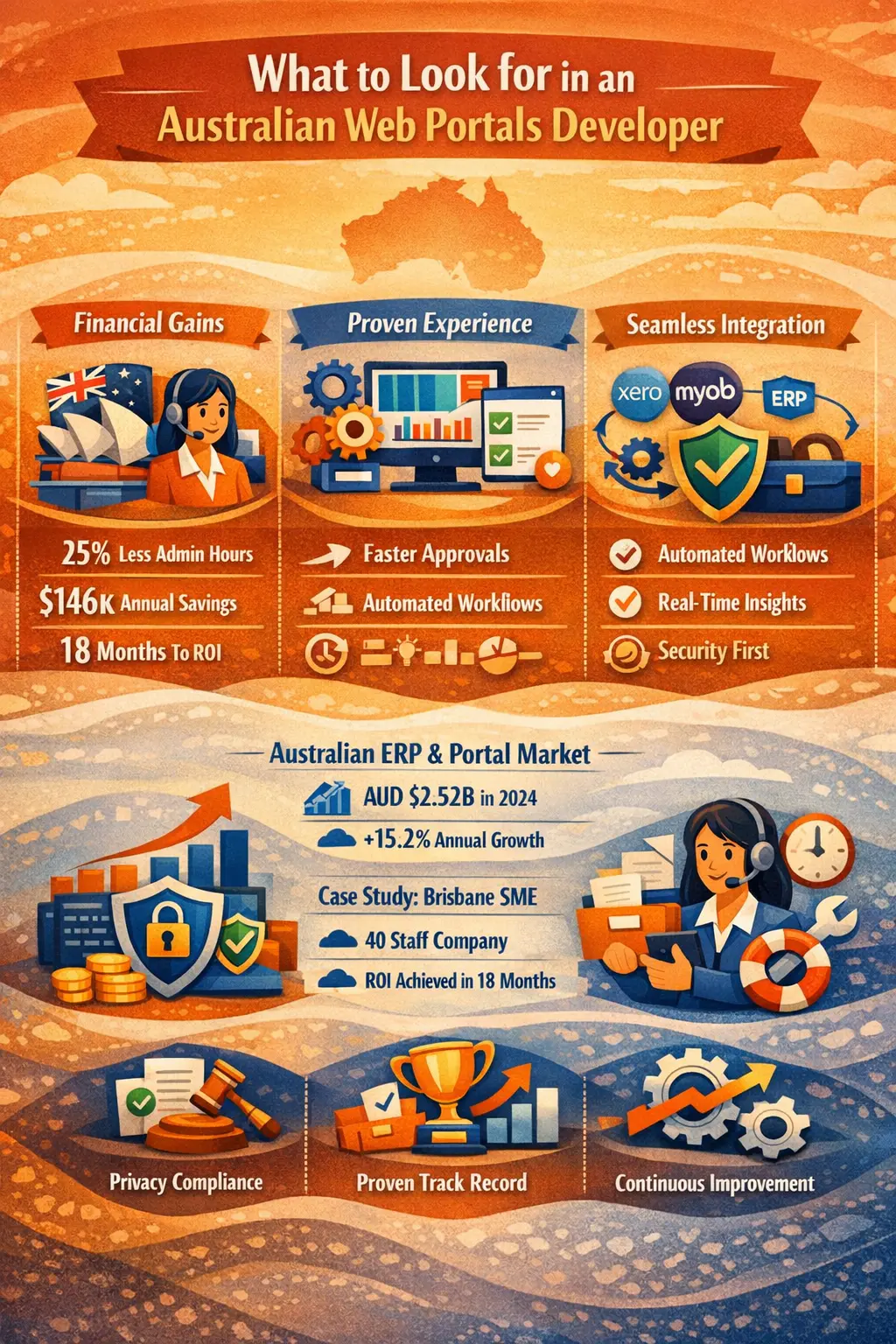
The quality of your bespoke portal is determined entirely by the capability and approach of your development partner. These are the criteria that separate a developer capable of delivering enterprise-grade results from one that delivers a generic product dressed up as bespoke:
- Australian-based development and support team — not an offshore team with no understanding of the local compliance and business landscape.
- Demonstrated experience across web portals development, customer portals development, and dashboards development — the ability to build both the operational and intelligence layers of a complete solution.
- Proven integration capability — a track record of connecting portals natively to Xero, MYOB, Salesforce, industry-specific ERPs, and government APIs.
- Security-first architecture — Privacy Act 1988 compliance, penetration testing, and ACSC Essential Eight alignment built in from day one.
- A structured, transparent methodology — discovery, wireframing, agile development sprints, user acceptance testing, and staged deployment. No black-box delivery.
- Post-launch support with Australian response times and a continuous improvement engagement model.
How C9 Builds Bespoke Web Portals for Australian Enterprises
C9 is Australia's leading custom software, apps, integration, and database developer. Our web portals developers, customer portals developers, and dashboards developers work exclusively on bespoke solutions — there are no templates, no off-the-shelf products, and no compromises built into our development model.
Our engagement process is designed for business owners and executives who need certainty before they commit. We begin with a structured discovery session to map your operational workflows, identify your highest-cost inefficiencies, and define the integration requirements your portal must address. Nothing is assumed. Everything is validated against your actual business before a single line of code is written.
Development proceeds in collaborative agile sprints, with regular client reviews so you see progress at every stage. Your portal is deployed in Australian cloud infrastructure, supported by an Australian team, built to comply with the Privacy Act 1988, and designed to evolve as your business grows.
|
C9 Bespoke Portal Development — What to Expect
- Discovery and requirements mapping — workflows, integrations, compliance needs defined
- Technical architecture design — Australian data sovereignty built in by default
- UI/UX wireframing — reviewed and approved before development begins
- Agile development sprints — regular client demos and feedback incorporated throughout
- Integration and data validation — native connections to your Australian systems
- User acceptance testing — real users from your team validate every workflow
- Staged deployment — phased go-live minimises disruption to your operations
- Ongoing Australian support — SLA-backed, Australian business hours
|
Conclusion
The operational costs silently draining your enterprise — the manual hours, the disconnected systems, the bottlenecked approvals, the clients waiting for information they should access themselves — are not inevitable. They are the predictable consequence of a business that has outgrown its infrastructure.
A bespoke web portal, built by specialist Australian web portals developers, is the infrastructure upgrade that eliminates those costs at their source. It does not patch your existing problems with another subscription. It replaces the processes that create them — with a single, integrated, secure, and scalable digital environment designed specifically around the way your business operates.
The ROI is measurable. The payback period is finite. The compliance protection is real. The competitive advantage — onboarding more clients, delivering faster decisions, and operating at scale without proportional overhead growth — is enduring.
|
In short:
- Manual processes and disconnected systems cost your enterprise significantly more than they appear to on the P&L.
- A bespoke web portal eliminates those costs through customer self-service, dashboard automation, workflow routing, system integration, and scalable onboarding — with measurable AUD savings at every point.
- The investment recovers within 9-18 months. The operational and competitive gains last the life of your business.
- Australian data sovereignty, Privacy Act 1988 compliance, and ACSC Essential Eight alignment are built into every C9 portal from day one — not retrofitted afterwards.
What's next?
Book a no-obligation discovery session with C9's Australian web portals and dashboards development team. We will map your specific operational cost centres and show you exactly how a bespoke portal addresses them — before you commit to a single dollar of development.
|
|
Ready to Reduce Your Operational Costs?
Partner with C9 — Australia's leading custom web portal, customer portal, and dashboard developers.
We build bespoke, fully integrated portals tailored to your workflows and Australian compliance obligations.
Visit www.c9.com.au to book your obligation-free discovery session today.
|
Frequently Asked Questions
What is a bespoke web portal?
A bespoke web portal is a custom-built, secure digital environment where your staff, clients, partners, or suppliers log in to access operational data and complete tasks specific to your business. Unlike off-the-shelf software, it is designed around your exact workflows, integrated with your existing systems, and owned entirely by your organisation.
How long does bespoke web portal development take in Australia?
For a mid-complexity enterprise portal, C9 typically delivers a production-ready solution within 12-16 weeks from signed engagement to go-live. Simpler portals can be delivered in 8-10 weeks. Timeline depends on integration complexity, number of user roles, and the scope of custom workflows required.
How does a bespoke portal satisfy Australian Privacy Act 1988 requirements?
A C9-built portal includes role-based access control, multi-factor authentication, encrypted data at rest and in transit, full audit logging, and hosting in Australian cloud regions. These features address the key obligations under the Australian Privacy Principles (APPs), including APP 11 (security of personal information) and the Notifiable Data Breaches scheme.
Will a bespoke portal integrate with Xero, Salesforce, or our existing systems?
Yes. Native API integration with Australian accounting, CRM, and operational platforms is a core capability of C9's web portals development practice. Our integrations connect directly to Xero, MYOB, Salesforce, Microsoft Dynamics, and custom databases — eliminating the data re-entry and version mismatches that off-the-shelf tools cannot resolve.
What is the typical ROI for a bespoke web portal in Australia?
Australian enterprises typically recover their portal development investment within 9-18 months through direct operational savings: reduced manual reporting hours, lower inbound support contact costs, faster approval cycles, and eliminated data re-entry errors. When client retention improvements and compliance risk reduction are factored in, many businesses reach break-even within 6-12 months.
How is a bespoke portal different from a SaaS client portal tool?
SaaS portal tools are built for the average business and impose feature limitations, per-seat licensing costs, and vendor-controlled data storage — often on overseas servers. A bespoke portal is built for your business specifically, owned by you entirely, hosted in Australia, and integrated natively with your existing systems. At scale (30-plus users), the total cost of ownership for a bespoke portal is typically equal to or lower than cumulative SaaS licensing.
References and Sources
All statistics, regulatory references, and market data cited in this article are sourced from verifiable Australian and international research bodies, regulatory authorities, and industry publications.
[2] OFX/Ipsos. (2025). The State of SME Financial Management in Australia — Survey of 500+ SME finance decision-makers.
Case Studies
Clinician Support System – Patient Data Capture & Research Platform
Manubread – Customer Ordering & Account Management Portal
ISG Funds Management – Investor Portal & Digital Application Platform
AI Transparency Notice:
This article was produced with the assistance of artificial intelligence tools, including content drafting, visual asset creation, and audio generation. All content has been reviewed and approved by C9 prior to publication.