EXECUTIVE SUMMARY
In short:
- Most Australian businesses are sitting on vast amounts of data — but the dashboards they rely on are static, delayed, and unable to explain what the numbers actually mean.
- Generative AI is changing Business Intelligence fundamentally: AI-powered custom BI dashboards now respond to questions in plain English, surface insights proactively, and deliver real-time, contextualised analysis without requiring technical expertise.
- Generic SaaS tools such as Power BI and Tableau — and their AI copilots — cannot replicate this for your specific data environment. Bespoke Business Intelligence development, built around your KPIs, data architecture, and industry, is the only path to accurate, trusted, AI-powered analytics.
- C9 builds custom BI and analytics dashboard solutions for Australian businesses ready to move from reactive reporting to intelligent, real-time decision-making.
What's next?
Generative AI-powered analytics is not a future capability for Australian enterprises — it is a present competitive advantage. Read on to understand exactly what is possible, what is holding most organisations back, and what the first correct step looks like for a business like yours.
|
The Data Gap That Is Costing Australian Businesses
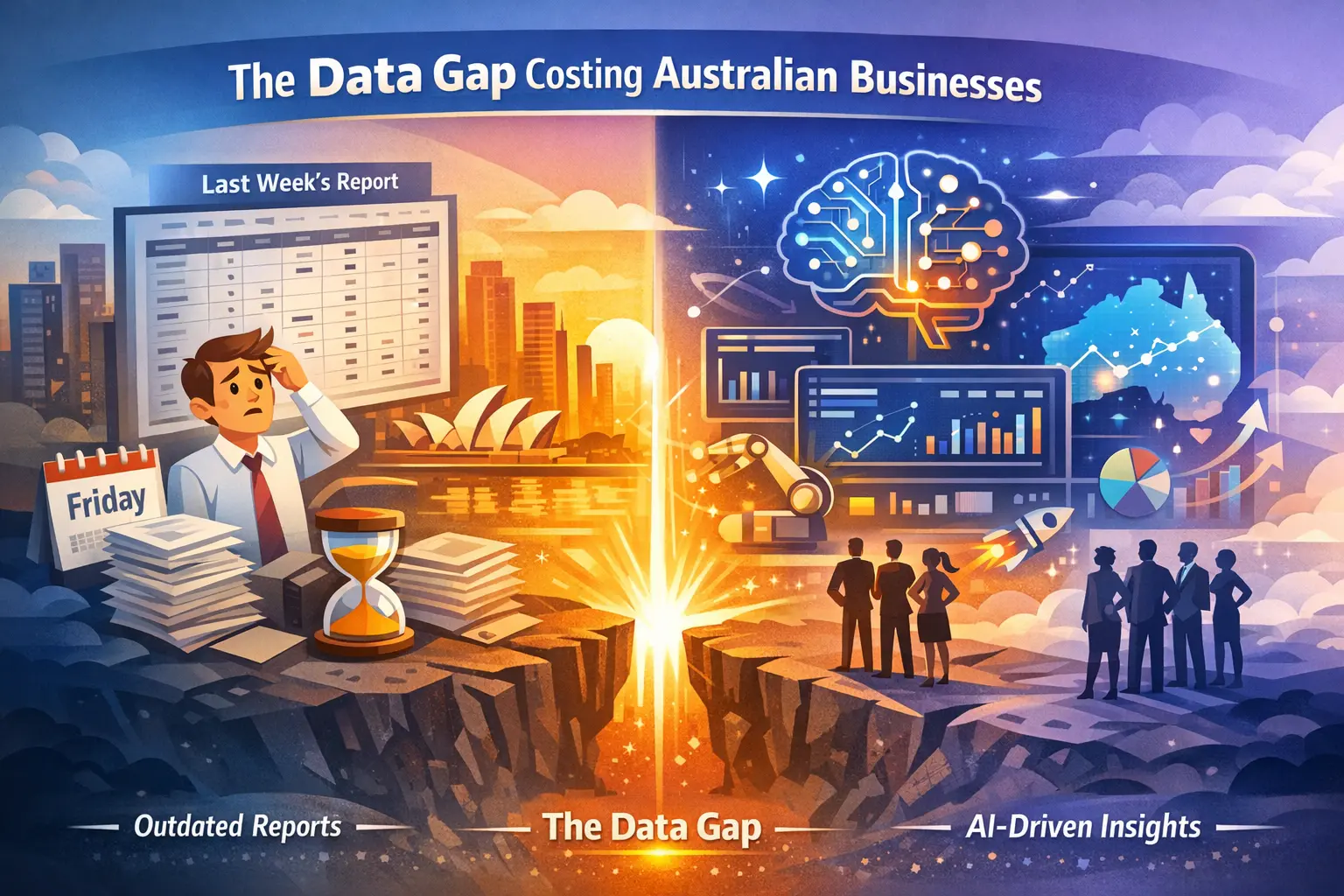
Australian businesses have never had access to more data. Every transaction, customer interaction, logistics event, and operational movement generates a digital record. And yet, in boardrooms and leadership meetings across Brisbane, Sydney, and Melbourne, decisions are still being made from spreadsheets assembled the previous Friday — already out of date before the first question is asked.
This is not a data problem. It is a Business Intelligence development problem. The tools, dashboards, and analytics processes most organisations rely on were designed for a slower world — one where weekly reports were sufficient, where data lived in one or two systems, and where AI was a concept rather than an operational capability.
In 2026, that world no longer exists. And the gap between organisations that have built intelligent, AI-powered analytics platforms and those still relying on static dashboards is widening every quarter.
|
12%
of Australian businesses report GenAI is already transforming their operations — vs 25% globally (Deloitte AU, 2026)
|
127%
average 3-year ROI for organisations with BI-driven strategies (Forrester / Nucleus Research)
|
65%
of Australian leaders plan to raise AI investment in 2026 — trailing the global average of 84% (Deloitte, 2026)
|
The numbers tell a clear story: Australian businesses recognise the strategic imperative of AI-powered analytics, but most are lagging both global peers and — more critically — the more advanced competitors within their own markets. This article explains what Generative AI actually does to a Business Intelligence dashboard, why the data foundation matters more than the AI model, and how Australian businesses can build this capability correctly.
What Is Generative AI in Business Intelligence? — Explained for Executives
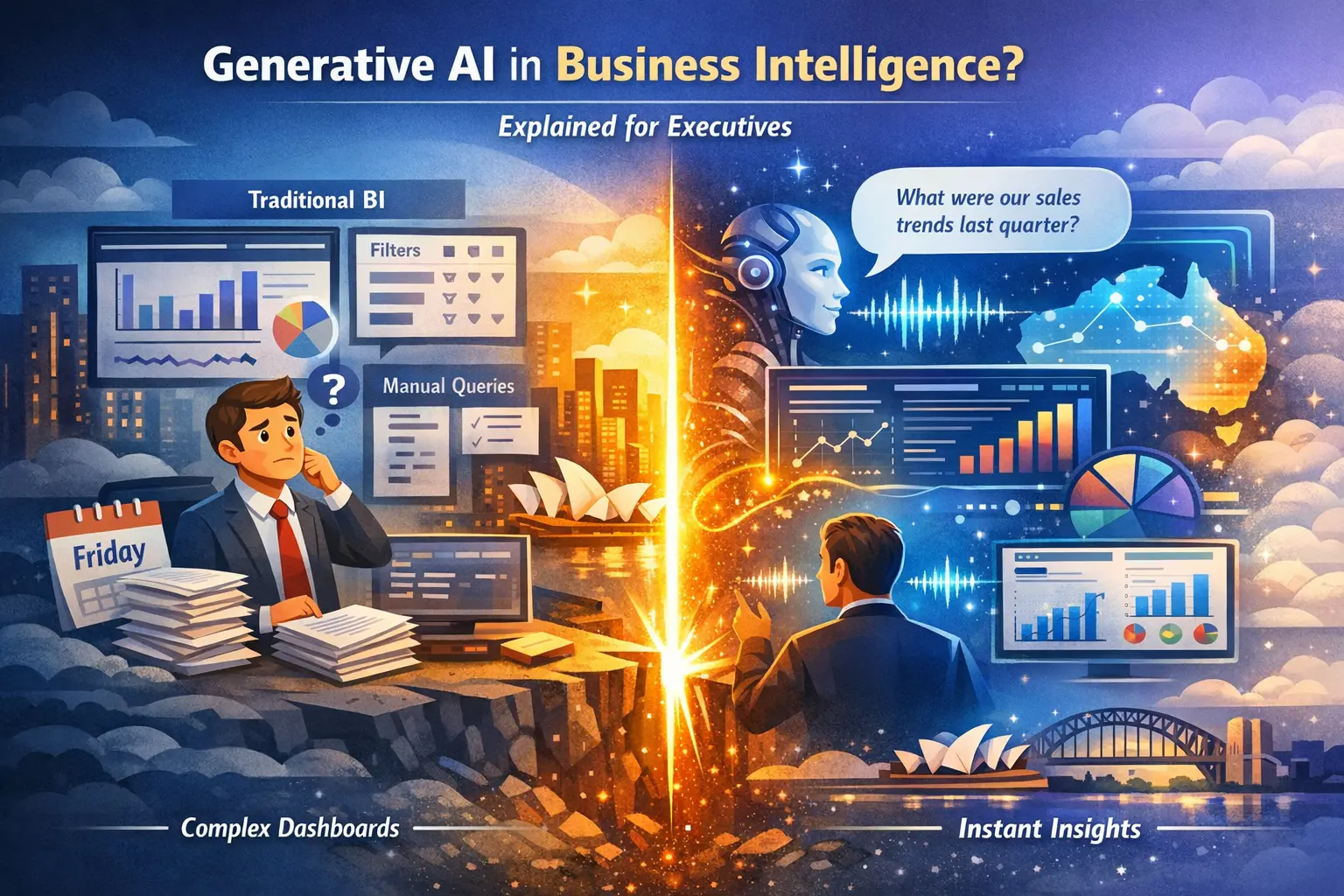
Generative AI refers to artificial intelligence systems — most commonly large language models (LLMs) such as GPT-4, Claude, and open-source alternatives — that generate content: text, analysis, code, and visualisations, based on natural language input. In the context of Business Intelligence, this means a system where a business user types or speaks a question in plain English and receives an accurate, contextualised analytical response — without writing a single query or navigating a dashboard.
This is fundamentally different from traditional BI tools, which require users to know which dashboard to open, which filters to apply, and how to interpret what they see. Generative AI removes all three of those barriers simultaneously.
Three Things Generative AI Changes About Analytics Dashboards
|
1 Natural Language Querying — Ask, Don't Navigate
Instead of opening a dashboard and drilling down through filters, your finance director types: 'Show me gross margin by business unit for the past 90 days versus the prior year, and flag any unit that has declined more than three percentage points.' The AI queries your live data, generates the analysis, builds a visualisation, and writes a plain-English summary — in under ten seconds. Natural language processing (NLP) capabilities now enable 59% of employees globally to query data using conversational prompts (DataStackHub, 2025), dramatically reducing reliance on data analysts for routine analytical requests.
|
|
2 Automated Narrative Generation — Numbers With Context
A traditional dashboard shows you that revenue is down 8% this month. A Generative AI-powered dashboard shows you the same number — alongside an automatically generated explanation: 'Revenue is tracking 8% below target for the month. The primary driver is a 14% decline in orders from the manufacturing segment, concentrated in the last 11 days. This correlates with the lead-time increase flagged by your largest supplier on the 4th of this month.' The data and its meaning arrive together. The executive reads one thing, not two separate reports that require manual synthesis.
|
|
3 Proactive Anomaly Detection — The Platform Finds Problems Before You Do
Properly architected Generative AI BI platforms continuously monitor your key metrics and surface deviations before they compound. A sales velocity drop that would have appeared in next week's pipeline review appears in a leadership inbox this afternoon — alongside a plain-English explanation of its likely cause and a recommended response. This shift from reactive reporting to proactive intelligence is the defining characteristic of next-generation analytics dashboards, and it requires a custom-built architecture to deliver reliably.
|
Why Off-the-Shelf BI Tools Are Failing Australian Businesses
The instinctive response to a Business Intelligence shortfall is to reach for a better product. Upgrade to Power BI Premium. Enable Microsoft Copilot. Subscribe to Tableau Creator or Qlik Sense. These decisions feel like progress — they involve action, budget commitment, and vendor presentations full of compelling demonstrations.
The demonstrations rarely survive contact with real business data. Here is why.
Generic AI Cannot Understand Your Specific Business Logic
Off-the-shelf AI tools — including Microsoft Copilot for Power BI — are trained on generic schemas and generic terminology. They do not know that your business defines 'active customer' as anyone who has placed an order in the last 60 days, not 90. They do not know that your 'revenue' figure excludes inter-company transactions. They do not know that your 'gross margin' calculation differs from the industry standard because of a unique cost allocation methodology your finance team developed ten years ago.
When a generic AI encounters these specifics — and it will, immediately — it guesses. And it guesses fluently, confidently, and incorrectly. The result is an analytics platform that produces plausible-looking but wrong answers, which is not merely unhelpful but actively dangerous for decision-making.
|
⚠️ The Hidden Cost of Wrong Answers
Research cited by SRAnalytics (2025) found that 90% of companies are using AI in their BI environments, yet only 39% see any measurable profit impact. The gap is almost entirely explained by poor data foundations and the absence of proper semantic governance — not by the quality of the AI model itself. An AI producing incorrect answers at speed is worse than no AI at all.
|
The Licensing Cost Problem
SaaS BI tools price per user. For an Australian manufacturer with 150 operational staff requiring dashboard access, Power BI Premium per-user licences can accumulate to $100,000+ annually — before any data integration, custom connector, or AI feature costs are added. Over three years, that compounding licensing expenditure frequently exceeds the cost of a fully custom-built BI platform that the organisation owns outright and can deploy to unlimited users.
|
Cost Factor
|
SaaS BI (3-Year Estimate)
|
Custom BI Development by C9
|
|
Licensing fees
|
$60,000–$180,000 cumulative
|
$0 after initial build
|
|
AI / Copilot features
|
Paid add-on, generic only
|
Custom-built, business-specific
|
|
Data integration
|
$20,000–$50,000 in extras
|
Included in development scope
|
|
Per-user scaling
|
Linear — costs grow with users
|
Fixed — unlimited users
|
|
IP and platform ownership
|
Vendor retains full control
|
You own the platform completely
|
|
Vendor lock-in risk
|
High — pricing and roadmap risk
|
Zero — you control the stack
|
The Foundation That Separates Successful AI BI From Failed Pilots: The Semantic Layer
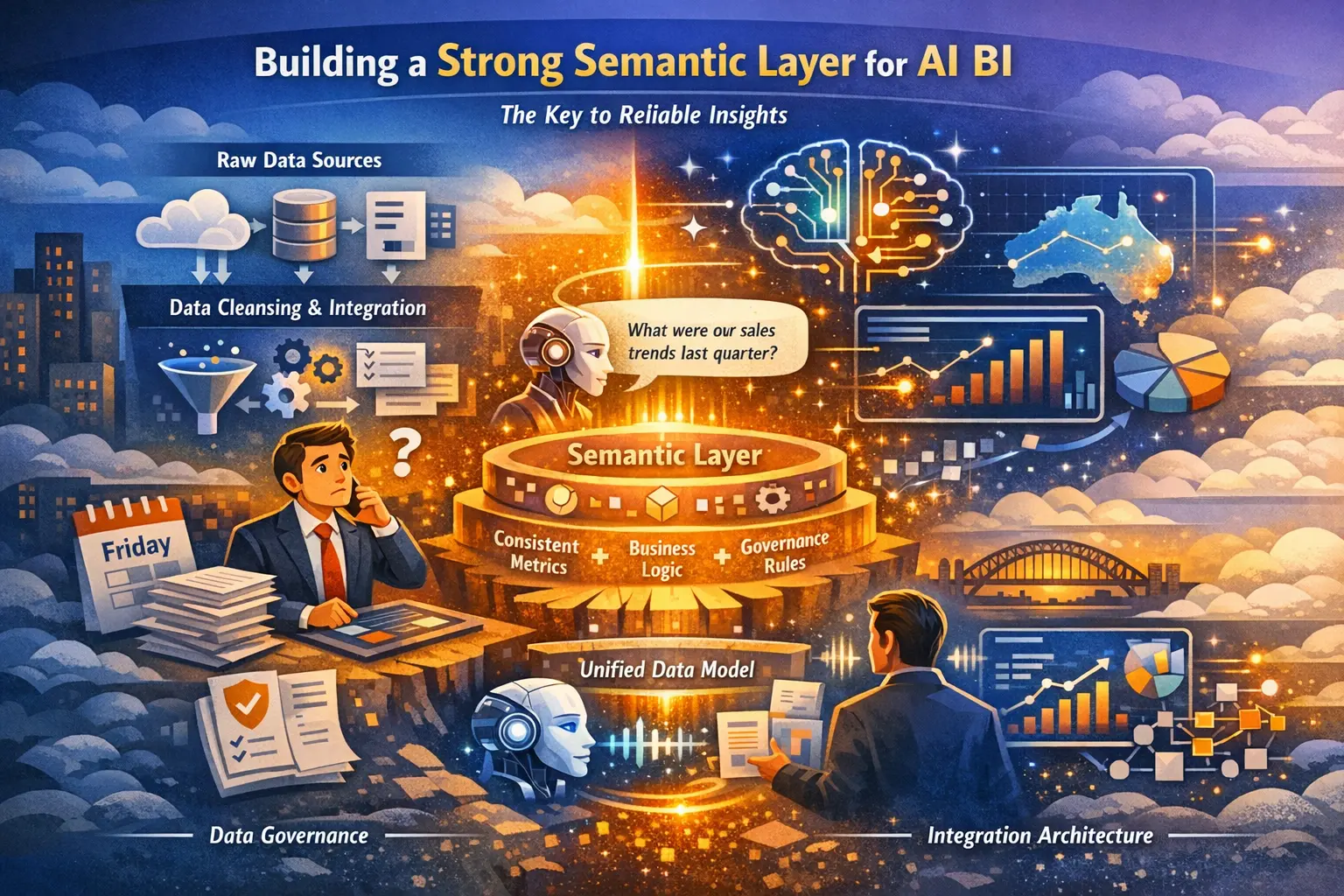
Here is the single most important fact about Generative AI in Business Intelligence that most vendors and consultants do not adequately explain: the quality of every AI-generated insight depends entirely on the quality of the data architecture underneath it. Specifically, it depends on whether a properly governed semantic layer exists between the raw data and the AI model.
A semantic layer is the governed translation layer that maps your raw database fields to the business concepts your AI needs to understand. It is what tells the large language model that:
- 'Revenue' = SUM of completed order values, net of returns, calculated on the invoice date, excluding inter-company transactions
- 'Active customer' = any customer with a purchase within the last 60 days
- 'Gross margin' = (Revenue minus direct cost of goods sold) divided by Revenue, expressed as a percentage
- 'On-time delivery' = shipments delivered within 24 hours of the committed date
Without these definitions, the AI guesses. With them, the AI is anchored to your exact business logic — and its answers are trustworthy.
|
📌 Why Most AI BI Pilots Fail at Scale
The BARC Trend Monitor 2026 confirmed data quality as the single most important prerequisite for analytics and AI success. IBM and BCG research consistently finds that 70% of enterprise AI failures stem not from model limitations but from poor data infrastructure — missing governance, inconsistent field definitions, and fragmented data pipelines. Building the semantic layer correctly is the difference between an AI analytics platform that transforms decision-making and one that erodes trust in data across the entire organisation.
|
What a Robust Data Foundation Looks Like
C9's Business Intelligence development methodology addresses the data foundation before any AI capability is introduced. This involves:
- Data source mapping — auditing every system that generates business-relevant data and documenting its structure, quality, and update frequency
- Data cleansing and standardisation — resolving inconsistencies, duplicates, and definitional conflicts across source systems
- Semantic model design — building the governed business logic layer that maps technical fields to business-meaningful concepts
- Integration architecture — connecting all sources into a unified analytical data layer with the appropriate refresh frequency for each use case
- Governance documentation — creating the audit trail and definitional record that supports AI explainability and compliance requirements.
Generative AI BI in Practice: Australian Industry Use Cases
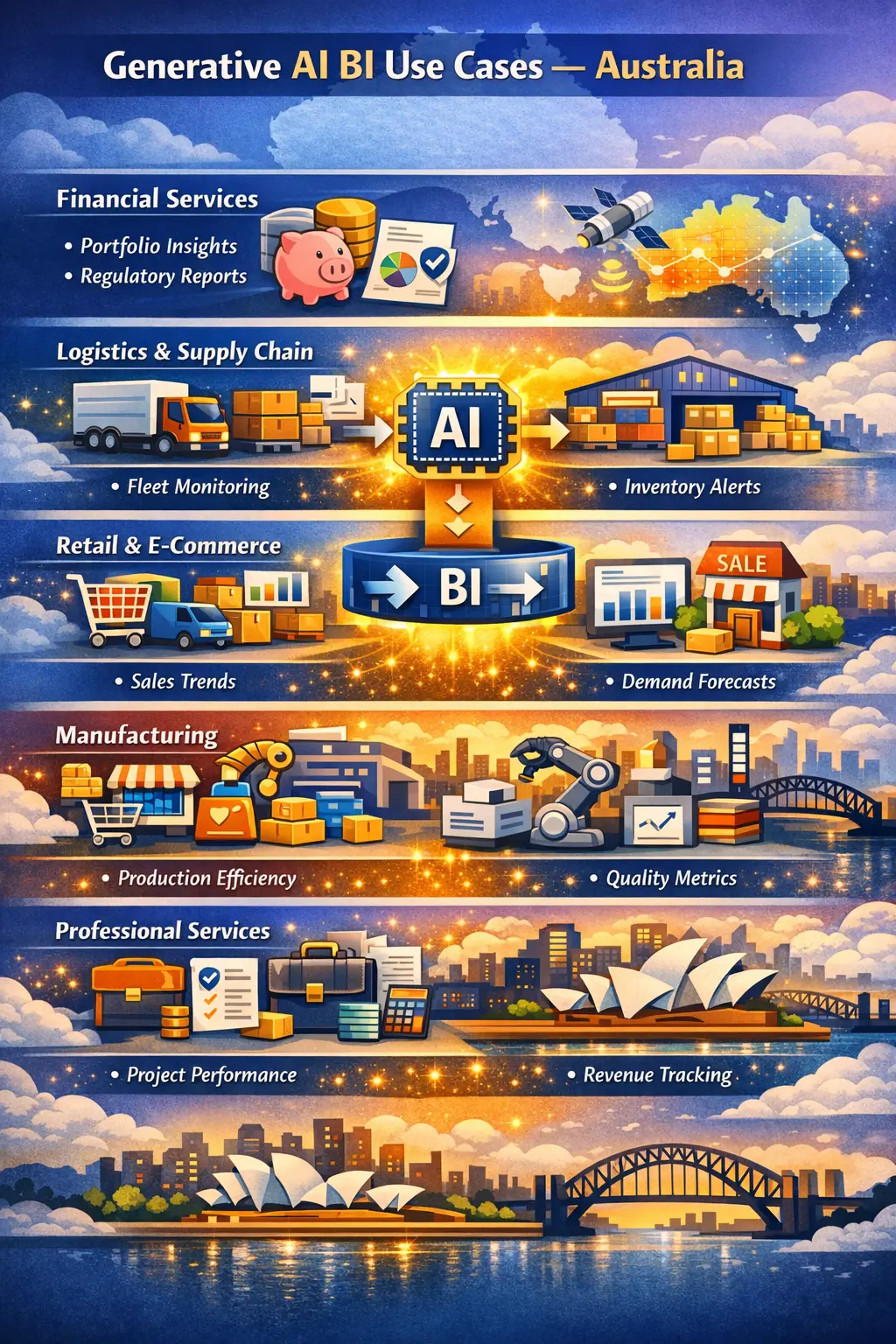
The following examples illustrate how Generative AI-powered custom BI dashboards create tangible business value across the industries where C9's clients operate. These are not theoretical applications — they reflect the real analytical workflows Australian businesses are building in 2026.
Financial Services and Wealth Management
Australian financial advisory firms and superannuation funds are using Generative AI BI to monitor client portfolio risk exposures in real time, automatically generate personalised portfolio review documents, and produce regulatory reporting summaries that previously required days of analyst effort. Under APRA CPS 234 and ASIC oversight obligations, the AI governance layer — with full audit trails and explainability documentation — is not optional; it is a compliance requirement that C9 builds into every financial services BI engagement.
Logistics and Supply Chain
Third-party logistics providers and national distributors are deploying Generative AI dashboards that consolidate live fleet telemetry, warehouse inventory data, and customer order systems into a single operational intelligence view. Proactive anomaly detection flags potential stockouts, supplier delays, and SLA breaches before they materialise — enabling operations managers to intervene hours earlier than traditional reporting allowed. McKinsey research indicates AI-driven forecasting improves volume accuracy by up to 10% and reduces costs by up to 15%.
Retail and E-commerce
Australian retailers are using AI-powered BI dashboards to monitor real-time sales velocity by SKU, generate daily demand forecasts, and produce plain-English morning briefings for store managers and buyers — covering what sold, what is at risk of stockout, and what promotional activity is driving or suppressing margin. Companies using BI for customer analytics report 19% higher revenue growth than competitors who do not (DataStackHub, 2025).
Manufacturing and Industrial
Manufacturers across Victoria and Queensland are integrating Generative AI into their operational dashboards to monitor Overall Equipment Effectiveness (OEE), quality reject rates, and production cost variances in real time. The AI narrative layer converts raw production data into shift handover reports, quality incident summaries, and maintenance prioritisation recommendations — reducing the documentation burden on floor supervisors while improving the quality of operational intelligence available to leadership.
Professional Services
Consulting, accounting, and legal firms are using custom BI dashboards to monitor project profitability, utilisation rates, and revenue recognition in real time. Generative AI capabilities allow partners to ask natural language questions — 'Which engagements are tracking below target margin this month, and why?' — and receive immediate, accurate answers that previously required a finance team member to run a bespoke analysis.
Real-Time Analytics: The Competitive Edge Australian Businesses Are Building Now
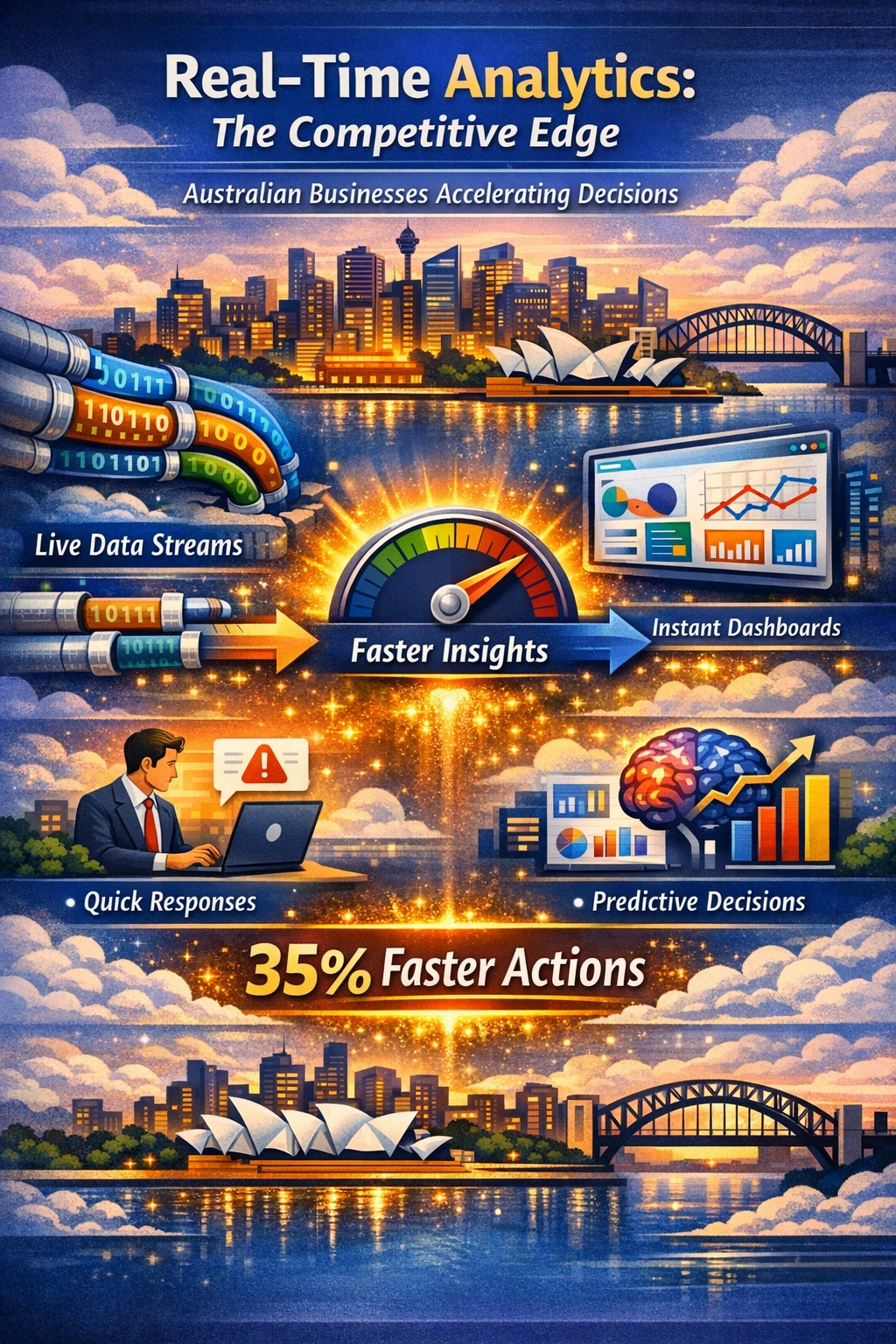
The shift from batch-refresh dashboards to real-time analytics represents one of the most significant operational advantages available to Australian businesses in 2026. Real-time analytics — dashboards updated continuously from live data streams rather than nightly batch processes — compresses the time between an event occurring and a decision-maker having the information they need to respond.
According to SRAnalytics (2025), organisations adopting real-time decisioning are discovering a compounding effect: the faster they react, the more competitive they become — and the gap between them and slower-moving competitors widens each quarter. Predictive BI analytics reduce decision latency — the time between insight and action — by 35% across industries (DataStackHub, 2025).
|
📊 The Real-Time Advantage in Numbers
Enterprises with advanced BI maturity report 2.5× faster decision-making and 40% higher ROI on their analytics investments compared to organisations using basic BI tools (DataStackHub, 2025). Data-driven organisations are 23 times more likely to acquire customers, 6 times more likely to retain them, and 19 times more likely to be profitable than their data-passive competitors (McKinsey Global Institute).
|
What Real-Time BI Requires Technically
Delivering genuine real-time analytics requires a data architecture designed for streaming data — not just a nightly batch pipeline refreshed more frequently. This includes event streaming infrastructure (such as Apache Kafka or Azure Event Hubs), in-memory or columnar database layers for sub-second query performance, and a Generative AI layer capable of interpreting and narrating live data changes as they occur. C9 designs and builds these architectures for Australian businesses across industries where operational speed is a commercial differentiator.
AI, Data Governance, and Australian Regulatory Compliance
For Australian businesses operating in regulated industries — financial services, healthcare, government, and increasingly retail and telecommunications — deploying Generative AI in Business Intelligence without a proper governance framework is not merely a technical risk. It is a potential compliance liability.
The Australian Privacy Act 1988 and the Notifiable Data Breaches scheme require organisations to demonstrate they understand and control how personal and sensitive data flows through their systems. APRA's CPS 234 requires financial services entities to apply information security governance to every system — including AI-powered analytics platforms. The Australian AI Ethics Framework establishes eight core principles — including transparency, accountability, and human oversight — that represent emerging expectations for responsible AI deployment.
|
🏛️ C9's Governance-by-Design Approach
C9 treats Australian data governance and compliance requirements as foundational design constraints — not afterthoughts. Every BI platform C9 builds includes role-based access control enforced at the query level, immutable audit logs of every AI-generated insight and the data that produced it, data lineage documentation for privacy impact assessments, and explainability modules that allow compliance teams to understand and validate AI outputs. This ensures every AI analytics deployment meets current Australian regulatory expectations and is positioned to adapt as frameworks evolve.
|
How C9 Builds Custom Generative AI BI Dashboards for Australian Businesses
C9 is one of Australia's leading custom software, application, and database development companies, with a specialist practice in Business Intelligence development and analytics dashboards. Their bespoke development methodology for Generative AI BI follows a disciplined, stage-gated process that addresses the data foundation before building the AI capability.
|
Development Stage
|
What C9 Does
|
Why It Matters
|
|
01 — Data Discovery
|
Maps every data source, KPI definition, and decision workflow
|
Prevents assumptions that cause production failures
|
|
02 — Semantic Model Build
|
Constructs the governed business logic layer for AI accuracy
|
Ensures AI answers are correct, not just plausible
|
|
03 — Data Pipeline Design
|
Builds real-time or batch ingestion architecture as appropriate
|
Delivers the data freshness your decisions require
|
|
04 — AI Layer Integration
|
Connects LLMs to the semantic model via secure, governed interfaces
|
Enables NLQ, narrative generation, and anomaly detection
|
|
05 — Dashboard UX Design
|
Designs interfaces for executive, operational, and analyst users
|
Drives adoption and maximises analytical value in use
|
|
06 — Governance and Security
|
Implements access controls, audit logs, and compliance architecture
|
Meets Australian regulatory requirements from day one
|
Throughout the development process, C9 works in Agile sprints with continuous client involvement — ensuring the platform reflects how the business actually operates, not how a development team assumes it does. The result is a custom BI platform that the organisation owns completely, can expand independently, and can scale without per-seat licensing constraints.
The Business Case: What ROI Does Custom Generative AI BI Deliver?
The financial case for investing in bespoke Business Intelligence development is well-supported by independent research. Organisations that implement BI correctly — with proper data foundations and AI integration — consistently achieve measurable returns across multiple dimensions.
|
127%
average 3-year ROI from BI-driven strategies (Forrester / Nucleus Research)
|
2.5×
faster decision-making at advanced BI maturity vs basic BI (DataStackHub, 2025)
|
35–40%
reduction in manual data preparation tasks from AI-assisted BI (DataStackHub, 2025)
|
Beyond these headline metrics, the operational impact compounds over time. Analyst teams freed from manual reporting contribute to higher-value analytical work. Leadership teams with access to real-time, AI-interpreted data make faster and more confident decisions. Finance functions with automated narrative generation reduce month-end reporting cycles from days to hours. And organisations with AI-powered anomaly detection resolve operational issues before they translate into customer impact or revenue loss.
The payback period for properly structured BI investments is typically 12–18 months, after which the platform delivers compounding returns as adoption deepens and use cases expand (DataStackHub, 2025 — citing long-term analytics investments delivering 200%+ cumulative ROI).
Frequently Asked Questions: Generative AI and Business Intelligence in Australia
Is Generative AI BI only for large enterprises?
No. While larger organisations have been early adopters, the underlying technologies — cloud data infrastructure, commercial LLM APIs, and bespoke development practices — are accessible to mid-market businesses and growing SMEs. C9 works with Australian organisations across revenue scales. The Australian Government's National AI Centre AI Adoption Tracker (Q1 2025) confirms 60% of Australian SMEs plan to deploy AI by 2026, reflecting a rapid democratisation of the capability.
How is this different from just enabling Copilot in Power BI?
Microsoft Copilot for Power BI assists users in navigating the Power BI interface and writing DAX formulas. It is an interface tool, not a Business Intelligence strategy. Copilot operates on Power BI's generic data model and cannot be trained on your specific business terminology, KPI definitions, or industry context. A custom Generative AI BI platform built by C9 starts with your exact business logic, connects to every data source you operate, and delivers accurate answers to the specific questions your business actually asks.
What data sovereignty considerations apply to Australian businesses using AI?
This is a critical question. Sending sensitive business data to overseas AI providers may create obligations under the Privacy Act 1988 and industry-specific regulations, including APRA CPS 234 for financial services entities. C9 architects AI integrations using Microsoft Azure's Australian-region infrastructure where data residency is required, and evaluates privately-hosted open-source models (such as Meta's Llama series) for organisations with the most sensitive data requirements. Data sovereignty is a design constraint, not an afterthought, in every C9 BI engagement.
How long does a custom BI development project typically take?
Engagement duration depends on data complexity, the number of integrated source systems, and the scope of AI capabilities required. C9's structured methodology allows organisations to go live with a first production module — typically a core operational dashboard with initial NLQ capability — within 8–16 weeks. More complex enterprise-wide platforms are typically delivered in phases over 4–9 months, with each phase delivering operational value before the next begins.
Conclusion: The Competitive Window Is Open — But Not Indefinitely
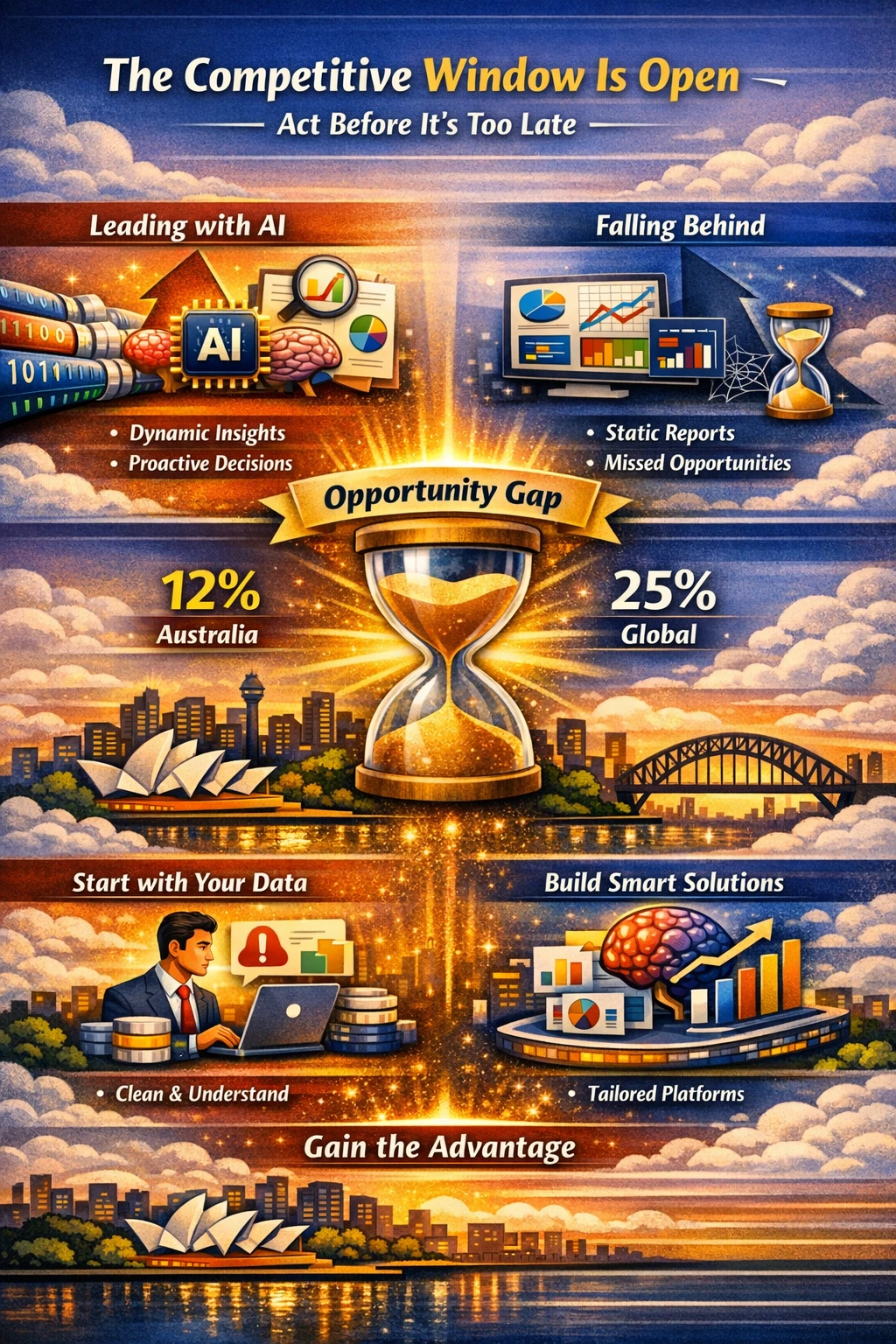
Generative AI has not merely improved Business Intelligence. It has redefined what is possible: from dashboards that report the past to intelligent platforms that explain the present, predict the future, and recommend what to do next — all in plain English, available to every decision-maker in the organisation without technical mediation.
The Australian organisations building this capability correctly — starting with clean data, investing in the semantic layer, and connecting AI to a platform that genuinely understands their business — are establishing decision-making advantages that compound over time. Their competitors, relying on static dashboards or generic AI tools, are not standing still either. The gap is widening.
Deloitte's 2026 State of AI in the Enterprise survey found that only 12% of Australian businesses report Generative AI is already transforming their operations — compared with 25% globally. That gap represents both a warning and an opportunity. The organisations that move decisively now have the potential to establish analytical capabilities their markets will spend years trying to replicate.
The first step is not a technology decision. It is a conversation about your data — what you have, where it lives, and what decisions you need it to support. C9's team starts every engagement there.
|
Ready to Build Your Custom AI-Powered BI Dashboard?
Book a no-obligation Discovery Session with C9's Business Intelligence development team.
We will map your data environment, identify your highest-value analytics use case, and show you exactly what a custom-built solution looks like for your business.
→ Visit www.c9.com.au to start the conversation
|
Business Intelligence & Reporting | Analytics Dashboards | AI Integration | Database Development
References and Sources
All statistics, research findings, and data cited in this article are sourced from peer-reviewed reports, government publications, and recognised industry research organisations. Readers are encouraged to consult the original sources for full methodological detail.
|
#
|
Citation
|
Source URL
|
|
1
|
Deloitte Australia (2026). State of AI in the Enterprise — Australian Edition. Deloitte AI Institute.
|
https://www.deloitte.com/au/en/issues/generative-ai/state-of-ai-in-enterprise.html
|
|
2
|
Deloitte Global (2026). State of AI in the Enterprise. Deloitte AI Institute. Survey of 3,235 leaders, Aug–Sep 2025.
|
https://www.deloitte.com/us/en/what-we-do/capabilities/applied-artificial-intelligence/content/state-of-ai-in-enterprise.html
|
|
3
|
Australian Department of Industry, Science and Resources (2025). AI Adoption in Australian Businesses — Q1 2025. National AI Centre / Fifth Quadrant.
|
https://www.industry.gov.au/news/ai-adoption-australian-businesses-2025-q1
|
|
4
|
Australian Department of Industry, Science and Resources (2025). Australia's Artificial Intelligence Ecosystem: Growth and Opportunities.
|
https://www.industry.gov.au/sites/default/files/2025-06/australias-artificial-intelligence-ecosystem-growth-and-opportunities-june-2025.pdf
|
|
5
|
DataStackHub (2025). Business Intelligence (BI) Statistics For 2025–2026. Comprehensive BI market and ROI benchmarks.
|
https://www.datastackhub.com/insights/business-intelligence-statistics/
|
|
6
|
SRAnalytics (2025). Business Intelligence Trends 2026: Why 90% Fail With AI. Research on BI implementation failure modes.
|
https://sranalytics.io/blog/business-intelligence-trends/
|
|
7
|
SRAnalytics (2025). Top 10 Business Intelligence and Analytics Trends 2025. Harvard Business Review / Google / Accenture data on data-driven productivity.
|
https://sranalytics.io/blog/business-intelligence-and-analytics-trends-2025/
|
|
8
|
OECD (2026). AI Use by Individuals Surges Across the OECD as Adoption by Firms Continues to Expand. OECD ICT Access and Usage Database.
|
https://www.oecd.org/en/Company/news/announcements/2026/01/ai-use-by-individuals-surges-across-the-oecd-as-adoption-by-firms-continues-to-expand.html
|
|
9
|
AppInventiv (2026). AI Implementation in Australia: Use Cases, Costs & Strategy. Enterprise AI adoption analysis.
|
https://appinventiv.com/blog/ai-in-australia/
|
|
10
|
AppInventiv (2026). Generative AI Use Cases in Australia for Enterprises. Industry-by-industry analysis of AU GenAI adoption.
|
https://appinventiv.com/blog/generative-ai-use-cases-australia/
|
|
11
|
AmplifAI (2026). 90+ Generative AI Statistics You Need to Know in 2026. Comprehensive GenAI adoption and ROI data.
|
https://www.amplifai.com/blog/generative-ai-statistics
|
|
12
|
Enterprise Monkey (2026). Maximising AI in 2026: A Roadmap for Australian Businesses on the Global Stage.
|
https://enterprisemonkey.com.au/maximising-ai-2026-roadmap-australian-businesses-global-stage/
|
|
13
|
SQ Magazine (2026). Big Data Analytics Statistics 2026: Growth Secrets. Market size, ROI and adoption benchmarks.
|
https://sqmagazine.co.uk/big-data-analytics-statistics/
|
|
14
|
Optimum (2025). The ROI of AI Data Analytics: Turning Insights into Business Impact. McKinsey forecasting accuracy data.
|
https://optimumcs.com/insights/the-roi-of-ai-data-analytics-turning-insights-into-business-impact/
|
|
15
|
The Reporting Hub (2026). 10 Analytics & AI Trends Redefining Business Intelligence in 2026. Semantic model and real-time analytics analysis.
|
https://thereportinghub.com/blog/10-analytics-ai-trends-redefining-business-intelligence-in-2025
|
|
16
|
Intelegain (2025). Top 10 Analytics and Business Intelligence Trends for 2026. BI market growth projections (MarketsandMarkets).
|
https://www.intelegain.com/top-10-analytics-and-business-intelligence-trends-for-2026/
|
|
17
|
Nucleus Research / Forrester — cited in Ailoitte (2025). 8 Business Intelligence & Analytics Trends for 2025. 127% 3-year BI ROI analysis.
|
https://www.ailoitte.com/blog/business-intelligence-analytics-trends/
|
|
18
|
McKinsey Global Institute — cited in Market.us Scoop (2026). Business Intelligence Statistics and Facts (2026). Customer acquisition / retention data.
|
https://scoop.market.us/business-intelligence-statistics/
|
|
19
|
Coherent Solutions (2025). The Future of Data Analytics: Trends in 7 Industries. Kearney profitability uplift from advanced analytics.
|
https://www.coherentsolutions.com/insights/the-future-and-current-trends-in-data-analytics-across-industries
|
|
20
|
Australian Government (2025). Australian AI Ethics Framework. Eight core principles for responsible AI deployment.
|
https://www.industry.gov.au/publications/australias-artificial-intelligence-ethics-framework
|
C9 | Australia's Leading Custom Software, Apps, Integration & Database Developer
© C9 2026. All rights reserved. Content accurate as at March 2026.
Explore Related Insights on Dashboards & Web Portals Development Solutions
How a Bespoke Web Portal Can Reduce Operational Costs for Australian Enterprises
Microsoft Fabric and Power BI: The Ultimate Unified Analytics Platform for 2026
AI-Powered Predictive Analytics in 2026: How Australian Businesses Are Turning Data into Millions in New Revenue (Before Their Competitors Do)
Unlock Smarter Decisions: How AI-Powered Analytics and Copilot Integration in Power BI Transforms Australian Businesses
AI-Driven Custom Dashboards: Your 2026 Guide to Real-Time Business Intelligence
AI Transparency Notice:
This article was produced with the assistance of artificial intelligence tools, including content drafting, visual asset creation, and audio generation. All content has been reviewed and approved by C9 prior to publication.