EXECUTIVE SUMMARY
In short:
- Australian businesses lose an estimated 35% of qualified leads not from a lack of marketing spend, but from delayed or absent follow-up. Agentic AI chatbots for sales solve this at the point of enquiry — engaging every lead within seconds, 24 hours a day, 7 days a week.
- Unlike traditional chatbots, agentic AI takes autonomous action: it qualifies prospects, books meetings, sends personalised follow-ups, logs data into your CRM, and re-engages cold leads — all without human intervention.
- AI post-meeting summarisation tools eliminate the administrative burden of client calls, automatically transcribing conversations, extracting action items, and populating CRM records within minutes of a meeting ending.
- AI-based scheduling removes the friction of diary coordination — reducing the average time-to-meeting from 1.7 days to under 4 minutes for high-intent leads.
- Generative AI in sales carries real limitations — including hallucination risk, Australian data privacy obligations, and integration complexity — all of which are fully manageable with a purpose-built implementation strategy.
What’s next?
Agentic AI is no longer a future consideration for Australian businesses — it is an operational decision you are making right now, by acting or by waiting. This guide gives you the knowledge to act wisely. Read each section in full, or use the headings to navigate directly to your most pressing business challenge.
|
The Lead Engagement Crisis Costing Australian Businesses Millions
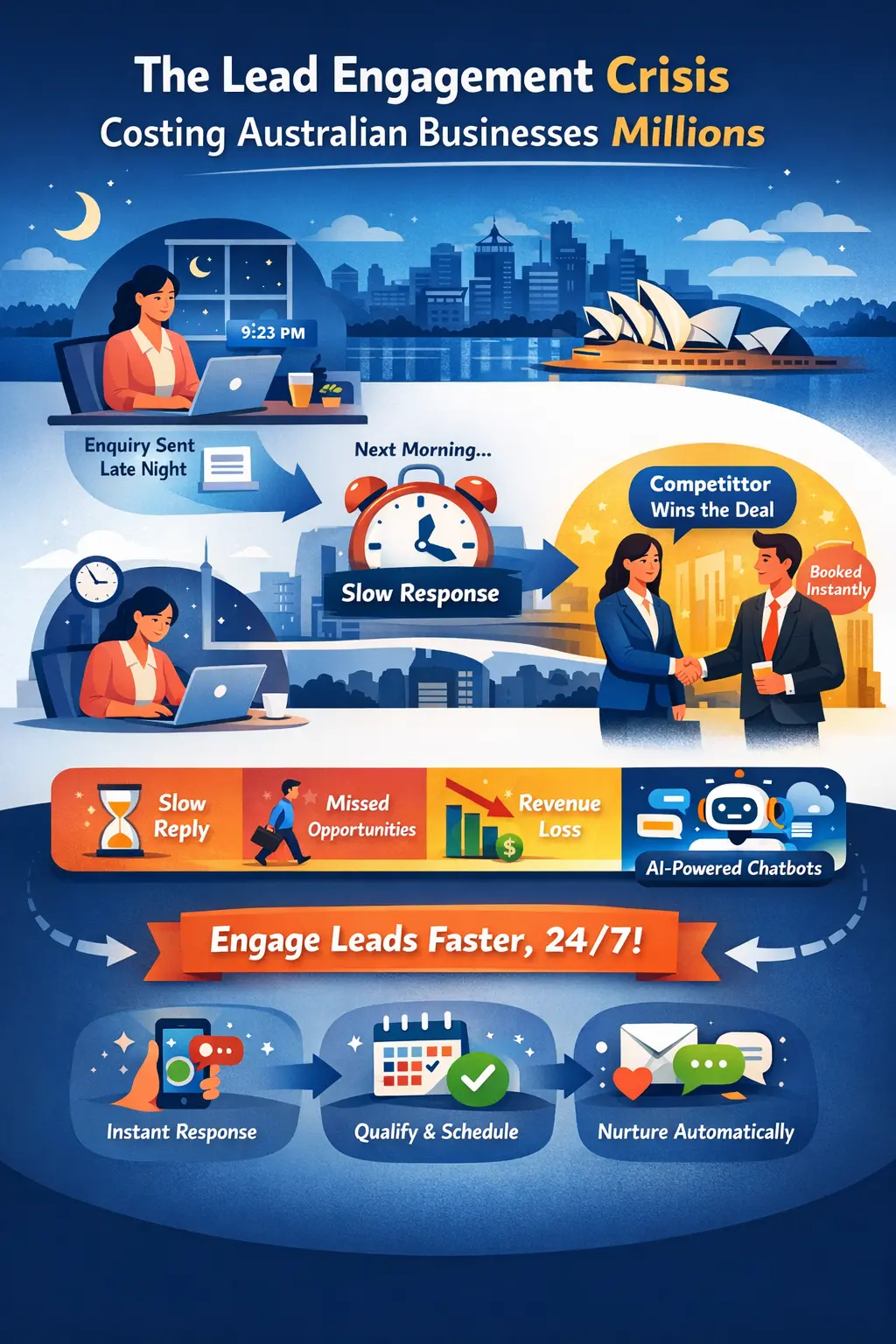
It is Wednesday evening. A senior procurement manager at a mid-sized Melbourne manufacturing company is researching software providers. She finds your website, reads your case studies, and fills in your enquiry form at 9:23 PM. She is genuinely interested.
By 9:30 AM the following morning — when your team opens their inboxes — she has already booked a discovery call with a competitor. Not because they offered a better product. Because they responded to her enquiry within four minutes of her submitting it. You did not respond until the next morning.
This scenario repeats itself thousands of times each day across Australian businesses. It is not a hypothetical risk. According to research published by Harvard Business Review [1], companies that respond to leads within the first five minutes are 100 times more likely to connect with a prospect than those who wait 30 minutes or longer. After one hour, the probability of meaningful contact drops by 60%.
For Australian businesses operating with lean teams, limited after-hours coverage, and an increasingly competitive digital landscape, the gap between enquiry and response is not just an operational inconvenience — it is a structural revenue problem.
|
100x
more likely to connect within 5 minutes vs. 30 minutes [1]
|
78%
of buyers choose the first business to respond [2]
|
35%
of Aussie leads lost due to slow or absent follow-up [11]
|
$2.4B
estimated annual revenue lost by Australian SMEs to poor follow-up
|
The solution is not to hire more staff to cover every hour of the day. The solution is to deploy intelligent automation that engages leads the moment they arrive, qualifies their intent, books the right next step, and nurtures the relationship until a human being is ready to close it.
That solution is called an agentic AI chatbot for sales — and it represents the most significant shift in lead engagement strategy available to Australian businesses today.
This guide covers everything you need to make an informed decision: what agentic AI actually is, how post-meeting AI summarisation eliminates costly administrative overhead, what the best practices for AI-based scheduling look like in an Australian context, and where the genuine limitations of generative AI in sales lie — and how to mitigate them.
What Is an Agentic AI Chatbot for Sales — and Why Does It Matter?
The word ‘agentic’ is doing significant work in this context, and it is worth defining clearly before we proceed.
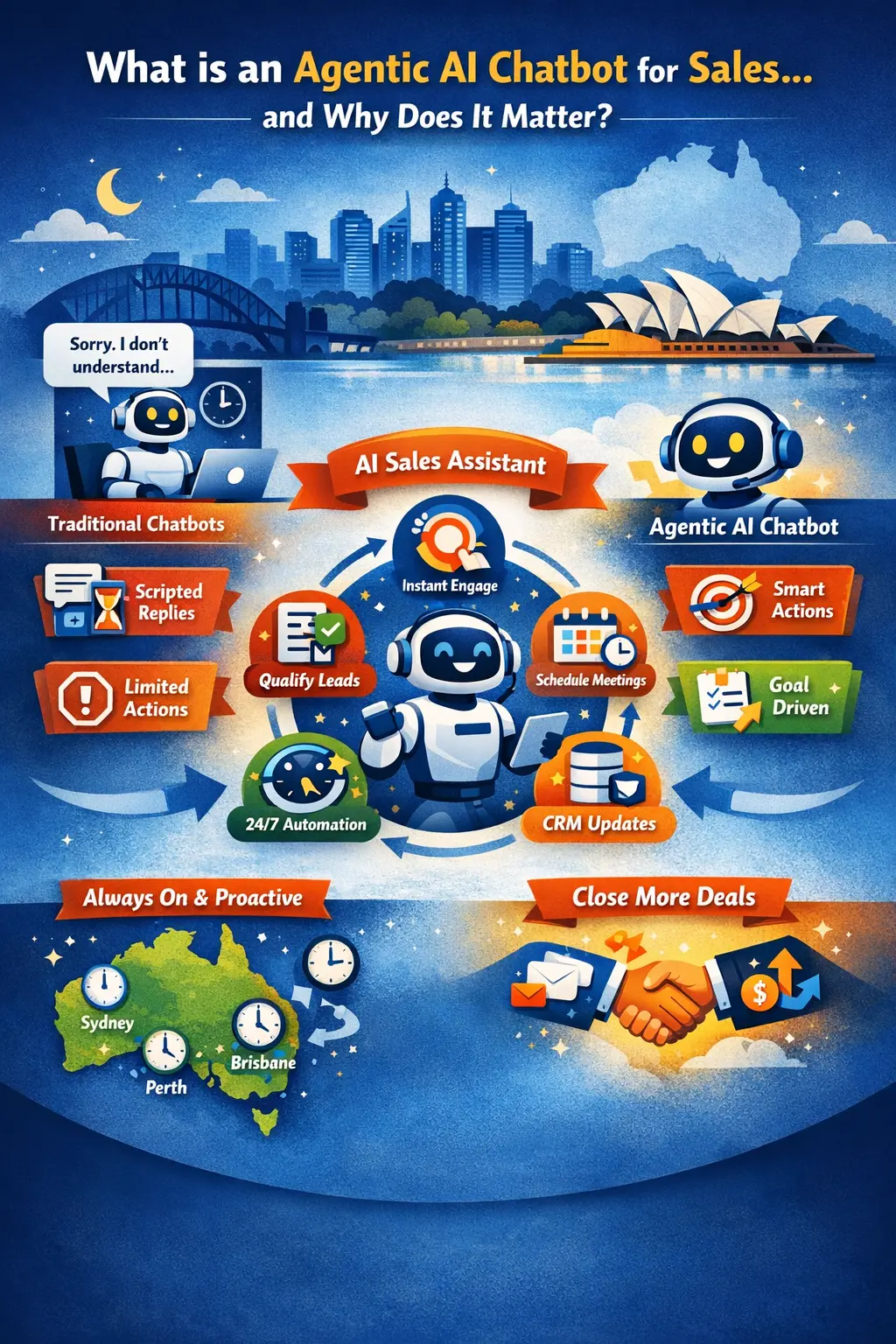
Traditional AI chatbots — the kind that have frustrated customers on websites for the past decade — are fundamentally reactive systems. They follow pre-scripted decision trees, respond to specific trigger phrases, and fail the moment a user’s question falls outside their programmed parameters. They answer. They do not act.
Agentic AI, as defined by IBM [13] and increasingly discussed in enterprise technology literature, refers to AI systems capable of autonomous goal-directed behaviour. An agentic AI chatbot does not merely respond to input — it perceives the goal of the interaction, determines what actions are required to achieve that goal, and executes those actions independently. It is, in the most practical sense, a virtual sales assistant that never sleeps, never loses patience, and never forgets to follow up.
The Anatomy of an Agentic AI Sales Workflow
A well-implemented agentic AI chatbot for sales performs the following functions in a continuous, autonomous loop:
- Instant engagement: The moment a lead submits an enquiry — whether at 2 PM on a Tuesday or 11 PM on a Saturday — the AI initiates a natural, context-aware conversation. It does not send a generic ‘thank you for your enquiry’ auto-reply. It engages.
- Intelligent qualification: Through a sequence of conversational questions — calibrated to your specific business — the AI determines the lead’s intent, budget range, timeline, decision-making authority, and primary pain points. This information is captured and structured, not buried in a chat log.
- Dynamic routing: Based on qualification score, the AI routes high-intent leads to an immediate human follow-up notification, schedules mid-intent leads into a nurture sequence, and politely disqualifies poor-fit leads — freeing your team’s time for conversations worth having.
- Automated booking: For qualified leads who are ready to speak with a team member, the AI presents real availability from your calendar and books the meeting directly — without a single email exchange between human parties.
- CRM population: Every piece of data captured during the conversation is automatically logged into your CRM — contact details, qualification answers, conversation sentiment, meeting time, and assigned sales rep.
- Personalised follow-up: Based on what the lead expressed during the conversation, the AI triggers a contextually appropriate follow-up sequence — not a generic drip campaign, but communications tailored to the specific concerns and interests the prospect raised.
- Re-engagement: Leads that go quiet after initial contact, or that did not attend a booked meeting, are automatically re-engaged on a configurable schedule — with progressively different messaging until a response is achieved or the lead is archived.
|
❌ Traditional Chatbot
|
✅ Agentic AI for Sales
|
|
Rigid, scripted decision trees
|
Context-aware, goal-directed conversations
|
|
Fails when questions go off-script
|
Handles nuanced, multi-topic enquiries
|
|
Responds only — cannot take action
|
Books, logs, follows up autonomously
|
|
No CRM or calendar integration
|
Native integration across your full tech stack
|
|
Identical response to every visitor
|
Personalised based on lead behaviour and data
|
|
High customer frustration and drop-off
|
Professional, human-like experience
|
|
Requires constant manual maintenance
|
Learns and improves from each interaction
|
|
Available during business hours only
|
Available 24 hours a day, 7 days a week
|
The Australian Market Context
For Australian businesses specifically, the case for agentic AI chatbots in sales is particularly compelling. According to data from the Australian Bureau of Statistics [4], 62% of Australian businesses with five or more employees now operate a website — but fewer than 18% have implemented any form of automated lead engagement. The gap between digital presence and digital conversion is wide, and it is widening.
Australia’s geographic spread compounds the problem. A Sydney-based business that sells nationally faces enquiries from clients in Perth who are two to three hours behind, from Far North Queensland clients who knock off earlier, and from businesses operating across multiple time zones. A human team simply cannot maintain consistent responsiveness across this breadth. An agentic AI system can.
|
💡 C9 Insight: Custom vs. Off-the-Shelf
The most effective agentic AI implementations for Australian businesses are not purchased as subscriptions and configured over a weekend. They are built — integrated deeply into existing CRM infrastructure, email platforms, calendar systems, and business databases. C9 builds these systems from the ground up, ensuring that the AI operates as a genuine extension of your business rather than a bolt-on widget.
|
AI for Post-Meeting Summaries & Notetaking: Recover the Hours Your Team Is Losing
Winning the first conversation with a lead is only the beginning. The quality of what happens after each meeting — the notes taken, the commitments recorded, the follow-up sent — determines whether that lead becomes a client or gradually disengages.
The post-meeting reality in most Australian businesses is sobering. According to research from McKinsey [3], knowledge workers spend an average of 9.3 hours per week writing emails and an additional 4.1 hours per week in administrative tasks related to meetings — including note-taking, summarisation, and CRM updates. For a sales team of five, that is the equivalent of losing one full-time employee’s productive hours entirely to meeting administration.
AI post-meeting summarisation and notetaking tools address this directly, systematically, and with a level of consistency that no human note-taker can reliably match.
How AI Post-Meeting Tools Work in Practice
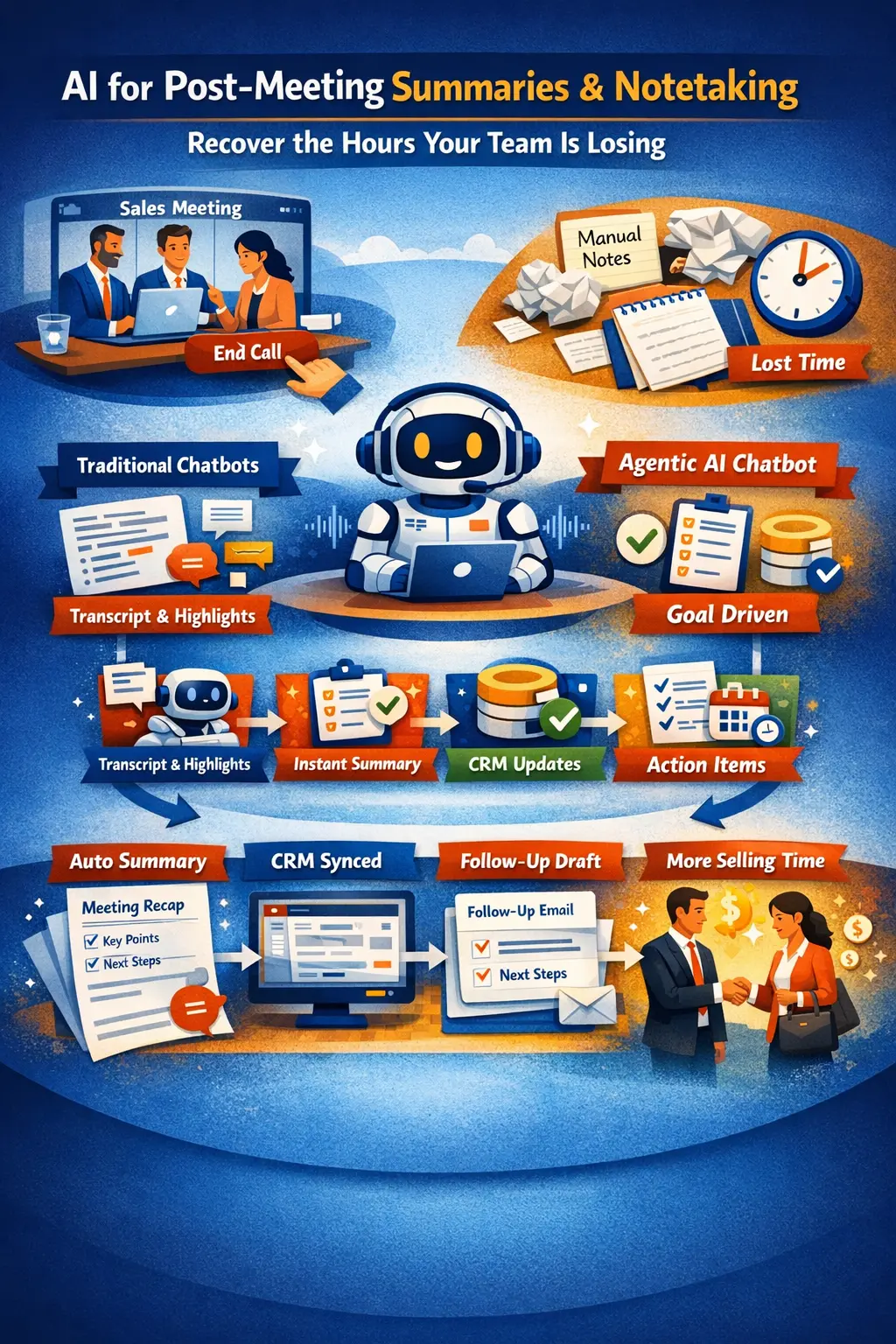
Modern AI meeting tools integrate natively with the platforms Australian businesses already use — Zoom, Microsoft Teams, and Google Meet are all supported by leading solutions. Here is the end-to-end workflow:
- Pre-meeting: The AI tool joins the call as a participant (or runs in the background on the host’s device), identified to all attendees to ensure compliance with Australian recording consent requirements.
- During the meeting: The AI transcribes the conversation in real time, identifies speakers by voice signature, and flags content of significance — including questions asked, objections raised, commitments made, deadlines mentioned, and decision points reached.
- Immediately post-meeting: Within 60 to 90 seconds of the call ending, the AI delivers a structured summary to all relevant parties. This summary includes: a headline overview of the discussion, a list of action items with ownership assigned, key decisions recorded, next steps and timelines agreed, and a sentiment indicator for the call overall.
- CRM sync: All summary data — including action items, contact notes, and follow-up tasks — is automatically pushed to your CRM, updating the relevant contact record and creating tasks assigned to the appropriate team members.
- Follow-up drafting: Based on the meeting transcript and summary, the AI drafts a personalised follow-up email that references the specific topics discussed, addresses any concerns raised, and proposes the agreed next steps. The rep reviews and sends — the heavy lifting is already done.
|
AI Capability
|
Business Outcome
|
Est. Weekly Time Saved
|
|
Real-time transcription
|
No detail ever missed
|
2–3 hours per executive
|
|
Automatic action item extraction
|
Complete accountability on commitments
|
1–2 hours per sales rep
|
|
CRM auto-population
|
Accurate records without manual data entry
|
3–4 hours per team
|
|
Sentiment & intent analysis
|
Data-driven coaching and pipeline forecasting
|
Ongoing strategic value
|
|
Follow-up email drafting
|
Faster, more personalised client comms
|
1–2 hours per rep
|
|
Stakeholder summary distribution
|
Full team alignment without extra meetings
|
1–2 hours per team
|
|
Action item tracking & reminders
|
Zero missed commitments or deadlines
|
Prevents costly relationship damage
|
The Australian Privacy Act Considerations You Cannot Ignore
Recording a business meeting — whether by video platform or AI tool — carries specific obligations under Australian law that every executive must understand before deployment.
- The Privacy Act 1988 [6]: Requires that personal information is collected with consent, stored securely, and used only for the purpose for which it was collected. AI meeting recordings contain significant volumes of personal information and must be treated accordingly.
- State-based surveillance legislation: The Surveillance Devices Acts in each Australian state and territory impose additional requirements around recording consent in private conversations. Requirements vary by state — Queensland, New South Wales, and Victoria each have distinct provisions that affect how recording consent must be obtained.
- Notifiable Data Breaches scheme [7]: If a data breach involving recorded meeting content were to occur, your business may be required to notify affected individuals and the Office of the Australian Information Commissioner (OAIC) within 30 days.
- Data residency: Many AI meeting tools are hosted on offshore servers. If the personal information of Australian residents is stored or processed outside Australia, additional obligations under APP 8 of the Australian Privacy Principles apply. Confirm data residency before selecting a platform.
|
⚠️ Compliance-First Implementation
C9 builds all AI meeting and notetaking solutions with Australian compliance requirements as a foundational design constraint — not an afterthought. This includes consent management workflows, data residency confirmation, privacy policy alignment, and breach notification readiness.
|
Best Practices for AI-Based Scheduling & Engagement: From Interest to Commitment in Minutes
The scheduling problem in B2B sales is deceptively costly. According to a 2023 report from Calendly [10], the average meeting between two professionals in different organisations takes 4.2 email exchanges and 1.7 business days to confirm. Across a sales team managing 80 to 120 active leads per month, this represents a staggering volume of low-value administrative communication that consumes time better spent on conversations that actually move deals forward.
AI-based scheduling eliminates this friction. When integrated correctly with your agentic AI chatbot and CRM, it can reduce time-to-meeting for high-intent leads from 1.7 days to under four minutes — capturing interest at its peak rather than chasing it once it has cooled.
The following are the best practices that consistently produce the strongest outcomes for Australian businesses deploying AI scheduling and engagement systems.
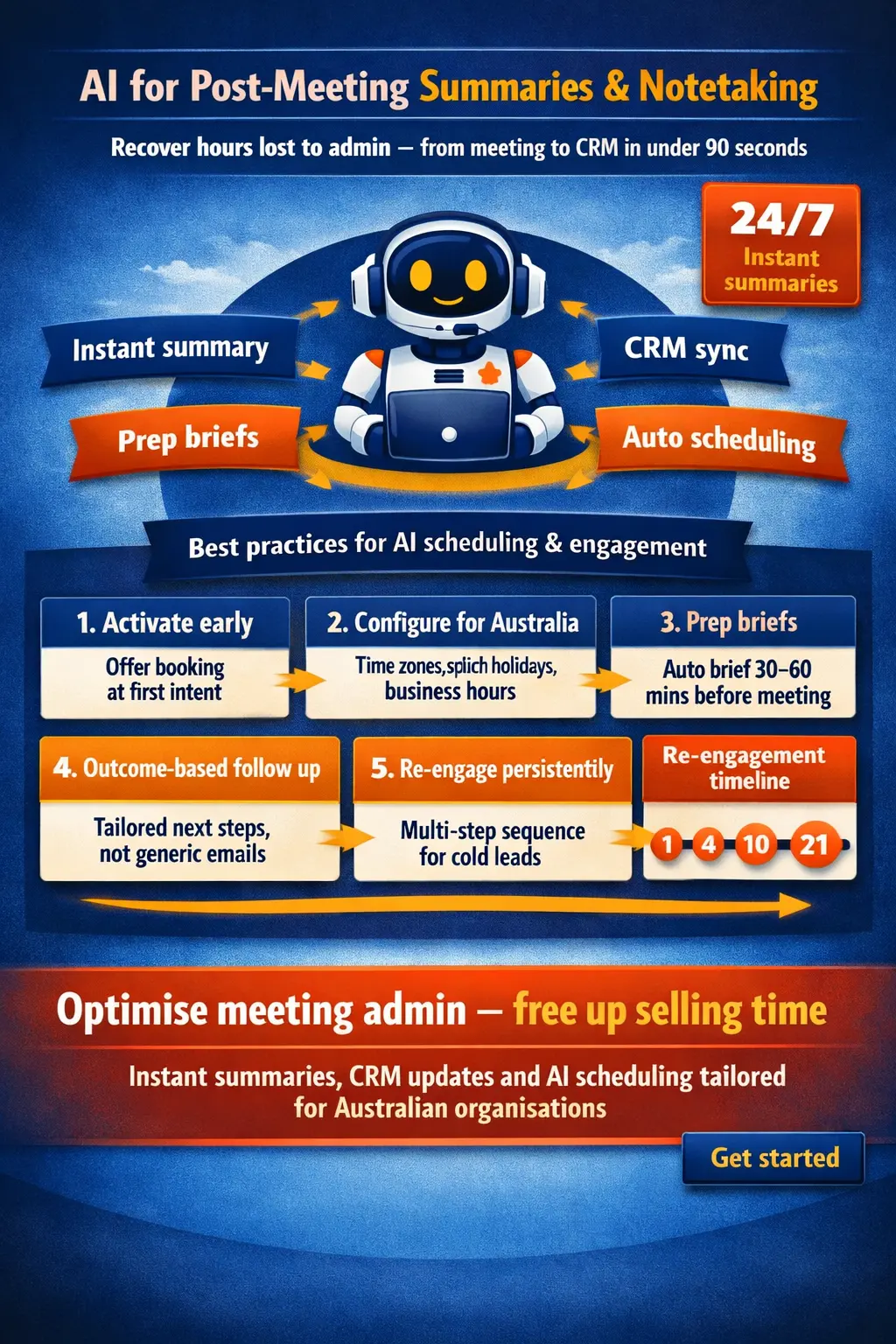
Best Practice 1: Activate AI Scheduling at the Earliest Moment of Intent
The most common mistake in AI scheduling implementation is positioning the meeting booking step too late in the funnel — after a lead has been manually reviewed, scored, and approved by a human gatekeeper. This introduces exactly the delay that AI is designed to eliminate.
Best practice is to offer scheduling at the first demonstrable moment of interest: when a lead submits a contact form, engages meaningfully with a chatbot conversation, or revisits a key page on your website for the second time. The AI presents availability immediately and books the meeting while interest is at its highest point.
Best Practice 2: Configure for the Australian Market Specifically
Generic scheduling tools built for international markets do not account for the complexity of the Australian business calendar. A correctly configured AI scheduler for Australian businesses must include:
- All four major Australian time zones: AEST, AEDT, ACST, and AWST — with automatic adjustment for daylight saving in states where it applies
- State-specific public holiday calendars: Queensland does not observe many of the same public holidays as Victoria or New South Wales — a fact that catches out interstate businesses repeatedly
- Standard Australian business hour conventions: 8:30 AM to 5:00 PM in the relevant state time zone, with avoidance of the traditional lunch window between 12:00 and 13:00
- EOFY sensitivity: The June/July period in Australia carries unique behavioural patterns for B2B buyers — scheduling AI should be calibrated to account for this
Best Practice 3: Deliver Automated Pre-Meeting Preparation Briefs
One of the most underutilised capabilities of integrated AI scheduling systems is pre-meeting intelligence delivery. Thirty to sixty minutes before every AI-booked meeting, your system should automatically compile and deliver a preparation brief to the attending sales representative. This brief should include:
- Full contact and company profile from your CRM
- A summary of all previous interactions — chatbot conversations, email exchanges, and prior meetings
- The specific topics, concerns, and interests the prospect expressed during their initial chatbot engagement
- Relevant case studies or reference clients from the same industry
- Any open tasks or outstanding commitments from previous interactions
Research from Forrester [9] indicates that sales representatives who enter discovery calls with a structured AI-generated brief are 34% more likely to advance the opportunity to the next stage. The preparation brief is not a luxury — it is a conversion lever.
Best Practice 4: Build Outcome-Based Post-Meeting Engagement Sequences
Generic follow-up emails — ‘Thanks for your time, here’s our brochure’ — are both ineffective and increasingly expected. Prospects who have invested 45 minutes in a discovery call with your team expect a follow-up that reflects the conversation they actually had.
AI-driven post-meeting engagement sequences should be triggered by meeting outcome tags, which your AI assigns based on the meeting summary content. Examples:
|
Meeting Outcome Tag
|
AI-Triggered Follow-Up Sequence
|
|
Prospect raised integration concern
|
Send relevant technical integration case study within 2 hours
|
|
Pricing discussed — budget below range
|
Deliver ROI calculator and phased implementation option
|
|
Decision-maker not present
|
Re-engage with summary email copied to decision-maker
|
|
Competitor named
|
Send competitive differentiation one-pager
|
|
Strong positive interest — verbal yes
|
Send proposal template with pre-populated details
|
|
No-show / did not attend
|
Trigger re-engagement sequence: Day 1, Day 4, Day 10
|
|
Referred to another stakeholder
|
Update CRM, notify rep, initiate stakeholder outreach sequence
|
Best Practice 5: Programme Re-Engagement Sequences for Cold and Lost Leads
Not every prospect attends their booked meeting. Not every proposal generates an immediate response. In the absence of AI automation, the majority of these recoverable leads are quietly abandoned after one or two follow-up attempts — a pattern confirmed by Drift’s 2024 report [11] which found that 44% of sales staff make only a single follow-up attempt before moving on.
A properly configured AI engagement system applies a re-engagement sequence that is persistent without being aggressive, and contextually relevant rather than repetitive:
- Day 1: Warm, conversational check-in — ‘Just checking you received our notes from our conversation...’
- Day 4: A value-add resource directly relevant to the topic discussed — case study, industry report, or practical guide
- Day 10: A direct, low-pressure call-to-action — ‘We have a spot available next Tuesday if you’d like to continue the conversation’
- Day 21: A final re-engagement with a different framing — often a reference to a market change, a new case study, or a seasonal prompt
- Day 45+: Move to a long-term nurture sequence at a lower cadence — monthly value-add content with periodic direct outreach
|
📋 AI Scheduling & Engagement Implementation Checklist
Connect your AI scheduler to your existing calendar platform (Google Workspace, Microsoft 365, or Apple Calendar) · Configure all Australian time zones and state public holiday exclusions · Link your CRM so every booking creates or updates a contact record automatically · Set automated reminder sequences at 24 hours, 1 hour, and 15 minutes pre-meeting · Define meeting outcome tags and the follow-up sequences each tag triggers · Programme re-engagement sequences for no-shows, cold leads, and post-proposal silence · Review AI-generated summaries weekly and refine prompts based on quality · Establish a quarterly AI audit process to maintain content accuracy
|
The Real Limitations of Generative AI in Sales — An Honest Assessment
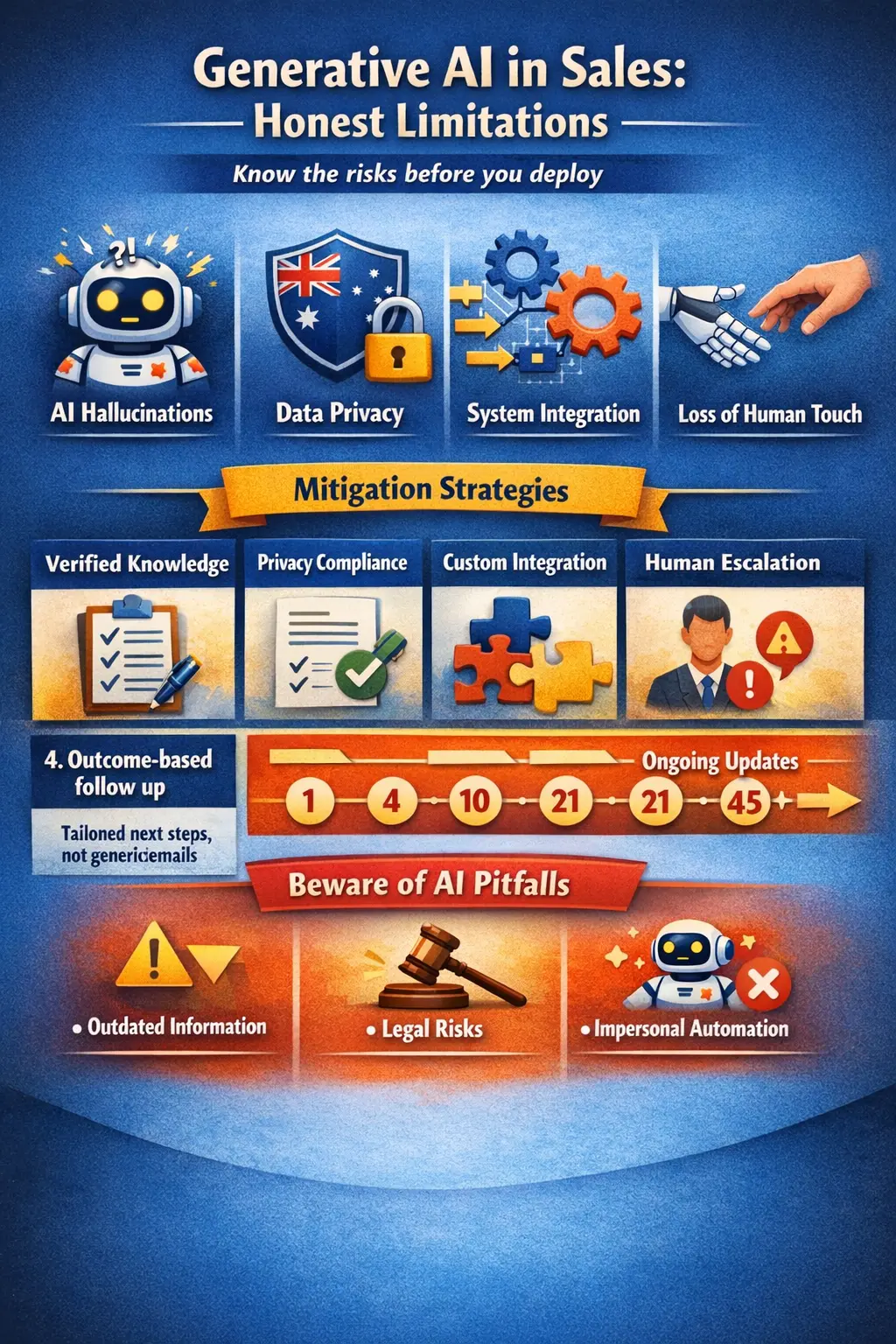
Any credible guide to agentic AI in a sales context must include an unvarnished assessment of its limitations. Generative AI is a transformative technology, but it is not without genuine risks and constraints. Executives who understand these limitations before deployment make better implementation decisions and achieve better outcomes. Those who discover them after deployment often spend significant budget recovering from avoidable mistakes.
The following are the five most significant limitations of generative AI in sales, alongside the mitigation strategies that proven implementations employ.
Limitation 1: Hallucination and Factual Inaccuracy
Large language models — the technology underlying most generative AI chatbots — are trained to produce fluent, confident-sounding text. This is both their greatest strength and their most significant risk. When a model does not know the answer to a question, it does not always say so. Instead, it may generate a plausible-sounding response that is factually incorrect — a phenomenon known as ‘hallucination’.
In a sales context, hallucination is a material business risk. An AI chatbot that confidently misrepresents your product’s features, your pricing structure, your delivery timelines, or your compliance certifications can damage client relationships, create legal exposure, and undermine brand trust in ways that are difficult to recover from.
✔ Mitigation: Ground all customer-facing AI responses in a verified, maintained knowledge base — your actual product documentation, pricing guides, FAQs, and service specifications. Do not allow the AI to generate responses from general training data for anything that touches product or commercial detail. Implement a regular content audit cycle — at minimum quarterly — to ensure the knowledge base remains accurate as your business evolves.
Limitation 2: Australian Data Privacy and Compliance Obligations
The Privacy Act 1988 [6], the Notifiable Data Breaches scheme [7], and the Australian Privacy Principles impose real, enforceable obligations on Australian businesses that collect personal information through AI-assisted interactions. These obligations do not disappear because the collection is automated.
Specifically, Australian businesses deploying generative AI in customer-facing contexts must address: lawful basis for collection and processing; disclosure obligations at the point of data collection; data storage location (many AI platforms store data offshore, which triggers additional obligations under APP 8); data retention limits; and individuals’ rights to access and deletion.
⌔ Mitigation: Conduct a privacy impact assessment before deploying any customer-facing AI system. Confirm data residency with your AI platform vendor. Update your privacy policy to reflect AI-assisted data collection. Implement consent workflows at the point of AI interaction. C9 builds all AI systems with Australian compliance requirements embedded in the architecture — not added as an afterthought.
Limitation 3: Integration Complexity and Legacy System Gaps
The transformative value of agentic AI in sales comes from its ability to take autonomous action across multiple systems — booking calendars, updating CRMs, triggering email sequences, logging call data. When an AI chatbot cannot connect to these systems, it is reduced to a sophisticated FAQ page.
The majority of off-the-shelf AI sales tools offer surface-level integrations that work well in controlled demonstrations and fail at the edges of real business operations — particularly in businesses with legacy databases, custom-built CRMs, or non-standard workflow configurations. This is one of the most common reasons that AI deployments underperform against expectations.
✔ Mitigation: Prioritise custom-built integration over out-of-the-box connectivity. Before selecting any AI platform, map your complete data and workflow architecture and confirm that the integration depth you require is achievable — not just promised. C9 specialises in building AI systems that integrate at the infrastructure level, not the surface level.
Limitation 4: Over-Automation and the Erosion of Human Connection
In B2B sales — particularly for high-value, complex, or relationship-driven engagements — the human element is frequently the deciding factor in a competitive sales process. An AI system that is deployed too aggressively, without well-designed human escalation triggers, risks frustrating prospects who are ready to commit but encounter only automated responses at precisely the moment they want human contact.
The risk of over-automation is not hypothetical. A 2024 Salesforce study [2] found that 68% of customers are more likely to switch providers after an experience they perceive as impersonal. Automated engagement that feels robotic, repetitive, or indifferent to the specific context of the relationship can actively damage the trust that AI is intended to support.
⌔ Mitigation: Design explicit and sensitive human escalation triggers into every AI engagement workflow. High-intent signals — a direct question about pricing, a request to speak with a specialist, a second visit to a proposal page within 24 hours, or a negative sentiment signal in conversation — should immediately notify a human team member and pause the automated sequence. AI handles the volume and the administration. Humans close the relationship.
Limitation 5: Ongoing Maintenance and Content Decay
Generative AI systems are not ‘set and forget’ deployments. As your products change, your pricing evolves, your processes shift, and the regulatory environment updates, the AI’s underlying knowledge base must be maintained to reflect these changes. A system that is not regularly audited and updated will gradually begin presenting outdated, inaccurate, or inconsistent information to customers — often without any visible indication that something is wrong.
This is particularly relevant for Australian businesses in regulated industries — financial services, healthcare, legal services, and construction — where outdated AI-generated content could carry compliance implications as well as commercial ones.
⌔ Mitigation: Establish a content governance process for your AI system from day one. Assign a named owner responsible for quarterly AI audits. Build a change management workflow that ensures product, pricing, and process changes are reflected in the AI knowledge base within 48 hours of the change taking effect. Treat your AI system as a living business asset, not a one-time capital expenditure.
|
🔑 The C9 Principle on Limitation Management
Understanding the limitations of generative AI in sales is not a reason to delay deployment — it is the knowledge that enables successful deployment. Every limitation described above has a known, proven mitigation strategy. The businesses that achieve the strongest ROI from agentic AI are those that enter implementation with clear objectives, rigorous integration architecture, and a technical partner who has already solved these problems in a business context comparable to their own.
|
The Decision You Are Already Making — Whether You Know It Or Not
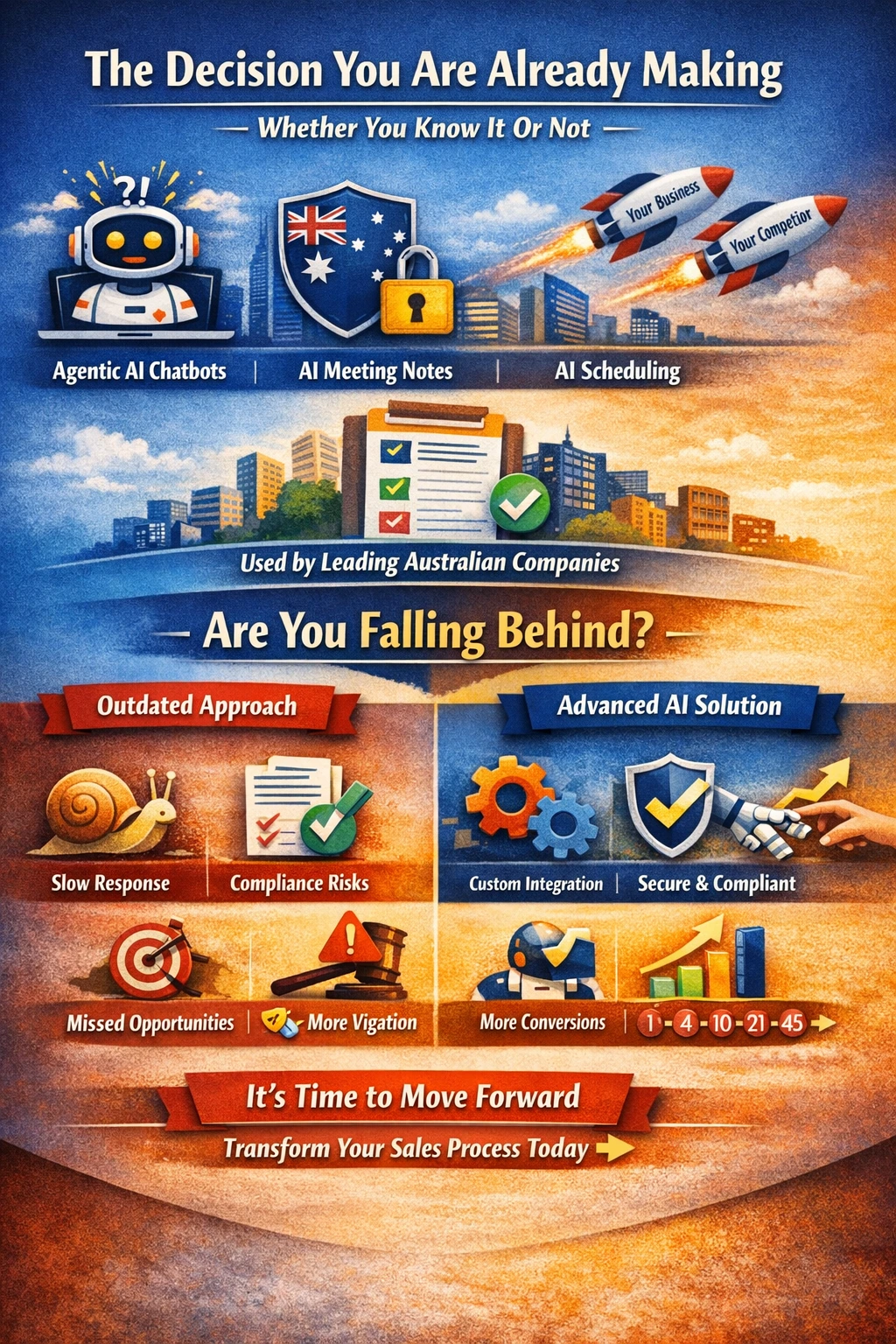
Every day that your business operates without agentic AI in its sales and lead engagement process is a day in which some percentage of your marketing-generated leads are experiencing a delay that your competitors may not be imposing. That is not a future risk to plan for. It is a current reality to address.
The technology discussed in this guide — agentic AI chatbots for sales, AI post-meeting summarisation and notetaking, and best-practice AI-based scheduling — is not experimental. It is deployed today by leading Australian businesses across financial services, professional services, technology, real estate, and manufacturing. The question is not whether the technology works. The research and the results are clear. The question is how well your implementation will be built.
Poorly integrated AI produces poor results. AI deployed without compliance consideration creates legal exposure. AI that lacks human escalation design frustrates the customers it is meant to serve. And AI maintained by a vendor with no understanding of the Australian market delivers generic outcomes in a context that demands local specificity.
C9 exists to close precisely this gap. As Australia’s leading custom software, apps, integration and database developer, we build agentic AI systems from the ground up — tailored to your workflows, integrated with your systems, compliant with Australian law, and designed to convert the leads you are already generating into the revenue your business is capable of achieving.
|
In short:
- Agentic AI chatbots for sales engage every lead instantly and keep your pipeline moving around the clock.
- AI post-meeting summaries and notetaking eliminate administrative overhead and ensure every client commitment is captured, stored, and actioned.
- Best-practice AI scheduling cuts time-to-meeting dramatically and eliminates wasted back-and-forth diary coordination.
- The genuine limitations of generative AI in sales — hallucination, privacy risk, integration gaps, and over-automation — each have known, proven mitigations.
- Implementation quality is everything. The right technical partner makes the difference between a chatbot that impresses in a demo and a system that reliably converts leads into revenue.
What’s next?
Contact the C9 team today to discuss a custom agentic AI solution built specifically for your business — one that integrates with your existing systems, respects your customers’ data, and is designed from the outset to convert more of the leads you have already paid to generate.
|
|
READY TO STOP LOSING LEADS?
Let C9 Build Your Custom Agentic AI Solution
C9 is Australia’s leading custom software, apps, integration and database developer. We design and build agentic AI systems tailored to your business workflows, fully compliant with Australian privacy law, and deeply integrated with the platforms your team already uses.
→ Book a Free Discovery Call at c9.com.au
No lock-in contracts. No off-the-shelf solutions. Custom AI built for the way your business actually works.
|
|
About C9
C9 is Australia’s leading custom software, apps, integration and database developer. Headquartered in Australia and building exclusively for the Australian market, C9 partners with businesses across every industry to design and build technology solutions that solve real operational problems — from bespoke software applications and mobile apps to agentic AI systems and complex enterprise integrations. If your business has a process problem, a data challenge, or an automation opportunity, C9 builds the solution that fits your business precisely.
|
Sources & References
All statistics, research findings, and external claims in this article are sourced from the following published references. URLs were verified as active at time of publication. C9 recommends readers consult primary sources directly for the most current data.
[1] Harvard Business Review — The Short Life of Online Sales Leads.
[2] Salesforce — State of the Connected Customer Report (2024).
[3] McKinsey & Company — The Next Frontier of Customer Engagement: AI-Enabled Customer Service (2023).
[4] Australian Bureau of Statistics — Business Use of Information Technology (2023–24).
[7] OAIC — Notifiable Data Breaches Scheme.
[8] MIT Sloan Management Review — Scaling Customer Service with AI.
[9] Forrester Research — The AI-Powered Sales Rep (2024). https://www.forrester.com/report/the-ai-powered-sales-rep/
[10] Calendly — The State of Scheduling 2023 Report.
[11] Drift — The 2024 State of Conversational Marketing Report.
[12] PwC Australia — AI Predictions 2025: What Australian Businesses Need to Know.
[13] IBM — What Is Agentic AI? (2024).
[15] Deloitte Australia — The AI-Ready Organisation: Building for the Long Term.
Tags: Agentic AI Chatbot for Sales · AI Post-Meeting Summaries · AI Scheduling & Engagement · Generative AI Limitations in Sales · Lead Engagement Australia · CRM AI Integration · Custom AI Development Australia · C9
Explore Related Insights on Chatbot Development Solutions.
Beyond 2025: The Next Evolution of Chatbot Development and What It Means for Your Business
AI Transparency Notice:
This article was produced with the assistance of artificial intelligence tools, including content drafting, visual asset creation, and audio generation. All content has been reviewed and approved by C9 prior to publication.