What Australian Business Owners & Executives Must Know Before Their Competitor Acts First
In short:
✅Most Australian business mobile apps are reactive and rules-based — they respond to user inputs but never anticipate needs. That gap is now a direct competitive risk.
✅Generative AI transforms your Android or iOS mobile app from a passive interface into an intelligent business engine that learns, adapts, and acts on your behalf.
✅Every $1 invested in generative AI returns an average of $3.70 — yet more than 80% of organisations report no measurable impact because they start without a strategy.
✅Australian Privacy Act obligations — including new automated decision-making transparency requirements active from 10 December 2026 — must be built into your AI mobile architecture from day one.
✅C9 is Australia's leading custom software, apps, integration, and database developer. We help Australian businesses build AI-powered Android and iPhone iOS mobile applications that deliver real, measurable returns.
What's next?
AI-powered mobile applications are no longer a future investment — they are a present competitive requirement. Read on to understand exactly what your business needs to do, and how C9 makes it happen.
EXECUTIVE SUMMARY
Australia's mobile app economy is at a critical inflection point. With nearly 23.6 million smartphone users projected by 2026, mobile is already the primary digital channel for commerce, customer service, and business operations. The businesses that embed generative AI into their custom Android and iPhone iOS mobile applications right now are not merely upgrading a feature — they are building a compounding intelligence advantage that becomes progressively harder for competitors to close. This blog provides Australian business owners and executives with a clear, fact-based, actionable framework for understanding generative AI integration in mobile applications: the commercial case, the practical architecture, the regulatory obligations, and the step-by-step strategy for getting from ambition to production with the support of C9, Australia's leading custom software, apps, integration, and database developer.
Your Business Mobile App Is Working Hard — But Not Smart Enough
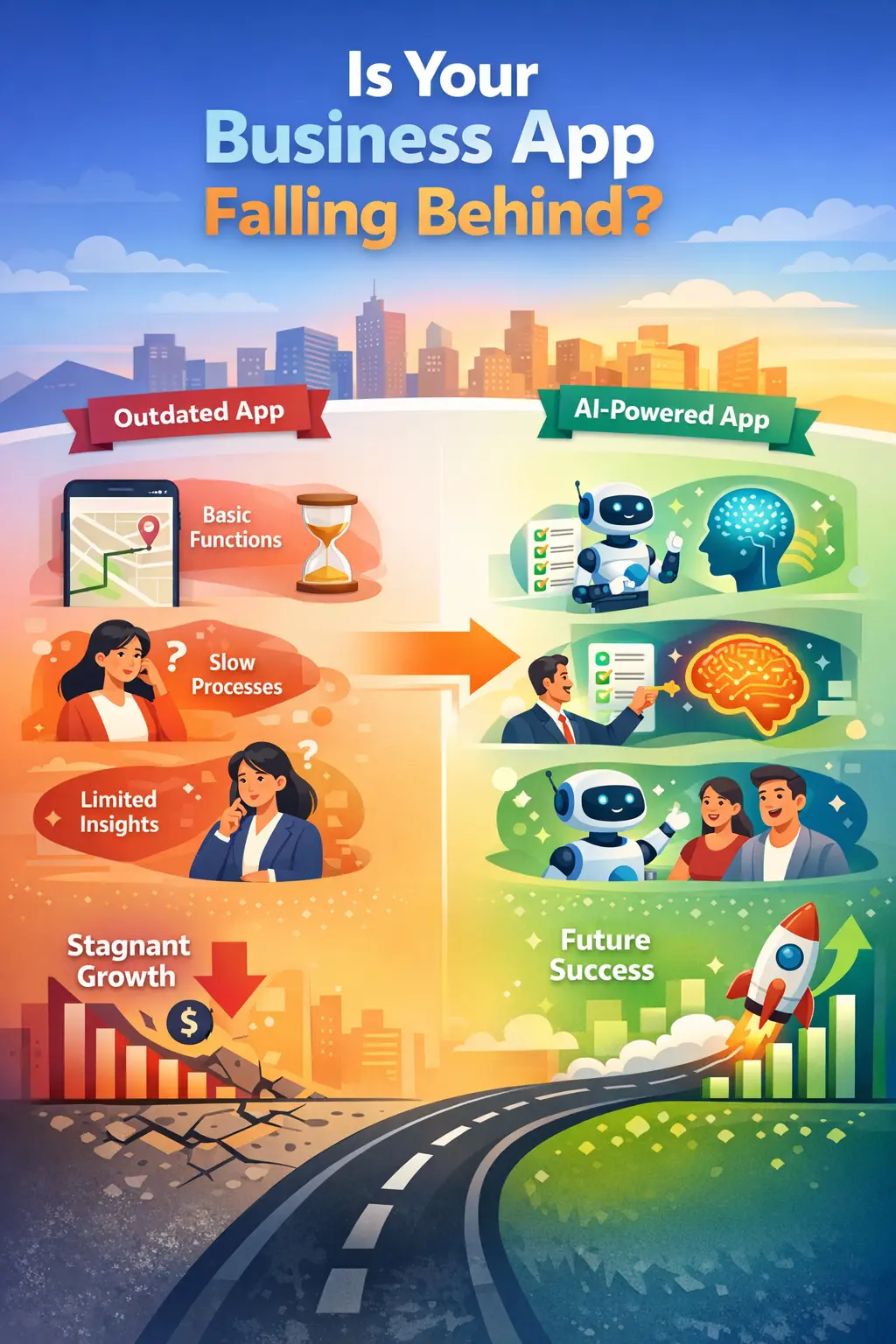
There is a good chance your business already has a mobile application. Perhaps it is a customer-facing iOS app that lets clients place orders, track deliveries, or book appointments. Perhaps it is an internal Android app your field team uses to log jobs, capture compliance data, or access your CRM on the go. Perhaps it was built two or three years ago, works reliably, and ticks the boxes your development brief specified at the time.
Here is the uncomfortable truth: that application, however competently built, is already operating below its potential — and the gap between what it does and what it could do is now measurable in revenue, efficiency, and competitive positioning.
The applications winning market share across every Australian industry in 2026 are not simply better-designed versions of conventional mobile apps. They are fundamentally different in how they process information, generate responses, and execute tasks. They are powered by generative AI — and they do not merely respond to what users ask. They anticipate what users need, act on multi-step workflows autonomously, and improve their own performance with every interaction.
This is not a technology article. It is a business strategy article — written for Australian CEOs, COOs, CTOs, and business owners who need to understand what generative AI integration means for their mobile application, their operations, and their competitive position. And it is written to give you a clear, practical path forward.
Why Conventional Business Mobile Apps Are Leaving Money on the Table
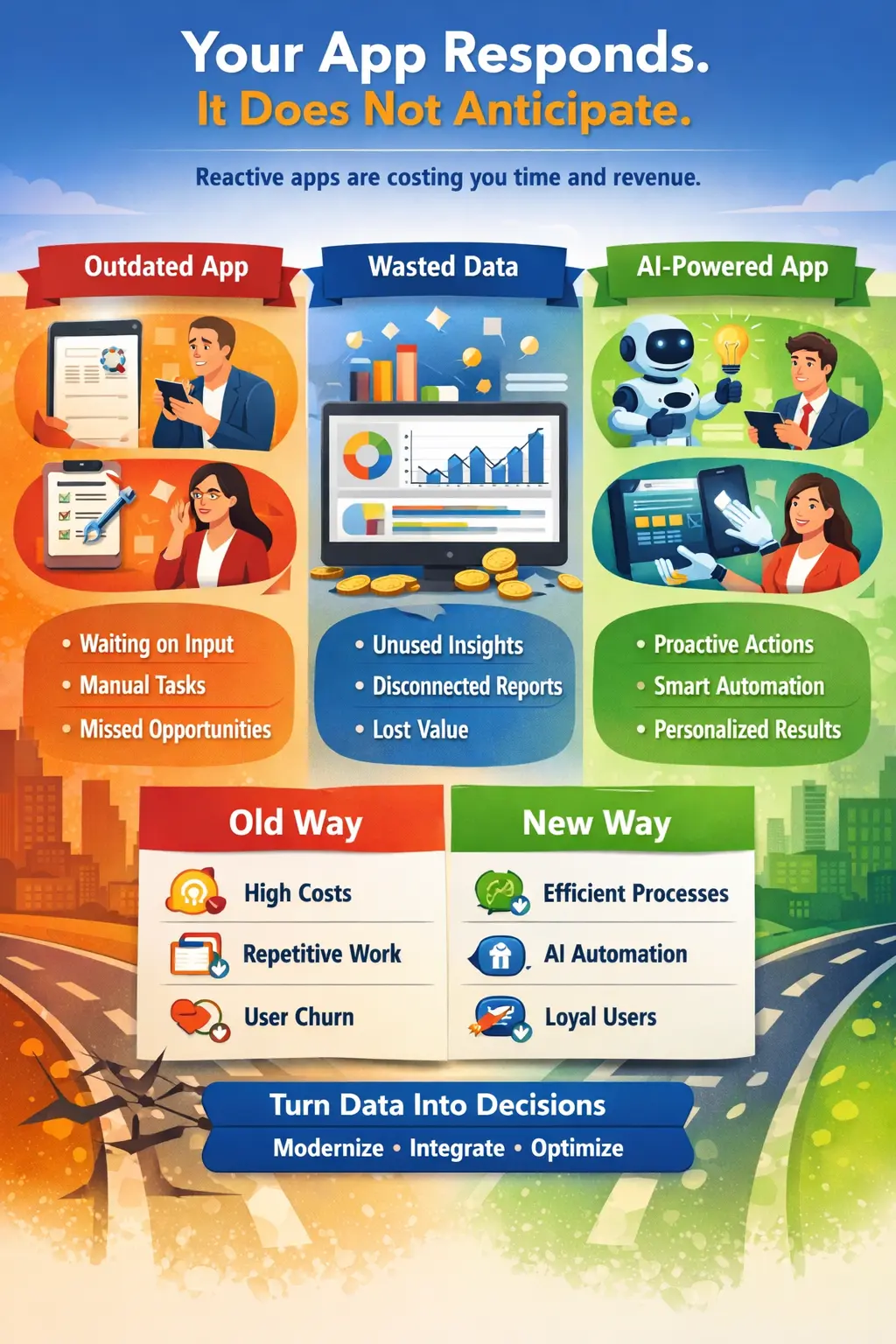
Your App Responds. It Does Not Anticipate.
The standard business mobile application — regardless of how well it was built — operates on a reactive logic: a user navigates to a screen, enters information, and the app returns a pre-defined result. This model served businesses adequately in the 2018-to-2023 era of mobile. In 2026, it is a competitive liability.
Australian consumers and business users have had their expectations permanently recalibrated by AI-native applications that understand context, personalise experiences in real time, and surface the right information before users consciously recognise they need it. When your business mobile app does not meet that expectation, the result is not a complaint filed with your customer service team. It is quiet, unannounced abandonment.
📊 DATA POINT: Generative AI apps were downloaded 1.7 billion times globally in the first half of 2025, generating USD $1.3 billion in revenue. More than 60% of mobile users now interact with AI-driven chatbots or voice assistants monthly. Your customers already expect AI. The question is whether they will find it in your app or your competitor's.
Your Team Is Doing Work That AI Should Handle
Across Australian businesses in every sector — retail, financial services, construction, healthcare, professional services, logistics — the most expensive non-strategic cost is human attention applied to predictable, pattern-driven tasks. Triaging customer enquiries. Populating data fields from photographed documents. Scheduling and rescheduling appointments. Generating compliance reports from field data. Escalating exceptions to the right person at the right time.
These tasks follow recognisable patterns. They do not require the full cognitive capacity of your best people. And they can be handled autonomously by a well-architected generative AI system embedded within your custom Android or iPhone iOS mobile application — at a fraction of the cost of manual execution, at significantly higher consistency, and at a scale no human team can match.
Your Mobile App Is Generating Data You Are Not Using
Every interaction your customers and employees have with your business mobile application generates behavioural intelligence: what they searched for, what they abandoned, how they navigated, what they purchased, when they returned. This data is, in theory, one of the most valuable assets your business owns — a real-time signal feed on customer intent and operational performance.
In practice, for most Australian businesses, this data sits in analytics dashboards that no one systematically analyses. It is not connected to the app's decision logic. It is not being used to personalise individual user experiences. It is not informing inventory decisions, staffing models, or product development. A generative AI integration strategy turns this dormant data into an active, self-improving intelligence system.
What Happens to Australian Businesses That Wait
The Australian AI Gap Is Real — and Growing
Deloitte's 2026 State of AI in the Enterprise report delivers an unambiguous warning for Australian business leaders: while AI adoption is increasing locally, the gap with global peers is growing when it comes to realising transformation at scale. The challenge is not getting started — it is shifting from pilots to production and unlocking full value across the business.
This gap is not abstract. It shows up on revenue scorecards, customer retention metrics, and operational cost structures. Businesses that have deployed generative AI in their mobile applications are already reporting measurable performance differentials that are compounding month by month.
|
Metric
|
Finding
|
Source
|
|
AI Adoption (AU)
|
Approx. 49% of Australians report using generative AI in the past 12 months — highest adoption among working-age professionals 18-44
|
|
|
Enterprise Usage
|
88% of organisations globally now use AI in at least one business function — the divide is between those deploying in under 3 months and those still in pilot mode
|
AmplifAI, 2026
|
|
ROI Per Dollar
|
Every $1 invested in generative AI returns an average of $3.70 — financial services leads at 4.2x ROI
|
McKinsey / AmplifAI, 2026
|
|
AI Agents
|
Enterprise apps featuring task-specific AI agents will jump from under 5% in 2025 to 40% by end of 2026
|
Gartner, 2026
|
|
Market Growth
|
The AI apps segment in Australia generated USD $41.1 million in 2024 and is forecast to grow at 48.8% CAGR through 2030
|
|
|
Workforce Impact
|
75% of workers now use generative AI daily — 71% of large enterprises believe they will fall behind without it
|
Second Talent, 2026
|
|
Revenue at Stake
|
In retail and CPG alone, generative AI may add USD $400-660 billion in annual global revenue
|
McKinsey, 2026
|
|
Fear of Delay
|
71% of large enterprises fear falling behind competitors if they delay AI adoption
|
Second Talent, 2026
|
⚠️ COMPETITIVE REALITY: The competitive advantage of an AI mobile app is not a one-time step-change — it is a compounding curve. Every user interaction produces training data that makes the AI more accurate, more personalised, and more commercially effective. An Australian business that deploys AI today will have twelve months of proprietary data advantage by the time a competitor reaches production. That gap cannot be purchased away.
The Regulatory Window Is Closing
There is a second, equally important reason why delay increases risk for Australian businesses: the regulatory environment governing AI in mobile applications is tightening, and the compliance obligations are mandatory — not optional.
New automated decision-making transparency requirements under the Australian Privacy Act 1988 come into force on 10 December 2026. Under the new APP 1.7 obligations, any business that uses a computer program to make decisions using personal information — decisions that could significantly affect the rights or interests of an individual — must disclose this in their privacy policy. Mobile applications that use AI to personalise content, recommend products, assess creditworthiness, triage healthcare queries, or determine service eligibility are all captured by this obligation.
The Office of the Australian Information Commissioner (OAIC) has already commenced its first-ever formal compliance sweep in January 2026, targeting organisations across six sectors. Civil penalties for serious or repeated privacy breaches can reach $50 million for significant corporate entities. The message from the OAIC is unambiguous: privacy compliance is no longer optional, and transparency about AI decision-making is now a non-negotiable foundation.
⚖️ LEGAL NOTE: Australian businesses deploying AI in mobile applications must ensure their privacy policies are updated to disclose automated decision-making arrangements before 10 December 2026. The OAIC recommends a privacy-by-design approach and a Privacy Impact Assessment before any new AI system processes personal information. Non-compliance is no longer a theoretical risk — the OAIC's compliance sweep and expanded enforcement powers make it an operational certainty.
The Solution: A Generative AI Integration Strategy That Delivers Real Commercial Returns
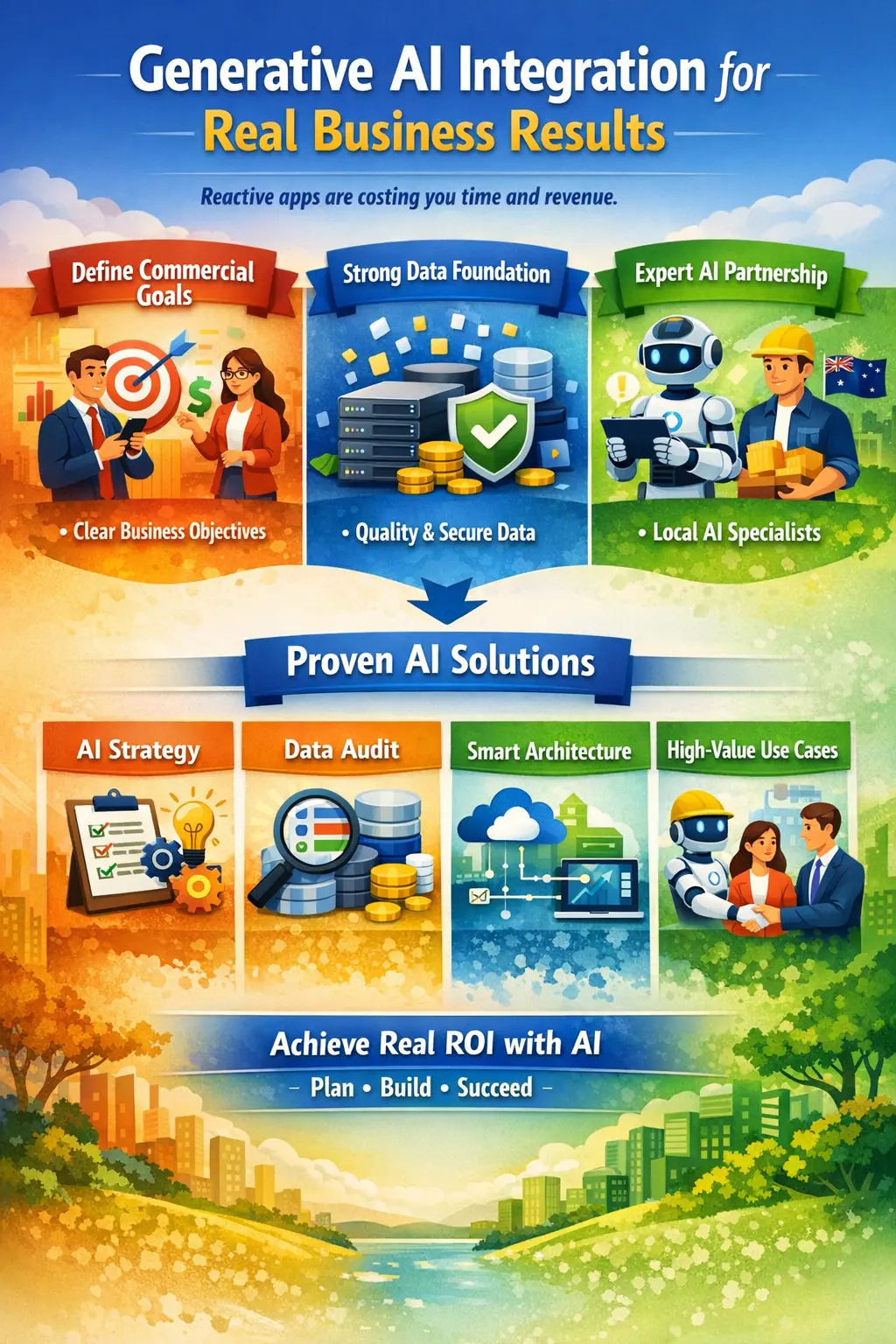
The answer to everything described above is not to rush into an AI project with the first vendor who promises fast delivery. The businesses that achieve measurable ROI from generative AI in their mobile applications share three characteristics: they start with a specific commercial outcome, they build on a sound data foundation, and they work with a development partner who understands both AI engineering and the Australian regulatory environment.
This is precisely how C9 approaches every AI mobile application engagement for Australian businesses. Here is the framework that works.
Step 1 — Define the Commercial Outcome Before Selecting the Technology
The most common and costly mistake in enterprise AI initiatives is leading with technology selection: 'We want to integrate an LLM' or 'We need an AI chatbot.' These are technology descriptions. They are not business outcomes. And building an AI integration around a technology rather than an outcome is the fastest path to a solution that impresses in a demonstration and disappoints in production.
The correct starting point is a precise commercial question: What specific, measurable business outcome do we need this AI capability to improve? Is it reducing cost per customer interaction? Increasing average order value? Improving field service first-time-fix rates? Reducing document processing time? Cutting customer churn?
The answer shapes every subsequent decision: the AI architecture, the data requirements, the integration approach, the success metrics, and the ongoing governance model. Without a clear commercial outcome as the north star, AI projects drift into endless optimisation cycles that consume budget without delivering results your board can defend.
💡 C9 APPROACH: Every AI mobile integration engagement at C9 begins with a structured commercial outcome brief — a single-page document specifying the target metric, the baseline, the improvement target, the measurement methodology, and the investment threshold for acceptable ROI. This brief is the contract between business ambition and engineering execution.
Step 2 — Audit Your Data Foundation Before Writing a Line of Code
Generative AI is only as commercially valuable as the data that grounds it. An AI system operating on incomplete, inconsistent, or poorly governed data generates outputs that are plausible-sounding but unreliable — which in a business context is not merely unhelpful but actively dangerous, particularly in regulated industries including financial services, healthcare, and construction.
Before C9 recommends or commences any AI integration within a custom mobile application, our team conducts a data architecture audit across three dimensions:
- Data quality: Are the records in your enterprise systems — your CRM, ERP, product catalogue, customer history — complete, consistent, and current enough to serve as a reliable source for an AI system?
- Data accessibility: Can the data your AI needs be retrieved and integrated efficiently, securely, and in compliance with the Australian Privacy Principles? Many organisations discover during this audit that their most valuable data is siloed in systems with inadequate API access, or subject to consent limitations that restrict AI use.
- Data governance: Do you have documented policies governing how personal information is collected, stored, used, and disclosed? Under new APP 1.7 obligations, these policies must now explicitly address automated decision-making arrangements.
This audit is not a barrier to starting. It is the fastest and safest route from where you are to where you want to be — because it prevents the expensive mid-project discoveries that derail AI initiatives that began without sufficient data diligence.
Step 3 — Choose the Right AI Architecture for Your Mobile Application
Australian business owners and executives do not need to become AI engineers. But they do need to understand the three primary AI architecture options for custom Android and iPhone iOS mobile applications, because the choice has direct implications for privacy compliance, application performance, and ongoing cost.
Cloud AI (API-based): Your mobile app sends user queries to a large language model hosted in the cloud — such as OpenAI's GPT-4o, Google's Gemini 2.5, or Anthropic's Claude — and returns generated responses to the user. This approach delivers the most capable AI models with continuous improvements as model providers update. The consideration for Australian businesses: user query data leaves the device and is processed by a third-party cloud service, requiring careful review under the Australian Privacy Principles — particularly for healthcare, financial services, and legal applications where sensitive personal information is involved.
On-Device AI (Edge): The AI model runs directly on the user's smartphone using Apple's Core ML for iPhone iOS or Google's ML Kit and TensorFlow Lite for Android. Data is processed locally without being transmitted to external servers, providing the strongest privacy compliance posture. On-device AI in 2026 supports sophisticated personalisation, natural language understanding, and computer vision within modern mobile hardware constraints. Over 70% of new premium smartphones now ship with AI-optimised processors, making this architecture increasingly viable for complex use cases.
Hybrid Architecture (C9's Recommended Approach): Routes AI workloads between on-device and cloud processing based on data sensitivity, latency requirements, and connectivity. Privacy-sensitive queries and real-time personalisation run on-device; complex reasoning and generation tasks requiring full LLM capability route to cloud APIs with appropriate safeguards. For most Australian enterprise mobile applications, hybrid architecture optimises across capability, privacy, performance, and cost simultaneously.
Step 4 — Deploy AI in the Use Cases That Deliver the Fastest Return
Not every AI capability delivers equal commercial value, and not every use case carries equal implementation complexity. The fastest path to board-defensible ROI from a generative AI mobile integration is to begin with high-value, manageable-complexity use cases and expand systematically as your data foundation, governance infrastructure, and operational AI maturity develop.
The following use cases consistently deliver the strongest initial ROI for Australian businesses across the most common industries:
AI-Powered Conversational Customer Service: An intelligent conversational interface within your existing iOS or Android app — powered by a large language model grounded in your product and service knowledge via Retrieval-Augmented Generation — eliminates the most common friction points in customer self-service. Businesses deploying AI customer service in their mobile applications are reporting 30-40% reductions in operating costs within the first twelve months, with customer satisfaction scores that match or exceed human-handled interactions for high-volume, pattern-driven enquiry categories.
Intelligent Document and Data Capture: For field-based and operations-facing Android and iPhone iOS mobile applications, AI-powered data capture replaces paper forms, manual entry, and phone-based communication with automated workflows that extract structured information from photographs, voice recordings, and handwritten notes — and populate enterprise systems directly. Australian construction, resources, and healthcare businesses using this capability are recovering two to four hours of productive field time per worker per day, with near-elimination of data entry errors.
Personalised Recommendation Engines: AI models within customer-facing mobile applications that analyse individual user behaviour, purchase history, and contextual signals to surface the product, service, offer, or content most likely to drive the next commercial interaction. McKinsey's research confirms that personalised app experiences can boost revenues by 10-15%; for Australian retail and financial services businesses deploying bespoke recommendation AI, average order value improvements of 20-35% are consistently achievable.
Agentic Workflow Automation: The most transformative near-term AI capability for Australian enterprise mobile apps — AI agents that autonomously execute multi-step business workflows: scheduling, ordering, reporting, escalating, communicating — all triggered by a single user action on a mobile device. Gartner projects that agentic AI will resolve 80% of common customer service issues without human intervention by 2029, cutting operational costs by 30%.
Step 5 — Build Your AI Governance Framework From Day One
AI governance is not a compliance burden to be addressed after your mobile application is in production. It is a structural requirement that must be engineered into the architecture, the development process, and the operational model from the first day of the project.
For Australian businesses, the minimum AI governance framework for a mobile application deployment comprises five non-negotiable elements:
- Privacy compliance mapping: A documented record of every data type the AI system processes, the legal basis for that processing under the Australian Privacy Principles, and the technical controls that enforce those obligations within the application architecture. From 10 December 2026, your privacy policy must explicitly disclose automated decision-making arrangements that could significantly affect user rights.
- Output quality monitoring: A continuous measurement system for AI output accuracy, relevance, and safety — with defined thresholds that trigger human review and model intervention when quality degrades below acceptable levels.
- User transparency: Clear disclosure within the mobile application whenever users are interacting with AI-generated content or AI-assisted decisions, consistent with OAIC guidance on transparency obligations.
- Incident response protocol: A documented process for identifying, containing, and notifying appropriate parties when an AI system failure may constitute a Notifiable Data Breach under Australian law.
- Model refresh schedule: A planned cadence for reviewing AI model performance, triggering retraining when data drift is detected, and evaluating foundation model upgrades as the vendor landscape evolves.
✅ C9 DELIVERABLE: C9 provides every Australian business we partner with on an AI mobile integration engagement with a standardised AI governance framework template — covering all five elements above, mapped to current OAIC guidance and Australian Privacy Principles — as part of our standard project delivery. Governance infrastructure built early scales confidently. Governance retrofitted later costs multiples of what it would have cost at the outset.
Generative AI Mobile Application Use Cases Across Key Australian Industries
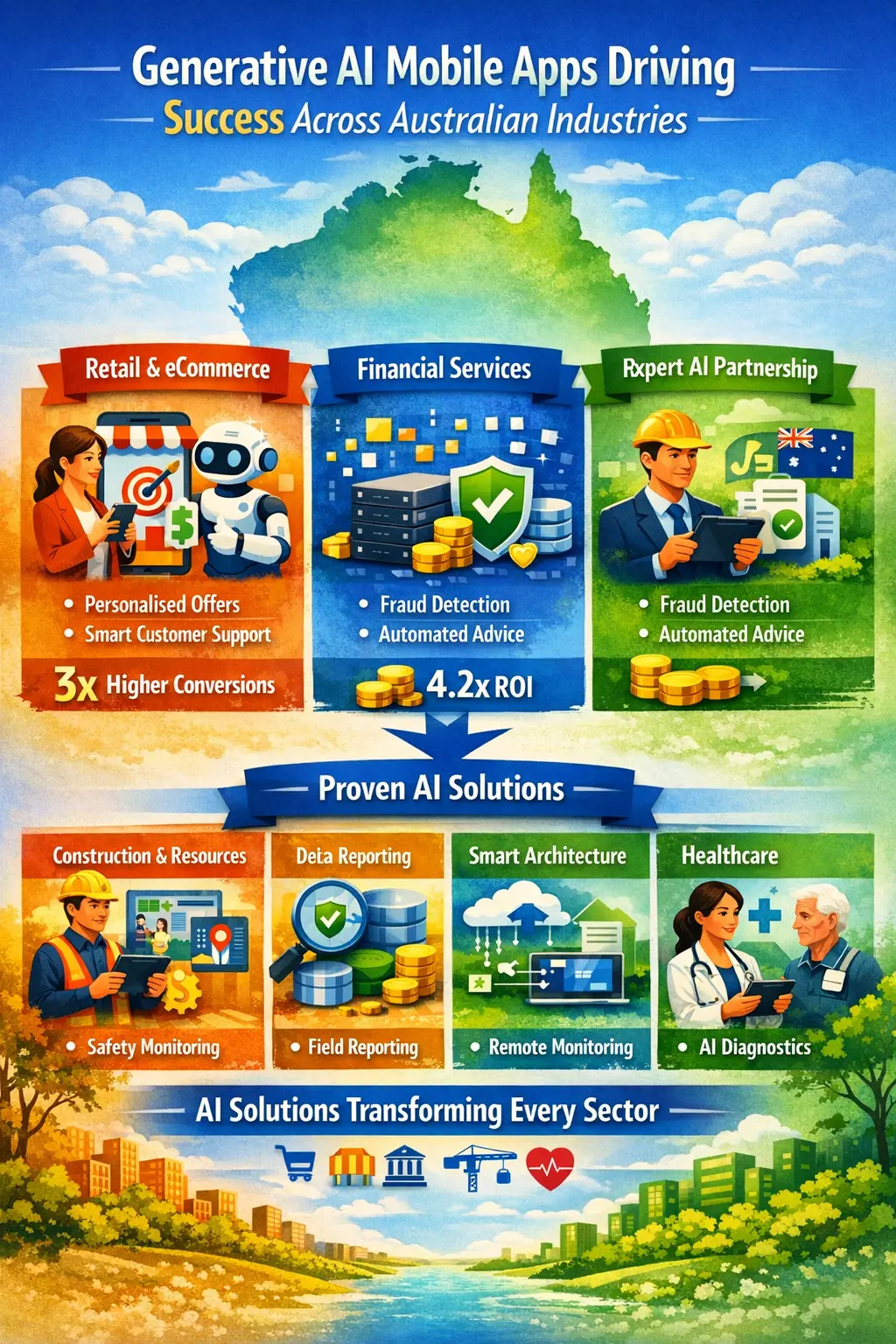
The commercial impact of generative AI in custom mobile applications varies by industry — but it is present in every sector. Here is where Australian businesses are finding the strongest and most immediate returns.
Retail & eCommerce
Australian retailers integrating generative AI into their custom iOS and Android shopping apps are deploying personalised recommendation engines, AI-powered natural language product search, and intelligent customer service agents that handle returns, exchanges, and order tracking autonomously. Early-moving retailers are reporting 3x higher conversion rates from AI-powered product discovery compared to conventional keyword search, and significant reductions in customer service operating costs. With the AI apps segment in Australia projected to grow at 48.8% CAGR through 2030, the retail opportunity for AI-native mobile experiences is substantial.
Financial Services
Australian banks, insurers, and wealth management firms are finding generative AI in mobile applications delivers their strongest sector ROI — McKinsey's research places financial services AI returns at 4.2x per dollar invested, ahead of every other industry. AI-powered personal finance assistants, fraud detection systems using on-device behavioural biometrics, regulatory compliance automation for financial advisers, and conversational loan pre-screening are all commercially deployed in Australian financial services mobile applications today. APRA CPS 234 compliance requirements and the Consumer Data Right framework make the data governance architecture of these applications a critical engineering discipline.
Construction, Resources & Field Operations
Australian construction, mining, and resources businesses are finding generative AI in custom field operations Android and iOS apps addresses their most acute operational challenges: safety compliance documentation, remote site management, maintenance intelligence, and regulatory reporting burden. AI-powered voice-driven data capture that transcribes verbal field reports and populates SAP or Oracle systems directly; computer vision apps that analyse site photographs for PPE compliance and hazard identification; predictive maintenance AI that interprets IoT sensor data on mobile and generates plain-language maintenance recommendations — these are not pilot-stage features in 2026. They are in production across leading Australian resources businesses.
Healthcare
The combination of geographic dispersion, workforce shortages, and rising chronic disease burden makes AI-powered mobile applications particularly valuable across Australia's healthcare system. AI-assisted clinical decision support in GP and allied health iOS apps; remote patient monitoring platforms with on-device AI interpretation of wearable sensor streams; voice-driven clinical documentation apps that transcribe consultations and pre-populate EMR records; and diagnostic imaging AI for telemedicine platforms serving rural and remote Australians — all represent commercially available, regulation-compliant AI mobile capabilities available to Australian healthcare providers. The My Health Records Act and Healthcare Identifiers Act impose additional data governance obligations that C9's healthcare-specialist engineering team builds into every healthcare AI mobile application architecture.
Why Australian Businesses Choose C9 for Generative AI Mobile App Integration
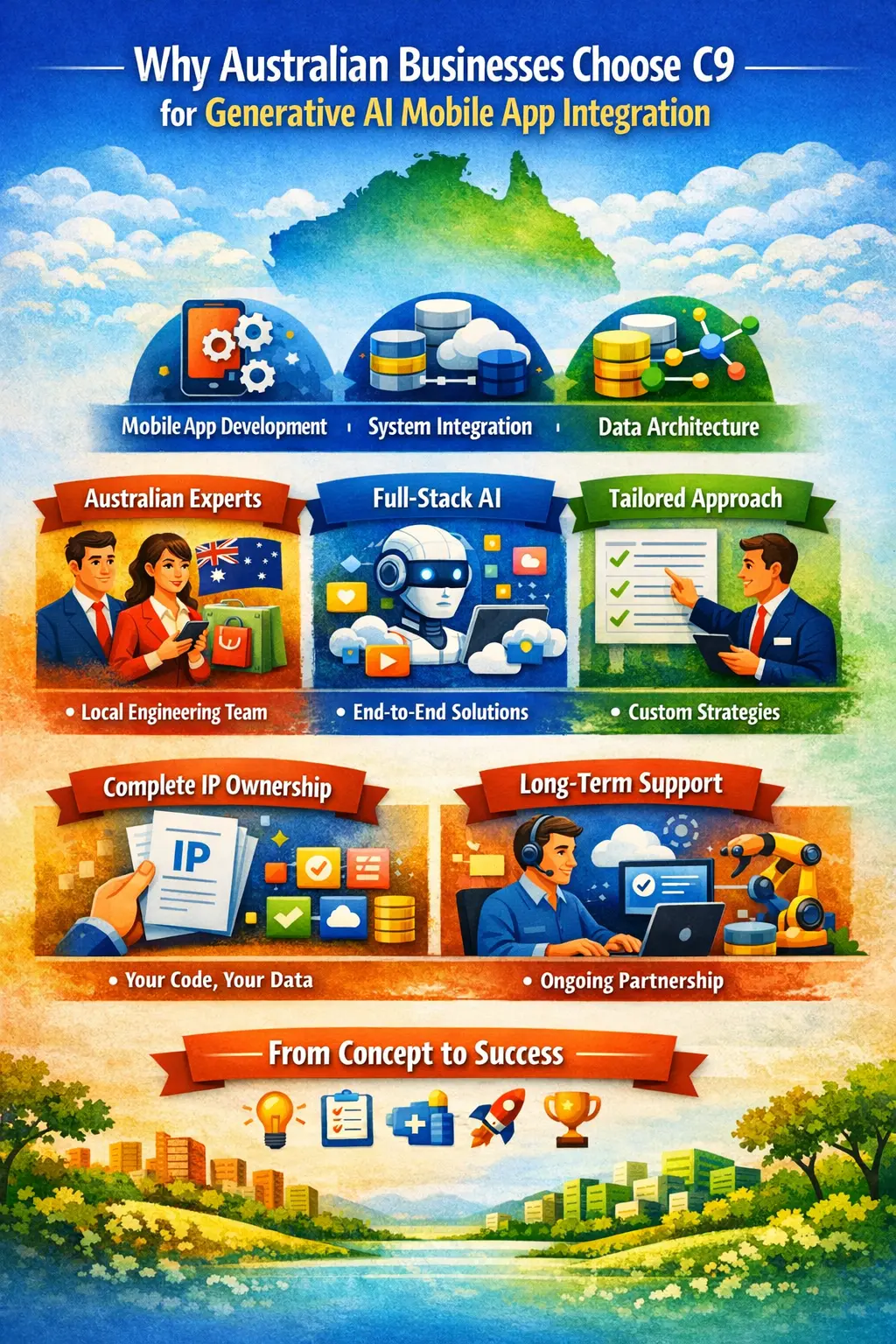
C9 is Australia's leading custom software, apps, integration, and database developer — and generative AI integration in Android and iPhone iOS mobile applications sits at the centre of our capability because it is where the three disciplines we have built our practice on converge: mobile application development, enterprise system integration, and data architecture.
When an Australian business engages C9 to build or evolve an AI-powered custom mobile application, they are not engaging a vendor with a single AI product to sell or a pre-built template to deploy. They are engaging a team of Australian-based engineers, architects, and product strategists who begin every engagement by understanding your specific business outcomes, your data environment, your regulatory obligations, and your competitive context — and then build the AI integration architecture that serves those specifics.
What Sets C9 Apart
- Australian-based team, Australian accountability: Every engagement is delivered by experienced Australian engineers working in Australian business hours — providing the communication responsiveness, regulatory knowledge, and cultural alignment that complex AI mobile projects demand. No offshore subcontracting on critical engineering deliverables.
- Full-stack AI and mobile expertise: C9 holds in-house capability across iPhone iOS development (Swift/SwiftUI), Android development (Kotlin/Jetpack Compose), multiplatform mobile app development (Flutter and React), backend and cloud engineering, AI and LLM integration (RAG architectures, on-device ML, cloud AI APIs), and enterprise system integration (SAP, Salesforce, Xero, MYOB, Microsoft Dynamics, custom APIs).
- Framework-agnostic and model-agnostic: C9's recommendations are driven solely by your project's commercial and technical requirements — not by partnerships with particular AI vendors or preferences for specific mobile development frameworks. We recommend Flutter when it is the right choice, native Swift or Kotlin when those are correct, and React Native when multiplatform mobile app development with React delivers the optimal outcome for your business.
- Mobile application development across Australia's key markets: C9 serves businesses across Sydney, Melbourne, Brisbane, and the full Australian market. Whether you need a mobile app developer in Brisbane, a mobile app development company in Sydney, or an iOS app developer or Android developer in Melbourne, C9's national team delivers consistent, high-quality outcomes regardless of location.
- Complete IP ownership, no lock-in: All code, AI models, data pipelines, and system architectures built for your project belong exclusively to your organisation upon delivery. No licensing complications, no vendor lock-in, no restrictions on future development with any partner.
- Post-launch partnership: C9 remains your technical partner after launch. AI mobile applications require ongoing model monitoring, retraining, security updates, and feature evolution — we deliver this as a structured ongoing engagement, not as reactive break-fix support.
Conclusion: The Decision Is Not Whether — It Is How, and How Soon
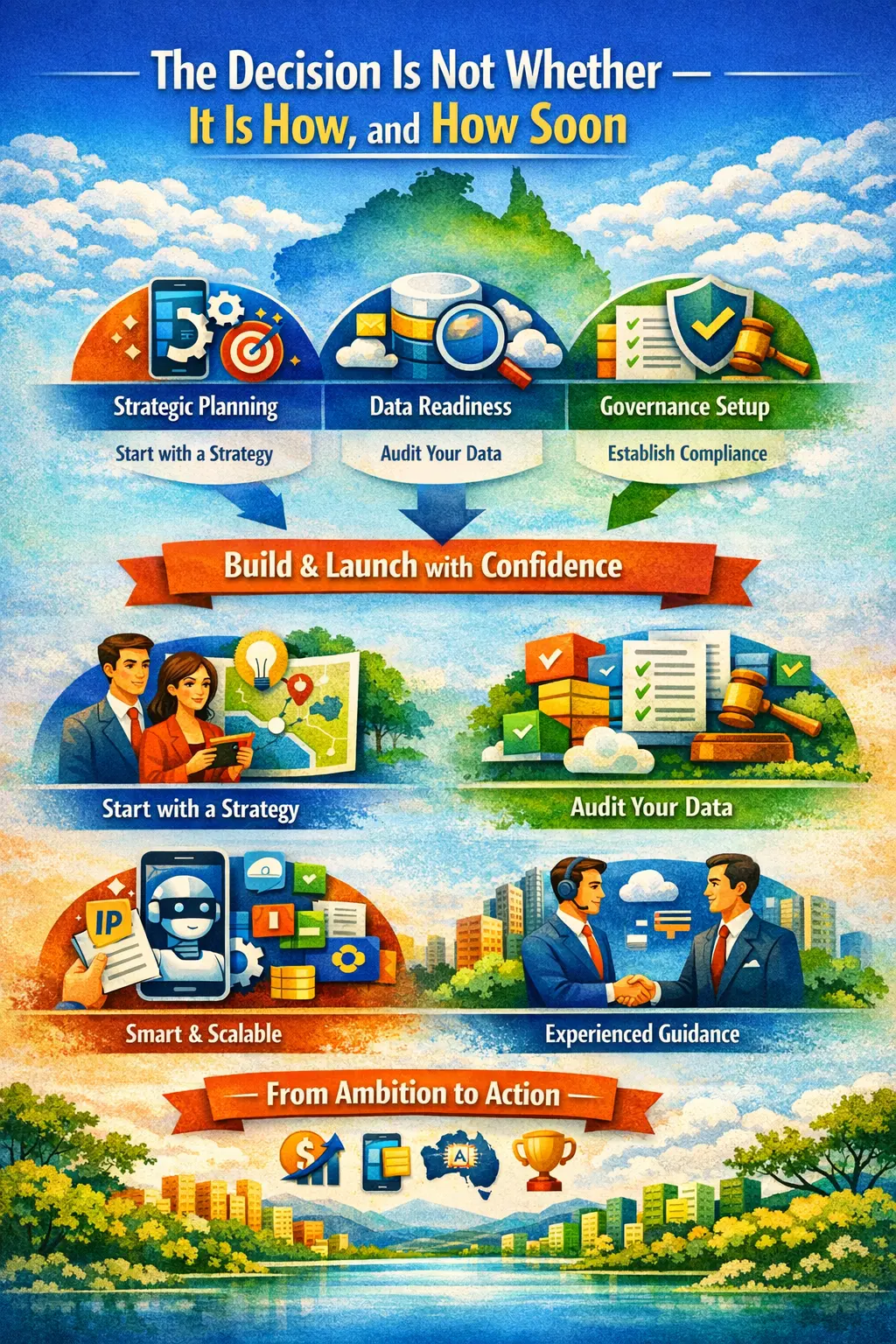
Australian business owners and executives reading this are not evaluating whether generative AI integration in their mobile applications is commercially viable. That question has been definitively answered by the businesses already in production across retail, financial services, construction, healthcare, and professional services — with ROI benchmarks that are now documented, verified, and reproducible.
The decision in front of you is how to execute this in a way that delivers genuine commercial returns, satisfies Australia's Privacy Act obligations — including the new automated decision-making requirements active from December 2026 — and positions your mobile application as a compounding intelligence asset rather than a one-time technology upgrade.
That how requires a strategy before it requires a development sprint. It requires a data audit before it requires a model selection. It requires a governance framework before it requires a production launch. And it requires a development partner who understands mobile application development, enterprise integration, and AI engineering — not just one of the three.
That is what C9 delivers for Australian businesses ready to move from AI ambition to AI execution.
What's next? The Australian businesses that commit to a generative AI mobile application strategy in the next 90 days will establish an intelligence advantage that compounds over time and becomes progressively harder for competitors to recover from. The best time to start was last year. The second-best time is now.
Ready to Build Your AI-Powered Mobile App Strategy?
Book a complimentary AI Mobile Strategy Session with C9's senior engineering team.
We will map your highest-value AI use cases, recommend the right architecture for your platform and data, and give you a clear 90-day roadmap from strategy to production.
Visit www.c9.com.au or contact our team today.
Custom Android & iPhone iOS Mobile Application Development Services | AI Integration | Enterprise System Integration | Database Architecture
References & Sources
The following sources were used in the research and preparation of this article. All data points are attributed and verifiable.
[1] ROI.com.au (2025) — AI Usage & Adoption Statistics in Australia (2026)
[2] AmplifAI (2026) — 90+ Generative AI Statistics You Need to Know in 2026
[3] LaunchNorth.com.au (2026) — AI Marketing Statistics 2026 | Trends & ROI Data Australia
[4] Second Talent (2026) — 40+ Important Generative AI and LLM Usage Statistics 2026
[5] Thomson Reuters Institute (2026) — 2026 AI in Professional Services Report
[6] Appinventiv (2026) — AI Implementation in Australia (2026): Use Cases, Costs & Strategy
[7] Azilen (2025) — Top Generative AI Statistics 2025: Adoption, Impact & Trends
[8] Appomate (2025) — AI App Market Statistics and Trends 2025
[9] Deloitte Australia (2026) — The State of AI in the Enterprise — 2026 AI Report
[10] Appomate (2025) — Australia App Market 2025: Growth, Trends, and Insights
[12] Office of the Australian Information Commissioner (OAIC) — Guidance on Privacy and the Use of Commercially Available AI Products
[13] Office of the Australian Information Commissioner (OAIC) — Chapter 1: APP 1 — Open and Transparent Management of Personal Information
[14] MinterEllison (2026) — OAIC Targets Privacy Policies — APP 1 Compliance and ADM Changes
[15] A&O Shearman (2026) — Guidance on Privacy Considerations Using Artificial Intelligence
[16] Vocare Law (2026) — Automated Decision-Making Privacy Act Amendments (2026)
© 2026 C9 Australia | All Rights Reserved | Australia's Leading Custom Software, Apps, Integration & Database Developer | www.c9.com.au
Explore Related Insights on Mobile App Solutions.
From Idea to Launch: The Ultimate Guide to Custom App Development for Australian Executives
How Custom Mobile Apps Can Transform E-Commerce for Australian Retailers
The Real Cost of Custom App Development in Sydney: A 2025 Price Breakdown
Why Flutter and React Native Are Dominating Cross-Platform App Development in 2026: A Guide for Australian Businesses
5G-Enabled Native Apps: Unlocking New Possibilities for Australian Enterprises
Explore Related Insights on Integrations Solutions.
How Custom Xero Integration Solves the #1 Challenge Facing Mixed Farming Operations in Australia
AI-Driven Automation and Real-Time Data Integration: Unlocking Efficiency for Australian Businesses
Beyond Automation: How a Strategic AI Integration Specialist Unlocks True Operational Efficiency
Seamless System Integration: Why Australian Firms Need Database Consultants Now
Real-World API Integration Success Stories: How Australian Businesses Transformed Their Operations with C9
API-First Development: Why Your Business Needs an API Integration Strategy for 2026
RPA + AI: The Intelligent Automation Combination Transforming Australian Businesses
Headless CMS & API-First Development in 2026: The Australian Guide to Faster, Flexible and Future-Proof Web Applications (Why C9 is Your Ideal Partner)
Why 37% of Enterprises Say Data Integration Is Their Biggest AI Barrier (And How to Overcome It)
Unlocking Real-Time Data Integration: How Seamless System-to-System Analytics Powers Smarter Business Decisions
Protecting Your Business from Money Runners: How Stripe + Xero Integrations and Smart APIs Stop Counterfeit AUD Conversion
Sydney Mobile App Development | iOS & Android Solutions for Local Businesses
Melbourne Mobile App Development | iOS & Android Solutions for Local Businesses
AI Transparency Notice:
This article was produced with the assistance of artificial intelligence tools, including content drafting, visual asset creation, and audio generation. All content has been reviewed and approved by C9 prior to publication.