Executive Summary: The Critical Facts You Need to Know Now
The 20,000 Instant Asset Write-Off (IAWO) ends at midnight on 30 June 2026. From 1 July 2026, the threshold plummets 95% to just 1,000—a change that fundamentally alters the economics of business technology investment for the next financial year and beyond.
For Australian businesses with aggregated annual turnover under 10 million, this represents the final opportunity to claim a full, immediate tax deduction on qualifying business assets valued up to 20,000. What makes this particularly significant for forward-thinking business owners is a fact that remains largely unknown: custom-built software, bespoke business applications, system integrations, and database development all qualify as depreciating assets under Australian Taxation Office guidelines.
This means commissioning a purpose-built software solution from C9 before 30 June 2026 can deliver both an immediate tax deduction of up to $20,000 and a long-term operational asset your business owns outright—with zero ongoing licence fees, no vendor lock-in, and complete control over your business data and intellectual property.
The Five Critical Facts
-
The deadline is absolute: The 20,000 IAWO expires at midnight 30 June 2026—the threshold then reverts to 1,000, representing a 95% reduction in immediate deduction capacity.
-
Software qualifies—but most don't know it: Custom software, apps, integrations, and database development are ATO-eligible depreciating assets, yet the vast majority of Australian business owners and even many accountants are unaware of this classification.
-
The tax savings are substantial: A 20,000 investment with C9 can generate between 5,000 and $6,000 in immediate tax savings in your FY26 return (depending on your marginal tax rate)—while simultaneously eliminating your most expensive operational bottleneck.
-
Installation timing is everything: The asset must be installed and ready for use before 30 June 2026—not just paid for, not just contracted. This "ready for use" requirement is where most businesses inadvertently disqualify themselves.
-
Strategic delivery is possible: C9 can scope, build, and deploy qualifying custom software solutions within the EOFY window—but only if engagement begins before mid-May 2026.
What You Should Do Next
Book a free discovery call with C9 today. We'll scope your project, confirm IAWO eligibility, assess technical feasibility, and commit to a delivery timeline before 30 June 2026. The window to act is measured in weeks, not months. Every day of delay reduces the available development timeline and increases delivery risk.
Why EOFY 2026 Is Different from Every Year Before It
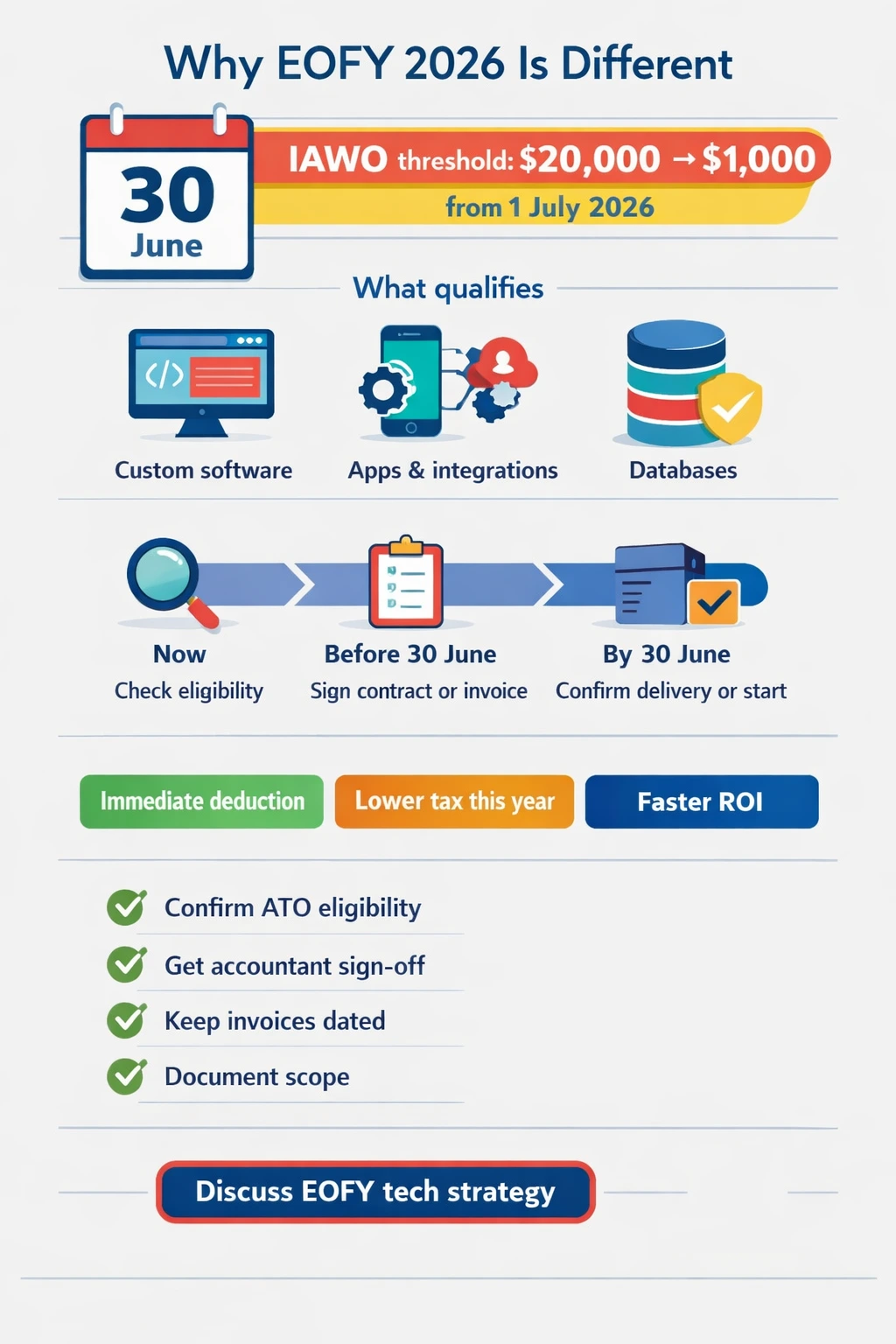
Every year, Australian business owners face the same end-of-financial-year question: where should I strategically invest the budget that remains before 30 June? The pattern is predictable. Laptops get purchased. Vehicles get ordered. Office equipment gets upgraded. And the software problem—the one your team has been manually working around for the past three years—gets pushed to "next financial year."
But 2026 is fundamentally different. This is the last financial year in which the 20,000 Instant Asset Write-Off applies at its current threshold. From 1 July 2026, it drops to 1,000. This isn't speculation or rumour—it's legislated under the Treasury Laws Amendment (Strengthening Financial Systems and Other Measures) Act 2025. There is no "next year" equivalent at this threshold level.
More importantly, 2026 is the year most business owners discover something their accountant probably hasn't explicitly told them yet: custom bespoke software, purpose-built applications, system integrations, and database development all qualify as ATO-eligible depreciating assets under the IAWO scheme—right alongside traditional equipment, machinery, and computer hardware.
This comprehensive guide is written specifically for Australian business owners and executives who want to understand exactly what the IAWO means for technology investment, why custom software represents the most strategically sound EOFY purchase of 2026, and precisely what you need to do—and when—to qualify for the full deduction.
The Real Cost of Software That Was Never Built
Before we discuss the tax opportunity, let's be direct about the operational reality facing most Australian businesses in 2026.
Your team is re-entering the same data between systems that don't communicate with each other. Your EOFY financial reporting takes weeks because nothing is integrated. You're paying monthly for five, six, or seven SaaS subscriptions—each solving a narrow slice of a broader operational problem—and none of them were built for how your business actually operates. You own none of them. You control none of them. And when the vendor increases pricing or discontinues a feature, you have no recourse.
This isn't a technology problem. It's a strategy problem that manifests as an operational one every single day.
The Hidden Costs Australian Business Owners Are Absorbing
According to research by Deloitte Access Economics, Australian businesses lose an average of 5.3 hours per employee per week to inefficient processes and manual workarounds—representing approximately $109 billion annually in lost productivity across the Australian economy.
| Operational Gap |
Weekly Time Lost |
Annual Financial Impact |
| Manual data re-entry between disconnected platforms |
4–8 hours per staff member |
Up to $25,000+ in hidden labour cost |
| Spreadsheet-based EOFY reconciliation and reporting |
20–40 hours at financial year end |
Significant accountant fees + error risk + delayed decision-making |
| SaaS subscription stack (tools that overlap or underperform) |
— |
15,000–60,000+ in annual licence fees with zero equity |
| Manual job, project, or client management processes |
3–6 hours per week across team |
Delayed billing; missed revenue; client friction; competitive disadvantage |
| Absence of real-time business intelligence |
— |
Decisions made on stale data; margin erosion; missed opportunities |
These costs are real, measurable, and—critically—they compound every year that the underlying problem remains unfixed. The software your business needed three years ago is three years more necessary today. The operational debt accumulates. The competitive disadvantage widens.
The Strategic Imperative
Australian businesses that invest in custom software aren't simply buying a tool. They're commissioning a strategic asset that:
- Eliminates recurring subscription costs
- Provides complete ownership of business logic and data
- Scales precisely with business growth
- Integrates seamlessly with existing systems
- Evolves according to your roadmap, not a vendor's
- Delivers competitive advantage through operational efficiency
The EOFY 2026 IAWO creates a time-limited window where the financial case for custom software becomes overwhelmingly compelling.
EOFY 2026: Understanding the Instant Asset Write-Off Window
Here is the financial reality that makes this particular EOFY different from every one before it.
The Australian Government's Instant Asset Write-Off has been a fixture of the business tax landscape since its introduction in the 2015 Federal Budget. It has been extended, adjusted, and—as of December 2025—confirmed for the final time at the $20,000 threshold through 30 June 2026. According to the Australian Taxation Office's most recent guidance (published March 2026), there is no current proposal to extend it at this level beyond FY26.
What the Numbers Actually Mean for Your Business
| Scenario |
FY26: Before 30 June 2026 |
FY27: From 1 July 2026 Onward |
| IAWO threshold per asset |
$20,000 (ex. GST) |
$1,000 (ex. GST) — 95% reduction |
| $15,000 custom app — tax saving at 25% rate |
$3,750 immediate deduction in FY26 return |
~$562 in Year 1 via depreciation pool |
| $20,000 custom software system — tax saving at 25% rate |
$5,000 immediate deduction in FY26 return |
~$750 in Year 1 via depreciation pool |
| $20,000 custom software system — tax saving at 30% rate |
$6,000 immediate deduction in FY26 return |
~$900 in Year 1 via depreciation pool |
| Years to realise full deduction benefit |
Immediately — FY26 return |
4–5 years via small business pool depreciation |
| Effective net cost of $20,000 investment at 25% tax rate |
$15,000 (after immediate tax benefit) |
$19,250 in Year 1 (benefit deferred over multiple years) |
The difference is not merely timing—it's a fundamental change in the economics of business investment. An immediate 5,000–6,000 tax benefit in FY26 versus a deferred, multi-year depreciation schedule in FY27 and beyond represents a material difference in cash flow, return on investment, and strategic decision-making.
What Most Business Owners Don't Know: Custom Software and the IAWO
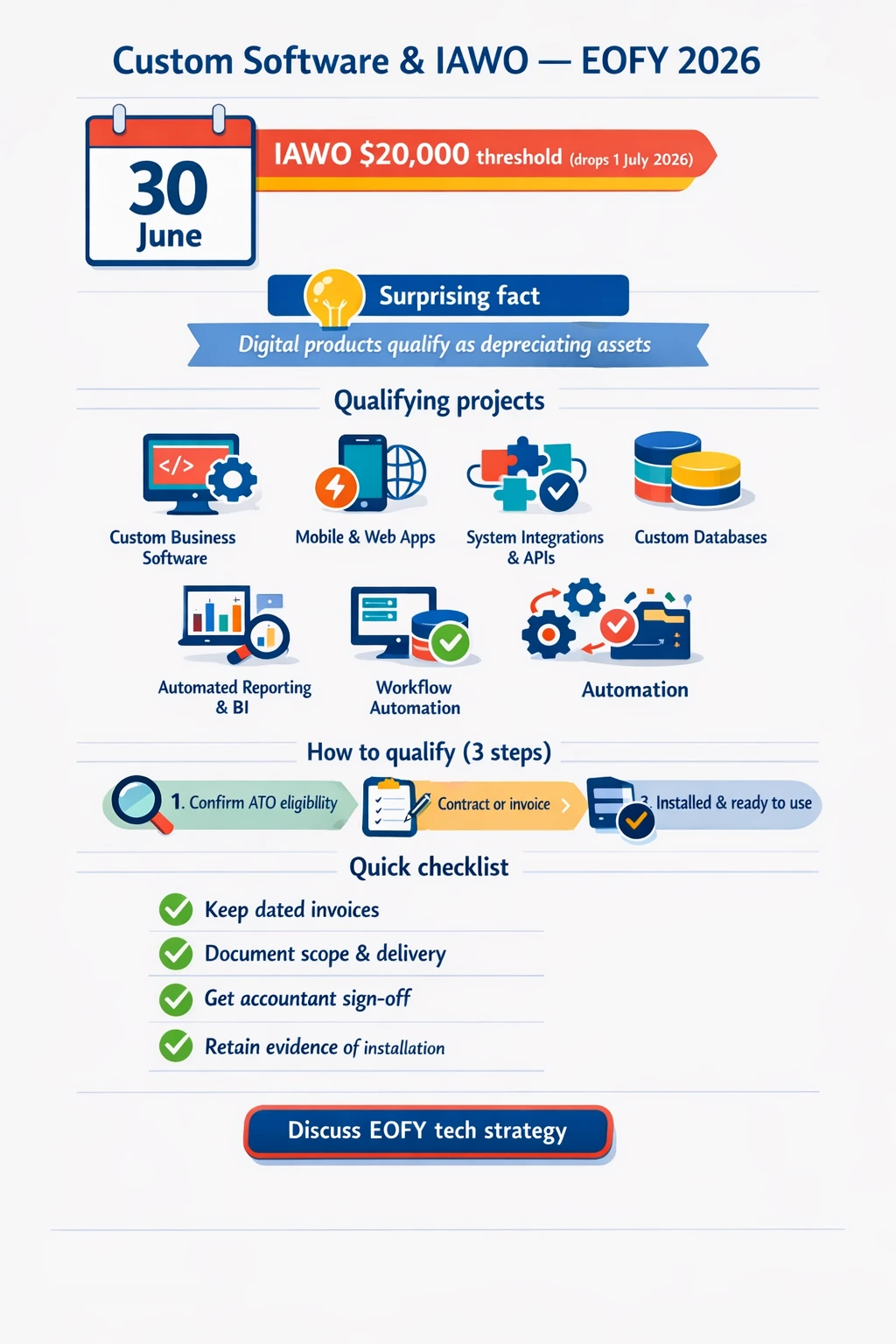
Here is the knowledge gap that this article closes.
When most Australian business owners think about the Instant Asset Write-Off, they picture tangible hardware—laptops, vehicles, manufacturing equipment, office furniture. This perception, while understandable, is incomplete.
The ATO's eligible asset categories explicitly include "digital products and software used in business operations" as depreciating assets under Division 40 of the Income Tax Assessment Act 1997. What this means in practice is broader than most business owners—and even many accountants—realise.
What Custom Software Investments Qualify Under the IAWO
The following bespoke development projects are classified as in-house depreciating business assets by the ATO and are eligible for the IAWO if the cost is under $20,000 (ex. GST) per asset and the system is installed and ready for use before 30 June 2026:
-
Custom bespoke business software — purpose-built management, operations, or workflow systems specific to your industry, business model, or operational requirements
-
Bespoke mobile and web applications — customer portals, booking systems, field service apps, client-facing tools, internal productivity applications
-
System integration and API development — custom connections between your accounting software (Xero, MYOB, QuickBooks), CRM (Salesforce, HubSpot), ERP, e-commerce platform (Shopify, WooCommerce), or payroll system
-
Custom database architecture and development — replacing spreadsheet-based operations with a structured, real-time business data layer that provides single source of truth
-
Automated reporting and business intelligence tools — custom dashboards drawing live data from your connected business systems, eliminating manual reporting processes
-
Workflow automation systems — custom-built approval workflows, document management systems, compliance tracking tools
-
Industry-specific operational tools — trade management systems, job scheduling applications, inventory management solutions, client management portals
The Critical Distinction: Capital Asset vs. Operating Expense
Understanding the tax treatment difference between SaaS subscriptions and custom software is essential:
| Generic SaaS Subscriptions |
C9 Custom Software — IAWO-Eligible |
| Operating expense — deductible annually as incurred |
Capital asset — full IAWO deduction in FY26 |
| No IP ownership — licence ends when you stop paying |
Full IP ownership — code and data are yours permanently |
| Built for everyone; fits no-one perfectly |
Built for your exact workflow and business rules |
| Annual cost grows with vendor pricing decisions |
Zero recurring licence fees after development |
| Integration requires paid middleware (Zapier, Make) |
Integrations built natively into the solution |
| Vendor roadmap controls your feature access |
Your roadmap — features evolve on your terms |
| Switching is costly — data held by the vendor |
No lock-in — portable, extensible, upgradeable |
| Monthly/annual fees continue indefinitely |
One-time investment with ongoing ownership |
According to research by Gartner, the average Australian SME spends between 18,000 and 54,000 annually on SaaS subscriptions, with zero equity accumulated. Over a five-year period, this represents 90,000 to 270,000 in subscription costs with nothing owned at the end.
A $20,000 custom software investment, by contrast, delivers:
- Immediate tax deduction of 5,000–6,000 (net cost: 14,000–15,000)
- Permanent ownership of the asset
- Zero ongoing licence fees
- Complete control over features, data, and evolution
- Competitive advantage through operational differentiation
ATO Guidance and Classification
The ATO's classification of software as a depreciating asset is established in:
- Income Tax Assessment Act 1997, Division 40 (Capital allowances: depreciating assets)
- ATO Taxation Ruling TR 2016/1 (Income tax: effective life of depreciating assets)
- ATO Practical Compliance Guideline PCG 2023/1 (Instant asset write-off)
Custom software commissioned for business use is classified under "computer software" with an effective life determination of 4–5 years. However, under the IAWO provisions, eligible assets can be immediately deducted in full in the year they are first used or installed ready for use.
How C9 Delivers IAWO-Eligible Custom Software Before 30 June 2026
C9 is Australia's leading custom software, apps, integration, and database development company. For over a decade, we've built purpose-built digital systems for Australian businesses—systems that replace operational chaos with structured, automated, data-driven workflows.
We understand the EOFY investment window intimately. Every project we scope is assessed for IAWO feasibility as part of the discovery process. Our delivery timelines are specifically structured to meet the 30 June "installed and ready for use" requirement—not just the invoice date.
What C9 Builds — and What It Looks Like as an Investment
| Solution Type |
What It Replaces |
Typical Scope |
IAWO Eligible? |
| Custom job or project management system |
Spreadsheets, disconnected tools, manual tracking, email-based coordination |
8,000–20,000 |
Yes — if under $20k and deployed by 30 June |
| Bespoke client or customer portal |
Manual communication, email-based approvals, PDF workflows, phone-based updates |
10,000–20,000 |
Yes |
| System integration (API development) |
Manual data re-entry between platforms (Xero, Shopify, CRM, inventory systems) |
6,000–18,000 |
Yes — each integration assessed per asset |
| Custom database and reporting system |
Excel-based reporting, manual EOFY reconciliation, disconnected data sources |
8,000–20,000 |
Yes |
| Automated operational workflow tool |
Manual multi-step approval or fulfilment processes, paper-based systems |
7,000–18,000 |
Yes |
| Custom mobile field app |
Paper-based or phone-based field reporting, manual job tracking |
10,000–20,000 |
Yes |
| Inventory management system |
Spreadsheet-based stock control, manual stocktake processes |
12,000–20,000 |
Yes |
| Compliance and documentation system |
Manual compliance tracking, paper-based records, audit preparation |
9,000–19,000 |
Yes |
C9's EOFY Delivery Commitment
We make the following commitments to every business engaging with C9 for EOFY 2026 delivery:
✓ 48-hour proposal turnaround: Every project inquiry received before 15 May 2026 will receive a fixed-price proposal within 48 hours of the discovery call.
✓ Confirmed deployment date: Every project proposal includes a confirmed deployment date—in writing—before you approve the project. No ambiguity, no "we'll try," no conditional timelines.
✓ Honest feasibility assessment: C9 will not accept projects that cannot be realistically deployed before 30 June 2026, and we will tell you that clearly upfront, not after you've signed a contract.
✓ IAWO-ready documentation: We provide IAWO-ready project documentation—invoice structure, asset description, and deployment evidence—to support your accountant's deduction claim.
✓ Production deployment guarantee: Your system will be deployed to production, tested, and ready for use before 30 June 2026, meeting the ATO's "installed and ready for use" requirement.
Beyond the Write-Off: The Strategic Case for Custom Software Investment
The tax deduction is the catalyst for the decision. The business transformation is the reason it's a great decision.
Australian business owners who invest in bespoke custom software, apps, integrations, and database development through C9 are not simply purchasing a tax deduction. They are commissioning an operational asset that will eliminate the manual work, disconnected data, and tool-subscription overhead that accumulates every year a business outgrows its technology.
The Compounding Return of Custom Software Ownership
Consider the five-year financial picture of a business that commissions a $20,000 custom operations system from C9 before 30 June 2026:
Year 0 (FY26):
- Investment: $20,000
- Immediate tax saving (at 25% rate): $5,000
- Net cost: $15,000
Year 1 (FY27):
- Zero licence fees (vs. 15,000–40,000 in SaaS subscriptions replaced)
- Team saves 6–10 hours per week in manual process time
- Improved cash flow from faster invoicing and better data visibility
- Competitive advantage from operational efficiency
Years 2–5:
- The system evolves at your direction
- No vendor price increases
- No forced migrations or platform changes
- No data held hostage by a third-party platform
- Continued productivity gains compound
Five-year total cost: $15,000 net (after tax)
Five-year SaaS equivalent: 75,000–200,000+ in subscription fees—with nothing owned at the end
The Strategic Advantages of Software Ownership
According to research by McKinsey & Company, businesses that invest in custom operational software report:
- 47% reduction in time spent on manual administrative tasks
- 34% improvement in data accuracy and reporting reliability
- 28% faster decision-making due to real-time business intelligence
- 23% increase in customer satisfaction due to improved service delivery
- 19% reduction in operational costs over three years
The EOFY write-off accelerates the ROI calculation. But the case for custom software over generic SaaS stands independently of the tax timing—the IAWO simply makes 2026 the obvious year to act.
Competitive Advantage Through Operational Differentiation
Your competitors are using the same SaaS tools you are. They have the same features, the same limitations, the same workflows. Custom software provides genuine competitive differentiation because it's built specifically for your business model, your processes, your competitive advantages.
When your operations are more efficient, your customer experience is better, your data is more accessible, and your team is more productive, you win business. The IAWO makes this investment financially compelling in FY26.
The Delivery Timeline: Working Backwards from 30 June 2026
The most common question C9 receives from businesses considering an EOFY software investment is: "Can we actually do this in time?"
For most focused, well-scoped projects, the answer is yes—but only if the conversation starts now.
Critical Path Timeline for EOFY 2026 IAWO Qualification
| Date |
Required Milestone |
Who Acts |
| By 15 May 2026 |
Discovery call completed; project brief defined; proposal received from C9 |
Business owner / executive |
| By 22 May 2026 |
Proposal approved; project contract signed; 50% deposit paid; development commences |
Business owner + C9 |
| By 12 June 2026 |
Core development complete; user acceptance testing (UAT) begins |
C9 + business team |
| By 22 June 2026 |
UAT approved; final changes made; deployment to production environment |
C9 |
| By 27 June 2026 |
System live; staff trained and actively using the software |
C9 + business team |
| By 30 June 2026 |
ATO "installed and ready for use" condition met; final invoice issued and paid |
C9 + accountant |
| By 31 October 2026 |
IAWO claimed in FY26 tax return lodgement |
Accountant / tax agent |
What Happens If You Start After 15 May?
Projects scoped after 15 May 2026 will be assessed individually for EOFY feasibility. Simpler integration and reporting projects may still be achievable in a compressed window. More complex systems will be quoted with an honest delivery assessment.
C9 will not commit to a timeline we cannot honour. If we determine that your project cannot be realistically delivered and deployed before 30 June 2026, we will tell you that clearly in the proposal stage—and we'll offer to schedule the project for FY27 delivery instead.
The Risk of Delay
Every day of delay between now and mid-May reduces:
- Available development time
- Testing and refinement capacity
- Buffer for unexpected complications
- Your accountant's ability to properly document the deduction
If you're considering a custom software investment for EOFY 2026, the time to act is now.
Frequently Asked Questions: IAWO and Custom Software
Does custom software genuinely qualify for the $20,000 Instant Asset Write-Off?
Yes. Custom-commissioned software is classified as an in-house depreciating business asset by the ATO under Division 40 of the Income Tax Assessment Act 1997. Provided the project costs under 20,000 (ex. GST), your business has aggregated annual turnover under 10 million, you've elected to use the simplified depreciation rules, and the software is installed and ready for use before 30 June 2026, you can claim the full cost as an immediate deduction in your FY26 return.
Always confirm specifics with your registered tax agent or accountant, as individual circumstances vary.
Can I claim multiple custom software projects under the IAWO?
Yes. The 20,000 threshold applies on a per-asset basis. Multiple separate projects—for example, a custom database AND a client portal AND a system integration—can each be claimed individually under the IAWO, provided each one is under the 20,000 threshold and qualifies as a separate depreciating asset in its own right.
Your accountant can advise on the correct asset classification for each project. The ATO's guidance is that each asset must be functionally independent and serve a distinct business purpose.
What does "installed and ready for use" actually mean for software?
According to ATO Taxation Ruling TR 2023/1, the software must be:
- Deployed to your production environment (not sitting in a development or testing environment)
- Accessible to your business users (login credentials distributed, access configured)
- Operational and capable of performing its intended function (all core features working)
- Available for use by your team (staff trained or training completed)
Paying the invoice or signing the contract is not sufficient. The system must be operational—not still in development, not waiting for final testing, not pending staff training to begin.
What if my project needs more than $20,000?
Projects over $20,000 have several options:
-
R&D Tax Incentive: If the development involves technical innovation or solving novel technical challenges, it may qualify for the R&D Tax Incentive, which offers a 43.5% refundable tax offset for eligible innovative development (for businesses with turnover under $20 million).
-
Multiple discrete assets: If appropriate, the project can be structured as multiple functionally independent assets, each under $20,000.
-
Small business depreciation pool: The full cost can be entered into the small business depreciation pool at 15% in Year 1 and 30% each year thereafter.
-
Staged delivery: Phase 1 delivered before 30 June 2026 (IAWO-eligible), Phase 2 delivered in FY27.
Your accountant and C9 can help structure the engagement appropriately based on your specific circumstances and objectives.
Does the IAWO apply to software subscriptions or SaaS products?
No. The IAWO applies only to assets you own. SaaS subscriptions (Xero, HubSpot, Salesforce, etc.) are operating expenses, not capital assets. They're deductible in the year incurred as a business expense, but they don't qualify for the IAWO because you don't own the underlying asset.
Custom software commissioned and built for your business is a capital asset that you own, which is why it qualifies.
What documentation do I need for my accountant?
C9 provides:
- Detailed invoice showing asset description, cost (ex. GST), and date
- Deployment confirmation letter stating the date the system was installed and ready for use
- Asset specification document describing the software's business purpose and functionality
- User acceptance testing sign-off (if applicable)
Your accountant will use this documentation to support the IAWO claim in your FY26 tax return.
What if I'm not sure my business qualifies for the IAWO?
The IAWO is available to businesses that:
- Have aggregated annual turnover less than $10 million
- Have elected to use the simplified depreciation rules (small business pool)
- Purchase eligible assets costing less than $20,000 (ex. GST)
- First use or install the asset ready for use before 30 June 2026
If you're unsure about your eligibility, consult your accountant or tax agent before proceeding. C9 can also connect you with tax professionals who specialise in technology investment structuring if needed.
Can I claim the IAWO if I'm a sole trader or partnership?
Yes. The IAWO is available to sole traders, partnerships, companies, and trusts, provided they meet the turnover and other eligibility requirements.
What happens if the software isn't finished by 30 June?
If the software is not installed and ready for use by 30 June 2026, it does not qualify for the FY26 IAWO at the $20,000 threshold. Instead:
- If it costs less than $1,000, it may qualify for the FY27 IAWO (at the reduced threshold)
- If it costs more than $1,000, it will be depreciated via the small business pool method over multiple years
This is why timing and realistic project scoping are critical. C9 will only commit to projects we can realistically deliver before the deadline.
Taking Action: Your EOFY 2026 Custom Software Investment Checklist
If you're considering a custom software investment to take advantage of the EOFY 2026 IAWO, follow this checklist:
☐ Week 1: Assessment and Discovery
☐ Week 2: Scoping and Proposal
Conclusion: The Window Is Closing—and It Won't Reopen

The end of financial year 2026 presents Australian business owners with a genuinely time-limited opportunity: claim a full, immediate tax deduction of up to $20,000 on a custom software investment that will outlast the financial year by many years—and eliminate the operational friction that compounds every month it goes unresolved.
The IAWO at this threshold will not return. The operational cost of not fixing your systems will only increase.
Custom bespoke software, purpose-built apps, system integrations, and database development commissioned through C9 before 30 June 2026 can satisfy both objectives simultaneously: deliver an immediate, substantial tax benefit in your FY26 return, and deliver a long-term business asset that your organisation owns, controls, and benefits from indefinitely.
The decision, as always, belongs to you. But the timing window does not. Every day between now and mid-May represents one less day of development time, one less day of testing capacity, one less day of buffer against the unexpected.
If you've been considering a custom software investment—if you've been working around a manual process, if you've been re-entering data between systems, if you've been paying for SaaS subscriptions that don't quite fit—this is the year to act.
The tax incentive expires at midnight on 30 June 2026. The operational problem you're solving will still be there on 1 July—but the financial case for solving it will be dramatically different.
Build Before the Deadline. Own It After.
C9 | Australia's Leading Custom Software, Apps, Integration & Database Developer
Contact C9 today to scope your EOFY 2026 project. We will assess your requirements, confirm IAWO eligibility, and commit to a deployment date before 30 June 2026—in writing.
Explore Related Insights on Custom Software Development Solutions
R&D Tax Incentive 2026: Is your custom software development eligible for a 43.5% tax offset?
EOFY 2026 Instant Asset Write-Off + Custom Software: What Every Australian Business Owner Must Know Before 30 June
AI-Powered Hyper-Personalisation in 2026: How Australian Enterprises Are Building Custom Software That Knows Your Customers
Why Sydney Businesses Are Switching to Custom Software Development
Your Competitors Are Making Their Core Software Smarter. What Are You Doing?
Why Melbourne Retailers Are Embracing Progressive Web Apps for Better Mobile UX – Insights from a Web Application Development Agency
Unlock the Power of Precision: How to Choose a Custom Software Development Partner in Australia: A Step-by-Step Guide for Executives
Navigating Australia's Tech Talent Crunch: How Skill Evolution is Reshaping Custom Software Development for Business Growth
The Generative AI Compliance Challenge: Building Secure, Ethical Enterprise Apps in Australia (Executive Guide)
Video Consultation Software Development: Building Secure Virtual Care Platforms
Unlock Efficiency: Why Progressive Web Apps (PWAs) and Hybrid Solutions Are Revolutionising Australian Businesses in 2026
Revolutionise Your Software Development: How AI-Powered Developer Collaboration is Boosting Australian Business Efficiency
AI Transparency Notice:
This article was produced with the assistance of artificial intelligence tools, including content drafting, visual asset creation, and audio generation. All content has been reviewed and approved by C9 prior to publication.