|
EXECUTIVE SUMMARY
In short:
- Most Brisbane businesses are running eight to twelve cloud platforms that don't communicate with each other — creating expensive manual workarounds, reporting delays, and data errors that quietly erode profitability every day.
- Off-the-shelf integration tools such as Zapier, Microsoft Power Automate, and MuleSoft solve simple, standardised workflows — but break down the moment your business has unique processes, legacy systems, or Australian compliance obligations.
- Bespoke custom cloud integration, engineered specifically for your systems and business logic, eliminates those workarounds permanently. It is a strategic asset — not a software purchase — and one that delivers measurable ROI within the first year.
- Australia's cloud computing market is valued at AUD 20.21 billion in 2025 and growing at 11.84% CAGR. Brisbane businesses that build the right integration foundation now will hold a compounding competitive advantage for years.
What's next?
Read on to understand exactly where off-the-shelf cloud solutions fail Brisbane businesses, what bespoke integration delivers in practice, and how C9 builds custom cloud solutions that work the way your business actually operates — then take the next step and book a free Cloud Integration Discovery Session at c9.com.au.
|
You invested in the cloud. You signed the contracts, migrated the data, trained the team, and were told efficiency was coming. And then — nothing quite connected the way it was supposed to.
Finance still exports a spreadsheet every Monday and re-enters the figures manually into the CRM. Your operations manager juggles three separate dashboards to produce a weekly report that should be a single click. Customer records updated in one platform don't appear in another until someone remembers to sync them. Decisions are being made on data that is 24 to 48 hours out of date.
If this sounds familiar, you are in the majority. Across Brisbane and throughout Queensland, businesses that moved to the cloud in good faith are discovering that being in the cloud and having a genuinely connected, intelligent cloud operation are two very different things. According to Salesforce research, 71% of enterprise applications remain unintegrated or disconnected — and that figure has not improved in three consecutive years.
The source of the problem is not the cloud itself. It is the assumption that off-the-shelf cloud tools — platforms built to serve millions of generic users — will naturally fit the specific way your business operates. They won't. And in 2026, the gap between businesses that have resolved that reality with bespoke cloud integration and those still trying to force generic platforms to behave is widening every quarter.
This article is for Brisbane business owners, CEOs, CTOs, and operational leaders who are done with generic cloud promises and ready for a solution that is built around the business they actually run.
|
71%
|
of enterprise applications remain unintegrated or disconnected — unchanged for three consecutive years. (Salesforce, State of Integration, 2025)
|
The Disconnected Cloud Problem Costing Brisbane Businesses More Than They Realise
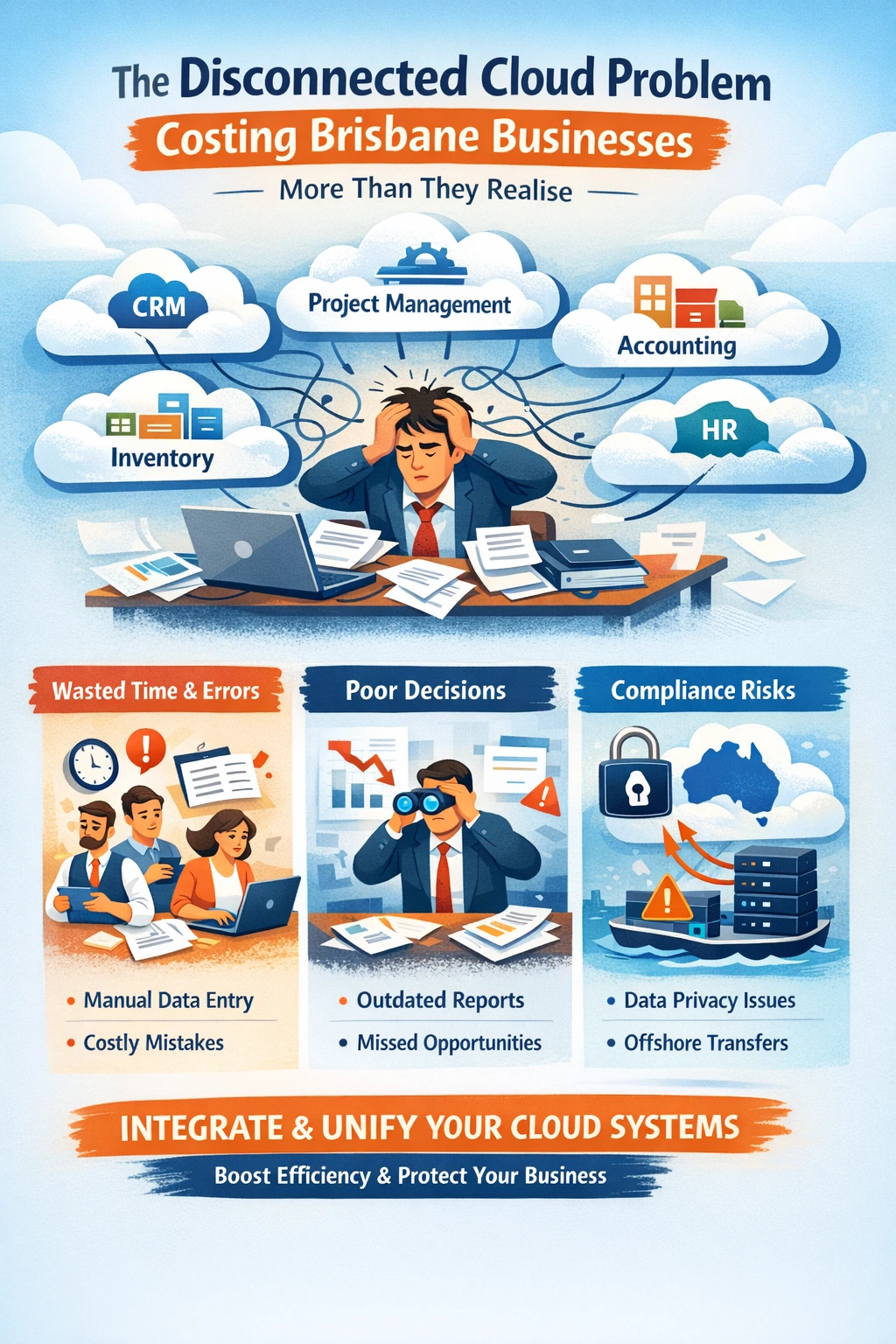
The modern Brisbane business has never had access to more cloud tools. Project management platforms, CRM systems, accounting software, HR platforms, inventory systems, e-commerce backends, and customer communication tools — each one individually justified, often from a different vendor, running on a different data structure, and entirely unaware of the others.
The result is a technology environment where data lives in silos, reporting is always slightly wrong, and your team spends a disproportionate share of their time acting as the integration layer between systems — manually moving information from one platform to another, checking that figures match, and fixing errors that should never have existed.
The Direct, Measurable Cost
The most immediate cost of disconnected cloud systems is staff time. Consider a modest example: three people in your business each spend ninety minutes per day on manual data tasks — exporting, re-entering, cross-checking, correcting. That is 4.5 hours per day, 22.5 hours per week, and over 1,100 hours per year of skilled labour producing no business value. At even a conservative fully-loaded cost, that is tens of thousands of dollars in wages dedicated entirely to bridging gaps that should not exist.
Then there is error cost. Manual data entry introduces human errors at a predictable rate. A wrong figure in a client quote, a missed update to a purchase order, a misaligned inventory count — each one carries remediation time, and some carry consequences that extend to customer relationships and compliance obligations.
The Strategic Cost That Accumulates Quietly
Beyond the measurable figures, disconnected systems create what technology strategists call 'strategic drag' — a gradual slowing of the business's ability to move, decide, and respond.
When your data is fragmented across platforms, business intelligence is always imprecise. Management decisions rely on reports that are assembled manually, which means they are based on yesterday's reality, not today's. Sales opportunities are missed because your CRM doesn't reflect what your operations team already knows. Growth initiatives stall because scaling a manual integration process means hiring more people — not deploying better technology.
According to Mordor Intelligence's January 2026 market analysis, 68% of Australian SMEs rank operational efficiency as their top business objective, and 71% prioritise profit improvement. Both of those objectives are directly impeded by disconnected cloud infrastructure. Bespoke cloud integration is not a technology project — it is an operational and commercial imperative.
The Compliance Exposure Most Brisbane Businesses Are Not Aware Of
There is a third dimension to this problem that is growing in urgency for Australian organisations. When your cloud platforms automatically sync data between one another, that data frequently travels through offshore servers operated by the platform vendors. Under Australia's Privacy Act 1988, the Australian Privacy Principles (APPs), and the Security of Critical Infrastructure Act 2018 (SOCI Act), your obligations regarding where data is stored and who can access it do not disappear simply because a third-party platform is managing the transfer.
Many Brisbane businesses are unknowingly creating compliance exposure with every automated sync between an offshore-hosted CRM and a separately hosted accounting platform — particularly in sectors such as healthcare, financial services, legal, and government contracting. A bespoke cloud integration architecture, designed with Australian data sovereignty requirements from the outset, addresses this risk at the architectural level — not as a configuration setting applied after the fact.
|
AUD 20.21B
|
value of Australia's cloud computing market in 2025, growing at 11.84% CAGR to reach AUD 61.88B by 2035. (Expert Market Research Australia, 2026)
|
Why the Problem Is Getting Worse: The SaaS Price Surge and the Vendor Lock-In Trap
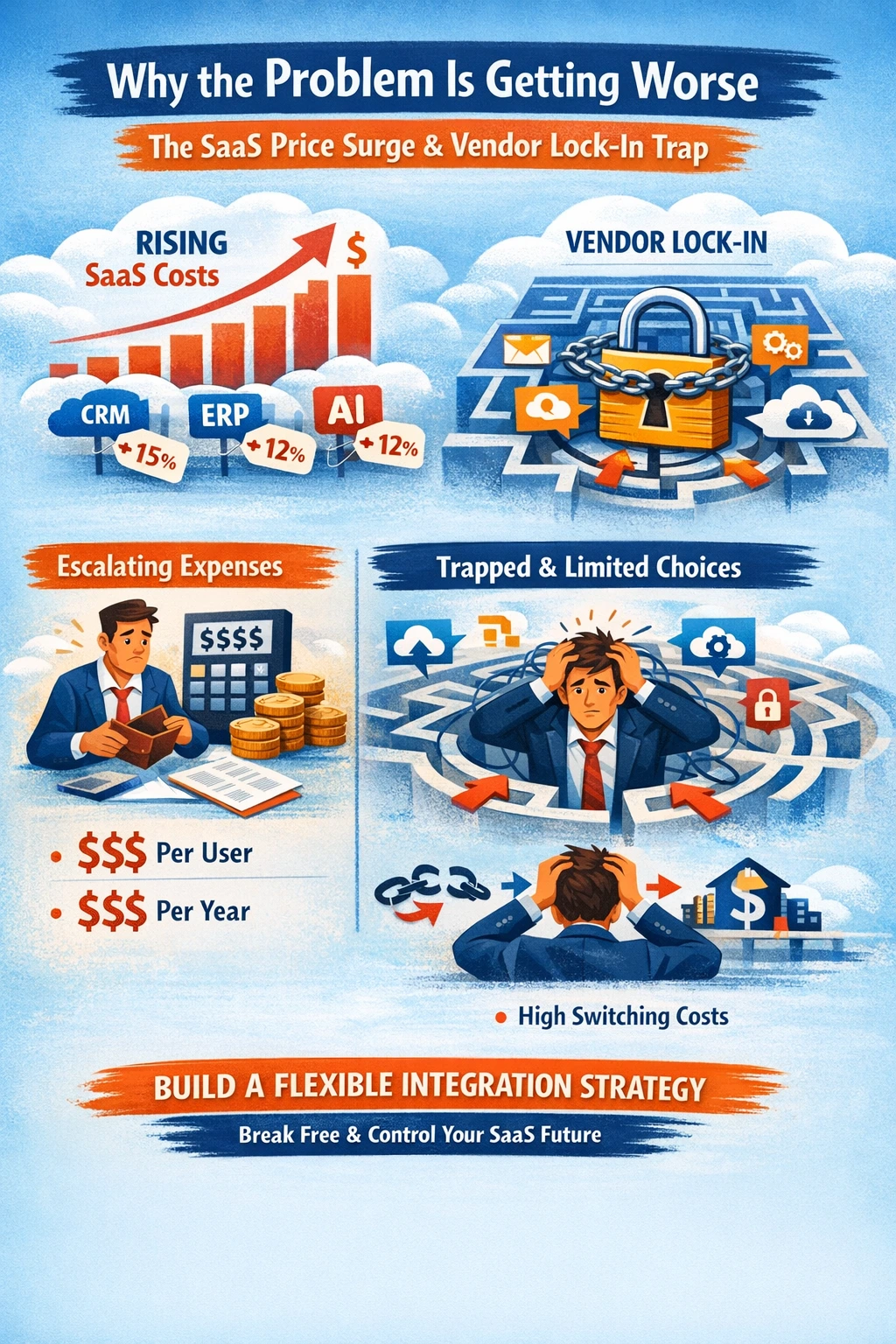
If disconnected cloud systems were simply an operational inconvenience, most businesses would tolerate them indefinitely. The reason 2026 is a pivotal year is that the financial and strategic costs are escalating simultaneously — and the businesses that delay addressing their integration architecture are paying an increasingly steep price for that delay.
SaaS Prices Are Rising Faster Than Inflation
According to the Vertice SaaS Inflation Index, the current SaaS inflation rate is 12.2% — 4.5 times higher than general inflation in G7 countries. SaaS costs per employee reached approximately AUD equivalent of $9,100 per year by end of 2025, up 15% over two years alone. For a 100-person business, that represents an annual SaaS spend of over $910,000 — and growing.
The increases are not uniform. Mission-critical platforms — ERP, CRM, and data platforms — have seen the largest cost increases, with Salesforce implementing consecutive price rises totalling nearly 15% over three years and deriving up to 72% of its revenue growth from price increases rather than new customers. Microsoft, Adobe, Atlassian, and ServiceNow have all implemented material price increases in 2025-2026. These are not isolated events. They are a structural shift in how major vendors extract value from their installed customer base.
|
KEY INSIGHT
SaaS inflation is currently running at 12.2% per annum — 4.5 times the general inflation rate. A 100-person Brisbane business spending the average per-employee SaaS rate will see their software bill grow by over $110,000 per year without adding a single new tool. (Vertice SaaS Inflation Index, 2025)
|
Vendor Lock-In Is Not a Technology Risk — It's a Business Risk
The same AI proliferation that vendors use to justify price increases is also accelerating vendor lock-in. As businesses embed deeper into platform ecosystems — with data, workflows, and team habits all structured around a specific vendor's architecture — the cost and complexity of switching grows. Vendors understand this, and they price accordingly.
According to Zylo's 2025 SaaS Management Index, the rapid adoption of AI solutions is tying organisations to specific platforms, making it difficult and costly to switch vendors over time, and leaving them with limited bargaining power. For Brisbane businesses that have not invested in a clean, portable integration architecture, every passing month of deeper vendor dependency makes extracting themselves more expensive.
Bespoke custom cloud integration is the architectural response to this dynamic. By building the integration layer between your systems as an asset you own and control — rather than a feature you rent from a vendor — you maintain the ability to swap out any individual platform without disrupting your entire operation. That portability is a strategic capability, not just a technical preference.
The Hidden Tax of the 'Good Enough' Middle Ground
Many Brisbane businesses have attempted to address their integration challenges with off-the-shelf middleware platforms — tools like Zapier, Microsoft Power Automate, and MuleSoft. These tools are positioned as the accessible, affordable middle ground between doing nothing and investing in bespoke development. For straightforward, standardised workflows, they can provide genuine value. But they have a ceiling, and most established businesses hit it faster than the vendors suggest.
The SaaStr analysis of the great SaaS price surge notes that vendors are using bundling, credit systems, and consumption-based pricing to increase effective costs while masking the increases behind feature additions. Generic integration platforms follow the same pattern — the entry price is low, but as usage scales and complexity grows, costs compound. The business ends up paying recurring licensing fees for an integration solution that still requires manual workarounds for anything outside the standard use case.
Five Reasons Off-the-Shelf Cloud Integration Fails Brisbane Businesses
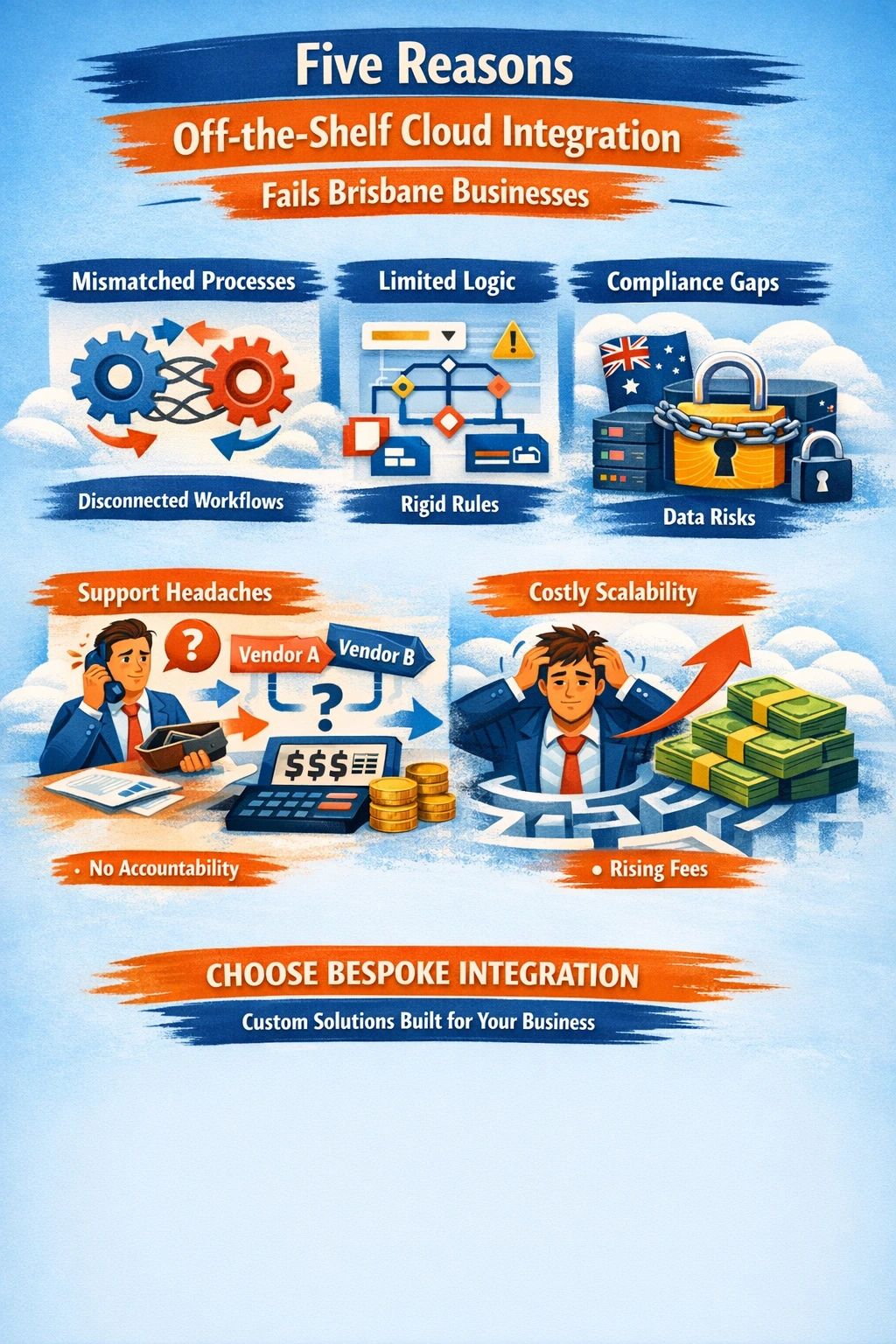
Understanding precisely where and why generic integration platforms fall short helps Brisbane business owners make better decisions about where to invest. These are not edge cases or technical footnotes — they are the consistent failure patterns that C9 encounters in discovery workshops with businesses across Queensland.
1. They connect the tools you have — not the processes you need
Off-the-shelf integration platforms work by mapping data from one system's structure to another's. They assume both platforms use reasonably standardised fields, and that the workflow between them is linear and predictable. Real businesses — particularly those with any operational complexity, custom data fields, or legacy systems — quickly discover that their actual processes don't map neatly to the template. The result is a workaround on top of a workaround, with the integration platform adding a new layer of dependency rather than removing an existing one.
2. Your business logic cannot live in a dropdown menu
Every Brisbane business has rules that govern how it operates — the conditions under which a job gets prioritised, the approval thresholds that trigger a different workflow, the exceptions that apply to specific customer types or contract structures. Generic integration tools offer conditional logic, but it is constrained to the scenarios the platform was designed to handle. If your logic falls outside those scenarios, you either compromise your process or accept that the automation will never work correctly for your most important cases.
3. Australian compliance is an afterthought, not a design principle
Generic integration platforms are built for a global market and designed primarily to meet US compliance standards. Australian data sovereignty requirements under the Privacy Act, the APPs, and the SOCI Act are not built into these platforms at the architectural level — they are addressed, if at all, through configuration settings and contractual clauses. A bespoke integration designed for Australian compliance obligations is architecturally different: data residency is controlled, access is governed, and audit trails are built in from the start.
4. When it breaks, nobody owns the problem
Every Brisbane business owner who has relied on a generic integration platform knows the experience: something stops working, and each vendor points to the other. The CRM vendor says the issue is with the integration platform. The integration platform's support team says the data looks correct on their end. The IT contractor who configured it has moved on. With bespoke integration built by C9, there is a single accountable partner who built the solution, understands every component, and is responsible for its performance.
5. Generic platforms become more expensive as your business grows
Off-the-shelf integration platforms price by usage volume — the number of tasks executed, connections maintained, or data rows processed each month. As your business grows, your bill grows with it, without any corresponding improvement in what the platform delivers. A custom bespoke integration is an asset your business owns. It scales with your operation because it was designed to — not because you have upgraded to a higher pricing tier.
Direct Comparison: Off-the-Shelf vs C9 Bespoke Cloud Integration
|
ASPECT
|
OFF-THE-SHELF PLATFORM
|
C9 BESPOKE INTEGRATION
|
|
Process fit
|
Adapts your business to the tool
|
Engineered to your exact workflow
|
|
Business logic
|
Template-based conditional rules
|
Unlimited custom logic, any complexity
|
|
Australian compliance
|
Global settings, AU as afterthought
|
SOCI Act & APP compliant by design
|
|
Data sovereignty
|
Offshore servers, limited control
|
Australian-hosted, full data ownership
|
|
Scalability cost
|
Pricing rises with usage volume
|
Fixed architecture, scales without extra fees
|
|
Accountability
|
Split across multiple vendors
|
Single Brisbane-based partner
|
|
AI readiness
|
Dependent on vendor's AI roadmap
|
Custom data layer, AI-ready from day one
|
|
Long-term total cost
|
Escalating subscriptions + labour
|
One investment, compounding efficiency gains
|
The Solution: What Custom Bespoke Cloud Integration Actually Delivers for Brisbane Businesses
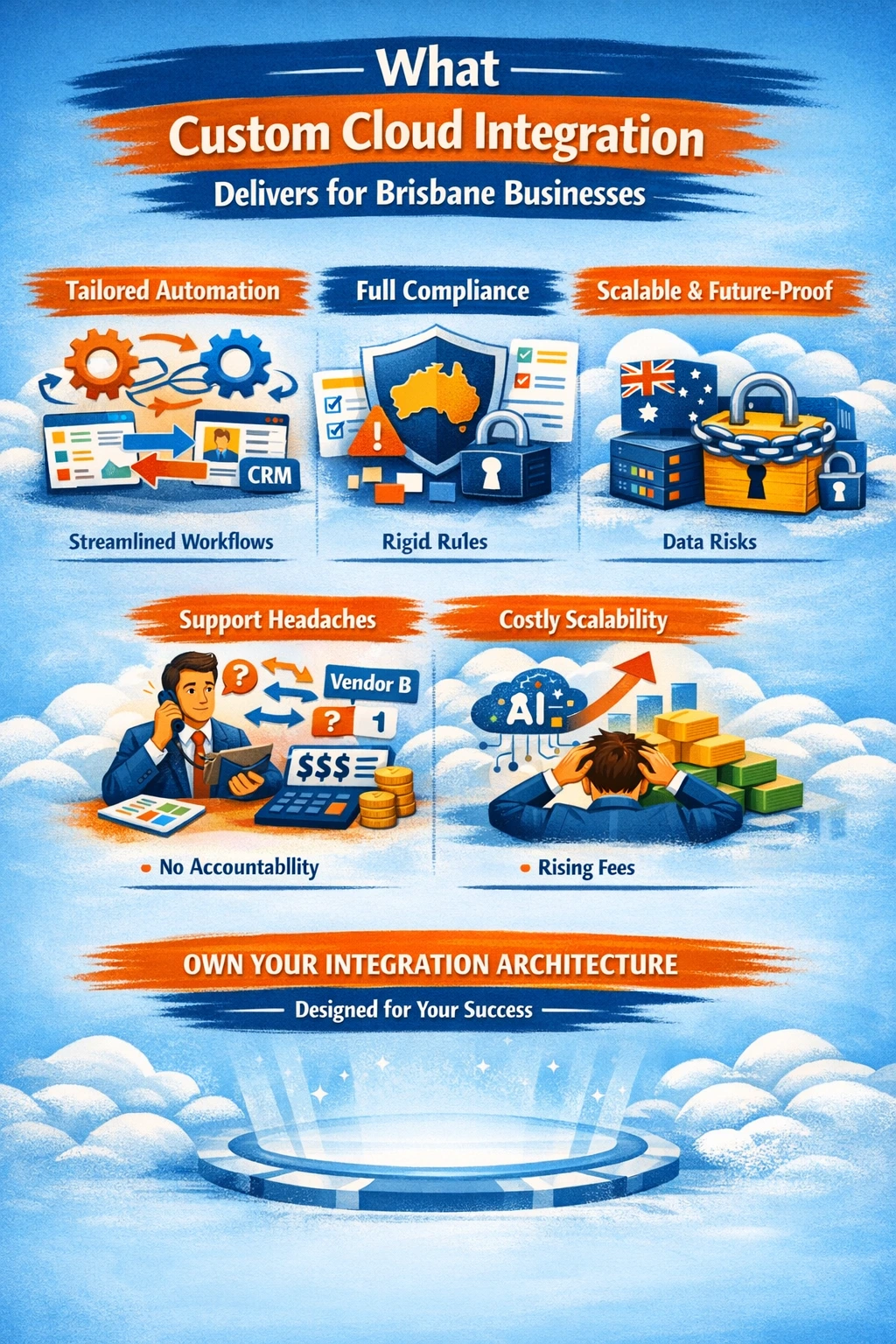
Custom bespoke cloud integration is the practice of designing and building the connective architecture between your cloud systems from scratch — engineered specifically for the way your business operates, the platforms you use, the compliance obligations you carry, and the outcomes you need to achieve. It is not a product you purchase from a vendor catalogue. It is a solution your development partner builds for you, and an asset your business owns.
The distinction matters because ownership changes the equation entirely. When your integration architecture is an asset — not a subscription — it does not escalate in price as your usage grows. It does not get deprecated when a vendor decides to discontinue a feature tier. It does not force you to adapt your business processes to match a platform's assumptions. And it does not create accountability gaps when something goes wrong.
What Bespoke Integration Looks Like in a Brisbane Business Context
Consider a professional services firm in Brisbane running a project management platform, a CRM, and a billing system. Without integration, a project milestone reached in the PM tool requires someone to manually trigger a billing event, update the CRM record, and notify the account manager. With a bespoke integration, those three actions happen automatically — triggered by the milestone, governed by the business's specific billing rules, and routed to the right person based on account ownership logic that the generic platform could never replicate.
Or consider a Brisbane construction business with procurement, site management, compliance reporting, and financial systems from four different vendors. No off-the-shelf integration platform was designed for that specific combination of platforms. A custom integration is — built around the actual data flows, approval chains, and reporting requirements of that business's operation.
In both cases, the business stops operating around its software and starts having software that operates around the business. That shift — from adaptation to alignment — is where the measurable efficiency gains emerge, and where the compounding competitive advantage begins.
Bespoke Cloud Integration and AI Readiness: The Connection Brisbane Businesses Must Understand
There is a forward-looking dimension to bespoke cloud integration that is becoming increasingly material for Brisbane business leaders: artificial intelligence is only as effective as the data it can access and trust.
According to the ONEiO State of Integration Solutions 2026, 95% of IT leaders cite integration as a challenge to seamless AI implementation, and 81% report specific challenges in leveraging AI for system integrations. The reason is structural: AI models need clean, consistent, real-time data to deliver value. When that data is fragmented across disconnected platforms, AI tools produce unreliable outputs — and the promised productivity gains never materialise.
A bespoke cloud integration architecture creates the unified data foundation that AI actually requires. When your systems share clean, real-time information through a properly designed integration layer, AI-driven insights, automated decision support, and intelligent process automation all become achievable rather than aspirational. For Brisbane businesses evaluating AI adoption in 2026, bespoke cloud integration is not optional groundwork — it is the prerequisite.
|
95%
|
of IT leaders globally cite integration as the primary challenge to seamless AI implementation. Without a unified data foundation, AI investments will underperform. (Salesforce / ONEiO, 2025–2026)
|
How C9 Builds Custom Cloud Integration Solutions for Brisbane Businesses
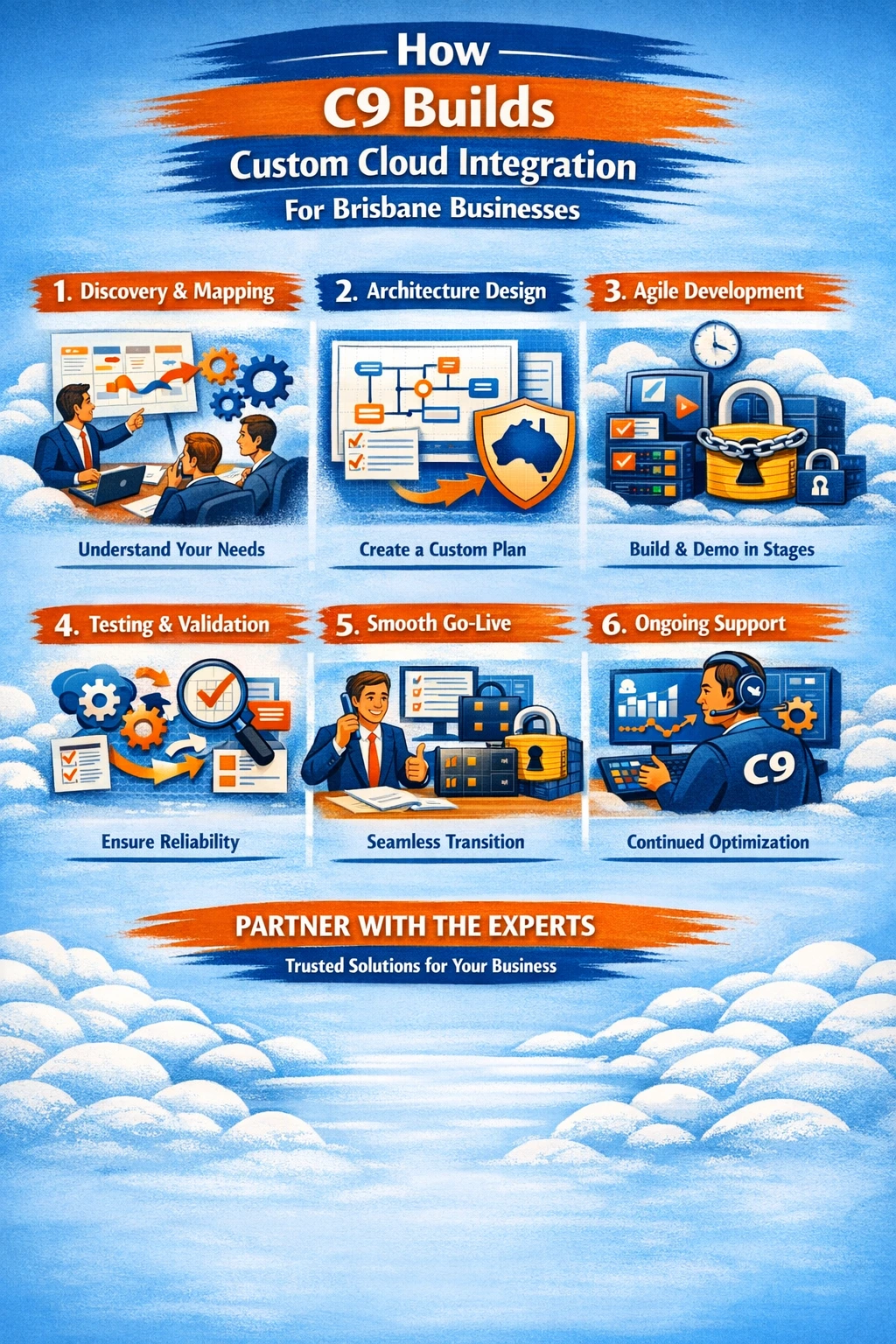
C9 is Australia's leading custom software, apps, integration, and database developer. Cloud integration is a core discipline — and the C9 approach is built on a clear, transparent development process that delivers working solutions without business disruption. Here is how it works.
Step 1: Discovery & Systems Mapping
Every C9 engagement begins with a structured discovery workshop. Before any architecture is proposed or any code written, C9's consultants work directly with your team to map your actual data flows — not the idealised version, but the real one, including the manual steps, the workarounds, the exceptions, and the legacy system constraints that have accumulated over time. This discovery ensures the integration that gets built reflects the business you actually have, with the capacity to support the business you are building towards.
Step 2: Architecture Design
Based on discovery findings, C9 designs a custom integration architecture that connects your systems at the data layer, honours your business rules, meets your Australian compliance obligations, and is built on infrastructure that can scale. The architecture is presented to your leadership team in clear, non-technical terms before development begins — so the business has full visibility and sign-off on what is being built before a single line of code is written.
Step 3: Development in Iterative Sprints
Development occurs in iterative sprints with regular demonstrations to your team throughout the build. This means you see working software progressively — not at the end of a long project when changes are expensive and difficult. Each sprint is validated against real business scenarios, not generic test cases, ensuring the integration performs correctly under the actual conditions your business operates in.
Step 4: Thorough Testing & User Acceptance
Before any integration goes live, C9 conducts comprehensive testing that includes load testing, edge-case scenario testing, compliance validation, and user acceptance testing with your own team. The objective is not simply that the integration works — it is that it works reliably under every condition your business is likely to encounter, including the unexpected ones.
Step 5: Phased Go-Live with Zero Disruption
C9 manages a phased go-live process specifically designed to eliminate disruption to your operations. Rather than a hard cutover that puts the business at risk, parallel systems run simultaneously during the transition, allowing your team to validate outputs before the legacy manual processes are decommissioned.
Step 6: Ongoing Optimisation & Support
Unlike generic platform implementations that conclude with a handover document and a support email address, C9 remains the accountable partner after go-live — monitoring integration performance, optimising as usage patterns emerge, and evolving the solution as your business changes. Bespoke integration is a living asset; C9 ensures it continues to serve you as your operation grows.
|
WHY LOCAL MATTERS
C9's Brisbane-based team means your integration partner is in your time zone, available for a direct conversation, and directly accountable to your outcomes — not to a global support queue managed from another country. For Australian compliance obligations, that proximity is not just convenient. It is architecturally important.
|
The Brisbane Cloud Market in 2026: Why the Timing Is Right to Act
Brisbane's position within Australia's technology landscape is strengthening considerably. Eastern Australia — encompassing Brisbane, Sydney, and Melbourne — holds approximately 45% of the total Australian cloud professional services market, and Brisbane specifically is emerging as a destination for mid-market cloud services projects driven by lower operational costs relative to Sydney and Melbourne.
Australia's IT services market reached USD 36.7 billion in 2025 and is projected to grow to USD 84.2 billion by 2034, with cloud computing driving a significant share of that expansion. The Australian cloud computing market alone is on a trajectory from AUD 20.21 billion in 2025 to AUD 61.88 billion by 2035 — a compound annual growth rate of 11.84%.
SMEs — the businesses most likely to be reading this article — are the fastest-growing segment of that market, expanding at a 22.74% CAGR through 2031. The tools, the talent, and the market infrastructure are all aligning in Brisbane's favour. The question for Brisbane business owners and executives is not whether to invest in cloud integration — it is whether to do so with a generic, off-the-shelf approach that will continue to constrain the business, or with a bespoke solution that compounds in value over time.
|
22.74%
|
CAGR for Australian SME cloud services spending through 2031 — the fastest-growing segment of the Australian IT services market. (Mordor Intelligence, January 2026)
|
Australian Regulatory Context: What Brisbane Businesses Must Factor In
The regulatory environment adds a dimension to the cloud integration decision that is specific to Australian businesses — and one that offshore vendors and generic platforms consistently underplay.
Privacy Act 1988 & Australian Privacy Principles (APPs) — Governs the collection, use, storage, and disclosure of personal information. Any cloud integration that moves customer or employee data between platforms must comply with the APPs — including obligations around cross-border disclosure that many generic sync tools create without the business realising.
Security of Critical Infrastructure Act 2018 (SOCI Act) — Imposes obligations on businesses in critical sectors to manage and mitigate risks to their infrastructure, including digital assets. The SOCI Act mandates that sensitive workloads remain onshore and imposes specific requirements on who can access infrastructure data.
Australian Government's Protective Security Policy Framework (PSPF) — Relevant for businesses working with government — establishes requirements for information and ICT security that flow through supply chains to contractors and technology partners.
Notifiable Data Breaches (NDB) Scheme — Requires entities covered by the Privacy Act to notify the OAIC and affected individuals when a data breach is likely to result in serious harm. An improperly architected cloud integration that exposes data in transit creates NDB risk.
Frequently Asked Questions: Custom Cloud Integration for Brisbane Businesses
The following questions are the ones Brisbane business owners and executives ask most frequently when evaluating custom cloud integration. Each answer is designed to give you a practical, honest foundation for your decision.
What is custom cloud integration and how is it different from standard cloud hosting?
Cloud hosting is where your data and applications live — the servers and infrastructure that store your systems. Cloud integration is the connective architecture that makes those systems communicate with each other. Standard cloud hosting provides the foundation; custom cloud integration builds the intelligence on top of it. Without integration, you have multiple cloud-hosted systems that don't share information automatically — which is the source of the manual workarounds most Brisbane businesses are managing today.
How long does a custom cloud integration project take for a Brisbane business?
Project duration depends on the complexity of your system landscape, the number of platforms being connected, and the sophistication of the business logic involved. A focused integration connecting two or three primary systems typically takes six to twelve weeks from discovery to go-live. More complex integrations across a broader set of platforms — particularly those involving legacy systems or custom data structures — may take three to six months. C9 provides a clear project timeline at the architecture design stage, before development begins.
Can C9 integrate with the specific platforms my business already uses — Xero, Salesforce, MYOB, and others?
Yes. C9's development team has extensive experience integrating across the full range of platforms used by Australian businesses — including Xero, MYOB, Salesforce, HubSpot, Microsoft 365, SAP, Oracle, and bespoke internal systems. The bespoke approach means the integration is built around your specific system landscape, not constrained by a predefined list of supported connectors.
What is vendor lock-in and how does custom cloud integration help avoid it?
Vendor lock-in occurs when your business becomes so deeply embedded in a specific platform's ecosystem — with data, workflows, and processes all structured around that vendor's architecture — that switching becomes prohibitively expensive. With bespoke cloud integration, the connective layer between your systems is an asset your business owns and controls. You can replace any individual platform without disrupting the entire operation, because the integration is not dependent on any single vendor's continued cooperation.
Is custom cloud integration compliant with Australian data privacy laws?
Bespoke cloud integration designed by C9 is built with Australian compliance requirements as a foundational design principle — not a configuration setting applied afterwards. This includes compliance with the Privacy Act 1988, the Australian Privacy Principles, and the SOCI Act where applicable. Data residency is controlled, access is governed through appropriate authentication architecture, and audit trails are built into the integration from the outset.
What does a bespoke cloud integration typically cost, and what is the ROI?
C9 provides specific investment and ROI projections at the discovery and architecture design stage, based on the actual complexity of your system landscape. What the discovery consistently reveals is that the total cost of a bespoke integration — amortised over three to five years — is significantly lower than the combined ongoing cost of manual workarounds, error correction, escalating SaaS licensing, and the operational drag of disconnected systems. The investment pays for itself; the question is how quickly.
Why should I choose a Brisbane-based integration partner over an offshore provider?
Three reasons: accountability, compliance, and context. A Brisbane-based partner like C9 is in your time zone, reachable for a direct conversation, and directly accountable to your outcomes under Australian law. Offshore development teams cannot make enforceable Australian data sovereignty guarantees, and they typically lack the contextual understanding of the Australian regulatory environment and business culture that shapes how integrations need to be designed. For anything touching sensitive business data, local accountability is not optional.
Choosing a Custom Cloud Integration Partner in Brisbane: Eight Questions to Ask
The quality of your integration partner will determine the quality of your outcome. Before engaging any provider, ask these eight questions directly — and evaluate the answers carefully. They are designed to separate experienced, accountable development partners from those who are selling capability they do not have.
- Can you show us an integration you built for a business with legacy systems that lack a native API?
- Where will our data be hosted, and can you provide a written Australian data residency guarantee?
- Who is the specific person accountable if the integration fails after go-live?
- How is the integration documented, and what would a handover look like if we needed to change partners?
- How do you price ongoing modifications as our business evolves — is it time-and-materials or a retained arrangement?
- What does your testing process look like, and do you include edge-case and load testing before go-live?
- Can you provide references from Brisbane or Queensland clients in a similar industry or of similar scale?
- How do you stay current with changes to the platforms we use, such as API version updates or vendor deprecations?
|
C9 can provide a direct, specific, documented answer to every question on this list. That transparency is the standard you should expect from any integration partner you engage.
|
Conclusion: The Brisbane Businesses That Win in 2026 Will Be the Ones That Built Properly
Australia's cloud computing market is on a trajectory from AUD 20.21 billion to AUD 61.88 billion over the next decade. That growth represents genuine opportunity — but only for the businesses that deploy their cloud investments with architectural intelligence, not just commercial convenience.
Off-the-shelf cloud tools served an important purpose in bringing cloud computing within reach of businesses at every scale. But they were never designed to be the permanent solution for organisations with real operational complexity, genuine compliance obligations, and ambitions for compounding growth. For those businesses, generic platforms create as many problems as they solve — and in 2026, with SaaS inflation running at 12.2% and vendor lock-in deepening every quarter, the cost of staying with a generic approach is escalating rapidly.
Bespoke custom cloud integration resolves the problem at the root. Not by replacing every platform in your business, but by connecting them intelligently — according to your specific processes, your data rules, your compliance obligations, and your strategic direction. The result is a technology foundation that supports growth rather than constraining it, and an operational capability that compounds in value the longer it runs.
The businesses that will be most competitive in Brisbane over the next three to five years are not those with the largest technology budgets. They are the ones that deployed those budgets with precision — investing in solutions built to fit their business, rather than perpetually adapting their business to fit generic tools.
C9 builds those solutions. Brisbane-based, Australian-compliant, and engineered for the specific way your business operates.
|
Ready to Stop Working Around Your Cloud Systems?
C9 is Australia's leading custom software, apps, integration, and database developer. Our Brisbane-based team specialises in building bespoke cloud integration solutions that are engineered for the way your business actually operates — with Australian data sovereignty built in, and a single accountable partner responsible for every component.
Book a free Cloud Integration Discovery Session with C9's Brisbane team. We will map your current system landscape, identify your three biggest integration gaps, and show you exactly what a bespoke solution would look like — with no obligation.
→ Visit c9.com.au to book your free discovery session today.
|
References & Sources
All data cited in this article is sourced from primary research organisations, government bodies, and peer-reviewed industry reports. Links were verified as of March 2026.
|
#
|
SOURCE / TITLE
|
URL
|
DATE
|
|
1
|
Mordor Intelligence — Australia IT Services Market Size & Forecast
|
mordorintelligence.com/industry-reports/australia-it-services-market
|
Jan 2026
|
|
2
|
Mordor Intelligence — Australia ICT Market Forecast 2026–2031
|
mordorintelligence.com/industry-reports/australia-ict-market
|
Jan 2026
|
|
3
|
Expert Market Research Australia — Cloud Computing Market 2026–2035
|
expertmarketresearch.com.au/reports/australia-cloud-computing-market
|
2026
|
|
4
|
IMARC Group — Australia Cloud Computing Market 2025–2033
|
imarcgroup.com/australia-cloud-computing-market
|
2026
|
|
5
|
IMARC Group — Australia IT Services Market 2026–2034
|
imarcgroup.com/australia-it-services-market
|
2026
|
|
6
|
Credence Research — Australia Cloud Professional Services Market 2032
|
credenceresearch.com/report/australia-cloud-professional-services-market
|
Jan 2025
|
|
7
|
ONEiO — State of Integration Solutions 2026
|
oneio.cloud/blog/state-of-integration-solutions
|
Mar 2026
|
|
8
|
Salesforce — State of Integration (cited via ONEiO 2025 research)
|
salesforce.com
|
2025
|
|
9
|
Vertice — SaaS Inflation Index Report 2025
|
vertice.one/l/saas-inflation-index-report
|
2025
|
|
10
|
SaaStr — The Great SaaS Price Surge of 2025
|
saastr.com/the-great-price-surge-of-2025
|
Oct 2025
|
|
11
|
SoftwareSeni — Why SaaS Prices Are Rising 4x Faster Than Inflation
|
softwareseni.com/why-saas-prices-are-rising-4x-faster-than-inflation
|
Dec 2025
|
|
12
|
Licenseware — Software Price Increases 2025–2026
|
licenseware.io/software-price-increases-2025-2026
|
Feb 2026
|
|
13
|
Zylo — 2025 SaaS Management Index
|
zylo.com/reports/2025-saas-management-index
|
Jan 2025
|
|
14
|
BetterCloud — AI and the SaaS Industry in 2026
|
bettercloud.com/monitor/saas-industry
|
Jan 2026
|
|
15
|
CIO — SaaS Price Hikes Put CIOs' Budgets in a Bind
|
cio.com/article/4104365/saas-price-hikes-put-cios-budgets-in-a-bind
|
Dec 2025
|
|
16
|
CloudNuro — 50+ Essential SaaS Statistics 2026
|
cloudnuro.ai/blog/saas-statistics
|
2026
|
|
17
|
Australian Office of the Australian Information Commissioner (APPs)
|
oaic.gov.au/privacy/australian-privacy-principles
|
Current
|
|
18
|
Department of Home Affairs — Security of Critical Infrastructure Act 2018
|
homeaffairs.gov.au/Company-us/our-portfolios/cyber-security/soci-act
|
Current
|
|
19
|
Digital Transformation Agency — Digital Government Strategy
|
dta.gov.au
|
2025
|
|
20
|
IBM — Cost of a Data Breach Report 2024 (Australia data)
|
ibm.com/reports/data-breach
|
2024
|
|
© 2026 C9 — Australia's Leading Custom Software, Apps, Integration & Database Developer · c9.com.au · Brisbane, Australia
All rights reserved. Australian English. Published March 2026. Copywriting Framework: Pain–Agitate–Solution (PAS). Google E-E-A-T Optimised.
|
Explore Related Insights on Integrations Solutions.
How Custom Xero Integration Solves the #1 Challenge Facing Mixed Farming Operations in Australia
AI-Driven Automation and Real-Time Data Integration: Unlocking Efficiency for Australian Businesses
Beyond Automation: How a Strategic AI Integration Specialist Unlocks True Operational Efficiency
Seamless System Integration: Why Australian Firms Need Database Consultants Now
Real-World API Integration Success Stories: How Australian Businesses Transformed Their Operations with C9
API-First Development: Why Your Business Needs an API Integration Strategy for 2026
RPA + AI: The Intelligent Automation Combination Transforming Australian Businesses
Headless CMS & API-First Development in 2026: The Australian Guide to Faster, Flexible and Future-Proof Web Applications (Why C9 is Your Ideal Partner)
Why 37% of Enterprises Say Data Integration Is Their Biggest AI Barrier (And How to Overcome It)
Unlocking Real-Time Data Integration: How Seamless System-to-System Analytics Powers Smarter Business Decisions
Protecting Your Business from Money Runners: How Stripe + Xero Integrations and Smart APIs Stop Counterfeit AUD Conversion
Explore Related Insights on Cloud Development & Integration Solutions
Custom Cloud Integration Services Brisbane: Why Bespoke Solutions Outperform Off-the-Shelf in 2026
Lowering the Barriers to AI Adoption: Tools, Methods, and Strategies Democratising Enterprise AI in Australia
2026 AWS Power Surge: Massive Data Centre Expansion and Custom Silicon Revolutionising Australian Business Efficiency
Hybrid & Multi-Cloud Database Strategies: How Australian Enterprises Are Avoiding Costly Vendor Lock-In in 2026
AWS vs Google Cloud vs Azure: Comparing Cloud Solutions for Australian Businesses
Revolutionise Your Operations: Why Cloud-Native Development is the Key to Scaling Australian Businesses in 2026
Legacy System Modernisation: Migrate Your Outdated Software to Cloud-Native Architecture
Enterprise Microsoft Azure Cloud Solutions
Brisbane Google Cloud Integration & Development Services
Mastering AWS Cloud for Brisbane Businesses: Strategic Consulting & Development
Fortify Your Digital Foundation: Brisbane's Premier DNS & Cloud Security Specialists
Transform Sydney's Enterprise Cloud Ecosystem with Azure Mastery
Transform Sydney's Enterprise Cloud Ecosystem with Google Cloud Platform
Empowering Sydney Businesses with Strategic AWS Cloud Solutions
Sydney DNS, Domain & Security Certificate Services
Azure Cloud Mastery: Melbourne's Leading Partner for Integration & Development
Melbourne Google Cloud Mastery: Enterprise Integration & Development
Strategic AWS Cloud Solutions to Drive Growth in Melbourne
DNS, Domain & Security Certificate Services in Melbourne
Mastering Cloud-Native Development: Scaling Operations
Explore Our Localised Software & Integration Services
Streamline Your Brisbane Operations with Tailored Digital Solutions
Solution Services in Sydney: Digital Systems Architecture & Engineering
Custom Software Development in Melbourne: Engineering Your Strategic Business Advantage
AI Transparency Notice:
This article was produced with the assistance of artificial intelligence tools, including content drafting, visual asset creation, and audio generation. All content has been reviewed and approved by C9 prior to publication.