EXECUTIVE SUMMARY
The promise and potential of AI in HR has been discussed in Australian boardrooms for years. In 2026, that conversation has changed completely. We are no longer asking whether AI belongs in people management. We are asking why so many Australian businesses are still running HR without AI — and what that decision is costing them.
This blog covers one specific and consequential shift: the arrival of Agentic AI in HR. Not the chatbots and document generators your team already uses. A fundamentally different class of technology — one that does not wait for instructions, but autonomously manages entire HR workflows from start to finish.
If you are a business owner, executive, CTO, or CHRO responsible for the performance of an Australian enterprise, this is the most operationally relevant AI development of 2026. Here is what you need to know.
In short:
● HR without AI in 2026 means slower hiring, compounding compliance risk, and people intelligence your competitors already have.
● Agentic AI is not an upgrade to existing software — it autonomously orchestrates entire HR processes end-to-end without human prompting at every step.
● 84% of Australians in office roles already use AI at work, yet only 35% have received formal training — creating a governance gap that is growing.
● The promise and potential of AI in HR is only fully realisable through custom enterprise application development built for Australia's regulatory environment.
● C9 is Australia's leading custom software, apps, integration and database developer — and the partner that builds these systems for Australian enterprises.
What's next?
Agentic AI is already live in Australian enterprises. The competitive gap between early movers and those still running HR without AI is widening every quarter.
Visit c9.com.au to begin a no-obligation discovery conversation about what a custom-built agentic HR system can deliver for your business.
The Monday Morning Problem Every Australian Executive Recognises
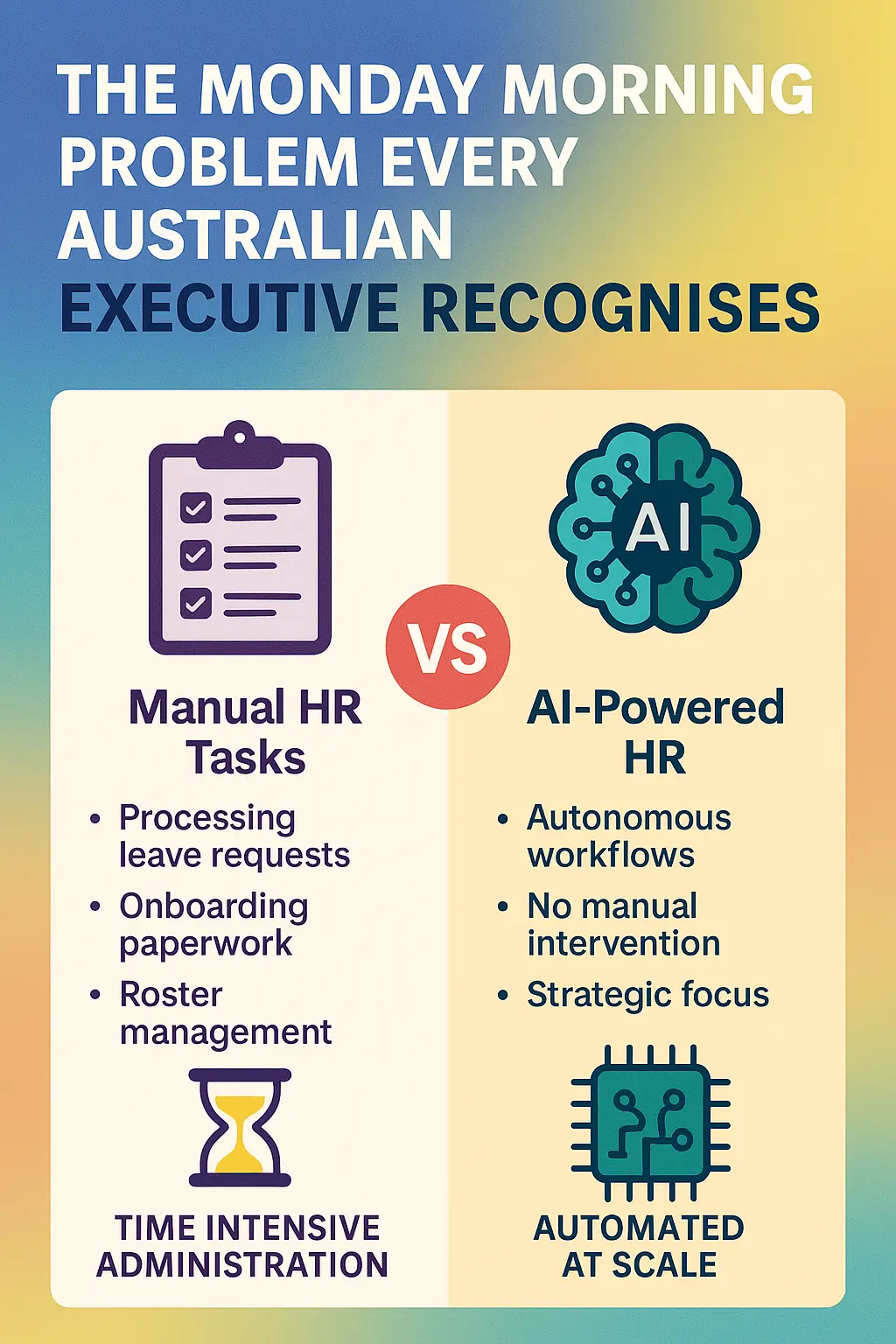
It is Monday morning in a mid-size Australian enterprise. The HR team has spent the weekend processing leave requests, chasing three new starters for onboarding documents, reconciling a roster discrepancy flagged by a line manager, and preparing a headcount report the CFO needs for a board pack.
None of that is strategy. None of it is the kind of people management work that retains your best talent, develops your emerging leaders, or builds the workforce capability your business needs to grow. It is administration — and the vast majority of it is entirely automatable.
Yet most Australian businesses are still doing it manually, with HR teams buried in operational tasks that consume the time and energy needed for genuine strategic people work.
This is the foundational cost of running HR without AI in 2026. And it is not just a productivity problem. It is a strategic liability.
"2026 marks a turning point. Rather than think of AI as a tool to increase individual productivity, we apply it to business processes themselves — redesigning how the company operates and building what we call Superagents to create scale and autonomy." — Josh Bersin, January 2026
The AI landscape has already produced one wave of tools — the generative AI assistants that draft job descriptions, summarise performance reviews, and answer HR policy questions. These tools are useful. They are also, in the broader context of what is now possible, the prologue.
The technology that is reshaping people management in Australian enterprises right now is Agentic AI: autonomous systems that do not assist with individual HR tasks, but manage entire HR processes independently — continuously, at scale, and without waiting to be asked.
Understanding the distinction between these two classes of AI is the most commercially important thing an Australian executive can do in 2026.
HR Without AI in 2026: What It Is Actually Costing Your Business
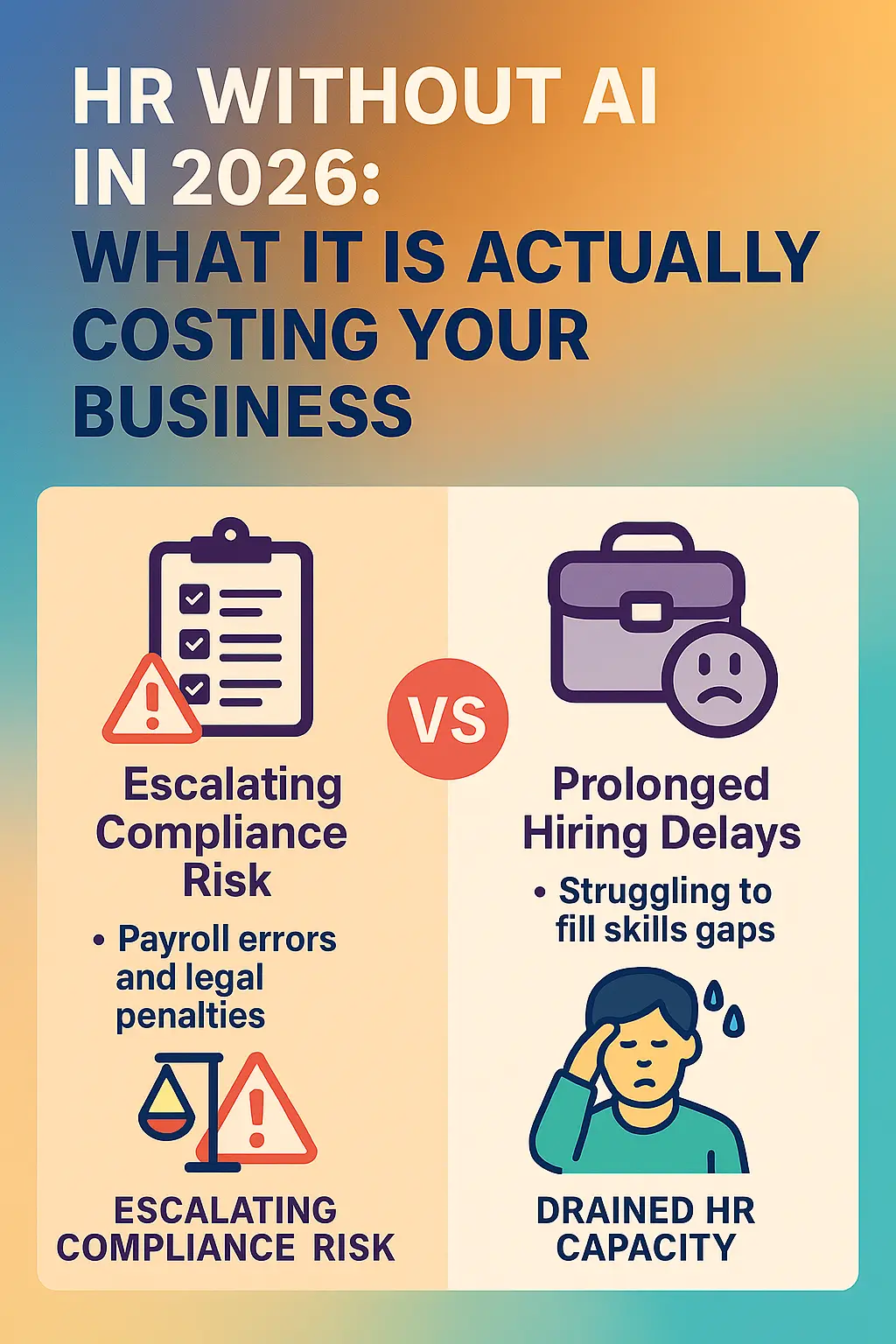
Before exploring the solution, it is worth being direct about the operational reality of HR without AI — because this cost rarely appears as a single line item. It accumulates quietly across hiring, compliance, retention, and manager effectiveness, compounding over time into something far more expensive than any software investment.
The Payroll and Compliance Exposure Is Escalating
Australia's employment compliance landscape in 2026 is among the most complex in the world for businesses to navigate — and it is getting more demanding, not less.
- The criminalisation of wage theft under the Closing Loopholes Act means underpayment now carries penalties of up to $7.8 million and potential director imprisonment of up to 10 years
- Payday Super takes effect from 1 July 2026, requiring superannuation guarantee contributions to be paid at the same time as wages — a fundamental change to payroll operations and cashflow planning for every Australian employer
- Updated Workplace Gender Equality Act (WGEA) rules from April 2026 require employers with more than 500 staff to set and report on specific gender equity targets across pay, representation, and flexible work
- Right to Disconnect legislation creates new obligations around after-hours communication policies that must be documented, communicated, and enforceable
- New rights for 'employee-like workers' from February 2025 have tightened compliance requirements for businesses using contractor and gig arrangements
⚠ Rippling's 2025 survey of 1,000 Australian workers found that 43% were deliberately or accidentally underpaid in the previous year — and 59% of payroll managers admitted to at least one payroll error, mostly due to siloed systems and manual data re-entry.
Organisations running HR without AI — relying on manual processes to manage Modern Award interpretation, roster compliance, and payroll accuracy — are not just inefficient. They are exposed. Every manual handover is a potential error. Every error in 2026 carries genuine legal consequences.
The Skills Shortage Is Structural, Not Cyclical
75% of Australian businesses are struggling more to find qualified local talent than they were a year ago (HRD Australia / HCAMag, 2026)
56% of Australian businesses missed a key business goal in the past 12 months due to a lack of talent (HCAMag, 2026)
57% of Australian HR leaders say skills shortages are already denting organisational productivity (AHRI / Rippling Australia, 2025)
According to the Australian HR Institute (AHRI), 33% of employers are now turning to overseas talent because the domestic workforce simply does not have the skills they need. Yet most organisations are still running recruitment processes that were designed for a different labour market: reactive, slow, and dependent on the capacity of individual HR staff.
In a tight talent market, the speed and precision of your hiring process is a direct competitive variable. Organisations using agentic AI to manage talent sourcing, screening, and engagement are moving three to four times faster than those doing it manually — and they are reaching the best candidates first.
The Invisible Cost: Management Capacity Is Exhausted
Perhaps the most underappreciated consequence of HR without AI is what it does to the people responsible for running it. AHRI research shows that 72% of HR professionals cannot disconnect from work, reporting feelings of being permanently on call. The resulting burnout leads to reactive decision-making — which compounds organisational risk.
This is not an HR team problem in isolation. It is an enterprise problem. When the people responsible for your most important asset — your workforce — are overwhelmed and operating reactively, the quality of every people decision in your business deteriorates.
Harrison Human Resources found that only 28% of Australian organisations invest meaningfully in leadership capability — while middle managers are simultaneously being asked to manage hybrid teams, navigate compliance changes, support wellbeing, and lead AI rollouts. The manager capacity crisis is real, and it is invisible until it breaks.
This is the full picture of HR without AI in 2026: not a single dramatic failure, but a compounding accumulation of compliance exposure, talent loss, administrative drain, and exhausted leadership — all entirely addressable with the right technology.
What Is Agentic AI — And Why Is It Categorically Different From Every AI Tool You Have Tried?
The promise and potential of AI in HR has been present in the market for years. What has changed in 2026 is not the promise. It is the architecture. Understanding this distinction is the foundation of every intelligent enterprise AI investment decision.
Generative AI vs. Agentic AI: The Distinction That Matters
Generative AI — the tools your teams are already using to draft documents, answer queries, and summarise reports — is a capable assistant. It responds to instructions. It completes one task per prompt. It requires a human to direct its activity at every stage.
Agentic AI operates on a fundamentally different architecture. It does not wait to be asked. It continuously monitors your enterprise data environment, identifies conditions that require action, plans a multi-step response, executes that response across multiple systems, and updates relevant stakeholders — all without human prompting.
|
GENERATIVE AI
|
AGENTIC AI
|
|
Responds when prompted
|
Initiates action autonomously
|
|
Completes one task per instruction
|
Manages complete multi-step workflows
|
|
Requires human direction at each step
|
Plans, decides, and executes independently
|
|
Accelerates individual tasks
|
Redesigns how entire processes operate
|
|
Example: Draft a job advertisement
|
Example: Detect an open role, source candidates, screen against skills criteria, schedule interviews, update HRIS, and notify all parties — automatically
|
|
Productivity tool
|
Capability transformation
|
The operational implication of this distinction for Australian business owners and executives is significant. Generative AI makes your HR team faster. Agentic AI changes what your HR team needs to do at all.
"Agentic AI is an inevitable next step for Australian organisations striving to reclaim HR from the backlog of routine tasks and reposition it as strategic. When agentic AI is deployed ethically, the result is more productivity and capacity returning to the business." — HR Leader Australia, December 2025
How Agentic AI Works in an HR Context
A true agentic HR system is built on four functional layers that work together continuously:
- Perception Layer — continuously ingests real-time data from your HRIS, payroll, project management, communication, and performance tools to maintain a live picture of your workforce
- Reasoning Layer — uses large language models and rules-based logic to analyse context, identify conditions requiring action, and plan appropriate multi-step responses
- Execution Layer — takes autonomous action across connected systems: updating records, sending communications, scheduling events, triggering approvals, and escalating to humans when policy requires it
- Governance Layer — logs every AI-driven action with full audit trail, applies human-in-the-loop gates for consequential decisions, and monitors outputs for bias and compliance
This architecture is what separates agentic AI from the configurable HR software features most platforms market as 'AI'. The vast majority of enterprise HRIS platforms offer Level 3 intelligence at best: they surface insights and make recommendations. Agentic AI executes.
93% of IT leaders plan to implement AI agents before the end of 2026, citing the need to mature from Generative AI to Agentic AI (Wowledge / McKinsey, 2026)
The Five AI Applications in People Management Delivering Real ROI for Australian Enterprises
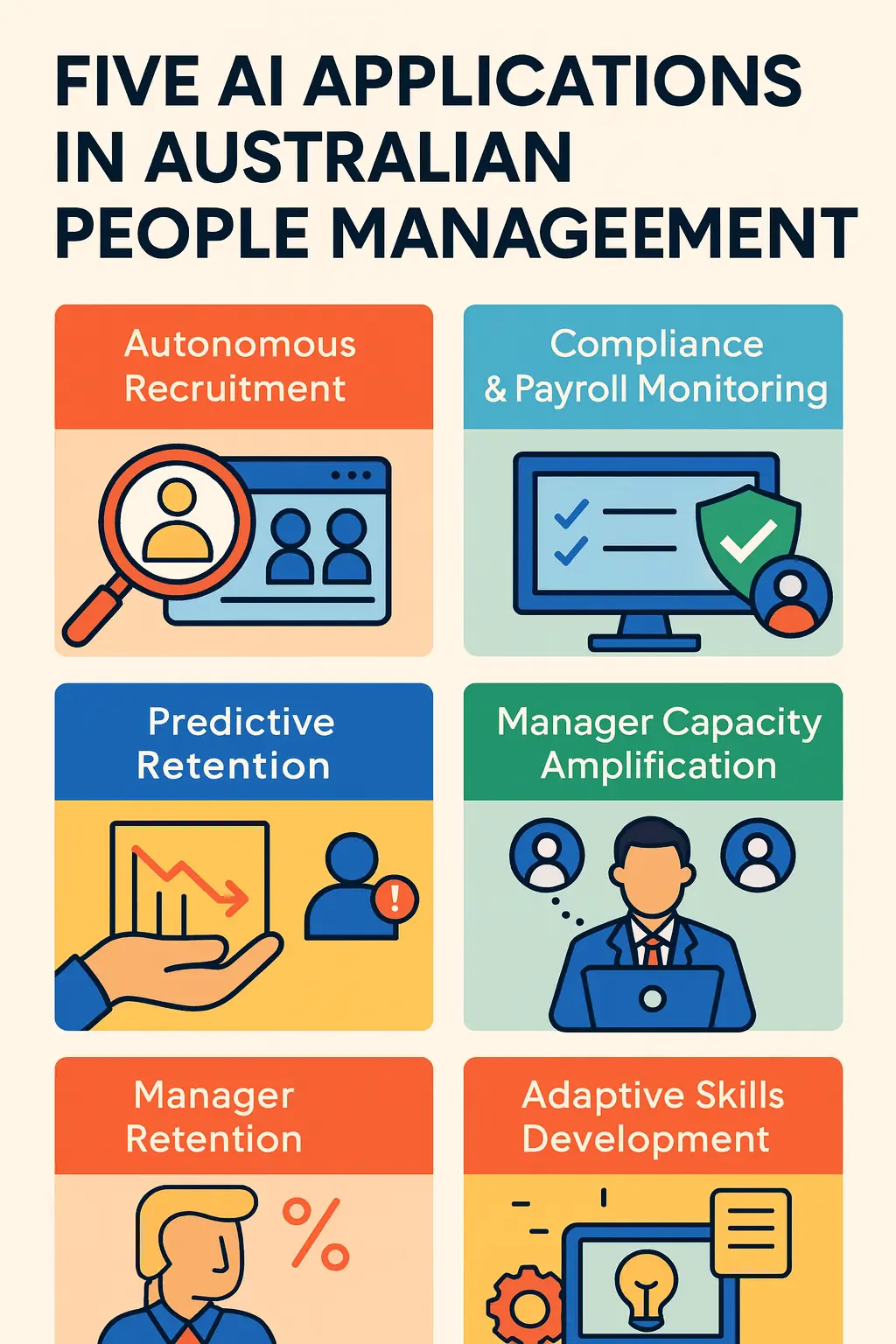
The following are the highest-impact agentic AI applications in people management for the Australian enterprise context in 2026. Each is grounded in specific Australian business conditions — not generic global use cases.
1. Autonomous Recruitment and Talent Acquisition
Agentic AI manages the complete recruitment pipeline without HR involvement at every handover point. From the moment a role is approved, the system creates the job brief from your skills framework, sources candidates across relevant channels, screens applications against defined criteria, coordinates interview scheduling, manages candidate communications, and updates your HRIS in real time.
The business case for Australian enterprises is direct. With 75% of businesses struggling more to find qualified local talent than a year ago, speed of engagement is a genuine competitive variable. Agentic systems move three to four times faster than manual processes — and the best candidates are claimed by the fastest movers.
70% reduction in time spent by hiring managers on talent sourcing when agentic AI manages the pipeline (PwC Australia, 2025)
2. Real-Time Compliance Monitoring and Payroll Governance
Given the scale of Australia's compliance obligations in 2026 — wage theft criminalisation, Payday Super, WGEA reporting, Modern Award complexity, Right to Disconnect — an autonomous compliance monitoring system has transitioned from innovation to risk management imperative.
An agentic compliance system continuously audits every payroll calculation, leave entitlement, award interpretation, and roster decision against current legislative requirements. It flags potential breaches the moment they are generated — not six months later during an audit. For businesses operating across multiple states with different employment conditions, this real-time monitoring capability is structurally impossible to replicate manually at any reasonable cost.
⚠ Under the Closing Loopholes Act, wage theft is now a criminal offence in Australia. Penalties reach $7.8 million per breach and expose directors to up to 10 years' imprisonment. Agentic compliance monitoring is no longer a productivity investment — it is a governance necessity.
3. Predictive Retention Intelligence
Employee turnover costs Australian businesses between 50% and 200% of the departing employee's annual salary in recruitment, onboarding, and lost productivity. Yet most organisations only discover a retention risk when the resignation letter arrives — weeks or months after the decision was made.
Agentic retention systems continuously analyse the behavioural, performance, sentiment, and workload signals that precede a departure. When an employee's signal pattern crosses a risk threshold — typically 60 to 90 days before they act — the system automatically triggers manager coaching prompts, development conversation recommendations, or review flags. The intervention happens before the decision, not after.
For Australian enterprises navigating a structural skills shortage, this application transforms retention from a reactive crisis response into a proactive operational discipline.
4. Manager Capacity Amplification
The Great Flattening of Australian enterprise structures has left the average middle manager responsible for more direct reports, more compliance obligations, more wellbeing duties, and more strategic accountability than at any point in the last two decades. The result is overwhelm — and overwhelmed managers make worse people decisions, which drives the disengagement and turnover that further compounds the problem.
Agentic AI acts as an intelligent management co-pilot. Before a 1:1 meeting, the system briefs the manager with the specific performance data, engagement signals, and development context relevant to that conversation. Between meetings, it flags team members showing early risk indicators. It handles the administrative layer of people management autonomously — so the manager's time is spent entirely on the human interactions that only they can deliver.
McKinsey's 2026 HR research confirms that agentic AI enables HR to shift from reactive service delivery — employee asks, HR responds — to proactive orchestration of the entire employee lifecycle. The shift requires systems that can act, not just advise.
5. Intelligent Skills Development and Learning Delivery
With 65% of Australian employers experiencing skills shortages in digital transformation and advanced technology areas (AHRI, 2025), the ability to develop the capability you cannot hire has become a strategic priority. Scheduled training programs — the traditional HR response — are demonstrably ineffective: learning research consistently shows that structured training delivered outside the flow of work is retained by fewer than 20% of participants.
Agentic learning systems deploy personalised micro-learning content directly in the context where it is needed. When a skills gap is identified through performance data, a new capability requirement is generated by a project, or a compliance obligation changes, the system automatically assigns targeted content to the relevant employees — and follows up to confirm completion. No HR scheduling, no mandatory group sessions, no administration.
49% of ANZ L&D leaders say their employees lack the skills needed to deliver current business strategy (Rippling / AHRI Australia, 2025)
Why Off-the-Shelf Enterprise Application Software Cannot Deliver Agentic HR for Australian Enterprises
The most common question from Australian executives who reach this point is: why not simply purchase an enterprise HRIS platform with AI features included? The major vendors — SAP, Oracle, Workday — are all marketing AI capabilities. Why build when you can buy?
The answer lies in three structural realities that generic enterprise application software cannot address.
Reality 1 — Australia's Regulatory Environment Requires Australian-First Engineering
Generic enterprise application software is developed and maintained primarily for North American and European regulatory environments. Australia's Modern Award system, Fair Work Act complexity, WGEA reporting obligations, Payday Super requirements, and the Right to Disconnect framework are either absent from these platforms entirely, or configured as afterthoughts by local implementation partners.
When your enterprise application development is done by a team that deeply understands Australian compliance obligations, that understanding is built into the system's architecture — not retrofitted. Every AI-driven decision the system makes is governed by Australian regulatory logic from the ground up.
The alternative is a perpetual compliance lag: your platform catches up to Australian legislative changes on the vendor's product roadmap timeline, not on the legislative calendar. In a regulatory environment where non-compliance carries criminal penalties, that lag is unacceptable.
Reality 2 — Your AI Is Only as Good as the Data It Knows
The AI applications in people management that deliver meaningful ROI require models trained on your data — your workforce patterns, your retention history, your skills framework, your industry context, your specific performance correlations. A model trained on aggregated data from thousands of global enterprises has no knowledge of what drives performance or predicts turnover in your specific organisational context.
Custom enterprise software development means your AI system learns from your environment. The predictive retention model that identifies flight risk in your business is calibrated to your workforce — not to a statistical average across companies you are nothing like.
Reality 3 — Your Technology Stack Demands Custom Integration
Large Australian enterprises operate complex, layered technology environments: ERP systems, financial platforms, project management tools, communication applications, and legacy databases that have accumulated through years of growth, acquisition, and transformation. Generic enterprise application software integrates with a standardised list of other major platforms. Custom enterprise application development integrates with your actual environment.
The result of a custom integration approach is a unified people data platform that sees the full operational picture — including the signals that live in systems a generic HRIS cannot connect to. This is precisely the 'context problem' that separates effective agentic AI from surface-level automation.
Gartner predicts that over 40% of agentic AI projects will be cancelled by the end of 2027 due to inadequate governance, escalating costs, and unclear business value. The organisations that fail will disproportionately be those that deployed generic AI on generic data — and discovered that context-free AI delivers context-free results.
The Total Cost of Ownership Calculation Most Executives Get Wrong
The default comparison is simple: SaaS subscription cost versus custom build cost. The former appears lower. But this comparison consistently omits several factors that reverse the conclusion when applied honestly:
- SaaS licence costs compound annually and escalate with user count — custom systems carry a fixed build cost and predictable maintenance
- The cost of poor AI model accuracy — wrong retention interventions, compliance failures, flawed hiring decisions — is rarely attributed to the platform, but should be
- The productivity cost of forcing your organisation's workflows to conform to a vendor's default process design is real and continuous
- Custom enterprise application development creates proprietary capability with genuine balance-sheet value — a strategic asset, not a recurring operating expense
The Governance Guardrails Every Australian Executive Must Demand
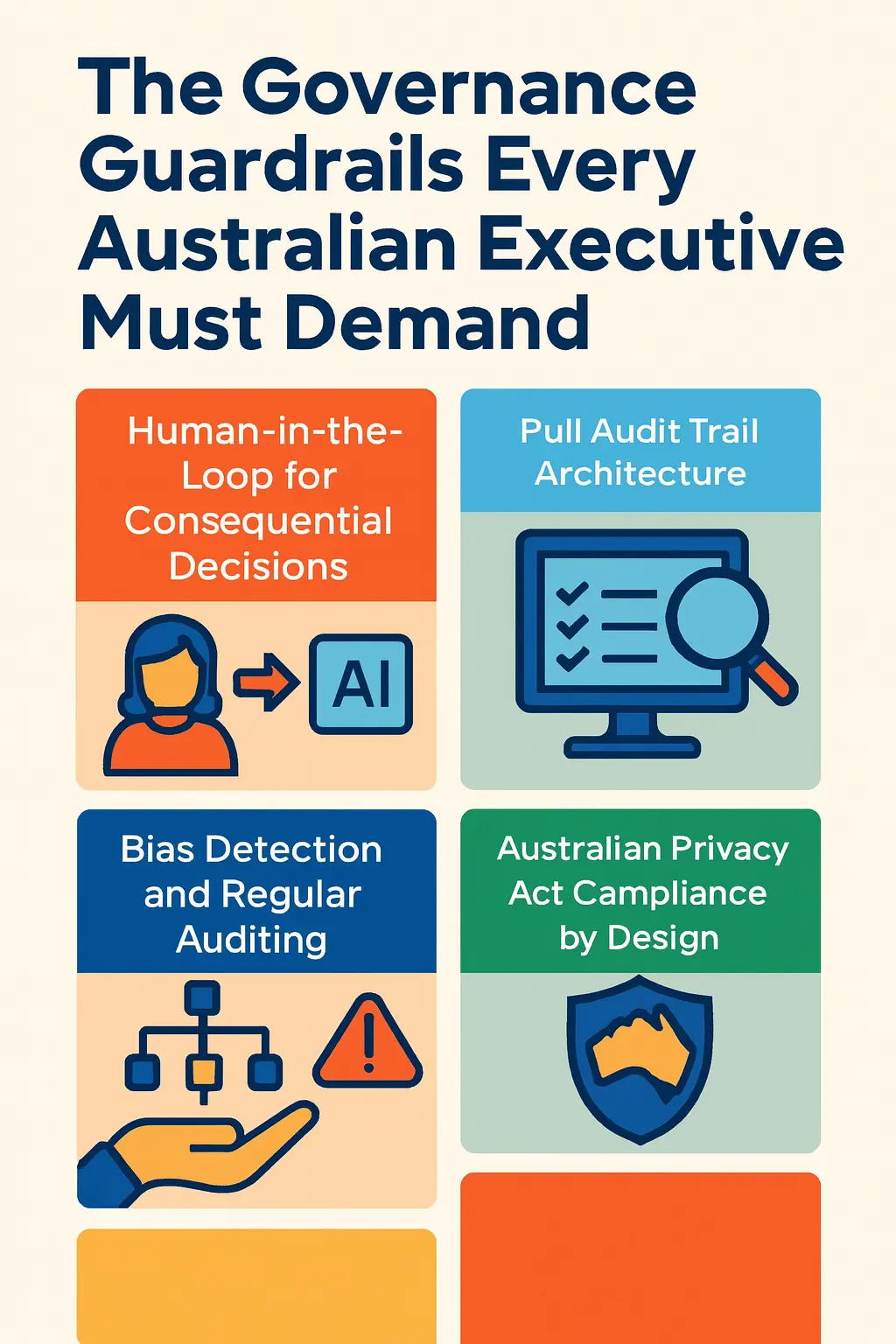
Deploying AI applications in people management responsibly is not only an ethical obligation — it is a commercial and legal one. Australian regulators are moving toward mandatory oversight requirements for AI systems that make or influence consequential employment decisions, and the reputational cost of AI governance failure in an HR context is significant.
Every agentic HR system built by C9 is architected with the following non-negotiable governance principles:
Human-in-the-Loop for Consequential Decisions
Agentic AI manages workflows and surfaces recommendations. Humans retain authority over promotion, termination, performance assessment, and remuneration decisions. The system is designed to amplify human judgement — not replace it where it matters most.
Full Audit Trail Architecture
Every AI-driven action is logged, explainable, and reviewable. This satisfies internal governance requirements, responds to employee transparency expectations, and positions the enterprise for the mandatory AI oversight obligations that are emerging in Australian regulation.
Bias Detection and Regular Auditing
Models are regularly tested for demographic disparities in outputs across gender, age, ethnicity, and disability dimensions. Bias that cannot be detected cannot be corrected — and in an Australian employment law context, algorithmic bias in hiring or performance decisions creates direct legal exposure.
Australian Privacy Act Compliance by Design
Sensitive employee data — health information, union membership, political opinion — is processed under Australia's privacy framework, with data sovereignty maintained within your specified environment. Offshore SaaS AI tools that process sensitive Australian employee data present privacy obligations that many enterprises have not fully assessed.
Transparent Communication with Employees
Employees are informed of how AI systems influence decisions affecting their employment. Transparency builds the organisational trust that supports adoption — and is rapidly becoming an expectation rather than a differentiator.
The research from the Australian HR Institute is clear on this point: Australian HR practitioners recognise AI's potential to boost productivity, yet many organisations lack the training, governance, and strategic frameworks to deploy it well. The organisations that get governance right will be the ones whose AI investments deliver — and whose deployments survive regulatory scrutiny.
The Inflection Point Has Arrived — What Australian Executives Do in the Next 90 Days Will Define Their People Advantage
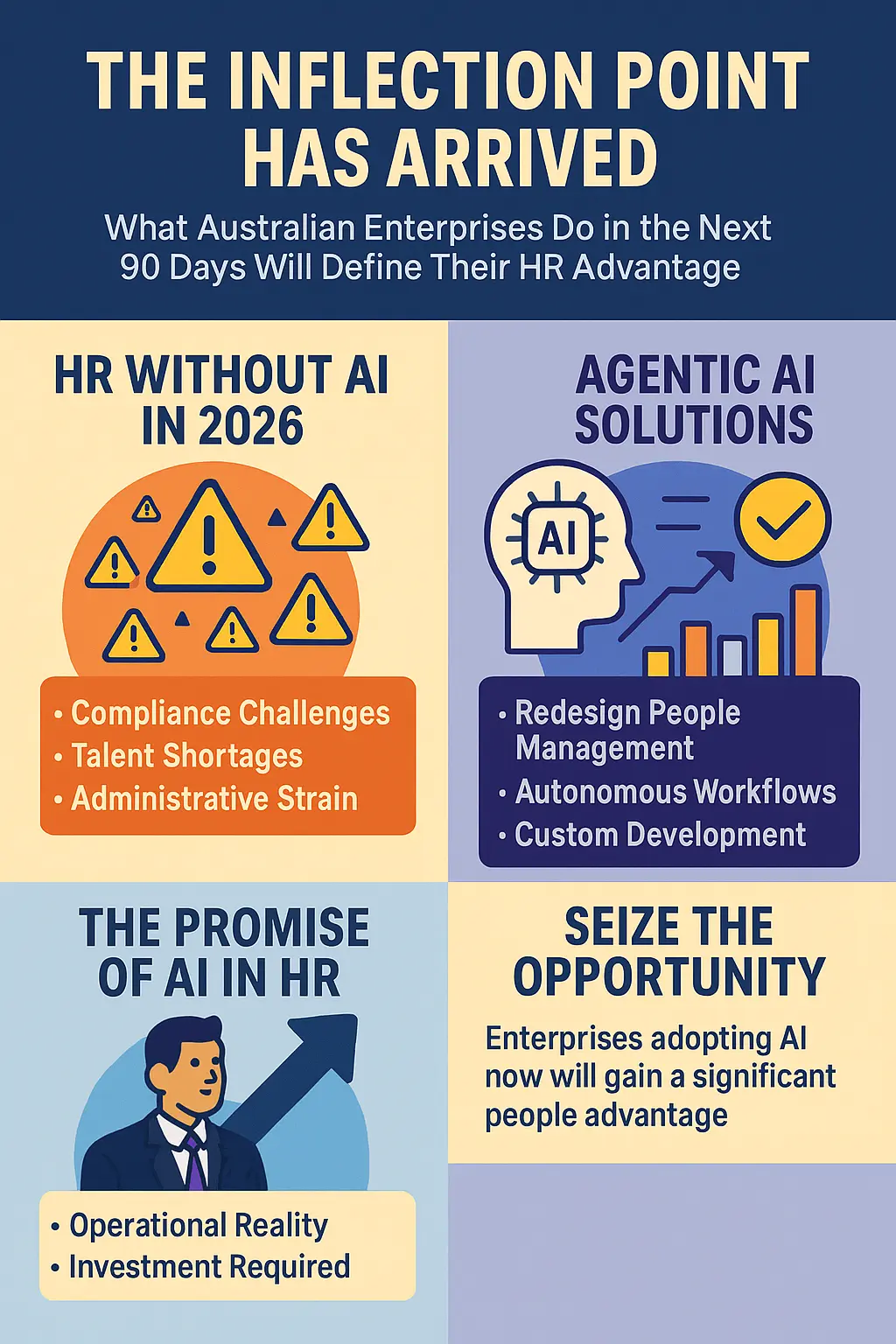
The promise and potential of AI in HR is no longer a future-state ambition. It is an operational reality in Australian enterprises right now — and the gap between those who have moved and those who have not is widening every quarter.
HR without AI in 2026 is not a neutral position. It is a shrinking one. The compliance landscape is tightening. The talent market is structurally challenged. The administrative burden on HR teams is at breaking point. The management capacity required to lead hybrid, distributed workforces is being consumed by tasks that should not require human time at all.
Agentic AI resolves these problems at a scale and speed that no manual improvement program, no additional headcount, and no generic SaaS platform can match. But it resolves them fully only when built specifically for your environment — your data, your compliance obligations, your enterprise architecture, your workforce.
This is the work C9 does. Not implementing someone else's platform. Building the system that fits your enterprise — and delivers the people management capability your competitors will spend years trying to replicate.
In short:
● HR without AI in 2026 is a compounding liability — in compliance exposure, talent loss, administrative overhead, and management exhaustion.
● Agentic AI does not upgrade HR software — it redesigns how people management works, autonomously managing entire workflows without human prompting.
● The AI applications in people management with the highest ROI — autonomous recruitment, real-time compliance monitoring, predictive retention, and manager intelligence — require custom enterprise application development to deliver fully in the Australian context.
● The promise and potential of AI in HR is achievable for Australian enterprises that invest in systems built for their environment — not generic platforms that approximate it.
● C9 designs and builds these systems for Australian enterprises. The conversation starts at c9.com.au.
What's next?
The enterprises building agentic HR capability now will have a people management advantage their competitors cannot quickly close.
Visit c9.com.au to start a no-obligation discovery conversation with C9 — Australia's leading custom software, apps, integration and database developer.
Build the HR System Your Competitors Cannot Replicate
C9 is Australia's leading custom software, apps, integration and database developer. We design and build bespoke enterprise application software for Australian organisations that need AI-powered people management systems built for their specific environment — not configured from a global template.
Whether you are evaluating your first enterprise AI investment, replacing a generic HRIS platform, or scaling a people management capability that has outgrown its current architecture, C9's enterprise software and integration specialists will define, design, and deliver the right solution.
Research, Data, and Citations
Note: All sources cited in this article are verifiable, publicly available, and current as of Q1 2026.
- Josh Bersin, The Great Reinvention of Human Resources Has Begun, joshbersin.com, January 2026
- PwC Australia, AI Agents and the Future of HR Productivity, 2025 — referenced in valuex2.com Agentic AI in HR Systems Guide 2026
- ADP, HR in 2026 Will Be Defined by the Impact of AI Innovation on Work, ADP Media Centre, November 2025
- ADP, Key HR Technology Trends for 2026 and How to Plan, ADP SPARK Blog, December 2025
- McKinsey & Company, HR's Transformative Role in an Agentic Future, November 2025
- HR Leader Australia (ServiceNow), Autonomous HR: The Next Era with Agentic AI, December 2025
- Harrison Human Resources, The Top 10 HR Trends Shaping Australian Workplaces in 2025 to 2026, January 2026
- Harrison Human Resources, HR and Workplace Relations Trends for 2026: What Employers Need to Know
- Australian HR Institute (AHRI), Quarterly Australian Work Outlook — March 2025, July 2025
- Rippling, 8 Workforce Trends Driving Aussie HR in 2025 (citing AHRI data), 2025
- HRD Australia / HCAMag, Australia's Workforce Is Global Now: Are Employers Ready?, February 2026
- Wowledge, 2026 HR Trends: How to Bridge the Gap in Models and Future Needs, January 2026
- SmartHCM Australia, Top 7 HR Challenges in Australia Every Business Must Tackle, October 2025
- Mercer, Heads Up HR — 2025 Is the Year of Agentic AI, 2025
- Ampcome, Agentic AI in HR: The Full-Context Guide for 2026, March 2026
- CPC Strategic Performance, Australia's HR Crisis: Stress, Burnout and Workforce Pressure, December 2025
- Worktrybe, The Growing Importance of Employee Development in Australia (citing AHRI Q2 2024 data), March 2025
- Gartner HR Symposium, Sydney 2025 — Agentic AI governance and HR transformation projections
- Australian Bureau of Statistics (ABS), Labour Market Statistics
- Safe Work Australia, Work Health and Safety Statistics
- Workplace Gender Equality Agency (WGEA), Gender Pay Gap Reporting 2025–26
- Fair Work Commission, Right to Disconnect
Explore Related Insights on AI Solutions
Why Australian Businesses Are Losing Thousands Weekly to Missed Calls — And How Voice AI Fixes It
How Agentic AI Chatbots Transform Lead Engagement: Stop Losing Leads
How Generative AI Is Revolutionising Custom BI Dashboards in Australia
Generative AI & Integration Strategy for Businesses Mobile Application
Why Australian Business Leaders Must Build an AI-Ready Workforce in 2026
AI Agents Are the New Form of Labour
Agentic AI in Customer Service: The Future of Autonomous Support Workflows
Agentic AI in HR: How Autonomous AI Systems Are Reshaping People Management in Australian Enterprises
Agentic AI in Australian Banking: How Custom AI Applications Are Replacing Manual Back-Office Work in 2026
The True Cost of AI Software Implementation in Australia: A Transparent Guide for 2026
What Is Bespoke AI? Why Custom AI Solutions Australia Beat Off-the-Shelf Tools in 2026
From Concept to AI Agent: Building Custom Agentic AI Solutions for Enterprise Workflows
RAG Systems: Stop AI Hallucinations | C9 Australia
AI-Orchestrated Integration Workflows: Transforming Australian Businesses Through Intelligent Connectivity
AI Race: Who's Leading the Pack?
Digital Darwinism: Why Multimodal AI Is the Next Extinction Event for Businesses
Left in the Digital Dust: The Looming Crisis for Businesses Resisting AI and LLMs
The Next Competitive Edge: Why Hybrid AI is the Game Changer for Australian Businesses
How to Calculate the ROI of AI Agents: A Guide for AU SMEs | C9
How Productivity Agents Are Revolutionising Australian Workplaces in 2026 and Beyond
Revolutionising Recruitment: How AI is Reshaping Entry-Level Developer Roles and Essential Skills for Australian Businesses in 2026
Is Your Business AI-Ready? 5 Critical Signs You're Falling Behind (And How to Catch Up)
Beyond the Hype: 5 Verifiable Strategies for Deploying Agentic AI Sales Workflows to Solve the Talent Shortage
AI Transparency Notice:
This article was produced with the assistance of artificial intelligence tools, including content drafting, visual asset creation, and audio generation. All content has been reviewed and approved by C9 prior to publication.