|
|
EXECUTIVE SUMMARY
In short:
- Manual back-office operations are consuming 50–60% of Australian financial businesses' operational capacity — at a time when AI-enabled competitors are processing the same work in a fraction of the time.
- Australia's Big Four banks — ANZ, Commonwealth Bank, Westpac, and Macquarie — have already deployed Agentic AI at scale. The competitive gap is widening every quarter for mid-tier institutions, fintechs, credit unions, and regional lenders that have not yet acted.
- Agentic AI is categorically different from the robotic process automation (RPA) tools of the previous decade. It reasons, plans, adapts, and executes multi-step tasks autonomously — delivering documented time savings of between 30% and 90% on targeted back-office processes.
- Off-the-shelf AI software cannot meet Australia's specific regulatory requirements (APRA, ASIC, AUSTRAC), integrate with local payment infrastructure (NPP, BPAY), or reflect your institution's unique risk and compliance obligations. Bespoke AI application development is the only path to compliant, scalable automation.
- C9 — Australia's leading custom software, apps, integration and database developer, with application developers across Brisbane, Sydney, and Melbourne — builds these systems for Australian financial businesses right now.
What's next?
The businesses that deploy bespoke Agentic AI applications in 2026 will establish operational advantages that compound for years. This article gives Australian business owners and executives the knowledge, context, and clear next step to move from informed to ready.
|
Agentic AI in Australian Banking: How Custom AI Applications Are Replacing Manual Back-Office Work in 2026
Every morning, across financial businesses in Brisbane, Sydney, Melbourne, and every regional centre in between, skilled professionals arrive at work and spend their first hours doing the same things they did yesterday. Reconciling transactions manually. Re-entering data between disconnected systems. Running compliance checks that follow an identical sequence, without variation, every single time. Preparing reports that draw from the same sources, in the same format, on the same schedule.
This is not because your people are inefficient. It is because the work itself was designed for a world that no longer exists — a world before artificial intelligence could reason, plan, and execute complex, multi-step tasks without human supervision.
That world has been replaced. Agentic AI — a new class of artificial intelligence that operates with goal-directed autonomy — is now being deployed at scale inside Australian banking and financial services. The question facing every business owner and executive in 2026 is no longer whether it works. ANZ, Commonwealth Bank, Westpac, and Macquarie have already answered that question. The question now is whether your business will close the capability gap before it becomes a permanent structural disadvantage.
This article explains what Agentic AI is, which back-office processes it replaces most effectively, why bespoke application development outperforms off-the-shelf software in the Australian context, and how C9's application developers build these systems for Australian financial businesses. By the end, you will have a clear, evidence-based picture of where to start — and why starting soon matters.
|
70%
of banks globally are using or piloting Agentic AI
MIT / EY Banking AI Survey, 2025
|
$3.50
returned per $1 invested in Agentic AI (average)
Accenture / IDC, commissioned by Microsoft, 2025
|
40%
productivity gains in banking operations using AI agents
McKinsey Global Banking Report, 2025
|
The Hidden Cost Draining Australian Financial Businesses in 2026
Most Australian financial executives know their back-office operations are not as efficient as they could be. What they frequently underestimate is the structural scale of that inefficiency — and the compounding cost it imposes across four distinct dimensions.
McKinsey's Global Banking Report (2025) estimates that between 50% and 60% of all full-time equivalent roles in banking operations are tied to work that is repetitive, rule-based, and procedurally predictable. That is not a minor inefficiency sitting at the edges of your business. It sits at the centre — inside your compliance team, your settlement desk, your onboarding workflows, your month-end reporting cycles.
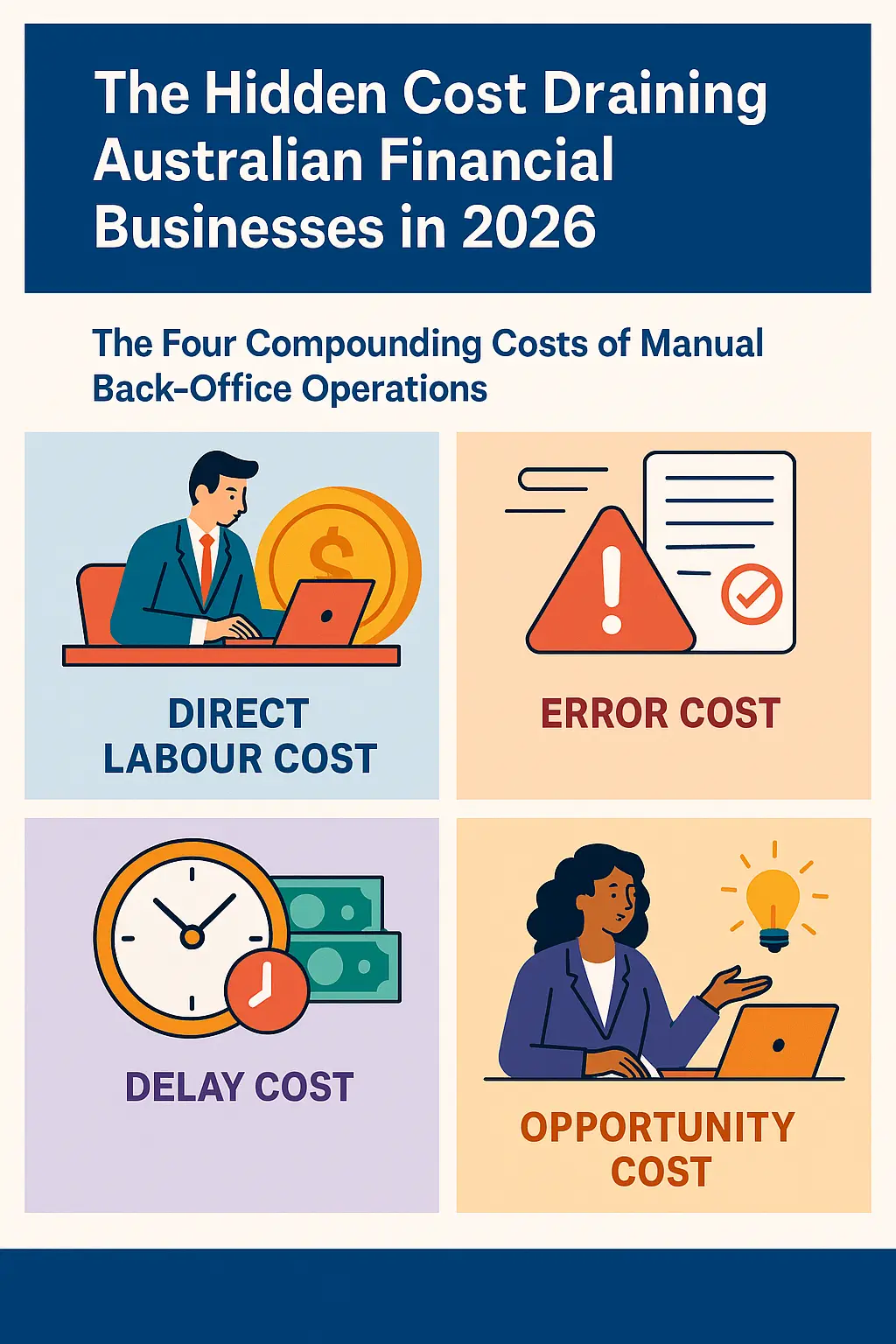
The Four Compounding Costs of Manual Back-Office Operations
- Direct labour cost: Your most expensive resource — skilled financial professionals — spending their working hours on tasks that require no original judgement, generate no client value, and create no competitive advantage.
- Error cost: Manual data handling introduces errors at statistically predictable rates. In a regulated Australian financial services environment, those errors carry real consequences: compliance breaches, remediation costs, audit findings, and reputational exposure under ASIC oversight.
- Delay cost: Manual processes operate at human speed. The NPP's New Payments Platform now settles transactions in real time across Australia. Back-office cycles measured in days or weeks are a structural constraint on your ability to compete in this environment.
- Opportunity cost: Every hour your experienced finance and operations professionals spend on routine processing is an hour not spent on client relationships, risk judgement, strategic analysis, and the higher-order work that creates real business value and cannot be automated.
|
Key Insight: The problem is not that Australian financial businesses have too many people. The problem is that highly capable people are spending too much of their time on work that should not require a person at all. Agentic AI does not displace your team — it returns to them the hours that have been consumed by operational routine.
|
PwC's 2025 Financial Services AI Report documents institutions achieving up to 90% time savings on targeted back-office processes following AI deployment. KPMG's analysis records average operational cost reductions of 35% among financial firms that have deployed AI agents at scale. Wolters Kluwer's 2026 report on AI in finance teams confirms that organisations deploying Agentic AI have achieved processing speed increases of between 30% and 50% across core operational workflows. These are not projections. They are documented outcomes from institutions operating within the same regulatory environment as your business.
Australia's Major Banks Have Already Made Their Move — Here Is What They Deployed
If you have been waiting for evidence that Agentic AI is production-ready in the Australian financial context, the evidence is already operating at scale — inside the institutions your customers compare you to every day.
ANZ Bank
ANZ became the first bank in the Asia-Pacific region to deploy Salesforce Agentforce across its entire business banking division. The system consolidated 20 previously disconnected data platforms into a single AI-powered interface available to every business banker and frontline team member. The measurable outcome: bankers recovered the equivalent of one full working month per year — previously lost to navigating fragmented systems — and could redirect that time to client-facing advisory work.
Commonwealth Bank of Australia
Commonwealth Bank deployed AI-powered voice and text agents that proactively engage suspected scammers in real time — intercepting fraud at the point of attack rather than detecting it after the fact. Simultaneously, its generative AI layer now personalises the mobile banking interface at an individual customer level, serving product and feature recommendations based on each customer's unique transaction behaviour and life circumstances. The bank's AI investment has spanned both fraud prevention and customer experience — two of the highest-value application areas in retail banking.
Westpac
Westpac's AI agents are deployed inside its engineering function, where they have transformed the time required for complex code migration tasks. A process that previously required six days of specialist developer time now takes one hour — a 97% reduction. Westpac has established a deep AI delivery partnership with Accenture, specifically to scale this AI capability across its operational and technology functions at an institutional level.
Macquarie Bank
Macquarie Bank deployed an AI-powered assistant that provides instant, personalised responses across its digital banking channels, handling the full breadth of routine client enquiries and redirecting the volume of contacts that previously required human staff. The result is both a higher standard of client response speed and a material reduction in operational load on frontline teams.
|
The Strategic Reality: McKinsey identifies 'Pilot Purgatory' as the defining risk for Australian mid-tier institutions in 2026 — organisations that trial AI in narrow, isolated use cases without connecting them to core operational workflows. These organisations will fall permanently behind those that deploy AI as a structural operational transformation. According to Neurons Lab and Deloitte (2025), 84% of organisations now believe that AI success depends on partnering with specialist implementation developers — not on procuring software independently.
|
For mid-tier banks, building societies, credit unions, regional lenders, and fintechs operating from Brisbane to Perth — the strategic question is no longer whether Agentic AI is proven. It is whether your organisation will move before the gap between your capabilities and the major banks' becomes visible to your customers.
What Is Agentic AI? A Plain-English Explanation for Australian Business Leaders
Many Australian executives carry scepticism about AI automation — and it is earned. Robotic Process Automation (RPA) was positioned as transformational a decade ago. It delivered narrow, brittle results and often created as much maintenance complexity as it saved. Understanding why Agentic AI is fundamentally different is essential before any investment decision is made.
RPA versus Agentic AI: The Critical Distinction
|
Feature
|
RPA
|
|
Instruction type
|
Fixed step-by-step script
|
|
Exception handling
|
Stops and escalates to human
|
|
Adapts to new data
|
No
|
|
Self-directed planning
|
No
|
|
True business autonomy
|
Low
|
Consider a concrete operational example. An Agentic AI system assigned to end-of-day settlement reconciliation does not follow a script. It ingests the day's transaction data from your systems, applies the appropriate matching logic for each transaction type, identifies discrepancies exceeding the defined threshold, classifies each exception by type and likely cause, drafts the exception report in your standard internal format, and routes it to the correct team member — all without being instructed how to do any individual step. The goal is the instruction. The execution is autonomous.
|
Plain-English Definition: An AI agent is software that pursues a defined business outcome by planning its own approach, using available data and tools, and adapting when conditions change — without requiring human approval at each step. The difference from RPA is the same as the difference between giving someone a process checklist and giving them the expertise to solve the problem.
|
This shift from task automation to outcome automation is what makes Agentic AI genuinely transformational for back-office operations. It is not incremental process improvement. It is a structural redesign of how work gets done.
Five Back-Office Processes Australian Financial Businesses Are Automating Right Now
Not every back-office process is equally suited to Agentic AI as a first deployment. The highest-value starting points share three characteristics: they are high-frequency, they follow predictable logic with manageable exception rates, and they carry material cost or compliance risk when performed manually. The following five processes meet all three criteria — and are being actively automated by Australian financial institutions in 2026.
|
Back-Office Process
|
Documented Saving
|
Australian Context
|
|
Trade Settlement & Reconciliation
|
Up to 90% time saved (PwC, 2025)
|
NPP same-day settlement obligations create volume pressure that manual reconciliation cannot absorb — AI processes in real time
|
|
AUSTRAC Compliance Reporting
|
35% average cost reduction (KPMG, 2025)
|
AML/CTF legislation requires real-time transaction monitoring and structured reporting — AI delivers both at scale with full audit trails
|
|
Customer Onboarding & KYC Verification
|
50% faster; 30–40% cost reduction (KPMG, 2025)
|
ASIC AML rules require rigorous, documented KYC — AI delivers the speed of digital onboarding with the rigour of manual compliance review
|
|
Loan Assessment & Credit Processing
|
Decisions in seconds (vs. days)
|
BNPL regulatory changes in 2025–26 are forcing lenders across Australia to rebuild their credit infrastructure urgently
|
|
Financial Reporting & Board Packs
|
Monthly close: days to hours
|
ASX-listed financial firms and APRA-regulated entities face non-negotiable disclosure deadlines — AI reduces both preparation time and error risk
|
|
$8
returned per $1 invested by top 5% of Agentic AI deployments. The average is $3.50. The performance gap is determined entirely by implementation quality — not by the AI model.
Source: Accenture / IDC, commissioned by Microsoft, 2025
|
The critical qualifier in every case above: these outcomes come from purpose-built AI applications — not from generic software subscriptions or consumer AI tools pointed at enterprise workflows. The institutions achieving 90% time savings and $8 returns are those that commissioned bespoke systems engineered to their data, their workflows, their compliance obligations, and their integration landscape.
Why Bespoke AI Applications Consistently Outperform Off-the-Shelf Tools in Australia
The global market for AI software is dominated by products built for North American and European financial institutions. This is not a criticism — it is a structural reality that carries direct, material consequences for Australian businesses that rely on these tools without modification.
Off-the-shelf AI platforms are trained on transaction patterns, risk models, and regulatory frameworks that do not map to the Australian financial environment. They cannot natively integrate with Australia's New Payments Platform (NPP), BPAY, or OSKO settlement systems. They were not designed around AUSTRAC's reporting formats, APRA's CPS 230 operational resilience standard, the National Consumer Credit Protection Act, or ASIC's guidance on explainability in AI-assisted lending decisions. Adapting them to the Australian regulatory context requires the same development investment as building purpose-built — without the control, flexibility, competitive differentiation, or intellectual property that a custom build delivers.
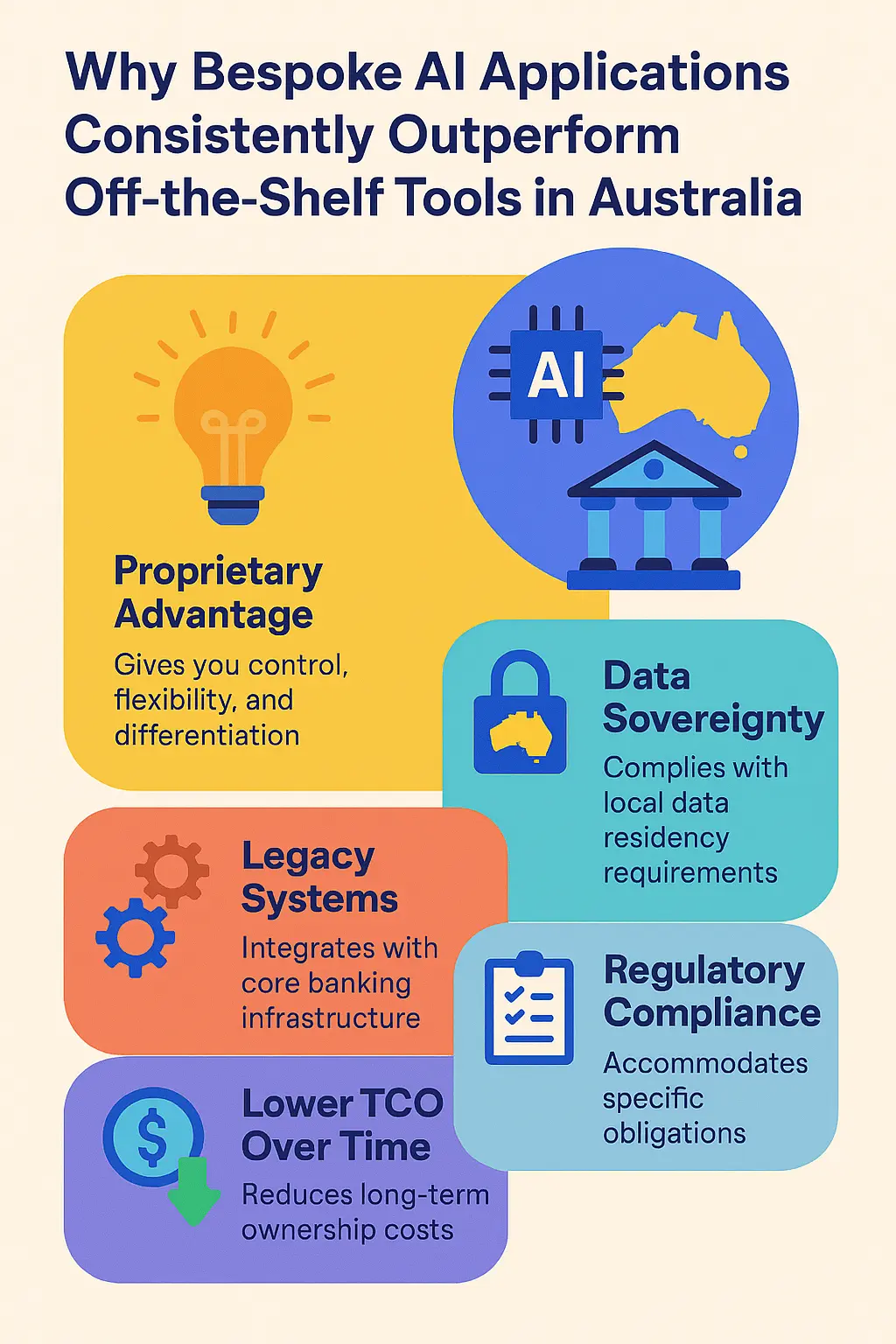
Five Structural Advantages of Bespoke AI Application Development for Australian Financial Businesses
- Your competitive advantage is proprietary. A bespoke AI application is an asset your business owns. A SaaS subscription is a commodity your competitors can purchase tomorrow and deploy at an identical configuration. The ability to differentiate your operational capability is only possible through custom development.
- Your data sovereignty is preserved. The Australian Privacy Act 1988, APRA's data governance expectations, and specific licence conditions often prevent financial businesses from processing core operational data on offshore cloud infrastructure. Custom applications can be built and hosted on Australian-based servers, fully compliant with local data residency requirements.
- Your legacy systems are accommodated. Regional banks, credit unions, and mid-tier lenders commonly operate core banking systems that are 15 to 20 years old. Integrating modern AI into this environment requires custom connector and integration development that no generic AI product provides. C9's application developers and integration specialists have extensive experience with Australia's core banking platforms and can build the bridge.
- Your regulatory obligations are specific to your institution. Your APRA licence conditions, your AML/CTF programme design, your credit policy parameters, and your ASIC-regulated disclosure obligations are unique. An AI application that is architected to reflect them is categorically safer, more auditable, and more defensible than one applying a global financial services template.
- Your total cost of ownership is lower over time. SaaS licensing scales with users and transaction volume. A bespoke application, built once and maintained on a continuous improvement cycle, delivers compounding ROI without escalating licence costs as your business grows. Independent research confirms that off-the-shelf AI spending fell from 38% to 32% of enterprise AI budgets between 2024 and 2025 as organisations recognised this equation.
|
Industry Data Point: 84% of organisations in financial services now believe that AI success depends on working with specialist implementation partners rather than procuring software independently. The era of self-serve AI deployment in regulated industries is over. The new model is expert-built, compliance-engineered, and purpose-designed. — Neurons Lab / Deloitte, 2025.
|
How C9 Builds Agentic AI Applications for Australian Financial Businesses
C9 is Australia's leading custom software, apps, integration and database developer. Our application development teams are based across Brisbane, Sydney, and Melbourne — and our financial services experience spans banking, fintech, insurance, wealth management, lending, and credit. We do not recommend AI strategies. We design, build, integrate, and deploy the applications.
Our approach to Agentic AI application development is governed by a single principle: the AI must serve your business, not the other way around. That requires a rigorous process that begins well before a line of code is written.
C9's Agentic AI Development Process
|
Phase 1: Discovery & Workflow Mapping
|
We document the target process with precision — inputs, decision logic, compliance checkpoints, exception handling rules, integration dependencies, and human escalation triggers. This phase determines the entire architecture. Done correctly, it prevents the expensive revisions that characterise poorly scoped AI projects.
|
|
Phase 2: Architecture Design
|
We design the AI agent's decision model, data flows, system integration points, and governance controls. The architecture is presented to your team for review and sign-off before development begins. Nothing is built until you understand exactly what it will do.
|
|
Phase 3: Build & Shadow Testing
|
The application is developed and run in shadow mode alongside your existing manual process. We compare AI outputs to human outputs, calibrate accuracy, identify edge cases, and refine the decision logic before any production workflow is handed to the AI.
|
|
Phase 4: Parallel Deployment
|
The AI runs alongside the existing manual process for a defined validation period. Your team reviews outputs, builds operational confidence, and identifies any remaining gaps. This stage eliminates the risk of undetected errors entering production.
|
|
Phase 5: Production Go-Live
|
Full deployment with a human oversight dashboard, configurable alert thresholds, complete audit trail generation, and documented escalation workflows. APRA-compliant process documentation is produced as a standard deliverable.
|
|
Phase 6: Continuous Improvement
|
Monthly performance review, model retraining on updated operational data, and structured expansion to adjacent processes as your AI capability matures and your team's confidence grows.
|
Our application developers have built production-grade systems across Australia's full technology stack — from cloud-native microservices architectures to legacy core banking integrations that other developers decline to take on. Whether you are a mid-tier lender in Brisbane looking to automate your first process, a Sydney-based fintech scaling an existing AI programme, or a Melbourne-headquartered financial services group embarking on an enterprise-wide transformation — C9 builds the system your business actually needs.
Governance and Compliance: Building AI That Your Regulators Can Audit
The most common reason Australian financial executives delay AI investment is not cost — it is governance uncertainty. How do you deploy autonomous AI inside an APRA-regulated, ASIC-supervised environment and remain confident in your compliance position? The answer requires building governance into the architecture from day one — not treating it as a feature to be added later.
The Compliance Landscape for AI in Australian Financial Services
- APRA CPS 230 (Operational Resilience): Requires regulated entities to demonstrate material control over all core operational processes, including AI-operated ones. Audit trail generation, human oversight documentation, and escalation workflows are not optional — they are prudential obligations.
- ASIC on AI in Lending: ASIC's guidance on responsible lending and AI-assisted credit decisions requires that adverse determinations be explainable to affected customers in plain language. Black-box AI models are not compliant with this obligation. Bespoke AI applications are designed with explainability as a core output, not an afterthought.
- AUSTRAC AML/CTF Requirements: Real-time transaction monitoring and structured reporting obligations under the Anti-Money Laundering and Counter-Terrorism Financing Act require AI systems that can produce complete, timestamped records of every decision made — including the data inputs, the logic applied, and the outcome generated.
- Privacy Act 1988 (and proposed 2026 reforms): The proposed 2026 reforms to Australia's Privacy Act introduce significantly stronger requirements around automated decision-making affecting individuals. Financial businesses using AI to make decisions about customers will need documented frameworks for human review and appeal. C9 designs this into every application.
|
Industry Warning: Infosys' 2025 AI research found that 95% of organisations using AI agents had experienced at least one AI-related incident — and that only 2% had adequate governance guardrails in place at the time. 77% of those incidents resulted in measurable financial loss. The risk of inadequate AI governance in Australian financial services is not theoretical. It is documented, quantifiable, and preventable.
|
C9 treats governance architecture as the foundation of every AI application we build — not a compliance feature added at deployment. Every system includes human oversight dashboards, complete audit trail generation, configurable alert thresholds, documented escalation logic, and explainability outputs suitable for ASIC review. These are standard deliverables, not optional additions.
Frequently Asked Questions: Agentic AI in Australian Banking
|
Q: What is Agentic AI in banking?
Agentic AI in banking refers to artificial intelligence systems that can pursue defined business outcomes autonomously — planning their own approach, selecting and using available tools and data sources, handling exceptions without human instruction at each step, and completing multi-step operational tasks end-to-end. Unlike RPA, which follows a fixed script, Agentic AI adapts to new conditions and reasons from goals rather than rules.
|
|
Q: Is Agentic AI being used in Australian banks right now?
Yes. ANZ, Commonwealth Bank, Westpac, and Macquarie Bank have all deployed Agentic AI in production environments as of 2025–2026. ANZ consolidated 20 data systems for its business banking division, Westpac reduced 6-day engineering tasks to 1 hour, and Commonwealth Bank deployed real-time fraud interception AI. Mid-tier institutions, fintechs, and credit unions are now the active growth market for AI application development in Australia.
|
|
Q: Why does my Australian financial business need a custom AI application rather than an off-the-shelf product?
Off-the-shelf AI products are built primarily for North American and European regulatory environments. They cannot natively integrate with Australia's NPP payment rails, BPAY, or OSKO systems, and they were not designed for APRA, ASIC, or AUSTRAC compliance requirements. Custom AI applications are built to your specific workflows, your data architecture, your legacy systems, and your regulatory obligations — delivering compliant, differentiated automation that generic tools cannot match.
|
|
Q: How long does it take to build a custom AI application with C9?
A well-scoped, single-process Agentic AI application typically takes 10–12 weeks from discovery to production deployment using C9's phased development process. This includes workflow mapping, architecture design, build, shadow testing, parallel deployment, and go-live. More complex multi-process implementations are scoped individually. C9's application developers work across Brisbane, Sydney, and Melbourne.
|
|
Q: What back-office processes should Australian financial businesses automate first?
The highest-value starting points are processes that are high-frequency, rule-based with manageable exceptions, and carry compliance or cost risk when performed manually. The five most commonly automated first processes in Australian financial services are: trade settlement and reconciliation, AUSTRAC compliance reporting, customer onboarding and KYC verification, loan assessment processing, and financial reporting and board pack generation.
|
Conclusion: The Cost of Waiting Is No Longer Zero
Agentic AI is not arriving in Australian banking. It is already operating at scale inside the institutions that serve your clients, compete for your customers, and set the service expectations your market now takes for granted.
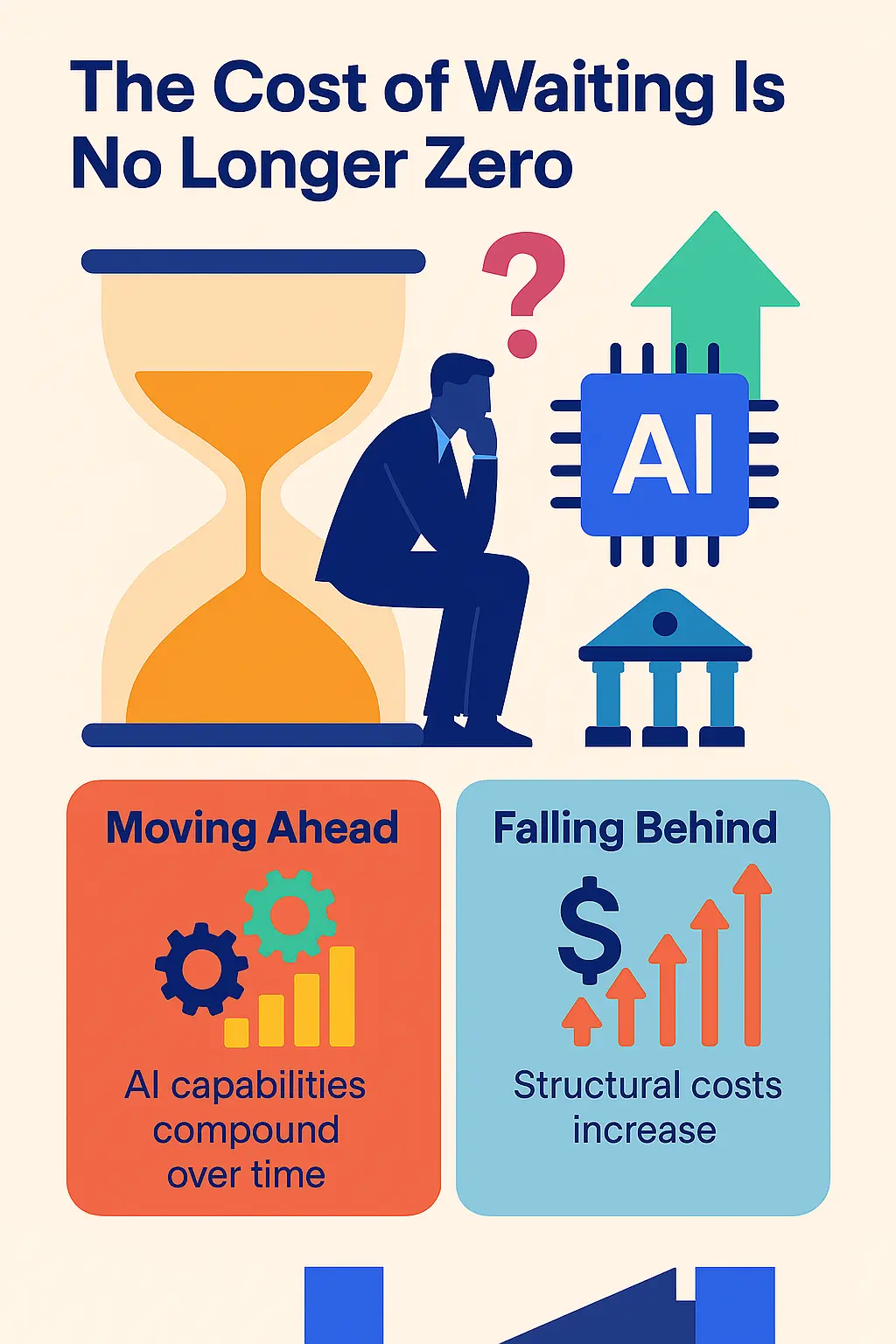
The businesses that move decisively in 2026 will build AI-enabled operational capabilities that compound over time — faster processing speeds, lower error rates, stronger compliance postures, reduced operational cost, and frontline staff capacity redirected from routine administration to genuine value creation. Those capabilities, once embedded, are difficult to replicate quickly.
The businesses that wait will absorb a growing structural cost — in labour inefficiency, compliance exposure, customer experience deterioration, and the accelerating price of playing catch-up — while competitors extend their advantages with every passing quarter.
The correct starting point is not a large-scale transformation programme. It is a single, well-scoped process — the highest-value back-office workflow in your business — delivered as a production-ready AI application with proper governance, proper integration, and a clear architecture for future expansion.
That is precisely the conversation C9 is built to have with you.
|
Ready to Automate Your Back Office with Agentic AI?
C9 is Australia's leading custom software, app, and integration developer. Our application developers across Brisbane, Sydney, and Melbourne build bespoke AI applications engineered specifically to your workflows, your systems, and your Australian compliance requirements.
Book a free discovery session — and leave with a clear, prioritised roadmap for your first high-value AI automation.
www.c9.com.au
|
References & Sources
All statistics, research findings, and institutional case studies cited in this article are drawn from the following primary and secondary sources. C9 recommends readers consult original sources to verify current applicability to their specific context.
Academic & Industry Research
[2] McKinsey & Company — Global Banking Report 2025: Charting New Horizons (2025)
[3] McKinsey & Company — The State of AI in 2025 (2025)
[7] Wolters Kluwer — AI in Finance Teams: Adoption and Impact Report (2026)
[8] Neurons Lab / Deloitte — AI Implementation Partners Research 2025 (2025)
[9] Capgemini — World Cloud Report: Financial Services 2026 (2026)
[11] Barclays Private Bank / Everest Group — Agentic AI in Financial Services: The Autonomy Shift (2025)
[12] Forrester Research — Consumer AI Advisory Adoption Forecast 2026 (2026)
Australian Regulatory Sources
AUSTRAC — AML/CTF Program Requirements and Reporting Obligations
Attorney-General's Department — Privacy Act Review — Proposed 2026 Reforms
Reserve Bank of Australia — New Payments Platform (NPP) — Real-Time Settlement Overview
Australian Bank Deployments
|
Disclaimer: All external links and URLs listed in the references section are provided for research and verification purposes. C9 does not control or endorse the content of third-party websites. Statistical data cited reflects published research available at time of writing (March 2026) and may be subject to revision by original publishers. Australian regulatory references reflect current legislative and prudential requirements; readers should seek independent legal and compliance advice for their specific circumstances.
|
|
About C9: C9 (c9.com.au) is Australia's leading custom software, apps, integration and database developer. Our application developers work across Brisbane, Sydney, and Melbourne, delivering bespoke AI applications, custom software platforms, database systems, and enterprise integrations for Australian financial services businesses, enterprises, and government organisations. C9 does not offer off-the-shelf products — we build what your business actually needs.
|
Explore Related Insights on AI Solutions
Why Australian Businesses Are Losing Thousands Weekly to Missed Calls — And How Voice AI Fixes It
How Agentic AI Chatbots Transform Lead Engagement: Stop Losing Leads
How Generative AI Is Revolutionising Custom BI Dashboards in Australia
Generative AI & Integration Strategy for Businesses Mobile Application
Why Australian Business Leaders Must Build an AI-Ready Workforce in 2026
AI Agents Are the New Form of Labour
Agentic AI in Customer Service: The Future of Autonomous Support Workflows
Agentic AI in HR: How Autonomous AI Systems Are Reshaping People Management in Australian Enterprises
Agentic AI in Australian Banking: How Custom AI Applications Are Replacing Manual Back-Office Work in 2026
The True Cost of AI Software Implementation in Australia: A Transparent Guide for 2026
What Is Bespoke AI? Why Custom AI Solutions Australia Beat Off-the-Shelf Tools in 2026
From Concept to AI Agent: Building Custom Agentic AI Solutions for Enterprise Workflows
RAG Systems: Stop AI Hallucinations | C9 Australia
AI-Orchestrated Integration Workflows: Transforming Australian Businesses Through Intelligent Connectivity
AI Race: Who's Leading the Pack?
Digital Darwinism: Why Multimodal AI Is the Next Extinction Event for Businesses
Left in the Digital Dust: The Looming Crisis for Businesses Resisting AI and LLMs
The Next Competitive Edge: Why Hybrid AI is the Game Changer for Australian Businesses
How to Calculate the ROI of AI Agents: A Guide for AU SMEs | C9
How Productivity Agents Are Revolutionising Australian Workplaces in 2026 and Beyond
Revolutionising Recruitment: How AI is Reshaping Entry-Level Developer Roles and Essential Skills for Australian Businesses in 2026
Is Your Business AI-Ready? 5 Critical Signs You're Falling Behind (And How to Catch Up)
Beyond the Hype: 5 Verifiable Strategies for Deploying Agentic AI Sales Workflows to Solve the Talent Shortage
AI Transparency Notice:
This article was produced with the assistance of artificial intelligence tools, including content drafting, visual asset creation, and audio generation. All content has been reviewed and approved by C9 prior to publication.