|
In short:
A seismic shift is underway in how Australian businesses operate. AI agents — autonomous systems powered by large language models and connected to your business tools via custom API integrations — are not a pilot programme or a future scenario. They are a production-grade operational reality transforming how competitive enterprises in Australia run their day-to-day workflows right now.
- AI agents own entire business processes end-to-end — they are not task accelerators, they are process replacements.
- 119% growth in AI agent creation was recorded among first-mover Australian companies in just the first half of 2025 alone.
- Generative AI could add between $2.6 trillion and $4.4 trillion annually to the global economy — and Australian businesses that act now will capture a disproportionate share.
- From 10 December 2026, Australian businesses face new legal obligations under the Privacy Act 1988 (Cth) requiring disclosure of automated decision-making — making governance-first AI deployment not just strategic but legally necessary.
- An expert API developer in Sydney, Melbourne, or Brisbane is the technical backbone that transforms AI agent strategy into production-grade competitive advantage.
What's next?
The organisations that define the next decade of Australian business will not be those with the most AI tools — they will be those with the most thoughtfully integrated, governance-ready AI agents. This article shows you exactly how to become one of them.
|
AI Agents Are the New Form of Labour
Imagine your most capable team member. Now remove every human constraint: no sleep, no sick days, no resignation letters, no onboarding delays, no performance variability between Monday morning and Friday afternoon. Now give that person the ability to work across ten conversations simultaneously, process a thousand data records in under a second, and maintain exactly the same quality on the millionth task as on the first.
That is not a futuristic thought experiment. That is an AI agent — and it is available to every Australian business owner and executive right now.
The question is no longer whether AI agents are ready for your business. The question is whether your business is ready for AI agents.
|
The Defining Moment for Australian Business
In 2023, enterprises experimented with generative AI. In 2024, they deployed copilots. In 2025, they scaled automation. In 2026, the most competitive Australian businesses are deploying AI agents — autonomous systems that do not just assist your workforce, but own entire business processes end-to-end. The labour model is changing. The only question is which side of that change your organisation will be on.
|
|
PART 1 — THE PROBLEM: A LABOUR MODEL UNDER PRESSURE
|
The Hidden Labour Crisis Draining Australian Business Performance
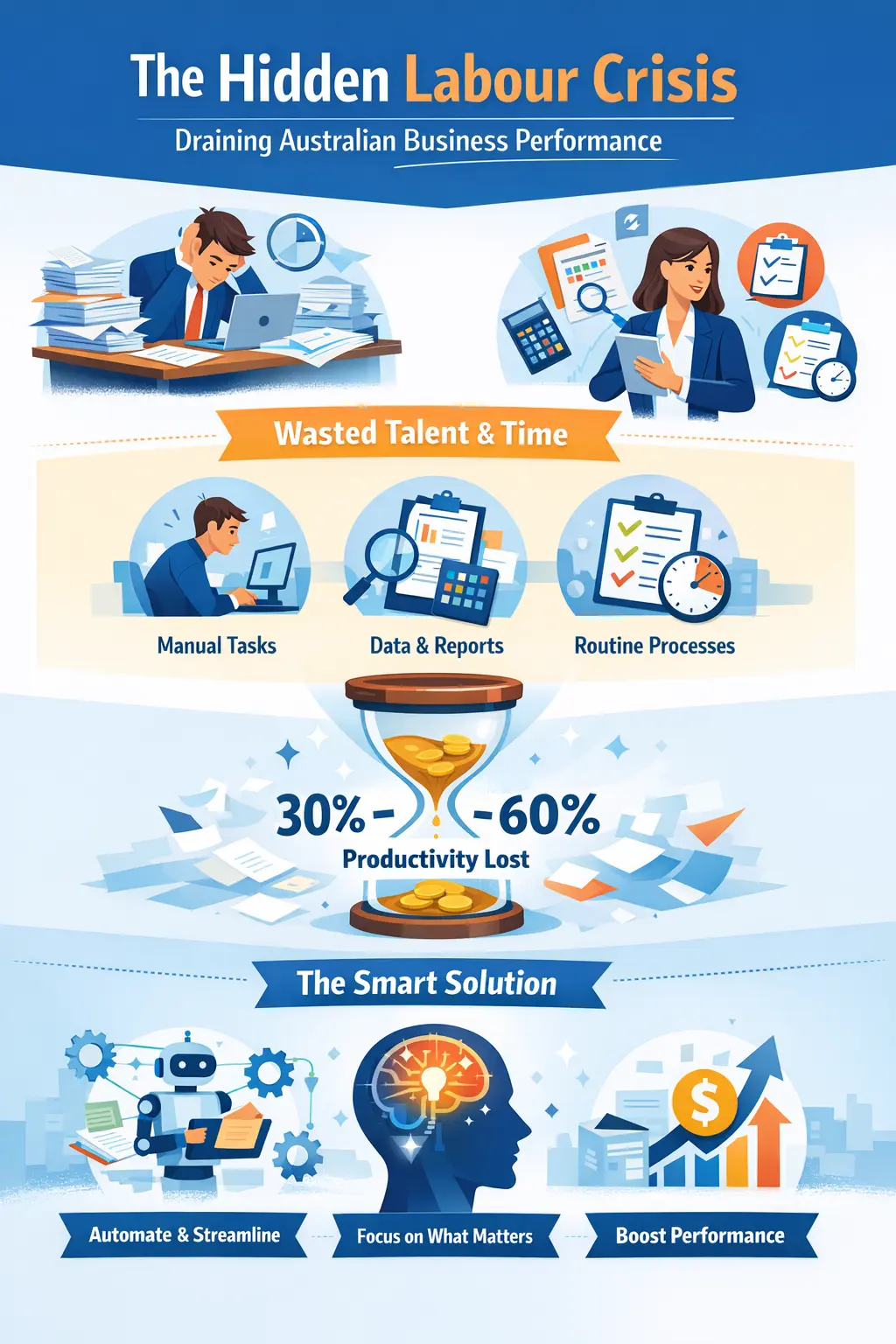
Let us name the problem that most Australian business owners and executives know intuitively but rarely articulate directly.
Your business is paying skilled, expensive people to do work that does not require their skill. Data entry. Report compilation. Customer triage. Invoice processing. Compliance monitoring. Follow-up sequences. These are not tasks that require strategic thinking, creative judgment, or human empathy. Yet they consume between 30 and 60 per cent of your team's productive hours, according to McKinsey's workforce analysis across 47 countries.
The result is a structural misallocation of your most valuable resource: human intelligence. And in 2026, with wage costs rising and skilled labour in short supply, that misallocation is not just inefficient — it is a competitive liability.
|
30–60%
of employee time is spent on work that AI agents could handle at higher speed and lower cost
McKinsey Global Institute
|
119%
growth in AI agent creation among first-mover Australian companies in just the first half of 2025
Salesforce Agentic Enterprise Index, October 2025
|
The traditional response to this problem has been to hire more people, introduce new software tools, or run efficiency workshops. In an era of AI agents, each of those responses addresses a symptom rather than the underlying cause.
The underlying cause is architectural: your business processes were designed around human constraints — limited working hours, finite attention, sequential task handling — and those constraints no longer have to apply.
|
The Core Strategic Misunderstanding
Most Australian businesses treat AI as something that helps their people work faster. The organisations pulling ahead in 2026 treat AI as something that makes certain categories of human work unnecessary. That distinction — from acceleration to elimination — is the architectural shift that drives transformational competitive advantage.
|
|
PART 2 — THE STAKES: WHAT INACTION ACTUALLY COSTS
|
The Compounding Cost of Delayed AI Agent Adoption in Australia
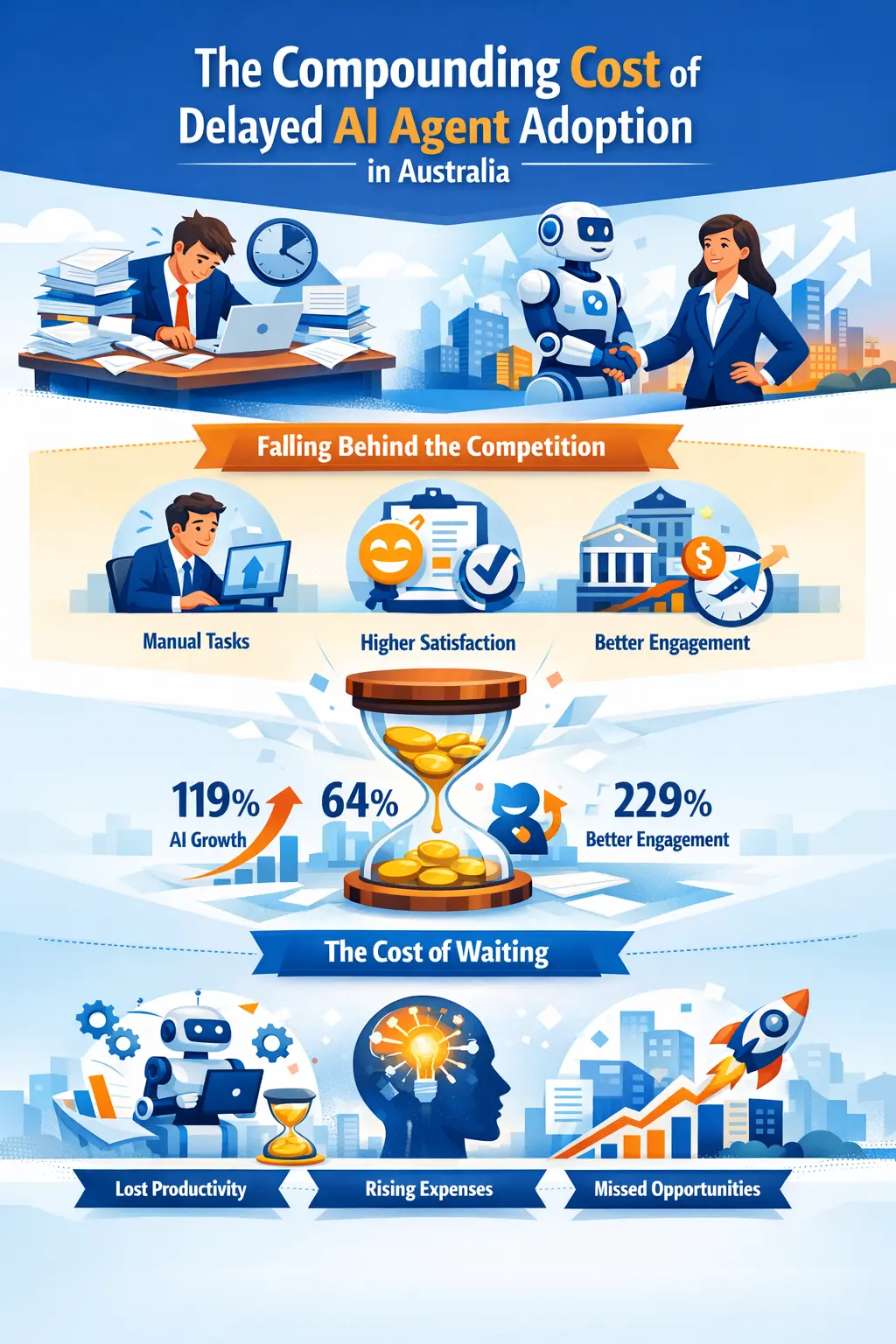
Inaction is not neutral. Every quarter an Australian business delays a structured AI agent deployment strategy is a quarter its competitors — some of them AI-native businesses that have never operated any other way — compound their productivity, cost, and speed advantages.
Consider the scale of what is already underway. AI agent creation among leading Australian enterprises surged by 119 per cent in the first half of 2025 alone. Australian consumers who regularly interact with AI agents report 64 per cent higher customer satisfaction — compared to a global average of 46 per cent. In the financial services sector, Australian customers using AI agents are 229 per cent more likely to report enhanced interactions.
|
64%
of Australian consumers who regularly interact with AI agents report higher customer satisfaction — compared to a 46% global average
Salesforce Agentic Enterprise Index, October 2025
|
These are not marginal improvements. They represent a fundamental shift in the experience your customers receive — and a corresponding expectation that will quickly become the baseline rather than the differentiator.
The Three Compounding Consequences of Delay
1. The Productivity Gap Compounds. Gartner projects that by the end of 2026, 40 per cent of enterprise software applications will include task-specific AI agents — up from less than 5 per cent in 2025. Every application your competitors integrate with AI agent capabilities creates a new layer of operational efficiency that compounds over time. The gap does not reset when you eventually deploy — it is structural.
2. The Compliance Window Is Closing. From 10 December 2026, the Privacy and Other Legislation Amendment Act 2024 (Cth) introduces new transparency obligations requiring Australian businesses to disclose automated decision-making processes in their privacy policies. Businesses deploying AI agents after that date without established governance frameworks face both regulatory risk and the far more expensive process of retrofitting compliance onto live systems.
3. Talent Expectations Are Shifting. LinkedIn's Jobs on the Rise 2026 report identifies AI-specific roles as the fastest-growing in Australia. All federal government agencies are now required to appoint Chief AI Officers. AI literacy has become the single most in-demand skill cited by Australian employers. The organisations that build AI capability now will attract the talent that accelerates their advantage further — while laggards struggle to find people willing to join a business that has not invested in the technology its workforce expects.
|
⚠ Regulatory Alert — Effective 10 December 2026
The Privacy and Other Legislation Amendment Act 2024 (Cth) requires Australian businesses to disclose in their privacy policies the types of personal information used in automated decision-making and the kinds of decisions made by computer programs. Penalties for significant privacy breaches by large organisations can reach up to $50 million under the expanded OAIC enforcement framework. Every AI agent deployment must be designed with these obligations in mind from the outset.
|
|
PART 3 — RETHINKING WHAT IS POSSIBLE: UNDERSTANDING AI AGENTS
|
What AI Agents Actually Are — and Why the Distinction Matters Enormously
Before Australian business owners and executives can develop an effective AI agent strategy, they need to understand what distinguishes an AI agent from the AI tools most organisations are already using — and why that distinction has profound implications for business design.
|
Traditional AI Tools
|
AI Agents
|
|
Assists a person with a specific task
|
Owns an entire business process end-to-end
|
|
Operates within one application
|
Coordinates across CRM, ERP, email, databases simultaneously
|
|
Requires human initiation for every action
|
Acts autonomously based on triggers and conditions
|
|
Executes predefined scripts and rules
|
Reasons about context and adapts when conditions change
|
|
Delivers outputs for human review
|
Executes and escalates only when human judgment adds value
|
|
Provides incremental productivity gains
|
Creates structural changes to how work gets done
|
The most important line in that comparison is the last one. AI tools make your existing processes faster. AI agents make some of your existing processes unnecessary — because they can own those processes entirely, with appropriate human oversight designed into the architecture rather than bolted on as an afterthought.
A Real-World Example for Australian Business Owners
Consider a typical sales follow-up process in an Australian professional services firm. A lead comes in. A team member checks the CRM for prior contact history. They qualify the lead manually against criteria they carry in their head. They draft a personalised email. They log the activity. They set a manual reminder for follow-up.
With a bespoke AI agent integration built by an expert API developer, the same process looks like this: the lead is received, the AI agent immediately retrieves full CRM history, scores the lead against defined qualification criteria, generates a personalised follow-up in the firm's brand voice, sends it via the email platform, logs all CRM activity, and adds a follow-up task to the sales queue — all within thirty seconds, for every single lead, around the clock.
The senior salesperson's time is now reserved entirely for high-value relationship conversations, complex negotiations, and strategic account development — the work that genuinely requires human intelligence and connection.
|
The Labour Shift in a Single Sentence
AI agents do not take your team's jobs — they take your team's most draining, least valuable work, and free your best people to do the work that actually drives revenue, client relationships, and competitive differentiation.
|
|
PART 4 — GENERATIVE AI & AI AGENT ORGANISATIONAL STRATEGY FOR LEADERS
|
Building Your AI Agent Organisational Strategy: Five Principles for Australian Leaders
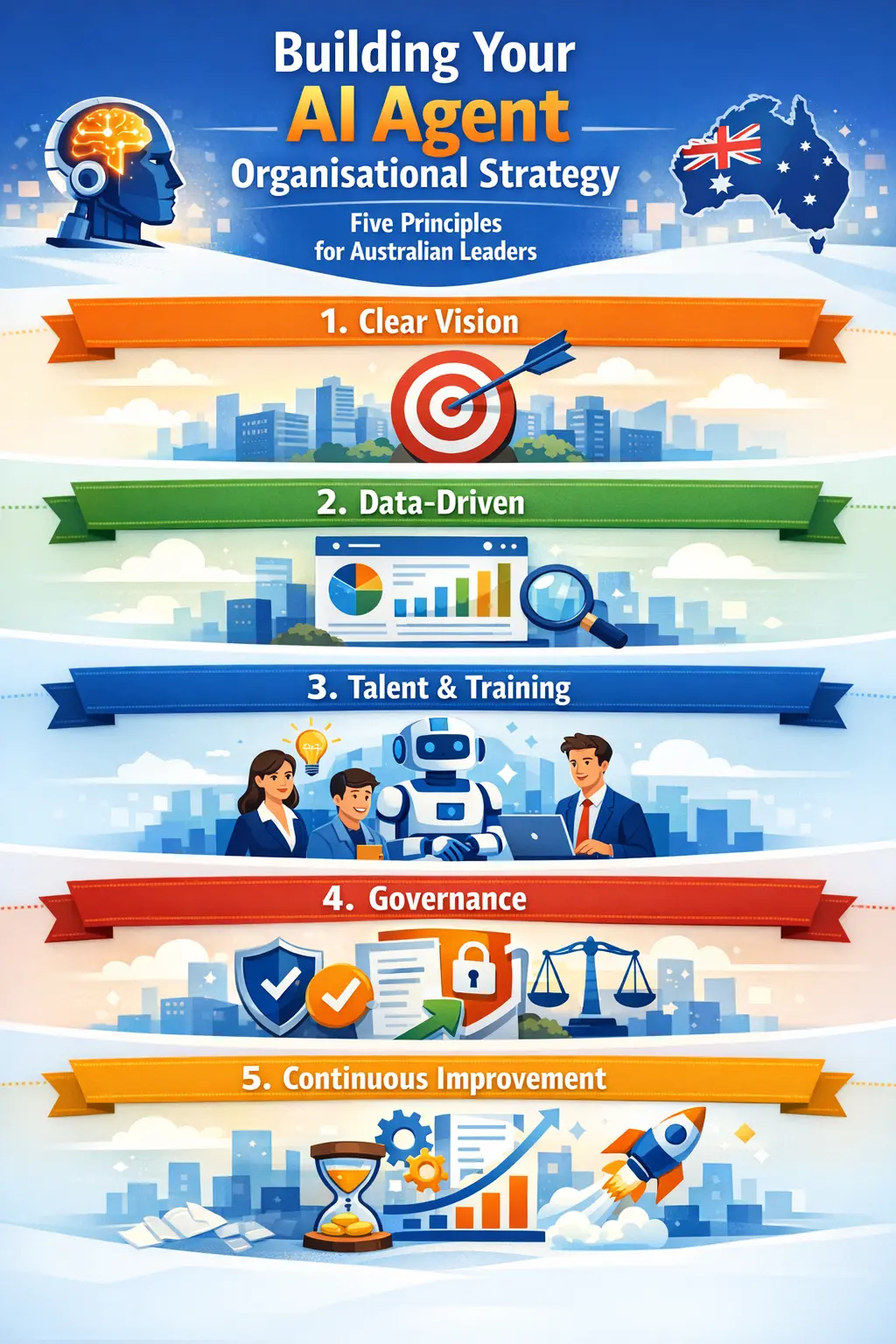
Deploying AI agents without an organisational strategy produces exactly the same outcome as hiring an exceptional team and giving them no direction, no accountability, and no performance framework. The technology underdelivers — not because it lacks capability, but because the organisation has not been designed to extract value from it.
The following five principles define what the most successful AI agent deployments in Australian enterprises share in common in 2026. They are sequenced deliberately. Skipping any of them is the fastest path to becoming one of Gartner's predicted 40 per cent of agentic AI projects that fail.
|
Principle 1 — Govern Before You Deploy
Every AI agent deployed inside your business must operate within a defined governance framework before it goes live. This means mapping decision authority — which actions the agent takes autonomously, and which require human sign-off. It means building audit trails into the agent's architecture as standard, not as a retrofit. It means defining escalation logic: the specific conditions under which the agent pauses and routes a decision to a human team member.
Crucially, from 10 December 2026, APP 1.7 of the Privacy Act 1988 (Cth) requires your privacy policy to disclose the use of computer programs in automated decision-making where those decisions could significantly affect individuals' rights or interests. Governance is not a philosophical position — it is a legal obligation for any Australian business deploying AI agents in customer-facing or HR-related workflows.
|
|
Principle 2 — Redesign Workflows, Do Not Just Automate Them
The single most common and most costly mistake in AI agent deployment is inserting an agent into an existing workflow without redesigning the workflow itself. Existing processes were built around human constraints: limited working hours, finite attention, sequential task handling, and the need for constant handoffs. AI agents do not have those constraints. A workflow designed with AI agents as a native capability produces fundamentally different — and far superior — outcomes to an AI agent bolted onto a legacy process.
The right question to ask before every deployment: if we were designing this process today, knowing that an AI agent could handle the routine execution, what would it look like? The answer is almost always radically different from your current state.
|
|
Principle 3 — Integration Architecture Is Your Competitive Moat
An AI agent's intelligence is bounded by the data and systems it can access. An agent that cannot see your CRM history, ERP operational data, financial records, and communication logs is an agent operating in the dark. The API integration layer — the technical architecture that connects AI agent intelligence to your specific operational systems — is where 80 per cent of the business value lives, and where the work of an expert API developer in Sydney, Melbourne, or Brisbane is irreplaceable.
According to appinventiv's 2026 Australian AI implementation research, 98 per cent of Australian organisations report barriers to using data for AI, with outdated IT architecture and data silos identified as the single biggest technical blocker. The quality of your integration architecture is not a technical footnote — it is your primary competitive moat.
|
|
Principle 4 — Measure Business Outcomes, Not Agent Activity
AI agent performance must be measured against business outcomes — cost per transaction reduced, customer resolution time improved, revenue pipeline velocity increased, compliance incidents avoided — not against activity metrics like queries processed or messages sent. Define your success metrics before deployment. If you cannot articulate what a successful AI agent looks like in the language of your P&L, you are not ready to deploy.
According to McKinsey's 2025 State of AI analysis, organisations that set concrete business outcomes and establish measurable controls before deployment consistently outperform those that optimise for AI activity metrics. Track CSAT, conversion rate, cycle time, and EBIT impact — not agent conversation volume.
|
|
Principle 5 — Build the Human Layer Around the Agent Layer
The emerging organisational model in Australian enterprises is not 'AI or humans' — it is blended human-AI teams where each is positioned to deliver what only they can deliver. AI agents own routine execution: the high-volume, rules-based, data-intensive work that drains human potential. Human team members own strategic judgment, complex negotiation, client relationships, creative problem-solving, and the exception cases that genuinely benefit from empathy and contextual wisdom.
According to Salesforce's Agentic Enterprise Index, escalations from AI agents to human service representatives grew from 22 per cent in Q1 2025 to 32 per cent in Q2 2025 — not because agents were failing, but because agents were getting better at identifying which cases genuinely needed human expertise. That is the blended model working exactly as designed.
|
|
PART 5 — GENERATIVE AI INTEGRATION: WHERE THE VALUE LIVES
|
Why Generative AI Integration — Not Just AI Access — Creates Competitive Advantage
One of the most important distinctions for Australian business owners and executives to understand is the difference between having access to a generative AI model and having a generative AI integration.
Accessing ChatGPT, Claude, or Gemini through a web browser gives your team a powerful assistant.
Integrating a large language model into your operational systems via a custom API architecture gives your business a competitive infrastructure.
The distinction is not subtle. When generative AI is integrated at the infrastructure level — connected to your CRM, ERP, email platform, databases, and workflow tools via professionally built APIs — the outputs become context-aware, your-data-specific, and embedded into the systems your team already uses. The AI does not sit beside your operations. It runs inside them.
Six High-Value Generative AI Integration Opportunities for Australian Businesses
|
CRM Integration
Connect your AI agent to Salesforce, HubSpot, or Microsoft Dynamics. The agent reads client history, interprets recent communications, generates personalised follow-up content, and logs all activity automatically — without your team switching tools or manually updating records.
|
ERP & Operations Integration
Connect to SAP, Microsoft Business Central, or MYOB. The agent monitors operational data, flags anomalies, generates exception reports with root-cause analysis, and routes resolution recommendations to the appropriate owner in real time.
|
|
Document Intelligence
Deploy agents across SharePoint, Google Drive, or DocuSign to ingest unstructured documents — contracts, policies, reports — extract structured data, flag risk clauses, generate compliance summaries, and populate downstream systems automatically.
|
Customer Service Workflows
Integrate with Zendesk, Freshdesk, or ServiceNow. Agents classify inbound queries, retrieve full customer context, generate resolution recommendations, and route complex cases to human agents with a complete brief — eliminating research time entirely.
|
|
Finance & Reporting
Integrate with Xero, NetSuite, or Power BI. Agents generate plain-language financial narratives from structured data, prepare variance analysis, monitor budget exceptions in real time, and draft board-ready reports — freeing your finance team for strategic analysis.
|
Internal Knowledge & Onboarding
Train agents on your internal knowledge base within Confluence, SharePoint, or Notion. The agent answers employee queries, surfaces relevant documentation, manages routine internal requests, and onboards new team members through interactive, context-aware guidance.
|
|
The 80% Rule That Changes How You Think About AI Investment
PwC's analysis of AI implementations globally finds that technology delivers only approximately 20 per cent of an AI initiative's total value. The remaining 80 per cent comes from redesigning the workflows around it. This reframes the investment decision: the API developer and integration architect who embeds AI into your operational infrastructure is not a technical cost centre — they are the primary source of your AI return on investment.
|
|
PART 6 — THE ROLE OF AN EXPERT API DEVELOPER IN YOUR AI DEPLOYMENT
|
Why Your API Developer in Sydney, Melbourne, or Brisbane Is Your Most Important AI Partner
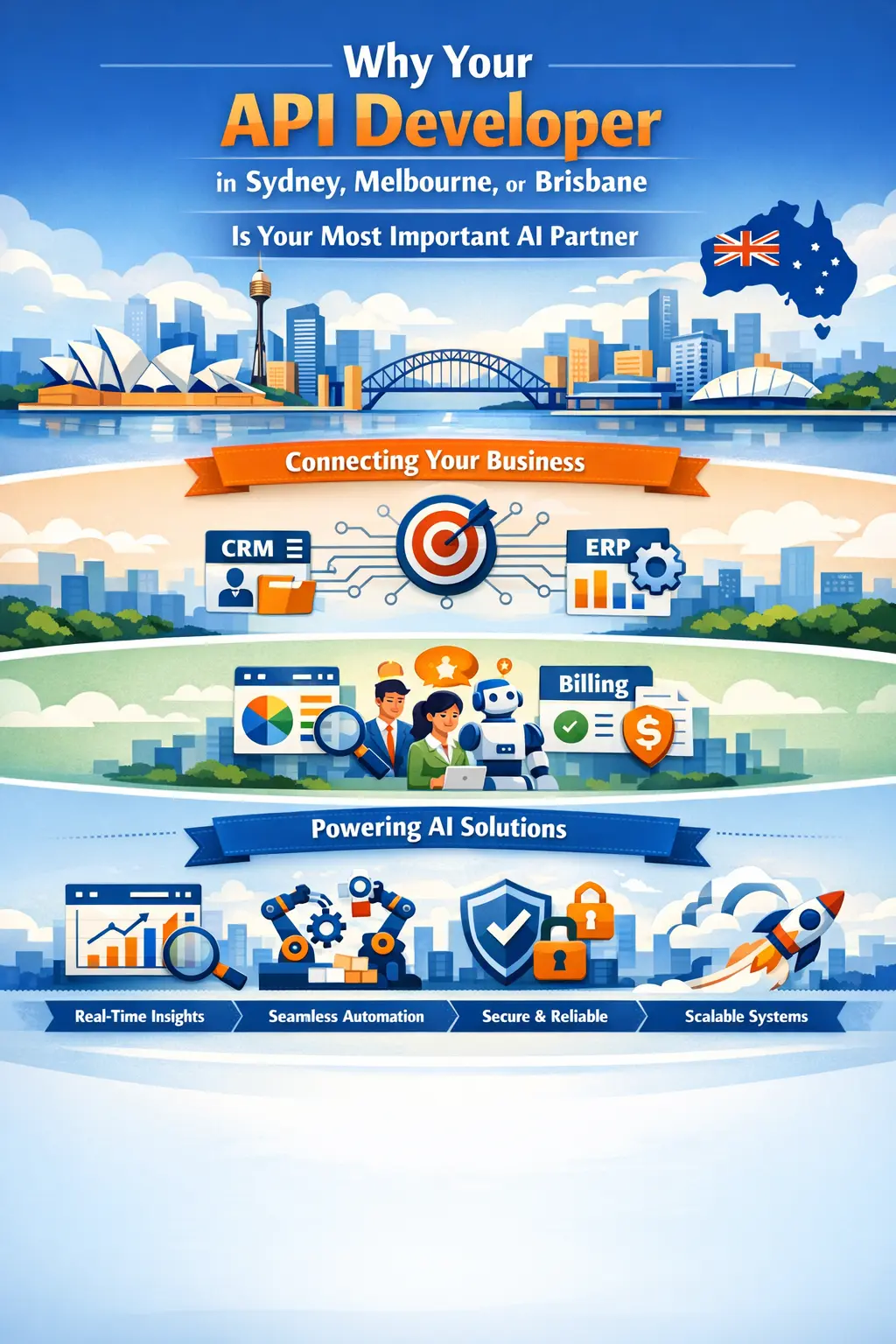
There is a version of AI agent deployment that many Australian businesses have already experienced: a tool that performed impressively in the demo and delivered minimal value in production. In almost every case, the reason is the same — the tool could not adequately connect to the specific systems, data structures, and workflows of the business deploying it.
The API integration layer is the nervous system of an effective AI agent deployment. It is the architecture that allows your AI agent to read your CRM history, query your ERP for inventory levels, retrieve customer data from your billing platform, and write results back to your operational systems — all in real time, with the security and reliability your business requires.
|
40%
of enterprise software applications will include task-specific AI agents by end of 2026 — up from less than 5% in 2025
Gartner 2026 Strategic Technology Forecast
|
Building this integration layer requires expertise that goes well beyond setting up a ChatGPT plugin or connecting a SaaS tool via a simple webhook. Production-grade AI agent integration involves authentication and authorisation architectures, data transformation and normalisation layers, rate limiting and retry logic, event-driven trigger systems, comprehensive logging and monitoring, and versioned API documentation that ensures the integration remains maintainable as your stack evolves.
Why Local API Expertise Matters for Australian Businesses
Working with an API developer based in Sydney, Melbourne, or Brisbane — rather than an offshore team operating in a different time zone and regulatory jurisdiction — provides specific advantages for Australian enterprise deployments:
- Australian Privacy Act compliance is embedded in the integration design, not reviewed by an overseas team unfamiliar with OAIC expectations and APP obligations
- Real-time collaboration during Australian business hours means integration issues are resolved in hours, not days
- Local accountability under Australian contract law for mission-critical business infrastructure
- Familiarity with Australian enterprise technology stacks, including the specific ERP, CRM, and operational platforms most common in Australian businesses
- Understanding of sector-specific requirements across Australian financial services (APRA, ASIC), healthcare (AHPRA), and professional services environments
|
The Technical Foundation That Makes Everything Else Possible
A generative AI model without integration is a research assistant. A generative AI model with professional API integration, connected to your live operational data and embedded in your existing workflows, is a competitive infrastructure investment. The difference between those two outcomes is the quality of the API developer building the bridge between intelligence and operations.
|
|
PART 7 — THE AUSTRALIAN REGULATORY CONTEXT: WHAT LEADERS MUST KNOW
|
Navigating Australia's Evolving AI Governance and Privacy Obligations
For Australian business owners and executives, deploying AI agents is not just a commercial decision — it is increasingly a regulatory one. Australia's privacy and AI governance framework is evolving rapidly, and the organisations that build compliance into their AI agent architecture from the outset will be structurally advantaged over those that treat governance as an afterthought.
The Privacy and Other Legislation Amendment Act 2024 (Cth) — Key Dates
From 10 December 2026: APP 1.7, 1.8, and 1.9 commence. Australian businesses are legally required to include in their privacy policies specific disclosures about automated decision-making — including the kinds of personal information used and the types of decisions made solely by computer programs, where those decisions could significantly affect individuals' rights or interests. This applies directly to AI agents operating in customer service, HR, credit assessment, and any other domain where automated decisions affect real people.
Penalty exposure: The OAIC now has expanded enforcement powers, including the ability to issue compliance notices directly and progress civil penalty proceedings. For large organisations, significant privacy breaches can attract penalties of up to $50 million. For smaller businesses, the reputational and operational consequences of a non-compliance event are equally significant relative to scale.
The OAIC's Privacy-by-Design Requirement for AI
The OAIC's guidance on privacy and the use of commercially available AI products (published October 2024) establishes a clear expectation: organisations deploying AI systems that process personal information must take a privacy-by-design approach. This means embedding privacy protections in the design and development of your AI agent deployment — not reviewing them after the system is live.
For Australian businesses working with C9 on bespoke AI agent development, privacy-by-design is embedded as a standard component of our integration architecture. Data handling rules, consent frameworks, and audit trail requirements are specified at the design stage, not the compliance review stage.
The National AI Centre's Voluntary AI Safety Standard
Australia's National AI Centre has published a Voluntary AI Safety Standard comprising ten guardrails that apply to organisations across the AI supply chain. While voluntary, these guardrails represent the direction of travel for Australian AI regulation and are increasingly referenced by procurement teams, boards, and institutional investors as part of AI due diligence processes.
The ten guardrails address accountability, transparency, privacy, fairness, and human oversight — all of which are components of the governance-first architecture C9 embeds in every bespoke AI agent deployment.
|
FREQUENTLY ASKED QUESTIONS — FEATURED SNIPPET & AI OVERVIEW OPTIMISED
|
Frequently Asked Questions: AI Agents for Australian Businesses
Q: What are AI agents and how are they different from chatbots?
AI agents are autonomous software systems that can reason about their environment, plan a course of action, and execute that plan across multiple digital tools — including CRM systems, ERPs, databases, and communication platforms — without requiring a human to direct every step. Unlike chatbots, which respond to queries within a single interface, AI agents own entire business processes end-to-end, adapt to changing conditions, and coordinate across multiple systems simultaneously.
Q: How are Australian businesses using AI agents in 2026?
Australian businesses are deploying AI agents across customer service resolution, sales pipeline management, document processing, compliance monitoring, finance reporting, and internal helpdesk functions. According to Salesforce's Agentic Enterprise Index, Australian consumer-facing industries including travel, retail, and financial services are seeing the fastest growth in agent deployment, with monthly action growth rates between 128 per cent and 133 per cent in retail and travel respectively.
Q: What does generative AI integration mean for my business?
Generative AI integration connects large language model intelligence to your existing operational systems via professionally built API architectures. Rather than accessing AI through a standalone web interface, your business systems — CRM, ERP, email, databases — connect directly to AI capabilities, enabling agents to read your live data, generate context-specific outputs, and write results back into your workflows automatically. This integration layer is where the majority of business value from AI is realised.
Q: Will AI agents replace workers in my Australian business?
According to Salesforce's research, 87 per cent of AI practitioners agree that AI agents augment existing roles rather than replace them. The dominant model in Australian enterprises in 2026 is blended human-AI teams: agents own routine, high-volume, and data-intensive work, while human team members focus on strategic judgment, complex problem-solving, and client relationships. The organisations seeing the best outcomes are those redesigning roles around this principle — rather than simply adding agents to existing job descriptions.
Q: What Australian laws apply to AI agent deployments?
AI agents that process personal information in Australia are subject to the Privacy Act 1988 (Cth) and the Australian Privacy Principles (APPs). From 10 December 2026, businesses must disclose automated decision-making processes in their privacy policies under APP 1.7 of the Privacy and Other Legislation Amendment Act 2024. The OAIC has published specific guidance on privacy obligations for both users and developers of AI systems. Sector-specific obligations under APRA and ASIC also apply to financial services deployments.
Q: How do I get started with AI agent deployment for my Australian business?
Begin with workflow identification: map the two or three processes in your business where autonomous AI action would create the most immediate, measurable business impact. Assess your current data architecture and system integration requirements. Define governance and compliance obligations relevant to your industry before committing to a technology stack. Then engage an expert API developer with local Australian expertise to architect the integration layer that connects AI agent intelligence to your specific operational environment. C9 provides end-to-end custom AI agent integration and development services for Australian businesses at c9.com.au.
The Decision in Front of Every Australian Business Leader
Every transformational technology in business history has had a window — a period when early movers build structural advantages that later adopters spend years, sometimes decades, trying to close. The internet had one in the mid-1990s. Cloud computing had one in the early 2000s. AI agents have one right now, in 2026, in Australia.
The evidence is unambiguous. Generative AI could add between $2.6 trillion and $4.4 trillion annually to the global economy, according to McKinsey's analysis of 63 use cases across 47 countries. AI agent creation among leading Australian enterprises grew by 119 per cent in the first half of 2025 alone. Australian consumers interacting with AI agents report 64 per cent higher satisfaction rates than the global average. And Gartner projects that 40 per cent of enterprise software applications will embed AI agents by the end of this year.
The window is open. The technology is mature enough for production deployment. The regulatory framework, while evolving, is sufficiently clear for organisations that build governance into their architecture from the outset. The only remaining question is execution.
|
One Thought to Leave You With
AI agents are not the end of human work in Australian business. They are the beginning of humans doing only the work that genuinely deserves human attention. For every business owner worried about what AI means for their team — the answer is this: it means your best people spending their entire working day on the work that only they can do, supported by an infrastructure that handles everything else with greater speed, consistency, and reliability than any human workforce ever could. That is not a threat. That is an extraordinary opportunity. Design for it deliberately, and deploy with the right technical foundation beneath it.
|
|
In short:
- AI agents are autonomous systems that own entire business processes end-to-end — not tools that assist with tasks.
- 119% growth in AI agent creation among first-mover Australian companies in H1 2025 signals this is production-grade reality, not future theory.
- Generative AI integration — not just access to AI models — is where the competitive advantage is built, through custom API architectures built by expert Australian developers.
- From 10 December 2026, Australian businesses face binding privacy obligations regarding automated decision-making under the Privacy Act — governance-first deployment is legally necessary, not just strategically smart.
- C9 builds bespoke AI agent integration and development solutions for Australian businesses, with expert API developers based in Sydney, Melbourne, and Brisbane.
What's next?
The first step is not a technology decision — it is a workflow decision. Identify the processes in your business where autonomous AI action would create the most immediate, measurable value. Then talk to C9. We will show you exactly what bespoke AI agent integration looks like for your specific business — and what it takes to have it running in production.
|
|
Ready to Deploy AI Agents in Your Australian Business?
C9 is Australia's leading custom software, apps, integration, and database developer. Our specialist API development teams in Sydney, Melbourne, and Brisbane build bespoke AI agent solutions designed around your specific systems, workflows, and competitive context — not a vendor's generic product roadmap.
Every C9 AI agent deployment is built governance-first, with privacy-by-design architecture, comprehensive audit trails, and full compliance with Australia's Privacy Act 1988 (Cth) and APP obligations.
→ Custom AI Agent Development | → Generative AI Integration | → API Development Sydney, Melbourne, Brisbane
www.c9.com.au
|
© 2026 C9 Pty Ltd. All rights reserved. This article is provided for informational purposes only and does not constitute legal advice. For specific compliance guidance regarding the Privacy Act 1988 (Cth) and AI obligations, consult a qualified Australian legal practitioner.
AI Transparency Notice:
This article was produced with the assistance of artificial intelligence tools, including content drafting, visual asset creation, and audio generation. All content has been reviewed and approved by C9 prior to publication.