Executive Summary
Australian businesses processing recurring payments face a critical infrastructure decision in 2026. With government mandates requiring PayTo integration for payday super contributions by July 2026 and 92% of financial institutions already supporting the New Payments Platform (NPP), the shift from legacy direct debit systems to real-time PayTo processing represents both a compliance requirement and a strategic opportunity.
This comprehensive guide examines the technical, financial, and operational implications of PayTo migration, revealing why professional payment integration services deliver superior outcomes compared to template solutions or AI-generated code. Business owners will discover the hidden $507,000 annual cost of maintaining direct debit systems, understand why discovery-driven development prevents project failures, and learn how C9’s blended hybrid teams deliver enterprise-grade payment integration at optimised rates whilst ensuring genuine knowledge transfer and long-term system ownership.
In Short
The Problem: Direct debit systems cost Australian businesses millions annually in hidden fees, fraud, failed payments, and reconciliation overhead — whilst settlement delays, painful customer disputes, and outdated infrastructure create operational drag.
The Solution: Strategic PayTo migration through professional discovery-driven development delivers real-time processing, enhanced security, superior customer experience, and future-proof infrastructure.
The Business Impact: Companies migrating now gain competitive advantage through 15-second payment confirmation versus 3-5 day settlement delays, operational cost reductions of 30-50%, improved customer retention, and compliance certainty. Professional online payment integration — not off-the-shelf templates or AI-generated code — ensures systems work in production, scale with growth, and remain maintainable. C9’s approach combines Australian expertise with global competitive pricing through blended hybrid teams, comprehensive knowledge transfer, and staged implementation that delivers ROI every 8-12 weeks.
What’s Next? Forward-thinking organisations are scheduling discovery sessions with specialist payment integration providers to map technical requirements, identify integration complexity, establish realistic timelines, and structure staged migrations that deliver early ROI whilst building comprehensive payment roadmaps. Businesses waiting until 2026 will face rushed implementations under pressure.
Table of Contents
- The $507,000 Direct Debit Tax: Hidden Costs Destroying Your Bottom Line
- Understanding PayTo: Australia’s Real-Time Payment Revolution
- PayTo vs Direct Debit: The Technical Comparison Business Owners Need
- Why Professional Payment Integration Services Are Non-Negotiable
- The Discovery Call Advantage: Why Skipping This Destroys Projects
- The AI Cowboy Problem: Why Cheap Comes Expensive
- C9’s Differentiator: Blended Hybrid Teams + Knowledge Transfer
- Staff Augmentation: Flexible Resources for Ongoing Payment Excellence
- The Indicative Pricing Trap: Why Most Proposals Are Worthless
- Implementation Roadmap: Staged Migration for Early ROI
1. The $507,000 Direct Debit Tax: Hidden Costs Destroying Your Bottom Line
Beyond Transaction Fees
Australian businesses processing 10,000 monthly direct debit transactions face a shocking reality: their payment system costs $507,588 annually — not the $84,000 they think they’re spending.
Most finance teams calculate payment costs exclusively through transaction fees: $0.50 per direct debit plus $2.50 for failed payments equals roughly $7,000 monthly. But this catastrophically underestimates true expense.
The Complete Direct Debit Cost Structure
Settlement Delay Impact — Three to five business days between customer payment and fund arrival creates invisible cash flow costs. For businesses processing $500,000 monthly, the delayed settlement at 6% annual cost of capital equals $2,466 monthly — $29,592 annually in pure working capital expense.
Failed Payment Churn — With average direct debits failing due to insufficient funds, closed accounts, or customer cancellations at 15% per month, and 15% of failed payments never recovering, that’s 120 permanently lost customers annually. At $550 monthly value, that’s $72,000 in annual lost revenue.
Operational Overhead — Finance teams spend 40 hours monthly reconciling bank files to billing systems at $75/hour ($36,000 annually). Failed payments require investigation — 800 monthly failures × 15 minutes × $50/hour equals $120,000 annually. Customer service fields 500 payment enquiries monthly at 8 minutes each, costing $28,000 annually. Manual dispute resolution consumes 50 disputes × 2 hours × $75/hour monthly, totalling $90,000 annually.
Total Annual Direct Debit Tax: $507,588
Compare this to PayTo’s total cost of ownership: $28,704 annually for the same transaction volume. The difference? $478,884 in annual savings — a 94% cost reduction.
The 2026 Compliance Cliff
The Australian government’s mandate requiring PayTo integration for payday super contributions by July 2026 isn’t the first domino in comprehensive payment infrastructure modernisation. Government agencies, utilities, and major subscription services are rapidly migrating to PayTo. Within 24 months, direct debit becomes legacy infrastructure reserved for business resisting modernisation.
Competitive erosion accelerates daily. Whilst you process payments through systems requiring 3-5 day settlement, competitors offer instant confirmation, real-time subscription modifications, and superior customer experience. Every customer switching to competitors with better UX represents permanent revenue loss.
Technical debt compounds exponentially. Current billing systems have grown increasingly interconnected — CRM integrations, accounting platforms, customer communication triggers. Each month delaying migration adds integration complexity. The payment layer that seemed simple becomes the bottleneck preventing business evolution.
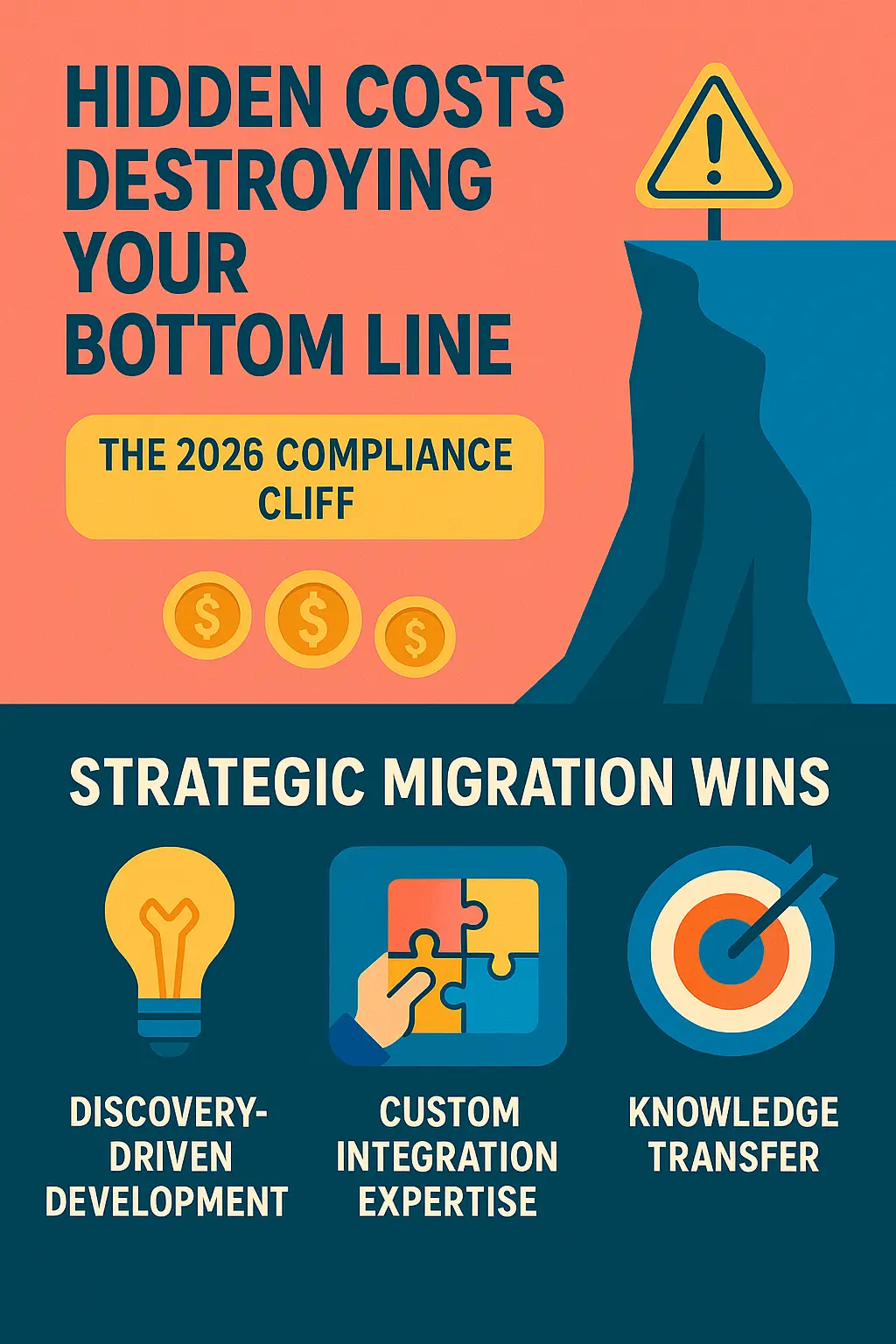
Strategic Migration Wins
Businesses thriving in 2026 aren’t those with largest budgets — they’re those with clearest strategy. Professional payment integration services address three non-negotiable elements:
This represents the fundamental difference between C9’s approach and hundreds of development shops offering “payment integrations.” We don’t just build PayTo systems — we build systems that represent a paradigm shift in Australian payment infrastructure.
2. Understanding PayTo: Australia’s Real-Time Payment Revolution
The Technical Foundation
PayTo operates on the New Payments Platform (NPP) infrastructure, processing payments in real-time 24/7/365. Unlike direct debit’s batch processing settlement overnight, PayTo transactions complete in under 15 seconds with immediate confirmation to both parties.
The NPP processed 1.2 billion transactions in 2024, with PayID registrations exceeding 25 million Australians. This isn’t experimental technology — it’s mature infrastructure with comprehensive financial institution support.
Here’s what happens technically during PayTo processing:
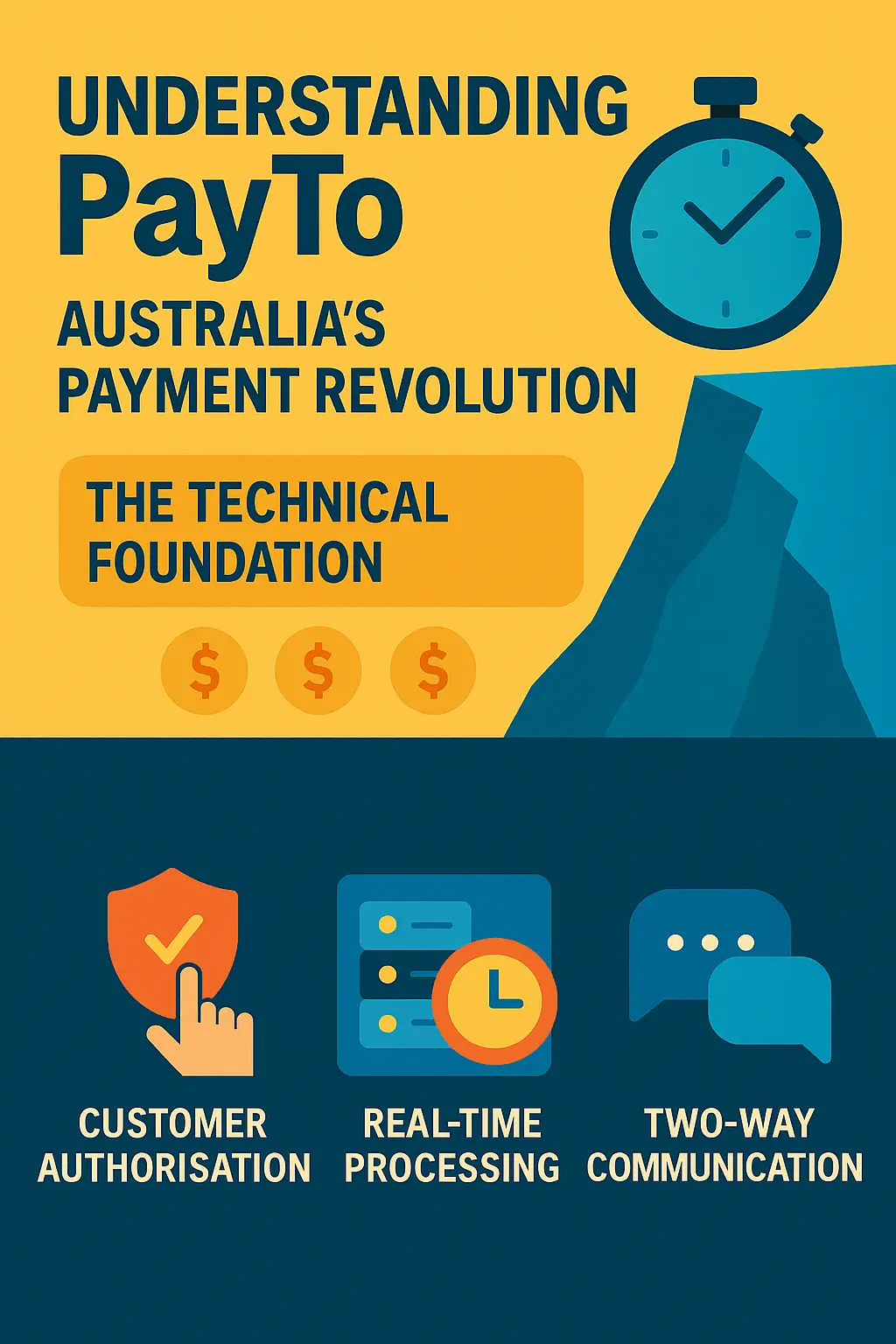
Customer Authorisation — Instead of paper mandates giving businesses permission to pull funds whenever desired, customers approve specific payment agreements through secure banking apps. They see exactly who can charge them, how much, and how often — with real-time visibility and control.
Real-Time Processing — When you initiate payment, NPP validates funds availability, processes transfer, and confirms settlement — all within seconds. The system provides immediate success or failure notification with specific reason codes enabling automated handling.
Two-Way Communication — Both parties receive instant notifications. Your system knows immediately whether payment succeeded or failed, triggering appropriate automated workflows without waiting days for batch file processing.
Customer Control — Users can pause, modify, or cancel payment agreements instantly through banking interfaces without contacting customer service teams. This transparency builds trust whilst reducing operational overhead.
Why This Matters for Business Operations
The operational implications are profound:
Cash Flow Certainty — Revenue forecasting becomes accurate when you know within seconds whether funds have cleared. No more “should clear in a few days” conversations with finance teams.
Operational Efficiency — Failed payments trigger immediate automated workflows. Customers with insufficient funds receive instant notifications and can resolve issues before service disruption occurs.
Customer Experience — Subscription changes take effect immediately. Customers see all payment agreements in one banking interface and manage them independently.
Fraud Reduction — Active customer approval through secure banking apps, combined with real-time mandate visibility, catches fraudulent charges immediately. This is why PayTo fraud rates are 73% lower than direct debit.
The Migration Challenge
Understanding PayTo’s benefits is straightforward. Implementing it without disrupting business operations requires considerable expertise in payment integration services. Your current direct debit integration likely involves batch file processing, reconciliation workflows built around settlement delays, customer service procedures assuming multi-day visibility gaps, and accounting integrations recognising revenue based on batch timing.
PayTo requires rebuilding or replacing every component whilst maintaining business continuity — precisely why professional online payment integration expertise matters more than technology choice.
3. PayTo vs Direct Debit: The Technical Comparison Business Owners Need
Settlement Speed and Financial Impact
Direct Debit: Batch processing overnight, 3-5 business days for settlement confirmation, weekend and holiday delays extending to 7+ days, zero real-time fund validation, dishonour notifications arriving after initiation.
PayTo: Real-time processing completing in 15 seconds, immediate settlement confirmation 24/7/365, no weekend or holiday delays, pre-payment fund validation, instant success or failure notification with specific reason codes.
Business Impact: A subscription business processing $500,000 monthly saves $29,592 annually purely from eliminated settlement delay costs. Add reduced failed payment rates (3% vs 8%) and the savings compound dramatically.
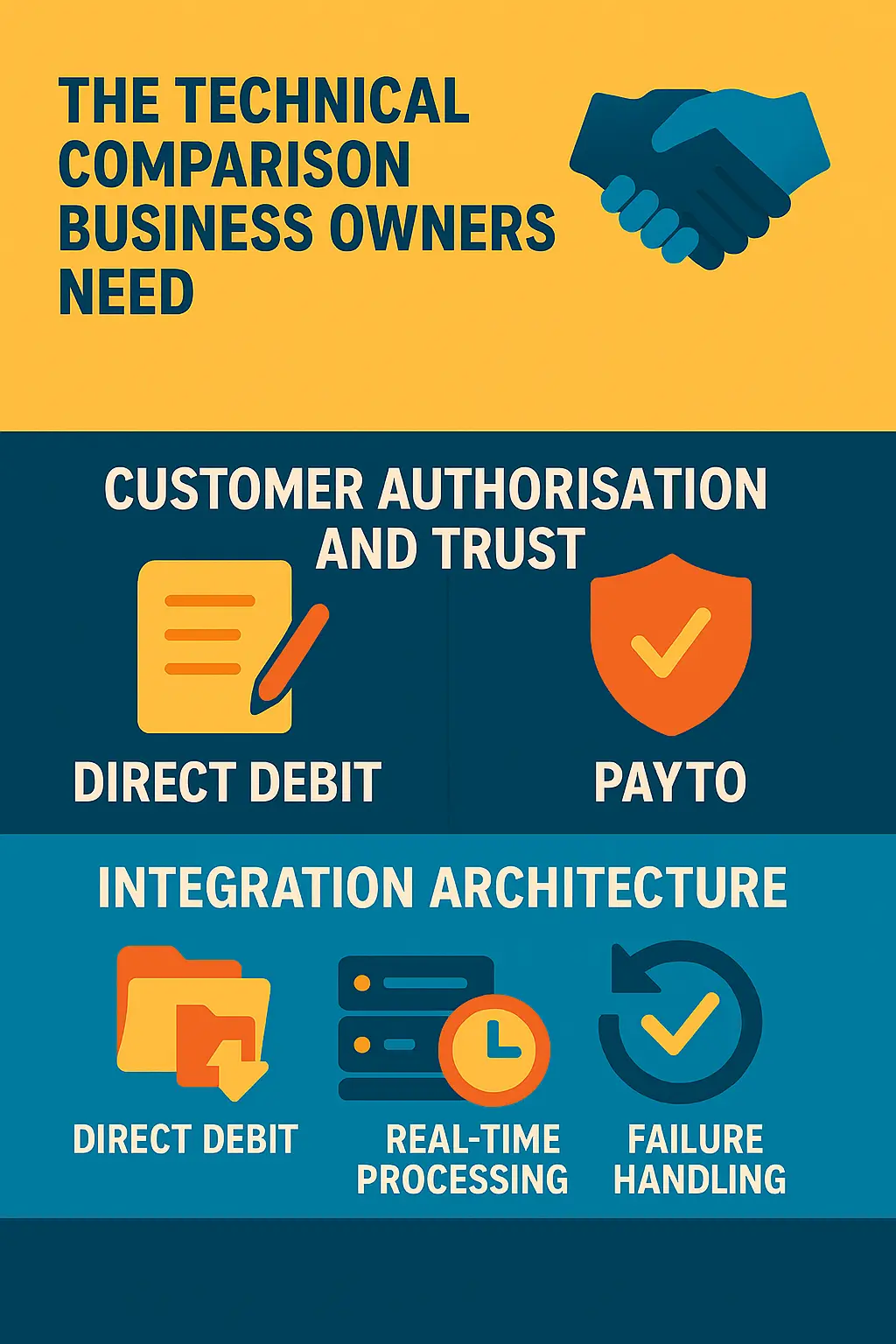
Customer Authorisation and Trust
Direct Debit: Paper or digital mandate signing often without strong authentication, customers give blanket permission without ongoing visibility, mandate cancellation requires contacting business or bank, dispute resolution is manual and time-consuming.
PayTo: Secure authorisation through banking apps with multi-factor authentication, customers approve specific agreements with defined parameters, all active agreements visible in banking interface, customers can pause, modify, or cancel instantly.
Business Impact: Customer service payment enquiries reduce 60-80% when customers self-manage agreements through banking interfaces. Trust improves when transparency is built into infrastructure rather than promised through policies.
Integration Architecture
Direct Debit: Batch file upload and download processes, asynchronous payment confirmation hours or days later, manual reconciliation between bank files and billing systems, limited structured data in transaction records.
PayTo: RESTful API integration with real-time responses, synchronous payment confirmation, automatic reconciliation through structured data, ISO 20022 rich data messaging for detailed remittance information.
Business Impact: Development teams spend 70% less time building reconciliation middleware with PayTo’s clean API-driven architecture versus direct debit’s batch file complexity.
Failure Handling and Recovery
Direct Debit: Generic dishonour codes with limited detail, 3-5 day delay before failure notification, manual customer contact required, batch retry scheduling creating further delays.
PayTo: Specific failure reason codes enabling intelligent automated responses, instant failure notification, automated customer communication workflows, real-time retry capability once issues resolve.
Business Impact: Failed payment recovery rates improve 40-60% when customers receive immediate notification with specific failed payment guidance days earlier.
The Migration Decision Matrix
Stay on Direct Debit If: You’re exiting the business within 12 months, process fewer than 100 transactions monthly and declining, have no customer service costs related to payment delays, regulatory compliance isn’t relevant to your industry, or your customers prefer batch processing uncertainty (they don’t exist).
Migrate to PayTo If: You process recurring payments of any volume, customer experience and retention matter, you value operational efficiency and automation, you need accurate cash flow forecasting, you’re planning to scale your subscription or recurring payment model, or you want compliance with emerging government mandates.
For 99% of Australian businesses with recurring payments, PayTo migration isn’t optional — it’s inevitable. The question is whether you migrate strategically on your timeline or reactively under compliance pressure.
Ready to eliminate the $507,000 direct debit tax and future-proof your payment infrastructure? Book your complimentary discovery session with C9 today. Our Australian-based payment integration specialists will map your current architecture, identify quick wins, and deliver a staged migration roadmap with clear ROI milestones.
Book Your Discovery Session →