Executive Summary
The conversation among Australian executives has shifted dramatically. It’s no longer “Should we modernise our legacy systems?” — the real question is “How fast can we modernise without breaking the business?” With outdated systems consuming 30–40% of IT budgets, increasing security risks, and failing regulatory requirements such as APRA CPS 230 (enforced from 1 July 2025), legacy software has become a financial, operational, and compliance liability.
Most legacy platforms—some 10–20 years old—cannot support remote work, mobile demands, API integrations, automation, or cloud resiliency. They slow innovation, create expensive bottlenecks, and make each new change riskier than the last. This guide breaks down why modernisation is now an urgent business imperative, the hidden costs of doing nothing, and the practical steps Australian organisations must take to migrate toward resilient, cloud‑native architecture.
The Problem
Legacy systems consume up to 40% of IT budgets, block innovation, undermine operational resilience, and create critical security and regulatory risks—especially under CPS 230. With shrinking expertise and outdated tooling, every change becomes slower, riskier, and more expensive.
The Solution
Move to cloud‑native architectures through structured modernisation: rehosting, refactoring, replatforming, or full re‑architecture. Cloud‑native platforms provide real-time resilience, lower maintenance costs, higher security, and rapid feature delivery. [cloudymap.com]
What’s Next
Start with a professional discovery and assessment phase to map system dependencies, risks, compliance gaps, and the best modernisation path. This prevents six‑figure mistakes, avoids downtime, and ensures a safe migration to future‑ready cloud infrastructure. [cflowapps.com]
The conversation amongst Australian business leaders has fundamentally shifted. It's no longer "Should we modernise our legacy systems?" but rather "How quickly can we modernise without breaking everything?" If you're still running software built 10, 15, or even 20 years ago, 2025 represents a critical inflection point—not just for staying competitive, but for business survival.
For Australian enterprises, the urgency is compounded by new regulatory requirements, particularly CPS 230, which comes into effect on 1 July 2025. Meanwhile, the financial stakes have never been higher: legacy systems now consume up to 40% of IT budgets just for maintenance, leaving little room for innovation or growth.
This isn't merely a technology issue—it's a business imperative that affects your bottom line, operational efficiency, customer experience, and competitive positioning.
Why Legacy Systems Are Holding Your Business Back
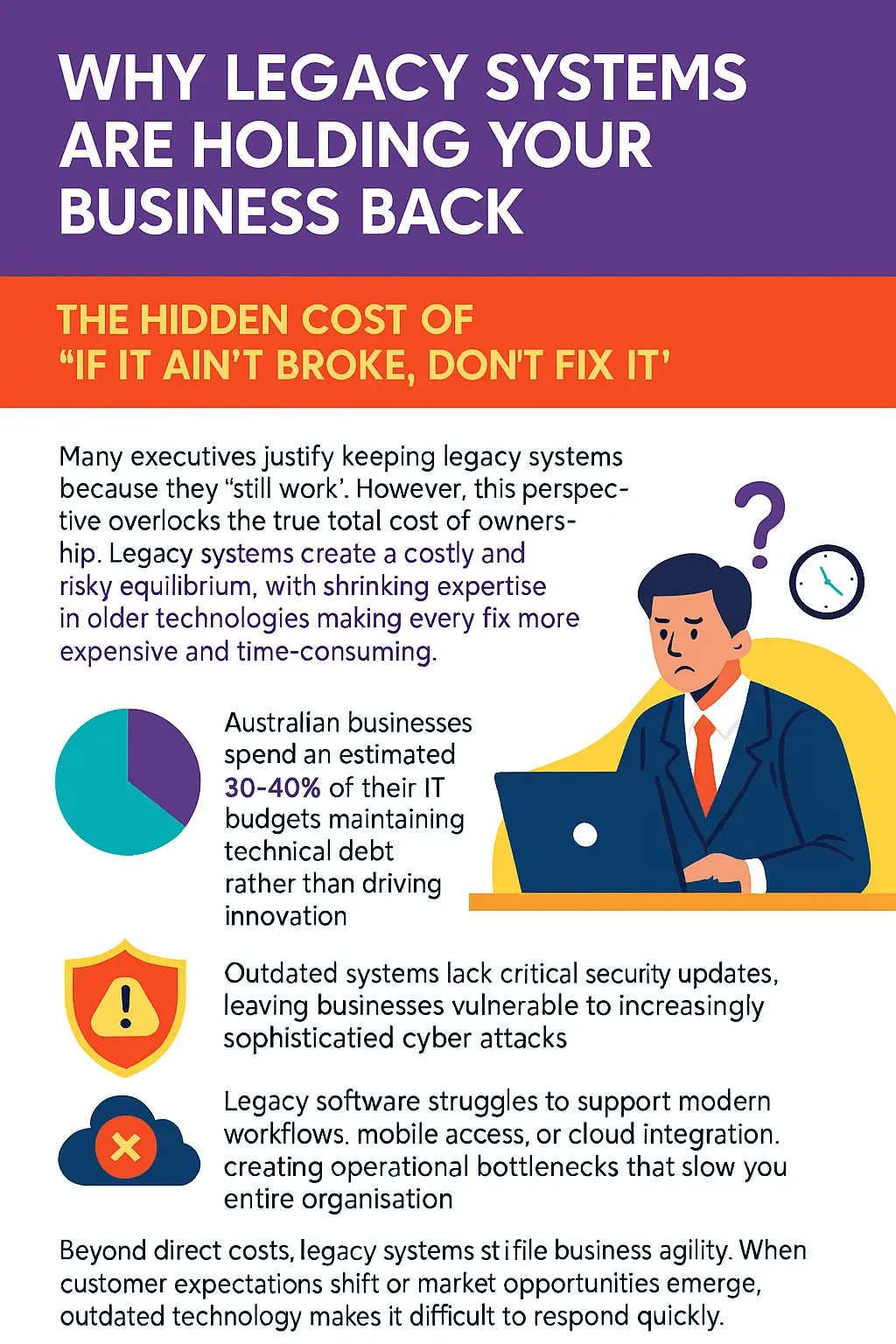
The Hidden Cost of "If It Ain't Broke, Don't Fix It"
Many executives justify keeping legacy systems because they "still work." However, this perspective overlooks the true total cost of ownership. Legacy systems create a costly and risky equilibrium, with shrinking expertise in older technologies making every fix more expensive and time-consuming.
The financial reality is stark:
- Australian businesses spend an estimated 30-40% of their IT budgets maintaining technical debt rather than driving innovation
- Outdated systems lack critical security updates, leaving businesses vulnerable to increasingly sophisticated cyber attacks
- Legacy software struggles to support modern workflows, mobile access, or cloud integration, creating operational bottlenecks that slow your entire organisation
Beyond direct costs, legacy systems stifle business agility. When customer expectations shift or market opportunities emerge, outdated technology makes it difficult to respond quickly. Your competitors with modern systems can launch new features in weeks whilst you're stuck in months-long development cycles.
Regulatory Compliance: The 2025 Deadline You Can't Ignore
For Australian financial institutions and APRA-regulated entities, CPS 230 introduces mandatory operational resilience standards that take effect on 1 July 2025. This isn't a guideline—it's a regulatory requirement with serious compliance implications.
CPS 230 requires organisations to prepare for service disruptions and enhance operational resilience through better risk management practices. Legacy systems often lack the monitoring, redundancy, and rapid recovery capabilities that modern regulations demand. Organisations must define clear tolerance levels for critical operations, implement robust third-party risk management, and maintain comprehensive incident response capabilities.
The key compliance deadlines include:
- 1 July 2025: CPS 230 takes effect
- 1 October 2025: Initial material service provider register submission
- 1 July 2026: All existing service provider contracts must be compliant
Even businesses outside APRA's direct oversight should pay attention. These regulatory trends signal broader expectations around operational resilience, data governance, and business continuity that will likely extend across industries.
Understanding Cloud-Native Architecture: More Than Just "Moving to the Cloud"
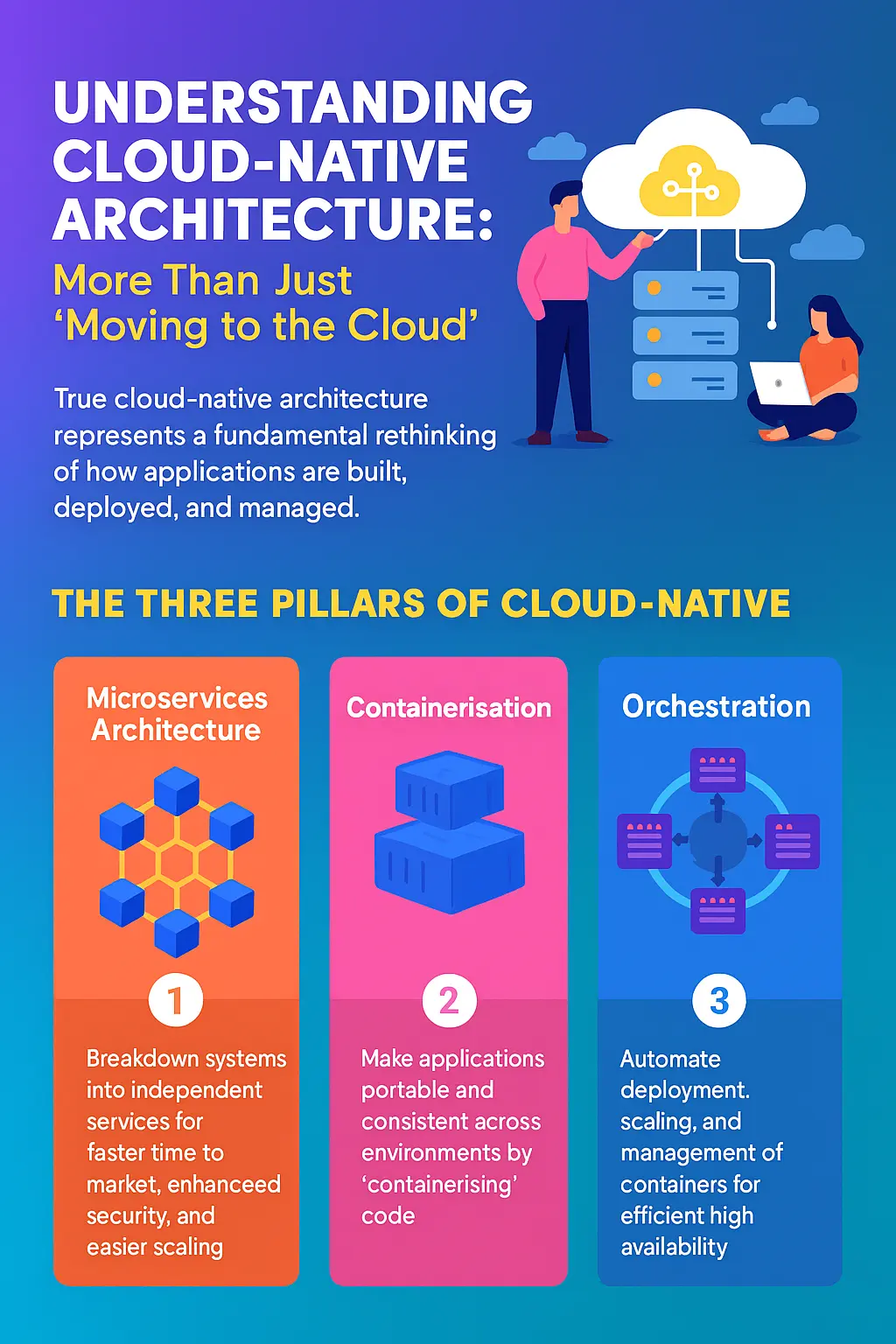
There's significant confusion in the market about what "going to the cloud" actually means. Simply moving your existing applications to cloud servers—often called "lift and shift"—delivers minimal benefits and can even increase costs.
True cloud-native architecture represents a fundamental rethinking of how applications are built, deployed, and managed.
The Three Pillars of Cloud-Native
1. Microservices Architecture
Instead of monolithic applications where everything is tightly coupled, microservices break systems into small, independent services that each focus on specific functions. This architectural approach delivers faster time to market, enhanced security through isolation, and easier scaling when services are independent from one another.
When one service needs updating, you can modify it without touching the rest of your application. This modularity dramatically reduces risk and accelerates development cycles.
2. Containerisation
Containers package applications and their dependencies into lightweight, portable units that run consistently across any environment. This eliminates the classic "it works on my machine" problem that plagues traditional development.
Containers use fewer resources compared to virtual machines whilst providing strong security through isolation. They make it dramatically easier to copy code from a developer's machine to testing, staging, and production environments with confidence.
3. Orchestration
Managing hundreds or thousands of containers manually would be impossible. Orchestration platforms like Kubernetes automate the deployment, scaling, and management of containerised applications. Kubernetes groups containers into logical units for easy management and discovery whilst ensuring efficient scaling for high availability.
Together, these three pillars enable organisations to deploy features continuously without downtime, scale automatically based on demand, and recover quickly from failures.
The Modernisation Strategy Framework: The 7 Rs
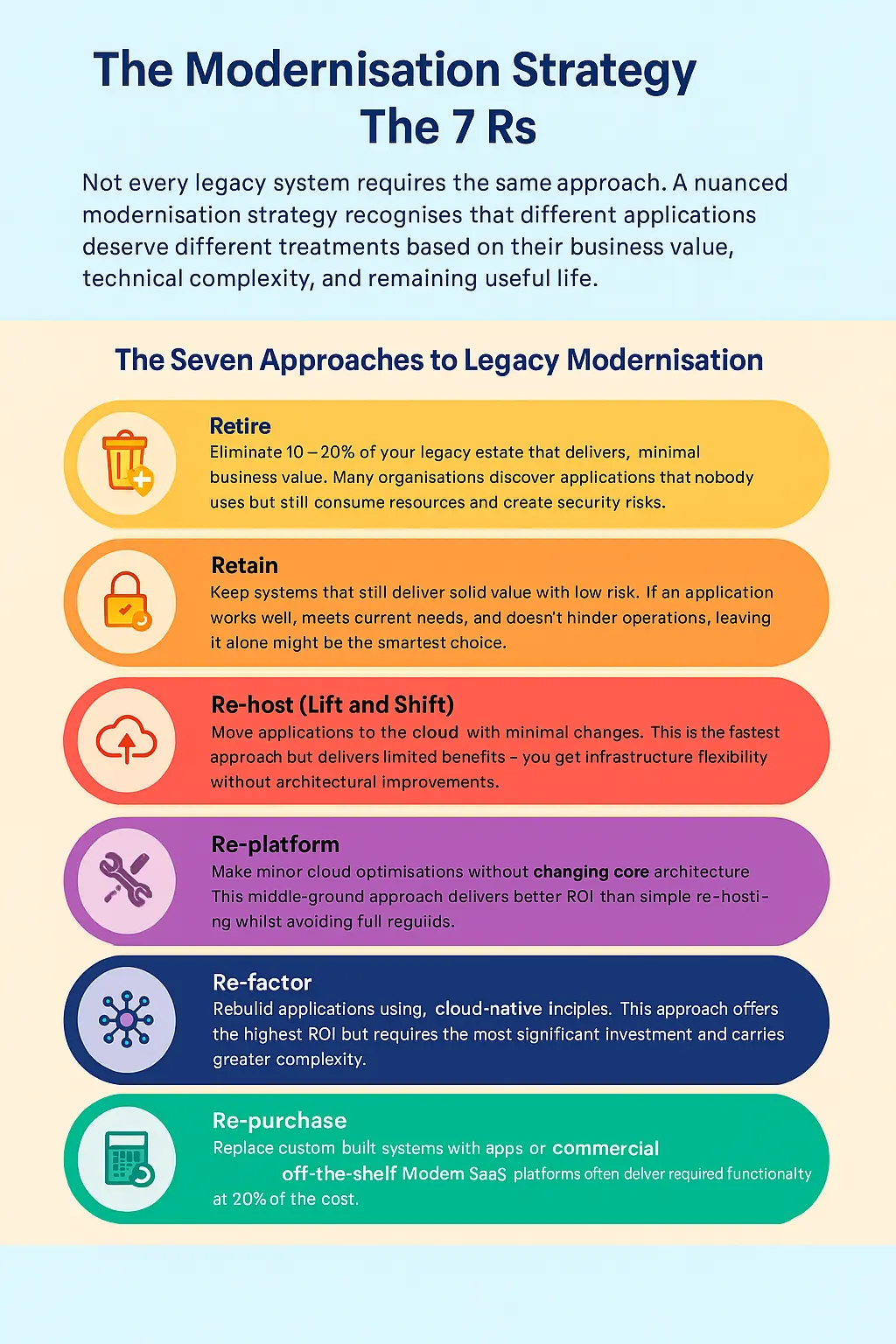
Not every legacy system requires the same approach. A nuanced modernisation strategy recognises that different applications deserve different treatments based on their business value, technical complexity, and remaining useful life.
The Seven Approaches to Legacy Modernisation
Retire: Eliminate 10-20% of your legacy estate that delivers minimal business value. Many organisations discover applications that nobody uses but still consume resources and create security risks.
Retain: Keep systems that still deliver solid value with low risk. If an application works well, meets current needs, and doesn't hinder operations, leaving it alone might be the smartest choice.
Re-host (Lift and Shift): Move applications to the cloud with minimal changes. This is the fastest approach but delivers limited benefits—you get infrastructure flexibility without architectural improvements.
Re-platform: Make minor cloud optimisations without changing core architecture. This middle-ground approach delivers better ROI than simple re-hosting whilst avoiding full rebuilds.
Re-factor: Rebuild applications using cloud-native principles. This approach offers the highest ROI but requires the most significant investment and carries greater complexity.
Re-purchase: Replace custom-built systems with SaaS or commercial off-the-shelf solutions. Modern SaaS platforms often deliver 80% of required functionality at 20% of the cost.
Re-architect: Completely redesign mission-critical systems that are core to competitive advantage. Reserve this intensive approach for applications that directly drive revenue or customer experience.
Rather than attempting a massive all-at-once migration, successful Australian companies choose structured, incremental updates that deliver value whilst managing risk.
Real Results: Australian Organisations Leading the Way
Bendigo and Adelaide Bank: 90% Reduction in Developer Time
Bendigo and Adelaide Bank undertook a comprehensive core banking modernisation that demonstrates the dramatic efficiencies possible with modern approaches. By leveraging AI-assisted migration tools and cloud-native architecture, they achieved a 90% reduction in developer time required to migrate off their legacy database.
Perhaps even more impressive, testing speed improved from 80 hours to just 5 minutes—at one-tenth the cost of traditional migration approaches. These aren't incremental improvements; they represent fundamental transformations in how quickly the organisation can respond to market changes.
Financial Services Transformation
One Australian financial services firm moved their transaction database to a managed cloud platform, reducing report generation time from weeks to just hours. This acceleration didn't just improve efficiency—it fundamentally changed what was possible for business intelligence and decision-making.
Real-time insights that were previously impossible became routine, enabling faster responses to market trends and customer needs.
Australian Bureau of Statistics: Decade-Long Vision
The Australian Bureau of Statistics committed to a comprehensive 10-year, $156.3 million modernisation plan, recognising that true transformation requires sustained investment and organisational commitment.
Their experience also provides valuable lessons: proper planning and cloud expertise are essential. Organisations that underestimate complexity or lack appropriate skills face expensive delays and cost overruns.
The Business Case: Quantifying Modernisation ROI
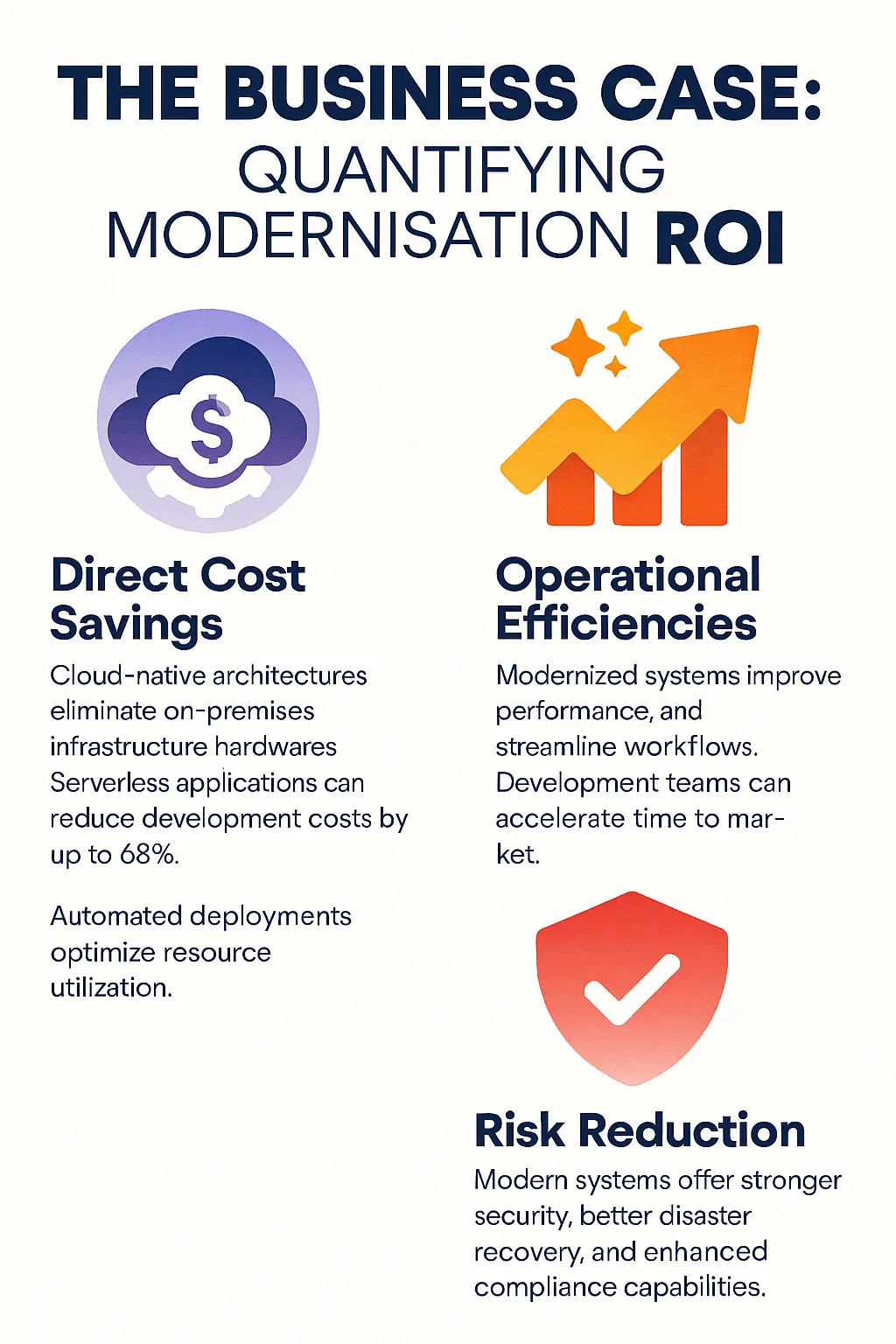
Direct Cost Savings
Cloud-native architecture eliminates on-premises infrastructure hardware acquisition and maintenance costs. Organisations no longer need to invest in procurement and maintenance of costly physical infrastructure, resulting in substantial long-term operational expense savings.
Pay-as-you-go pricing models significantly reduce upfront IT infrastructure costs. Instead of purchasing capacity for peak loads that sits idle most of the time, you pay only for resources you actually use, avoiding costs associated with over-provisioning.
Serverless applications can reduce development costs by up to 68%, particularly for environments with variable workloads. Automated resource deployment saves time and optimises costs by eliminating manual provisioning and reducing overprovisioning.
Operational Efficiencies
Modernised systems dramatically improve performance, reducing system downtime and streamlining workflows. Development teams can deploy new features faster through flexible architecture, accelerating time to market.
Organisations typically experience a 30% productivity lift after full adoption of cloud-native practices. This efficiency gain compounds over time as teams become more proficient with modern development practices.
Risk Reduction
Perhaps the most significant—but hardest to quantify—benefit is risk reduction. Modern systems provide better security, improved disaster recovery, enhanced compliance capabilities, and greater operational resilience. These factors directly address board-level concerns about business continuity and reputational risk.
Managing Risks and Change
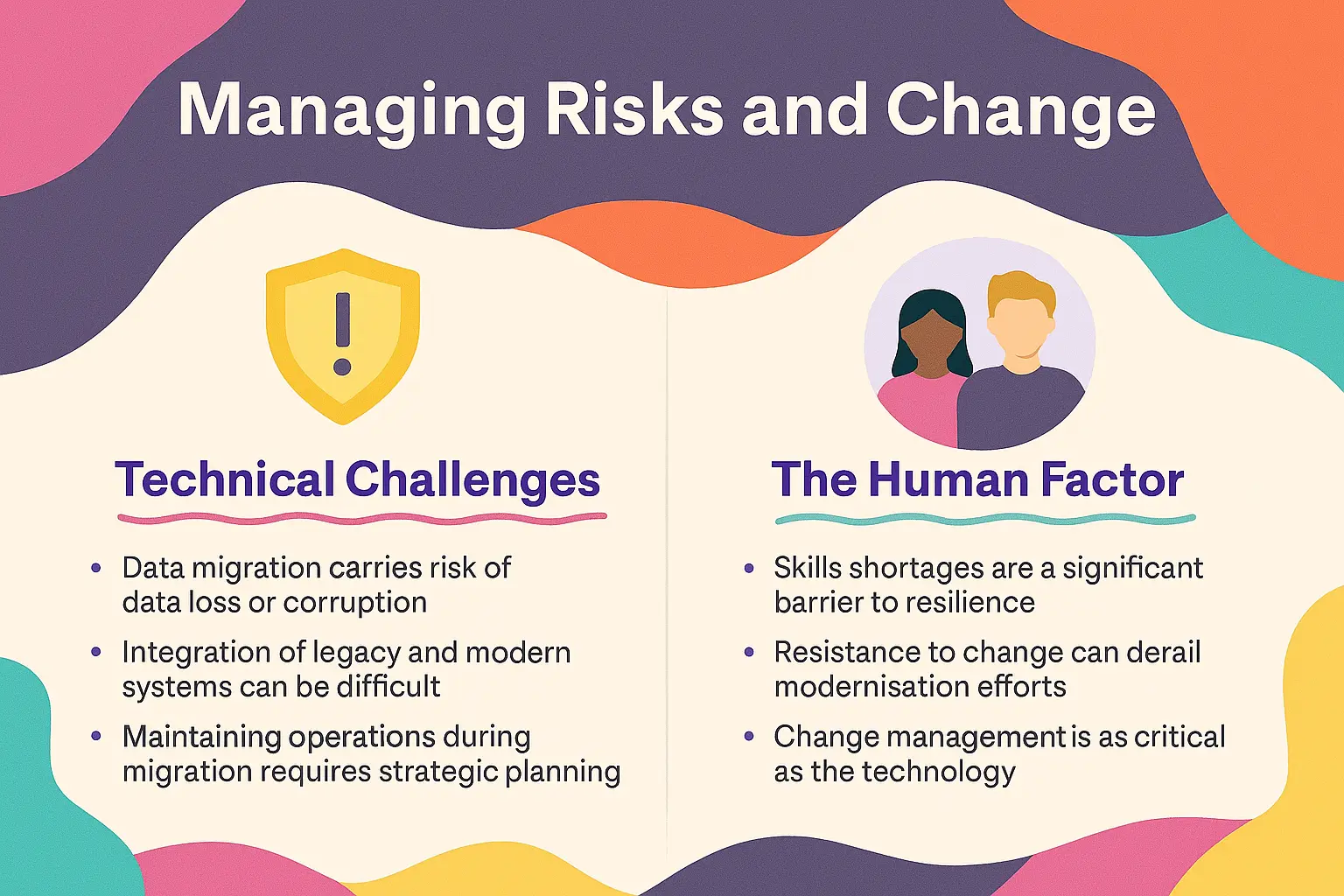
Technical Challenges
Legacy modernisation isn't without risks. Data migration requires careful planning and validation to prevent loss or corruption. Integration difficulties can emerge when connecting legacy systems with modern applications during transition periods. Maintaining business operations during migration demands thoughtful phasing and robust rollback capabilities.
These risks are manageable with proper planning, but they require acknowledgment and mitigation strategies from the outset.
The Human Factor
Nearly a third of Australian businesses identify skills shortages as the biggest barrier to operational resilience. Your existing IT team likely has deep knowledge of legacy systems but may lack cloud-native expertise.
Organisational resistance to change can derail even technically sound modernisation efforts. Change management—ensuring staff understand, support, and are equipped for new ways of working—is as critical as the technology itself.
Successful modernisation requires executive endorsement, clear communication of benefits, comprehensive training programs, and patience as teams adapt to new tools and processes.
Your 90-Day Modernisation Roadmap
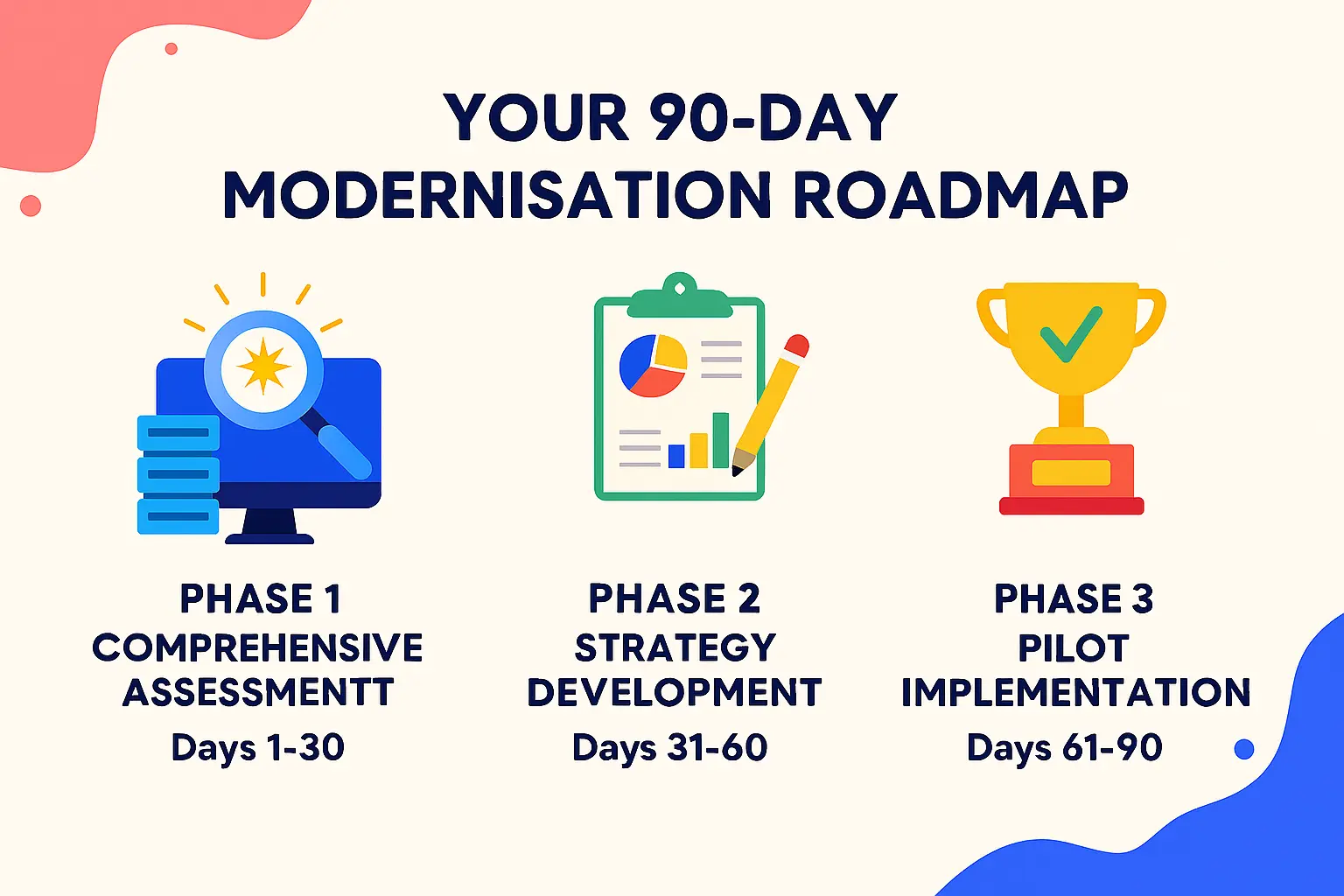
Phase 1: Comprehensive Assessment (Days 1-30)
Begin by cataloguing every workload, data store, and integration point using automated discovery tools. This inventory phase often reveals surprising insights about what systems actually exist and how they interconnect.
Evaluate current systems to identify which are outdated, underperforming, or creating security risks. Map each asset against regulatory requirements including GDPR, HIPAA, and CPS 230 to understand compliance gaps.
Document business value, technical complexity, and interdependencies for each system. This assessment creates the foundation for prioritising modernisation efforts.
Phase 2: Strategy Development (Days 31-60)
Apply the 7 Rs framework to each system, determining the appropriate modernisation approach based on business value, technical complexity, and strategic importance.
Define clear success metrics and key performance indicators that align with business objectives—not just technical measurements. Build a comprehensive business case with total cost of ownership analysis that board members and financial stakeholders can evaluate.
Engage stakeholders across the entire organisation, ensuring alignment between IT, business units, finance, and executive leadership. Misalignment at this stage creates friction throughout implementation.
Phase 3: Pilot Implementation (Days 61-90)
Select a low-risk, high-value pilot project that can demonstrate benefits without jeopardising critical operations. Success with an initial project builds organisational confidence and reveals challenges in a controlled environment.
Document lessons learned meticulously. Every organisation's modernisation journey is unique, and early insights prove invaluable for subsequent phases.
Refine your approach based on pilot results before scaling to more critical systems. This measured progression balances urgency with prudent risk management.
Choosing the Right Modernisation Partner
Essential Capabilities
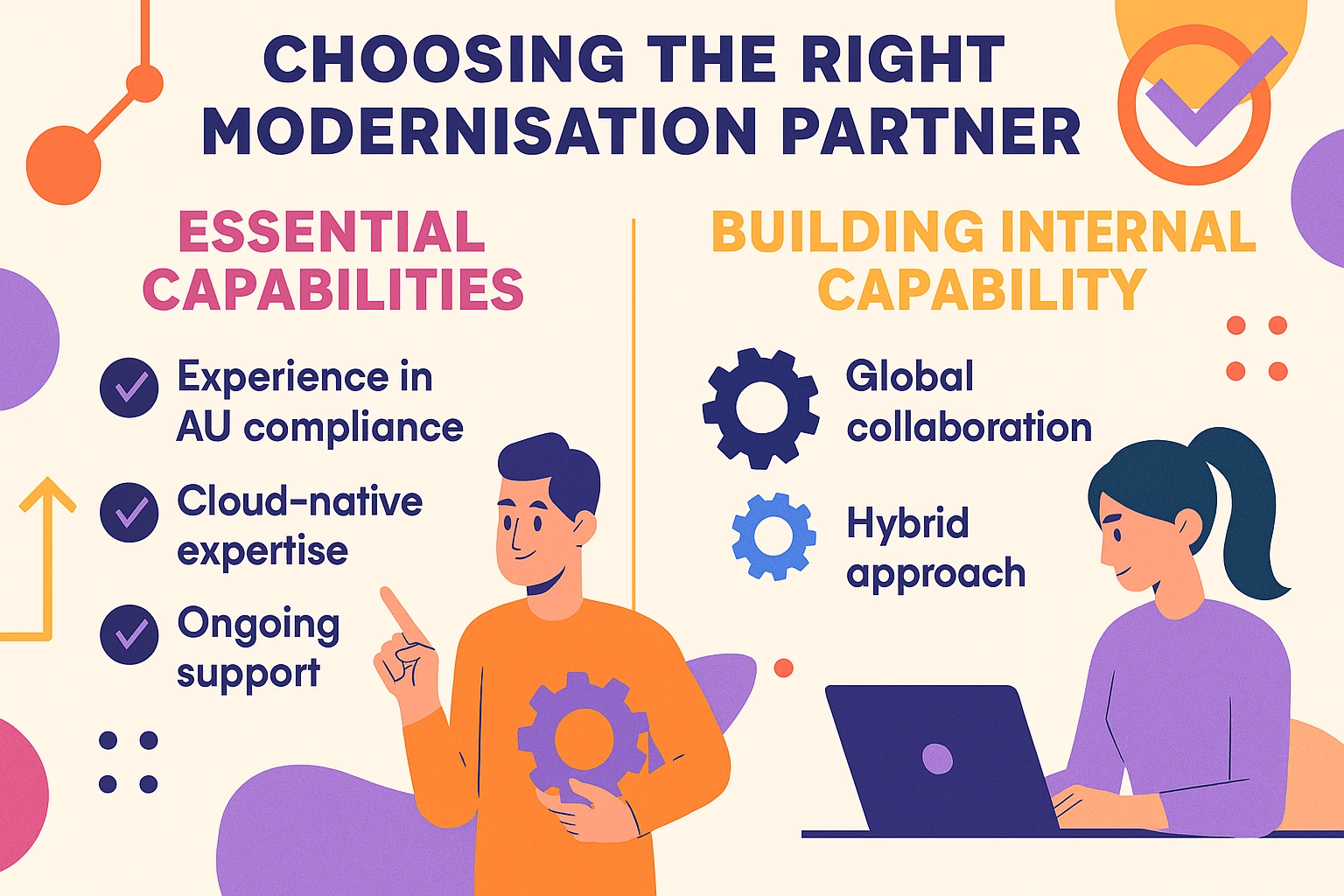
Select development partners with demonstrated experience in Australian compliance requirements, particularly CPS 230 and data sovereignty obligations. Local regulatory knowledge isn't optional—it's fundamental to avoiding costly compliance failures.
Look for proven cloud-native expertise across major platforms including AWS, Azure, and Google Cloud. Your partner should have track records with incremental modernisation approaches, not just "big bang" replacements that carry excessive risk.
Post-migration support capabilities matter tremendously. The relationship doesn't end at go-live; ongoing optimisation, troubleshooting, and evolution require sustained partnership.
Building Internal Capability
Many Australian businesses collaborate with global engineering experts due to the complex and time-sensitive nature of modernisation. However, the goal shouldn't be complete outsourcing—you need to build internal cloud-native capabilities over time.
Consider hybrid models where external partners handle initial heavy lifting whilst knowledge transfers to internal teams. This approach balances speed with long-term capability development.
Future-Proofing Your Technology Investment
Continuous Improvement
Approaching modernisation as a one-off project risks falling behind again. Resilience and agility require sustained commitment to continuous improvement. Modern systems enable regular updates without downtime, allowing organisations to evolve continuously rather than in disruptive big-bang projects every decade.
Implement DevOps practices and continuous integration/continuous deployment pipelines that enable rapid, reliable feature releases. These practices transform how quickly you can respond to opportunities and challenges.
Emerging Technologies
Cloud-native architecture positions organisations to adopt emerging technologies including serverless computing for ultimate scalability and cost optimisation, artificial intelligence and machine learning capabilities that require flexible data architectures, edge computing for latency-sensitive applications, and service mesh adoption for complex microservices environments.
The key benefit of modernisation isn't just solving today's problems—it's creating a technology foundation that can adapt to tomorrow's opportunities.
Take Action: Your Next Steps
Legacy system modernisation isn't a luxury or a nice-to-have—it's a business imperative. With CPS 230 taking effect in July 2025, regulatory pressure adds urgency to the competitive and operational drivers already demanding action.
The question isn't whether to modernise, but how quickly and strategically you can execute transformation whilst managing risk and maintaining operations.
Ready to begin your modernisation journey?
At C9, we specialise in helping Australian businesses navigate the complex transition from legacy systems to cloud-native architecture. Our team understands local compliance requirements, has delivered successful modernisation projects across industries, and takes an incremental approach that balances speed with prudent risk management.
Contact C9 today for a complimentary legacy system assessment. We'll evaluate your current environment, identify quick wins and long-term opportunities, and develop a practical roadmap aligned with your business objectives and timeline.
Don't let legacy systems hold your business back in 2025 and beyond. The time to act is now.
About C9 Australia
C9 is a leading custom application development services company specialising in cloud-native architecture, legacy system modernisation, and digital transformation for Australian enterprises. With deep expertise in compliance requirements including CPS 230, we help organisations modernise technology infrastructure whilst maintaining operational continuity. Learn more at www.c9.com.au