Your business invested heavily in ERP, CRM, and legacy systems over the years. They function—mostly. But your team drowns in manual processes, copying data between disconnected systems, chasing approvals through endless email chains, and spending hours on tasks that should take minutes.
Power Platform and Power Automate promise to solve this: connect your existing business systems, automate workflows, and unlock data trapped in organisational silos. The technology delivers—when implemented correctly.
Here's the reality: 67% of Power Platform projects fail to deliver expected ROI. Not because the technology doesn't work, but because businesses rush into development without proper planning, choose inexperienced partners, or fall victim to what we call "AI Cowboys" practising "vibes coding."
As Australia's leading custom software, apps, integration, and database developer, C9 has witnessed both spectacular successes and costly failures. This guide reveals what you must know before signing any Power Platform development contract.
The Hidden Tax of Disconnected Systems
Every day, Australian businesses pay an invisible tax. Finance teams manually enter invoice data from emails into accounting systems. Sales teams toggle between Salesforce, SharePoint, and Outlook updating customer records. Operations managers export CSV files from one system to import into another—praying data doesn't disappear.
Recent studies show Australian businesses waste an average of 26 hours per employee monthly on repetitive, manual tasks that could be automated. For a company with 50 employees, that's 1,300 hours monthly—equivalent to 7.5 full-time employees doing nothing but copying and pasting data.
The Real Cost Extends Beyond Time
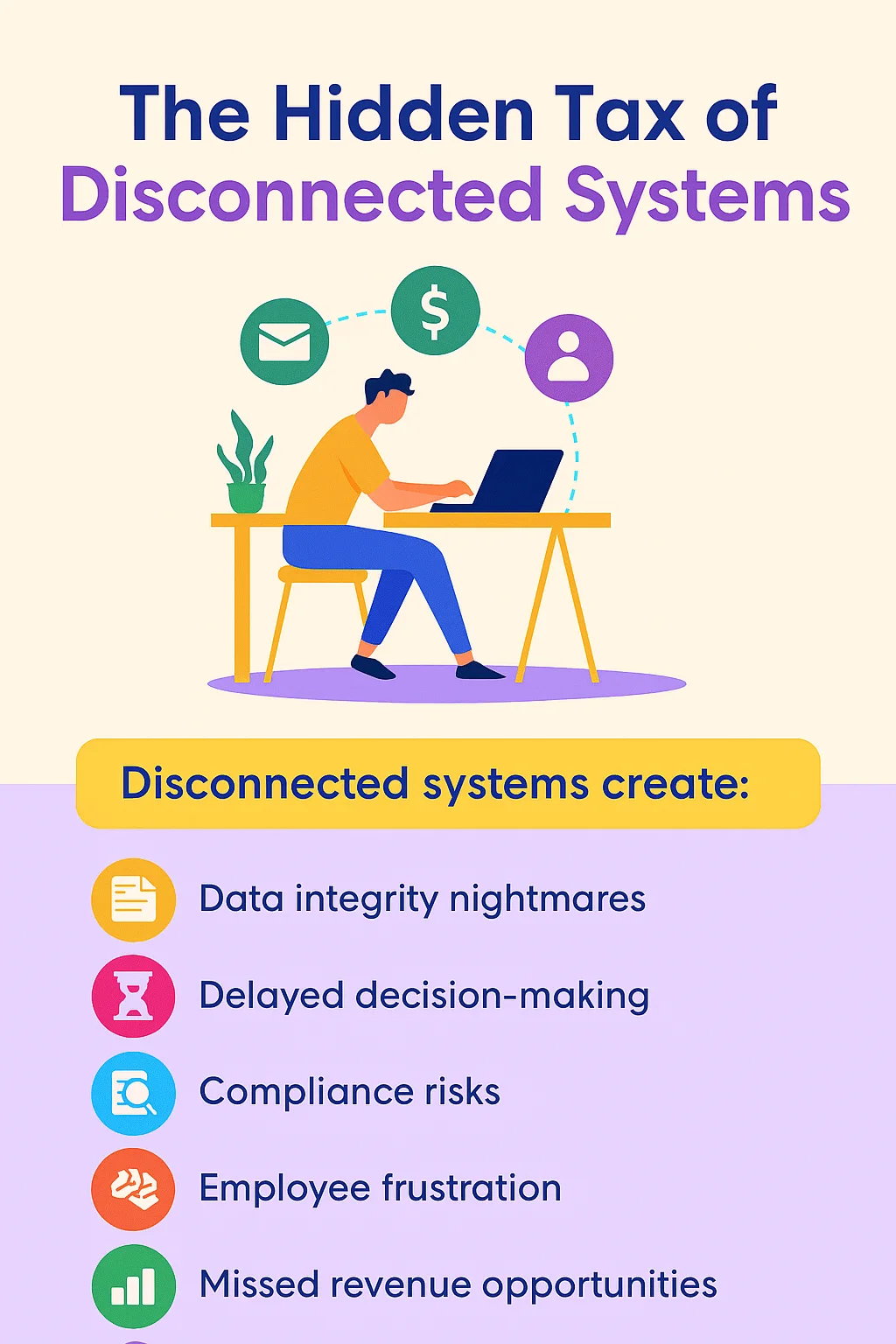
Disconnected systems create:
- Data integrity nightmares: Multiple versions of truth across different systems
- Delayed decision-making: Executives can't access real-time insights when data fragments
- Compliance risks: Audit trails break down across multiple disconnected systems
- Employee frustration: Top talent wasting time on mind-numbing administrative work
- Missed revenue opportunities: Slow quote-to-cash cycles from manual handoffs
- Security vulnerabilities: Shadow IT solutions bypassing proper controls
One Australian manufacturing client discovered their manual order processing cost them $847,000 in lost orders over 18 months—orders simply "lost" between CRM and ERP because someone forgot to send an email.
Why Most Power Platform Projects Fail
You've identified the problem. You're ready to fix it. You search for "Power Platform developer Australia" or "Power Automate consultant" and suddenly face overwhelming options:
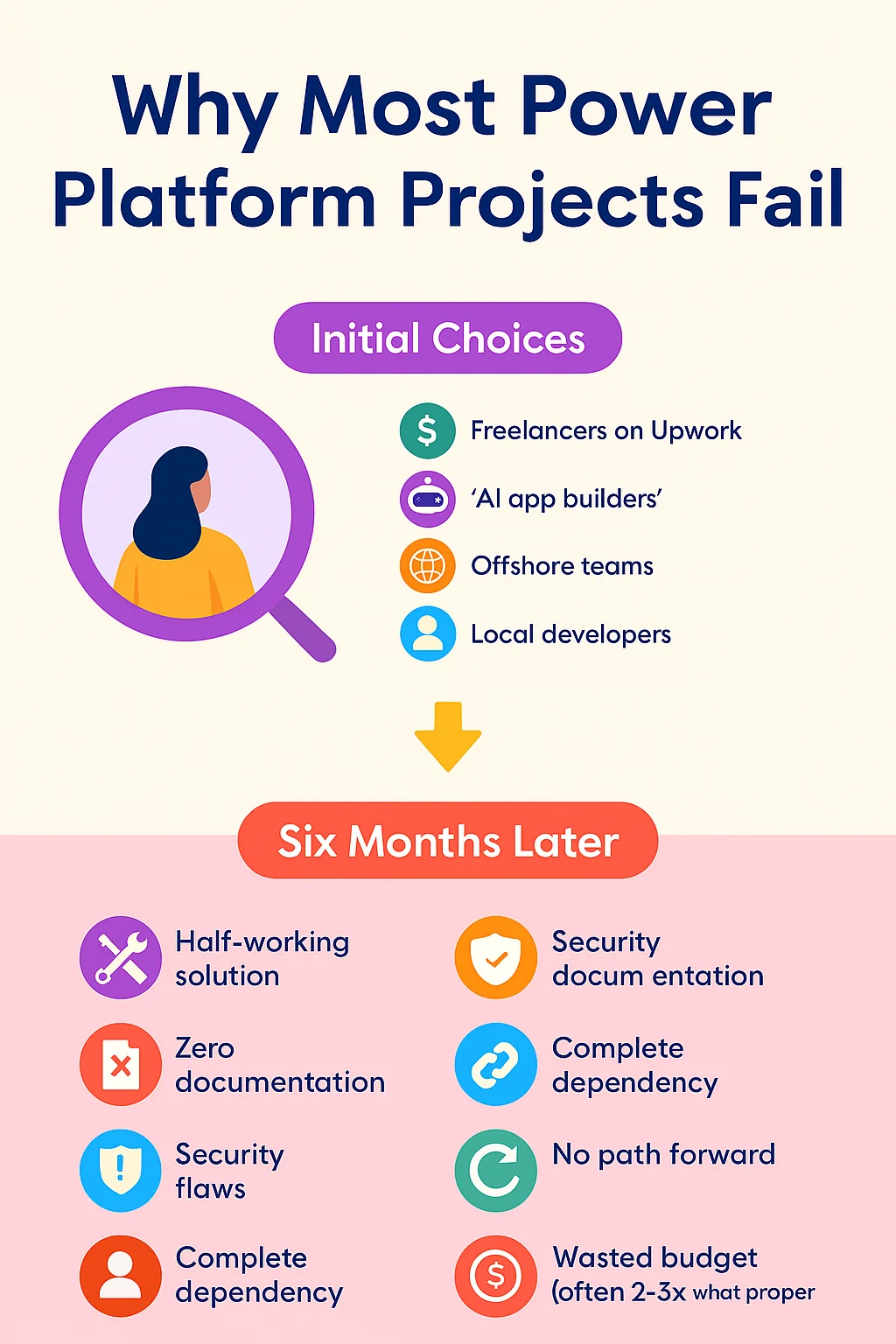
- Freelancers on Upwork promising solutions for $2,000
- "AI App Builders" claiming they can integrate systems in 2 weeks using ChatGPT
- Offshore teams offering rock-bottom hourly rates
- Local developers quoting $150-$250/hour with vague estimates
The cheapest, fastest option feels like smart business. Why pay more when someone does it for half the price?
Six months later, you'll have:
- A half-working solution breaking with every Microsoft update
- Zero documentation explaining functionality
- Security vulnerabilities from poor governance understanding
- Complete dependency on the original developer
- No path forward—foundation so poorly built you must start over
- Wasted budget (often 2-3x what proper implementation would have cost)
The "AI Cowboy" Phenomenon: Technical Debt Disguised as Innovation
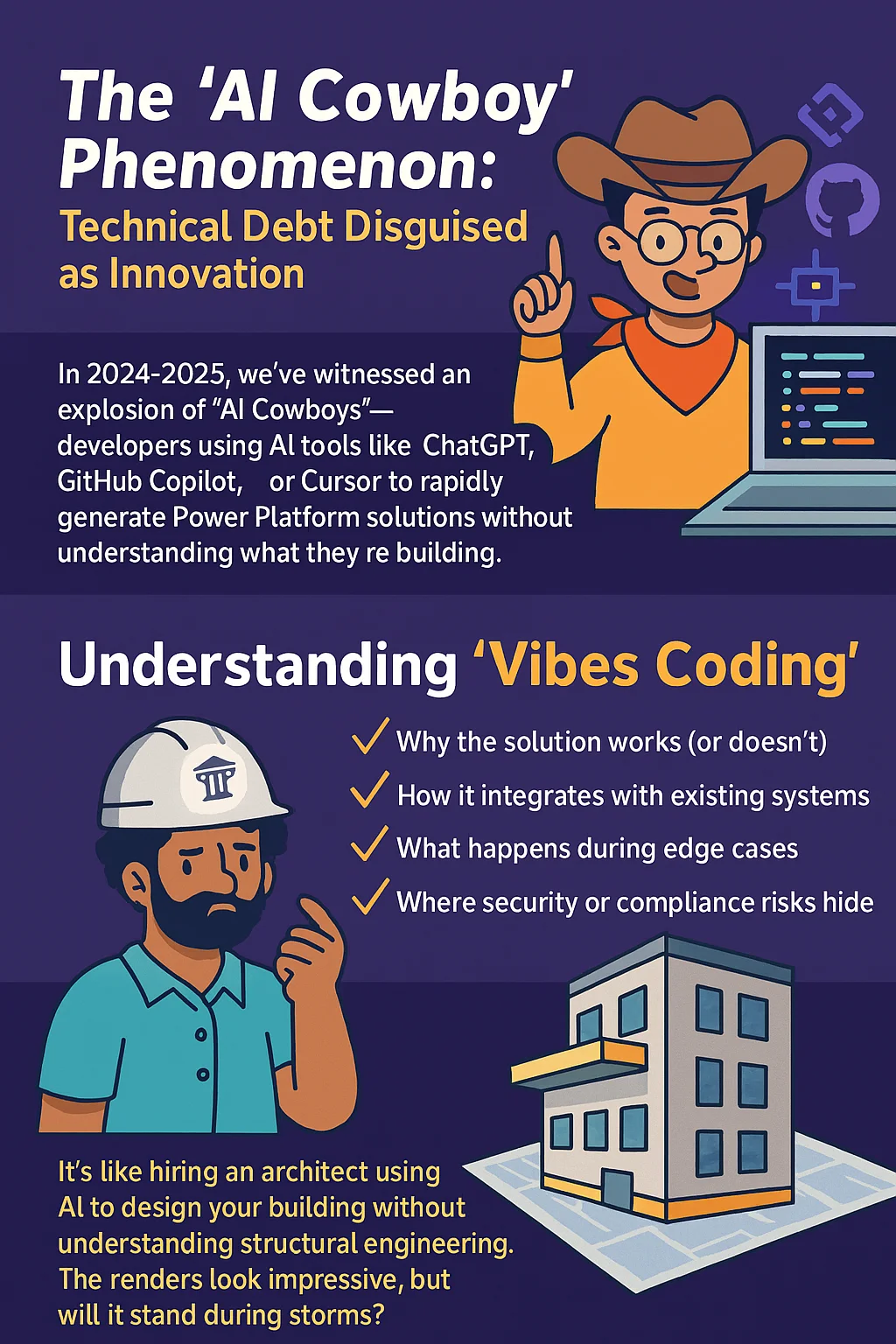
In 2024-2025, we've witnessed an explosion of "AI Cowboys"—developers using AI tools like ChatGPT, GitHub Copilot, or Cursor to rapidly generate Power Platform solutions without understanding what they're building.
Understanding "Vibes Coding"
"Vibes coding" means asking AI to generate code or configurations from high-level descriptions, then implementing results without truly understanding:
- Why the solution works (or doesn't)
- How it integrates with existing systems
- What happens during edge cases
- Where security or compliance risks hide
It's like hiring an architect using AI to design your building without understanding structural engineering. The renders look impressive, but will it stand during storms?
Gray Areas Creating Technical Debt
AI-generated Power Platform solutions frequently miss critical considerations:
Security & Governance Issues:
- Overly permissive access controls
- Hardcoded credentials instead of secure connection references
- No data loss prevention (DLP) policy considerations
Scalability Problems:
- Solutions working fine with 10 users but collapsing at 100
- Non-optimised delegable queries causing performance degradation
- No consideration for API throttling or rate limits
Integration Fragility:
- Solutions working in test environments but failing in production
- Missing error handling when external systems become unavailable
- Brittle connections breaking with minor schema changes
Maintenance Nightmares:
- Zero documentation explaining complex logic
- No version control or change management processes
- Solutions only the original creator can maintain
Real-World Disaster: The $180,000 "Quick Fix"
An Australian financial services firm hired a cheap Power Automate freelancer to build document approval workflows. Total cost: $8,000. Six months later:
- The workflow processed 200+ daily approvals
- One morning, everything stopped—all approvals frozen
- The freelancer had disappeared
- No error handling or logging existed
- C9 rescued the project at $67,000
- Lost productivity during downtime: $113,000
- Total damage: $180,000 for an "$8,000 savings"
The freelancer used AI to generate basic approval flow but never considered API throttling, concurrent approvals, error logging, exception handling, or delegation limits.
This represents the hidden cost of "vibes coding."
Why Discovery Calls Are Non-Negotiable
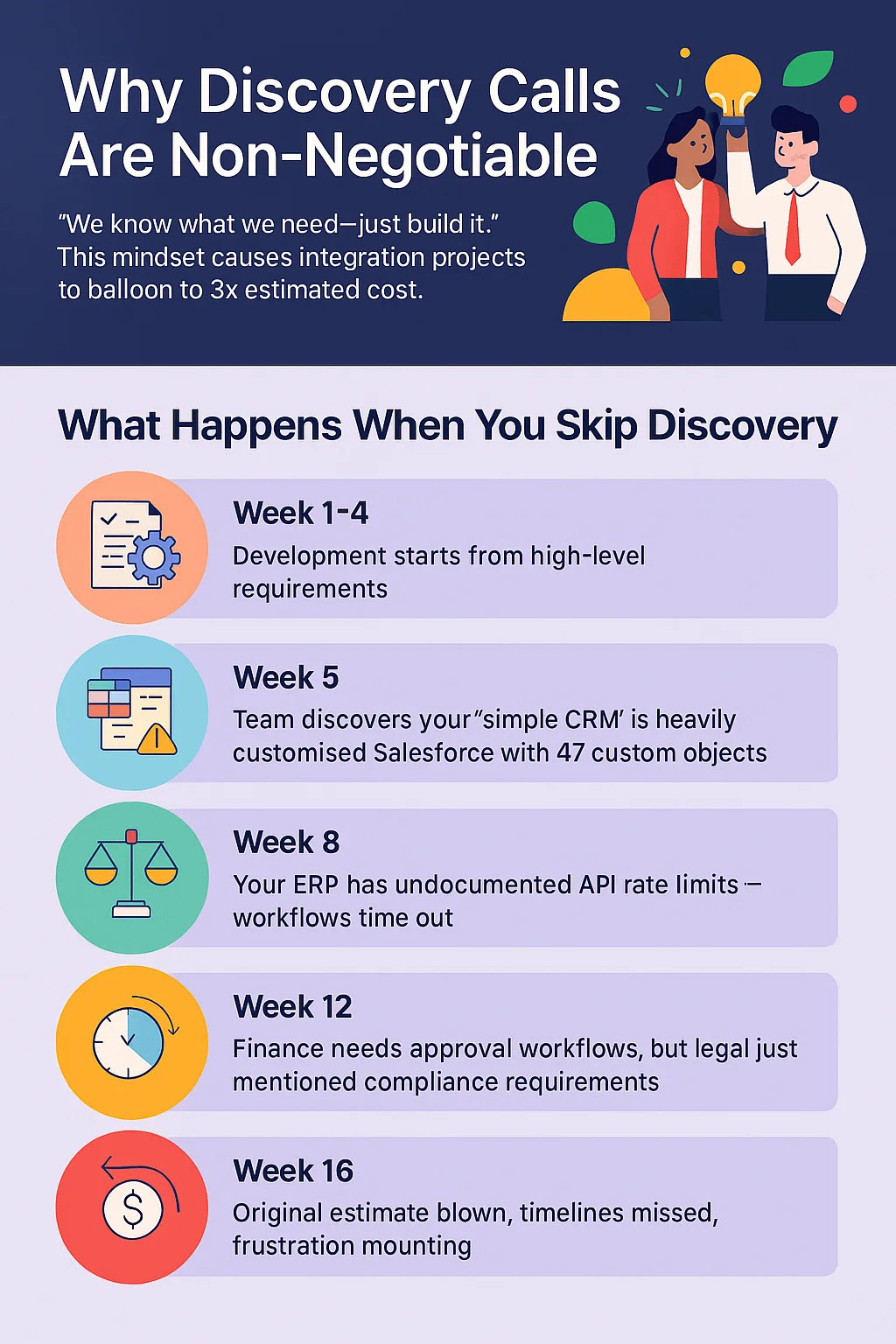
Most businesses want to skip straight to development. "We know what we need—just build it." This mindset causes integration projects to balloon to 3x estimated cost.
What Happens When You Skip Discovery
Week 1-4: Development starts from high-level requirements
Week 5: Team discovers your "simple CRM" is heavily customised Salesforce with 47 custom objects
Week 8: Your ERP has undocumented API rate limits—workflows time out
Week 12: Finance needs approval workflows, but legal just mentioned compliance requirements
Week 16: Original estimate blown, timelines missed, frustration mounting
Week 20: Project paused for "re-scoping"—back to square one after spending $80,000
The C9 Discovery Process
At C9, every dollar spent on discovery saves ten dollars in development. Our structured process maps business reality, uncovers hidden complexity, and creates success blueprints.
Phase 1: Initial Consultation (1-2 Hours) - Complimentary
We determine if Power Platform integration is even the right solution by exploring:
- Current pain points and business impact (quantified in dollars and hours)
- Existing technology ecosystem (every system, integration, workaround)
- Business objectives (what success looks like in 6, 12, 24 months)
- Team technical capabilities
- Timeline and budget reality
30% of potential clients discover during this phase that Power Platform isn't their best solution—we redirect them before wasting money.
Phase 2: Deep Discovery Workshop (4-8 Hours)
We map every decision point, integration touchpoint, data flow, and edge case through:
- System audit: Documenting every system, API, database, integration point
- Process mapping: Walking through actual workflows (not SOPs—what really happens)
- Data flow analysis: Tracing where data originates, moves, and breaks
- User interviews: Speaking with people doing daily work
- Compliance review: Australian regulations, industry requirements, data sovereignty
- Security assessment: Current access controls, authentication methods, DLP requirements
This delivers:
- Detailed integration architecture diagrams
- User story matrices
- Technical specification documents
- Risk registers with mitigation strategies
- Accurate project timelines
- Fixed-price proposals based on known scope
This investment (typically $3,000-$8,000 depending on complexity) eliminates scope creep, prevents cost blowouts, and ensures aligned expectations.
Discovery vs. No Discovery: Real Numbers
Project A: With Discovery
- Discovery investment: $5,000
- Development: $45,000
- Timeline: 12 weeks
- Total cost: $50,000
- Delivered on time: Yes
- ROI achieved: 4 months
Project B: Without Discovery
- Discovery: $0 (skipped)
- Initial estimate: $35,000
- Actual development: $67,000
- Emergency fixes: $12,000
- Timeline: 22 weeks
- Total cost: $79,000
- Delivered on time: No
- ROI achieved: 11 months
Project B cost 58% more and took 83% longer. The "$5,000 savings" became a $29,000 additional cost.
Why C9 Stands Apart from Hundreds of Australian Developers
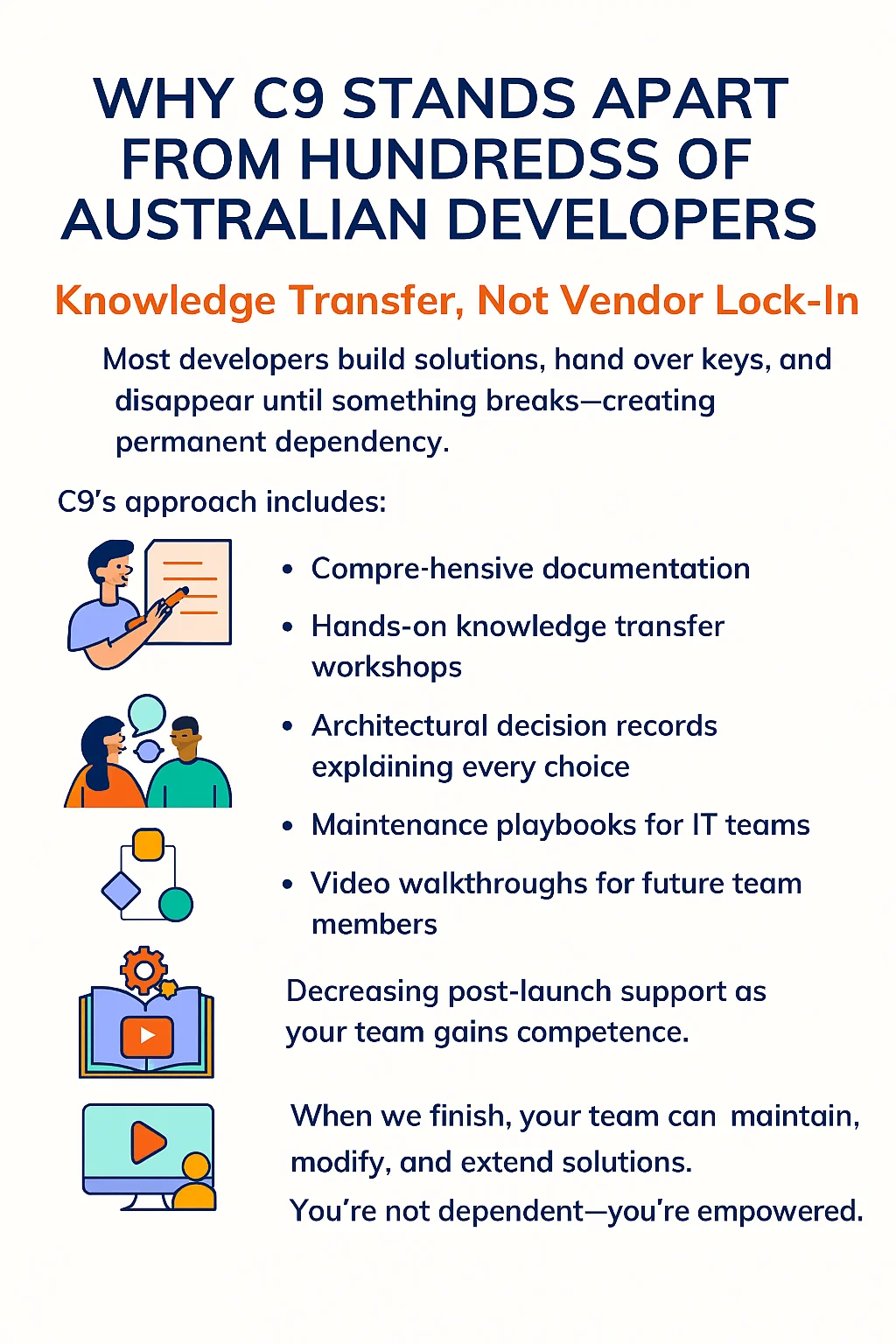
1. Knowledge Transfer, Not Vendor Lock-In
Most developers build solutions, hand over keys, and disappear until something breaks—creating permanent dependency.
C9's approach includes:
- Comprehensive documentation
- Hands-on knowledge transfer workshops
- Architectural decision records explaining every choice
- Maintenance playbooks for IT teams
- Video walkthroughs for future team members
- Decreasing post-launch support as your team gains competence
When we finish, your team can maintain, modify, and extend solutions. You're not dependent—you're empowered.
2. The Blended Hybrid Model: Best of Both Worlds
The Australian developer dilemma:
- All-Australian teams: $150-$250/hour, limited capacity, slower delivery
- All-offshore teams: $40-$80/hour, communication challenges, timezone chaos, quality concerns
C9's hybrid approach combines:
- Senior architects and project leads: Australian-based, your timezone, strategic oversight
- Development team: Blend of onshore and offshore directly hired talent
- Quality assurance: Australian-based oversight
- Account management: Local, accessible, understands Australian business culture
This delivers:
- Cost savings: 30-50% lower than all-Australian teams
- Quality assurance: Australian leadership ensures standards
- Communication: Meetings in your timezone, rapid responses
- Risk mitigation: Multiple team members understand your project
3. Skills-Based Pricing (Not One-Size-Fits-All)
Most developers charge flat hourly rates for everything. C9 offers skills-based pricing:
| Role |
Hourly Rate (AUD) |
| Solution Architect |
$185-$220/hour |
| Senior Developer |
$140-$165/hour |
| Mid-Level Developer |
$95-$120/hour |
| Junior Developer |
$65-$85/hour |
| Project Manager |
$120-$145/hour |
| QA Analyst |
$85-$105/hour |
Rates reflect blended onshore and offshore C9 directly hired talent, subject to CPI adjustments. Additional discounts available for long-term contracts (12+ months) and multi-resource engagements (3+ team members).
Example savings:
Flat-Rate Competitor ($180/hour):
- Solution design: 8 hours × $180 = $1,440
- Development: 40 hours × $180 = $7,200
- Testing: 12 hours × $180 = $2,160
- Total: $10,800
C9 Skills-Based Model:
- Solution design: 8 hours × $200 = $1,600
- Development: 32 hours × $110 + 8 hours × $75 = $4,120
- Testing: 12 hours × $95 = $1,140
- Total: $6,860 (36% less with better quality)
4. Remote-First Delivery (Clear Expectations)
C9 does NOT offer:
- Traditional in-house local hiring in Australia
- Developers sitting in your office 9-to-5
- "Bums-in-seats" staff augmentation
C9 DOES offer:
- Remote-first delivery with Australian and international directly hired talent
- Outcome-focused engagement
- Flexible communication
- Australian business hours alignment
If your organisation requires physical office presence, C9's model may not fit. We specialise in remote delivery with Australian leadership and accountability—maintaining quality whilst keeping costs reasonable.
Staff Augmentation: Flexible Expertise When You Need It
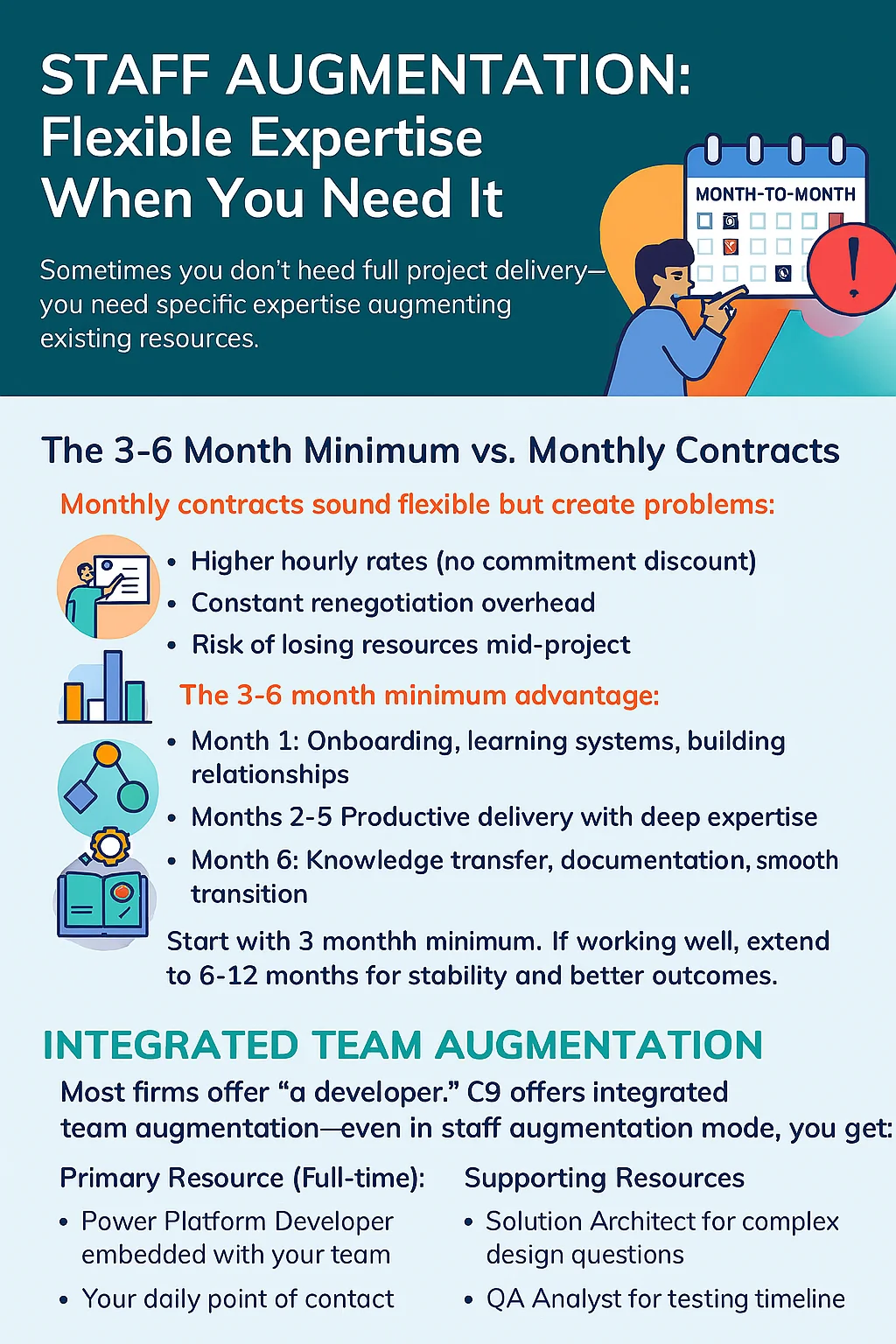
Sometimes you don't need full project delivery—you need specific expertise augmenting existing resources.
The 3-6 Month Minimum vs. Monthly Contracts
Monthly contracts sound flexible but create problems:
- Higher hourly rates (no commitment discount)
- Constant renegotiation overhead
- Resources not deeply invested in success
- Risk of losing resources mid-project
The 3-6 month minimum advantage:
Month 1: Onboarding, learning systems, building relationships
Months 2-5: Productive delivery with deep expertise
Month 6: Knowledge transfer, documentation, smooth transition
Start with 3 months minimum. If working well, extend to 6-12 months for stability and better outcomes.
Integrated Team Augmentation
Most firms offer "a developer." C9 offers integrated team augmentation—even in staff augmentation mode, you get:
Primary Resource (Full-time):
Supporting Resources (As-needed):
- Solution Architect for complex design questions
- QA Analyst for testing critical workflows
- Project Manager for timeline coordination
- Technical Writer for documentation support
Monthly packages can scale up or down with notice periods, with unused hours rolling over for future feature development stockpiling.
The Indicative Pricing Trap: Why Most Proposals Are Worthless
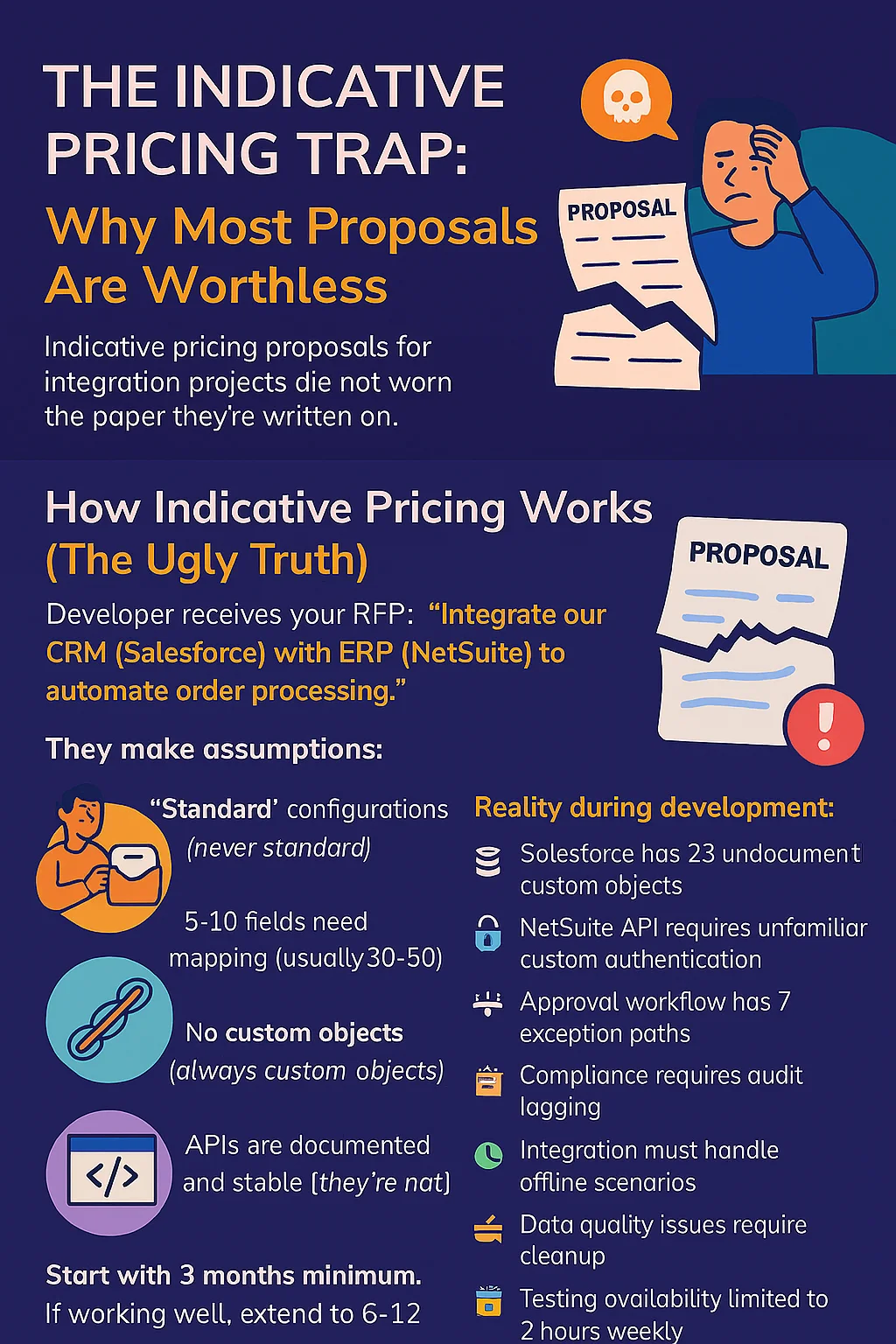
Indicative pricing proposals for integration projects are not worth the paper they're written on.
How Indicative Pricing Works (The Ugly Truth)
Developer receives your RFP: "Integrate our CRM (Salesforce) with ERP (NetSuite) to automate order processing."
They make assumptions:
- "Standard" configurations (never standard)
- 5-10 fields need mapping (usually 30-50)
- No custom objects (always custom objects)
- APIs are documented and stable (they're not)
Napkin math: "Basic integration... 120 hours development... plus testing... 160 hours total" 160 hours × $150/hour = $24,000, add 50% buffer = $36,000, round to $40,000
Proposal states: "Estimated cost: $40,000 ± 20%"
Reality during development:
- Salesforce has 23 undocumented custom objects
- NetSuite API requires unfamiliar custom authentication
- Approval workflow has 7 exception paths
- Compliance requires audit logging
- Integration must handle offline scenarios
- Data quality issues require cleanup
- Testing availability limited to 2 hours weekly
Actual cost: $78,000
Now you're battling scope and budget overruns.
Discovery-Based Pricing: The Right Way
After comprehensive discovery, C9 delivers phased, fixed-price proposals:
Phase 1: Foundation (Weeks 1-3) - $22,400
- Salesforce-NetSuite connection configuration
- Core object mapping
- Basic order sync workflow
- Working integration for standard orders
Phase 2: Exception Handling (Weeks 4-6) - $31,200
- 7 approval exception paths
- Custom object mapping (23 objects)
- Offline scenario handling
- Data validation
Phase 3: Compliance & Production (Weeks 7-9) - $18,600
- Audit logging implementation
- Compliance reporting
- Production deployment
- User training and knowledge transfer
Total: $72,200 (or start with Phase 1 only at $22,400 to prove value)
Phased Approach for Early ROI
Your order processing wastes 40 hours weekly in manual work.
Phase 1 results:
- Automates 50% of orders
- Saves 20 hours/week
- At $50/hour = $1,000/week savings
- ROI achieved in week 24
Phase 2 results:
- Automates remaining 45% of orders
- Additional 18 hours/week savings
- Now saving $1,900/week total
- Combined ROI achieved in week 29
By month 5, the project pays for itself. Every week after is pure profit.
Breaking projects into stages enables early ROI that feeds savings for future improvements.
The Cost of Waiting
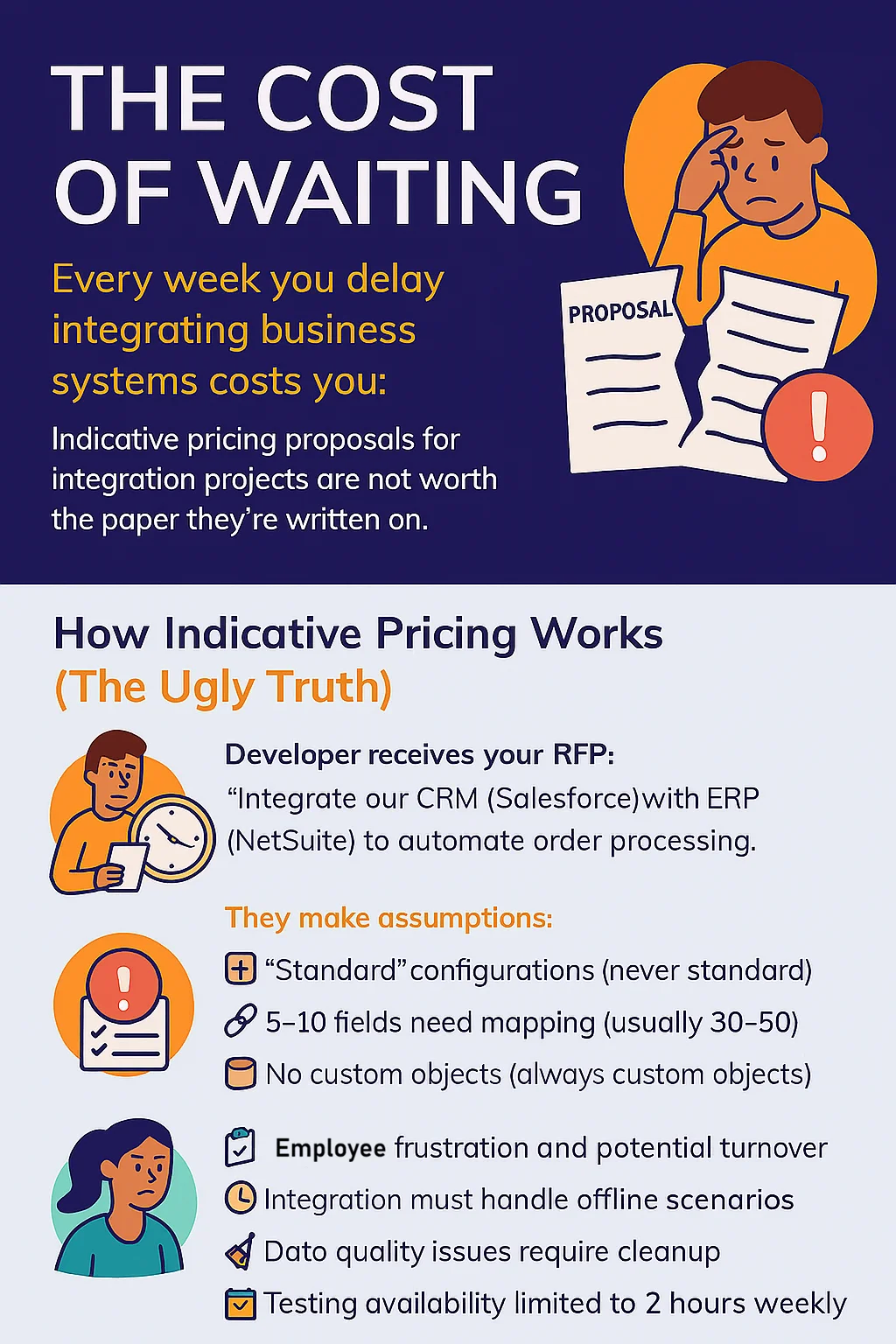
Every week you delay integrating business systems costs you:
- 26+ hours per employee in wasted manual work
- Data entry errors rippling through your organisation
- Delayed decisions from fragmented information
- Employee frustration and potential turnover
- Competitive disadvantage as others automate
If your business has 50 employees, and 30 spend just 10 hours monthly on automatable manual tasks:
300 hours/month × $50/hour = $15,000/month = $180,000/year in waste
A typical Power Platform integration investment of $50,000-$80,000 pays for itself in 4-6 months—then saves $180,000 annually.
The question isn't whether you can afford to integrate. It's whether you can afford not to.
Your Next Step: Book a Discovery Call with C9
Complimentary Initial Consultation (1-2 Hours)
No sales pitch. No obligation. Just honest assessment.
We'll:
- Listen to your current challenges (quantify pain in dollars and hours)
- Review your existing technology stack
- Determine if Power Platform is the right solution
- Identify immediate red flags
- Provide preliminary recommendations
Book your complimentary consultation:
🌐 https://www.c9.com.au/About/Contact
Deep Discovery Workshop (If We're a Good Fit)
Investment: $3,500 - $8,500 Duration: 1-2 weeks Deliverables: Complete architecture, detailed specifications, fixed-price proposal, ROI projections
This isn't expense—it's insurance against $80,000+ disasters from rushed projects.
Start Small, Prove Value, Scale Smart
Based on discovery, we'll recommend starting with Phase 1:
- Typically $15,000 - $35,000
- Delivers in 2-4 weeks
- Solves highest-impact pain point
- Proves ROI before major investment
Once you see results, scaling is easy. But you can't scale a bad foundation.
Don't Let Your Business Fall Behind
Your competitors are automating. Your employees are frustrated. Your data is fragmented. Your opportunity window is closing.
The difference between thriving and surviving in the next 12 months may come down to one decision: Do you continue with disconnected systems, or do you integrate and automate?
C9 has helped hundreds of Australian businesses transform operations through Power Platform integration. We've seen the struggles, solved the problems, and delivered measurable ROI.
Now it's your turn.
Book Your Complimentary Discovery Call Today
🌐 https://www.c9.com.au/About/Contact
Let's discover what's possible for your business.
About C9
C9 is Australia's leading custom software, apps, integration, and database development company. With a track record delivering complex Power Platform integrations for healthcare, finance, manufacturing, and professional services clients, we combine technical expertise with business outcome focus.
Our blended hybrid team model provides Australian strategic oversight with global delivery efficiency, ensuring quality outcomes at sensible costs. We specialise in projects other developers walk away from—complex integrations, legacy system modernisation, and strategic business transformation.
Our Certifications:
- Microsoft Gold Partner (Power Platform)
- ISO 27001 Certified (Information Security)
- Australian Cyber Security Centre (ACSC) Aligned
Ready to transform your business systems?
Start your Power Platform integration journey with C9 today.
🌐 https://www.c9.com.au
This blog was last updated December 2025. Power Platform capabilities, pricing, and market conditions are subject to change. All pricing examples are indicative and based on FY25/26 rates. Contact C9 for current pricing and availability.