Executive Summary
Australian businesses are drowning in disconnected systems. The average mid‑sized firm now uses 371 software applications, yet less than 28% are properly integrated — a gap causing millions in preventable losses. Manual data entry, inconsistent systems, and outdated processes are costing firms upwards of $50,000+ per year, not including lost productivity, customer churn, and compounding operational drag. While disconnected systems drain resources, competitors leveraging API‑first integration strategies are shipping features 78% faster, scaling efficiently, and delivering real‑time experiences customers expect. This guide explains why API‑first is now a survival requirement in 2026, how to avoid the trap of cheap integrations, and why discovery-driven architecture is the only safe pathway forward.
The Problem
Australian businesses rely on hundreds of systems that don’t communicate. Manual work, double‑handling, errors, and delays cripple finance, operations, sales, and customer experience — costing mid‑sized firms hundreds of thousands in lost revenue. Competitors with real‑time, API‑driven systems deliver faster, smarter, automated workflows that legacy integrations simply can’t match.
The Solution
API‑first development creates a connected ecosystem where every system communicates seamlessly. Instead of building applications first and “adding an API later,” API‑first designs the integration contract up front — enabling rapid development, scalable architecture, plug‑and‑play capabilities, and real‑time data visibility across the business.
[techbuzzonline.com]
What’s Next
2026 marks the turning point. Businesses that adopt API‑first integration gain automation, visibility, and speed. Those who don’t remain trapped in spreadsheets, rework, and legacy drag. The next strategic step: a structured discovery phase to map your systems, data flows, API requirements, technical blockers, and integration architecture before development begins.
As a business owner or executive in Australia, you're battling rising costs, fierce competition, and the pressure to achieve more with less. But what if the greatest threat to your growth isn't economic uncertainty or market shifts—it's the disconnected software systems quietly draining your resources? Picture losing $50,000 annually to manual data entry, errors, and missed opportunities because your CRM doesn't communicate with your inventory system, or your e-commerce platform fails to sync with your ERP. This isn't speculation; it's the harsh reality for many mid-sized Australian firms using an average of 371 different software applications, with less than 28% properly integrated.
You're not isolated in this challenge. Your finance team wastes hours weekly on automatable tasks, your sales team lacks real-time insights, and customers abandon carts due to outdated data. The outcome? Reduced productivity, frustrated staff, and competitors advancing with seamless, API-driven systems. While you manually transfer data between spreadsheets, they're releasing features 78% faster via API-first integration strategies.
Enter 2026, where software integration transcends technical details—it's the line between market dominance and obsolescence. At C9, we excel in custom software, apps, integration, and database development, empowering businesses like yours to escape these silos. In this post, we'll expose the stark realities of integration failures, highlight the perils of "cheap" solutions, and demonstrate how our collaborative, innovative approach crafts customised strategies that enhance efficiency and profitability.
The Brutal Truth About Software Integration in 2026
Let's confront it: the integration crisis is under-discussed but devastating Australian businesses. Consider AussieTech, a Melbourne manufacturing firm with "adequate" systems—an ERP from 2015, a CRM acquired in 2019, and an e-commerce platform launched in 2021. All top-tier, yet all isolated.
Their routine? Operations managers export orders from Shopify at 8:00 AM, manually input them into the ERP by 8:30 AM, identify duplicates by 9:15 AM, update spreadsheets by 10:00 AM, sync inventory manually by 11:30 AM, field customer calls on backorders by 2:00 PM, and correct invoicing errors by 3:00 PM. By 4:30 PM, consensus forms: "There must be a better approach." This $12M enterprise with 35 employees suffered from lost real-time visibility, resulting in oversold items, surging complaints, and $847,000 in revenue loss over two months—solely because systems didn't interconnect.
This isn't an anomaly; it's standard. The real crisis hit when a competitor launched same-day delivery. AussieTech wanted to match it, but their systems couldn't provide real-time inventory visibility. By the time they manually updated stock levels, items were oversold. Customer complaints skyrocketed. They lost three major accounts in two months—all because their systems didn't talk to each other.
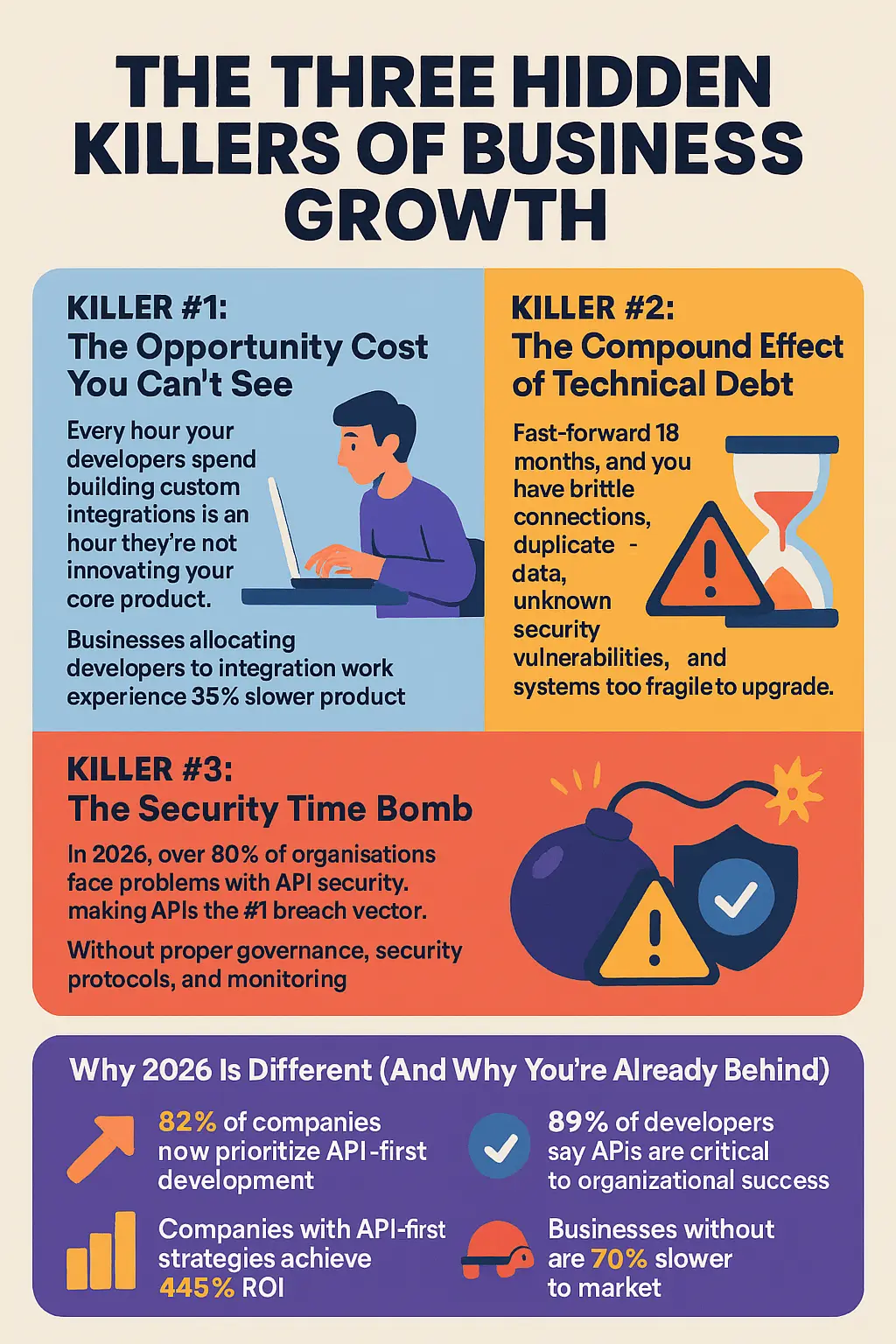
The Three Hidden Killers of Business Growth:
Killer #1: The Opportunity Cost You Can't See
Every hour your developers spend building custom integrations is an hour they're not innovating your core product. Businesses allocating developers to integration work experience 35% slower product velocity. Translation: Your competitors launch features in three months that take you six, surrendering tomorrow's advantage today.
Killer #2: The Compound Effect of Technical Debt
Nobody warns you about "quick integration fixes." They're like credit card debt—that temporary solution now supports multiple systems, and changing it breaks everything. Fast-forward 18 months, and you have brittle connections, duplicated data, unknown security vulnerabilities, and systems too fragile to upgrade. One API evangelist with 35 years in tech notes he's never seen technical debt accumulate this fast, turning maintenance into a nightmare.
Killer #3: The Security Time Bomb
In 2026, over 80% of organisations face problems with API security, making APIs the #1 breach vector. Without proper governance, security protocols, and monitoring, you're creating data breach highways. In Australia's stringent regulatory environment (Privacy Act 2025), a single breach costs $3.35 million on average, with penalties up to $50 million or 30% of turnover, plus irreparable reputation damage.
Why 2026 Is Different (And Why You're Already Behind):
API-first development isn't a trend—it's survival. Here are the numbers:
- 82% of companies now prioritise API-first development (up from 23% in 2023).
- 89% of developers say APIs are critical to organisational success.
- Companies with API-first strategies achieve 445% ROI.
- Businesses without are 70% slower to market.
Yet, 93% of API teams face collaboration blockers. Even those trying struggle—imagine laggards.
Australian Context: Why You Can't Afford to Wait:
- Labour shortages: Can't hire out of inefficiency.
- Geographic isolation: Integration enables global competition.
- Regulatory complexity: APRA, ASIC, Privacy Act demand compliant systems.
- Customer expectations: Aussies expect Amazon-level experiences—real-time tracking, instant visibility, seamless omnichannel, immediate responses.
Without proper software and apps integration, you can't deliver at scale.
The API-First Solution (But Not the Way You Think)
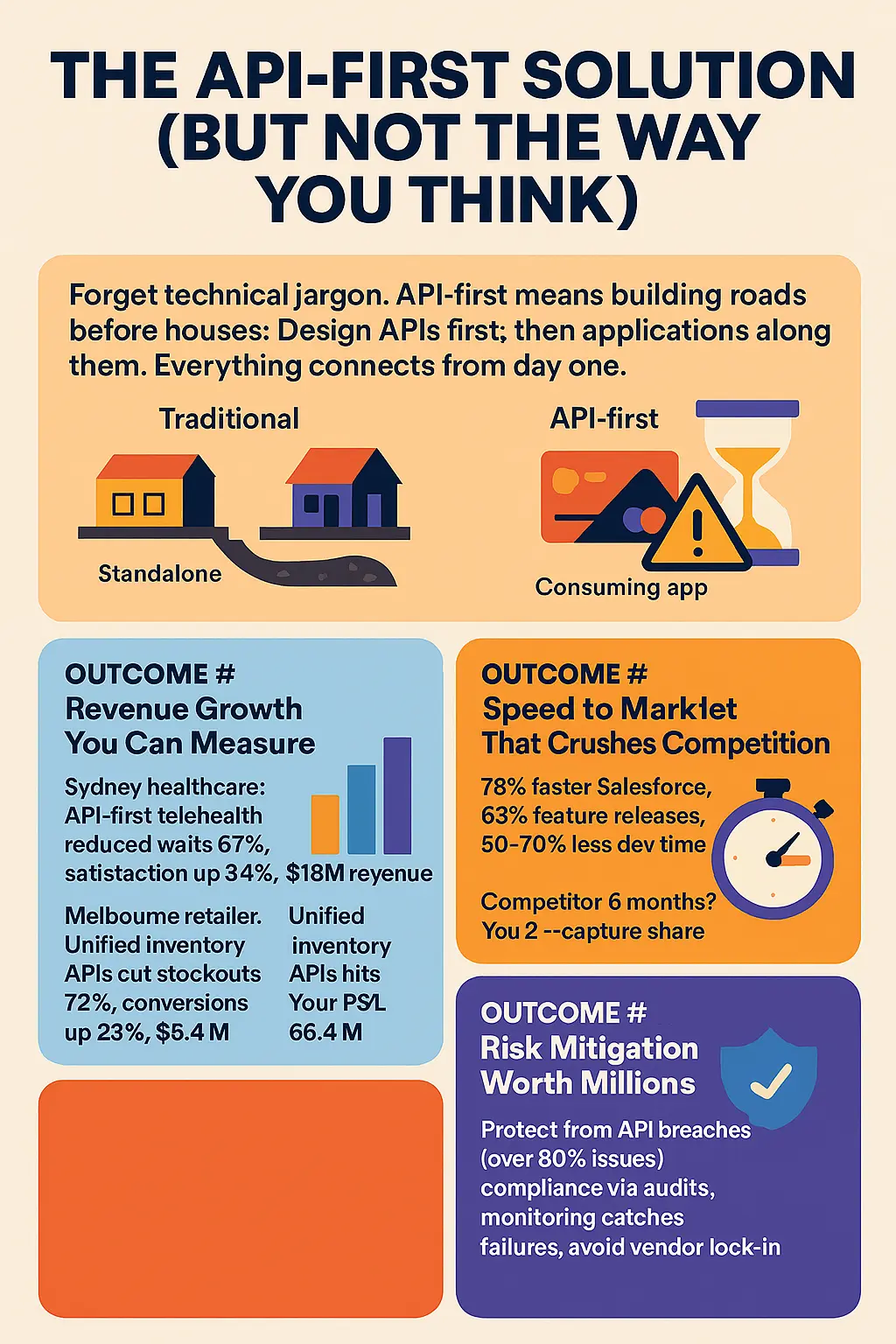
Forget technical jargon. API-first means building roads before houses: Design APIs first, then applications along them. Everything connects from day one.
Traditional: Build standalone, then dig tunnels.
API-first: Design APIs, build consuming apps.
Practical Example: New customer portal.
Traditional:
- Build portal.
- Need CRM data: 4-8 weeks integration.
- Need ERP orders: 6-10 weeks.
- Need billing payments: 3-6 weeks. Total: 5-6 months.
API-first:
- Design APIs for data, orders, payments.
- Build portal using APIs.
- Launch in 6-8 weeks.
- Add mobile? Same APIs.
- Add chatbot? Same APIs. Total: 6-8 weeks, reusable.
The Four Business Outcomes:
Outcome #1: Revenue Growth You Can Measure
Sydney healthcare: API-first telehealth reduced waits 67%, satisfaction up 34%, $18M revenue.
Melbourne retailer: Unified inventory APIs cut stockouts 72%, conversions up 23%, $6.4M revenue.
Outcome #2: Operational Efficiency That Hits Your P&L
Australian businesses: 30-40% finance workload cut, 45% faster service, 52% fewer errors, 60% less IT "plumbing."
Outcome #3: Speed to Market That Crushes Competition
78% faster Salesforce, 65% feature releases, 50-70% less dev time.
Competitor 6 months? You 2—capture share.
Outcome #4: Risk Mitigation Worth Millions
Protect from API breaches (over 80% issues), compliance via audits, monitoring catches failures, avoid vendor lock-in.
Brisbane firm avoided $3.2M breach via API monitoring.
Real Cost of No Strategy: 50-person business—
- Manual entry: 5 staff × 10h/wk × $45/h × 52wks = $117,000/yr
- Lost sales: 3% abandonment improvement = $180,000/yr ($6M biz)
- Dev time: 40% of 2 devs × $130K = $104,000/yr
- Errors: 2% revenue = $120,000/yr
- Delayed launches: Market loss $340,000/yr
Total: $861,000/yr.
C9 phased: $120K-$180K first year. Payback 2.5-4 months, then $680K+ savings.
The Dark Side of "Cheap" Solutions
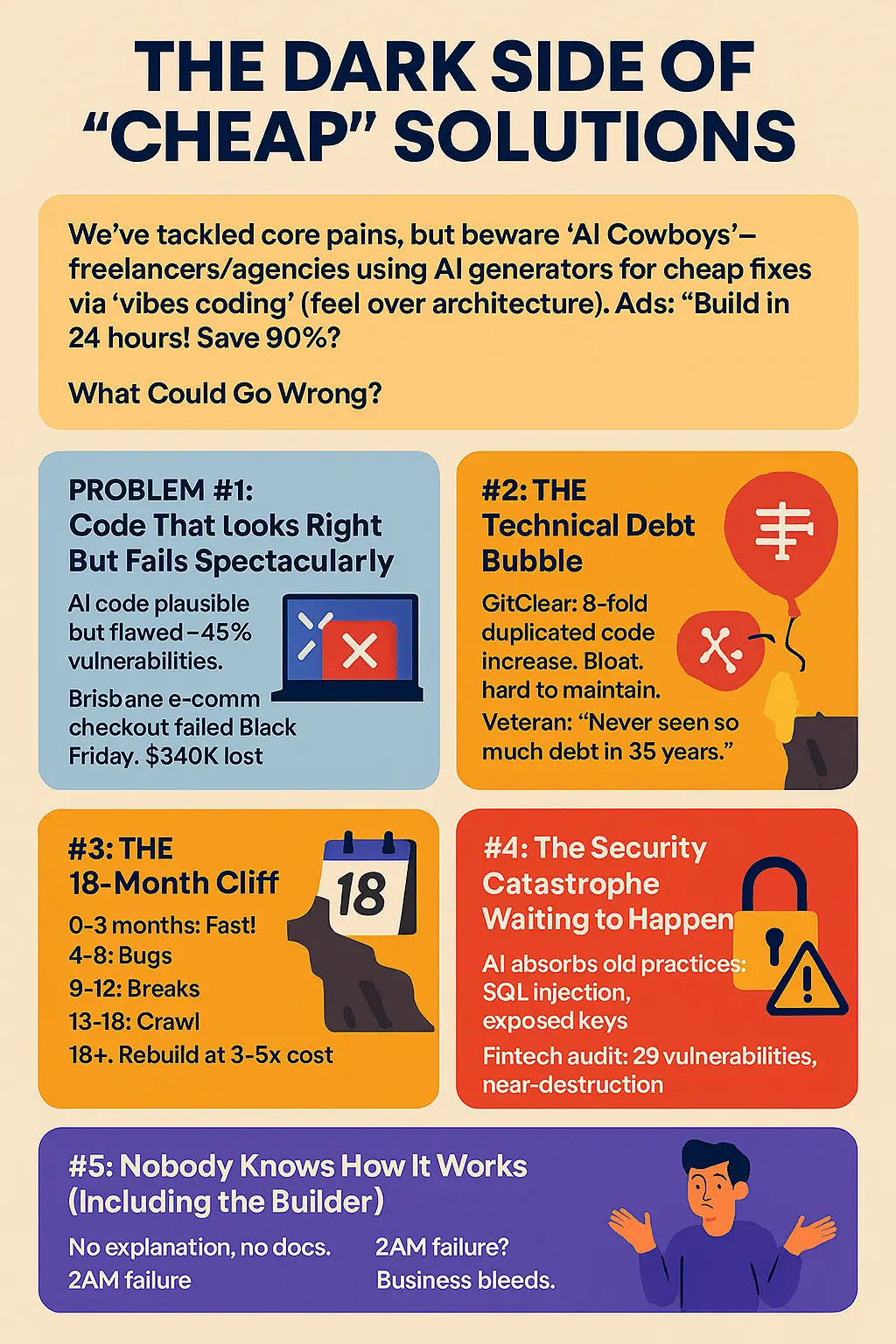
We've tackled core pains, but beware "AI Cowboys"—freelancers/agencies using AI generators for cheap fixes via "vibes coding" (feel over architecture). Ads: "Build in 24 hours! Save 90%!"
What Could Go Wrong?
Problem #1: Code That Looks Right But Fails Spectacularly
AI code plausible but flawed—45% vulnerabilities. Brisbane e-comm checkout failed Black Friday, $340K lost.
Problem #2: The Technical Debt Bubble
GitClear: 8-fold duplicated code increase. Bloat, hard to maintain. Veteran: "Never seen so much debt in 35 years."
Problem #3: The 18-Month Cliff
0-3 months: Fast! 4-8: Bugs. 9-12: Breaks. 13-18: Crawl. 18+: Rebuild at 3-5x cost.
Problem #4: The Security Catastrophe Waiting to Happen
AI absorbs old practices: SQL injection, exposed keys. Fintech audit: 23 vulnerabilities, near-destruction.
Problem #5: Nobody Knows How It Works (Including the Builder)
No explanation, no docs. 2AM failure? Business bleeds.
Why "Cheap" Becomes Expensive:
Perth SaaS: $15K AI MVP, $87K C9 rebuild, $240K transition, $420K lost customers—$762K+. Proper: $95K.
Sydney firm: $8K AI portal, $125K remediation, $280K fine—$413K+. Proper: $65K.
C9 Difference: Knowledge Transfer, Not Black Boxes
AI Cowboys:
❌ Ununderstood code,
❌ No docs,
❌ "Trust me,"
❌ Disappear,
❌ No rationale,
❌ Copy-pasted.
C9:
✅ Transfer every stage,
✅ Docs,
✅ Decision records,
✅ Training,
✅ Reviews,
✅ Maintainability.
Knowledge Transfer Means:
- Why built this way
- Safe modification
- Fixes for wrongs
- Add features without breaks
Deliverables:
- Architecture: Diagrams, API docs, patterns, protocols.
- Code: Naming, comments, READMEs, guides.
- Training: Walkthroughs, extensions, troubleshooting, practices.
- Base: FAQs, issues/solutions, guides, optimisation.
Result: No hostage—own your tech. AI Cowboys can't—they don't understand.
Bottom Line on AI Code:
Tools like Copilot boost experts. Problem: Inexperienced using as replacement.
AI doesn't consider maintainability, architecture—generates short-term code with vulnerabilities, inefficiencies.
Like power tools: Expert carpenter? Boost. YouTube newbie? Dangerous shoddy work.
C9: AI for boilerplate, tests, docs, reviews—never decisions. Professional vs vibes.
Why Discovery Calls Are Crucial (And Skipping Them Is Your Worst Idea)
Discovery maps needs, decisions, timeline—essential for success. Skipping? Misaligned, costs balloon, delays.
How: 1-2 hour audit systems, pains, goals. Outline phases, risks, ROI. Collaborative, not pitch.
Why Not Waste: Prevents creep, ensures fit. Breaks stages for early ROI (e.g., high-value integration first, save $50K/month for next).
Why C9 Beats Hundreds of Other Developers
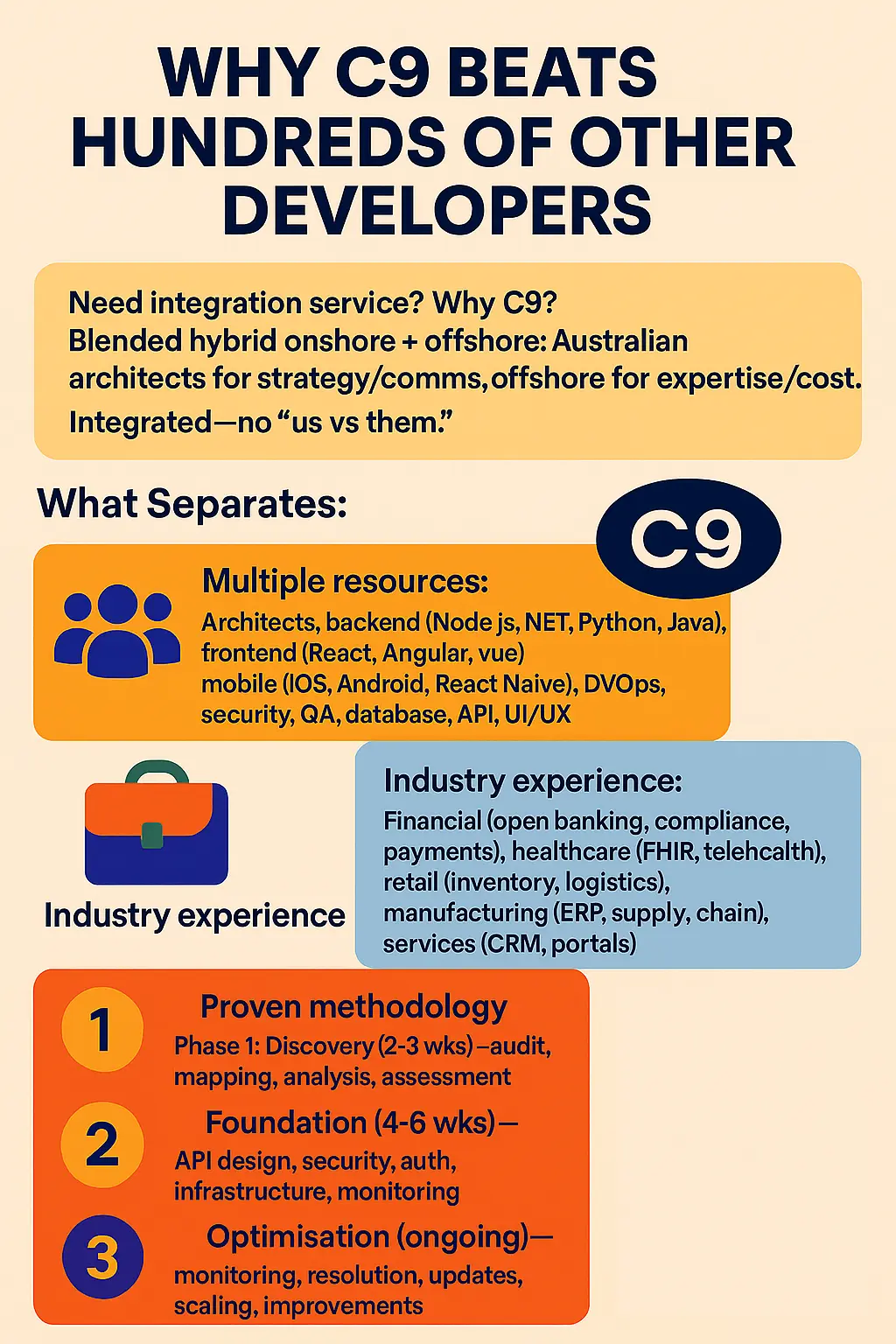
Need integration service? Why C9? Blended hybrid onshore + offshore: Australian architects for strategy/comms, offshore for expertise/cost. Integrated—no "us vs them."
What Separates: https://www.c9.com.au/
Multiple resources: Architects, backend (Node.js, .NET, Python, Java), frontend (React, Angular, Vue), mobile (iOS, Android, React Native), DevOps, security, QA, database, API, UI/UX.
Industry experience: Financial (open banking, compliance, payments), healthcare (FHIR, telehealth), retail (inventory, logistics), manufacturing (ERP, supply chain), services (CRM, portals).
Proven methodology:
Phase 1: Discovery (2-3 wks)—audit, mapping, analysis, assessment, design.
Phase 2: Foundation (4-6 wks)—API design, security, auth, infrastructure, monitoring.
Phase 3: Implementation (8-16 wks)—high-value first, iterative, testing, reviews, transfer.
Phase 4: Optimisation (ongoing)—monitoring, resolution, updates, scaling, improvements.
Staff Augmentation Options and Flexibility
Flexible: Project-based (fixed), augmentation (add team), dedicated, hybrid. Min 3-6 month lock-in vs monthly—3-6 better for continuity, knowledge, discounts.
Integrated teams, not single devs—remote, no office 9-5 expectation (business hours video).
FAQs:
Q: Start time?
A: 2-4 weeks.
Q: Fit issues?
A: Replace free 2 weeks.
Q: Management?
A: You tasks; we HR.
Q: Hire later?
A: Yes, fee.
Q: Changes?
A: Flexible milestones.
Q: Quality?
A: Reviews, testing.
Transparent Pricing: Why Indicative Proposals Are Worthless
Rates by skillset: Junior $80-120/hr, mid $120-160, senior $160-200, architect $200+. FY25/26, CPI, mix. Vary if local only. Discounts long-term/multi (>3). Scale monthly, rollover.
Indicative pitfalls: Vague "65K-95K" ignores details, overruns.
Discovery-based: Nearest hour vs day/week.
Example: Indicative AI workflow $50,000 (week). Discovery: Complexities—actual $47,500 (hour). Discovery first: Stages for early ROI, savings feed forward.
Why C9 for Your API Integration Strategy
We've covered a lot: What makes C9 right?
☑ Proven: projects, battle-tested discovery, phased for ROI, transfer built-in.
☑ Transparent: Skill rates, ±5-10% estimates, no hidden, discounts.
☑ Flexible: Fixed, augmentation (3/6/12 months), dedicated.
C9 offers complete advantage—one place. Innovative, trustworthy, collaborative—maximise efficiency, cut costs, drive revenues, competitive edge.
Ready? Book free discovery at https://www.c9.com.au/. Unlock potential.