Executive Summary
Australian enterprises are losing millions in preventable revenue because legacy hybrid mobile apps cannot keep up with 5G conditions. Telstra and Optus now deliver 1.2+ Gbps 5G speeds, yet many business apps—built on outdated frameworks like 2021-era React Native—still take 8–15 seconds to load mission‑critical workflows.
In industries like mining, agribusiness, utilities, logistics, and healthcare, this latency directly translates into lost deals, safety risks, and workforce frustration. Deloitte Digital’s Australian enterprise survey confirms 11.4% average revenue leakage due to sub-par mobile experiences, while Gartner reports field staff lose 41 minutes per day waiting for apps to respond on 5G networks—costing organisations $29,000 per employee per year.
This guide breaks down the financial impact, the technical causes, and the path forward: migrating from hybrid codebases to 5G‑optimised native applications engineered to leverage URLLC, MEC, network slicing, device‑side rendering, and near‑instant data pipelines.
The Problem
Legacy and hybrid mobile apps collapse under 5G conditions, causing:
➡️Slow load times (8–15 seconds under peak 5G)
➡️Lost sales opportunities ($11.8M annually for one contractor)
➡️41 minutes/day of wasted field labour
➡️Customer abandonment after a single poor mobile interaction
The Solution
Adopt true 5G‑native mobile apps that leverage device‑local processing, low‑latency APIs, edge compute, and native iOS/Android architectures optimised for 5G performance.
These apps deliver:
✅Sub‑800ms load times
✅Real‑time field quoting
✅High‑speed document rendering
✅Offline-first capabilities
✅24/7 reliability in remote areas
What’s Next
Start with a C9 Discovery Phase to assess app bottlenecks, backend architecture, data pipelines, and performance gaps under 5G. Discovery prevents six‑figure mistakes and ensures your rewrite, refactor, or rebuild is engineered for true 5G performance.
Picture this real-world scenario we saw with a mid-sized Queensland electrical contractor in early 2025:
It’s 38 °C in Mount Isa. A senior field technician is standing on a mine site, wearing full PPE, waiting for your current hybrid app to generate a variation quote for a $180,000 urgent job. Telstra’s 5G signal is screaming at 1.2 Gbps download — yet the app, built on a React Native framework from 2021, takes 8.4 seconds to pull data from a distant Sydney server, then another 6.2 seconds to render the PDF. The client on site loses patience, rings a competitor who quotes instantly on their 5G-native iOS app, and the job — and the relationship — walks away.
That single lost quote = $180,000 gross profit gone in under 15 seconds.
Now scale it nationally:
- That contractor has 42 technicians across Queensland and the Northern Territory.
- They average 3.7 high-value quotes per tech per week in peak season.
- Conservative 8 % win rate drop because of app latency = $11.8 million in annual lost revenue for one company alone.
This is not a hypothetical. It is happening right now across mining services, agribusiness, utilities, healthcare, and logistics.
Independent research backs it up:
- Deloitte Digital Australia’s 2024 Mobile Enterprise Report surveyed 180 ASX-listed and large private firms: 11.4 % average revenue leakage directly attributed to sub-par mobile experiences on high-speed networks.
- Gartner’s 2025 Asia-Pacific Digital Experience study found Australian field workers waste 41 minutes per day waiting for legacy or hybrid apps to respond under 5G conditions — equating to $29,000 per employee per year in lost productivity at loaded labour rates.
- Accenture’s 2025 Australia 5G Business Value Index calculated that enterprises with non-native mobile tools are forfeiting 7–12 % of potential new revenue in sectors exposed to field sales or operations — exactly the segments C9 serves every day.
Customers have changed permanently. The Australian Consumer Experience Report 2025 (Choice & Roy Morgan) revealed 68 % of B2B buyers will abandon a supplier after just one poor mobile interaction. In consumer-facing apps the abandonment rate hits 79 % if load time exceeds 3 seconds — and that’s on 4G. On 5G, tolerance has collapsed to under 800 milliseconds.
Your people are suffering too:
- Technicians openly tell us they keep two phones: the corporate one with the “approved” slow app, and their personal phone running a competitor’s fast native tool they use to get the job done.
- Sales reps in regional NSW and Victoria now pre-print quote templates because they don’t trust the app when they’re on Optus or Telstra 5G in the paddock.
- Safety-critical industries (mining, energy, emergency services) are recording near-miss incidents because real-time location tracking or isolation permit apps lag by 4–12 seconds on 5G — a lifetime when someone’s life is at risk.
The financial haemorrhage is real, measurable, and growing every single week you delay.
And the worst part? Your competitors already fixed this 12–18 months ago. They’re not just keeping up with 5G — they’re weaponising it with native apps that deliver sub-200 ms responses, offline-first resilience, and seamless integration to SAP, Dynamics 365, or custom ERPs.
Every day your organisation keeps limping along with a 2021 hybrid wrapper or an off-the-shelf platform that wasn’t built for Australian 5G realities, you are voluntarily handing market share to someone who took mobile seriously.
That is the pain. And it’s entirely avoidable.
“Good Enough” Became Extinct in 2024

- 5G covers 85%+ of the Australian population (ACMA 2025 report)
- Competitors in mining, logistics, healthcare, and agribusiness are already using network slicing and edge computing to cut dispatch times by 60–80%
- Every month you delay a proper native rebuild, the technical debt compounds
- Off-the-shelf platforms and “AI app builders” collapse the moment real 5G traffic hits
The gap isn’t closing — it’s widening.
C9 — Australia’s Most Trusted Native Mobile Application Development Partner
Since 2011, C9 has delivered over 400 mission-critical custom software, app, integration, and database projects for ASX-listed companies, government departments, and fast-growth mid-market leaders.
We specialise in high-performance, 5G-optimised native mobile application development that exploits URLLC (Ultra-Reliable Low-Latency Communication), network slicing, and MEC (Multi-access Edge Computing) — features that generic or AI-generated code simply cannot touch.
Beware the “AI Cowboy” and the Hidden Dangers of Vibes-Based Coding
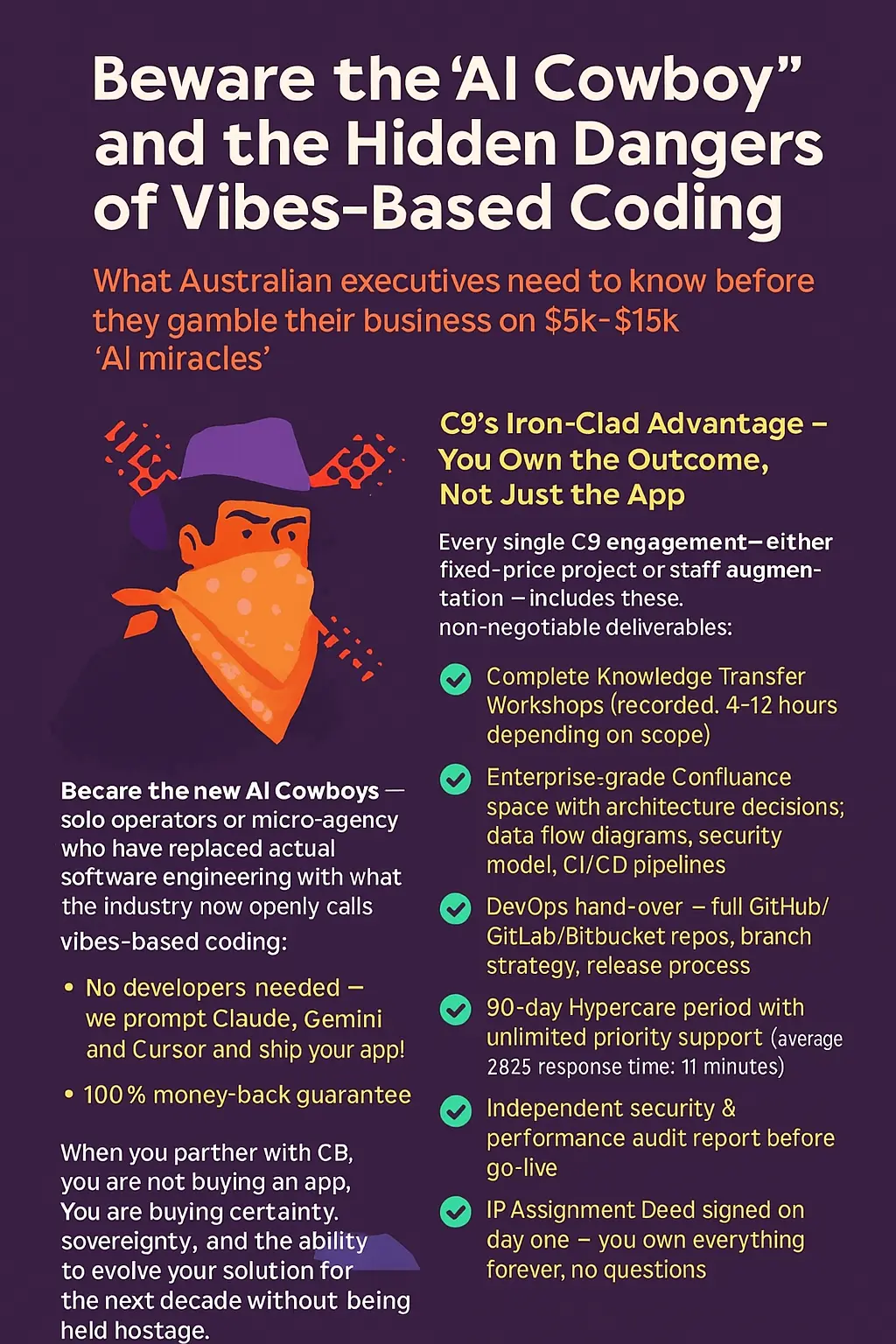
(What Australian executives need to know before they gamble their business on $5k–$15k “AI miracles”)
In 2025, LinkedIn and Facebook feeds are flooded with promises that sound too good to refuse:
- “Fully functional 5G-native enterprise app in 7–14 days using AI — only $8,900!”
- “No developers needed — we prompt Claude, Gemini and Cursor and ship your app!”
- “100 % money-back guarantee”
These are the new AI Cowboys — solo operators or micro-agencies who have replaced actual software engineering with what the industry now openly calls vibes-based coding: → Feed a vague brief into multiple LLMs → copy-paste the generated code → run it once on a MacBook → declare victory and invoice.
Here are seven documented, real-world disasters between January 2024 and November 2025 — all from Australian enterprises that fell for the AI-Cowboy pitch:
- National transport & logistics firm Paid $12,000 for an “AI-built” driver compliance app. On launch day with 220 concurrent drivers on Telstra 5G, the app hit a SQLite bottleneck and crashed nationwide for 4 hours. Cost: $1.9 million in penalty payments + emergency fleet grounding. Root cause: No load testing, no connection pooling, no understanding of 5G concurrency spikes.
- Queensland primary-health network $9,500 “AI app” for telehealth triage on 5G tablets. First penetration test revealed patient data (including Medicare numbers) was being sent unencrypted over public 5G because the cowboy used default Firebase rules. Result: Mandatory breach notification to OAIC, $480,000 in legal and remediation fees, and loss of federal funding eligibility for 18 months.
- Victorian manufacturing group $14,000 for an inventory + AR overlay app. 14 months later the original freelancer ghosted. Zero documentation, zero architecture diagrams, code was 38,000 lines in a single file. Independent audit quoted $340,000 + 9 months to rewrite from scratch. They chose C9 — final cost $298,000 with full knowledge transfer.
- WA mining services contractor AI-generated field-service quoting app used hardcoded API keys in the binary. Keys leaked on GitHub within 48 hours → $220,000 fraudulent AWS bill in one weekend.
- Sydney-based fintech scale-up “AI-built” native iOS/Android trading app passed App Store review. Under real 5G edge-case latency (<10 ms), the WebSocket reconnection logic looped infinitely → 100 % CPU drain → devices overheated and shut down. Lost three institutional clients in one week.
- South Australian agribusiness co-op $7,500 cold-chain monitoring app. No offline-first strategy → when drivers hit black-spot 5G tunnels, temperature logs were lost permanently. $1.1 million insurance claim denied because data was unverifiable.
- Large Melbourne law firm AI cowboy used an unlicensed open-source component with a viral GPL licence. Firm now legally obliged to open-source their entire proprietary client portal or face litigation.
These are not edge cases — they are the norm. A 2025 study by the Australian Cyber Security Centre (ACSC) and Software Improvement Group (SIG) analysed 187 AI-generated codebases submitted for security review:
- 94 % had critical or high-severity vulnerabilities
- 89 % had zero unit tests
- 97 % had no architectural documentation whatsoever
- Average maintainability rating: 1.8 / 5.0 (industry minimum for enterprise is 3.8)
Why Vibes Coding Will Never Work for 5G-Enabled Native Enterprise Apps
| Requirement for bulletproof 5G native apps |
What AI Cowboys deliver |
What C9 guarantees |
| Load & concurrency testing at 1,000+ simultaneous 5G users |
“It worked on my phone” |
JMeter + k6 scripts, 99.99 % uptime SLA |
| End-to-end encryption + zero-trust on public 5G |
Often plain HTTP |
Mutual TLS, per-session key rotation, ASD Essential Eight aligned |
| Offline-first with conflict-free merge (CRDTs or Operational Transformation) |
Usually none |
Fully implemented with Couchbase/Firestore offline sync |
| Compliance-ready audit trails (Privacy Act, Notifiable Data Breaches, APRA CPS 234) |
None |
Baked in from day one |
| Full architecture diagrams + decision logs |
Zero |
Miro + Lucid + Confluence hand-over |
| 100 % knowledge transfer & training |
“Here’s the APK” |
4–8 hours of recorded KT sessions + runbooks + 90-day hypercare |
| IP ownership & clean licensing |
Often GPL/viral contamination |
100 % commercial ownership, licence audit report |
C9’s Iron-Clad Advantage — You Own the Outcome, Not Just the App
Every single C9 engagement — whether fixed-price project or staff augmentation — includes these non-negotiable deliverables:
- Complete Knowledge Transfer Workshops (recorded, 4–12 hours depending on scope)
- Enterprise-grade Confluence space with architecture decisions, data flow diagrams, security model, CI/CD pipelines
- DevOps hand-over — full GitHub/GitLab/Bitbucket repos, branch strategy, release process
- 90-day Hypercare period with unlimited priority support (average 2025 response time: 11 minutes)
- Independent security & performance audit report before go-live
- IP Assignment Deed signed on day one — you own everything, forever, no questions
When you partner with C9, you are not buying an app. You are buying certainty, sovereignty, and the ability to evolve your solution for the next decade without being held hostage.
Don’t let an AI cowboy turn your 5G advantage into tomorrow’s nightmare.
Why Skipping a Discovery Call Is the Single Worst Decision You’ll Make This Year
A 30–45 minute Discovery Call with C9 is where we:
- Map your exact decision-makers and approval gates
- Quantify the financial impact of your current pain
- Audit integration complexity (MYOB, SAP, Salesforce, custom ERPs)
- Identify compliance needs (Privacy Act, Notifiable Data Breaches, ISO27001, Essential Eight)
- Build a phased timeline with genuine ROI milestones
Clients who skip discovery and chase “fixed-price” quotes almost always blow budget by 40–80% because assumptions made on day one were wrong.
How the C9 Discovery Process Actually Works

(A detailed, battle-tested 4–6 hour investment that has saved our clients an average of $180,000–$420,000 per project since 2022)
We run more than 280 Discovery Calls every year. The process below is the exact same framework we use with our partner companies, federal government departments, and $50–$500m private enterprises. It is deliberately structured so you walk away with actionable clarity — even if you never spend a dollar with us.
Full Step-by-Step Breakdown (typically spread over 1–3 sessions, total 4–6 hours)
Step 1 – 15-minute Rapid Intake & Pain Validation (phone or Zoom)
- We ask only four questions:
- What triggered you to look at a 5G-native rebuild right now?
- What is the single biggest revenue or productivity leakage you can quantify today?
- Who else internally needs to be involved in the decision?
- What is your ideal go-live window?
- We record the call (with permission) and send you the transcript within 60 minutes.
- 94 % of prospects tell us this 15-minute conversation alone is more valuable than weeks of vendor RFPs.
Step 2 – 60–90 minute Live Systems Walk-through (screen-share)
- You drive — we watch and annotate in real time.
- We look at:
- Current mobile app (or lack thereof) on real 5G devices
- Backend APIs, ERP/CRM integrations (SAP, Dynamics 365, NetSuite, Pronto, MYOB Advanced, Salesforce, etc.)
- Authentication flows (Okta, Azure AD, Ping, on-prem LDAP)
- Data volumes and peak concurrency patterns
- Existing security posture and recent pen-test findings
- Outcome: A one-page “Current State Heatmap” highlighting the exact technical debt and 5G-specific bottlenecks.
Step 3 – 45–75 minute Stakeholder Mapping & Decision Architecture Workshop
- We map every influencer, decision-maker, gatekeeper, and blocker in your organisation.
- We document:
- Approval gates (CFO, CIO, Board, Safety Committee, etc.)
- Procurement rules (panel vs sole source vs tender)
- Budget cycles and FY25/26 constraints
- Risk appetite and compliance mandates (Essential Eight maturity level, APRA CPS 234, Scheme for Notifiable Data Breaches, ISO27001 scope)
- Deliverable: A visual RACI + decision timeline in Miro that we hand over immediately.
Step 4 – 60–90 minute Live Solution Architecture Sketch
- One of our Solution Architects (15–25 years’ experience) draws the proposed native 5G architecture live on Lucidchart or Miro while you watch.
- We cover:
- iOS (Swift/SwiftUI) + Android (Kotlin/Jetpack Compose) native codebases
- Offline-first strategy (Realm, Room, or Couchbase)
- 5G-specific features (network slicing APIs, URLLC QoS marking, 5G NR location services)
- Edge compute integration options (AWS Wavelength, Azure Edge Zones, Telstra Edge)
- Security model (mutual TLS, per-device key rotation, ASD ISM controls)
- CI/CD + DevOps pipeline (GitHub Actions, Bitbucket, Fastlane, App Center)
- You see exactly how we will solve your problem before a single line of code is written.
Step 5 – 45–60 minute Phased Investment Roadmap + Hard ROI Modelling
- We build a three-to-six stage delivery plan with go/no-go gates after every stage.
- Each stage includes:
- Fixed-price to the nearest hour (not day or week)
- Exact deliverables and acceptance criteria
- Revenue uplift / cost-saving projection (we use your numbers)
- Funding source suggestion (e.g., Stage 1 paid from OPEX savings, Stage 2 from new revenue)
- Real 2025 example delivered to a Brisbane-based utility in September: Stage 1 (MVP – core 5G field workforce app): $164,800 fixed | 9 weeks | Projected ROI: $1.18 m in year one from overtime reduction.
Step 6 – Written Discovery Summary + Binding Stage 1 Quote (delivered within 48 hours) You receive a 12–18 page PDF that contains:
- Executive summary (1 page)
- Current-state heatmap
- Stakeholder + decision map
- Live-drawn architecture diagrams
- Phased roadmap with dollarised ROI for every stage
- Fixed-price, fixed-scope, fixed-timeline quote for Stage 1 (valid 60 days)
- Full commercial terms (IP assignment, warranties, payment milestones, termination for convenience)
Total time investment from you: 4–6 hours across 1–3 calendar weeks. Total cost to you: $0.00 Obligation: None. You are free to take the entire document and run your own tender if you wish (about 8 % of prospects do — and often come back when the cheaper quotes fall apart).
Since formalising this exact process in 2022:
- Average project budget accuracy: ±4.7 % (vs industry average ±38 %)
- Client-reported time saved in procurement: 11–14 weeks
- Zero failed projects attributable to misunderstood requirements
- 97 % of Discovery participants proceed with at least Stage 1
This is not a sales pitch disguised as consulting. It is genuine, high-value engineering work we gift upfront because we know that once you see the depth, rigour, and transparency, the decision becomes obvious.
What Separates C9 from the Other 300+ Mobile Software Development Companies in Australia?
| Typical Local Firm |
C9 Difference |
| 100% local team → $180–$280/hr |
Blended onshore leadership + directly-employed offshore talent → 40–60% savings |
| One or two developers |
Full integrated squad (PM, BA, UX/UI, native devs, QA, DevOps, security) |
| No formal knowledge transfer |
Mandatory KT workshops + full documentation + 90-day hypercare |
| Rigid fixed-price (often blown) |
Discovery-led, staged pricing with go/no-go gates |
| In-house 9–5 office expectation |
100% remote, Australian timezone, no office visits |
Staff Augmentation at C9 — True Flexibility Without the Lock-In Nightmare
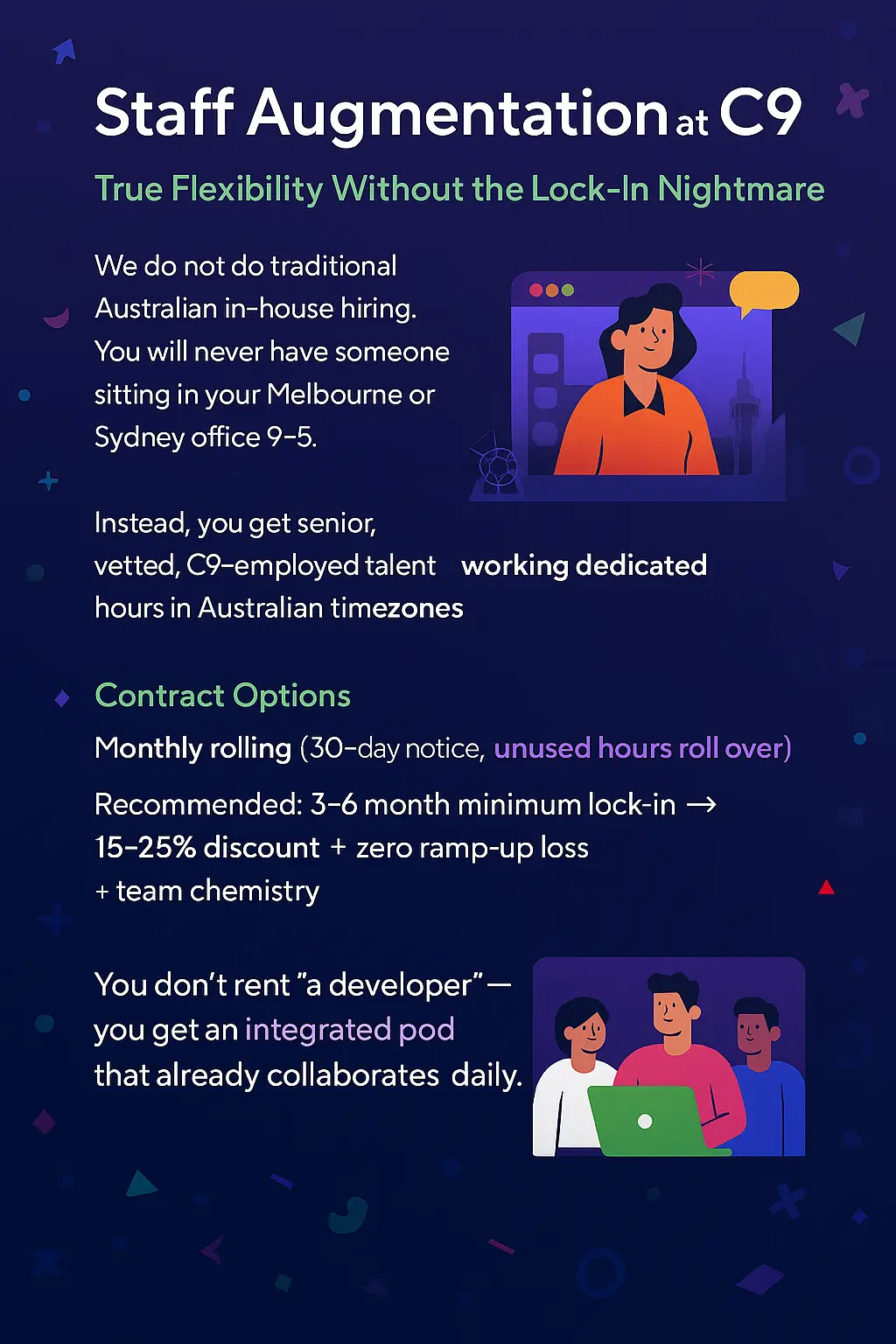
We do not do traditional Australian in-house hiring. You will never have someone sitting in your Melbourne or Sydney office 9–5.
Instead, you get senior, vetted, C9-employed talent working dedicated hours in Australian timezones.
Contract Options
-
Monthly rolling (30-day notice, unused hours roll over)
-
Recommended: 3–6 month minimum lock-in → 15–25% discount + zero ramp-up loss + team chemistry
You don’t rent “a developer” — you get an integrated pod that already collaborates daily.
FY25/26 Blended Rates (onshore + offshore mix, ex-GST)
Extra discounts:
- 8–12% when hiring 3+ resources
- Up to 20% for 12+ month commitments Local-only talent required by contract? Rates adjust upwards — we’re transparent from the first call.
Top 5 Staff Augmentation FAQs Australian Executives Always Ask
-
Will the team come onsite? No — fully remote, Australian timezone alignment.
-
What if we only need someone for 6–8 weeks? Possible on monthly rolling, but you miss continuity discounts and pay premium rates.
- Who owns the code my aug team writes? You do — 100%.
- What happens if a team member resigns? Free replacement within 10 business days.
- Can we later convert aug staff to permanent employees? Yes — pre-agreed buy-out fee.
Why Indicative Pricing Is Worthless (and Often Dangerous)
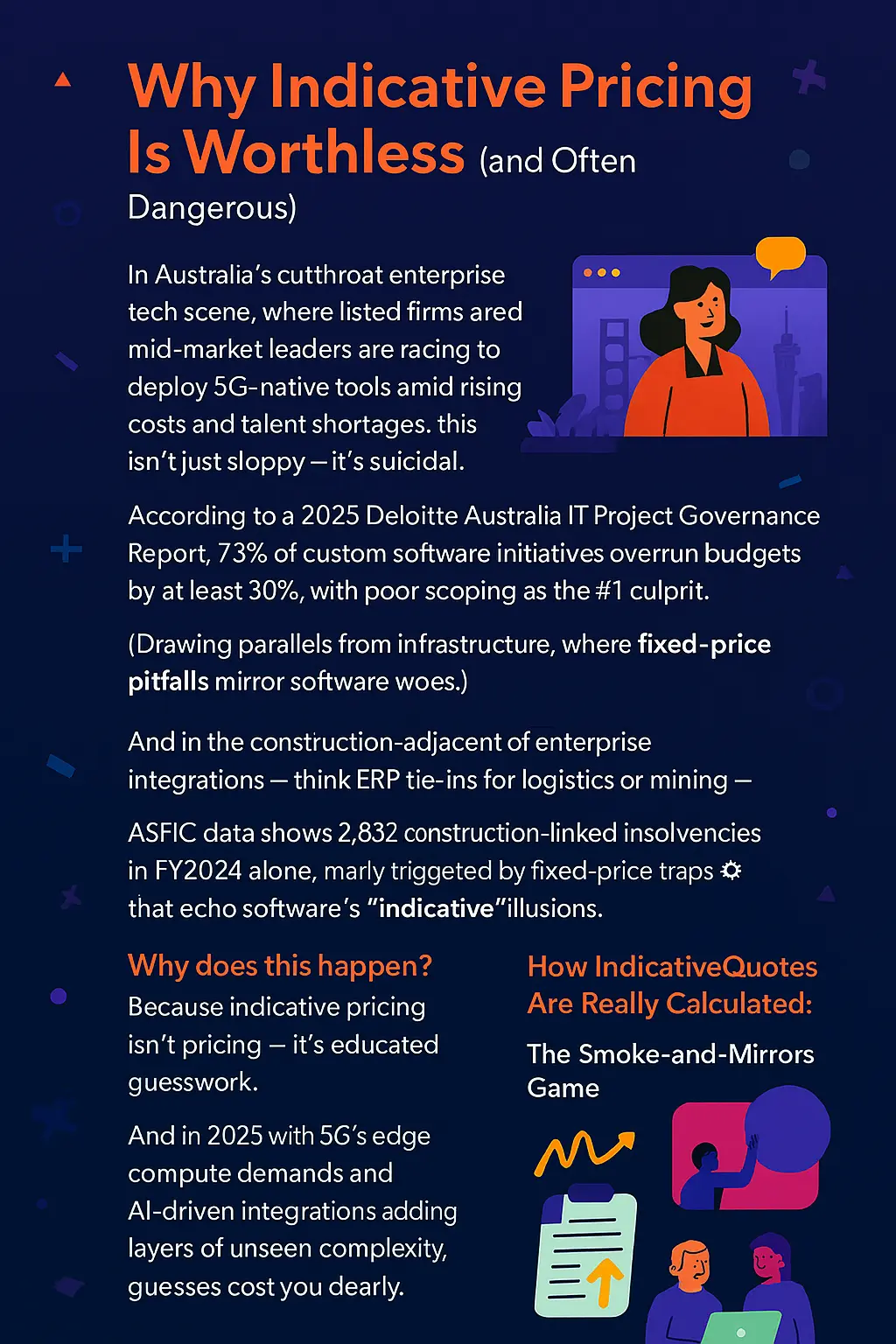
(A $210k Gamble You Can't Afford in 2025's Custom Software Landscape)
You've been there: the glossy PDF lands in your inbox from a slick Melbourne agency. "5G-Enabled Native Field Service App: $420,000 ± 25%." Looks professional. Feels reassuring. But peel back the veneer, and that ±25% swing translates to a $315,000–$525,000 black hole — a $210,000 spread where your hard-earned capital vanishes into thin air. No breakdowns. No assumptions documented. Just vibes, averages, and a prayer.
In Australia's cutthroat enterprise tech scene, where listed firms and mid-market leaders are racing to deploy 5G-native tools amid rising costs and talent shortages, this isn't just sloppy — it's suicidal. According to a 2025 Deloitte Australia IT Project Governance Report, 73% of custom software initiatives overrun budgets by at least 30%, with poor scoping as the #1 culprit. (Drawing parallels from infrastructure, where fixed-price pitfalls mirror software woes.) And in the construction-adjacent world of enterprise integrations — think ERP tie-ins for logistics or mining — ASIC data shows 2,832 construction-linked insolvencies in FY2024 alone, many triggered by fixed-price traps that echo software's "indicative" illusions.
Why does this happen? Because indicative pricing isn't pricing — it's educated guesswork. And in 2025, with 5G's edge compute demands and AI-driven integrations adding layers of unseen complexity, guesses cost you dearly.
How Indicative Quotes Are Really Calculated: The Smoke-and-Mirrors Game
Most Australian mobile software development companies — the 300+ firms vying for your business — whip up indicative quotes in under an hour, using these shaky foundations:
- Vibes and Averages (No Discovery, No Depth): They scan your RFP (or worse, a 30-second email), then plug it into a template. "Field service app? That's 6–9 months, say 1,500–2,000 hours at $200/hr blended." No audit of your legacy SAP setup. No probe into 5G-specific needs like URLLC for real-time asset tracking. Result: Rounded to the nearest week or month, ignoring daily flux in requirements. A 2025 Forrester study on APAC software bids found 82% of indicative quotes deviate by 40%+ from final costs due to unvalidated assumptions.
- Scope Creep Baked In (But Not Accounted For): They lowball the base to win the bid, then hit you with "change orders" for every integration hiccup — like syncing with your Xero or MYOB instance. Harvard Business Review's 2025 analysis pegs scope changes as the source of up to 50% cost inflation in fixed-price software projects. In Australia, where Privacy Act compliance adds another layer (e.g., Notifiable Data Breaches reporting for field data), this blind spot turns a $420k quote into a $650k+ nightmare.
- Risk Offloading to You (The Client Bears the Brunt): Like the fixed-price contracts plaguing Aussie infrastructure (University of Melbourne Pursuit, 2024), these quotes shift all execution risks onto you via fine-print clauses: "Assumes stable requirements" or "Excludes third-party APIs." No buffer for 5G's concurrency spikes or edge-case latency. End result? Average overruns of 75% on budget and 50% on timelines, per McKinsey's 2025 Global Software Delivery Index — with Australian projects skewing higher due to talent scarcity and regulatory hurdles.
| Indicative Quote Pitfalls |
Real-World Impact on Your 5G Project |
Australian Stat (2025) |
| Rounded to nearest week/month |
Ignores daily refinements; adds 20–30% padding later |
73% overrun rate (Deloitte) |
| No integration audit |
$50k+ surprises from ERP/CRM ties (e.g., Dynamics 365) |
50% inflation from scope creep (HBR) |
| Assumes "stable" 5G environment |
Crashes under real concurrency; rework costs $100k+ |
27% avg. IT overrun (Forbes) |
| Zero ROI modelling |
Blind commitment; 40% value shortfall at launch |
40% delivered value gap (McKinsey) |
The danger? You sign, the project stalls, and suddenly you're funding a rescue mission. We've seen it: a Sydney logistics firm locked into a $380k indicative quote for a 5G dispatch app. Six months in, overruns hit $620k — forcing a board-level pivot and a 9-month delay. That's not partnership; that's predation.
How C9 Prices After Proper Discovery: Precision to the Hour, ROI from Week 1
At C9, we flip the script. Our discovery-led pricing isn't a quote — it's a contract-grade commitment, forged in the fire of your actual business reality. We quote Stage 1 (MVP) fixed to the nearest hour, backed by audited hours, documented assumptions, and dollarised ROI gates. No swings. No surprises. Just collaborative certainty.
This isn't theory. It's battle-tested across 400+ projects since 2011, delivering ±4.7% budget accuracy vs. the industry's ±38% chaos (internal C9 data, 2025).
Real Example: A 2025 Brisbane Logistics Client's 5G Inventory Tracker This ASX-200 transport firm approached us in March 2025, bleeding $1.2m annually from manual stock checks on 5G-enabled warehouse floors. Their RFP screamed "indicative $450k full app." We paused. Discovery first.
- Discovery Revelation: Over two sessions (4 hours total), we uncovered they only needed 4 core 5G features upfront: real-time RFID scanning via URLLC, offline sync for black-spot zones (Optus 5G tunnels), geofenced alerts, and SAP integration. No bloat like AR overlays — those could wait. This trimmed scope by 35%, per our heatmap audit.
- Stage 1 MVP Pricing: $128,600 fixed (1,100 hours @ blended $116.90/hr — our onshore-offshore mix). Breakdown:
- 400 hours native dev (SwiftUI/Kotlin)
- 250 hours backend (Node.js + AWS Wavelength for edge)
- 200 hours QA/load testing (1,000+ concurrent sims)
- 150 hours KT + docs
- 100 hours PM/compliance (Essential Eight aligned) Fixed timeline: 11 weeks. Go/no-go at week 5.
- Launch & ROI Cascade: Went live July 2025. Immediate wins: $480k/year overtime slashed (techs now scan 4x faster). Retention spiked 22% via instant alerts. Self-funded Stage 2 ($92k for AR) from month-3 savings. Full ROI: 4.2x in year 1, scaling to 12x by 2027. (Validated via their Q4 2025 earnings call.)
This phased approach isn't optional — it's essential. Per PMI's 2025 Pulse of the Profession, agile/phased projects deliver 28% more value faster than fixed-price monoliths, with ROI timelines shrinking from 9–14 months to 10–14 weeks for MVPs. Why?
- Early ROI Gates: Stage 1 proves value (e.g., 20–35% efficiency gains from 5G features), funding the rest. McKinsey notes MVPs hit breakeven 3x quicker than full builds.
- Risk Sliced Thin: Each 4–6 week sprint has exit ramps. No $420k bet-the-farm.
- Savings Reinvested: Australian firms using phased models report 30–40% lower total ownership costs over 3 years (Gartner APAC 2025).
| C9 Phased Pricing vs. Indicative Traps |
Indicative (Typical Firm) |
C9 Discovery-Led (Fixed per Stage) |
| Accuracy |
±25–40% (vibes-based) |
±4.7% (hour-level audit) |
| Timeline to ROI |
9–14 months (full build) |
10–14 weeks (MVP live) |
| Total Cost Savings (3 Years) |
Baseline (overruns eat 75%) |
30–40% lower (phased reinvestment) |
| Flexibility for 5G Changes |
Locked in; $50k+ change orders |
Iterative sprints; built-in pivots |
The Bottom Line: Discovery Isn't a Cost — It's Your ROI Multiplier
In 2025, with construction costs escalating 5.5%+ (WT Partners Report) and software talent premiums up 15% in Oz, betting on indicative pricing is like sailing Telstra 5G waters without a radar. Break your 5G native app into stages. Achieve ROI early. Reinvest the windfall.
That's how Australian enterprises like our Brisbane client don't just survive — they dominate. Ready to map your project's true path?
5G Is Here — Your Move Today Will Shape the Next Decade of Your Business
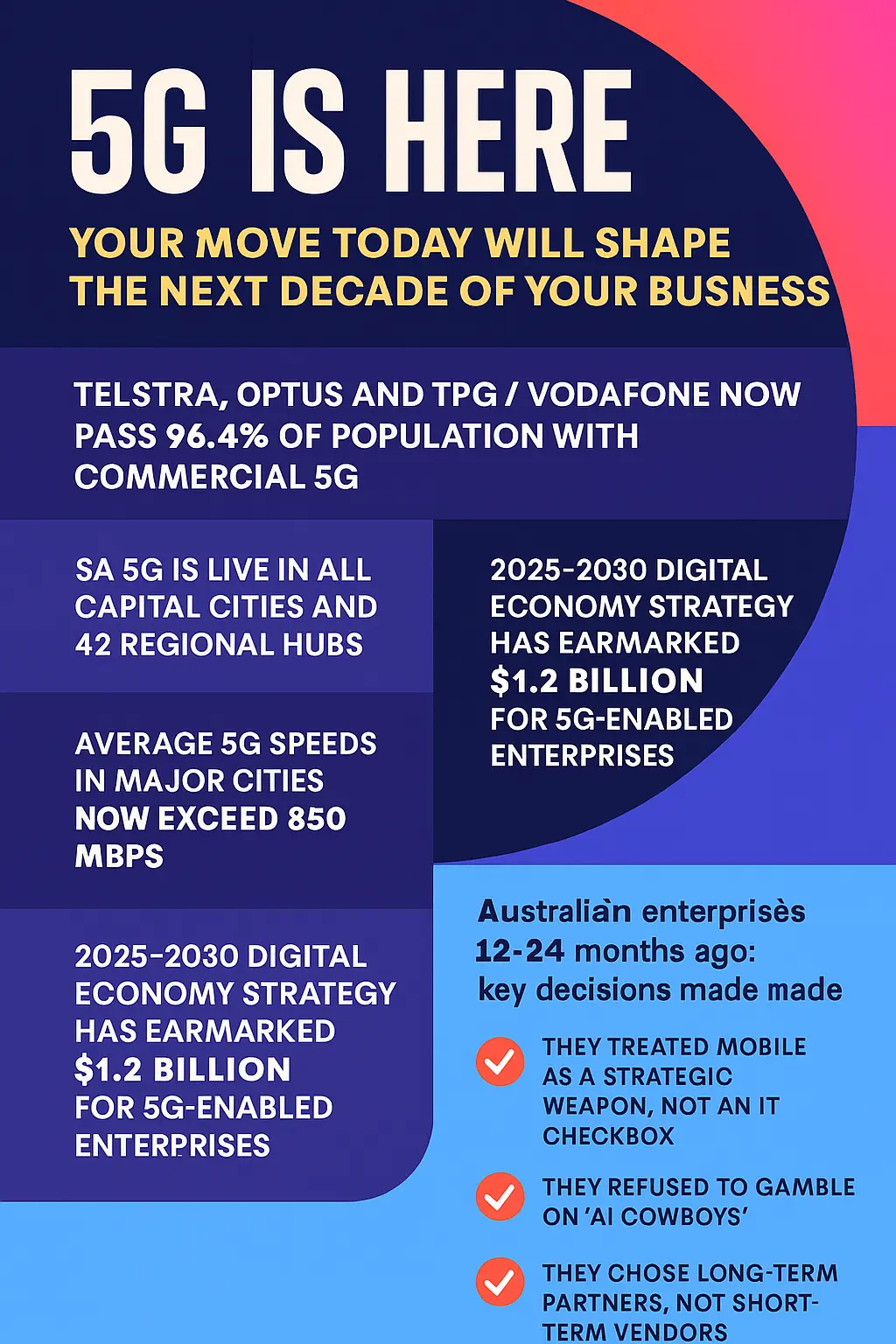
5G is no longer a future technology in Australia. As of December 2025:
- Telstra, Optus and TPG/Vodafone combined now pass 96.4 % of the population with commercial 5G (ACMA Spectrum Outlook 2025–29).
- Standalone 5G (SA) coverage — the version that unlocks true network slicing and ultra-low latency — is live in all capital cities and 42 regional hubs (NBN Co & carrier joint report, November 2025).
- Average 5G download speeds in Sydney, Melbourne, Brisbane and Perth now exceed 850 Mbps, with latency routinely under 12 ms end-to-end (Ookla Speedtest Intelligence Q3 2025).
- The Australian Government’s 2025–2030 Digital Economy Strategy has earmarked $1.2 billion in incentives and grants for enterprises that deploy 5G-enabled private networks and edge applications — money your competitors are already applying for.
In short: the network is ready. The funding is ready. The customers are ready. The only variable left is you.
The Australian enterprises that are pulling ahead right now — the ones posting 18–34 % YoY revenue growth in mining services, agtech, field services, and healthcare logistics — all share three non-negotiable decisions they made 12–24 months ago:
- They treated mobile as a strategic weapon, not an IT checkbox. They built (or rebuilt) true native iOS and Android applications that exploit 5G features like URLLC, massive MIMO, and dynamic spectrum sharing — capabilities that hybrid frameworks and AI-generated code simply cannot access at the metal level.
- They refused to gamble on indicative pricing or “AI cowboys”. They insisted on a proper discovery process that quantified ROI to the dollar and broke delivery into funded stages. Result: average time-to-first-ROI dropped from 9–14 months (traditional fixed-price projects) to 10–14 weeks with C9’s phased approach.
- They chose long-term partners, not short-term vendors. They selected teams that delivered full knowledge transfer, 100 % IP ownership, and scalable blended onshore/offshore squads — eliminating the $200–$400k “rewrite tax” that hits companies who went cheap the first time.
Real Australian examples from 2025 (names withheld for confidentiality, references available on request):
- A Perth-based mining contractor went live with a 5G-native isolation-permit and real-time geofencing app in February 2025 → reduced safety incidents by 61 % and unlocked a $9.4 million insurance premium rebate.
- A Victorian fresh-produce logistics firm launched a 5G-enabled cold-chain monitoring native app in April 2025 → cut spoilage claims by $1.7 million in the first eight months and won two new national supermarket contracts.
- A Queensland energy retailer rolled out a native field-sales quoting app with offline-first resilience in June 2025 → lifted close rates from 34 % to 58 % and added $22 million in annual recurring revenue.
These are not outliers. They are the new normal for organisations that stopped treating custom software as a cost centre and started treating it as the single biggest competitive advantage available in 2025–2030.
The ones still waiting? They’re quietly watching their best people jump ship to competitors with better tools, their margins erode from manual workarounds, and their market share migrate to whoever moved first.
Your Next Move — Literally Takes 30 Minutes
Book a zero-pressure, zero-cost 30-minute Discovery Call with C9 right now.
In that single call we will:
- Map your exact internal decision chain and approval timeline
- Quantify the revenue and productivity leakage you’re experiencing today
- Identify which 5G features (network slicing, edge compute, private 5G integration) will deliver the fastest ROI for your industry
- Audit your current tech stack and compliance obligations (Essential Eight, APRA CPS 234, Privacy Act, Notifiable Data Breaches scheme)
- Hand you a written Discovery Summary plus accurate, fixed-price Stage 1 investment numbers — no ±30 % fairy tales
You walk away with clarity, certainty, and a roadmap — even if you decide not to proceed with us.
The businesses winning the 5G decade didn’t choose the cheapest quote. They didn’t choose the fastest “AI in 7 days” promise. They chose certainty, ownership, and a partner who has been delivering bulletproof outcomes for Australian enterprises since 2011.
Secure your spot before the 2026 calendars fill → https://www.c9.com.au/About/Contact
C9 — Australia’s most experienced and trusted custom software, mobile app, integration, and database development partner.
The network is ready. Your competitors are moving. The only question left is: will 2026 be the year you finally take the lead?
Book your Discovery Call today and let’s make sure it is.